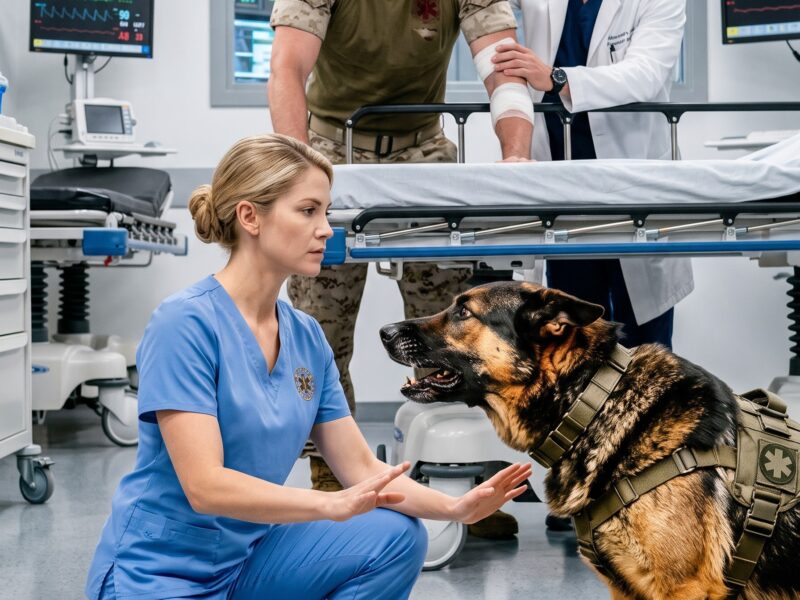
They locked me inside the police station’s K9 kennel while everyone laughed, and the chief’s wife sneered that a nurse like me didn’t belong among real heroes
The metal door slammed behind me at 11:47 p.m., and the sharp, industrial tang of wet fur, zinc cages, and heavy Pine-Sol filled my lungs. The bolt slid into place with a dry, mechanical clatter that sounded remarkably like the chambering of an assault rifle.
Three massive German Shepherds paced inside the enclosed concrete run. Their claws clicked in frantic, jagged rhythms against the drainage tiles, teeth flashing like polished ivory beneath the humming fluorescent tubes overhead. The air was warm, thick with hostility and canine breath.
Outside the heavy iron bars, Police Chief Thomas Mason leaned against the painted cinderblock wall, cradling a lukewarm paper coffee cup. His posture was deliberate, a showcase of small-town authority dripping with rehearsed boredom.
“Maybe now you will learn some damn respect, Harper,” he said, blowing across the rim of his cup without looking me directly in the eye.
Beside him stood his wife, Claire Mason. Her fingers were tight around an iPhone, the twin lenses angled directly through the mesh toward my face. The diamond on her ring finger caught the cruel ceiling light, throwing splintered reflections against the wire. She was smiling the tight, satisfied smile of a woman who had never once been told no in her entire adult life.
“Look at her,” Claire whispered, her voice carrying that sweet, venomous lilt typical of local royalty. “Look at the great hospital saint. Not quite as high and mighty when you are down in the dirt with the beasts, are you? Let’s see how brave you are now.”
I did not answer her. I kept my back straight, my palms flat against my thighs, my breathing rhythmic, slow, and measured. Four seconds in. Four seconds hold. Four seconds out. Four seconds empty. It was the box breathing drilled into me until it became an involuntary physiological reflex, an anchor forged under mortar fire long before I ever set foot in Oakridge County.
For the past six months, I had been nothing more to these people than Nurse Harper Lane—the quiet, unassuming woman on the graveyard shift at County Memorial. I took the vitals nobody else wanted to take. I cleaned the vomit and the blood from drunk drivers. I held the hands of dying grandmothers when their families couldn’t make it in time. I treated the patrol officers who came in with lacerations and sprained wrists, always offering a soft voice, fresh gauze, and warm coffee. I lived in a clapboard cottage near the creek, bought my groceries in cash, and kept my eyes on the floor.
I never spoke of the past. I never spoke of the desert. And I certainly never spoke of the brass medals sitting inside a buried steel ammo can two hundred miles away.
The trouble had started three hours earlier in Trauma Bay 2.
Claire’s younger brother, Deputy Jesse Vance, had brought in a young man in zip-ties. The suspect was barely twenty, his face battered into an unrecognizable purple mass, two ribs broken, coughing up frothy red sputum. Jesse had handed me a pre-printed form with a casual smirk, ordering me to classify the injuries as pre-existing trauma sustained prior to arrest. He claimed the kid had slipped down a concrete embankment while fleeing.
The boy’s injuries were from a combat boot and a steel-toed baton. I knew the difference. I had spent six years charting fractures, blast radiuses, and blunt-force trauma across three continents.
I refused to sign the waiver.
Jesse screamed. Claire arrived twenty minutes later, demanding my immediate termination from the hospital board. When the attending physician hesitated to cross the chief’s family, Chief Mason himself showed up in full uniform. He didn’t ask; he commanded. When I still refused to sign my name to a lie, they manufactured a charge of obstructing a police investigation, took my badge, shoved me into the back of a cruiser, and brought me to the station’s basement annex.
They didn’t put me in a holding cell. The holding cells were monitored by state-mandated digital feeds. Instead, Mason had marched me into the K9 isolation wing—the off-grid bullpen used for quarantined and aggressive service animals.
“She needs an attitude adjustment before she sees the magistrate in the morning,” Mason had told the desk sergeant, who had simply looked away.
Inside the kennel, the smallest of the three Shepherds lunged at the mesh. His jaws snapped inches from my face with a concussive pop.
Outside, Claire laughed, a high, tinkling sound that echoed down the hallway. “Look at her eyes, Tommy. She’s terrified. Record this. Let everyone see what happens when someone tries to ruin Jesse’s career.”
I didn’t blink. The dog wasn’t truly aggressive; he was agitated, territorial, smelling the raw adrenaline pumping from Claire and Mason. Animals mirror the rot around them.
Then the largest Shepherd moved.
He was an immense sable male, broader across the shoulders than standard civilian working lines, his left ear notched with a jagged scar that ran down across his cheekbone. He had remained back near the sleeping bench, watching me from the shadows with intelligent, assessing eyes.
As the dog stepped forward into the harsh fluorescent beam, his gait was slightly uneven—the barely noticeable hitch of an old shrapnel wound in the left hip.
My breath hitched in my chest. The steady rhythm of my pulse broke.
The dog stopped three paces away. His nostrils flared, drawing in the scent of my skin, the hospital soap, the faint trace of salt from my neck. His golden eyes locked onto my left wrist, where the cuff of my navy-blue scrub top had ridden up, exposing a pale, jagged scar that formed an uneven cross against my radial artery.
His ears didn’t pin back in aggression. They lifted, twitching forward into high alerts.
A low, deep rumble started in his chest, but it wasn’t a growl. It was a guttural, vibrating whine of recognition.
Slowly, without a sound, the eighty-five-pound war dog sank his haunches to the concrete. He lowered his massive head, laid his muzzle flat across his front paws, and slid forward until the velvet tip of his nose brushed the rubber toe of my sneaker.
The other two dogs stopped instantly. The young one who had lunged at me abruptly shut his jaws, took two steps back, and sat down in complete, disciplined silence.
The laughter outside the cage died as if someone had cut a wire.
Chief Mason lowered his paper cup. His brow furrowed in irritation. “What the hell is that animal doing? Brutus! Up! Guard!”
The dog didn’t move. He didn’t even twitch an ear in Mason’s direction.
“Brutus, get up!” Mason barked, stepping toward the bars and kicking the lower iron rail. The metallic clang rang through the room, but the sable dog merely pressed closer against my shoe, his tail thumping once, twice, softly against the wet floor.
I dropped slowly to one knee, the dampness of the concrete soaking through my scrub pants. I didn’t care. My hand, trembling with a shock I hadn’t felt in half a decade, reached out.
“Don’t touch him, you idiot!” Claire shrieked. “He’ll rip your arm off!”
My fingers slipped beneath the heavy tactical collar, burying themselves into the dense, coarse fur behind his scarred ear. My thumb found the exact spot—a tiny, raised knot of scar tissue where a piece of an RPG shell had been cut out in the field without anesthesia.
“His name isn’t Brutus,” I whispered, my voice barely louder than the hum of the light fixture, but it carried clearly across the silent room. “His name is Atlas. K9-Three-Zero-Two. First Battalion, Special Operations Task Force Pale Horse.”
Atlas let out a long, shuddering sigh, rolling his great head sideways into my palm, whimpering with a devastating, heartbroken affection.
I had washed the blood of five men from this dog’s coat in the back of an MH-47 Chinook screaming across the mountains of Kunar. I had held his airway open with my bare hands while we took heavy small-arms fire through the floorboards. I had carried him through the smoking ruins of an insurgent compound after his handler—my squad leader, Master Sergeant Daniel Miller—had stepped on a pressure-plate IED.
When the unit was broken and buried, they told me Atlas had been retired to a specialist handler in Germany. They told me he was dead two years later.
They had lied about everything.
“What did she just say?” Claire snapped, lowering her phone, her eyes darting between me and her husband. “Tommy, why is that beast licking her?”
Mason’s face had gone from red to an unsettled, mottled gray. “I bought that dog at a government surplus auction in Virginia three years ago. He doesn’t have a name like that. He’s an aggressive patrol animal. He tore the calf off a car thief two months ago.”
“He didn’t tear anything off because he was aggressive,” I said, rising slowly, my hand still resting on Atlas’s broad head. Atlas rose with me, gluing his flank against my left leg in perfect, flawless heel position. “He did it because your officers don’t know how to give commands in Czech, and his combat drive was triggered by your incompetence.”
Mason reached for the keys at his belt, anger flaring back over his confusion. “I don’t know what kind of game you’re playing, Lane, but you’re not walking out of here until Jesse is cleared. You’re going to sit in that damn box until morning, and if you touch that department property again, I’ll add destruction of police assets to your charges.”
Atlas suddenly broke his heel. He didn’t attack. He stepped directly between me and Chief Mason, his body rigid, his lips peeling back just enough to reveal the long, lethal line of his canines. The whine in his throat had vanished, replaced by an infrasonic vibration that made the concrete floor hum beneath our feet. He wasn’t guarding the station. He was guarding me from the station.
Claire backed up three steps, her heel catching on an electrical conduit. “Tommy… get me out of here. Shoot the damn thing. It’s defective.”
“Nobody is shooting anything,” a new voice cut through the damp corridor.
The heavy fire door at the end of the hall swung open with a hydraulic hiss. Footsteps echoed down the concrete—measured, deliberate, heavy combat boots, not the standard soft-soled department shoes.
A man stepped into the yellow light. He was wearing the uniform of a county lieutenant, but he didn’t wear it like the others. The shoulders were tailored, the patrol cap sat straight and low, and beneath his rolled-up sleeves, both arms were covered in dark, faded tattoos of maritime compasses and nautical stars.
His face was drawn, his skin the color of dry parchment, his dark eyes fixed entirely on the cage.
Chief Mason swung around, visibly relieved. “Miller! Good. Bring the tranquilizer rifle from the armory. This damn dog went rogue, and this nurse is trying to provoke an incident.”
Lieutenant Miller didn’t look at Mason. He didn’t look at Claire.
He stopped two feet from the bars of the kennel, his eyes moving down from my face to my hand, to the scar on my wrist, and finally to Atlas, who had stopped growling the moment the lieutenant appeared. Instead, Atlas gave a single, muffled bark—a sound of greeting.
Miller’s hands were shaking. He reached out with one finger, touching the iron lock on the kennel door, his breath coming in ragged, uneven hitches.
“Ma’am,” he said, and the word didn’t sound like a polite greeting from an officer to a citizen. It sounded like an invocation. “Step back from the gate, please.”
“Miller, what are you doing?” Mason barked, reaching for the man’s shoulder. “I gave you an order. Step away from that lock.”
Miller didn’t turn around. With a single, explosive movement born of instinct and old violence, his left arm whipped back, catching Chief Mason in the center of the chest and shoving the larger man four feet back into the wall. Mason hit the brick with a dull thud, his paper cup falling and splattering dark coffee across his polished shoes.
“Don’t touch me, Thomas,” Miller said, his voice flat, icy, and entirely stripped of departmental deference.
“You’re done!” Claire screamed, pointing her phone at him. “You’re fired! You’re both fired! Tommy, pull your gun!”
Miller ignored them entirely. He pulled a heavy master key from his tactical vest, jammed it into the kennel lock, and turned it. The heavy iron door swung open with a high-pitched shriek of ungreased hinges.
Atlas immediately stepped out, turning to maintain a physical barrier between Miller, the Masons, and me.
Miller stood in the doorway. He slowly removed his patrol cap, revealing short-cropped graying hair and a long, jagged scar that ran from his temple down to the corner of his jawline—a scar that mirrored the one on Atlas’s hip.
He looked at me, his eyes shining with an unbearable, suffocating grief.
“Chief,” Miller whispered without looking back, “you have five seconds to walk down this hallway, take your wife into your office, and close the door before I do something that will put me in a federal penitentiary for the rest of my life.”
“Have you lost your mind, Vance?” Mason roared, using Miller’s middle name in fury. “She’s a nobody! A local scrub! A contract nurse!”
Miller turned his head just enough to expose his profile to the chief. His jaw was clenched so hard the muscles jumped beneath the skin.
“She is not a nurse, sir,” Miller said, each syllable dropping like lead weights onto the wet floor. “Her name is Chief Hospital Corpsman Harper Lane. She holds the Navy Cross, two Silver Stars, and three Purple Hearts with Task Unit Vanguard. And she is the only reason you have an operations commander standing in front of you instead of a name on a granite wall in Arlington.”
The corridor went entirely dead. Claire’s phone slowly lowered, her mouth falling open in a slack, ugly oval. Mason’s hand remained frozen near his holster, his face draining of whatever color had returned to it.
My chest felt crushed. The name—Task Unit Vanguard—had not been spoken aloud to my face in five years, seven months, and twelve days. Not since the night the sky turned white over the Helmand valley.
“You’re…” I whispered, my voice breaking. I stared at the lieutenant’s face, stripping away the uniform, stripping away the gray hair and the deep lines of weariness etched into his eyes. “You were the boy. The second gunner. Daniel’s little brother.”
“Marcus,” he choked out, tears finally breaking past his lashes and cutting trails through the dust on his cheeks. “I was Marcus, Chief. You pulled me out through the cockpit glass when the bird went down. You tied off my femoral artery with your own tourniquet while the cabin was melting.”
I swayed on my feet. The damp walls of the kennel seemed to close in, the smell of the pine cleaner warring with the phantom reek of burning jet fuel and pulverized brick that lived permanently in the back of my sinuses.
Marcus took half a step forward, then stopped, holding his hands out as if afraid I would vanish if he came any closer.
From his tactical vest, he didn’t pull a weapon. He pulled a thick, manila document envelope sealed with red evidentiary tape. It was dog-eared, the corners softened from being carried against his body, handled hundreds of times in private shadows.
He didn’t hand it to Mason. He held it out to me with both hands, his head bowed, the traditional posture of an enlisted operator reporting to a superior officer in the field.
Across the front of the envelope, written in faded black grease pencil, was my service number.
And beneath it, scrawled in fresh blue ink with Marcus’s shaky hand, were five words that tore the ground out from under my existence:
WE FOUND YOUR MISSING BROTHER.
The fluorescent light overhead hummed its monotonous, droning song. Claire let out a tiny, frightened squeak. Chief Mason took a slow step backward, his boots sliding through the puddle of spilt coffee.
Atlas leaned his entire weight against my knees, anchoring me to the earth, but the floor felt like it had dropped into an endless, terrifying abyss.
My brother, Nathan, had disappeared six months before my final deployment. The Navy told me he had gone over the side of a transport vessel in the Persian Gulf. They gave me an empty casket and a folded flag.
“Where?” I whispered, my voice no longer that of the quiet nurse who wiped down counters at County Memorial. The voice that came out of my throat belonged to the woman who had walked through hell with an assault rifle in one hand and a trauma bag in the other. “Marcus. Where is he?”
Marcus looked down at the envelope in his trembling hands, his jaw tightening as if bracing for a blast wave.
“He’s not dead, Harper,” Marcus said quietly. “And he’s not in the desert. He’s here. In this county. And he’s running for his life.”
The chief’s office smelled of stale cigar smoke, leather polish, and the metallic tang of fear.
Thomas Mason sat behind his massive mahogany desk, his hands clasped together so tightly that his knuckles were chalky white. Claire stood behind him in the corner, her arms crossed defensively over her chest, the arrogant smirk completely erased from her features. She looked at me not as an insolent nurse, but as an unexploded shell brought into her living room.
Marcus Miller had locked the heavy oak door behind us. He had drawn the blinds over the internal glass partition that looked out onto the dispatch bullpen. Atlas lay flat across the threshold of the door, his chin resting on his paws, his eyes never leaving Chief Mason’s chest.
On the mahogany desk lay the manila envelope. The red tape was broken.
Spilled across the polished wood were photographs, satellite printouts, internal hospital intake sheets, and five separate incident reports bearing the official seal of the Oakridge County Sheriff’s Department—reports that had never been entered into the state justice database.
I stood over the desk, my hands flat on the edge, leaning forward until Mason had to tilt his head back to look at me.
“Start talking, Marcus,” I said. My voice was dangerously calm, devoid of inflection.
Marcus leaned against the heavy oak bookcase, his arms crossed, his eyes dark. “Nathan wasn’t Navy, Harper. You knew that much. He worked for the Defense Logistics Agency as an auditor. What you didn’t know was what he found six years ago.”
“They told me he fell off a supply tender during a transit through the Strait of Hormuz,” I said, each word feeling like jagged glass in my throat. “They said the current took him. They held a memorial service with seven people in Norfolk.”
“It was a cover story,” Marcus said bluntly. “Nathan discovered that a private defense contracting network—overseen by former brass and state-side logistics coordinators—was skimming classified weapons systems, surgical equipment, and advanced tactical pharmaceuticals out of forward bases and routing them through civilian supply chains back to the States. Millions of dollars in military hardware, written off as combat losses in the desert, shipped in commercial shipping containers through the Port of Savannah.”
I looked down at the papers on the desk. My eyes caught a blurred black-and-white photograph taken from a distance with a telephoto lens.
It was Nathan.
He was thinner, his hair long and pulled back into an unkempt knot, a ragged beard framing a face that carried our mother’s sharp jawline and our father’s dark, hooded eyes. He was wearing an oil-stained mechanic’s jacket, carrying a wooden crate behind an abandoned agricultural warehouse.
My fingers touched the glossy paper. The last time I had seen Nathan, he was waving goodbye on a dock in San Diego, his laughter clear over the sound of the ocean gulls, telling me to make sure I came back from the mountains in one piece.
“When Nathan realized how high the network went,” Marcus continued, “they tried to eliminate him on the ship. He survived, jumped into the water before they could put a bullet in his head, and was picked up by a commercial freighter crew he had secretly paid off. He spent three years off the grid, moving through Europe, tracking the supply chain from the receiving end. The weapons and drugs weren’t staying on the coast. They were being dispersed into rural, low-oversight counties across the American South.”
Marcus paused, then turned his gaze slowly toward Chief Mason.
“Counties with small, insular police departments,” Marcus whispered. “Departments where the chief runs the county board, the local judges are childhood friends, and the medical examiners don’t ask questions about unmarked boxes arriving in the middle of the night at the regional airstrip.”
The room seemed to drop ten degrees.
“That’s a lie,” Mason croaked, his voice thin and brittle. “Marcus, you’ve been working with these damn federal conspiracy nuts again. You’re delusional. I’ve known you since you were a boy. I gave you this job when you came home broken from the service!”
“You didn’t give me a job out of charity, Thomas,” Marcus spat, his voice dropping into a guttural growl that made Atlas lift his head from the floor. “You hired me because you thought a damaged combat vet with brain trauma and an honorable discharge would be quiet, loyal, and easily confused. You brought Atlas in through the surplus auction because you thought he’d be an intimidating tool for your street deputies. You didn’t realize that Atlas and I knew the difference between real service and local extortion.”
“Where is Nathan now?” I demanded, cutting through the crossfire of accusations. I didn’t care about their small-town corruption. I didn’t care about Mason’s stolen empire. I cared about the pulse of my brother.
Marcus stepped forward, tapping a finger against an intake sheet dated three days ago.
“Oakridge Community Clinic. The free clinic on the south side of town,” Marcus said. “A man matching Nathan’s description came in under an alias—’David Cole.’ He had a through-and-through gunshot wound to the left shoulder. He wouldn’t let the volunteer nurses call an ambulance. He stitched it himself with veterinary suture, paid cash for broad-spectrum antibiotics, and vanished before the morning shift arrived.”
“Who shot him?” I asked, looking directly at Mason.
Mason swallowed hard, his throat bobbing. He kept his eyes locked on his blotter.
“Jesse,” Claire blurted out, her voice cracking under the pressure. “It was Jesse! But it wasn’t his fault! That man was trespassing on our family farm out by the creek! He was snooping around the old grain silos!”
“Shut up, Claire!” Mason roared, slamming his palm on the desk.
“No, you shut up, Tommy!” Claire screamed, stepping out from the corner, her face pale, mascara running down her cheeks. “This woman was in the military! Look at that damn dog! Look at Marcus! They know! It’s falling apart, Tommy! Jesse told you that man had files! He said the man had ledgers with your signature on every manifest since twenty-twenty-two!”
The truth lay bare in the open air, filthy and undeniable.
Jesse Vance hadn’t assaulted a suspect in a bar fight. The “suspect” I had treated three hours earlier wasn’t a civilian drunk—he was a local warehouse worker who had tried to help Nathan hide the evidence. Jesse had beaten the boy within an inch of his life trying to find Nathan’s location, and then Jesse and Mason had tried to force me to certify the boy as mentally incompetent and violent so his testimony would be thrown out.
They didn’t know who I was when they dragged me into the station. To them, I was just an inconvenient medical worker who wouldn’t bend the knee.
“Where is the silo?” I asked, stepping around the desk until I was standing inches from Mason’s chair.
Mason looked up at me. For a moment, the petty tyrant who had ruled this county with an iron fist tried to muster his old arrogance. He set his jaw, glaring up into my eyes.
“You don’t have jurisdiction here, Corpsman,” he sneered, leaning heavily on the military rank. “You’re in my town. You walk out of that door with those papers, and every car in this county will be on you before you hit the highway. You won’t make it to the state line. You think you’re still in the mountains? You think you can play commando in Oakridge?”
I didn’t draw a weapon. I didn’t yell.
I reached out, took the heavy brass pen holder off his desk—a solid, three-pound block of engraved brass—and placed it gently in the center of his desk pad.
Then, with an open-palm strike honed through a thousand hours of hand-to-hand combat drills in the muddy compounds of Coronado, I drove the heel of my palm into the top of the brass block.
The internal welds snapped with a sharp crack. The brass flattened, splintering the oak surface of the desk beneath it.
Mason jumped, nearly tipping his leather swivel chair backward. Claire gasped, pressing herself against the bookshelf.
“I spent seven years putting shattered human beings back together while people like you sat in air-conditioned rooms counting dirty money,” I said, my voice barely a whisper, cold and steady as an arctic wind. “I have buried brothers in dirt you aren’t worthy to walk on. If you send one car after me, Thomas, I will stop being a nurse. Do you understand what that means?”
Mason didn’t speak. He couldn’t. The sheer, predatory stillness in the room had suffocated his bluster.
Marcus unclipped a set of keys from his belt and tossed them onto the broken desk. “They won’t send any cars, Chief Lane. I’ve already disabled the department repeaters. The dispatch consoles are running on a local loop. We have forty-five minutes before Jesse realizes nobody is answering the radio out at the farm.”
“Jesse is at the silos?” I asked, turning toward Marcus.
“He took two deputies with him an hour ago,” Marcus replied, his face darkening. “They found a blood trail leading into the woods behind the old milling plant. If Nathan is still out there, bleeding and without backup, they’re going to hunt him down and bury him in the swamp.”
I looked down at Atlas. The big dog stood up immediately, his eyes locked on mine, waiting for the order he hadn’t heard in years.
“Atlas,” I said softly, switching to the sharp, guttural commands of our former life. “K noze.” (Heel.)
Atlas moved instantly, pressing his shoulder against my knee.
“Marcus,” I said, gathering the photographs and the medical logs into the envelope and tucking it into my scrubs. “Where is your vehicle?”
“Parked in the sally port out back,” Marcus said, pulling a standard-issue tactical shotgun from behind the door and racking the slide with a clean, lethal snap. “Unmarked Dodge Ram. Four-wheel drive. Full medical kit in the rear seat.”
I looked back at Chief Mason one last time. He was sitting frozen, his hands trembling over his ruined desk, staring at the flattened brass.
“Don’t leave this office, Thomas,” I said quietly. “If you do, Atlas won’t sit down next time.”
We turned and moved down the hallway, leaving Claire sobbing hysterically into her hands and the Chief of Police paralyzed by the ghost he had accidentally pulled from the shadows.
As the heavy sally port door rolled up to reveal the black, rain-swept southern night, the cool air hit my face, and the fog that had dulled my life for five years evaporated completely.
My brother was alive.
And a pack of corrupt local thugs was hunting him through the mud.
They had spent the night thinking they were the wolves. They were about to learn what it felt like to be tracked by the creature that hunted the pack.
The rain fell in violent, diagonal sheets, turning the unpaved access road into a churning canal of red clay and decaying pine needles. The windshield wipers of the Dodge Ram slapped across the glass in a frantic, losing battle against the storm.
Marcus drove with both hands locked on the wheel, the tires slipping and biting into the ruts as the truck climbed the ridge toward the abandoned milling complex. Atlas sat upright between the front bucket seats, his nose wedged against the air vent, drawing in the scent of the wet wilderness outside. Every few miles, his ears would twitch, his neck muscles corded and tense.
I sat in the passenger seat, tearing through the tactical first-aid kit Marcus had stashed behind the console.
It wasn’t a standard police kit. It was an old military-grade stomp bag, packed with high-potency combat gauze, Celox clotting applicators, chest seals, and morphine auto-injectors. Someone had kept it meticulously stocked.
“How did you end up here, Marcus?” I asked, my voice cutting through the thrum of the engine. “After the squadron was deactivated… why Oakridge?”
Marcus stared into the dark swath carved by the headlights. “After Daniel died… after my brother died in that valley… I couldn’t go back to the teams, Harper. My head was ringing. The TBI left me with balance issues and memory gaps. The Navy medically retired me with seventy percent. I had nowhere to go. Daniel always talked about this part of the country. Said he wanted to buy land here, build a cabin, raise bird dogs.”
A heavy silence settled between us, save for the rain drumming against the roof.
“I came here to see what he saw,” Marcus said, his voice raw. “Instead, I found Mason. I found a department that was rotten from the spine down. I took the badge because I thought maybe I could keep some kid from getting killed by these local cowboys. Then, three years ago, a surplus transport arrived from Fort Bragg with three retired combat K9s that were slated for euthanasia because of behavioral issues. One of them was Atlas. Mason wanted to make him an attack dog. I took him under my wing, retrained him using our old codes, and kept him from biting the wrong people.”
He glanced at me sideways, the green glow of the dashboard lights accentuating the scar across his cheek.
“Then your brother showed up,” Marcus whispered. “He didn’t know who I was. But I knew his name. Daniel had a picture of you and Nathan pinned to the inside of his locker on the base. I recognized Nathan’s eyes the second he walked into that clinic. Before I could reach him, Jesse’s crew ambushed him behind the abandoned rail yard. He took a round, but he took down two of Jesse’s men with a pipe wrench before he vanished into the tree line.”
“Nathan was always stubborn,” I said, a faint, ghost of a smile touching my lips despite the ice in my veins. “He never learned when to stay down.”
“He’s bleeding out, Harper,” Marcus said grimly. “If he took a through-and-through to the shoulder like the clinic nurse said, and he’s been in this cold rain for three hours… hypothermia is going to finish what the bullet started.”
The truck crested the ridge. Marcus cut the headlights fifty yards before the clearing, letting the momentum carry us down into the shadow of the old milling facility.
The complex was a rusted skeleton of corrugated iron and rotted timber, looming against the dark sky like a prehistoric beast. Below it, in the center of an overgrown gravel yard, three police cruisers sat idling, their red and blue emergency flashers reflecting off the standing water in dizzying, garish circles.
Beside the cruisers stood an open-topped utility vehicle and four men dressed in tactical rain gear, holding high-powered spotlights and assault carbines.
Jesse Vance was leaning against the hood of the lead cruiser, screaming into a hand-held radio.
“We go on foot from here,” Marcus said, slipping the transmission into park and cutting the ignition.
Atlas let out a barely audible whine, his front paws treading the carpet.
“He stays silent,” I ordered, turning to look the dog in the eyes. “Ticho.” (Quiet.)
Atlas froze instantly, lowering his posture, his eyes wide and black in the cabin’s gloom. He understood combat discipline. He had waited in cold mud for eighteen hours outside a Taliban stronghold without making a single sound.
I unbuttoned my civilian scrub jacket and threw it into the back seat, leaving me in a tight black athletic undershirt. I checked my laces, strapped the medical bag across my chest with the cross-body strap, and reached into the floorboard where Marcus had pulled two weapons from the rack: an M4 carbine with an Aimpoint sight, and a suppressed Glock 19.
He held the Glock out to me.
I looked at it. For five years, I had sworn I would never touch a firearm again. I had spent those years trying to scrub the smell of cordite from under my fingernails, trying to believe that saving lives at three in the morning could balance the scales for the lives I couldn’t save on the tarmac.
“Harper,” Marcus said, his voice urgent. “There are four of them out there. They’re not cops anymore. They’re an execution squad.”
I took the weapon. The cold polymer settled into my palm with a familiarity that made my stomach turn. I dropped the magazine, checked the brass casing of the top 9mm hollow-point round, slapped it back into the well, and chambered a round with a smooth, soundless pull of the slide.
The nurse was gone. The operator took her place.
“Atlas, sem,” I whispered, opening the passenger door. (Here.)
The dog slid out through the door without a splash, moving low through the tall blackberry bushes that flanked the access road. Marcus followed with the carbine, dropping into a wide combat crouch.
We moved through the perimeter of the pine woods, the rain muffling our footfalls. The wind was blowing toward us, carrying the scent of the men by the cruisers—tobacco, cheap coffee, gun oil, and the sharp, coppery stink of fear.
“I don’t give a damn what the Chief said!” Jesse’s voice carried over the roar of the downpour. He was pacing beside the cruisers, his slicker flapping in the wind. “The radio’s dead because the storm took out the repeater tower! We don’t wait for him! We find that son of a bitch before he reaches the state road, or we’re all going to federal prison!”
“Jesse, look at the mud,” one of the deputies shouted back, shining a two-million-candlepower spotlight toward an abandoned drainage culvert at the base of the mill. “There’s fresh blood on the concrete pipe. He went inside the lower silos. He’s cornered.”
Jesse grinned, a wet, feral expression. “Good. Get the canisters from the truck. We don’t need to crawl in there after him. We smoke him out like a rat, and when he runs, we put two in his chest and say he reached for a weapon.”
“Two canisters of industrial CS gas,” Marcus whispered beside me, his jaw clenching as he raised his rifle to his shoulder. “If Nathan breathes that in with a punctured lung, his chest will flood. He’ll suffocate in three minutes.”
“They won’t get the chance,” I said.
I looked at Atlas, placing my hand flat against his ribs. I could feel his massive heart hammering against his chest—a steady, rhythmic drum of pure focus.
“Atlas. Držet.” (Hold.)
I raised the suppressed Glock, aligning the tritium night sights with the front left tire of the utility vehicle where the gas canisters were stored.
Phfft. Phfft.
Two suppressed rounds punched through the rubber, dropping the front axle with a dull hiss.
Before the deputies could react to the sound, I shifted my aim three feet higher and fired into the external halogen spotlight mounted to Jesse’s cruiser. The glass exploded in a shower of sparks, plunging the gravel yard into sudden, disorienting shadow.
“Sniper!” one of the deputies screamed, diving toward the mud behind an open cruiser door. “We’re taking fire!”
Jesse spun around, raising his carbine blindly into the rain-swept woods. “Who’s there? Identify yourself!”
I didn’t answer.
I leaned down to the dog’s ear, my voice sharp, clear, and uncompromising.
“Atlas. Útok!” (Attack!)
The sable shepherd vanished into the blackness like a shadow detached from the night.
He didn’t bark. He didn’t growl. A military working dog bred for classified operations attacks in complete, terrifying silence.
The deputy reaching for the CS canisters in the rear of the truck never saw him coming.
Eighty-five pounds of muscle and teeth hit the man’s chest at thirty miles an hour, driving him backward into the gravel. The man shrieked as Atlas’s jaws clamped onto his right forearm, crunching through the heavy nylon of his jacket, twisting with systematic, calculated leverage to snap the bone and strip the weapon from his grip.
“Get it off me! Shoot it! Shoot the dog!” the man wailed.
The second deputy swung his weapon toward the thrashing pile, but Marcus stepped out from the woodline, the muzzle of his carbine leveled squarely at the man’s forehead.
“Drop it, Miller,” Marcus commanded, his voice booming over the thunder. “Drop it or you won’t live to see the sunrise.”
The deputy froze, his hands trembling on the foregrip, looking from Marcus’s scarred face to the black hole of the barrel. He dropped the rifle into the mud and raised his hands.
Jesse Vance, however, didn’t drop his weapon.
Panicked, wild-eyed, and soaked to the bone, Jesse saw me stepping out from the tree line, walking slowly through the rain with the suppressed handgun held low at my side.
Recognition hit him like a physical blow.
“You?” Jesse screamed, his voice cracking into a high, hysterical register. “You’re the nurse! What the hell is this? Who are you?”
“I was the nurse,” I said, walking steadily forward, never breaking eye contact. “Until you tried to murder my brother.”
Jesse raised his carbine, his finger tightening on the trigger. “You’re crazy! All of you! I’ll put you down right now!”
He never got the round off.
A shadow broke from the rusted mouth of the drainage culvert behind the cruisers.
A figure, drenched in black mud and covered in dried crimson, threw itself forward with a ragged, feral scream. A piece of rusted iron pipe struck Jesse across the back of the neck with a sickening crunch.
Jesse dropped like a sack of wet sand, his weapon flying into the weeds.
The figure stood over him, swaying violently, his chest heaving, his left arm hanging limp and useless at his side, tied to his torso with a torn strip of an old flannel shirt.
The storm seemed to stop. The wind died down to a low, mournful sigh through the pines.
The man lowered the iron pipe. He slowly lifted his head, wiping the rainwater and blood from his eyes with his good hand.
He looked at me through the darkness.
“Harper?” he croaked, his voice raw, hollow, and filled with five years of unimaginable ghosts. “Harper… is that you?”
My hands trembled. The suppressed weapon slipped from my fingers, splashing softly into the red mud at my feet.
“Nathan,” I choked out, running forward through the gravel, my boots sliding as I caught him before his knees could hit the ground.
Nathan weighed nothing.
When I caught him, the realization hit me with the force of a hammer: the tall, broad-shouldered brother who used to hoist me onto his shoulders to pick wild apples in Virginia had been whittled down to bone, sinew, and scar tissue. His skin was burning hot against the freezing rain—the unmistakable, terrifying fire of advanced sepsis.
“Harper…” he muttered, his head rolling against my collarbone as I dragged him into the shelter of the abandoned milling shed. “I tried to get the papers to Washington… they were at the ports… they were everywhere…”
“Shut up, Nate,” I commanded, my voice cracking with tears I refused to let fall. “Save your breath. I’ve got you. I’m right here.”
Marcus appeared beside us, grabbing Nathan’s legs, helping me lift him onto an overturned wooden workbench inside the dry interior of the shed. Atlas followed closely, positioning himself at the entrance of the shed, his hackles raised, watching the rainy darkness where the two surviving deputies sat handcuffed against the cruiser tires.
Marcus pulled a high-output tactical lantern from his kit, setting it on a nearby crate. The white LED glare washed over Nathan, revealing the full horror of his condition.
His flannel shirt was soaked through with a sickening mixture of dark venous blood, yellow pus, and stagnant marsh water. His left shoulder was swollen to twice its normal size, the skin taut, shiny, and marbling with dark purple veins. The entry wound was a jagged, blackened hole near the collarbone, but there was no exit wound.
The bullet was still inside him.
“Through-and-through, my ass,” Marcus hissed, cutting away the remains of Nathan’s sleeve with trauma shears. “The clinic nurse lied, or she didn’t know what she was looking at. That round fragmented against the scapula. It’s sitting right on top of the subclavian artery.”
Nathan groaned, his teeth chattering uncontrollably as hypothermic tremors racked his body. His lips were blue, his eyes rolling back into his head, showing only the whites.
“Harper…” Marcus looked at me, his face pale beneath the grime. “We have to take him to the county hospital. He needs an operating theater. He needs a surgical team.”
“No,” I snapped, stripping my gloves from my pockets and snapping them onto my hands. “County Memorial is forty minutes away, Mason’s deputies control the perimeter, and Jesse’s friends are on the night board. Nathan won’t survive the ride, and even if he does, he won’t survive the recovery room if Mason gets a lawyer in there first.”
“You can’t do this here!” Marcus argued, pointing at the filthy, dust-covered workbench. “Look at this place! It’s an open barn! You don’t have suction, you don’t have blood bags, you don’t have an assistant surgeon!”
I reached out and grabbed Marcus by the collar of his tactical vest, pulling him down until his eyes met mine.
“On May fourteenth, twenty-nineteen,” I said, my voice dropped into an icy, unyielding register, “I resected three feet of small intestine and clamped an abdominal aorta inside a smoking Humvee while we were taking mortar fire from three directions. I kept Daniel alive for six hours with a bicycle pump and a pocketknife. Do not tell me what I cannot do, Lieutenant.”
Marcus swallowed hard, the fight draining from his eyes. He straightened up, his jaw set. “What do you need?”
“Light,” I ordered, ripping open the military medical bag. “Every lantern you have. Hang them from the rafters. Get the alcohol bottles from the kit and douse this entire bench. I need you to hold his right arm down. If he goes into shock and thrashes while I’m near that artery, he’ll bleed out before I can get a clamp on it.”
“Understood,” Marcus said.
I moved with the terrifying, mechanical speed of a combat medic who had spent a lifetime dancing on the knife-edge between life and death.
I emptied two bottles of isopropyl alcohol over Nathan’s chest and my own gloved hands, not caring about the sting. I slapped a pulse oximeter onto his index finger. The reading was catastrophic: heart rate 142, oxygen saturation 81%. His lungs were beginning to crackle—pulmonary edema brought on by trauma and sepsis.
“Nathan,” I said, leaning down over his ear, slapping his right cheek with gentle firmness. “Look at me. Look at Harper.”
His eyes fluttered open, glassy, unfocused. “Harper… did you bring the… the flag?”
“No flags today, Nate,” I whispered, pressing my forehead against his for a fraction of a second. “You’re coming home. But this is going to hurt worse than anything you’ve ever felt. You scream as loud as you want, but do not move that arm. Do you hear me?”
Nathan swallowed, giving a faint, microscopic nod. “Do it.”
I had no local anesthetic strong enough to numb the deep muscle tissue. All I had was a single ampoule of ketamine, which I injected directly into his thigh to provide dissociative sedation, praying his weakened cardiovascular system wouldn’t collapse under the drop in blood pressure.
Within forty seconds, his eyes glazed over, staring blankly at the corrugated iron ceiling.
“Hold him, Marcus,” I commanded.
I picked up the field scalpel.
The initial incision released a foul-smelling wave of pressurized infection that made Marcus gag, but I didn’t flinch. I had smelled the rot of combat wounds a thousand times. My left hand moved inside the wound with practiced, anatomical certainty, my fingers tracing the jagged path of the lead projectile through the pectoralis major.
“Suction,” I muttered instinctively, catching myself. “Gauze! Marcus, jam the Celox pack into the lower pocket! Don’t let the blood pool over the clavicle!”
Marcus worked with trembling hands, packing the specialized clotting gauze into the edges of the incision while I navigated the blind, bloody corridor of muscle.
My fingertips brushed metal.
It was sharp, jagged—a lead hollow-point that had flattened against the bone, mushrooming into a lethal starburst. It was resting less than two millimeters from the pulsating sheath of the subclavian artery. One wrong twitch, one slip on the wet floor, and the serrated edge of the bullet would shear through the vessel wall like tissue paper.
Nathan’s body suddenly arched. A guttural, animal shriek tore from his throat, his heels drumming violently against the wooden workbench.
“He’s seizing!” Marcus shouted, throwing his entire upper body weight across Nathan’s chest and pinning his right arm. “Harper, he’s breaking loose!”
“Hold him!” I roared.
Outside, Atlas broke into a single, sharp bark—a warning.
Footsteps sloshed through the mud outside the shed.
“Marcus!” I screamed, my fingers still buried deep inside my brother’s chest, holding the fragmented bullet between my index and middle fingers. “The door!”
A voice echoed from the darkness—not Jesse, not the deputies.
A heavy, authoritative voice, backed by the low idle of four large diesel engines that hadn’t been there two minutes ago.
“Oakridge Police! Drop your weapons and step out with your hands up!”
Chief Mason had arrived.
He hadn’t stayed in his office. He had gathered whatever reserve deputies, retired cronies, and off-duty loyalists he could scrape together from the north side of the county. Through the cracks in the shed’s rotting siding, I could see the high-intensity searchlights of four four-wheel-drive trucks pinning the milling shed in an inescapable crossfire of white light.
“Marcus Miller!” Mason’s voice boomed through an external megaphone. “You are harboring an escaped felon and an accessory to attempted murder! You have sixty seconds to exit the building, or we open fire! There will be no negotiations!”
Marcus looked at me, his face drawn tight as drumhead skin. He reached for his carbine with one hand while still trying to hold Nathan’s thrashing shoulders with the other.
“They’re going to spray the shed,” Marcus whispered. “These walls are rusted sheet metal, Harper. They’ll shred this place with deer slugs and five-point-five-six.”
Nathan’s pulse was failing under my fingers. The monitor was beeping with a high, erratic whine. The bullet was shifting, sliding closer to the artery with every violent convulsion of his diaphragm.
“Harper…” Nathan gasped, a line of bloody foam appearing at the corner of his lips.
I looked at the scalpel in my hand. I looked at the dark opening of the wound. I looked at Atlas, who stood at the threshold of the door, his teeth bared, ready to die in a hail of gunfire to buy us three more seconds of life.
The world contracted down to a single, burning point of absolute clarity.
The fear, the grief, the five years of hiding in uniform scrubs and quiet hospital rooms—it all burned away into ash.
“Marcus,” I said, my voice dead, flat, and absolute.
“Yeah?”
“Get your rifle.”
“What about Nathan?”
“I have the bullet,” I said.
With a swift, steady, and terrifyingly precise motion, my fingers clamped around the jagged lead fragment and pulled it free from the muscle bed.
A fountain of dark, venous blood followed, but before it could drain the life from his chest, I jammed three inches of HemCon dressing directly into the void, driving the heel of my palm down onto his collarbone with forty pounds of direct, unyielding pressure.
Nathan’s head snapped back. He went limp, his breathing shallow, rattling, but his pulse steadied. The monitor’s frantic whine slowed to a rhythmic, fragile beat.
The bleeding was controlled. For now.
“Now,” I said, wiping the blood from my face with the back of my forearm and picking up the suppressed Glock from the crate where Marcus had set it.
“Chief Mason wants a war in his county,” I whispered, stepping toward the shed door where Atlas stood waiting. “Let’s show him what one looks like.”
The searchlights outside were blinding, cutting through the heavy sheets of rain like laser beams, turning the falling water into a dazzling, impenetrable curtain of white mist.
“Thirty seconds, Miller!” Mason’s voice crackled through the megaphone, distorted by the rain and the cheap speaker horn. “Throw the weapons out first! If that dog comes out, we put him down!”
Behind me, Marcus was kneeling beside Nathan, wrapping a heavy compression bandage around my brother’s shoulder, securing the clotting packs with military-grade duct tape.
“Pressure is holding,” Marcus called out, his voice steady now, the panic completely gone, replaced by the grim fatalism of a soldier who knew the perimeter was about to collapse. “He’s stable enough to move, Harper, but we can’t move him through thirty yards of open gravel under four trucks.”
“We’re not moving him,” I said.
I looked down at Atlas. The big dog looked back up at me, his eyes bright, his body trembling with stored kinetic energy. He wasn’t afraid of the lights. He had faced vehicle headlights in the badlands of Maiwand while heavy machine guns chewed the dirt around his feet.
“Atlas,” I whispered, touching the scar behind his notched ear. “Zůstaň.” (Stay.)
He sat instantly, his eyes locked on Nathan’s pale face on the workbench. He understood his post. Nathan was the casualty. Atlas was the final line of defense.
I turned to Marcus. “Give me your tactical radio.”
Marcus unclipped the portable department radio from his vest and handed it to me. “What are you going to do? Mason disabled the repeaters. You can only transmit on the local tactical band.”
“Local is all I need,” I said.
I keyed the microphone.
Across the gravel yard, my voice blasted out through the open windows of Mason’s four department trucks, echoing back across the rusted iron of the mill with an eerie, metallic reverb.
“Thomas,” I said.
The megaphone went dead. The yard fell silent, save for the thrumming diesel engines and the torrential drumming of the rain.
“I know you can hear me, Thomas,” I continued, my voice calm, measured, conversational. “You have six men out there. Three of them are young patrolmen who took this job because they wanted to protect their hometown. They don’t know about the shipping containers in Savannah. They don’t know about the unmarked crates in your silos. They don’t know that you and Jesse have been running military hardware through this county for four years.”
Through the cracked siding, I saw two of the deputies in the second truck look at each other, their silhouettes shifting uncomfortably behind the glass.
“She’s lying!” Mason’s voice boomed back over the megaphone, but the edge of panic was unmistakable now. “Don’t listen to her! She’s a hostile combatant! Fire on the structure!”
Nobody fired.
The deputies hesitated. A small-town cop might shoot at a fleeing suspect in the dark, but shooting into an enclosed building while a woman speaks their secrets over the open radio is a different psychological reality entirely.
“If you pull those triggers,” I said, stepping slowly toward the open door of the shed, “you will kill three people: a retired Navy lieutenant with a traumatic brain injury, a decorated civilian logistics auditor who uncovered treason, and a Navy medic.”
I stepped out into the blinding glare of the searchlights.
I didn’t carry a rifle. I didn’t hold the Glock in an offensive stance. I held it at low ready, my finger straight along the frame, my navy-blue scrubs soaked with rain and Nathan’s dark, infected blood.
The white beams pinned me against the dark mouth of the shed, illuminating the crimson smeared across my arms, my face, and my chest.
“Shoot her!” Mason screamed from behind the engine block of his command SUV. “Shoot her, you cowards!”
“Put the weapons down!” I shouted, and this time, I didn’t use the voice of the clinic nurse.
I used the voice that had commanded field triage units through artillery barrages—a voice with enough iron, authority, and raw combat command to stop an advancing squad in their tracks.
“You are participating in an active conspiracy against the United States government,” I roared into the storm. “Deputy Vance is already in zip-ties behind those cruisers. The logs from the clinic are already backed up to an encrypted federal cloud server. Marcus Miller sent the data packet twenty minutes ago from the console of his cruiser before you arrived.”
That was a bluff. Marcus hadn’t sent anything; the repeaters were down. But Mason didn’t know that.
Mason stepped out from behind the door of his vehicle, his face twisted in a mask of homicidal rage. He held a twelve-gauge tactical shotgun leveled directly at my sternum.
“You ruined everything,” Mason snarled, his voice breaking as he stepped through the mud toward me. “Six years! Six years building this county into something that ran like clockwork! We had the money, we had the judges, we had the state reps! And you… a damn scrub-washer from the graveyard shift… you think you can tear it down?”
“I don’t think I can, Thomas,” I said, taking one slow, deliberate step forward into the mud. “I know I can. Because men like you are cowards. You hide behind your badges, you hide behind your family, and you let your brother-in-law beat twenty-year-old kids half to death because you’re terrified of what happens when the lights come on.”
Mason racked the slide of the shotgun. The mechanical sound was distinct and final.
“Die then,” he whispered.
He never pulled the trigger.
From the tree line behind Mason’s convoy, three high-intensity red illumination flares shot into the night sky, bathing the entire clearing in a violent, crimson glow.
The heavy, rhythmic, earth-shaking thrum of twin turbine engines descended through the low cloud cover.
A Sikorsky UH-60 Black Hawk—unmarked, matte black, its navigation lights extinguished—dropped out of the storm like a falling boulder. The downwash from its massive rotor blades hit the gravel yard with hurricane force, whipping the rain into a stinging, horizontal vortex that blew the hats from the deputies’ heads and sent standing water spraying twenty feet into the air.
Two of Mason’s trucks were shoved sideways on their suspensions by the sheer force of the rotor wash.
“What is that?” one of the deputies shrieked, falling to his knees and covering his head. “What is that?”
The Black Hawk hovered ten feet above the gravel, its skids barely clearing the mud. From the open cabin doors, four men in sterile, sterile-black tactical armor and advanced night-vision goggles slid down fast-ropes with terrifying, fluid speed.
They weren’t county cops. They weren’t state troopers.
They were federal tactical operators from the Department of Defense Special Investigations Unit—the very unit Nathan had been trying to reach for three years.
Marcus stepped out of the shed behind me, holding a military strobe light high above his head, the green flash signaling our position through the crimson smoke of the flares.
“Federal agents!” the lead operator shouted, his weapon trained on Mason’s chest before his boots had even settled in the mud. “Drop the weapon! Drop the weapon now!”
Mason spun around, the shotgun shaking wildly in his grip. The wind from the helicopter tore his rain jacket open, revealing the heavy gold shield pinned to his chest—a shield that meant nothing now.
“This is my county!” Mason screamed into the rotor roar, his voice pathetic and drowned out by the turbines. “I have jurisdiction! I am the Chief of Police!”
“You’re a traitor,” the lead operator said.
A single non-lethal beanbag round struck Mason squarely in the solar plexus. The chief collapsed into the red mud, gasping for air, the shotgun flying from his hands.
Within ten seconds, the remaining deputies had thrown their weapons into the gravel, lying flat on their stomachs with their hands behind their heads.
The storm seemed to break, the heavy deluge slackening into a soft, steady mist.
Two combat medics jumped from the helicopter’s cabin, carrying a lightweight carbon-fiber litter. They ran toward the shed, their boots splashing through the water, stopping dead when they saw me standing in the doorway, covered in blood, with Marcus at my side and Atlas standing guard over Nathan.
The lead medic—a master sergeant with weathered eyes and a combat patch on his shoulder—looked from my face to the neat, improvised field dressing on Nathan’s shoulder.
He checked the pulse on Nathan’s neck, then looked up at me with an expression of profound, professional reverence.
“Who did this resection?” the medic asked.
Marcus stepped forward, placing a hand on my shoulder. “Chief Hospital Corpsman Harper Lane. Task Unit Vanguard.”
The medic stared at me for a long, silent second. Then, without a word of instruction, he snapped his heels together and raised his right hand to the brim of his helmet in a crisp, razor-sharp salute.
“Honored to meet you, Chief,” he said. “We’ll take him from here. The bird is equipped with three units of O-negative and an active trauma bay. He’s going to make it.”
I couldn’t speak.
The strength that had kept my spine straight for six hours, for five years, suddenly drained out of me like water through a sieve. My knees buckled.
I didn’t hit the mud.
Marcus caught me under the arm, his grip solid and unyielding, while Atlas pressed his massive, warm head firmly against my hip, taking my weight.
We watched as the litter was loaded into the belly of the Black Hawk.
Through the open cabin, I saw Nathan’s eyes flutter open one last time before the flight medic administered the sedative. He looked out through the rain, his eyes finding mine across the gravel yard.
He didn’t say anything. He didn’t have to.
He lifted his right hand—the hand that wasn’t broken, the hand that wasn’t bleeding—and gave me a tiny, thumbs-up gesture. The same gesture he had given me twenty years ago when we built our first treehouse in the Virginia woods.
The helicopter’s turbines spun up to a deafening scream, lifting the black machine into the low clouds, disappearing into the northern sky toward Walter Reed Medical Center.
The federal operators remained behind, methodically zip-tying Mason, Jesse, and the deputies, securing the evidence crates from the silos, their flashlights dancing across the rusted metal of the old mill.
The lead agent walked over to Marcus and me, handing us two heavy, dark wool blankets.
“The transport for you two will be here in twenty minutes, Chief Lane,” the agent said gently. “The Secretary of the Navy has already been briefed. Your records are being fully restored. All administrative flags on your file have been wiped clean.”
I wrapped the wool blanket around my shoulders, the warmth beginning to push back the bone-deep chill that had lived in my chest for half a decade.
“I don’t care about the file,” I said, my voice quiet, looking out over the quiet hills of the county.
Marcus looked down at me, a soft, tired smile breaking across his scarred face. “What do you care about, Harper?”
I reached down, burying my fingers into the thick, coarse fur behind Atlas’s notched ear. The dog leaned into my touch, letting out a long, contented sigh that seemed to carry the weight of three wars, five years of exile, and a thousand sleepless nights into the wet southern soil.
“I care about taking my dog home,” I said.
Atlas looked up at me, his golden eyes clear and calm beneath the gray dawn breaking over the ridge.
We turned our backs on the flashing red lights, the ruined empire of Chief Thomas Mason, and the cages of the Oakridge annex, and walked together down the gravel road toward the morning sun.
The end.









