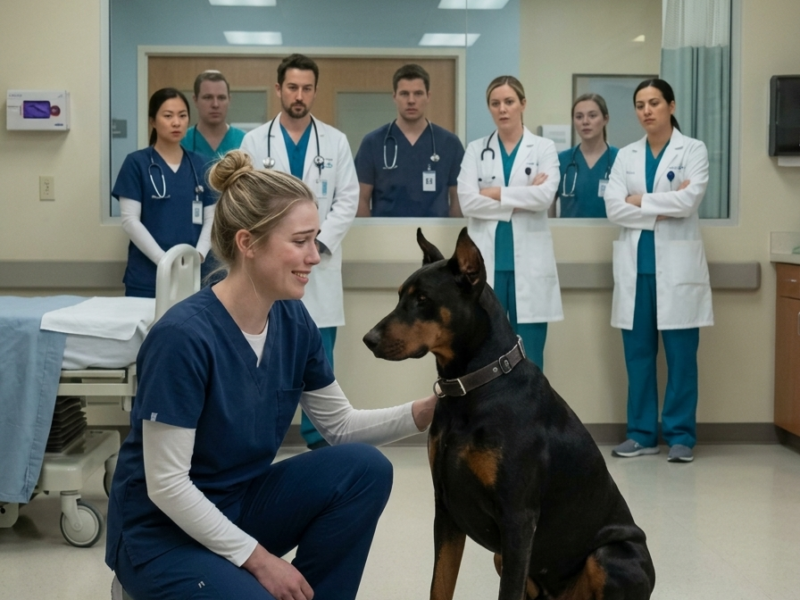
“They locked me inside an isolation room at a military hospital with an aggressive K9 and laughed when I begged them to open the door
The isolation ward on the third floor of Fort Meade’s psychiatric and behavioral medical wing smelled of aggressive industrial disinfectant, copper, and cold fear. The reinforced safety glass was thick, twice-laminated to withstand heavy impacts, but it couldn’t filter out the suffocating atmosphere inside the room.
The door slammed behind me with a heavy, metallic thud. I heard the electronic lock click into place, followed by the dull double-thunk of the mechanical deadbolt sliding home.
Outside the glass window, three senior nurses and two off-duty orderlies stood watching in a loose semicircle. One of them, a veteran chief nurse named Miller who had taken an instant dislike to my quiet demeanor since I transferred in, smiled thin and sharp.
“Good luck, rookie,” Miller said, her voice piped through the wall intercom with a tinny, robotic hum. “Let’s see if your delicate bedside manner works on a patient who bites.”
The dog was enormous. He was a scarred, muscular Belgian Malinois-German Shepherd cross named Atlas, weighing at least ninety pounds. His coat was a dark, grizzled sable, and his left ear was torn near the tip. His official record jacket, which I had glanced at briefly before being shoved into the room, was stamped with red hazard tape: EXTREME AGGRESSION / COMBAT PTSD / CANINE EUTHANASIA EVALUATION.
His handler, a twitchy sergeant who had abandoned the leash the moment the dog bared his fangs in the hallway, had warned everyone never to approach him. Atlas had spent three tours in high-risk tactical zones, and his latest deployment had left him volatile, unresponsive to commands, and prone to violent outbursts.
Atlas paced in tight, frantic circles near the far corner of the room, his long claws clicking against the smooth linoleum. His teeth were bared in a wet, silent snarl, and the heavy leather leash dragged along the floor behind him like a broken tether.
My hands trembled violently at my sides. My heart hammered against my ribs, making my breath hitch in my throat. But I didn’t run toward the door. I didn’t scream for them to let me out, though every basic human instinct urged me to claw at the glass.
Instead, I lowered myself slowly onto the cold floor, sitting cross-legged against the wall furthest from him. I kept my chin down, my posture soft, avoiding direct eye contact while remaining completely still.
“Hey, buddy,” I whispered softly into the quiet room.
Atlas whipped his head toward me, a deep, chest-vibrating growl rolling out of his throat. He took two stiff, deliberate steps forward, his body locked into a low, predatory crouch.
I closed my eyes, taking a slow, measured breath through my nose.
Then, beneath the terrifying resonance of his growl, I heard something else. A subtle, rhythmic flaw in his posture. A faint, wet clicking sound in his upper air passage every time he exhaled, accompanied by an uneven, asymmetric hitch in his hind stride.
I opened my eyes halfway and focused on his right flank. Tucked beneath the thick fur along his ribcage was an old, jagged star-shaped scar where a high-velocity shrapnel fragment had torn through flesh and bone years ago.
My stomach dropped into a cold, weightless void.
I had seen that exact scar structure before. Not on a dog named Atlas in an official medical file. On a tactical working dog named Shadow—a specialized combat tracking asset assigned to an ultra-classified, black-budget special operations team operating out of the Hindu Kush mountains nine years ago.
The same operation that had officially claimed the life of my older brother, Staff Sergeant Ethan Vance.
My throat tightened until I could barely swallow. The sterile hospital room seemed to dissolve around me, replaced by the memory of burning diesel, freezing high-altitude air, and the smell of ozone.
I leaned forward slightly, keeping my movement agonizingly slow, and whispered a single word—a name I hadn’t spoken out loud in nearly a decade.
“Shadow.”
The dog froze instantly.
The deep, continuous growl died in his throat, cut off mid-breath. His head snapped up, his torn left ear lifting high as his nostrils flared, taking in the air around me with rapid, hungry sniffs.
Outside the observation glass, the muffled laughter and casual chatter stopped entirely. Nurse Miller’s smug expression melted into a frown as she pressed her face closer to the reinforced window.
I slowly turned my right arm over and held out my hand, palm up, resting it gently on my knee.
Atlas—Shadow—did not lunge. He dropped his shoulder, lowering his heavy frame until his belly nearly scraped the floor, and began to crawl toward me. It was not an attack; it was the cautious, disbelieving approach of a creature recognizing something thought long lost in the fog of war.
He reached my knee, buried his wet nose directly into the palm of my hand, and let out a long, shuddering whine. Then, slowly, heavily, he placed his massive head directly against my chest, leaning his entire body weight into my torso.
I closed my eyes as something deep inside me broke open. I wrapped my arms around his broad, muscular neck, burying my face in his coarse fur.
The last time I had touched a military working dog in this exact manner, I hadn’t been wearing oversized pale blue hospital scrubs and a plastic ID badge. I had been wearing custom night-vision mounts, a suppressed carbine, and a reinforced plate carrier stained with red dirt.
Suddenly, the heavy isolation door burst open behind me.
Captain Marcus Mason, the base’s chief veterinary officer and head of clinical security, rushed inside, flanked by two armed military police officers with tusers raised.
“Step away from the dog!” Mason ordered, his voice echoing off the hard walls. “Rookie, get against the wall!”
Before the officers could take a step, Shadow spun around. He planted his forepaws firmly on the linoleum, placing his heavy body directly between the guards and me, letting out a low, dangerous warning growl that shook the doorframe.
Captain Mason stopped dead in his tracks. He stared at the dog, then looked at me, his sharp grey eyes narrowing in utter disbelief.
“Where did you learn to handle him?” Mason asked, his voice dropping into a tense, cautious register. “He attacked three handlers in Fort Bragg last month. He hasn’t let anyone touch him without sedation in two years.”
I didn’t answer immediately. I reached up and slowly pushed back the long sleeve of my scrub top to check my own forearm, where my skin was burning with cold adrenaline.
Mason’s eyes followed the movement. As the blue fabric rolled up past my elbow, his expression shattered.
Faded beneath years of skin growth and old scar tissue was a small, precise tattoo tucked near the inside of my wrist: three thin, parallel black lines intersected by an inverted dagger.
It was the unofficial, unrecorded insignia of Task Force 99—a classified, off-the-books combat search and rescue unit that officially did not exist on any military roster, roster ledger, or government database.
Mason whispered, his voice barely audible over the hum of the ventilation system: “You were there. At Sector Seven.”
I gave a single, slow nod.
Shadow turned his head, nudging his cold nose directly against the faint, silver scar tissue right above the black tattoo on my wrist—a scar from an old shrapnel spray we had both survived.
“He remembered me,” I said softly.
The room fell into an uncomfortable, absolute silence. The two MP officers exchanged bewildered looks, slowly lowering their non-lethal weapons, completely out of their depth.
Captain Mason reached into his heavy tactical jacket, his hands unnaturally steady for a man who had just witnessed an impossible medical anomaly. He pulled out a thick, wax-sealed brown manila folder marked with an obsolete security clearance stamp.
“We pulled this from a double-locked trunk during a retrospective inventory of your brother’s personal effects after the base tribunal six months ago,” Mason said quietly, stepping forward alone and offering the file to me. “It was categorized as non-actionable mail. Nobody could make sense of it.”
My hands shook as I took the folder from him. The paper was dry, brittle, and smelled faintly of gun oil and old leather. I broke the wax seal and slid the contents into my hand.
Inside was a single, high-contrast black-and-white photograph. It showed my older brother, Ethan, wearing an unbadged tactical uniform, smiling tiredly while kneeling in the desert dirt with his arm draped around a younger, unscarred version of Shadow.
I turned the photograph over. Written on the back in Ethan’s distinctive, rushed handwriting was one short sentence:
If she ever finds you, tell her I didn’t die in the valley.
I stared at those six hand-written words until they began to blur and warp behind a wave of sudden tears. Nine years of grieving a phantom, nine years of accepting a closed-casket funeral with an empty pine box, nine years of hiding my true identity under a fake nursing license—all shattered by a single sentence written in dark ink.
Before I could speak, Shadow’s ears suddenly pinned back flat against his skull.
He lunged toward the reinforced observation window, his head low, and began barking wildly at the dimly lit hallway outside. His front claws slapped against the glass as he tracked a motion in the corridor.
Everyone in the room turned toward the window.
Through the reflective glass, deep in the shadows of the main corridor, a dark figure in an unmarked grey uniform stepped back from the viewing area and turned sharply down the rear stairwell exit.
Someone had been standing outside, watching the interaction through the glass.
And whoever it was had just realized that the secret they had spent nine years burying in classified archives was no longer safe.
Captain Mason was the first to react. He bolted out of the isolation room, his combat boots sloshing against the polished floor as he shouted down the hall: “Security! Lock down the third floor rear stairwell! Nobody leaves through Access Point Four!”
The alarm sirens did not go off. This was a military facility, but the wing we were standing in operated under a specialized black-budget budget code. The staff didn’t move with the frantic energy of a civil hospital; they moved with the cold, practiced efficiency of intelligence operatives caught in a containment breach.
I stood up, pulling my scrub sleeve back down over my wrist tattoo, though my knees felt like water. Shadow stayed locked to my left side, his shoulder pressed against my hip, his body quivering with a mixture of combat readiness and protective instincts.
“Nurse Vance,” Nurse Miller snapped from the doorway, her voice trembling slightly, her previous arrogance entirely wiped away. “You need to stay in this room until security clears the floor.”
“My name isn’t Vance,” I said, looking her dead in the eye for the first time since I had been assigned to her shift three weeks ago. “And if you try to lock this door again, I’ll let him finish what he started in Bragg.”
Miller went pale, taking two quick steps backward into the hallway and leaving the doorway wide open.
I walked out into the corridor, Shadow pacing beside me in a textbook tactical heel. My heart was pounding, but the fog of grief and confusion that had hung over my life for nine years was gone, replaced by a crystalline, hyper-focused clarity.
Ethan was alive. Or at least, he had been alive long enough after the official crash date to leave a trail through this dog.
Captain Mason returned five minutes later, his face grim, his sidearm holstered securely at his waist. He motioned for me to follow him into an auxiliary office down the hall and locked the door behind us. Shadow sat immediately under the desk, his eyes fixed on the door handle.
“The man in the hallway cleared the security perimeter using an active Red-Level clearance card,” Mason said, leaning against the edge of his desk and crossing his arms. “The surveillance cameras in that corridor mysteriously went through a power cycle thirty seconds before you stepped into the isolation room. It was an inside job.”
“Who owns the Red-Level cards on this floor?” I asked, my voice cold and flat.
“Only three people,” Mason replied. “The Base Commander, the Chief of Surgical Operations, and the director of the special veterinary rehabilitation unit—Colonel Arthur Vance.”
I let out a short, hollow laugh. “My uncle.”
“Your uncle?” Mason raised an eyebrow. “Your records say you have no living family after your brother’s death.”
“My uncle is the one who filed the casualty report nine years ago,” I said, leaning over the desk and pointing at the folder in Mason’s hand. “He was the senior logistics officer for Task Force 99. He’s the one who signed the death certificate, delivered the empty casket to my mother, and told me to never ask questions about the mission.”
Mason was silent for a long moment. He reached into his desk drawer, pulled out a encrypted military tablet, and tapped the glass screen several times.
“When this dog—Shadow—was transferred to my unit three weeks ago from an undisclosed installation in Germany, his medical file came with a strict directive,” Mason said softly. “Euthanasia within thirty days if non-responsive to rehabilitation. The order was signed by Colonel Vance.”
“He wasn’t trying to rehabilitate the dog,” I realized, the horrifying reality sweeping over me. “He was trying to destroy the last physical witness to what happened in Sector Seven. Shadow wasn’t aggressive because he had PTSD, Mason. He was aggressive because he was being held in solitary confinement to prevent anyone from reading his microchip or recognizing his tracking markers!”
“Which brings me to my next question,” Mason said, looking at me intently. “Who are you really? Because a junior civilian nurse doesn’t know tactical hand signals, doesn’t carry a Task Force 99 tattoo, and doesn’t make a rogue combat dog heel in ten seconds.”
I took a deep breath, resting my hand on Shadow’s head under the desk.
“My real name is Lieutenant Clara Vance,” I said. “I was an embedded flight medic attached to Task Force 99. Nine years ago, my unit was ambushed in the Korengal Valley during an unauthorized extraction mission. I was ordered to remain at the forward staging base while Ethan’s team went in. Only three people came back to the staging area: Colonel Vance, two private security contractors, and this dog.”
“And your brother?”
“Colonel Vance told me Ethan’s chopper took a direct hit from an RPG over a deep ravine,” I said, my teeth grinding together. “He said there were no remains to recover. Three days later, I was given an administrative discharge on medical grounds, my security clearance was wiped from the central registry, and I was told that if I ever spoke about Task Force 99, I would spend the rest of my life in a federal military prison.”
“So you went underground,” Mason said.
“I spent six years changing my identity, getting a civilian nursing credential, and waiting for an opening to get onto this base,” I replied. “I knew my uncle ran the specialized medical units here. I knew if there were any records left from the old unit, they would be routed through his office.”
Shadow let out a soft, low whine under the desk.
“He knows something,” Mason said, looking down at the dog. “Military working dogs assigned to Task Force 99 had sub-dermal encrypted tracking chips implanted near their shoulder blades. If Shadow was with Ethan after the crash, his internal log file will have recorded every GPS coordinate, every heart rate burst, and every distress beacon transmitted within fifty meters of his frame.”
“Where is the scanner?” I asked, standing up immediately.
“In the main surgical bay,” Mason said, grabbing his jacket. “But my uncle’s team controls that wing. If we walk in there with this dog, they’ll lock the facility down and seize him under military quarantine laws.”
“Then we don’t ask for permission,” I said, reaching down to unhook Shadow’s heavy leather leash, leaving him untethered and free to move. “We take the portable scanner and we leave the base.”
Before Mason could reply, the desk phone on his office console began to ring with a sharp, high-priority emergency tone.
Mason picked up the receiver, listened for five seconds, and turned to look at me, his face devoid of color.
“That was the main gate,” Mason whispered, setting the phone down slowly. “A team of Military Police officers armed with an administrative seizure warrant signed by Colonel Vance is currently on their way up to this floor. They’re coming to take the dog—and arrest you for impersonating a federal officer.”
“We have two minutes,” Mason said, turning to a metal locker in the corner of his office. He punched in a six-digit code and pulled out a heavy black hard-shell case containing a handheld sub-dermal RFID diagnostic scanner and a tactical radio. “If they get you to the main gate, my uncle’s authorization will override any medical defense I can offer.”
“Is there an exit through the basement?” I asked, my medic instincts taking over. “The old utility tunnels beneath the surgical wing—do they connect to the civilian drainage network?”
“They do,” Mason said, tossing me a set of master electronic keycards. “Sub-Level Two. It’s an old Cold War bunker line used for high-value medical storage. But it’s restricted access. If the alarm trips down there, the blast doors will seal automatically.”
“Shadow knows the way,” I said, tapping my hip.
The dog instantly stood, his tail held low and rigid, his ears swept forward. He knew we were moving into an evasion profile. The frantic, unguided anxiety that had plagued him for weeks had vanished the moment he recognized my voice; he was back in his element, operating as a trained tactical asset with a trusted handler.
We slipped out of the office through a rear service door just as the loud, rhythmic thud of heavy tactical boots echoed down the main corridor near the front desk.
We took the concrete service stairwell down, dropping past the main floor, past the basement labs, straight into the damp, cold chill of Sub-Level Two. The air down here smelled of rust, standing water, and old concrete. Overhead, dim fluorescent bulbs flickered inside wire cages, casting long, swaying shadows along the narrow brick corridor.
“Over here,” Mason whispered, guiding us toward a heavy steel double door marked CLASSIFIED ARCHIVAL STORAGE – MEDICAL RECORDS. “This room has its own isolated power grid. We can scan his chip here without tripping the main network’s digital intrusion monitors.”
We pushed through the heavy doors into a dusty room filled with rows of tall metal shelving units holding thousands of old paper medical files and magnetic tape reels.
Mason snapped open the plastic case, powered on the handheld RFID scanner, and knelt beside Shadow. “Hold his neck steady.”
I knelt in front of Shadow, wrapping my arms around his head, whispering soft praise into his torn ear while Mason pressed the broad, illuminated head of the scanner against the dog’s left shoulder blade.
The scanner let out a series of high-pitched digital beeps. The tiny LCD screen flickered, reading: SCANNING… ENCRYPTED CHIP DETECTED… DECRYPTION KEY REQUIRED.
“It’s double-encrypted,” Mason cursed under his breath. “Task Force 99 proprietary format. I don’t have the master key.”
“I do,” I said.
Mason looked up at me in surprise. “You have a Task Force decryption key?”
“Ethan gave me his personal deployment key before he left for his final tour,” I said, reaching into my collar and pulling out a silver dog tag hanging from a thin steel chain. I popped off the black rubber silencer around the edge of the tag, revealing a micro-engraved 16-digit alphanumeric code stamped on the metal rim. “He told me if anything ever happened to him and the military refused to answer my questions, I was to input this key into any high-level terminal I could find.”
Mason quickly typed the 16-character string into the scanner’s interface.
The device let out a long, solid chime. The green LED light on top went solid, and lines of raw data began cascading down the small display screen.
CHIP ID: MWD-99-SHADOW
LAST SYNC DATE: 14-OCTOBER-2017
LOCATION DATA LOGGED: GRID 42-NOVEMBER-SECTOR-7
STATUS: OPERATIONAL ASSIGNMENT – SSGT VANCE, ETHAN
“Scroll down to the medical telemetry logs,” I commanded, my heart hammering against my ribs so hard I could barely breathe. “Look for the cardiac and distress signal timestamps on the day of the crash.”
Mason’s thumb scrolled through the text lines. “October 14th… 0400 hours… high kinetic impact detected… explosive pressure wave… The dog survived the chopper crash.”
“What about Ethan?”
Mason paused, his eyes scanning down the raw data readout. “Heart rate monitor linked through Ethan’s wrist telemetry array… 0415 hours: Ethan’s pulse is stable… 0600 hours: pulse stable… 1200 hours: pulse stable…”
Mason froze, his thumb stopping on the screen.
“What is it?” I demanded, grabbing his arm. “Read it to me, Mason!”
“Ethan’s vital signs were logged continuously for seventy-two hours after the official time of his death,” Mason whispered, his voice trembling with genuine shock. “He wasn’t killed in the crash. He was rescued from the crash site by an unauthorized ground transport unit.”
“And where did they take him?”
Mason tapped the GPS coordinate history log. “The signal moved twenty miles north, across the border, into a private medical compound owned by Global Tactical Solutions—a private military contracting firm funded directly through a sub-agency directed by…”
“…Colonel Arthur Vance,” I finished the sentence, a cold, lethal rage settling into my chest. “He didn’t die in the crash. My uncle didn’t cover up his death—he captured him! He took his own nephew prisoner!”
Before Mason could reply, the heavy steel doors of the archival room were violently blown off their hinges with a deafening CRACK.
A cloud of white drywall dust and smoke filled the room. High-powered tactical flashlights cut through the haze, their bright white beams pinning Mason, Shadow, and me against the back wall.
“Don’t move! Hands on your heads! Do it now!” a harsh, authoritative voice barked through the dust.
Through the haze stepped Colonel Arthur Vance. He was wearing his crisp, tailored dress green uniform, his chest covered in rows of service ribbons, his silver hair perfectly combed. Behind him stood four heavily armed private security operatives wearing unmarked black tactical gear, their suppressed carbines pointed directly at my chest.
“Hello, Clara,” Colonel Vance said, his voice smooth, calm, and utterly devoid of warmth. “I must admit, I am impressed. I always knew you were your brother’s sister, but I didn’t think you had the discipline to stay undercover for six years.”
“Where is he, Arthur?” I rasped, stepping in front of Shadow, shielding him with my body. “Where is Ethan?”
Colonel Vance sighed, resting his hand on his leather belt. “Ethan was a soldier who refused to understand the bigger picture, Clara. And I see you’ve inherited his unfortunate habit of digging through graves that were meant to stay closed.”
“He’s alive, isn’t he?” I demanded, my hands clenched into tight fists at my sides. “You kept him locked away for nine years because he found out you were skimming funds from Task Force 99 to build your private contractor network!”
Colonel Vance smiled thinly, taking a slow, measured step into the room, his shining leather boots stepping over the shattered remains of the door frame.
“Task Force 99 was an experimental operational framework, Clara,” Vance said, his voice echoing off the concrete walls like a university professor delivering a lecture. “In war, money vanishes. Supplies get mislaid. Operations fail. Ethan was a brilliant tactical leader, but he had a hopelessly naive moral compass. When he stumbled onto our logistics clearing accounts in Bagram, he tried to go directly to the Senate Armed Services Committee.”
“So you ambushed his helicopter,” Mason said, stepping up beside me, holding his RFID scanner tight against his chest like a weapon.
“I saved his life!” Colonel Vance snapped, his voice suddenly dropping its calm demeanor, flashing with a cold, desperate vanity. “The crash was an accident caused by an insurgent RPG! My team pulled him out of the fire! But he refused to sign the non-disclosure agreements. He refused to accept the reality of the situation. So I had to put him somewhere quiet—somewhere he could reflect on his stubbornness without ruining the lives of everyone in this family!”
“Where is he?” I repeated, every fiber of my being focused on the man standing ten feet in front of me.
“He’s at the Blackwood Rehabilitation Annex in West Virginia,” Vance said flatly. “A private, high-security medical facility where retired assets who suffer from… unfortunate cognitive decline are cared for away from the public eye.”
“He’s not crazy,” I snarled. “You kept him drugged!”
“I kept him safe!” Vance shouted. “And I would have kept him safe until the end of his natural life! But then you showed up here. You pulled this miserable, brain-damaged animal out of the euthanasia queue, and you reopened a file that was buried six feet deep!”
Vance turned his head slightly toward his head of security—a tall, thick-necked operator with a tactical headset. “Secure the girl. Euthanize the dog immediately. And make sure Captain Mason suffers a sudden, tragic cardiac event in his quarters tonight.”
“Not today, Colonel,” Mason said quietly.
Before the lead contractor could raise his rifle, Mason hit a red emergency button on his handheld tactical radio.
A ear-splitting, 120-decibel intruder alarm shrieked throughout the entire basement complex. Red emergency strobe lights began flashing along the ceiling, and the heavy, motorized steel blast doors at the end of the corridor began sliding shut with a loud, mechanical whine.
“Shadow! ATTACK!” I screamed, using the original, unreleased German strike command Ethan had taught me years ago. “FASS!”
Shadow didn’t hesitate. He launched himself forward like a released steel spring, clearing six feet of concrete floor in a single leap. He slammed his broad chest directly into the lead contractor, his heavy jaws locking onto the man’s right forearm, shattering the bone inside the tactical armor with a sickening crunch.
The contractor screamed, dropping his weapon as he crashed heavily onto the concrete floor.
“Move!” Mason yelled, grabbing my arm and yanking me toward a narrow emergency ventilation access hatch in the rear wall.
“Kill them!” Colonel Vance roared over the deafening alarm sirens, pulling a silver sidearm from his shoulder holster and firing two wild shots into the dusty air.
The bullets ricocheted off the metal shelving units, sending sparks and paper files flying through the room.
Shadow let go of the contractor, spun around on his hind legs, and lunged directly at Colonel Vance. His massive forepaws struck Vance squarely in the chest, knocking the older man backward onto the hard floor, sending his gun skittering across the linoleum into the dark corner.
“Clara! GO!” Mason screamed, dragging me through the open hatch into the dark, narrow service shaft just as the heavy steel security blast doors slammed shut behind us, cutting off the archival room from the main corridor.
I turned back to look through the small, reinforced observation port in the hatch.
Inside the room, Colonel Vance was pinned to the floor, gasping for air, while Shadow stood over him, his heavy paws planted firmly on Vance’s chest, his jaws inches from his throat, letting out a low, terrifying growl that froze every remaining security guard in their tracks.
“Tell him to hold!” Mason yelled into my ear over the roar of the alarm. “If the dog kills him, we’ll never get the access codes to the West Virginia facility!”
I pressed my face against the hatch glass and shouted through the speaker grate: “Shadow! AUS! HOLD!”
Shadow immediately stopped his growl. He didn’t bite. He remained standing on Colonel Vance’s chest, his sharp eyes locked onto the old man’s face, holding him completely motionless like a living statue of vengeance.
“Keep him there!” I called out to the guards who were nervously pointing their rifles at the dog. “If anyone shoots, he’ll tear his throat out before your bullet hits him!”
I turned to Mason, my face covered in dust and sweat, my hands steady. “Give me your radio. I’m calling the Federal Marshal’s regional dispatch.”
The sun was just beginning to crest over the horizon three days later, casting a long, golden light across the rolling green hills of the West Virginia countryside.
The heavy rain that had plagued the region for forty-eight hours had finally stopped, leaving the air cool, clean, and smelling of wet pine and stone.
A convoy of four dark blue Federal Marshal SUVs sat parked along the narrow dirt road leading up to the wrought-iron gates of the Blackwood Annex—a sprawling, secluded brick estate surrounded by a ten-foot security fence and high-definition surveillance towers.
I stood beside the lead SUV, wearing a clean, dark blue tactical jacket with U.S. MARSHAL SERVICE / MEDICAL DETAIL stamped in gold letters across the back.
Beside me, standing tall, quiet, and completely calm, was Shadow. His torn left ear flicked slightly in the cool breeze, his dark eyes fixed on the front gates of the compound. His coat had been washed, his scars cleaned, and for the first time in nine years, he wore a bright red working vest bearing his official, fully restored military registry tag: MWD SHADOW – ACTIVE RECOVERY ASSIGNMENT.
Captain Mason walked over from the lead Marshal vehicle, holding a stack of federal search warrants signed directly by a judge from the United States District Court for the District of Columbia.
“The federal team has taken control of the main gate,” Mason said, his voice soft, filled with a deep, quiet satisfaction. “Your uncle’s private security team laid down their arms five minutes ago when they saw the federal warrants. The entire facility is secure.”
“And Arthur?” I asked quietly.
“Colonel Vance is currently being held in a federal detention center in Baltimore,” Mason replied. “The raw telemetry data from Shadow’s chip, combined with the financial ledgers we recovered from his office, opened a door that the Department of Defense couldn’t close. He’s facing thirty counts of high treason, kidnapping, and embezzlement.”
I took a deep, shuddering breath, feeling the cold weight that had rested on my chest for nearly a decade slowly melt away in the morning light.
“Is Ethan inside?” I asked, my voice barely a whisper.
Mason looked at me, a warm, genuine smile breaking across his face. “Building C. Room 104. He’s waiting for you, Clara.”
I didn’t run. I didn’t rush through the gates like a frantic child. I took slow, deliberate steps, my boots crunching rhythmically against the gravel drive, with Shadow walking in a perfect, disciplined heel right beside my knee.
We passed through the heavy iron gates, past the silent surveillance towers, and walked up the broad stone steps of Building C. The interior of the facility was quiet, bright, and decorated in soft, neutral tones—a gilded cage built to look like an upscale country clinic.
We walked down the long, carpeted hallway until we reached Room 104. The door was slightly ajar, letting out a thin strip of morning sunlight onto the floor.
I pushed the door open softly.
Sitting in a comfortable armchair near a large bay window overlooking the valley was a man in his late thirties. He was thin, his short hair streaked with silver at the temples, wearing a plain grey sweater and dark trousers. His face was weathered, bearing a long, thin surgical scar running from his hairline down to his right jawline.
He was staring out at the trees, a steaming mug of tea resting in his lap.
“Ethan?” I called out, my voice trembling so violently the name sounded like a prayer.
The man froze.
Slowly, carefully, he set his mug down on the small table beside him and turned his head. His dark grey eyes—the exact same eyes I saw in the mirror every morning—widened in utter, disbelieving shock.
“Clara?” he whispered, his voice hoarse from years of disuse.
He stood up, his legs slightly unsteady, taking a slow step toward me.
Before he could take another step, Shadow let out a sharp, joyful bark. The massive dog broke his heel formation, bounded across the soft carpet, and buried his head directly into Ethan’s lap, his tail thumping against the wooden floorboards like a drum beat.
Ethan dropped to his knees right there on the floor. He wrapped his strong arms around the dog’s broad neck, burying his face in his fur, his shoulders shaking with silent, deep sobs that had been held back for nine long years.
“Shadow…” Ethan wept softly, pressing his forehead against the dog’s head. “You found her… my boy, you actually found her…”
I dropped to my knees beside them both, wrapping my arms around my brother’s thin shoulders, holding him as tight as I could, feeling the warmth of his breath, the steady beat of his heart, the absolute undeniable truth that he was real, he was alive, and he was finally home.
“I never stopped looking, Ethan,” I whispered into his hair, tears streaming down my face, warm and bright in the morning sun. “I never stopped looking.”
Ethan pulled back slightly, looking at my wrist, where my scrub sleeve had pulled up to reveal the black Task Force 99 tattoo and the shrapnel scar we had all shared. He smiled—a tired, battered, but profoundly free smile—and took my hand in his.
“The war is over, Clara,” Ethan said softly, looking at the dog resting his heavy head across both of our laps. “It’s finally over.”
Outside the window, the sun rose high above the West Virginia mountains, scattering the last remnants of the morning fog, bathing the valley in a clear, endless white light.
The end.









