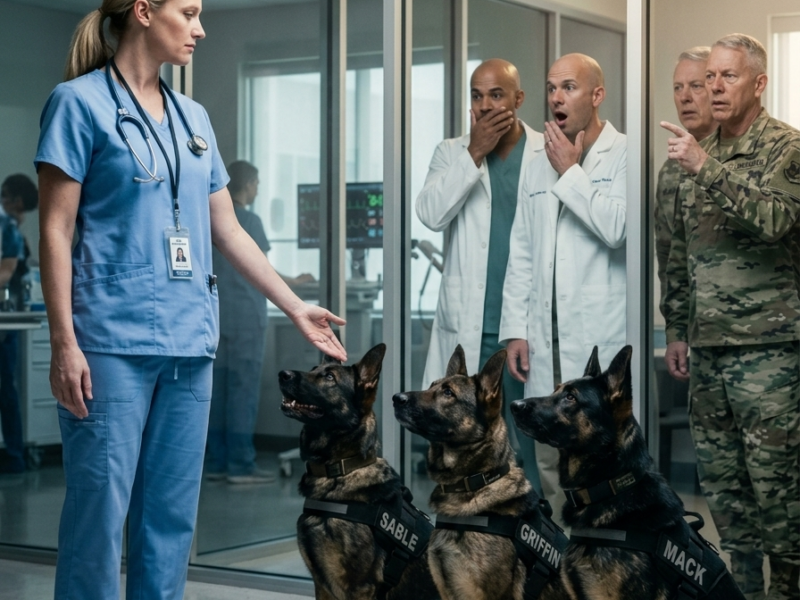
They locked me inside a cold military kennel with three snarling K9s while the entire training unit watched through the glass
The reinforced steel door slammed shut behind me with a heavy, metallic clang that echoed through the concrete enclosure. The electronic latch engaged automatically, its sharp click sealing me inside the cold, airless military kennel. The scent of ozone, damp concrete, and raw animal tension hung thick in the air.
Outside, beyond the triple-paned bulletproof glass, a dozen soldiers in tactical fatigues were gathered. Among them was Captain Reeves, standing with his hands folded behind his back, a triumphant, cruel sneer curving his lips. Beside him, three junior handlers chucked quietly, nudging each other as they watched me back away from the gate.
“You think you know more than my handlers?” Reeves’s voice cut through the intercom system, flat and mocking. “You come into my facility, a civilian nurse who spends her days wrapping sprained ankles and handing out ice packs, and you lecture my men on stress signals? You say my dogs are reactive because they’re terrified?”
I pressed my back against the cold cinderblock wall, my heart hammering against my ribs like a trapped bird. “No, Captain,” I said, my voice surprisingly steady as it filtered through the wire mesh microphone overhead. “I said you’re misreading their posture. They aren’t aggressive. They’re overstimulated.”
“Then let’s see how well you handle overstimulation,” Reeves sneered. He gestured to the handler standing near the manual release lever. “Unlatch the interior gates.”
“Captain, don’t—” I started, but it was already too late.
The heavy chain-link dividers separating the three individual runs slid upward with a harsh screech of metal. Out surged three massive military Belgian Malinois-German Shepherd crosses. Their muscles were taut under sleek, dark coats, their teeth bared as they surged toward the intruder in their territory.
Ranger, the dark-sabled pack leader, lunged first. He took three explosive strides across the concrete, a deep, guttural roar rumbling in his chest. Behind him came Atlas, a broad-chested male with a scarred muzzle, and Bear, the largest of the three, whose dark eyes were fixed on my movement.
The soldiers behind the glass chuckled louder, stepping closer to the pane to watch the civilian nurse panic. Reeves crossed his arms, waiting for the screams, waiting for me to throw my hands over my face and beg to be let out.
I didn’t scream. I didn’t turn my back. I froze entirely, absorbing the threat with every instinct buried deep within my nervous system.
As Ranger closed the final six feet, his jaws open to strike, I locked eyes with him.
And then, in a fraction of a second, the universe seemed to arrest its motion.
Ranger’s front paws slammed into the concrete, but he didn’t leap. His ears, which had been pinned flat in sheer defensive rage, suddenly twitched forward. His chest slammed to a halt so violently his rear legs skidded on the wet floorboards.
Behind him, Atlas veered sharply to the left, his snarl dying in his throat. Bear stopped dead in his tracks, his head tilting to one side, his nostrils flaring violently as he drew in deep, frantic draughts of the air surrounding me.
The laughter outside the glass began to flicker and die, replaced by a sudden, uneasy silence.
The three deadly tactical K9s—dogs trained to tear down armed insurgents and hold their ground through flashbangs and live gunfire—had stopped barking entirely.
Ranger took one slow, trembling step forward. The terrifying predator was gone. His tail lowered, sweeping the floor in a slow, hesitating, tentative arc. Atlas lowered his head until his snout nearly touched the floor, letting out a soft, high-pitched whine that sounded almost human in its desperation.
I stared at the three animals, a strange, electric shiver running down my spine. The professional distance I had maintained for six months at Fort Adams shattered into a million pieces.
I took a breath, lowered my head slightly, and whispered a single, quiet word into the silence of the kennel.
“Easy.”
Ranger froze as if hit by a lightning bolt. Then, slowly, deliberately, his heavy rear end settled onto the cold floor. He sat down in a textbook military parade rest, his bright amber eyes fixed on my face with absolute, unyielding devotion.
Outside, the laughter died completely. Reeves stepped closer to the glass, his brow furrowed, his cold smile vanishing into a look of baffled irritation. He hit the intercom button.
“What did you just do?” he demanded, his voice dropping an octave. “Miller, step back from those dogs! Handlers, get in there and secure them!”
None of the handlers moved. They were staring at the scene inside the glass as if they were looking at a ghost.
Atlas walked slowly toward me, his heavy paws moving with infinite care. He reached out and gently pressed his wet nose directly into the palm of my right hand, nudging it upward, demanding to be touched. Bear followed right behind, sinking his massive head against my knee, breathing out a long, trembling sigh.
I knelt in the middle of the three deadliest dogs on the base, my hands resting on their heads. Tears pricked the backs of my eyes, burning hot against the cold air of the room.
I slowly pulled back the cuff of my long-sleeved medical scrubs, exposing the inner underside of my right wrist. There, running from the base of my palm down toward my elbow, was a jagged, pale silver scar—the mark of a shrapnel tear and surgical reconstruction.
The moment the dogs saw the exposed skin and caught the faint, unmistakable scent of the surgical steel plate beneath, they went wildly restless. Ranger began pawing urgently at the concrete floor, whining in deep, throat-clearing bursts. Atlas licked at the scar with desperate affection.
Bear turned away from me, spinning around and marching directly toward the far dark corner of the kennel run. He dropped his head, digging frantically under an old, chewed-up wool blanket sitting near the drainage grate.
With a soft metallic clink, Bear pulled something out from under the blanket and trotted back to me, dropping it gently onto my lap.
It was a battered, scratched metal training tag, dull with age and scorched along one edge.
I picked it up with trembling fingers. I wiped away the dust layer on the reverse side. Scratched deeply into the hardened alloy was a callsign and a name that hadn’t existed on any active military roster in seven years:
COMMANDER V. MENDOZA – SHADOW UNIT K9
The entire room outside went dead quiet.
Reeves pressed both hands against the glass, his knuckles turning white. His face had gone completely pale, drained of every drop of color.
“You’re… you’re Victoria Mendoza,” Reeves whispered into the microphone, his voice trembling for the first time since I had met him. “You’re supposed to be dead. The deployment in Kandahar—the warehouse explosion. The entire Shadow Unit was wiped out.”
I slowly stood up, surrounded by the three massive dogs who had positioned themselves in an impenetrable triangle around my feet. I looked straight through the bulletproof glass into the eyes of the man who had tried to humiliate me.
“That’s what they wanted everyone to believe,” I said, my voice ringing out clear and hard through the concrete room.
Before Reeves could answer, Bear’s ears snapped back. He turned his head toward the dark access hallway leading into the kennel facility, his upper lip curling back into a silent, lethal growl.
A second later, a woman’s terrified scream echoed from deep within the administrative corridor.
The heavy electronic lock on the main kennel door suddenly clicked red. The heavy steel door swung open on its own, unlocked remotely from the main security console.
And without a single command spoken, Ranger, Atlas, and Bear moved in front of me, forming a solid wall of teeth and muscle, ready to wage war for the commander they had waited seven years to protect.
The administrative corridor outside the glass descended into instant, terrifying chaos.
The red emergency lights began rotating along the ceiling, bathing the gray concrete walls in pulses of crimson light. High-pitched alarm sirens blared through the facility’s speaker system, drowning out the shouting of the guards.
“Lock it down! Lock down Sector Four!” Reeves bellowed through the intercom, turning away from the glass window to yell at his men. “What the hell is happening out there?”
Through the glass, I watched two young handlers sprint past the observation window toward the main corridor exit, their hands resting on their sidearms. Before they could reach the double doors, the heavy metal access doors were blown inward with a deafening CRACK that sent dust and plaster flying through the air.
Two men dressed in tactical black gear without military insignia burst through the smoke. They carried short-barreled automatic weapons equipped with suppressors. Before the handlers could even draw their pistols, the intruders fired twice—quick, precise, non-lethal taser rounds that dropped both handlers instantly to the floor in convulsing heaps.
My blood ran cold. These weren’t local protestors or rogue soldiers. These were contractors. Black-budget mercenaries.
Reeves backed away from the window, drawing his service weapon, his face twisted in panic. “Who authorized this? State your identity!”
The lead intruder stepped through the smoke, raising his weapon and aiming it directly at Reeves’s chest. “Shut up, Captain,” the contractor said, his voice digitized and flat through his tactical mask. “We aren’t here for you. We’re here for the asset.”
His eyes swept past Reeves, locking directly onto me through the bulletproof glass.
In that moment, everything I had suppressed for seven years came rushing back with terrifying clarity.
Seven years ago, my covert K9 team—Shadow Unit—had uncovered a high-level treason network within the Department of Defense involving stolen weapons technology being funneled through private contractors. Before we could deliver the encrypted drive to federal prosecutors, our forward operating base in Kandahar was struck by a targeted missile strike.
My team was declared dead. I survived, barely, rescued by local villagers who nursed me back to health. When I finally made it back to the United States under a false identity, I discovered my records had been completely erased from the military database. Victoria Mendoza was dead. I became Sarah Miller, a quiet civilian nurse hiding in plain sight at Fort Adams, waiting for the right moment to find out who had ordered the hit on my team.
And now, they had found me.
“She’s in the primary holding pen,” the mercenary leader said into his shoulder radio. “We have visual on Mendoza. Moving to secure.”
Reeves looked from the gunman to me, his hands shaking. “Mendoza? What is this? What did you bring onto my base?”
“They didn’t track me here, Reeves,” I called out from inside the kennel, my voice cool and precise despite the sirens. “They tracked you. You brought those three dogs here from the archives two weeks ago, didn’t you? You pulled Shadow Unit’s old assets out of deep storage to evaluate them for your program.”
Reeves swallowed hard, his eyes wide. “I… I just requisitioned them from the classified inventory…”
“And when you booted up their records, you triggered a flag on the contractor’s surveillance grid,” I said, stepping closer to the open kennel door. “They realized the only reason those dogs were being moved was because someone was looking into Shadow Unit.”
The lead mercenary didn’t waste time talking. He raised his weapon and fired three armor-piercing rounds directly into the heavy glass window. The bulletproof glass shattered into a web of white fractures, but held. He immediately reached into his tactical vest, pulling out a heavy breach charge to stick to the frame.
“Ares, fall back!” the lead contractor shouted to his partner. “Set the charge on the door frame! Blow the lock!”
Inside the kennel, my three dogs didn’t tremble at the sound of the gunshots. They were combat-tested veterans of the highest caliber. Ranger dropped low, his body coiled like a steel spring. Atlas moved to my left flank, his ears back, his eyes tracking the explosives in the mercenary’s hand. Bear stood directly in front of me, his massive chest blocking my torso.
“Reeves!” I yelled through the cracked glass. “If you want to survive the next two minutes, you open the secondary access gate to the maintenance tunnel right now!”
Reeves looked terrified, his eyes darting between the armed contractors planting explosives on his glass window and the woman he had tried to humiliate ten minutes ago. “I… I can’t release the maintenance gates without command clearance—”
“They are going to kill you, Reeves!” I screamed over the roar of the alarms. “You’re a witness now! Look at him!”
Reeves looked at the mercenary, who was calmly arming a remote detonator while aiming a gun at Reeves’s chest. The realization hit the captain like a physical blow. He lunged across the control desk, slamming his hand down on the red manual override button labeled MAINTENANCE CLEARANCE.
Behind me inside the kennel, a heavy iron grate at the floor level clicked loudly and began to slide upward, revealing a dark, concrete utility tunnel designed for drain access.
At that exact second, the breach charge on the main glass window exploded.
BOOM!
A blinding flash of light and smoke filled the observation room. Shrapnel and heavy safety glass rained down into the kennel.
“GO! GO! TAKE HER DOWN!” the contractor shouted, leaping through the shattered window frame into the smoke-filled kennel.
I didn’t hesitate. “Shadow Unit! ATTACK!” I commanded, using the classified assault trigger phrase we had taught them seven years ago in the mountains of Afghanistan.
“COMMAND ACCEPTED!”
The three dogs didn’t bark. They became silent, lethal blur of shadow and muscle moving through the white smoke.
The sound that followed was chaos.
Ranger hit the lead contractor mid-air as the man cleared the broken window frame. Eighty pounds of pure muscle slammed into the mercenary’s chest, driving him backward onto the shattered glass floor. Ranger’s jaws locked around the man’s weapon arm, biting through the tactical Kevlar with terrifying force. The contractor screamed, dropping his rifle.
Atlas sprinted to the right, tackling the second mercenary who was trying to clear the door frame. The dog bypassed the body armor, clamping onto the man’s thigh and twisting his weight, taking the soldier off his feet and slamming his head against the concrete wall.
“Shoot them! Shoot the damn dogs!” the second contractor shrieked, struggling frantically to pull a sidearm from his chest holster.
Bear didn’t give him the chance. The massive dog lunged over Atlas, his jaws snapping shut on the soldier’s wrist, pinning the weapon against the floorboards.
“Mendoza, get out of here!” Reeves screamed from the control desk. He fired two frantic shots from his service pistol over the heads of the contractors, forcing a third mercenary who was coming down the hallway to take cover behind the doorframe.
I grabbed the heavy metal training tag from the floor and stuffed it into my scrub pocket. I turned toward the open maintenance tunnel grate.
“Ranger! Atlas! Bear! REFORMATION!” I shouted over the din.
Instantly, the three dogs released their holds. They didn’t linger to maul or celebrate. They disengaged with tactical precision, stepping backward through the smoke, keeping their faces toward the enemy as they formed a protective screen between the groaning mercenaries and the escape tunnel.
“Into the tunnel!” I ordered, dropping onto my hands and knees and sliding into the dark, narrow concrete pipe.
Ranger went first, plunging into the darkness ahead of me to scout the route. I crawled in second, the rough damp concrete scraping against my elbows and knees. Atlas followed right behind my boots, and Bear brought up the rear, his massive body completely blocking the entrance behind us.
A second later, automatic gunfire sprayed into the mouth of the tunnel, bullets ricocheting off the heavy metal entrance frame with deafening PINGS. But Bear was already inside, and the angle of the pipe protected us from the direct line of fire.
“Move! Move!” I urged, crawling as fast as my hands could carry me through the damp darkness.
The maintenance tunnel was narrow, built beneath the base’s old sewer and electrical grid. The air was cold, smelling of rust, wet mud, and old copper. Ahead of us, Ranger’s dark shape moved with absolute confidence, his nose sweeping the ground, guiding us through the labyrinth of underground pipes.
After fifty yards of intense crawling, the tunnel angled upward. Ranger stopped at a heavy iron ladder leading toward a square ceiling hatch. He looked back at me, letting out a soft huff of air to signal that the path ahead was clear of immediate human presence.
I climbed the rusted rungs of the ladder, pressed my shoulder against the heavy metal cover, and shoved upward with all my strength.
The hatch popped open, and cold night rain washed over my face.
We emerged into the brush behind the base’s vehicle maintenance depot, nearly three hundred yards away from the kennel facility. The storm was howling overhead, thunder rolling across the dark sky, masking the sound of our escape.
I pulled myself out of the manhole, shivering violently in my soaked scrubs. One by one, the three dogs bounded out behind me, shaking the water from their coats, instantly fanning out into a perimeter defense formation around the bush.
In the distance, across the base runway, searchlights were switching on. Red emergency lights bathed the tactical buildings in blood-colored light, and the wail of base-wide sirens echoed through the valley.
I knelt in the tall, wet grass, pulling Ranger close to me. I inspected his coat, running my hands over his ribs and legs to check for gunshot wounds or shrapnel injuries. He was unhurt, his chest heaving with exertion, his wet tongue licking my trembling cheek.
“You guys saved me,” I whispered, tears mixing with the rainwater pouring down my face. “You remembered.”
Atlas pressed his side against my hip, giving me his warmth in the freezing rain. Bear took up a post at the edge of the treeline, his dark eyes fixed on the perimeter fence fifty yards away.
I pulled out my civilian cell phone from my pocket. It was miraculously dry, protected inside its waterproof case. I turned it on, staring at the screen.
I knew I couldn’t stay on this base. I couldn’t run to the local police, and I couldn’t go back to my quiet apartment in the town outside Fort Adams. The contractors who had tried to kill me had high-level access to military intelligence—access provided by someone sitting in the upper echelons of the Pentagon.
If I wanted to survive, if I wanted to protect these dogs from being put down as “compromised assets,” I had to finish what Shadow Unit started seven years ago.
I opened a secure, encrypted messaging application I hadn’t opened since 2019. I typed in a single string of numbers—an emergency contact frequency belonging to the Inspector General’s Special Investigations Unit.
I typed a message:
SHADOW COMMANDER IS ALIVE. ASSETS RECOVERED. MERCENARIES ON FORT ADAMS SITE. PREPARE FOR DATA DELIVERY.
I hit send.
Beside me, Ranger let out a low, vibration-deep growl.
I looked up. Fifty yards away, at the edge of the vehicle depot, headlights cut through the pouring rain. A dark civilian SUV was slowly cruising along the fence line, its searchlight sweeping the treeline.
They were already sweeping the perimeter.
I looked at my three dogs. They weren’t broken animals. They weren’t reactive strays. They were the finest tactical K9 unit the military had ever produced, and they were back with their commander.
“Alright, boys,” I whispered, reaching down to grab Ranger’s tactical harness. “Let’s go finish the mission.”
We moved through the shadows of the forest surrounding Fort Adams like ghosts.
The rain worked in our favor, masking our scent and muffling the sound of our footsteps as we navigated the three miles of dense woodland separating the military installation from the abandoned industrial district near the river.
Ranger took the lead, his tactical training seamlessly re-engaging after seven years of dormancy. He picked out paths through the brush that avoided the automated thermal motion sensors scattered along the base boundary. Atlas stayed glued to my left side, providing a physical shield, while Bear trailed thirty paces behind us, constantly stopping, turning, and checking our rear flank.
By 0200 hours, we reached an old, rusted corrugated steel warehouse sitting near the abandoned coal docks. The building had been decommissioned in the late nineties, its windows broken and its iron doors sagging on rusted hinges.
This was my contingency location—a place I had quietly stocked three years ago when I first suspected that someone from my past was monitoring Fort Adams.
I slid through a broken panel in the side door, the three dogs slipping in behind me without making a single sound.
Inside, the warehouse was dark and dry, smelling of old timber, dry dust, and river moss. I reached under a pile of rotting wooden pallets in the far corner, pulling out a heavy, green waterproof pelican case.
I popped the heavy plastic latches. Inside was a tactical medical kit, clean dark clothing, a satellite phone, and a small, silver encrypted hard drive—the twin to the drive that had gotten my unit killed in Kandahar.
I stripped off my mud-soaked scrubs and pulled on a black thermal shirt, cargo pants, and sturdy combat boots. I bandaged the scrapes on my arms and knees, my hands steady now, fueled by a cold, sharp focus that I hadn’t felt in nearly a decade.
As I worked, the three dogs sat in a neat circle around the lantern I had placed on the floor. Ranger kept his eyes on the main entrance. Atlas rested his head on his paws, his eyes tracking my every movement. Bear sat near the pelican case, his heavy tail thumping twice against the floorboards whenever I looked at him.
I sat down on the crate, pulling the silver hard drive into my lap.
“Seven years,” I murmured to the empty room. “Seven years of hiding because I thought I was the only one left.”
I opened the satellite phone and dialed the private line associated with the Inspector General’s message I had sent earlier. The line rang three times before a sharp, heavily accented voice answered.
“State your authentication code,” the voice said coldly.
“Shadow Seven-Zero-Niner,” I replied immediately. “Operation Cerberus. The commander is sitting in a warehouse on the North Docks with three live assets.”
There was a long, heavy pause on the other end of the line. I heard the sound of papers shuffling frantically, followed by the deep exhale of a man who had just seen a ghost.
“Victoria?” General Thomas Vance’s voice came through the speaker, devoid of its usual bureaucratic sternness. “Is that really you?”
“It’s me, Thomas,” I said quietly. “And I have Ranger, Atlas, and Bear with me.”
“My God,” Vance breathed. “We were told… we were told your entire squad was incinerated in the Kandahar strike. The contractor reports said there were no survivors.”
“The contractor reports were written by the men who called in the strike, Thomas,” I said, my voice hardening. “Apex Tactical Solutions. They set us up. They were selling night-vision optics and heavy munitions to regional warlords, and when my team found their warehouse in the Valley, they decided to erase us.”
“Victoria, listen to me very carefully,” Vance said, his tone dropping into urgent hushed whispers. “Apex Tactical isn’t just a contractor anymore. Over the last five years, they’ve absorbed three major defense intelligence contracts. Their CEO, Marcus Cole, sits on the advisory board for defense logistics. He has people inside the base, inside the state police, inside my own office.”
“I know,” I said, looking down at the hard drive. “That’s why I’m calling you on a cold line. I have the secondary encryption key from the Kandahar drive. It has the bank account transfers connecting Cole to the warlord sales.”
“Where are you?” Vance asked. “I can have a federal marshal team at your location in forty minutes—”
Suddenly, Bear let out a sharp, low huff.
I froze, my thumb immediately pressing the mute button on the satellite phone.
Bear was standing up, his neck fur bristled straight up like a brush. His ears were rotated toward the high, broken windows near the warehouse ceiling.
A second later, Atlas stood up too, his upper lip curling back over his teeth in a silent, lethal threat.
Through the heavy rain beating against the corrugated iron roof, I heard the faint, high-pitched whine of multiple electric motors. Drones. Heavy tactical surveillance drones hovering directly above the building.
They hadn’t tracked my phone. They had tracked the base-wide signal from the satellite burst the moment I opened the connection.
“Thomas,” I whispered into the phone, my eyes darting toward the broken side doors. “They found us.”
“Victoria, wait! Stay inside!” Vance yelled through the speaker.
“I don’t stay inside, General,” I said, snapping the satellite phone shut and shoving it into my tactical vest. “I command Shadow Unit.”
I picked up a heavy tactical harness from the supply case—an old, heavy-duty Kevlar rig designed for K9 insertion—and tossed it to Ranger. The dog stepped into it effortlessly, lifting his front paws so I could snap the chest buckles shut. I fitted Atlas and Bear with their harnesses just as quickly.
Outside, the harsh glare of halogen spotlights cut through the cracked windows, illuminating the dust motes dancing in the air of the warehouse.
A heavy loudspeaker crackled to life from the yard outside.
“VICTORIA MENDOZA! THIS IS APEX TACTICAL SECURITY! YOU ARE SURROUNDED BY THIRTY ARMED OPERATIVES! DROP YOUR WEAPONS AND STEP OUTSIDE WITH YOUR HANDS ON YOUR HEAD!”
I reached into the pelican case, pulling out a pair of dark tactical goggles and slipping them over my eyes. I looked down at my three dogs. They were standing in a tight line beside me, their posture magnificent, their fear completely non-existent.
“They think we’re hiding, boys,” I whispered, reaching down to unlatch the heavy iron side exit gate that led out into the shipping container yard behind the warehouse.
Ranger let out a low, eager growl.
“Let’s show them why they called us Shadow.”
The storm raged outside as I kicked open the heavy iron side door, launching us directly into the maze of stacked steel shipping containers behind the warehouse.
Spotlights swept wildly across the gravel yard, cutting through the heavy sheets of rain. Heavy footsteps echoed off the metal walls as dozens of private military operatives moved in a tight pincer formation, trying to compress the sweep zone around the building.
“Thermal target acquired!” a mercenary shouted from atop a high container stack fifty feet away. “She’s moving toward the river gate! Take out the dogs first!”
A high-caliber rifle cracked through the roar of the wind, the bullet slamming into the gravel two inches from my left boot.
“SHADOW UNIT! COVER AND FLANK!” I roared, throwing myself behind a massive blue cargo container.
The response was instantaneous and terrifyingly coordinated.
Atlas sprinted straight down the narrow alleyway between two containers, drawing the primary rifle fire toward his position. As the sniper on the container roof turned his spotlight to track the dog, Ranger executed a blind-side flank, leaping off a stacked wooden pallet, springing onto a lower crate, and launching himself six feet into the air to drag the lower ladder guard off the container frame.
The guard went down with a heavy crash, his rifle clattering against the concrete. Ranger didn’t pause; he pinned the man, neutralized his capability to engage, and immediately took up a defensive guard stance over the fallen weapon.
Meanwhile, Bear executed a silent rear-guard sweep. Two contractors coming around the corner of the primary container line were met not by a panicked woman, but by an eighty-pound war dog bursting through the rain like a battering ram. Bear slammed into the first operative, taking him off his feet, while I stepped around the corner, bringing a heavy iron pipe down across the second contractor’s weapon arm, disarming him instantly.
“Clear!” I shouted, grabbing the contractor’s tactical radio from his vest.
I switched the channel selector to the main tactical frequency.
“Marcus Cole!” I yelled into the microphone over the sound of rain and sirens. “This is Commander Mendoza! You killed four of my soldiers in Kandahar seven years ago! You tried to erase my life! But you forgot one thing about Shadow Unit!”
On the other end of the radio line, a long, heavy silence stretched out, broken only by the sound of static. Then, a cool, arrogant voice answered.
“And what is that, Mendoza?” Cole replied from his command vehicle outside the gate. “You’re surrounded by thirty men with automatic weapons. You have no air support. You have no backup. You’re a ghost playing soldier.”
I smiled into the rain, looking at Ranger, Atlas, and Bear, who had re-assembled around me in perfect, flawless formation, their eyes glowing like fire in the dark.
“We don’t need air support, Cole,” I said into the radio. “We never did.”
I snapped the radio in half and threw it into the mud.
“Ares! Atlas! Bear! FULL TACTICAL SWEEP!”
What followed over the next eight minutes was a masterclass in tactical K9 warfare.
Using the narrow, maze-like environment of the shipping container yard, my three dogs operated as a single, terrifyingly effective organism. They didn’t engage in prolonged fights; they executed hit-and-run strikes, taking out tactical lights, disarming operatives in the dark, and driving the panicked contractors toward the narrow bottleneck of the main gate.
The mercenaries, trained for conventional firefights, had no answer for three apex predators moving through the pitch-black rain with complete silence and absolute tactical coordination. Operative after operative threw down his weapon, retreating in terror as shadows bounded off shipping containers and tackled them into the mud.
By 0225 hours, the yard was completely silent.
Twenty-four private contractors lay disarmed, tied up, or unconscious in the gravel. The remaining six had fled through the side gates into the night.
I stepped through the front entrance of the shipping yard, walking slowly toward a heavy black armored SUV parked near the road. The vehicle’s engine was idling, its headlights cutting through the mist.
Inside the driver’s seat sat Marcus Cole. His face was slick with sweat, his eyes wide with utter, disbelief-fueled terror as he looked out at the dark yard.
Standing directly in front of his front bumper were Ranger, Atlas, and Bear.
The three dogs didn’t bark. They didn’t lunge at the windshield. They simply stood in a tight line, their heavy paws planted firmly on the asphalt, blocking his only escape route.
I walked up to the driver’s side window, tapping the hard plastic of the heavy hard drive against the glass.
Behind me, down the main highway leading from Fort Adams, the sky erupted in a brilliant sea of blue and red lights. Dozens of federal law enforcement vehicles—accompanied by armored state police transports—came roaring around the bend, shutting down the entire highway and surrounding the complex.
General Vance stepped out of the lead federal vehicle, surrounded by heavily armed federal marshals. He took in the scene with wide eyes: the disarmed mercenary force, the secured facility, the trapped CEO, and the quiet woman standing in the rain.
Vance walked up beside me, looking down at the three Belgian Malinois-German Shepherd crosses standing guard before the armored car.
“My God, Victoria,” Vance said, his voice full of reverent awe. “You took down an entire tactical company with three dogs.”
I reached down, my fingers running through Ranger’s wet, thick coat. The dog leaned his heavy head against my thigh, letting out a soft, contented sigh. Atlas and Bear stepped up beside him, pressing their noses against my hands.
“I didn’t take them down with three dogs, General,” I said softly, looking up into the rain-slicked sky as the first light of dawn began to break over the horizon. “I took them down with my squad.”
Six months later, the morning sun shone warm and bright over the training grounds of the newly reinstated Department of Defense Special K9 Operations Unit at Fort Adams.
The headlines had made global news. The evidence on the hard drive had dismantled Apex Tactical Solutions, leading to the arrest of Marcus Cole and sixteen high-ranking defense officials. Captain Reeves had been stripped of his command and faced military court-martial for negligence and obstruction of justice.
I stood on the raised wooden observation deck overlooking the rolling green fields of the facility, wearing my full military uniform—the gold oak leaves of a Major glistening on my collar.
Beside me, standing at absolute, perfect parade rest, were Ranger, Atlas, and Bear.
They weren’t kept in cold cinderblock kennels anymore. They had custom-built quarters, state-of-the-art medical care, and their retired service medals framed inside the main hall of the facility. But most importantly, they had their commander back.
A young lieutenant walked up the steps of the observation deck, snapping a sharp, crisp salute.
“Major Mendoza!” the lieutenant said respectfully. “The new class of tactical handlers is assembled on the lower field. They’re waiting for your opening demonstration.”
I looked down at my three old friends. Their tail tips thumped twice against the wooden deck, their eyes locked onto mine, ready for whatever command came next.
I turned back to the lieutenant and smiled.
“Tell them to take notes,” I said, stepping off the deck with my squad falling into flawless step beside me. “Because today, we’re going to teach them how to listen.”
The end.









