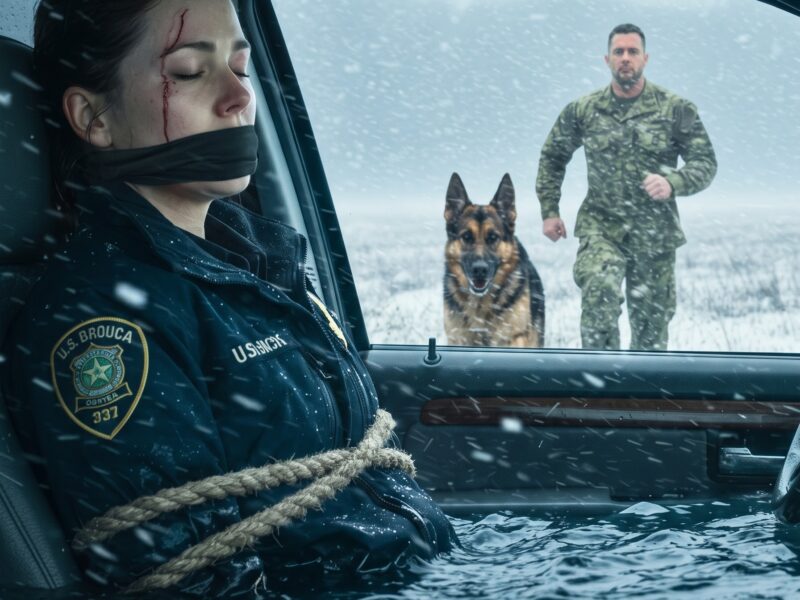
They left me locked inside my patrol SUV on a frozen mountain road, my hands too numb to reach the radio
The silence after an engine dies in a mountain blizzard isn’t quiet; it’s an absolute, crushing weight.
When the digital dashboard of my patrol SUV flickered once, hummed a low, dying frequency, and faded into pitch black, the ambient roar of the storm outside seemed to double in volume. Wind whipped down the pass, hurling needle-sharp ice against the driver’s side glass with a rhythmic, sickening click. It was 12:14 AM. The temperature gauge on the mirror had read negative twelve degrees before the battery died. Now, the cabin was bleeding warmth at a terrifying rate.
I grabbed the chrome door handle and yanked upward. It clicked, but the heavy steel door remained rigidly flush against the frame. I shifted my weight, driving my shoulder hard against the interior panel. Nothing. The electric locks were dead, but worse, the rubber weather stripping around the door frame had seized solid in the flash freeze, glued shut by layers of packed ice.
“Dispatch, this is Officer Claire Bennett,” I said, my voice tight, hitting the push-to-talk button on my shoulder mic.
Shhhhhhh.
A hiss of empty white noise crackled back through the tiny speaker. I reached for the central console radio, flicking the channel dial to the repeater frequency for Blackwood County. The green digital display blinked, dropped to a single flickering bar, and went completely dark.
I leaned my forehead against the steering wheel, breathing in the smell of damp leather, stale coffee, and cold exhaust. My breath formed thick, milky clouds that lingered in the air inside the cabin. Through the windshield, obscured by a rapidly rising wall of drift snow, two red spots flickered in the distance.
Lieutenant Aaron Vance’s cruiser.
He was idling at the bend near the ridge line, no more than fifty yards away. I could see the faint glow of his rear taillights through the swirling whiteout. I pounded my gloved fist against the windshield, then pressed my face against the icy glass, staring. He knew I was in here. He had watched my headlights cut out. He had watched my engine die.
And then, without a flash of his brake lights, without a radio check, the red tail lamps rolled forward, rounded the curve, and vanished into the storm.
“No,” I whispered. “No, no, no…”
My heart hammered against my ribs, a fast, frantic pulse that felt completely disconnected from the slow creeping numbness in my extremities. Three hours earlier, this night had been a routine patrol along Route 9, the lonely stretch of asphalt that winds through the national forest connecting our isolated county to the interstate.
Then Vance’s voice had come over the radio, tense and unusually quiet, ordering me to execute a traffic stop on a dark grey, unmarked Ford F-250 hauling an enclosed trailer near the county line. He had told me to hold the vehicle until he arrived.
When I pulled behind the truck, something felt wrong immediately. The rear license plate was covered in road grime, but under my spotlight, the numbers didn’t match any state registry pattern I recognized. When I approached the driver’s side window, the man inside didn’t roll down his glass. He didn’t look at me. He just sat staring straight ahead, his hands gripping the wheel so tightly his knuckles were stark white.
Before I could ask for his license, the truck tore away, fishtailing wildly on the slick asphalt before slamming into a snowbank fifty yards down the road. The driver bolted on foot into the pine forest.
I chased him. I ran through knee-deep drifts, branches whipping across my face, my lungs burning with cold air. I didn’t catch the driver, but ten minutes later, back near the abandoned trailer, I found a black leather manifest folder half-buried in the snow where he had fled. Inside were handwritten logs—names, dates, GPS coordinates, and small metal shipping tags stamped with five-digit numbers.
That was when Vance arrived.
He didn’t ask if I was alright. He didn’t ask which direction the suspect ran. He walked up to me, took the leather manifest right out of my gloved hands, looked down at it under his flashlight, and his jaw tightened so hard I heard his teeth click.
“You’re getting nervous, Bennett,” he had said, his voice flat, completely devoid of his usual gruff authority. “You’re seeing things that aren’t your concern. Go home.”
“Lieutenant, that trailer—”
“I said go home, Claire.”
He took the folder, walked back to his vehicle, and waited. I had no choice. I got back into my SUV, turned around, and began the climb back down the pass. Two miles later, my steering wheel locked, my engine sputtered out, and the power vanished entirely.
He had cut my alternator lead. Or dropped something in my fuel line. He knew I wouldn’t make it off the mountain.
Now, three hours later, the reality of my situation was sinking in with brutal clarity. My fingers were turning a waxy, translucent blue inside my tactical gloves. My steel-toe boots felt like blocks of solid ice encased around my feet. The shivering, which had been violent thirty minutes ago, was beginning to slow down—a dangerous sign. Hypothermia was taking over. My brain felt sluggish, my thoughts dragging through syrup.
Just close your eyes for five minutes, a soft, insidious voice whispered in the back of my head. Just rest.
CRACK.
The sound smashed through the muffled howling of the wind. I jerked my head up, my eyes struggling to focus.
Outside the passenger window, a massive shadow was moving against the white backdrop of the blizzard. A dark shape, low to the ground, pressed its face against the glass.
Two golden eyes stared directly into mine. A German Shepherd—no, a Belgian Malinois, jet-black, snow clinging like frost to his muzzle and ears. The dog’s breath fogged the cold glass from the outside, his nose nudging the pane urgently.
Behind the animal, a towering figure stepped out of the whiteout. The man was broad-shouldered, wearing a heavy tactical parka dusted in snow, a dark beanie pulled low over his forehead. He didn’t hesitate. He pulled an emergency glass breaker from his vest, positioned it against the corner of the passenger window, and struck hard.
THWACK.
The reinforced glass spiderwebbed into ten thousand tiny, frosted crystals. He kicked the centre of the window inward, sending a shower of safety glass cascading onto the passenger seat and floorboards.
The gale-force wind swept into the cabin instantly, bringing a freezing blast of fresh snow, but along with it came the scent of pine, diesel smoke, and life.
“Can you hear me?” a deep, steady voice called out over the wind.
I tried to speak, but my tongue felt heavy, thick, and unresponsive. All that came out was a low, weak rasp.
The man reached inside through the broken window, unlocking the door manually from the inside mechanism before using a heavy pry bar to pop the frozen seal. The door groaned and swung open against the wind.
He leaned in. Up close, I could see dark, sharp eyes, weathered skin around his jaw, and a jagged scar running from his left temple down to his collar. He took one look at my face, pulled a heavy, olive-drab thermal wool blanket from a pack over his shoulder, and wrapped it tightly around my torso.
“Can you stand?” he asked again. His tone wasn’t frantic; it was disciplined, calm, and absolute.
“M-m-maybe,” I managed to stammer, my teeth chattering violently now as the rush of cold air snapped me out of my stupor.
“Don’t force it,” he said. He reached down, unbuckled my seatbelt with practiced efficiency, and scooped me up into his arms as if my duty belt and body armor weighed nothing at all.
The black dog leaped back into the snow, circling us and letting out a sharp, authoritative bark that cut through the roar of the blizzard.
“My name is Mason Reed,” the man said, carrying me toward a heavy-duty, dark grey Chevy Silverado idling twenty yards down the shoulder, its off-road lights cutting twin yellow beams through the whiteout.
The dog trotted beside us, keeping his body pressed against my dangling feet as if trying to shield them from the wind.
“His name is Ghost,” Mason added as he pulled open the rear door of his truck, sliding me gently onto the heated leather back seat. Ghost jumped in immediately after, laying his large, warm body directly across my legs, radiating an incredible heat that made my frozen skin sting with a furious, painful prickle.
I collapsed against the seat, tears finally spilling down my cheeks, burning hot against my freezing skin. “Thank you,” I gasped. “I… I thought I was going to die out there.”
Mason didn’t answer immediately. He climbed into the driver’s seat, pulled a vacuum flask from the console, and handed it back to me. “Drink slowly. It’s warm broth. Don’t gulp it.”
As I took small, painful sips, the feeling slowly began returning to my hands. The truck surged forward, its heavy snow tires gripping the icy road as Mason navigated down the winding mountain pass with effortless precision.
Twenty minutes later, the storm began to thin out as we descended into the lower valley. Mason pulled the truck up to a small, low-slung brick building with a glowing red cross hanging over the awning—the Oak Creek Emergency Clinic, a tiny 24-hour facility that served the rural logging communities at the base of the mountains.
He helped me inside. The night nurse, an older woman named Martha with tired eyes and a silver braid, took one look at my blue lips and shivering frame and immediately rushed me into a heated triage room.
For the next forty-five minutes, I was subjected to warm IV fluids, thermal blankets, and a heated air circulation shroud. The sharp, agonizing pain of thawy frostbite in my fingers and toes gradually dulled into a manageable throb. Martha checked my core temperature, nodded in relief, and stepped out to finalize my chart.
“You got lucky, Officer,” Martha said, leaning back into the room. “Another fifteen minutes in that metal box and your heart would have started slipping into arrhythmia. You had minutes left.”
I sat up on the edge of the examination bed, clutching a fresh blanket around my shoulders. Mason was standing just outside the doorway, leaning against the doorframe, his arms crossed over his chest. Ghost was sitting patiently at his left heel, his golden eyes watching the hallway.
When Martha left, Mason walked into the room. In his hand, he held his smartphone, its screen illuminated. His face was unreadable, carved out of dark angles and cold lines.
“You were reported missing thirty minutes ago,” Mason said softly.
I frowned, rubbing my aching forehead. “Missing? By who?”
Mason turned the phone toward me. On the screen was an open dispatch bulletin broadcast across the tri-county law enforcement network.
ALERT: OFFICER CLAIRE BENNETT. VEHICLE 402 ABANDONED NEAR MILE MARKER 14. SUSPECTED MEDICAL CRISIS OR DISORIENTATION DUE TO EXTREME WEATHER. OFFICER LEFT VEHICLE ON FOOT AGAINST PROTOCOL. SEARCH AND RESCUE INITIATED.
The bulletin was signed by Lieutenant Aaron Vance.
My stomach dropped into a cold, bottomless pit. The air felt thin again, just like it had inside the frozen car.
“He lied,” I whispered, the realization hitting me like a physical blow. “He didn’t just leave me there. He set the scene. If I froze to death in that car, he’d claim I panicked, ran off into the woods, and froze. He was controlling the narrative before my body was even found.”
Mason set his phone down on the small stainless steel tray beside my bed. “He’s not just controlling the narrative, Claire. He’s covering a line that was crossed a long time ago.”
I looked up at him, my brow furrowed. “Who are you, Mason? How did you find me out there? That road was closed to public traffic hours ago.”
Mason reached into his heavy jacket, pulled out an encrypted tablet, and tapped the screen before handing it to me. On it was an image from the Blackwood County Evidence Registry—a photograph of the unmarked grey Ford F-250 I had chased earlier that night.
“That truck,” Mason said, his voice dropping an octave, heavy with a dangerous, quiet authority, “was officially listed as impounded, crushed, and destroyed in a wreck six months ago. Yet here it is, hauling unmanifested cargo across state lines on a night when half the county police force is pulled off patrol for ‘storm response.'”
“How do you have access to county evidence files?” I asked, my voice trembling slightly.
“Because my brother spent three years tracking that exact truck,” Mason replied.
He leaned in closer, his dark eyes locking onto mine. “My name is Mason Reed. I spent eight years with Naval Special Warfare, Special Operations K9 Unit. Two years ago, my younger brother, Deputy Thomas Reed, was killed on this mountain. The official report said his patrol car slid off an embankment during an ice storm. An accident.”
My breath caught in my throat. I remembered that accident. It happened right after I transferred to the department. Thomas Reed had been a rising star—quiet, brilliant, dedicated.
“It wasn’t an accident,” I said softly, the dots connecting in my mind with horrifying speed.
“No,” Mason said chillingly. “It wasn’t. Thomas found out that Blackwood County wasn’t just a quiet rural district. It’s a transit corridor. A blind spot where certain high-value cargo moves through the mountains without ever appearing on a federal radar. And the man directing the traffic, clearing the roads, and burying the deputies who ask questions…”
He pointed down at his phone screen.
“Is Lieutenant Aaron Vance.”
I sat frozen, the wool blanket slipping slightly from my shoulders. The sheer scale of the betrayal was staggering. I had worked under Vance for two years. I had taken orders from him. I had trusted him with my life on domestic disturbance calls, high-speed pursuits, and armed standoffs.
“Your lieutenant wasn’t trying to scare you tonight, Claire,” Mason continued, tapping the screen again to reveal a second file. “He was eliminating a liability. Look at this.”
On the tablet screen was a scanned copy of my personal duty file. Beside it was a list of missing persons cases in Blackwood County spanning the last four years—seven names, all travelers, truck drivers, or low-level county employees who had vanished along Route 9 during severe winter weather. Every single case file had been signed off, closed, and archived by the same supervisor.
Aaron Vance.
“He uses the weather,” I realized out loud, a cold horror washing over me. “The blizzards. The isolated roads. He uses the elements to erase people, and then he writes the report himself.”
“And tonight, you were supposed to be number eight,” Mason said grimly.
Before I could process his words, Ghost suddenly stood up. The dog’s ears swiveled toward the frosted glass doors of the clinic entrance. A low, vibrating growl echoed from deep within his chest, his lips curling back to reveal sharp white teeth.
Mason’s hand moved with fluid, terrifying speed, slipping under his jacket to grip the butt of a suppressed tactical sidearm.
Outside the clinic, through the fogged glass of the front entrance, a tall figure stepped out of a idling police cruiser. The snow was blowing hard around him, but the amber strobes of his light bar painted the white snow in rhythmic pulses of orange and red.
The man pushed open the heavy glass doors, his heavy duty boots squeaking against the linoleum floor. He wore a high-collared police parka, his campaign hat pulled low, obscuring his eyes.
On his chest, gleaming under the bright fluorescent lights of the lobby, was a silver star.
Lieutenant Aaron Vance had arrived.
The silence in the clinic hallway snapped tight like a pulled wire.
Lieutenant Vance stood in the center of the waiting room, letting the heavy glass doors seal shut behind him with a slow, hydraulic hiss. Snow melted instantly on the shoulders of his heavy navy parka, dripping onto the clean tile floor. His eyes, small, cold, and calculated, swept the empty reception desk before drifting slowly toward the hallway where Mason and I stood.
“Claire?” Vance’s voice echoed down the corridor, smooth, booming, and completely devoid of panic. It was the voice of a man accustomed to commanding absolute authority in every room he walked into. “Claire, are you in here? Dispatch said a civilian vehicle picked up a signal near Mile Marker 14. I came as fast as I could, kid.”
I felt a sudden, violent spike of adrenaline shot through my system. My heart pounded against my ribs like a trapped bird. I looked at Mason.
Mason hadn’t moved an inch. His hand remained buried inside his jacket, his thumb resting lightly on the safety of his weapon. Ghost was standing rigidly at his thigh, silent now, but every muscle in the dog’s 80-pound frame was coiled like a steel spring.
“Don’t make a sound,” Mason whispered, his voice barely a breath against the air. “He didn’t come here to rescue you, Claire. Look outside.”
I glanced past Vance’s towering figure toward the glass doors. Parked in the snow-dusted driveway behind Vance’s cruiser wasn’t an ambulance or a Search and Rescue unit. It was a secondary vehicle—a dark, unmarked SUV with tinted windows, idling silently with its headlights off.
Vance hadn’t called in a team. He had come alone, with backup that didn’t wear a badge.
“Claire?” Vance called out again, taking two slow, deliberate steps down the hallway. The floorboards beneath his heavy boots groaned. “I know you’re shaken up. You shouldn’t have been out on that pass alone. That engine failure… terrible luck. But you’re safe now. Step out so we can get you back to the station.”
He reached into his inner pocket. For a terrifying second, I thought he was pulling a firearm, but instead, he produced his silver lieutenant’s badge, holding it up slightly, as if attempting to reassure a frightened animal.
“I have your duty weapon from your trunk, Claire,” Vance said, his tone dipping into a sickeningly soft, fatherly cadence. “You left it behind when you walked away from the car. That’s a serious breach of protocol, Claire. But we can fix the paperwork. Just come out.”
I leaned back against the cool drywall of the examination room, my breath shallow. “He took my gun,” I whispered to Mason. “He cleared out my trunk while I was trapped inside.”
“He was setting up a suicide or a desertion story,” Mason said, his voice deadly calm. “If he finds you alive, he has to change the script. We leave through the rear supply door. Now.”
Mason moved like a shadow. He grabbed my arm, guiding me gently but firmly down a narrow side corridor toward the back of the clinic. Ghost trailed behind us without making a single sound, his paws sliding over the smooth tile floor like a phantom.
“Martha!” Vance’s voice suddenly sharp, echoing from the front lobby. “Where is the patient that was just brought in?”
“She’s in triage three, Lieutenant,” Martha’s voice answered from an office near the front desk. “She was severely hypothermic. She needs rest—”
“I’ll take it from here, Martha,” Vance interrupted, his tone leaving no room for argument. “County business.”
Heavy footsteps accelerated down the hallway behind us.
“Move,” Mason muttered.
We reached the heavy steel emergency exit at the back of the building. Mason pushed the crash bar down softly, but the rusty hinge gave off a sharp, metallic screech that echoed down the quiet hallway.
“Bennett!” Vance shouted, his voice losing all its artificial warmth. “Stop right there!”
Mason shoved the door open, exposing us once again to the howling wind and blinding snow of the alleyway behind the clinic. He ushered me through first, followed immediately by Ghost, then slammed the heavy steel door shut behind us, jamming a thick steel pipe he pulled from a nearby construction dumpster through the exterior handles.
A second later, something heavy slammed against the inside of the door.
BANG!
“Bennett! Open this door!” Vance’s voice was muffled through the heavy steel, but the rage in it was unmistakable.
We sprinted through the deep snow of the alley toward Mason’s truck. The wind was howling louder now, swirling snow around us in dense, blinding sheets that obscured the surrounding buildings. Mason threw open the passenger door, helped me inside, and gestured for Ghost to leap into the back.
He rounded the front of the truck, jumped into the driver’s seat, and slammed the transmission into reverse just as the glass of the clinic’s rear window shattered outward.
A tall figure leaned through the broken frame, raising a black sidearm.
POP! POP!
Two suppressed rounds slammed into the front grill of Mason’s truck with heavy, dull thuds. Mason didn’t flinch. He stomped on the accelerator, spinning the heavy 4×4 around in a cloud of snow and gravel, tearing out of the alleyway and onto the deserted main street of Oak Creek.
My heart was hammering against my chest so hard I could barely draw a full breath. “He shot at us,” I gasped, staring back through the rear window as the clinic receded into the whiteout. “A police lieutenant just opened fire on an unarmed officer!”
“He’s not a police lieutenant anymore, Claire,” Mason said coldly, his eyes fixed on the road ahead, his hands relaxed on the steering wheel despite the slick, treacherous conditions. “He’s a contractor for a cartel network. He’s been one for five years.”
“How do you know all this?” I demanded, the adrenaline finally overriding my lingering exhaustion. “You said your brother was killed two years ago. What have you been doing since then?”
Mason pulled the truck off the main road, navigating a series of narrow, unpaved logging roads that carved deep into the dense pine forests bordering the national park. The snow was lighter down here in the treeline, but the ruts in the dirt road were treacherous, filled with frozen mud and slush.
“When Thomas died,” Mason began, his voice steady and low, “the state police closed the case in forty-eight hours. They said he was speeding, lost control on black ice, and went over the ridge. But Thomas was an expert mountain driver. He grew up on these roads. I was deployed in Eastern Europe when I got the news.”
He paused, his jaw tightening so hard the scar on his cheek stood out in sharp relief under the dashboard lights.
“I took emergency leave, came back for the funeral, and went to inspect his personal belongings,” Mason continued. “His notebook was missing. His duty laptop had been wiped. And when I went down to the wrecking yard to look at his patrol car, the braking lines hadn’t been snapped by the crash—they had been cut clean with a hydraulic tool.”
I swallowed hard. “You realized it was murder.”
“I resigned my commission three months later,” Mason said. “I bought this truck, brought Ghost with me, and moved into a cabin three miles from the pass. I spent twenty-four months watching Vance. Listening to county radio chatter. Tracking every unmarked shipment that moved through Blackwood Pass during winter storms.”
“Why winter storms?” I asked.
“Because blizzards wipe out satellite imaging, ground law enforcement helicopters, and keep civilian drivers off the roads,” Mason explained. “Vance clears the route. He pulls the county deputies off Route 9 under the guise of ’emergency storm staging’ near the town center. That leaves a forty-mile stretch of mountain road completely unguarded for two hours. Enough time to move weapons, untracked cash, and human cargo across the border.”
A cold shudder ran down my spine. Human cargo. The missing-persons list on Mason’s phone flashed in my mind—the names of seven people who had vanished without a trace over the last four years.
“And tonight,” I said, the horror dawning on me, “that trailer I saw… the one that ran into the snowbank…”
“Was a shipment,” Mason finished. “And you got too close. When you found that manifest, you signed your own death warrant. Vance couldn’t let you walk away with those coordinates.”
The truck hit a deep rut, bouncing heavily before Mason brought it to a stop deep inside a thick grove of towering Douglas firs. He killed the headlights, dropping us into absolute darkness. The only light came from the dim green glow of the instrument panel.
“Where are we?” I asked, looking out into the dense, black woods.
“A safe house,” Mason said. “An old forestry service lookout cabin my family owned. It’s off the grid. No power, no cellular towers within five miles. We stay here until dawn, map out our evidence, and contact the Federal Bureau of Investigation in Seattle.”
He turned to face me in the dim light. “You have a choice, Claire. Once we cross this line, there is no going back to your old life. Vance controls the local department, the county prosecutor, and the coroner. If you stand up to him, they will brand you a rogue officer, a traitor, or a lunatic. Are you ready for that?”
I looked down at my hands. The blue color had faded, replaced by a dull, aching red. I thought about the four years I had spent wearing the Blackwood County badge. I thought about the oath I had taken to protect the people of this valley. And I thought about Deputy Thomas Reed, a man I had briefly met in the precinct breakroom, whose life had been snuffed out because he refused to look the other way.
I looked Mason directly in the eyes.
“He tried to freeze me to death in my own car, Mason,” I said, my voice dropping into a hard, unwavering register. “I’m not running. Tell me what we need to do.”
A faint, ghostly shadow of a smile touched the corner of Mason’s scarred mouth. “Good,” he said simply. “First, we get you armed.”
He reached into the back seat, pulling a heavy canvas gear bag from beneath the bench. He unzipped it, revealing a black Glock 19 9mm pistol, three fully loaded magazines, and a tactical tactical flashlight. He handed the weapon to me.
I took it, checking the action out of habit, feeling the weight of the steel in my hand. It was cold, but it offered a strange, comforting sense of agency.
“We need to get to Thomas’s original evidence locker,” Mason said, pulling out a laminated topo map of the county and spreading it across the steering wheel. “Before he was killed, Thomas hid a backup flash drive containing three months of audio recordings between Vance and his contacts. He hid it inside an old ranger station near the abandoned lumber mill at the north end of the valley.”
“The old Blackwood Mill?” I asked, frowning. “That place has been abandoned since the nineties.”
“That’s why Thomas chose it,” Mason said. “Nobody goes up there. But Vance knows Thomas was investigating him. If Vance realizes you’re alive and working with me, that ranger station will be the first place his men search.”
Right on cue, Ghost, sitting in the rear seat, let out a sharp, low breath. His head snapped toward the rear window of the truck.
Mason froze. He slowly lifted his head, peering into his side mirror.
Far back down the narrow logging trail, obscured by the dense pine branches and falling snow, two faint shafts of white light were cutting through the darkness.
A vehicle was creeping up the trail, moving slowly, deliberately, without its siren or emergency lights.
“They tracked us,” I whispered, my thumb instinctively dropping the safety on the Glock in my lap. “How? How could they possibly find us out here?”
Mason reached under the dashboard of his truck, his fingers tracing along the underside of the steering column. He felt around for a second before his hand came back out.
In his palm was a small, round black plastic disc, no larger than a coin, blinking with a tiny, faint red LED light.
A magnetic GPS tracker.
“They didn’t track us,” Mason said, his voice dropping into a chillingly calm tone as he crushed the small plastic disc under his boot heel. “They tracked my truck. Vance had this planted on my bumper while I was inside the clinic.”
The shafts of light through the trees were growing brighter. The low rumble of a heavy V8 engine vibrated through the freezing night air.
Mason locked eyes with me. “Get ready, Claire. We aren’t going to the mill tomorrow.”
He racked the slide of his own weapon.
“We’re going right now.”
The dark SUV crept through the thick timber like a predator stalker through high grass.
Through the rear window of Mason’s truck, I watched the vehicle stop fifty yards down the trail. Its headlights flickered off, plunging the forest back into near-total darkness, save for the pale moon struggling through the storm clouds above.
Two doors clicked open. Two men stepped out onto the frozen snow, clad in dark tactical gear, carrying short-barreled automatic rifles. They didn’t speak. Their movements were swift, disciplined, and military-grade.
“Private security contractors,” Mason murmured, his eyes scanning them through the side mirror. “Ex-military. Vance isn’t using county deputies for this. He’s using his buyers’ cleanup crew.”
“We can’t take them both in the open,” I whispered, my grip tightening on the Glock. “They have thermal optics on those rifles.”
“I know,” Mason replied smoothly. “Which is why we aren’t going to fight them here.”
He turned to Ghost in the back seat. Mason made a silent hand sign—a flat palm raised, followed by a quick two-finger tap against his own chest.
Ghost immediately dropped flat onto the leather seat, his body completely still, his breathing shallow and silent. The dog understood the command instinctively: absolute camouflage.
“Claire, when I drop the clutch, I want you to lean out the window and fire three rounds toward the tree line on the left,” Mason instructed, his voice as calm as if he were giving driving directions. “Don’t try to hit them. Just force them to take cover on the south side of the trail.”
“And then?”
“Then we show them what happens when you hunt a man in his own mountains.”
Before I could answer, Mason stomped his left foot down on the clutch and slammed the heavy floor shifter into gear. The big V8 engine roared to life with a deafening snarl, shattering the quiet of the forest.
The two mercenaries instantly raised their rifles, the green glow of their night-vision goggles flashing in the dark.
TRRRRRAT!
Muzzle flashes erupted from the shadows, 5.56mm rounds tearing through the pine needles and slamming into the tailgate of Mason’s truck with loud, metallic thuds. Glass shattered in the rear canopy.
I rolled down the passenger window, pushed the slide of my Glock forward, aligned the sights toward the left ridge, and squeezed the trigger three times in rapid succession.
BANG! BANG! BANG!
The bright orange muzzle flashes illuminated the swirling snow. As Mason predicted, the shooter on the left dove behind a massive Douglas fir to break my line of sight.
Mason dumped the clutch. The truck’s four massive snow tires dug into the frozen mud, spewing a cloud of dirt and ice as the vehicle surged forward, plunging off the main trail and smashing directly through a dense thicket of young saplings.
Branches scraped violently against the truck’s bodywork like screaming nails. The vehicle bounced wildly over hidden rocks and fallen logs, plunging down a steep, treacherous slope toward the valley floor.
Behind us, the mercenaries scrambled back to their SUV, their engine revving as they attempted to follow our track down the incline.
“Hold on!” Mason yelled.
The truck broke through the final tree line, sliding sideways onto a wide, flat expanse of rusted steel, rotting timber, and decaying concrete structures.
The old Blackwood Lumber Mill.
In the moonlight, the massive, skeletal remains of the 19th-century industrial complex looked like the ribcage of a giant beast forgotten in the snow. Corrugated iron roofs groaned under the weight of decades of ice; rusted conveyor belts hung suspended forty feet in the air between silent, towering silos.
Mason slammed on the brakes, bringing the truck to a sliding stop inside the wide, open bay of an abandoned equipment shed.
“Out! Now!” Mason ordered.
We scrambled out of the cab. Ghost bounded out after us, his dark fur blending seamlessly with the deep shadows of the mill. Mason grabbed a heavy tactical pack from the truck bed, slung it over his shoulder, and pulled me toward a narrow iron spiral staircase leading up to the second-story catwalks of the main processing facility.
“The ranger station is half a mile north of here,” I gasped, catching my breath as we sprinted along the rusted steel walkway high above the factory floor. “Why are we stopping at the mill?”
“Because they have a vehicle and thermal scopes,” Mason replied, keeping his head low as we moved. “If we run across the open snow toward the ranger station, they’ll pick us off from three hundred yards. We have to strip them of their technological advantage. We force them into close quarters.”
Below us, the low, guttural roar of the mercenaries’ SUV echoed as it entered the mill grounds. The vehicle came to a stop near Mason’s truck. The headlights cut through the gloom, illuminating the empty shed.
Two figures stepped out into the light, their rifles raised, red laser dots sweeping the snow-covered ground.
“They’re moving in,” I whispered, peering over the edge of the iron railing. “Mason, if Vance sent these guys, he’s not far behind. He knows this valley.”
“Good,” Mason said, his jaw set. “Let him come.”
He unzipped his tactical pack, pulling out three small, cylindrical objects—infrared strobe flares used by military air controllers to mark drop zones. He handed two of them to me.
“These emit massive amounts of heat and light across the infrared spectrum,” Mason explained, a cold, ruthless intelligence gleaming in his eyes. “If they’re using thermal goggles, these will blind them instantly.”
He pointed toward two open structural beams overlooking the main entrance floor below. “Cover the left walkway. When the first man enters the processing bay, toss your flare onto the floor directly beneath him.”
I nodded, gripping the metal cylinder tightly.
Below us, the heavy wooden doors of the main mill building groaned as one of the contractors kicked them open. The man stepped inside, moving with methodical precision, his rifle raised to his cheek, his head turning slowly as his thermal goggles scanned the icy darkness.
Step. Step. Step.
His boots crunched on the icy floorboards.
“Now,” Mason breathed.
I pulled the safety pin on the flare and tossed it over the rail.
The cylinder fell thirty feet, landing with a clatter directly at the contractor’s feet. A fraction of a second later, a brilliant, white-hot burst of magnesium flame ignited, erupting with intense light and a massive pulse of thermal energy.
Down below, the contractor let out a muffled scream of pain, reflexively tearing the thermal goggles from his face as the sudden flare burned out his night-vision sensors.
Before he could recover, a black shadow dropped from the upper catwalk with terrifying speed.
Ghost.
The Malinois hit the contractor at full speed, his 80-pound weight knocking the man flat onto his back against the icy concrete. The rifle skidded away across the floor. Ghost clamped his jaws onto the man’s tactical vest sleeve, holding him pinned with absolute, unyielding force.
The second contractor rushed through the door, raising his weapon toward the dog.
BANG!
Mason fired a single round from his sidearm from the upper catwalk. The bullet shattered the concrete at the second man’s feet, sending sharp fragments flying into his face and forcing him to dive backward behind a rusted steel iron boiler for cover.
“Claire! Move!” Mason shouted, grabbing my jacket cuff and hauling me back toward the rear exit of the catwalk.
We sprinted along the narrow steel walkway as the second contractor fired a furious volley of automatic fire upward.
TRRRAT-TAT-TAT!
Sparks flew off the iron railings around us, steel splinters whistling past my ears. We reached the far end of the catwalk, where a wooden loading ramp led down to the ground floor near the mill’s frozen millrace.
Mason whistled—a short, high-pitched two-tone signal that cut through the gunfire.
A second later, Ghost disengaged from the first contractor, bounded across the floor, and leaped over a pile of rotting lumber, catching up to us at the base of the ramp without a single scratch on him.
“Good boy,” Mason grunted, patting the dog’s chest briefly.
We burst through the rear exit of the mill into the blinding white of the snowstorm. The wind had picked up again, howling through the valley, whipping snow into dizzying spirals that reduced visibility to less than ten feet.
We pushed forward through knee-deep drifts, heading north along the frozen riverbank toward the dense treeline where the old forestry ranger station stood.
Ten minutes of agonizing, chest-burning effort later, the small wooden structure emerged from the whiteout like a ghost.
The ranger station was a small, green-painted log cabin built on concrete piers, its windows boarded up with heavy plywood, its roof thick with a foot of fresh snow. It looked abandoned, dead, forgotten by time.
“This is it,” I panted, my hands resting on my knees as I fought for air.
Mason stepped onto the snow-dusted wooden porch, pulled a tactical knife from his belt, and pried open a small, hidden compartment concealed beneath the floorboards near the front door.
Inside sat a small, weatherproof Pelican case wrapped in thick black electrical tape.
Mason picked it up, used his knife to slice through the tape, and popped the heavy plastic latches open.
Inside, resting on a bed of custom foam, was a dark grey USB flash drive, a spiral-bound notebook covered in meticulous handwriting, and an old police-issue micro-cassette recorder.
Deputy Thomas Reed’s legacy.
Mason picked up the flash drive, holding it in his hand as if it weighed a hundred pounds. His eyes softened for a brief, heartbreaking second, the cold military demeanor slipping away to reveal the agonizing grief of a brother who had lost everything.
“We got it, Tommy,” Mason whispered into the cold wind.
“Mason,” I said softly, stepping onto the porch beside him. “We have to go. Before Vance circles back.”
“Vance isn’t circling back, Claire,” a voice called out from the dark pine trees twenty yards away.
The storm seemed to freeze mid-air.
Out of the whiteout stepped Lieutenant Aaron Vance. He wasn’t wearing his police hat anymore. His dark hair was plastered to his forehead by melting snow, his eyes wide, bloodshot, and filled with an unhinged, desperate rage.
In his right hand, he held a heavy-caliber revolver—a custom .357 Magnum—pointed directly at Mason’s chest.
Behind him, two more men emerged from the shadows, armed with shotguns.
“I knew Thomas was foolish enough to keep a diary,” Vance said, his voice trembling with a terrifying mixture of anger and triumph. “I searched his house three times looking for that drive. I never thought he’d hide it in his father’s old forestry outpost.”
Vance stepped closer, his boots crunching loudly on the frozen snow. He looked at me, his lip curling into a cold, contemptuous sneer.
“I gave you a chance, Bennett,” Vance said, shaking his head. “I told you to go home. I offered you a way out of this with your life and your pension. But you had to play detective. You had to dig into things that don’t belong to you.”
“You murdered Thomas Reed,” I said, my voice ringing clear and strong through the roaring wind. “You murdered seven innocent people along Route 9. You’re a disgrace to that badge, Aaron.”
Vance laughed—a dry, bitter, hollow sound that was swallowed immediately by the storm.
“That badge doesn’t pay for my daughter’s medical bills, Claire!” Vance snarled, his eyes flashing with sudden violence. “That badge doesn’t buy security in a world that discards you the second you get too old to chase drunks! I built a system out here. A clean, quiet system. Nobody gets hurt who doesn’t stick their nose where it doesn’t belong!”
“You left me to freeze in a metal box!” I screamed back. “You watched me die!”
“And I should have put a bullet in your head while you were sitting there!” Vance roared.
He raised the .357 Magnum, leveling the heavy barrel directly between my eyes.
“Hand over the drive, Reed,” Vance ordered, looking at Mason. “Hand it over, or I blow her head off right here on this porch.”
Mason didn’t blink. He stood beside me, his broad frame slightly angling forward, his hand still clutching the dark grey drive.
“You take one step closer, Aaron,” Mason said, his voice dropping into a register so low and terrifying it made my skin prickle, “and my dog tears your throat out before you can pull that trigger.”
Ghost stepped up to the edge of the porch floorboards. His body was tense, his lips drawn back, his chest vibrating with a growl so intense it rattled the wooden railings.
Vance sneered, his finger tightening on the trigger of the Magnum.
” Shoot the dog first,” Vance commanded his men.
The world exploded into motion in a fraction of a second.
Before Vance’s men could raise their shotguns, Mason grabbed my shoulder and slammed me flat onto the wooden floorboards of the porch just as the heavy report of the .357 Magnum shattered the air.
CRACK!
The heavy bullet plowed into the thick log wall directly where my head had been a second prior, sending wood splinters flying like shrapnel.
“Ghost! ATTACK!” Mason yelled.
The black Malinois didn’t hesitate. He launched himself off the porch like an arrow released from a bow, his body flying through the air, hitting Vance full in the chest before the lieutenant could re-align his weapon.
Vance let out a sharp cry as he was slammed back into the knee-deep snow, the heavy revolver knocked from his grip, spinning away into the whiteout.
“Shoot him! Shoot the dog!” Vance screamed, struggling frantically against Ghost’s teeth, bringing his heavy gloved hands up to protect his throat as the dog locked onto his thick parka sleeve.
One of the armed contractors swung his shotgun toward Ghost.
BANG!
I rolled onto my side, raised my Glock with both hands, and fired two rounds straight through the contractor’s torso.
The man staggered back, dropping his shotgun into the snow with a dull thud before collapsing against a tree trunk.
The second contractor leveled his rifle at Mason, who was already sprinting off the porch. Mason closed the distance between them in two massive strides, grabbing the barrel of the contractor’s rifle, twisting it upward just as a volley of automatic fire ripped uselessly into the night sky.
TRRRRAT!
Mason drove a devastating right hook into the man’s ribs, followed by a sharp, lethal palm strike to his chin. The contractor’s head snapped back, his eyes rolling back as he went limp, dropping unconscious onto the frozen ground.
“Claire! Watch Vance!” Mason shouted, turning back toward the porch.
I swung my weapon around, but Vance had already managed to fight Ghost off using a heavy hunting knife he pulled from his belt. He slashed wildly at the air, cutting the heavy fabric of Ghost’s tactical collar, forcing the dog to leap back to avoid the sharp steel blade.
Vance scrambled to his feet, bleeding from a deep bite wound on his forearm, his face twisted in pure desperation. He didn’t try to retrieve his gun. He turned and plunged into the blinding whiteout, running frantically toward the frozen riverbank.
“He’s going for the ice!” I yelled, scrambling down off the porch, my boot heels sinking into the deep drifts.
“Don’t let him cross!” Mason called out, sprinting right beside me, Ghost tracking close at his heels.
We gave chase through the dense pine trees. The storm was reaching its absolute peak—the wind howling at fifty miles an hour, driving ice particles so hard they felt like tiny needles against exposed skin.
Ahead of us, Vance’s dark shape was stumbling across the snow-covered expanse of the Blackwood River.
The river was a hundred yards wide here, choked with jagged blocks of ice and treacherous deep pools that never froze solid due to the fast-moving mountain current beneath. In the summer, it was a raging torrent; in the winter, it was a minefield of fragile, hidden ice shelves covered by deceptive layers of fresh snow.
“Vance! STOP!” I shouted, bringing my weapon up as we reached the edge of the riverbank. “The ice isn’t stable! You won’t make it across!”
Vance turned back for a second, his face pale, blood dripping from his sleeve onto the white snow. “I’m not going back to a cell, Bennett!” he screamed over the roaring wind. “I run this county!”
He turned and took three heavy, frantic steps further out onto the river channel.
CRACK.
The sound wasn’t like a gunshot. It was a long, terrible, echoing groan that resonated deep beneath the ice sheet—the sound of structural failure under tension.
Vance froze.
The white surface beneath his boots suddenly cracked in a web of dark blue lines. Cold, black river water oozed up through the fissures, soaking his boots instantly.
“Don’t move!” Mason called out, stopping at the edge of the solid shore ice. He pulled a thick nylon rescue line from his tactical pack. “Aaron, stand still! If you shift your weight, the shelf gives way!”
Vance looked down at his feet, his arrogant composure finally collapsing into pure, primal terror. The dark water was rising around his ankles, the ice block he was standing on tilting dangerously toward the rushing current below.
“Bennett…” Vance gasped, his voice cracking, his eyes wide as he looked at me. “Help me… Claire, please… I took care of you… I gave you this job…”
“You left me in the cold, Aaron,” I said, my voice cold, steady, and unyielding as I held my weapon aimed at his chest. “You left Thomas in the cold. You left seven other families with empty chairs at their dinner tables.”
“I have money!” Vance pleaded, his hands shaking violently as he tried to balance on the tilting block of ice. “In a safe in the station! Two million dollars! It’s yours! Just drop the rope!”
Mason held the rescue rope in his hands, his knuckles white, his eyes fixed on the man who had murdered his brother.
For three long, agonizing seconds, the only sound in the valley was the roaring of the blizzard and the terrifying, grinding noise of the shifting river ice.
Mason looked at the small Pelican case tucked securely inside his jacket pocket—the drive that would finally give Thomas justice, clear his name, and expose the entire dark network that had poisoned this county for a decade.
Then, Mason looked at Vance.
“My brother believed in the law, Aaron,” Mason said softly, his voice cutting through the wind with absolute clarity. “Even when men like you corrupted it. He died protecting people. I won’t tarnish his memory by letting you drown like a coward.”
Mason coiled the rope, stepped to the absolute edge of the stable ice shelf, and hurled the heavy rescue line straight toward Vance.
“GRAB IT!” Mason roared.
The weighted end of the rope landed across Vance’s shoulder.
Vance reached out frantically, his gloved hands clutching at the nylon line—
THWACK-CRACK!
The main ice shelf snapped completely.
A massive slab of ice, six feet wide, buckled under the river’s immense pressure, flipping upward into the black, churning water.
Vance let out a blood-curdling scream as he was swept off his feet, plunged instantly into the sub-zero river current. The force of the rushing water yanked the rescue line right out of Mason’s hands, dragging it down into the dark abyss beneath the ice.
“MASON!” I screamed.
Vance’s head bobbed up thirty feet downstream, his arms thrashing wildly against the jagged ice edges, his face white with immediate, violent shock as the freezing water filled his heavy parka.
“CLAIRE! MASON!” Vance shrieked, his voice choked with icy water. “HELP ME! I CAN’T—”
The fast-moving current pulled him under a massive, solid ice sheet spanning the narrow bend of the river.
His hand broke through the surface once, his fingers clawing uselessly at the slick, unforgiving ice above—and then he was gone.
The river roared on, black, cold, and silent, swallowing Lieutenant Aaron Vance whole.
Silence settled over the Blackwood River valley like a heavy, velvet shroud.
The storm, as if satisfied with the violence it had witnessed, began to lose its fury. The howling wind died down to a soft, whispering breeze through the high branches of the pines. The thick cloud cover above began to fracture, revealing brilliant, sharp patches of dark blue night sky sprinkled with cold, distant stars.
Mason stood at the river’s edge for a long time, his eyes fixed on the dark patch of water where Vance had vanished beneath the ice.
Ghost walked up beside him, sitting down quietly in the snow, leaning his heavy shoulder against Mason’s leg. Mason reached down, his gloved hand resting gently on the dog’s head, his fingers burying into the thick, dark fur.
I lowered my weapon, my hands trembling slightly as the final surge of adrenaline began to bleed out of my system. My breath formed slow, steady clouds in the freezing night air.
“He’s gone,” I said softly.
“The river takes everything down to the gorge,” Mason replied, his voice raspy and exhausted. “He won’t come up until spring.”
He turned back to face me. The first faint light of dawn was beginning to paint the eastern horizon in pale hues of pink and gold, illuminating the dramatic, snow-covered peaks surrounding the valley.
“We have work to do, Officer Bennett,” Mason said, reaching into his pocket and pulling out the small Pelican case containing his brother’s flash drive. “This is just the beginning. Vance was the local enforcer, but the men paying him… the ones buying those shipments… they’re still out there.”
“Then we finish it,” I said, stepping up beside him. “Together.”
Two hours later, as the morning sun finally broke over the ridge lines, sending shafts of brilliant golden light sparkling across the pristine, unbroken snow fields, three heavy black SUVs bearing official federal insignias pulled up to the perimeter of the Blackwood Lumber Mill.
A team of FBI agents clad in tactical vests deployed across the grounds, securing the weapons left behind by Vance’s mercenaries and cordoning off the area.
Special Agent Sarah Vance—no relation to Aaron—stepped out of the lead vehicle. She was a stern-faced woman in her late nineties, her eyes sharp as a hawk’s as she walked up the wooden steps of the ranger station porch where Mason, Ghost, and I were waiting.
I had used the emergency satellite radio in Mason’s truck to contact the FBI Regional Office in Seattle at 5:00 AM, transmitting the preliminary files from Thomas’s drive.
Agent Vance looked down at the Pelican case sitting on the small wooden table between us, then looked at me, her gaze lingering on my bruised face, my frozen duty uniform, and the Glock sitting on my belt.
“Officer Claire Bennett?” Agent Vance asked, her tone professional, precise, and serious.
“Yes, ma’am,” I replied, standing up straight despite the dull, aching exhaustion in every muscle of my body.
“We verified the digital signature on the files you transmitted,” Agent Vance said. “The audio logs, the shipping manifests, the off-shore account numbers… they’re authentic. This is the largest law enforcement corruption network uncovered in this state in twenty years.”
She turned her attention to Mason. “And you must be Mason Reed.”
Mason didn’t stand. He remained sitting on the wooden bench, his hand stroking Ghost’s back. “Is the file enough to clear my brother’s name?”
Agent Vance’s stern expression softened slightly—a rare, genuine crack in her professional demeanor.
“Deputy Thomas Reed will receive a full posthumous Medal of Honor from the State of Washington,” Agent Vance said quietly. “His official record has already been updated. The official cause of death is being re-classified as Killed in the Line of Duty while conducting an undercover investigation.”
I looked at Mason. A single tear tracked its way down his scarred cheek, catching the morning sunlight before he brushed it away with the back of his hand. He looked up at the blue sky above the mountain peaks, closing his eyes as if feeling a heavy burden finally lifted from his shoulders.
“Thank you,” Mason whispered.
Agent Vance turned back to me. “Officer Bennett, Blackwood County is going to be under federal administration for the next several months while we clear out the remaining officers involved in Vance’s ring. We’re going to need a local authority—someone who knows these roads, knows the people, and has proven beyond any doubt that they cannot be bought.”
She extended her hand toward me.
“The State Governor has authorized an interim appointment for County Sheriff until special elections are held in the fall. I’m offering you the position, Claire. If you want it.”
I looked down at her outstretched hand, then looked out over the sunlit valley below.
I saw the quiet timber towns, the isolated homesteads, the miles of lonely mountain asphalt winding through the pines—a place that had been terrorized by shadows for far too long. A place that needed someone to stand on the line and keep the cold from coming back in.
I shook Agent Vance’s hand, my grip firm and resolute.
“I’ll take it,” I said.
Three weeks later.
The snow on the lower slopes had begun to melt, feeding the swelling rivers and bringing the fresh, earthy scent of pine needles and damp soil back to the Blackwood Valley.
I stood on the front steps of the newly renovated Blackwood County Sheriff’s Department. On my chest sat a shiny new silver star—the Sheriff’s badge. My duty belt was heavy, but for the first time in years, the air inside the precinct felt clean, honest, and clear.
Down in the parking lot, a heavy dark grey Chevy Silverado pulled up to the curb.
The door opened, and Mason Reed stepped out, wearing a simple flannel shirt and jeans. Ghost jumped out of the passenger side, his tail wagging as he trotted up the concrete steps toward me, letting out a soft, happy bark.
“Sheriff Bennett,” Mason said with a rare, genuine smile as he reached the top of the steps.
“Mr. Reed,” I replied, kneeling down to give Ghost a firm, loving pat along his ribs. “How’s the cabin holding up?”
“Quiet,” Mason said, leaning against the iron railing, looking out over the town. “Real quiet. I brought something for you.”
He reached into his pocket and handed me a small, polished wooden box.
I opened it. Inside sat a small, brass desk plaque, exquisitely carved with a simple phrase:
TRUTH DOES NOT FREEZE.
I looked up at him, my heart full. “Thank you, Mason. For everything. If you hadn’t come down that pass three weeks ago…”
“Ghost found you, Claire,” Mason said, tossing a tennis ball down the steps for the dog, who immediately bolted after it with joyous energy. “I just drove the truck.”
He turned to leave, walking down the steps toward his Silverado.
“Where are you going now, Mason?” I called out after him.
Mason paused at his truck door, looking back over his shoulder, his eyes clear, peaceful, and steady under the bright afternoon sun.
“Out on patrol,” Mason said softly. “The mountain’s big, Claire. And there’s still a lot of road left to watch.”
He climbed into his truck, Ghost leaping into the passenger seat beside him, and drove off down Route 9, disappearing into the warm, golden light of the valley ahead.
The end.









