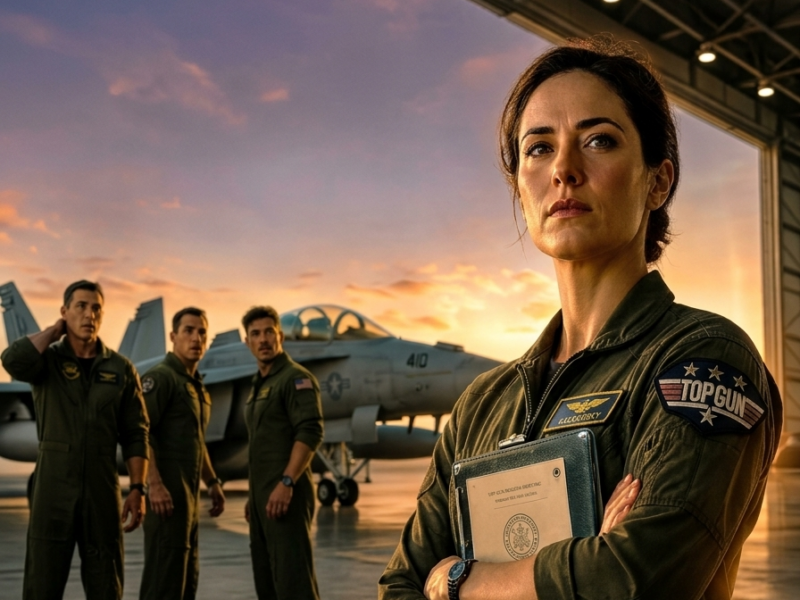
They laughed when the shy woman in the plain gray sweater sat in the TOPGUN instructor’s chair at Naval Air Station Fallon
The Nevada sun beat down mercilessly on the cracked concrete of Naval Air Station Fallon, radiating heat in shimmering waves that distorted the distant silhouettes of F/A-18 Super Hornets. The air smelled of burnt aviation fuel, hot asphalt, and the dry dust of the high desert. It was an unforgiving environment, designed to break egos and forge the deadliest aviators in the world. I pulled the collar of my plain gray sweater slightly higher against the harsh wind, fully aware of how completely out of place I looked. I was thirty-four years old, wearing scuffed flat shoes, dark slacks, and a sweater that looked like it belonged in a high school library, not the most elite fighter training facility on the planet. I held a thick, unmarked manila folder tightly against my chest like a shield.
I had been at the base for less than an hour when the whispers began. They started in the corridors of the tactical training building, murmured between lieutenants and captains clad in crisp olive-drab flight suits covered in patches.
“Who is that?” one whispered, leaning against a locker.
“She doesn’t look like an instructor,” another replied, stifling a laugh.
“Maybe she got lost on the way to the administrative block.”
I kept my eyes down, staring at the polished linoleum floor, and continued walking. Let them whisper. Let them assume I was a secretary, an accountant, or a lost civilian. Nobody knew why I was there. That was exactly how I wanted it. Anonymity was my armor, and invisibility was my weapon.
I reached the double doors of the primary briefing room. The heavy oak doors swung open to reveal a tiered room, walls lined with tactical maps, whiteboards covered in complex geometrical flight trajectories, and rows of heavy chairs. A dozen of the Navy’s top aviators were scattered around the room, drinking coffee, boasting about their recent simulator scores, and projecting an aura of absolute, impenetrable confidence.
The senior instructor, Commander Blake Harris, was standing near the digital projector. He was a tall man with silver at his temples and the sharp, calculating eyes of a veteran who had survived countless combat deployments. He saw me standing in the doorway and frowned slightly. He walked over, offering a skeptical, polite smile that did not reach his eyes.
“Can I help you, ma’am?” he asked, his voice a low rumble that cut through the chatter of the room. “This is a restricted briefing area.”
“I’m the new evaluator,” I said quietly, keeping my voice flat and unassuming.
Blake’s eyebrows rose. He looked down at the clipboard in his hand, then back at me. He glanced at my lack of uniform, my unstyled hair, and the nervous way I seemed to be clutching my folder.
“You’re the new evaluator?” he repeated, disbelief coloring his tone.
“Yes, sir.”
He reached out. “Let me see your clearance credentials.”
I handed him the laminated card and the sealed orders from the Pentagon. Blake scanned the documents. His frown deepened. The credentials were flawless, carrying clearance codes that even he did not fully possess, but they provided almost no personal information. Just a name: Elena Rostova, civilian tactical consultant.
He glanced from the credentials to me. “First time here at Fallon?”
I nodded slowly.
He laughed softly, shaking his head as he handed the papers back. “Well, Ms. Rostova. Good luck. They eat evaluators alive in here, especially ones who have never pulled Gs.”
He turned back to the room and clapped his hands loudly. The pilots immediately ceased their chatter and gathered around the central briefing table. It was a massive digital surface displaying a topographical map of the surrounding desert ranges. Someone pulled out a chair for me. It was the chair at the very end of the table, as far from the action as possible. A deliberate placement.
I sat down without saying anything. I placed my plain manila folder on the edge of the illuminated table and kept my hands folded in my lap.
Blake stood at the head of the table. “Alright, listen up,” he announced. “Today’s exercise is simple. We are running dissimilar air combat training. Four against four. Red Air against Blue Air. Our guest evaluator from Washington will observe from the tower and take notes.”
I opened my folder. The sound of the thick paper parting was surprisingly loud in the quiet room.
“No,” I said.
The word hung in the air. Everyone stopped moving. Twelve highly trained combat pilots turned their heads to stare at the quiet woman in the gray sweater.
Blake frowned, clearly annoyed by the interruption. “Excuse me? You said you are the evaluator. Your orders are to observe.”
“I said nothing about staying quiet,” I replied, looking up from the folder. My voice was no longer flat. It carried a sharp, cold edge that instantly changed the atmospheric pressure in the room.
A few pilots exchanged uncomfortable, mocking looks. One of them, a broad-shouldered aviator with the callsign ‘Viper’ stitched on his chest, smirked openly.
I ignored the smirk and looked directly at the first page in my folder. It was filled with raw telemetry data from their morning simulator runs. Numbers, angles, throttle percentages, and reaction times. To them, it was data. To me, it was a psychological profile written in numbers.
“Captain Miller,” I said, not looking up.
The broad-shouldered pilot stopped smirking. “Yeah?”
“Your last two approaches in the canyon simulation were fourteen knots too fast. You rely heavily on your engine thrust to compensate for your poor angle of attack. You enter the merge wide because you are afraid of losing energy, which makes you a massive, predictable target.”
His smile disappeared completely. The color rushed out of his face. He opened his mouth to argue, but I was already moving on.
“Lieutenant Carter,” I said, turning the page.
A younger pilot across the table swallowed hard. “Ma’am?”
“You abandoned your wingman during the second defensive maneuver. You saw a brief window for a missile lock, and you took it, leaving your wingman exposed to a high-yo-yo counterattack. You got the simulated kill, but your wingman died. In a real war, you just sent a letter home to someone’s mother because you wanted a trophy.”
The room became completely still. The silence was absolute. You could hear the hum of the air conditioning vents.
I continued reading. I went down the line, tearing apart every single pilot at the table. I exposed every mistake they had made over the last week. Every hesitation in the merge. Every selfish decision in formation. Every microscopic error they thought nobody had noticed because they had masked it with aggressive flying. I stripped them of their egos, piece by piece, using only cold, irrefutable data.
Finally, Blake stepped forward, his eyes wide with a mixture of shock and anger. He slammed his hand on the table.
“Hold on a minute,” Blake demanded. “Who the hell are you? You read the telemetry data, fine. Any analyst can read numbers. But you’re talking about the tactical philosophy of these specific scenarios. You’ve flown these exercises before.”
I looked up at him, my expression blank. “No.”
“Then how did you know exactly where Miller would break? How did you know Carter’s wingman was positioned for that specific trap? You can’t learn that from a piece of paper. You have to fly it.”
I closed the folder, running my hand over the smooth manila cover. I looked at Blake, then at the twelve pilots who were staring at me as if I were a ghost.
“Because I didn’t just read these exercises, Commander,” I said softly. “I designed them.”
Nobody laughed anymore. The silence was deafening, heavy with the sudden, terrifying realization that the quiet woman in the gray sweater was not a lost secretary. She was the architect of their nightmares.
The revelation hung in the briefing room like a suspended explosive. The pilots stared at me, their previous arrogance replaced by a tense, wary silence. Commander Blake Harris slowly lowered his hand from the table, his eyes narrowing as he re-evaluated the woman sitting at the far end of the room. He knew the origin of the tactical training modules they were using. They were classified, cutting-edge scenarios designed to break pilots of their deepest bad habits. The author of those modules was classified, known only by a shifting alphanumeric code in the Pentagon’s servers.
“You wrote the Viper-Strike protocols?” Blake asked, his voice stripped of its earlier condescension.
“I wrote all of them,” I replied calmly, sliding the folder into my bag. “And based on the telemetry, your pilots are failing to grasp the core objective. They are flying to win the dogfight. They need to fly to survive the war. There is a difference.”
I stood up, smoothing the wrinkles out of my slacks. “The next flight begins in twenty minutes. I expect to see improvements.”
Without waiting for a dismissal, I turned and walked out of the briefing room. The silence followed me all the way down the hall.
Twenty minutes later, I was standing in the observation tower. The room was dark, illuminated only by the soft green and blue glow of the massive radar screens and telemetry monitors. The air traffic controllers spoke in hushed, rapid bursts of jargon, communicating with the jets that were now screaming over the Nevada desert.
Blake walked into the observation room, standing a few feet away from me. He didn’t say anything at first, choosing to watch the screens. Four blue dots and four red dots converged on the main tactical display. It was a chaotic swirl of simulated violence.
I watched every aircraft’s telemetry on the secondary monitors. The F/A-18s were pushing the absolute limits of their airframes. I could see their throttle positions, their pitch, their yaw. I could feel what they were feeling in the cockpit. I knew the physical strain of pulling seven Gs in a tight turn, the way the blood pooled in your legs, the way your vision narrowed to a gray tunnel. I knew it intimately.
“Miller is entering the merge,” Blake said, crossing his arms.
“He’s going to pull high,” I said softly, staring at the data stream. “He wants to prove me wrong about his energy management. He’s going to try a vertical maneuver.”
On the screen, Miller’s blue dot shot upward, trading airspeed for altitude.
“It’s a mistake,” I whispered. “The Red Air aggressor is baiting him.”
A split second later, the red dot on the screen performed a flawless slicing maneuver, cutting inside Miller’s turn radius. The tactical system immediately flashed a red warning. SIMULATED MISSILE LOCK. BLUE ONE DESTROYED.
“Damn it,” Blake muttered under his breath. He turned to look at me. “One pilot made the exact mistake you predicted.”
“Carter is next,” I said, pointing to the edge of the radar screen. “He’s overcompensating for abandoning his wingman last time. He’s flying too tight a formation. When Red Two breaks left, Carter will hesitate, afraid of causing a collision.”
On the screen, the exact scenario played out. The aggressor broke hard left. Carter, terrified of striking his wingman, pulled back on his throttle for half a second. It was all the aggressor needed. SIMULATED GUN KILL. BLUE THREE DESTROYED.
Blake stared at me through the thick glass of the observation deck. The reflection of the radar screens danced across his face. His expression had changed from suspicion to profound, unsettling awe.
“Who trained you?” Blake asked, his voice barely a whisper over the chatter of the controllers. “Nobody writes tactics like that without having spent a lifetime in the cockpit of a fighter. I know every top-tier instructor in the Navy. I know the ghosts. I don’t know you.”
I didn’t answer. I kept my eyes locked on the screens, watching the remaining dots dance across the digital sky. I couldn’t tell him the truth. I couldn’t tell him that I had learned these lessons over the freezing waters of the North Pacific, fighting for my life in an aircraft that was rapidly tearing itself apart.
Before Blake could press the issue, my phone vibrated in the pocket of my sweater.
It was a heavy, persistent buzz. I pulled it out. It was a secure device, encrypted by my handlers at the Pentagon. It was never supposed to ring here. It was never supposed to receive outside messages.
I unlocked the screen. One single message appeared.
UNKNOWN NUMBER: THEY FOUND YOUR OLD FLIGHT RECORD.
My hands went completely cold. The blood drained from my face, leaving a chilling numbness in my cheeks. My breath caught in my throat. I stared at the harsh white text on the screen, feeling the walls of the observation room suddenly closing in on me.
Blake noticed my sudden rigidity. He stepped closer, his brow furrowing with concern. “What is it? Are you alright?”
I couldn’t speak. The implications of the message were catastrophic. If my old flight record had been uncovered, my cover was blown. The people who had been hunting me for a decade knew I was alive. Worse, they knew exactly where I was.
I slowly turned the screen toward him.
Blake looked at the message. Then, a second image loaded beneath the text. The message contained a photograph, scanned from a highly classified, redacted physical file from eleven years earlier.
It was a picture of a crashed fighter jet, its smoldering wreckage scattered across a jagged, ice-covered shoreline. The tail fin was barely visible, bearing the insignia of a black-ops squadron that officially did not exist. Beneath the photograph was a manifest. Three names.
Two of the names, Lieutenant Marcus Jackson and Captain David Vance, were marked with a stark, red stamp: DECEASED.
The third name was heavily blacked out with a thick marker.
But beneath the black marker, someone had scratched away the ink to reveal the underlying text. Mine. The name I was born with, the name I had buried in the ice eleven years ago. Lieutenant Sarah Jenkins.
Blake looked at the photograph. His eyes widened as he read the tail number of the crashed jet. He knew the story. Every senior pilot knew the dark legend of the Ghost Squadron crash over the Pacific. It was whispered about in the dark corners of officers’ clubs. A catastrophic failure. A tragic loss of elite pilots.
Blake’s face drained of color. He looked from the phone to my face, tracing the faint, almost invisible scars along my jawline that I spent an hour every morning covering with makeup.
“That crash…” Blake breathed, his voice trembling slightly. “There were no survivors. The report said the entire crew perished in the freezing water.”
He looked at me, really looked at me, for the first time. The unassuming gray sweater, the quiet demeanor, the terrifying knowledge of aerial combat.
“You’re supposed to be dead,” he whispered.
I slowly closed the manila folder on the desk in front of me, my hands finally stopping their trembling. I locked eyes with the Commander.
“That was the point,” I said, my voice cold as ice.
Outside the observation glass, the next jet screamed across the desert sky, leaving a white vapor trail against the harsh blue. And for the first time that day, as I looked at the encrypted threat on my phone, I wondered whether I had come to Fallon to teach these arrogant pilots how to fly… or to finally find out who had tried to kill me eleven years ago.
The observation tower felt incredibly small, the air suddenly thick and suffocating. The green glow of the radar screens cast long, erratic shadows across Commander Harris’s face. He stared at the photograph on my phone, then back at me, his mind desperately trying to reconcile the ghost of a dead pilot with the quiet woman standing in front of him.
“Eleven years,” Blake muttered, his voice dropping an octave, ensuring the air traffic controllers twenty feet away couldn’t hear him. “The Navy held a closed-casket memorial. I was a junior lieutenant at the time. I stood in the rain and saluted a flag draped over an empty box for Sarah Jenkins.”
“The box wasn’t entirely empty,” I replied, my voice steady, though my heart was hammering violently against my ribs. “They put my dog tags in it. I made sure to leave them in the wreckage before the rescue teams arrived.”
“Why?” Blake demanded, stepping closer, his imposing frame blocking me from the view of the rest of the room. “Why let the world think you died? Why abandon the uniform?”
I locked my phone and shoved it deep into my pocket. The memory of that night over the Pacific hit me like a physical blow. The sudden, violent shudder of the airframe. The warning alarms shrieking in the cockpit. Marcus screaming over the comms that his controls were dead. David’s jet turning into a fireball before he could even reach for the ejection handle.
“It wasn’t an accident, Commander,” I said, my voice barely above a whisper. “The official report blamed a catastrophic compressor stall due to atmospheric anomalies. It was a lie. Our flight control software was overridden. Someone manually fed a command sequence into our navigational computer that locked our control surfaces and initiated a forced dive. Someone murdered my squadron.”
Blake’s eyes widened. To accuse the Navy, or someone within its ranks, of intentionally sabotaging a black-ops flight was treasonous, but he saw the absolute certainty in my eyes.
“I survived because my manual override linkage was physically jammed by a piece of shrapnel when David’s plane exploded,” I continued, the details pouring out of me like bleeding a wound. “I managed to pull up just enough to skip off the water instead of nose-diving into it. I washed ashore on an uninhabited atoll. By the time the search helicopters arrived, I had figured out what happened. I knew that if I went back, whoever sabotaged the planes would finish the job. So I became a ghost. I disappeared. I spent years working in the shadows, analyzing flight data, designing tactics, trying to find the signature of the person who rewrote our code.”
“And you found it?” Blake asked, his professional skepticism warring with the raw gravity of my story.
“A month ago,” I nodded. “I was reviewing the training logs from Fallon. The new experimental evasion protocols your instructors have been teaching the advanced classes. Embedded in the source code of the simulator was a highly specific algorithmic string. It’s an energy-management subroutine. It’s identical to the anomaly that locked my controls eleven years ago.”
Blake shook his head slowly. “You’re saying the person who sabotaged your squadron is here. At TOPGUN.”
“Yes.” I looked toward the window, out at the sprawling complex of hangars and barracks. “And based on the text message I just received, they know I’m here too. They breached my secure comms. They want me to know they found me.”
“We need to lock down the base,” Blake said immediately, his command instincts taking over. “I’m calling the Master-at-Arms. We secure the perimeter and initiate a full cyber-security audit.”
“No!” I grabbed his arm. My grip was surprisingly strong, forged by years of physical rehabilitation and survival training. “If you lock down the base, they will vanish. Or worse, they will panic and try to destroy the evidence. The only way to catch them is to flush them out. Who has access to the simulator’s core programming?”
Blake hesitated, weighing his loyalty to standard operating procedure against the desperate truth standing in front of him. He looked down at my hand gripping his sleeve, then nodded slowly.
“Only three people have read-write access to the core tactical subroutines,” Blake said, his mind working rapidly. “Myself. The base commander, Admiral Vance. And the Chief of Maintenance and Cyber Warfare, Captain Thomas Aris.”
The name hit me like a physical shock. “Wait. Admiral Vance? As in…”
“David Vance’s father,” Blake confirmed grimly. “He was promoted shortly after the crash. He’s overseen all tactical software integration at Fallon for the last five years.”
My mind raced. David’s own father? It didn’t make sense. Why would a father sabotage his own son’s aircraft? Unless the target wasn’t David. Unless the target was Marcus, who had been investigating missing munitions at our previous deployment. David was just collateral damage. And Vance had used the tragedy to propel his career, overseeing the very software that caused it.
“Where is Admiral Vance right now?” I asked, a cold fury settling in my chest.
“He’s in the primary control center,” Blake said, checking his watch. “He oversees the live-fire exercises on Tuesday afternoons. Captain Aris is with him.”
“Take me there.”
Blake nodded. We turned to leave the observation deck. But just as my hand touched the door handle, the base’s emergency klaxon screamed to life. The sound was deafening, a high-pitched, warbling siren that cut through the entire facility. The red strobe lights in the tower began to flash.
One of the air traffic controllers ripped off his headset and shouted across the room. “Commander Harris! We have a Code Red! Blue Two is declaring an in-flight emergency!”
Blake sprinted to the console. “Who is Blue Two?”
“It’s Captain Miller, sir,” the controller replied, his hands flying across the keyboard. “He’s seventy miles out over the salt flats. He says his flight controls are unresponsive. He’s locked in a five-degree downward pitch, and he can’t pull up. He’s losing altitude fast.”
Blake froze, the blood draining from his face. He slowly turned his head to look at me.
The saboteur wasn’t trying to escape. They were making a statement. They had just initiated the exact same catastrophic failure in Captain Miller’s jet that they had used to kill my squadron eleven years ago. And they were doing it while I was forced to watch.
The observation room erupted into organized chaos. Controllers shouted coordinates, radio frequencies snapped with static, and the red emergency lights washed everything in a frantic, bloody glow.
“Get him on the primary channel, put it on speakers!” Blake roared, leaning over the console.
The room filled with the ragged, terrified breathing of Captain Miller. Over the radio, the shrill, automated voice of his jet’s warning system repeated endlessly: ALTITUDE. PULL UP. ALTITUDE. PULL UP.
“Mayday, Mayday, this is Blue Two,” Miller shouted, his voice tight with panic. “Flight controls are completely locked! The stick is dead. Rudder pedals are dead. Throttle is unresponsive. I am stuck at Mach 1.2 in a shallow dive. I can’t break the lock!”
“Blue Two, this is Tower,” Blake commanded, trying to project a calm he did not feel. “Initiate manual hydraulic override. Cycle the flight control computers, soft reset.”
“I tried that!” Miller screamed. “Nothing! The computers are completely frozen. It’s like something else is flying the plane! I’m passing ten thousand feet. I’m going to have to punch out!”
“Negative, Blue Two, do not eject at that speed and angle!” Blake yelled. “At Mach 1.2 in a dive, the wind shear will break your neck!”
“I don’t have a choice, Commander! I’m going into the dirt in less than ninety seconds!”
I stood paralyzed for exactly three seconds. The sound of Miller’s panic, the relentless mechanical voice of the altitude warning, the flashing red lights—it was a perfect, horrific recreation of the night I died. The phantom smell of burning wires filled my nose. I could hear David screaming in my memories.
No.
I stepped forward and shoved the air traffic controller out of his chair. I grabbed the headset, clamped it over my ears, and keyed the microphone.
“Miller, listen to my voice,” I said. My tone was cold, sharp, and cut entirely through the panic in the room.
“Who is this?” Miller yelled over the alarms. “Where is the Commander?”
“This is the evaluator you tried to impress an hour ago,” I snapped. “You are experiencing a malicious software override in your fly-by-wire system. The computer is physically locking the hydraulic servos. A soft reset will not work because the malware is in the root directory. You have sixty seconds before impact. Listen to me very carefully.”
Blake stared at me, astonished, but he didn’t intervene. He waved the other controllers back, giving me absolute control of the room.
“What do I do?!” Miller shouted. “Eight thousand feet!”
“You cannot regain digital control, so you have to sever the digital connection entirely,” I said rapidly, my eyes tracing the telemetry data on the screen. He was dropping like a stone. “You have to physically disconnect the fly-by-wire datalink from the hydraulic pumps.”
“That’s impossible from the cockpit!”
“It’s not. I’ve done it,” I lied. I hadn’t done it. I had figured out the theory while recovering in a hospital bed a year after the crash, obsessively going over the blueprints of the aircraft. “Behind your right elbow, beneath the environmental control panel, there is a maintenance access panel. Four screws.”
“I’m strapped in, I can’t reach it!”
“Dislocate your shoulder if you have to, Captain! Reach it!” I roared into the mic.
I heard a frantic scrambling sound over the radio, the clinking of metal as Miller likely used his survival knife to pry the panel off.
“Six thousand feet! Pull up! Pull up!” the automated voice screamed in the background.
“Got the panel off!” Miller gasped.
“Inside, there is a thick bundle of wires wrapped in yellow tape,” I instructed, my eyes glued to his altitude. Five thousand feet. “That is the primary data trunk. Do not cut the yellow bundle.”
“Okay! What do I cut?!”
“Behind the yellow bundle, there is a single, thick, braided steel cable with a red connector. That is the physical diagnostic bypass link. If you sever it, it shorts out the digital flight control module and forces the hydraulic valves into mechanical failsafe mode. The stick will be heavy—like flying a tank through wet concrete—but it will connect.”
“Three thousand feet!” Miller was hyperventilating now. “I can’t see it! There’s too many wires!”
“Look for the red connector, Miller! Do it now, or you die!”
“Found it!”
“Cut it!”
A loud, violent crack echoed over the radio, followed by the sound of rushing air.
On the telemetry screen, Miller’s altitude froze at one thousand, two hundred feet above the desert floor. Then, agonizingly slowly, the blue dot began to arc upward.
“I have the stick!” Miller roared, his voice cracking with sheer adrenaline and terror. “It’s heavy as hell, but I have pitch control! Throttle is still locked at eighty percent, but I’m climbing! God Almighty, I’m climbing!”
A collective breath left the observation room. One of the controllers actually collapsed into a chair, wiping sweat from his face.
“Good job, Captain,” I said, my voice betraying none of the adrenaline flooding my veins. “Bring her back to base in a wide, ascending orbit. Bleed your speed by climbing. You’re going to have to cut the engines entirely and glide her onto the runway. We’ll have the crash trucks waiting.”
“Copy that, Evaluator,” Miller said, breathing heavily. “I owe you my life.”
I pulled the headset off and dropped it on the console. I turned to Blake. His face was a mask of pure awe and terrifying realization.
“He’s safe,” I said. “But the person who did this is still on the base.”
Blake’s expression hardened into granite. The Commander of TOPGUN had just witnessed an attempted murder of one of his pilots using a cyber-weapon.
“Admiral Vance and Captain Aris,” Blake growled, his hands balling into fists. “They are in the primary control center. The only place on this base with the uplink capability to override a jet in flight.”
“Then let’s go,” I said, pulling the plain gray sweater tight against my sides. “It’s time to teach them a lesson in tactics.”
The primary control center was located beneath the main administrative building, a hardened bunker designed to monitor global naval operations. Blake and I moved through the corridors with terrifying purpose. He had silently signaled two armed Master-at-Arms guards to fall in behind us, their faces tense, sensing the gravity of the Commander’s fury.
We reached the heavy blast doors of the control center. Blake didn’t swipe his keycard; he punched in a master override code. The doors hissed and slid apart.
The room was vast, dominated by a wall of digital screens displaying global maps and local flight telemetry. Standing at the center console, looking remarkably calm for a man whose base had just experienced a near-fatal disaster, was Admiral Vance. He was a distinguished, silver-haired man wearing a pristine uniform covered in ribbons. Beside him stood Captain Aris, the chief of cyber warfare, whose hands were moving frantically across a terminal keyboard.
Vance looked up as we entered. He offered a tight, authoritarian frown. “Commander Harris. We are in the middle of a crisis response. Why have you left the observation tower?”
“The crisis is over, Admiral,” Blake said, his voice echoing in the cavernous room. He stepped to the side, allowing me to walk past him into the light.
Admiral Vance’s eyes snapped to me. For a fraction of a second, the patrician mask of control slipped. His pupils dilated. His breath hitched. He recognized the face of the dead woman standing in his control room.
“Who is this civilian?” Vance demanded, his voice recovering its authoritative bark, though it sounded hollow. “Remove her from this secure area immediately.”
“She stays,” Blake said, gesturing for the guards to block the exit. “Captain Aris. Step away from that terminal.”
Aris froze, looking nervously at the Admiral. “Sir, I am attempting to isolate the malware that infected Miller’s jet…”
“You aren’t isolating it,” I said, walking slowly toward the center console. My footsteps felt incredibly loud on the metal grate floor. “You’re trying to wipe the access logs. You’re trying to erase the digital footprint of the transmission you sent to Miller’s navigational computer ten minutes ago.”
“That is an absurd accusation,” Vance stepped forward, towering over me. “I don’t know who you are, young woman, but I will have you arrested for treason.”
“My name is Lieutenant Sarah Jenkins,” I said, my voice ringing with absolute clarity. “But you know that, don’t you, Admiral? Because eleven years ago, you authorized the transmission of a very similar line of code to my squadron over the Pacific.”
Silence fell over the room like a heavy shroud. The technicians sitting at the lower consoles stopped typing, staring at the confrontation in shock.
“You’re insane,” Vance spat, though a bead of sweat was forming at his temple. “Sarah Jenkins died in a tragic accident.”
“It wasn’t an accident,” I countered, closing the distance until I was standing inches from him. I didn’t look up; I made him look down at me, the ghost in the gray sweater. “Marcus Jackson had uncovered evidence of high-level munitions theft at our previous station. He told David. David told you, his father, because he trusted you. But you were the one orchestrating the theft, weren’t you? You were selling experimental weapons tech on the black market to fund your own rise to power.”
Vance’s face tightened. Aris took a step back, looking desperately toward the exit.
“You couldn’t let Marcus expose you,” I continued, the anger finally bleeding into my voice. “And you couldn’t just kill Marcus without raising suspicion. So you had Captain Aris design a malware package to hijack our fly-by-wire systems. You sacrificed your own son, and me, to make it look like a catastrophic squadron-wide hardware failure.”
“You have absolutely no proof of this,” Vance said, his voice dropping to a lethal whisper. “You are a dead woman walking into a military base making wild accusations. I am an Admiral. Who do you think they will believe?”
I smiled. It was a cold, empty smile.
“I don’t need them to believe me, Admiral,” I said quietly. “I just needed you to try to kill me again.”
Vance blinked. “What?”
I reached into my pocket and pulled out the encrypted phone. I tapped the screen.
“When I received the text message earlier, I knew you had breached my secure communications,” I explained, holding the phone up. “But what Captain Aris didn’t realize is that my phone is linked to a Pentagon black-site server. When he breached my phone to send the threat, he unwittingly downloaded a passive routing protocol I wrote years ago.”
Aris’s eyes went wide. He lunged toward his keyboard, but Blake drew his sidearm with lightning speed, aiming it directly at the Captain’s chest. “Step away from the console, Aris!” Blake roared.
Aris raised his hands, trembling.
“When you sent the kill-code to Miller’s jet,” I said, looking back at Vance, “my routing protocol mirrored the transmission. It traced the origin point, bypassed your local firewalls, and copied your entire encrypted drive. Everything. The flight logs from eleven years ago. The offshore bank accounts. The black market arms transfers. And the source code you just used to try and kill Captain Miller.”
Vance’s face went completely slack. The realization that he had been outmaneuvered, that the trap had snapped shut around him, drained the life from his eyes. He looked like an old, broken man.
“I didn’t send the code today,” Vance whispered, his voice cracking. He looked at Aris. “I told him not to do it. I told him we just needed to scare you off the base.”
“It doesn’t matter,” I said, stepping back from him. The hatred I had carried for eleven years felt suddenly heavy, exhausted. “You gave the order eleven years ago. You killed David. You killed Marcus. You took my life away.”
I turned to Blake. “Commander. Make the arrest.”
Blake lowered his weapon slightly and nodded to the Master-at-Arms. “Admiral Vance, Captain Aris. You are under arrest for treason, espionage, and the murder of United States naval officers.”
The guards moved forward, slapping heavy iron cuffs onto the wrists of the two men. Vance didn’t fight. He just stared at the floor as they led him away. Aris wept silently.
The control room was deathly quiet as the doors hissed shut behind them.
Blake holstered his weapon and let out a long, shuddering breath. He looked at me, a profound respect etched into his weathered face.
“What happens now?” Blake asked softly. “You have your life back, Sarah. You can take off the sweater. You can put the uniform back on. We need instructors like you. Hell, Miller owes you his life. The whole squadron would follow you into hell.”
I looked down at the plain gray sweater. It had been my armor for so long, I wasn’t sure who I was without it anymore. I thought about the thrill of the cockpit, the smell of jet fuel, the camaraderie of the squadron.
But I also knew the truth about the shadows. The military had dark corners, and someone needed to watch them.
“I came here to do an evaluation, Commander,” I said, picking up my plain manila folder from the console. I tucked it under my arm.
“And?” Blake asked, a faint, hopeful smile touching his lips.
“Captain Miller needs to work on his energy management,” I replied, turning toward the exit. “Make sure he runs the Viper-Strike module again tomorrow. I’ll be watching the telemetry.”
Blake’s smile widened. He snapped a crisp, perfect salute. “Yes, ma’am.”
I didn’t return the salute. I just nodded, turned, and walked out of the control center, stepping back into the harsh Nevada sunlight. I wasn’t a ghost anymore. I was a weapon. And my war was just beginning.
The end.









