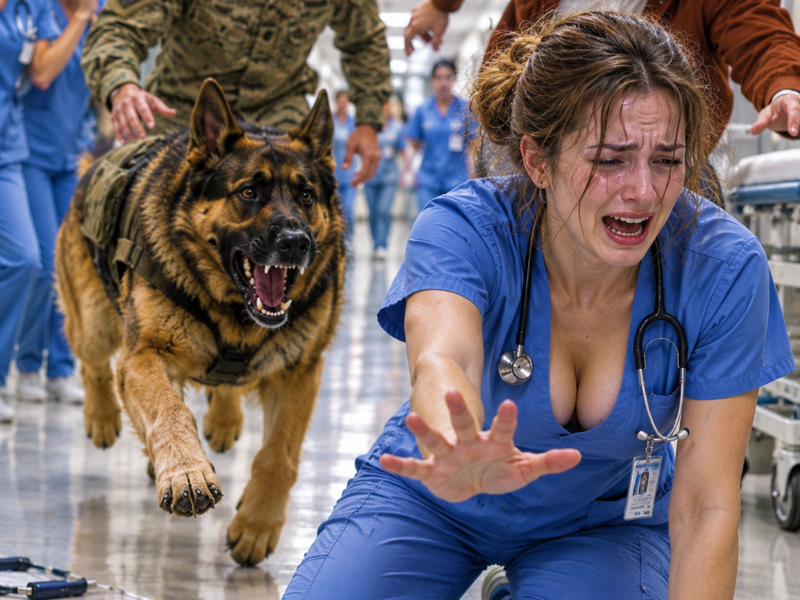
“They laughed when the quiet nurse was ordered to leave the hospital gala in front of hundreds of guests
I looked down at the envelope in my hands.
Four years.
Four years of waking up in the middle of the night because I had dreamed about my brother calling my name. Four years of keeping his photograph beside my bed. Four years of telling myself that the military had done everything possible, that Nathan had died serving his country, and that nothing I did could bring him back.
Now a Navy commander stood in front of me, holding the leash of a dog I recognized, telling me the official story was incomplete.
I couldn’t make my fingers move.
“Open it,” Commander Walker said quietly. “You deserve to know.”
Dr. Lawson stepped forward.
“Commander, perhaps we should move this conversation somewhere more appropriate. This is a hospital fundraising event, and we’re attracting unnecessary attention.”
Walker didn’t even look at him.
“That’s interesting, Doctor. A few minutes ago, you had no problem making this woman the center of attention.”
A murmur traveled through the ballroom.
Trevor shifted uncomfortably near the stage. The woman in the silver dress suddenly found her champagne glass fascinating.
I finally broke the seal.
Inside was a photograph, a folded letter, and a small memory card taped to the paper.
The photograph showed Nathan standing beside Ranger.
He looked thinner than I remembered, with a short beard and a scar running from his left temple toward his cheek.
But he was alive.
My knees nearly gave out.
I gripped the edge of a nearby table.
“That’s my brother,” I whispered.
Walker nodded.
“Yes, ma’am.”
I turned the photograph over.
In Nathan’s handwriting were five words.
Claire, don’t trust St. Catherine’s.
My stomach tightened.
I read the sentence again.
Then I looked up at Walker.
“What does my hospital have to do with my brother?”
He glanced toward Lawson.
For the first time since entering the ballroom, the commander’s expression changed.
It wasn’t anger.
It was recognition.
“Doctor Lawson,” he said, “do you know why Nathan Bennett disappeared?”
Lawson straightened his jacket.
“I have absolutely no idea what you’re talking about.”
Walker reached into his uniform and produced a second document.
“Four years ago, a Navy medical transport was redirected after an emergency landing in Virginia. Three injured personnel were transferred to a private medical facility. The official report listed Nathan Bennett among the deceased.”
I remembered that day.
The military casualty officer had come to our apartment. He’d spoken gently, handed me a folded flag, and explained that Nathan’s remains had been identified.
I had asked to see him.
They told me it wasn’t possible.
I had believed them because I couldn’t imagine anyone lying about something so cruel.
Walker continued.
“The identification was falsified. Nathan survived. He was moved before the investigation could reach him.”
“Moved where?”
Walker looked at the envelope.
“That’s what we’re trying to establish.”
I stared at the memory card.
“What’s on this?”
“Records Nathan managed to preserve. He believed someone inside the medical system was helping conceal what happened.”
My hands went cold.
Lawson stepped forward again.
“This is outrageous. You’re making accusations without evidence. Security!”
Two guards started toward us.
Ranger immediately stood.
He didn’t bark or lunge.
He simply moved between me and the approaching guards, his body rigid, eyes fixed on them.
Walker shortened the leash.
“Easy, Ranger.”
The dog remained still.
One of the guards stopped.
The other looked toward Lawson for instructions.
That hesitation told me more than any document could.
Walker noticed it too.
“Commander,” Lawson said, his voice tightening, “you cannot bring an armed military animal into a private event and disrupt hospital operations.”
“Ranger is a trained military working dog. He’s under control. And I’m here under authorization from the Navy’s investigative command.”
He produced an identification card.
Then he turned toward the crowd.
“I’d recommend everyone remain where they are until the investigating officers arrive.”
A few guests began whispering.
Someone raised a phone.
Lawson’s face had gone pale.
I stepped closer to Walker.
“Why did you say you’ve been looking for me?”
He hesitated.
“Because Nathan left one instruction that we couldn’t ignore.”
“What instruction?”
Walker looked down at Ranger.
“Find Claire. She’ll know what happened at the hospital.”
I shook my head.
“I don’t understand. I’ve never been involved in anything military. I’m a nurse.”
“That’s exactly what Nathan wanted people to believe.”
He pointed to the silver pin on my dress.
I instinctively covered it with my hand.
“My brother gave me this.”
“Did he tell you where he got it?”
“No.”
Walker studied the pin.
“It’s not just a Navy insignia. There’s a serial number engraved on the back.”
I turned it over.
I had never noticed the tiny numbers.
NC-0417.
Walker took a slow breath.
“That’s the designation of a medical archive that disappeared during the transport investigation.”
I looked at the photograph again.
Nathan’s handwriting.
Don’t trust St. Catherine’s.
Suddenly, the last four years felt like one enormous lie.
“Why would he give me something connected to an investigation?”
“Because he knew you’d keep it safe. And because he knew you wouldn’t sell it.”
I felt sick.
I had worn that pin to every hospital interview, every difficult shift, every day I needed to remember that my brother had believed in me.
It had been sitting against my heart the entire time.
And someone had been looking for it.
“Doctor Lawson,” Walker said, “I need to ask you one question.”
Lawson forced a laugh.
“I’ve answered enough questions.”
“Four years ago, did St. Catherine’s receive a sealed medical archive from a Navy transport?”
For a moment, nobody moved.
Then Lawson answered.
“No.”
Walker nodded.
“That’s unfortunate. We have a signed delivery receipt with your name on it.”
The ballroom erupted in whispers.
Lawson’s eyes flicked toward Trevor.
It was brief, but I caught it.
Trevor took one step backward.
Walker saw that too.
“Mr. Trevor, please don’t leave.”
Trevor froze.
“I don’t know anything about this.”
“Then you’ll have no trouble answering a few questions.”
Lawson raised his voice.
“This is a private hospital. You have no authority to question my staff.”
“Actually, Doctor, I do.”
Walker pulled another document from his jacket.
It was a federal investigative authorization.
The room fell silent.
I looked at Lawson.
The man who had humiliated me minutes earlier now seemed to be struggling to keep his hands from shaking.
But I still didn’t understand why he had targeted me.
“Commander,” I whispered, “if the pin was important, why didn’t anyone take it before?”
Walker lowered his voice.
“Because they didn’t know you had it.”
A chill moved through me.
“Then why did Lawson react when he saw it?”
Walker didn’t answer immediately.
He looked at the doctor.
“That’s what I intend to find out.”
Security escorted the guests into the adjoining conference room while two federal investigators entered the ballroom.
I stayed beside Walker.
Ranger remained close to my leg, occasionally looking up as if checking that I hadn’t disappeared.
One investigator introduced herself as Agent Melissa Grant.
She examined the photograph, the letter, and the pin.
When she saw the serial number, her expression sharpened.
“Where did you get this?”
“My brother gave it to me.”
“When?”
“Four years ago. Before he deployed.”
She exchanged a glance with Walker.
“Was anyone else present?”
“No. He gave it to me at my apartment. He said it was something I should keep.”
Agent Grant carefully placed the pin into an evidence pouch.
“Claire, I need you to understand something. This may be the only surviving authentication key to the original archive.”
I stared at her.
“What archive?”
“The archive contains medical transfer logs, patient identification records, and the original chain of custody for several classified cases. Someone altered those records after the transport incident.”
“Why?”
“Because one of the patients wasn’t supposed to survive.”
My throat tightened.
“Was it Nathan?”
Agent Grant didn’t answer.
Walker did.
“Nathan was one of them.”
I sat down.
For four years, I had mourned a brother who had apparently been alive somewhere, possibly injured, possibly trapped, while I went to work and helped strangers recover from their worst days.
I pressed my hands against my face.
“Did he know I thought he was dead?”
Walker’s silence was answer enough.
I looked up.
“Did he try to contact me?”
“Yes.”
The word struck harder than anything else.
“When?”
“Several times. The first attempt was about six months after the incident. The second was almost two years later.”
“Why didn’t I get them?”
Agent Grant opened a folder.
“Every attempt was intercepted through a communication relay connected to a private medical contractor.”
She placed a printed message in front of me.
The sender’s name was Nathan Bennett.
The recipient was me.
The message was dated three years earlier.
Claire, I’m alive. I can’t explain everything yet. Keep the pin. Don’t let anyone from the hospital take it. I’ll find a way home.
I couldn’t breathe.
I read it again.
Then again.
My brother had written those words.
He had been alive.
He had tried to reach me.
And somebody had made sure I never knew.
“Who intercepted it?” I asked.
Agent Grant closed the folder.
“We believe the relay was accessed by someone with administrative privileges at St. Catherine’s.”
I looked toward the conference room.
Lawson was standing between two investigators, speaking rapidly.
Trevor sat alone, staring at his shoes.
The woman in the silver dress had disappeared.
“Was Lawson involved?”
“We’re still establishing the extent of his involvement.”
I thought of all the nights I had worked under him.
The way he dismissed my observations.
The way he made junior nurses afraid to speak.
The way he had looked at my pin tonight.
Maybe he hadn’t been insulting me because I was a nurse.
Maybe he had been trying to make me leave before anyone recognized what I was wearing.
At 10:42 p.m., Agent Grant received a phone call.
Her expression changed as she listened.
Then she turned toward Walker.
“We have a location.”
My heart began pounding.
“Where?”
“A private rehabilitation facility outside Norfolk, Virginia. The property is registered to a medical contractor connected to the original transport.”
Walker closed his eyes briefly.
“That’s the place.”
“What place?”
“The facility where Nathan was last seen.”
I stood.
“Then we’re going.”
Agent Grant looked at me carefully.
“Claire, this could be dangerous. We don’t know who is still there or whether your brother is safe.”
“He’s been gone for four years.”
“I understand.”
“No,” I said, my voice breaking. “You don’t. I buried him. I kept his room exactly the way he left it. I still have the last voicemail he sent me. Every birthday, I listened to it because I thought that was all I had left.”
Walker stepped closer.
“Claire, we’re going to find him.”
I looked at him.
“Promise me you won’t leave him behind again.”
His expression softened.
“I promise.”
We reached Virginia just before dawn.
The rehabilitation facility stood beyond a line of pine trees, surrounded by a tall metal fence.
From the road, it looked abandoned.
The windows were dark. The front gate was chained. A faded sign advertised a private neurological recovery center.
Agent Grant coordinated with local authorities while Walker and I waited in an armored vehicle.
Ranger sat between us.
He had been unusually quiet since we left the hospital.
I reached down and touched the faded patch on his harness.
“Is he really here?”
Walker looked through the windshield.
“Ranger was trained to work with Nathan. When the investigation began, the dog was transferred into protective custody. Nathan’s scent was one of the few things he still reacted to.”
I swallowed.
“So when he saw me…”
“He recognized someone Nathan had taught him to protect.”
I closed my eyes.
My brother had taught a dog to remember me.
That thought nearly broke me.
A radio crackled.
“Perimeter secure. We’re moving in.”
The gate was forced open.
Two officers approached the building while Agent Grant followed with a small team.
Walker asked me to remain in the vehicle.
I hated every second of it.
Then Ranger suddenly stood.
His ears lifted.
A low sound escaped his throat.
“What is it?” I whispered.
He stared at the building.
Then he pulled toward the door.
Walker opened it carefully.
“Easy, boy.”
Ranger stepped onto the gravel and moved toward the entrance.
He stopped beside a narrow window.
His tail moved once.
Then again.
I got out.
“Ranger?”
The dog turned toward me.
For the first time since I had seen him at the gala, he made a soft, almost excited sound.
Someone inside was moving.
A shadow appeared behind the glass.
A man.
Thin.
Unsteady.
With a beard and a scar near his temple.
My heart stopped.
“Nathan?”
The shadow disappeared.
Then the door opened.
A man stood in the doorway, one hand gripping the frame for support.
He looked older.
Much older.
But his eyes were the same.
His gaze moved from Walker to Ranger.
Then it found me.
For several seconds, neither of us moved.
His lips parted.
“Claire?”
I ran.
I don’t remember crossing the distance between us.
I only remember his arms around me, his face buried against my shoulder, and the sound of him crying.
I held him so tightly I could feel his ribs beneath his shirt.
“You’re alive,” I whispered.
He nodded against my shoulder.
“I’m sorry.”
I pulled back.
“Don’t you dare apologize for being alive.”
His eyes filled.
“I tried to get home.”
“I know.”
“I sent messages.”
“I know.”
“I thought you hated me because you never answered.”
I shook my head.
“I thought you were dead.”
He looked at Walker.
Then at Ranger, who was pressing his head against Nathan’s leg.
The dog let out a quiet whine.
Nathan dropped to one knee and wrapped both arms around him.
“Hey, buddy.”
Ranger pushed his nose into Nathan’s neck.
I watched my brother hold the dog he had once trained, and for a moment the world seemed to stop moving.
Then Agent Grant approached.
“Nathan, we need to talk about what happened here.”
His expression changed.
The warmth disappeared from his eyes.
“Did you find the archive?”
“We found the authentication key.”
He looked at me.
“The pin?”
I nodded.
He closed his eyes.
“Then they can’t bury it anymore.”
Inside the facility, Nathan explained what had happened.
Four years earlier, he had been part of a Navy medical transport team carrying sensitive records after an operation overseas.
During the journey, the aircraft had been forced to make an emergency landing.
Several personnel were injured.
Nathan had discovered that one patient’s medical identity had been changed before the transfer paperwork was completed.
The patient was a civilian informant whose testimony could expose a network selling military intelligence.
The records had been altered to make it appear that the patient had died.
Nathan refused to sign the revised report.
A few hours later, he was attacked.
He survived, but suffered serious injuries and was transferred to the rehabilitation facility under a false identity.
The people responsible controlled his medical records, restricted his communications, and threatened to harm me if he tried to escape.
“Why didn’t you tell them who you were?” I asked.
“I did. The first time. They told me nobody would believe me because the official records said I was dead.”
He looked down at his hands.
“Then I saw the name of the contractor managing the facility. It was connected to the same hospital network where you worked.”
I felt the blood drain from my face.
“St. Catherine’s.”
He nodded.
“They had access to the records. They had access to the messages. I knew they could find you if I made another attempt.”
I remembered Lawson’s face when he saw the pin.
“Was he one of them?”
Nathan took a slow breath.
“Richard Lawson wasn’t the person who planned everything. But he was the person who kept the medical side of the operation hidden.”
Agent Grant opened her notebook.
“Do you have evidence?”
Nathan nodded toward a locked cabinet.
“Everything I could preserve is inside.”
An officer opened it.
There were folders, old medical forms, storage drives, and a small encrypted device.
Nathan pointed to one folder.
“That’s the original transfer manifest. It proves the patient was alive when the records were changed.”
Agent Grant examined the documents.
Then she looked at Nathan.
“This is enough to reopen the case.”
He nodded.
“But there’s something else.”
He turned toward me.
“The person who ordered the falsification knew you had the archive key. They just didn’t know where it was.”
I looked down at my hands.
“So they were watching me?”
“Probably.”
“Even at the hospital?”
Nathan’s face tightened.
“Especially there.”
By noon, the first arrests had been made.
Dr. Lawson was taken into federal custody after investigators recovered deleted messages from his office computer.
Trevor cooperated after learning that his administrator account had been used to access the intercepted communications.
He admitted that Lawson had ordered him to flag any employee who asked questions about old Navy medical transfers.
The woman in the silver dress was identified as a contractor’s attorney who had attended the gala to monitor the situation.
She was detained at the airport before boarding a flight.
The investigation continued for months.
The original medical records exposed falsified death certificates, unlawful patient transfers, and a chain of payments involving several private contractors.
The civilian informant was eventually located alive and placed under federal protection.
Nathan testified before investigators and later before a military review panel.
His testimony helped clear the names of two service members who had been blamed for the transport incident.
The man who had ordered the cover-up was arrested several weeks later.
But none of those headlines meant as much to me as the first morning Nathan came home.
He stood in the doorway of our old apartment, holding a small overnight bag.
He looked at the framed photograph on the shelf.
It was from his last birthday before deployment.
He was laughing, his arm around my shoulders.
“You kept it,” he said.
“Of course I did.”
He touched the frame.
“I thought you’d move on.”
I stepped beside him.
“I did move forward. I just never stopped missing you.”
He nodded.
For a moment, neither of us spoke.
Then Ranger padded into the room and dropped his head onto Nathan’s knee.
Nathan laughed softly.
“Looks like somebody remembers where home is.”
I knelt and scratched Ranger behind his ears.
“He remembered before I did.”
Three months later, I returned to St. Catherine’s.
Not as the nervous nurse who had walked into a gala wearing a borrowed dress.
Not as the woman who had stood silently while a hospital executive humiliated her.
I returned because I wanted to finish the work I had started.
The hospital had appointed an interim medical director. An independent review had been launched, and several policies involving patient records and staff reporting had been rewritten.
My supervisor met me at the entrance.
“Claire, we’re glad you’re back.”
I nodded.
“I want to keep working nights.”
“Of course.”
“And I want the new staff reporting process to protect nurses who raise concerns.”
She smiled.
“We’ve already started making those changes.”
I walked through the lobby.
The same polished floors.
The same reception desk.
The same hallway where I had once been told I didn’t belong.
This time, I didn’t feel small.
At the end of my shift, I stepped outside into the morning sunlight.
Nathan was waiting beside his car.
Ranger sat in the passenger seat, wearing a new harness with his old patch carefully sewn onto it.
My brother leaned against the door.
“Ready?”
I smiled.
“Where are we going?”
“Breakfast. Then we’re taking Ranger to the beach.”
I laughed.
“Since when does Ranger like the beach?”
Nathan opened the passenger door.
“Since he decided he’s allowed to enjoy being alive.”
I looked at my brother.
For four years, I had believed his story ended with a folded flag and a photograph.
Now he was standing in front of me, making ordinary plans about breakfast and the beach.
I touched the silver pin on my dress.
The serial number was no longer a secret. The evidence had been secured, and the people who had hidden the truth were finally being held accountable.
But I kept the pin.
Not because it was evidence.
Because it was the last gift my brother had given me before everything went wrong.
Nathan noticed me looking at it.
“You still wear that thing?”
“Every chance I get.”
He smiled.
“Good.”
Ranger gave a small bark from the passenger seat.
I climbed in beside him.
As we drove away, Nathan reached over and squeezed my hand.
Neither of us said anything for a while.
We didn’t need to.
For the first time in four years, I wasn’t waiting for a phone call that would never come.
I wasn’t listening to an old voicemail just to hear my brother’s voice.
He was there.
Alive.
And when I looked back at the hospital disappearing behind us, I finally understood something.
The night they tried to make me feel like I didn’t belong had become the night the truth found its way home.
I had walked into that gala as an ordinary nurse.
I had walked out knowing that my voice mattered, that my brother was alive, and that no title or expensive suit could make a lie stronger than the truth.
The end.









