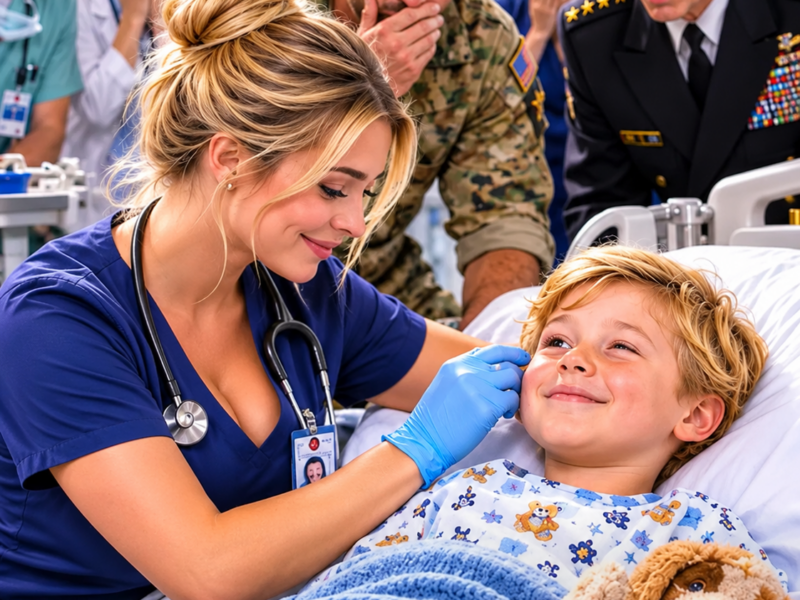
“The doctors had already given up on the eight-year-old boy, and his Navy SEAL father was preparing to watch an ambulance carry his son away for what might be the last time
The words hung in the room.
“Chief Dunn?”
For several seconds, I couldn’t hear the alarms, the rushing water, or the voices around Noah’s bed.
I heard only the name.
Chief.
A title I had buried with the uniform, the medals, and the life I had promised myself never to return to.
Rear Admiral Gerald Stanton stepped farther into the room.
He was older than I remembered, his silver hair thinner, his face more deeply lined, but his eyes were exactly the same.
He looked at me as if he had found someone who had been missing for a decade.
“Emily Dunn,” he said.
Captain Hollister turned toward me.
“Chief?”
I kept my eyes on Noah’s temperature monitor.
“Thirty-nine point two,” I said. “Continue cooling. We need to avoid overshooting.”
Denise glanced at me.
“Emily, the temperature is dropping.”
“Good. Keep monitoring his core temperature and follow the emergency team’s cooling protocol.”
Stanton moved beside the bed.
“Someone tell me what happened.”
Dr. Rhodes immediately stepped forward.
“Admiral, we had a critically ill pediatric patient with suspected meningitis. Nurse Dunn independently initiated an unauthorized treatment procedure—”
“Is the child receiving appropriate care?” Stanton interrupted.
Rhodes hesitated.
“We’re treating him.”
“That’s not what I asked.”
Dr. Shaw answered.
“Sir, his core temperature was forty-two point one degrees. We identified exertional heat stroke. Cooling has brought it down significantly.”
Stanton looked at the monitor.
Then he looked at me.
“You recognized it?”
“Yes, sir.”
“How?”
I finally turned toward him.
“Because I’ve seen it before.”
His expression softened.
“I know.”
That was the problem.
He knew far more than I wanted him to.
The cooling continued until Noah’s core temperature reached approximately thirty-nine degrees.
The team carefully transitioned to controlled monitoring and supportive care.
His seizure had stopped, his glucose was being corrected, and the emergency physician was preparing him for transfer to the pediatric intensive care unit.
But the danger wasn’t over.
Heat stroke could damage the brain, kidneys, liver, and other organs even after the temperature came down.
When the paramedics arrived, Captain Hollister stood beside his son, holding Biscuit in one hand.
“Is he going to live?” he asked.
Dr. Shaw answered honestly.
“We’ve improved his chances considerably, Captain. But we won’t know the full extent of the damage until the specialists evaluate him.”
Jack closed his eyes.
Then he bent down and kissed Noah’s forehead.
“Stay with me, buddy. Dad’s right here.”
I stepped away to give him room.
That was when Stanton approached me.
“Emily, we need to talk.”
“Not here.”
“I agree.”
He glanced toward the hallway.
“Walk with me.”
I looked at Noah.
“I can’t leave until he’s transferred.”
Stanton nodded.
“Then I’ll wait.”
He didn’t argue.
He simply stood near the door while the medical team prepared the ambulance.
And for the first time in ten years, I wished I had somewhere else to be.
Twenty minutes later, Noah was on his way to Children’s Regional Medical Center.
Captain Hollister climbed into the ambulance with him.
Before the doors closed, he looked back at me.
“Nurse Dunn.”
I approached.
He held out Biscuit.
“I think he should stay with you until I come back.”
I looked at the stuffed dog.
One floppy ear.
A blue ribbon around its neck.
“He’ll be safe with me,” I said.
Jack nodded.
Then the ambulance doors shut.
I watched the vehicle disappear through the hospital entrance.
Only then did I realize my hands were trembling.
Stanton was waiting beside the nurses’ station.
“Conference room,” he said.
I followed him.
Dr. Rhodes was already there, speaking quietly to the hospital administrator.
He stopped when I entered.
“This is an internal clinical review,” he said. “Nurse Dunn’s actions need to be documented.”
Stanton pulled out a chair.
“Then document them.”
Rhodes looked surprised.
“Admiral?”
“Document the patient’s condition when he arrived. Document the temperature. Document the treatment decisions. Document who recognized the emergency and who delayed the appropriate response.”
Rhodes’s jaw tightened.
“You’re suggesting I neglected my responsibilities?”
“I’m suggesting we establish the facts.”
He turned toward me.
“Emily, sit down.”
I remained standing.
“I’d rather not.”
Stanton studied my face.
“You haven’t changed much.”
“That’s not true.”
“No,” he said quietly. “I suppose it isn’t.”
For a moment, nobody spoke.
Then he opened a folder he had brought with him.
Inside was a photograph.
A younger version of me stood in desert camouflage beside three other service members.
My hair was shorter.
My shoulders were straight.
There was a silver insignia on my uniform.
I looked at the photograph for less than a second before looking away.
“Why did you keep that?” I asked.
“Because people like you shouldn’t disappear from the record.”
I let out a quiet breath.
“People like me?”
“People who saved lives.”
I shook my head.
“You don’t know what happened.”
Stanton closed the folder.
“I know exactly what happened to your team.”
“No, Admiral. You know what the report says.”
His expression changed.
And I knew I had said too much.
Ten years earlier, I had been Senior Chief Petty Officer Emily Dunn, a Navy medical specialist attached to a special operations unit.
I had spent years learning how to keep people alive under conditions where hospitals were hundreds of miles away.
I knew how to recognize shock, control bleeding, manage airways, and make decisions when there wasn’t time to ask permission.
My team called me Doc.
They trusted me with their lives.
And I had loved every one of them.
Especially Daniel.
Petty Officer Daniel Mercer had been my closest friend.
He was thirty-six, had a crooked smile, and carried photographs of his daughter in the pocket of his uniform.
He used to tell me that when he retired, he would buy a little house near the water.
He wanted a dog.
He wanted to teach his daughter how to fish.
He never got the chance.
During a deployment, our team was caught in an ambush.
An explosion destroyed part of the evacuation route.
Two men were badly wounded.
A third was trapped beneath a collapsed section of concrete.
I was treating Daniel when the second blast hit.
He had shrapnel wounds and severe internal bleeding.
I knew he needed surgery.
I knew we had very little time.
The evacuation aircraft was delayed.
Our communications failed.
And when the dust finally settled, Daniel was gone.
I survived.
Two other members of the team survived.
But one of the wounded men died before evacuation.
The investigation that followed was brutal.
There were questions about command decisions, delayed evacuation, equipment failures, and the accuracy of the initial incident report.
I testified about what I had seen.
I told them the evacuation request had been made earlier than the official timeline indicated.
I also told them Daniel had repeatedly asked for medical assistance before the explosion.
My statement contradicted a senior officer’s report.
The investigation continued for months.
Then Daniel’s family received the final findings.
The report placed much of the blame on operational conditions and communication failures.
No one was charged.
No one was publicly held responsible.
And I couldn’t make peace with the fact that the people who had sent us into danger were still sitting behind desks while Daniel’s daughter grew up without a father.
I requested a medical discharge.
I declined the ceremonies.
I packed my belongings and disappeared into civilian life.
For years, I couldn’t stand the sound of helicopters.
I couldn’t sleep when someone slammed a metal door.
And I couldn’t bear to wear anything that reminded me of the uniform.
Eventually, I became a nurse.
I chose a small hospital.
A quiet job.
A place where nobody knew my history.
I thought if I kept my head down, I might finally learn how to live again.
Stanton watched me carefully.
“You shouldn’t have had to carry that alone,” he said.
“I wasn’t asking anyone to carry it for me.”
“I know.”
He paused.
“There’s something else.”
I looked at him.
“What?”
He opened the folder again.
“This morning, before I came here, I received a call from the Navy Inspector General’s office.”
My stomach tightened.
“What does that have to do with me?”
“They’ve reopened the review of your old deployment.”
I stared at him.
“Why?”
“New evidence.”
The room seemed smaller.
“What evidence?”
Stanton glanced toward the door.
“Not here.”
Before I could respond, my phone vibrated.
It was a message from an unknown number.
I opened it.
There was no greeting.
Just one sentence.
You should have let the boy die before you started asking questions.
My fingers went cold.
I read it again.
Stanton noticed my expression.
“Emily?”
I handed him the phone.
He read the message without speaking.
Then he looked toward the hallway.
“Who else knows about your involvement in Noah’s treatment?”
“Everyone in that room.”
“Anyone outside the hospital?”
“I don’t know.”
He pulled out his own phone.
“Don’t respond. Save everything. I’m contacting security.”
I looked at the message again.
There was something else that bothered me.
The sender had used the word started.
Not stopped.
Started asking questions.
I hadn’t asked any questions about Daniel in years.
But someone apparently believed I had.
Before I could think further, the conference room door opened.
Captain Hollister stood there.
His uniform was soaked at the sleeves.
His face looked exhausted.
“Emily.”
I stood immediately.
“How’s Noah?”
“He’s alive.”
The words came out unevenly.
“His kidneys are showing signs of injury, and his liver enzymes are elevated. The doctors say he’s critically ill, but he’s responding to treatment.”
I let out a breath I hadn’t realized I was holding.
“That’s good.”
Jack nodded.
Then he looked at Stanton.
“Admiral, may I speak with Nurse Dunn privately?”
Stanton studied him.
“Of course.”
He closed the folder and stepped outside.
Jack waited until the door shut.
Then he placed something on the table.
A small black object.
It was a military challenge coin.
The design showed an eagle over a trident.
I recognized it immediately.
My throat tightened.
“Where did you get that?”
Jack pulled out a chair but didn’t sit.
“My father gave it to me.”
I looked at him.
“Your father?”
“Commander Thomas Hollister.”
The name landed like a stone.
I remembered him.
He had been the officer responsible for our operational planning during the deployment.
He had signed the report that contradicted my testimony.
Jack watched my face.
“You knew him?”
“I served under him.”
He nodded slowly.
“He died three years ago.”
I didn’t answer.
Jack turned the coin over.
There was a date engraved on the back.
The date of Daniel’s death.
Then he said something that made the room feel suddenly airless.
“My father told me that if I ever met a woman named Emily Dunn, I should give her this.”
I stared at the coin.
“Did he tell you why?”
“No.”
Jack rubbed his forehead.
“He kept it in his desk for years. After he died, I found it in an envelope with a letter addressed to you.”
I couldn’t take my eyes off the date.
“Where is the letter?”
Jack reached into the inside pocket of his uniform.
He removed a folded envelope.
My name was written across the front in familiar handwriting.
Commander Thomas Hollister.
The same man whose report had changed the official account of the day Daniel died.
I didn’t touch it.
“Why didn’t you give this to me earlier?”
“Because I didn’t know who you were.”
He paused.
“And because my father made me promise not to open it unless I found you.”
I looked up.
“Captain, I don’t understand.”
Jack’s voice became quieter.
“I think you need to.”
He placed the envelope in front of me.
For several seconds, I couldn’t move.
Then I slid my finger beneath the seal.
Inside was a single sheet of paper.
The first line read:
Senior Chief Dunn, if you are reading this, I have failed to tell the truth when it mattered most.
I sat down.
Jack pulled the chair opposite me.
Neither of us spoke.
I read the letter slowly.
Thomas Hollister wrote that he had altered the official timeline after receiving instructions from a superior officer.
The evacuation request had been received much earlier than the report stated.
A transport aircraft had been available.
But the order to proceed had been delayed.
The reason wasn’t a lack of resources.
It was a decision to protect an operation that had been considered more important than the men waiting for medical evacuation.
Thomas had been told that revealing the delay would expose a classified operational failure.
He had signed the revised report.
He had told himself that the truth would cause more damage than silence.
For years, he had lived with that decision.
The final paragraph was shorter.
Daniel Mercer deserved better. So did you. I cannot undo what happened, but I kept a copy of the original communications log. It is hidden with the rest of the deployment records. If the Navy ever reopens the investigation, tell them to look beyond the official report.
My eyes blurred.
I reached the bottom of the page.
There was an address.
And a final sentence.
I hope you will forgive me, although I have no right to ask.
I placed the letter on the table.
Jack stared at me.
“My father wasn’t a perfect man,” he said. “I know that.”
I swallowed.
“He signed the report.”
“I know.”
“He let Daniel’s family believe the evacuation had been impossible.”
Jack looked down.
“I know.”
I could hear the anger in his breathing, but there was something else underneath it.
Shame.
He hadn’t written the report.
He hadn’t been there.
But he was carrying his father’s choices as if they were his own.
“Captain, you don’t have to apologize for something you didn’t do.”
He looked at me.
“Then why does it feel like I should?”
I had no answer.
For a long time, I had imagined what I would say if I ever met the officer who changed that report.
I had rehearsed angry speeches.
I had imagined demanding an explanation.
But now his son was sitting across from me, looking like a man who had just discovered that the person he loved had left behind a terrible secret.
I folded the letter carefully.
“Your father tried to tell the truth eventually.”
“Too late.”
“Yes.”
Jack nodded.
“I suppose that’s better than never.”
Before I could answer, Stanton returned.
He had two security officers with him.
“Emily, we’ve identified the number that sent the message.”
I stood.
“Who is it?”
“An unregistered prepaid phone. The message was routed through a temporary service.”
He glanced at the letter.
“Is that from Thomas Hollister?”
Jack nodded.
Stanton read the first few lines.
His face hardened.
“Where did you find this?”
“His father left it for him,” Jack said.
Stanton looked at me.
“Then the new evidence may be more important than we thought.”
I pointed to the address.
“He says the original communications log is hidden here.”
Stanton took out his phone.
“I’ll have the Inspector General’s office secure the location.”
“No,” I said.
He looked up.
“Emily—”
“If someone is willing to threaten a nurse over a message, I don’t want the only copy of this evidence disappearing into another closed investigation.”
“I’m not asking you to go alone.”
“I wasn’t planning to.”
Jack stood.
“Neither was I.”
Stanton studied us both.
Then he nodded.
“We’ll do this properly. Investigators, legal oversight, and security. No private searches, no unauthorized access.”
For the first time that day, I felt as though the truth might actually have a chance.
The address led to a storage property outside Norfolk.
It belonged to a small company Thomas Hollister had used for personal records.
The Inspector General’s investigators obtained the necessary authorization and arranged for the contents to be examined.
Jack and I waited outside the storage unit while they worked.
The air smelled of rain and wet asphalt.
Jack stood with his hands in his pockets.
“My father used to tell me that being a good officer meant knowing when to follow orders.”
I looked at him.
“He was wrong about that.”
He gave a small, sad smile.
“I think he eventually figured that out.”
An investigator came out carrying a sealed evidence container.
Inside were copies of communications logs, printed messages, and a handwritten timeline.
The original evacuation request had been received at 10:14 a.m.
The official report said it had arrived at 11:06.
The difference was fifty-two minutes.
Fifty-two minutes during which Daniel and the others had been waiting.
There was also a signed order postponing the transport.
The signature belonged to a senior operations commander.
The reason was written in a short note:
Maintain mission priority. Medical evacuation to remain on standby.
The evidence didn’t prove every detail of what had happened.
It didn’t tell us whether Daniel would certainly have survived.
But it proved that the evacuation had not been delayed for the reasons given in the official report.
And it proved that the people who had written the report knew it.
I stood beside the investigator’s vehicle, staring at the documents through the clear evidence sleeve.
For ten years, I had wondered whether I had failed Daniel.
Whether I should have done something differently.
Whether I had missed a sign.
Whether another decision might have bought him enough time.
Now I knew that the delay had been real.
The truth didn’t bring him back.
But it finally gave his death the honesty it had been denied.
The investigation continued for several weeks.
The Inspector General interviewed former personnel, reviewed the communications records, and examined the chain of command.
The hospital also began its own review of Noah’s treatment.
Dr. Rhodes was placed on administrative leave while the clinical decisions were evaluated.
Dr. Shaw later told me that she had questioned the medication order because she recognized the risk, but she had been afraid of openly challenging the chief physician.
“I should have spoken sooner,” she said one afternoon.
I looked at her.
“You did speak.”
“Not loudly enough.”
“Next time, don’t wait until someone else gives you permission.”
She nodded.
A few days later, the hospital issued new emergency procedures for suspected exertional heat stroke.
Staff received additional training on rapid recognition, core temperature measurement, and immediate cooling.
I didn’t ask for credit.
I didn’t want a ceremony.
I just wanted the next child who arrived overheated and confused to be recognized before the situation became irreversible.
Noah remained in intensive care for eleven days.
His kidney function gradually improved.
His liver enzymes began to fall.
The neurologists monitored him closely, and there were difficult conversations about the possibility of lasting effects.
Jack barely left the hospital.
He slept in a chair beside his son’s bed and learned how to braid the strings on Noah’s favorite blanket because the boy had once told him it looked like a fishing net.
Every evening, Jack sent me a short update.
Sometimes it was only a photograph of Biscuit sitting on the bedside table.
Sometimes it was a message saying Noah had opened his eyes.
On the twelfth morning, my phone rang.
It was Jack.
“He’s awake.”
I sat down in the medication room.
“What?”
“He’s awake, Emily.”
I pressed my hand against my mouth.
“Does he recognize you?”
A small laugh came through the phone.
“He asked where Biscuit was.”
I closed my eyes.
“That’s a good sign.”
“He also asked if the quiet nurse was coming.”
I couldn’t speak for a moment.
Then I said, “I’ll be there after my shift.”
When I entered Noah’s room that afternoon, he was sitting up against his pillows.
He looked pale and smaller than I remembered, but his eyes were open.
Biscuit rested beside him.
Jack stood near the window with a paper cup of coffee.
Noah looked at me.
“Are you the mouse?”
I smiled.
“I’ve been called that.”
He considered this.
“That’s a weird name.”
“It is.”
“Can I call you Emily?”
“Of course.”
He held out Biscuit.
“Dad says you kept him safe.”
I took the stuffed dog and placed it carefully in his lap.
“I think Biscuit did most of the work.”
Noah smiled.
It was a small smile, but it was the first one I had seen from him.
Then he asked, “Was I really that sick?”
Jack moved closer.
“You were, buddy.”
Noah looked at me.
“Did I almost die?”
I pulled a chair beside his bed.
“You were very sick, Noah. But a lot of people worked hard to help you.”
He looked down at Biscuit.
“I’m glad you were there.”
I brushed a loose strand of hair away from his forehead.
“So am I.”
A month later, Noah was discharged.
His recovery would take time.
He needed follow-up appointments, physical therapy, and careful monitoring, but the specialists were optimistic.
Before leaving, he gave me a folded piece of paper.
It was a drawing.
A small boy stood beside a woman with yellow hair.
Between them was a stuffed dog with enormous ears.
Above the drawing, in uneven handwriting, he had written:
THE MOUSE WHO WASN’T SCARED.
I laughed softly.
Then I tucked it into my locker.
The Navy investigation concluded several months later.
Its findings confirmed that the original evacuation request had been received earlier than reported and that the subsequent investigation had relied on an inaccurate timeline.
Several former officers faced administrative consequences.
The report was corrected.
Daniel Mercer’s family received the revised findings and an official acknowledgment of the failures surrounding his evacuation.
I attended the meeting with Stanton.
Daniel’s daughter, Lily, was twenty years old.
She had her father’s crooked smile.
When she saw me, she stood and walked across the room.
“Are you Senior Chief Dunn?”
I nodded.
She held a photograph in her hands.
It showed Daniel sitting on the hood of a military vehicle, smiling at someone outside the frame.
“My mom told me you stayed with him.”
I swallowed.
“I did.”
“Did he know he wasn’t going to make it?”
I took a moment before answering.
“He knew he was hurt. He knew we were trying to get him out. I don’t know what he believed in those final moments.”
Lily looked down at the photograph.
“He used to tell me about you.”
My throat tightened.
“He did?”
“He said there was a medic who never panicked, even when everyone else did.”
I looked away.
“That sounds like him exaggerating.”
She smiled.
“He also said you were terrible at telling jokes.”
A laugh escaped me before I could stop it.
“That part is probably true.”
Then Lily’s expression grew serious.
“I used to think someone had decided my dad wasn’t worth saving.”
I looked at her.
“I’m sorry.”
She shook her head.
“I don’t need you to apologize for what happened. I just wanted to know the truth.”
She placed the photograph on the table between us.
“For years, I wondered if he died because nobody tried hard enough.”
I reached across the table and gently touched her hand.
“He mattered, Lily. He mattered every minute.”
Her eyes filled.
“I know that now.”
We sat together for a while.
There were no speeches.
No grand gestures.
Just a daughter holding a photograph of the father she had lost and a woman who had finally been able to tell her what she remembered.
On my way out, Stanton caught up with me.
“The Navy would like to recognize your service.”
I shook my head.
“I’m not interested in another medal.”
“I thought you might say that.”
He handed me a small envelope.
Inside was a copy of the corrected report.
Daniel’s name was written clearly in the section acknowledging the evacuation failures.
There was no attempt to hide what had happened.
No altered timeline.
No carefully chosen language to make the truth easier for someone else.
Just the truth.
“Thank you,” I said.
Stanton nodded.
“You saved that boy’s life, Emily.”
“I had help.”
“And you helped make sure another family didn’t have to live with a lie.”
I looked at the envelope.
“That’s enough.”
He didn’t try to persuade me.
He simply shook my hand.
Months passed.
I continued working at Seabrook.
I still wore oversized scrubs.
I still kept my hair in a messy bun.
And I still spoke softly.
But something had changed.
I no longer lowered my eyes when someone questioned my judgment.
I no longer apologized for knowing what I knew.
And I stopped believing that surviving the past meant I had to pretend it never happened.
One afternoon, Noah and Jack visited the hospital for a follow-up appointment.
Noah was walking on his own.
He had a little more color in his cheeks and a new pair of sneakers that lit up when he stepped.
He carried Biscuit under one arm.
When he spotted me, he ran toward the nurses’ station.
“Emily!”
I crouched just in time for him to wrap his arms around my shoulders.
Jack stood behind him, smiling.
“He’s been talking about visiting you all week.”
Noah stepped back.
“I have something.”
He reached into his backpack and pulled out a small blue ribbon.
“Dad said this was yours.”
I looked at it.
It was an old Navy ribbon from a uniform insignia.
I recognized it immediately.
“Where did you get this?”
Jack smiled.
“My father kept it with the letter. I found it in the envelope after the investigators finished examining everything.”
I held the ribbon between my fingers.
For years, I had believed that everything connected to my former life had to stay locked away.
But now the little piece of blue fabric felt different.
It wasn’t a reminder of what I had lost.
It was a reminder that I had survived.
Noah looked up at me.
“Are you still a mouse?”
I smiled.
“Sometimes.”
“Good.”
He hugged Biscuit.
“Mice are small, but they can be brave.”
I laughed, and Jack laughed with me.
After they left, I stood by the hospital window.
Outside, the afternoon sun stretched across the parking lot.
A digital sign displayed the temperature.
Ninety-eight degrees.
I watched a family cross the courtyard, a little boy skipping between his parents.
Then I looked down at the blue ribbon in my hand.
For ten years, I had thought courage meant carrying everything without letting anyone see the weight.
Noah had reminded me that sometimes courage was simply stepping forward when a child needed someone to speak.
And sometimes, the quietest person in the room was the one who remembered exactly what to do.
I placed the ribbon beside Noah’s drawing in my locker.
Then I returned to the nurses’ station.
There were patients waiting.
There were lives to care for.
And for the first time in a very long time, I no longer felt like I was hiding from my own.
The end.









