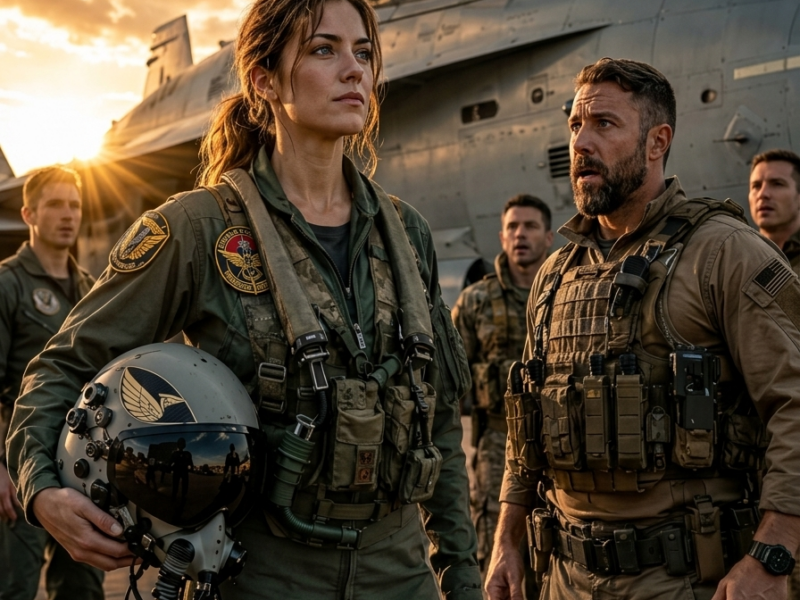
They laughed when the new pilot stumbled beside her F-18 at Naval Air Station Oceana, but the SEAL commander stopped cold when she quietly gave her call sign, because “Black Widow”
The Atlantic wind barreled across the concrete apron at Naval Air Station Oceana, carrying the bitter sting of winter salt and the sharp, chemical stench of burned JP-5 jet fuel. It was an unforgiving environment, designed for high-stress operations and unforgiving men. Every surface was stripped of sentimentality: grease stains blackened the parking revetments, maintenance carts rattled over expansion joints, and gray F/A-18F Super Hornets sat crouched on the tarmac like predatory birds waiting for the scent of blood.
I walked toward Row Bravo with deliberate hesitation. My helmet was tucked awkwardly beneath my left arm, its white shell pristine, without the personal emblems, kill tallies, or scratched call signs of an experienced aviator. My boots were polished to an unnatural, mirror-like shine—a dead giveaway of someone fresh from officer training, someone whose feet had spent more time marching across parade decks than kicking rudder pedals in a high-G turn.
To ensure the illusion took hold, I let my left heel catch the uneven lip of a fuel drainage grating.
I stumbled, my knee buckling slightly, the heavy flight manual slipping in my hand before I caught myself against the steel ladder of Aircraft 204.
A chorus of laughter broke out immediately from the staging line.
Four aviators stood near a ground-power unit, their green flight suits patched with the skull-and-crossbones insignia of the Grim Reapers. A junior lieutenant with close-cropped hair and an unearned swagger took a step forward, his eyes traveling over my immaculate gear with undisguised contempt. He glanced down at the single-page flight clearance clipped to his kneeboard.
“Fresh out of training?” he smirked, loud enough for the crew chiefs to hear.
“Something like that,” I replied, keeping my pitch slightly elevated, making my voice carry the uncertain cadence of an outsider out of her depth.
A couple of mechanics chuckled as they dragged a heavy pneumatic hose across the concrete. In their world, arrogance was currency, and humility was weakness. They saw a twenty-something replacement pilot sent to fill a roster slot for a low-priority combat air patrol over an empty Atlantic corridor. They saw meat for the grinder.
Then the laughter stopped.
It didn’t taper off gradually; it died instantly, severed by the arrival of a presence that altered the atmosphere of the hangar deck. Boots struck the tarmac in an even, unhurried cadence.
Commander Ryan Cole walked into the sunlight.
He was built like an anchor chain—thick-shouldered, scarred, and weathered by fifteen years of black operations and carrier launches. His flight suit lacked the colorful morale patches favored by younger aviators. Over his chest hung the subdued trident of the Navy SEALs alongside naval aviator wings—a rare and lethal dual qualification that made men involuntarily straighten their spines whenever he walked into a room. His dark eyes were cold, calculating, and weighed down by memories that had never made the declassified logs.
Cole stopped five paces away, looking down at me. The silence stretched between us until the only sound was the distant drone of an E-2 Hawkeye taxiing toward runway zero-five.
“You’re flying my squadron’s cover today?” Cole asked. His voice was gravelly, scraping against the chill air.
“Yes, sir,” I answered, keeping my gaze level with his collar insignia rather than meeting his eyes.
He didn’t take my paperwork. He didn’t look at my logbook. Instead, his gaze remained fixed on my face, studying the curve of my jaw, the set of my shoulders, and the stillness in my posture that no rookie could ever fake. For a fraction of a second, an expression flickered across his scarred face—a phantom of recognition, quickly buried beneath hardened disbelief.
“You don’t look old enough,” he remarked coldly.
“I’m older than I look.”
The junior lieutenant behind him let out another short, mocking chuckle. Cole didn’t smile. His eyes hardened like slate.
“Stay tight on my wing, Lieutenant,” Cole warned, leaning in close enough that I could smell black coffee and tobacco on his breath. “We’re running top cover for a sensitive transport package off the Virginia Capes. Routine patrol or not, if you get disoriented in the clouds or drift off vector, I will leave you in the salt. I don’t carry dead weight.”
“Understood, Commander,” I said softly.
He turned on his heel and strode toward lead Aircraft 201. I watched his back for three seconds before swinging myself up the boarding ladder of Aircraft 204.
The cockpit was home. The smell of pressurized rubber, hydraulic fluid, and electrical ozone washed over me, instantly wiping away the clumsy facade I had worn on the ground. I dropped into the ejection seat, buckled the five-point harness, and clicked the leg restraints into their locking rings with smooth, mechanical efficiency.
Beneath the main multifunction display, hidden from the view of any mechanic or canopy inspector, was an inspection hatch. Taped to the underside of that aluminum flap was a worn, water-damaged photograph. It showed three naval aviators standing in the desert heat of Fallon, Nevada, their arms slung over each other’s shoulders. On the left was Ryan Cole, ten years younger, grinning without the scar across his cheek. In the middle was Captain Marcus Ward—a man officially buried in an empty coffin at Arlington National Cemetery seven years ago.
And on the right was me.
Before the crash. Before the fire. Before the Defense Intelligence Agency erased my service records, scrubbed my dental charts, and declared Lieutenant Commander Kathryn “Black Widow” Mercer killed in action over the Black Sea.
I slammed the inspection flap shut and engaged the battery switch.
Twin General Electric F414 turbofans spooled up with an ear-splitting whine that turned into an earth-shaking roar. The instruments flickered alive in emerald green. Within eight minutes, Cole’s lead jet and mine were lined up on Runway 05 Right. The catapult was unnecessary on the long land runway; we throttled up to full military power, released the brakes, and lit the afterburners.
The acceleration shoved my spine deep into the seat. The gray shoreline of Virginia vanished underneath us, replaced by the vast, gunmetal sheet of the North Atlantic.
The mission profile was simple: transit sixty miles east, hold a race-track patrol at twenty-four thousand feet, and provide electronic surveillance while an unmarked naval auxiliary ship transferred a classified container to an amphibious assault vessel.
At twelve thousand feet, we punched through a thick, unbroken deck of stratus clouds. The sky above was pale blue, but the ocean below was swallowed by white mist.
Then the world unraveled.
At exactly 1422 Zulu, my tactical data link didn’t just flicker—it died. The Link 16 network vanished. The satellite feed went dead. The secure radio channel dissolved into a flat, unnatural hum that carried the distinct signature of military-grade wide-spectrum jamming.
A second later, two bright crimson contacts bloomed on my nose radar.
They weren’t commercial carriers, and they weren’t friendly assets. They were traveling at Mach 1.6, descending through thirty thousand feet, cutting across our patrol sector with terrifying precision. They had no transponders, no identification friend-or-foe (IFF) returns, and their radar cross-sections were razor-thin.
Cole’s voice broke through the tactical frequency, harsh and clipped over the interference.
“Identify.”
I toggled the sensor suite, trying to paint them with an active radar pulse. The signals bounced back scattered and broken.
“They’re not answering,” I reported, my voice steady, stripped of all rookie pretense.
“Stay with formation,” Cole ordered immediately. “Do not engage. We maintain orbit and re-establish link with Fleet Command.”
I stared at the closing range. Forty nautical miles. Thirty-five. Thirty.
They weren’t vectoring toward the transport ship below. Their intercept geometry was locked directly onto us. More specifically, they were splitting their formation to bracket Aircraft 204. My aircraft.
They knew who was in the cockpit.
A familiar, icy stillness washed through my veins. The hesitation, the fear, the carefully acted clumsiness of the morning fell away like dead skin. I knew that intercept pattern. I had written the tactical manual for it a decade ago at the Strike Fighter Tactics Instructor program.
“Negative,” I said quietly into the mask.
“That’s an order, Two!” Cole snapped back, anger flaring through his headset. “Vector zero-niner-zero, keep your nose on my tail!”
“Negative, Lead,” I repeated.
I disconnected the autopilot, slammed the twin throttles forward into zone-five afterburner, and shoved the stick forward and left.
My Super Hornet peeled away from Cole’s wing like a falling blade, slicing downward through the cloud tops at eight hundred knots. The sudden descent pulled positive Gs that dragged at my cheeks, but my hands were surgical on the stick and throttle.
The two unknown bogeys reacted instantly. They ignored Cole entirely, tipping their wings and diving through the cloud ceiling in pursuit of my jet.
For ten seconds, the radio frequency was filled with nothing but the roar of rushing air and the high-pitched telemetry hum of combat computers. Through the broken cloud deck, the dark, churning water of the Atlantic appeared below—gray, violent, and indifferent.
Then Cole’s voice cut through the static, stripped of anger, replaced by a sudden, razor-sharp suspicion.
“Pilot… state your call sign.”
My finger rested on the push-to-talk paddle. The cockpit was freezing, but my palm was steady. I had spent seven years running through shadows, changing names, living in the margins of the world to protect a secret that had cost everyone I loved their lives. But they had tracked me here. They had forced my hand.
I keyed the transmitter.
“Black Widow.”
The radio frequency went utterly, completely dead.
Not a click of static. Not the rustle of atmospheric noise. A suffocating void filled the headset.
Across the four miles of airspace separating our jets, I knew what was happening inside Ryan Cole’s cockpit. I knew the image that had just exploded in his mind: an officer’s club in Pensacola, a burning wreckage off the Crimean coast, and seven years of grief built upon a lie.
Then came a single, ragged breath over the open channel.
“No,” Cole whispered. His voice was hoarse, stripped of all rank. “Say that again.”
“Black Widow,” I repeated, my tone as cold and immovable as the granite cliffs of Virginia.
His voice broke, cracking with disbelief and fury. “That pilot died seven years ago. I carried her locker out of the squadron ready room myself.”
I banked the Hornet hard toward the incoming contacts, watching their dark silhouettes materialize through the rain-soaked mist—two unmarked, swept-wing interceptors bearing the unmistakable aerodynamic lines of an experimental black project.
“She didn’t die, Ryan,” I said softly.
As soon as my voice cleared the frequency, the two approaching interceptors broke their attack runs. Simultaneously, without firing a single missile or painting us with targeting radar, they pulled into vertical climbs, punched their afterburners, and vanished into the upper stratosphere.
They hadn’t come to kill me. They had come to verify my presence.
My fingers tightened around the aluminum stick until my knuckles went white beneath the leather gloves. They knew. The men who had buried us seven years ago now had eyes on my cockpit.
And down below, hidden in the grey swell of the Atlantic, was the ship that held the proof of everything they had done.
Cole’s voice returned over the radio. The commander was gone. Only a ghost hunter remained.
“Who are you?” he asked, his voice barely louder than the hum of the avionics.
I reached out with my left hand and tapped the aluminum panel beneath my screen, where the photograph of three young pilots remained taped in the dark.
“I’m the one who survived,” I said. “And the man we buried in Arlington is down there on that ship.”
The cloud deck below us seemed to curdle into an opaque, churning sea of slate and foam. My radar screen flickered as the high-altitude interceptors disappeared beyond the limit of our scan volume, their engine signatures fading into the ionosphere. But the silence inside my flight helmet was far louder than the roar of the twin F414 turbofans.
“Say that again,” Cole’s voice was low, taut as an overstressed arrester cable. “You repeat what you just said about Ward, or by God, I’ll declare you hostile right now.”
“Check your tactical display, Ryan,” I answered, keeping my tone devoid of emotion. “You think two fifth-generation prototypes stumbled into our patrol sector by accident? You think they jammed our Link 16 with commercial frequencies? Look at the transponder data on that naval auxiliary below us. Call her up on the fleet net. See if Norfolk answers.”
A ten-second pause stretched across the channel. On my tactical display, Cole’s aircraft banked hard, swooping down through the cloud break to re-establish visual contact with the cargo vessel below.
The ship was the USNS Antietam, officially designated as an oceanographic research vessel operating under the Military Sealift Command. But from three thousand feet, her lines told a different story. She carried no oceanographic cranes, no towed sonar arrays, and no civilian scientific markings. Her deck was flat, reinforced, and occupied by four sealed, climate-controlled cargo containers painted in non-reflective matte olive.
“Antietam, this is Reaper Lead,” Cole broadcast on the primary naval distress channel. “We have an unassigned airborne interception in your immediate vicinity. Advise your status and identify cargo manifest.”
Static hissed back. Nothing more.
“Antietam, respond,” Cole repeated, his tone sharpening.
A click broke the silence, followed by a voice that was too calm, too synthetic to belong to a merchant marine watch officer.
“Reaper Lead, this is special courier unit Seven-Alpha. Your patrol parameters do not include vessel interaction. Resume designated combat air patrol route immediately. This frequency is restricted under Title 50 authority.”
Cole’s aircraft pulled level with mine, flying close enough that I could see the hard, rigid outline of his helmet against the cockpit glass. Title 50 was intelligence authority—clandestine operations. It was the jurisdictional shield used by the CIA, the Defense Intelligence Agency, and black budget programs to shut out regular military oversight.
“Seven years ago,” I said over our private, encrypted inter-flight channel, “Marcus Ward discovered that someone inside Naval Air Systems Command was diverting fly-by-wire source code to a private defense contractor called Aegis Apex. They weren’t just selling avionics; they were developing an autonomous override system. An electronic kill-switch capable of taking control of any frontline fighter in the United States military.”
“Marcus was shot down during an exchange over international waters,” Cole countered, though the certainty in his voice had begun to crumble. “His emergency beacon activated for twelve seconds before his locator pinged at four thousand feet underwater. We retrieved the black box.”
“You retrieved a manufactured transponder,” I told him, remembering the fire, the blacked-out hangars, and the cold metal of a gun pressed against the back of my neck in a staging bunker in Rota, Spain. “I was his wingman that day. My call sign was Black Widow because I was the only pilot in the strike group who had survived two catastrophic systemic fly-by-wire failures during testing. When Marcus figured out the override system was being installed on the fleet’s new block of Super Hornets, his flight controls locked up mid-air. His plane didn’t crash because of enemy fire. It was flown into the water by a computer sitting in a bunker three thousand miles away.”
“And you?” Cole asked, his breath trembling over the radio. “What happened to you, Kathryn?”
“They caught me before I could upload his diagnostic logs to the Inspector General,” I said. “They told me I had two choices: I could die in an unexplained training collision, or I could disappear into a deep-cover evaluation unit under DIA oversight. They put an empty casket in Arlington, told you I burned in the wreckage, and put me in a room without windows for three years testing airframes that don’t officially exist. I took their deal because it was the only way to stay alive long enough to find where they took him.”
“Took him?” Cole’s voice was hoarse. “Marcus is dead, Kathryn. You’re talking about a man who’s been gone for seven years.”
“They didn’t kill him, Ryan. Marcus designed the root encryption for the flight control architecture. The override system won’t fully integrate with the fleet’s mainframes without his personal biometric access key. They’ve kept him alive in black-site isolation for seven years trying to break his encryption. And today, they’re moving him.”
“Why today?”
“Because tomorrow, the Atlantic Fleet begins Exercise Northern Shield. Two hundred aircraft, three carrier strike groups, all running the newly upgraded tactical software. If that container on the Antietam reaches the offshore relay station, whoever controls Aegis Apex won’t just monitor the exercise—they will possess the ability to ground, disable, or redirect every naval fighter on the Eastern seaboard.”
The realization hit Cole like a physical blow. His aircraft dipped slightly as his attention shifted between my jet, the ship below, and the empty sky above where the two unmarked interceptors had vanished.
“Those two planes…” Cole muttered.
“Apex scouts,” I replied. “They were sent to confirm that the transport corridor was clear of any unexpected variables. When I gave my old call sign, their telemetry computers recognized the vocal frequency. They know the ghost has returned, Ryan. Which means that ship isn’t heading to Norfolk anymore.”
As if on cue, the USNS Antietam began a violent turn to the east, churning the sea into a massive semicircle of white water. Her heading was changing toward international waters, pointing directly into the deep, lawless expanse of the open Atlantic.
On the forward deck of the cargo ship, a heavy hydraulic hatch slid open. A surface-to-air missile battery—a containerized, Russian-built Pantsir system that had no business existing on a United States naval vessel—swiveled toward our flight path.
“Warning! Missile lock! Missile lock!” the automated voice of my threat library screamed through my headset.
“Cole, break!” I shouted, slamming the stick into my ribs and dumping bundles of radar-defeating chaff into the slipstream.
The sea below erupted with twin pillars of fire as two radar-guided missiles ripped out of the ship’s hold, slicing through the mist and climbing directly toward us.
The sky tore open in an instant.
The two missiles left thick, corkscrewing trails of white smoke as they accelerated through Mach 3. At that range—less than four miles—we had less than five seconds before the proximity fuses detonated fifty pounds of continuous-rod warheads against our cockpits.
“Flares! Jink right!” Cole yelled.
His Super Hornet snapped ninety degrees onto its wingtip, slicing through the gray soup of the clouds while pumping magnesium flares into the cold air. The lead missile took the bait, detonating in a blinding flash of yellow flame that rocked his airframe, sending him tumbling through a severe buffeting cycle before he wrestled the nose back to level flight.
The second missile didn’t track heat. It was riding a narrow, millimetric radar beam, and it was locked onto my exhaust.
I didn’t turn away. Turning offered the missile a larger surface profile to track. Instead, I shoved the stick into the corner, inverted the aircraft, and dove straight down at the ship’s superstructure.
The ocean rushed up to meet me—a terrifying expanse of freezing gray water and jagged whitecaps growing larger by the millisecond. Three thousand feet. Two thousand. Fifteen hundred.
“Pull up, Kathryn! You’re inside the fragmentation zone!” Cole’s scream was distorted by the brutal G-forces he was pulling to clear the engagement box.
At eight hundred feet, with the warning alarm shrieking a continuous, deafening tone in my ears, I chopped the throttles to idle, kicked the left rudder pedal to the floor, and popped the speed brake. The sudden asymmetric drag threw the Hornet into a violent, barrel-rolling flat slip.
The missile’s tracking computer couldn’t compensate for the sudden, impossible loss of forward airspeed. It flashed past my canopy, close enough that I could read the serial numbers stenciled on its green casing, and plunged into the sea three hundred yards beyond the Antietam, sending a hundred-foot geyser of brine into the air.
I slammed the throttles back into full afterburner, the twin engines catching with a concussive boom just fifty feet above the rolling crests of the waves. The saltwater spray misted my canopy, immediately wiped away by the hurricane of air screaming across the Plexiglas.
“I’m alive,” I gasped, the sweat burning my eyes beneath the helmet visor.
“I see you,” Cole panted, his voice ragged. His jet was banking hard around the northern perimeter of the ship, outside the firing arc of the containerized missile launcher. “They just fired on active-duty naval aviators in American territorial waters. That’s treason. That’s an act of war.”
“It’s not treason to them, Ryan,” I said, banking my jet into a tight circle around the stern of the vessel. “It’s an asset liquidation. Once those missiles launched, the Antietam committed to running. Look at her bridge.”
Through the spray, I zoomed the optical targeting pod onto the ship’s wheelhouse. The glass was darkened, reinforced, and on the exterior catwalks, men in civilian tactical gear were bringing heavy machine guns to bear on our low-flying aircraft.
“We have two AIM-9X Sidewinders and two AIM-120 AMRAAMs each,” Cole said, his voice dropping into the clinical, deadly cadence of a SEAL assault commander. “We have the gun. We sink her.”
“No!” I shouted back. “If you hit that hull, the sea takes the cargo. Marcus is down in that hold, Ryan! He’s in one of those four reinforced containers on the lower deck!”
“How do you know he’s still breathing?” Cole demanded, the agony of seven years of deception bleeding into his words. “How do you know they didn’t put a bullet in his head the moment those bogeys turned around?”
“Because the electronic warfare suite on that ship isn’t automated,” I replied, pointing my nose toward the vessel’s central mast. “Look at the jamming pattern. It’s cycling every seven seconds on the old naval tactical frequency. It’s an SOS in naval teletype code. Marcus is at the terminal. He’s fighting them from the inside.”
Cole went quiet for three seconds. Three seconds in which seven years of grief, duty, and military protocol were weighed against the impossible chance that his best friend was still breathing in the dark.
“What’s the plan?” he asked.
“The ship’s automated defense system relies on an external radar dome mounted on the forward mast,” I said, pulling my aircraft into a climbing turn to set up an attack vector. “We take out the radar with the 20mm cannon. That blinds their surface-to-air missiles. Then, you fly low-altitude passes across their bow to suppress their topside gunners.”
“And you?”
“I’m putting this Hornet on the rear cargo deck.”
“You’re out of your mind!” Cole roared. “The Antietam has a helicopter pad designed for an MH-60 Seahawk, not an eighteen-ton supersonic fighter! You don’t have an arresting wire! You’ll hit that deck at a hundred and twenty knots and tear yourself into scrap metal!”
“The rear deck has four heavy shipping containers chained to the tie-down tracks,” I said, my fingers flipping the switches to arm the M61A2 Vulcan cannon. “I’m not landing, Ryan. I’m ditching.”
“Kathryn—”
“He spent seven years in hell because he wouldn’t give them the keys to kill us,” I interrupted, my voice dead level. “I’m not leaving him behind again. Cover my run.”
A heavy sigh crackled through the radio, followed by the familiar, distinct sound of a master-arm switch clicking into place.
“Reaper Lead is in,” Cole said grimly. “God help you, Widow.”
Cole’s Super Hornet dove out of the mist like a thunderbolt. He came in from the ship’s port side, his 20mm cannon spitting a continuous stream of tungsten-cored rounds that stitched across the Antietam’s bridge, shattering the reinforced glass and tearing the automated sensor mast into ribbons of shredded metal. The containerized missile launcher sparked violently, its tracking radar blinded, and swung aimlessly toward the gray sky.
Topside gunners scattered, diving for cover beneath steel companionways as Cole roared overhead at two hundred feet, his engine wake churning the sea into a frenzy.
“Radar is dead!” Cole shouted. “You have the deck, Kathryn! Go! Go!”
I cut my airspeed to the absolute aerodynamic limit. The stall warning horn began to blare—a flat, rhythmic tone echoing inside my ears. Beep. Beep. Beep. The flight controls felt mushy, unresponsive, fighting the violent updrafts rolling off the ship’s churning wake.
The stern of the cargo ship loomed ahead, rising and falling ten feet with every swell of the Atlantic.
Two hundred yards. One hundred yards. Fifty yards.
I yanked the manual gear-release handle. The landing gear plummeted down and locked into place. I wasn’t aiming for the runway; I was aiming for the space between the two rearmost cargo containers.
“Brace!” I screamed to myself.
The main wheels slammed onto the wet, steel helicopter deck with the force of an artillery shell.
The impact sheared the right landing gear clean off the aircraft.
A shower of orange sparks erupted as the right wing dipped, scraping against the steel deck plating with a shriek that cut through the roar of the dying engines. The plane spun violently to the right, slamming into the corrugated wall of the first shipping container.
The canopy shattered. Freezing sea wind, jagged shards of Plexiglas, and the suffocating stench of ruptured fuel lines blasted into the cockpit. The violent deceleration snapped my head forward, cracking my helmet against the glare shield and plunging my vision into a haze of red and black.
The aircraft ground to a halt, wedged tight between two massive steel containers, its left engine burning, smoke pouring from the crushed nose cone.
For five seconds, the world was reduced to the hiss of sea spray against hot turbine blades and the ragged sound of my own breath.
I blinked away the blood trickling into my eyes from a gash on my forehead. My left shoulder was screaming in pain, dislocated or fractured by the impact against the side console. But there was no time for shock. The smell of raw jet fuel was overpowering; one stray electrical spark would turn the wreckage into a funeral pyre.
I slapped the emergency release buckle on my harness, kicked the shattered canopy frame free with both boots, and hauled myself out of the cockpit.
I tumbled onto the wet steel deck, rolling behind the cover of the container just as a volley of automatic rifle fire chipped the paint off the aircraft’s tailfin.
Two private military security contractors in black tactical uniforms were advancing from the forward companionway, their weapons raised.
I didn’t hesitate. I drew the standard-issue SIG Sauer M18 from the holster strapped across my chest, leaned around the corner of the container, and fired three rounds in rapid succession. The double-tap dropped the lead contractor onto the deck; the second dove behind a winch housing, pinned down.
High above, the sky screamed as Ryan Cole brought his Super Hornet across the ship at mast-height, the deafening sonic boom rattling the steel hull and forcing the remaining deck crew to clutch their ears in agony.
“Widow! I’m on bingo fuel!” Cole’s voice crackled through my survival radio earpiece. “I have enough kerosene for two more passes before I’m gliding back to the coast! What’s your status?”
“I’m on the deck,” I panted, clutching my injured arm against my ribs. “Moving toward the lower hold.”
“Move fast! I’m painting two more high-speed contacts descending from thirty thousand feet! Apex reinforcements are inbound!”
I sprinted down the narrow catwalk leading to the cargo hold’s access hatch. The heavy steel door was dogged down, but the emergency pressure wheel was unlocked. I threw my weight against it, wrenching it open, and slipped into the darkness of the lower deck.
The interior of the ship smelled of ozone, diesel oil, and decay.
Emergency red battle lights illuminated a cavernous cargo bay. In the center of the bay sat an insulated, mobile containment unit—a pressurized clean-room pod typically used for transporting hazardous biological material or sensitive electronics. Heavy power cables snaked across the floor, hooked into the ship’s primary generators.
Standing outside the unit was a man wearing a civilian suit beneath a heavy winter parka. He was clutching a ruggedized laptop, his fingers flying across the keyboard with frantic speed.
He froze when he heard my boots hit the steel deck.
He looked up, pushing gold-rimmed glasses up the bridge of his nose. He didn’t look like a soldier. He looked like an executive. A technician of murder.
“You shouldn’t be here, Commander Mercer,” he said, his voice trembling slightly, though he tried to maintain an air of clinical detachment. “Your file was closed. The agency expended considerable resources constructing a dignified departure for you.”
“Where is he, Keller?” I demanded, raising the pistol with my good hand, the red dot of the iron sights centered between his eyes.
Keller swallowed hard, his eyes darting toward the sealed door of the containment pod behind him. “You don’t understand the scope of what we’ve built. The human element in tactical aviation is obsolete. You suffer from hypoxia, from G-induced loss of consciousness, from hesitation, from grief. Aegis Apex isn’t a crime; it’s an evolution. We are removing the flaw from the machine.”
“The flaw is what keeps the machine from slaughtering everything in its path,” I said, cocking the hammer of the pistol. “Open the door.”
“It’s too late,” Keller sneered, a desperate courage creeping into his face. “The master handshake has already begun. The tactical core is transferring to the offshore relay. Once it finishes, every combat aircraft in the Atlantic Fleet will answer to the network. Marcus understood that. He resisted for seven years, but the human mind has limits. We broke his sequence thirty minutes ago.”
A sudden sound cut through his words.
A slow, rhythmic knocking from inside the pod.
Clang. Clang. Clang.
It wasn’t random panic. It was a cadence. Long, short, short, long.
X.
The international brevity code for Execute.
Keller’s eyes widened in realization, but before he could touch the laptop, I fired.
The round took him in the center of the chest, throwing him back against the steel bulkhead. The laptop clattered to the deck, its screen flashing red with an encryption error warning.
I lunged forward, kicked the computer away, and grabbed the heavy manual locking lever on the containment pod’s door. The hydraulic seals hissed as I wrenched it upward with everything I had left in my body. The heavy steel door swung outward.
The air that poured out of the pod was freezing, smelling of antiseptic and stale coffee.
Sitting in the center of the room, strapped to a reinforced steel chair before a bank of glowing server racks, was a man.
His hair was long, matted with gray, and his face was gaunt, hollowed out by seven years of artificial light and nutritional paste. His hands were covered in old burns, his flight suit stripped of all insignia, hanging loosely on a frame that had lost forty pounds.
He slowly lifted his head.
His sunken eyes found mine. For a moment, he blinked against the red emergency light, as if looking at a ghost he had summoned in his dreams ten thousand times.
“You’re late for your briefing, Widow,” Marcus Ward whispered.
His voice was barely a rasp, dried out by years of silence, but the wry, defiant tilt of his mouth was unmistakable.
Tears cut through the grime and blood on my face. I stepped into the pod, dropped to my knees before the chair, and reached out with a trembling hand to touch his cheek. He was cold, but his skin was real. His pulse was beating against his neck—ragged, weak, but alive.
“I had to find a plane,” I choked out, a ragged sob tearing from my throat.
“Did you bring Ryan?” he asked, his eyes drifting toward the ceiling as another sonic boom rattled the ship’s hull.
“He’s on the roof,” I said, pulling a combat knife from my boot to cut through the heavy zip-ties binding his wrists to the chair. “And he’s out of fuel.”
Marcus let out a dry, hacking laugh that turned into a cough. “Typical. The man never could manage his fuel burn.”
He rubbed his freed wrists, where deep scars had formed from years of steel cuffs, and looked down at the server terminal beside him.
“Kathryn, listen to me,” Marcus said, his eyes suddenly burning with an intense, terrifying focus. “Keller wasn’t lying. They used a brute-force neural interface to extract my authorization cipher. The transfer to the satellite network is at eighty-nine percent. If it hits one hundred, they possess the root command for the entire Atlantic Fleet. They can order the fighters to crash into the sea, or turn their weapons on Norfolk.”
“Can you stop it?”
“Not from this terminal,” Marcus said, pointing to the severed cables Keller had damaged when he fell. “The local input is destroyed. The only way to kill the transmission is to destroy the ship’s primary transmitter in the upper hold.”
“Where is it?”
“Right beneath the helicopter pad,” Marcus said, looking directly into my eyes. “Directly underneath the wreckage of your aircraft.”
The ship shuddered violently as a heavy explosion rocked the forward hull.
“Kathryn!” Cole’s voice screamed through the radio, competing with an avalanche of acoustic static. “Apex reinforcements have arrived! Two stealth platforms are on my tail! I’m Winchester—I’m out of ammo, and my left engine just took a missile fragment! I can’t keep them off you much longer!”
I helped Marcus to his feet. He swayed, his knees nearly giving out after months of confinement, but he caught himself against the server rack. He looked at the dead technician on the floor, then bent down and picked up Keller’s sidearm with steady, practiced hands. Seven years of captivity hadn’t erased fifteen years of combat training.
“Let’s go kill this thing,” Marcus said.
We moved through the lower corridor, climbing the steel ladder toward the secondary machinery room beneath the flight deck. Above us, the sounds of modern air combat raged—the high-pitched scream of passing jet engines, the rapid-fire thud of 20mm cannons, and the distant detonations of decoy flares.
We burst into the upper transmitter bay.
The room was dominated by a massive, liquid-cooled transmission unit that hummed with enough electrical energy to make the hair on my arms stand up. On the control console, a digital progress bar was glowing with cold, white efficiency:
UPLINK TO AEGIS APEX SATELLITE ARRAY: 94%
“It’s running on an isolated, shielded power grid,” Marcus said, inspecting the armored conduits running into the deck plating. “Small-arms fire won’t stop it. The casing is three-inch hardened steel. Even if we empty our magazines into the casing, the upload will finish before the circuits short out.”
“Then what stops it?” I asked, looking up at the ceiling.
Right above us, the steel plates were dented downward. Smoldering jet fuel was already beginning to drip through the seams of the overhead hatch.
“The fuel,” Marcus said softly, his eyes meeting mine. “Your Super Hornet is sitting directly on top of this room. The fuel tanks ruptured on impact. There are at least three thousand pounds of unburned JP-5 pooling on that deck.”
“If we ignite that fuel,” I said, the reality sinking into my chest like a block of ice, “it will cook off the transmitter. But the explosion will breach the bulkheads. The ship will go down in minutes.”
“Then we make sure we’re not on it,” Marcus replied.
He turned toward the starboard emergency escape hatch—a direct exit leading to an inflatable life raft station mounted on the exterior hull.
“Get the raft ready, Kathryn,” Marcus ordered, his old rank asserting itself naturally. “I’ll set the timer on the emergency flare discharge.”
“Marcus—”
“I spent seven years waiting to die in a cage, Widow,” he said, offering a ghost of the brilliant, reckless smile that had defined him a lifetime ago. “I’m not dying on this bucket of rust today. Now move!”
I kicked open the starboard hatch.
The freezing Atlantic wind hit me like a physical wall, throwing rain and sea spray across my face. Sixty feet below, the black ocean churned violently around the ship’s steel hull. I reached for the deployment lanyard of the twenty-man survival raft, ripped it from its housing, and threw the yellow canister into the water. It hit the swell and inflated with a loud, concussive hiss, bobbing against the ship’s hull on its nylon painter line.
Above the ship, the air battle reached its climax.
Through the low-hanging clouds, Cole’s F-18 roared past, trailed by a long plume of black smoke from his left engine. Directly behind him, carving through the rain with impossible agility, was one of the unmarked black interceptors.
“I’m hit, I’m hit!” Cole shouted over the guard channel. “Controls are failing! I’m punching out—”
“Negative, Reaper Lead!” Marcus’s voice suddenly bellowed over the radio, using the transmitter console’s open microphone. “Do not eject over the target! Vector zero-four-zero! Ditch into the sea north of the ship! We have the raft deployed!”
A stunned gasp echoed from Cole’s cockpit. “Marcus…?”
“Move your ass, Ryan! That’s an order!”
Cole didn’t hesitate. His crippled fighter banked sharply away from the ship, drawing the pursuing interceptor with him, before the Super Hornet entered a fatal, tumbling roll and crashed into the ocean two miles out. A second later, a single white parachute bloomed against the gray clouds, drifting down toward the water.
Inside the transmitter room, the progress monitor flashed: 98%.
Marcus appeared at the hatchway, holding a standard military emergency magnesium flare. His face was covered in soot, but his eyes were bright, fierce, and alive.
“Time to burn,” he yelled over the howling wind.
He struck the ignition cap of the flare. A blinding, four-thousand-degree crimson flame erupted from the cylinder. Without a second’s hesitation, Marcus turned and threw the burning flare directly through the inspection hatch into the pool of jet fuel beneath my shattered fighter.
“Jump!” he roared, grabbing my tactical vest with his good hand.
We leaped into the void together.
The fall felt endless. For two seconds, there was only the whistle of the wind and the terrifying rush of the gray ocean coming up to meet us.
Then, behind us, the world ended.
Three thousand pounds of aviation fuel ignited simultaneously with the force of a tactical bomb. A blinding wall of yellow-orange fire tore through the flight deck of the USNS Antietam, blowing the shattered remains of my Super Hornet two hundred feet into the air. The blast wave struck us mid-fall, slamming into our backs like an iron fist, hurling us through the freezing air and tossing us into the boiling foam of the Atlantic.
The cold hit me like a thousand needles, driving the breath from my lungs, dragging me down into the silent, suffocating dark.
My flight suit grew heavy, pulling me toward the abyss. My broken shoulder throbbed with agony so intense that my vision began to fade into blackness. I couldn’t tell which way was the surface. The water was churned into a frothing mass of bubbles and sinking shrapnel.
Then, a hand seized the collar of my vest.
A grip hardened by seven years of surviving in the dark pulled me upward with desperate, furious strength.
My head broke the surface. I gasped for air, coughing out mouthfuls of bitter saltwater, choking, shivering violently.
Beside me, Marcus was treading water, spitting brine, holding my head above the waves with one arm while swimming toward the yellow life raft bobbing twenty feet away with the other.
Behind us, the USNS Antietam was burning furiously from bow to stern. Her main mast had collapsed, her transmission arrays completely incinerated, her hull groaning as thousands of tons of seawater poured into her breached compartments.
Above the burning wreck, the remaining black interceptor circled once, its mission destroyed, its satellite link severed. Denied its objective and without a base to recover on, the ghost aircraft banked east toward the open horizon and vanished into the storm clouds, fleeing before the arrival of the United States Navy.
With the last ounce of strength left in our bruised, bleeding bodies, Marcus and I hauled ourselves over the thick rubber gunwale of the life raft and collapsed onto its wet floor.
For a long time, neither of us spoke. We lay side by side, chest to chest, our breath misting in the freezing air, listening to the crackle of the burning ship and the steady, mournful rhythm of the ocean swell.
Twenty minutes later, the low, rhythmic thumping of rotor blades echoed across the water.
An MH-60S Seahawk rescue helicopter broke through the cloud deck, its searchlight cutting through the mist, illuminating the yellow raft and the sinking remains of the cargo ship.
Sitting in the open cabin door of the helicopter, wrapped in a gray wool blanket with a rescue swimmer securing his harness, was Commander Ryan Cole.
The searchlight settled on our raft.
Cole leaned out of the helicopter, his scarred face illuminated by the bright beam, staring down at the two battered, grease-stained figures looking back up at him.
Marcus Ward slowly raised his hand, forming a fist, and tapped his heart twice—the old, secret signal of the Grim Reapers.
Cole dropped his head into his hands for three seconds, his shoulders shaking with silent, heaving sobs, before he looked up again, his face set with the fierce, unbreakable resolve of a man who had finally brought his ghosts home from the war.
The hoist cable dropped toward our raft.
I reached out, my fingers wrapping around the cold steel of the rescue hook, feeling the steady, powerful upward pull toward the light.
Seven years of running was over. The lie was dead.
And as the helicopter lifted us out of the freezing Atlantic and climbed toward the clouds, I looked back at the burning sea one last time, knowing that the Black Widow had finally finished her flight.
The end.









