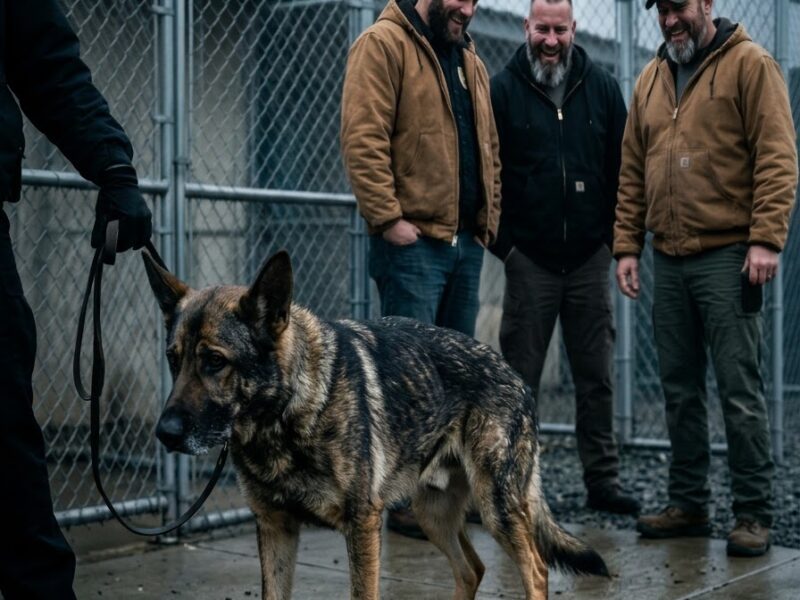
They laughed when the new military K9 froze beside the ammunition truck at Fort Campbell
I remember the laughter more than the shouting. It was that sharp, dismissive kind of laughter unique to young infantrymen who think they’ve seen everything the military has to offer.
We were standing on the sun-baked asphalt of the primary motor pool at Fort Campbell, Kentucky. The humid September air hung heavy with the reek of diesel exhaust, hot gun oil, and scorched rubber. Rows of heavy transport vehicles, armored humvees, and fuel tankers sat lined up like iron beasts waiting for the autumn deployment orders.
Rex had arrived that morning in the back of a steel-crated transport. He was a young Belgian Malinois, lean and muscular, with short mahogany fur, coal-black ears, and nervous, hyper-vigilant eyes. A jagged, three-inch pink scar cut diagonally across his black muzzle—a permanent souvenir from somewhere hot, sandy, and unrecorded.
His handler, Sergeant Cole, looked thoroughly embarrassed. Cole was a good non-commissioned officer, competent and usually patient, but he was under immense pressure. The entire unit had been pulled out of quarters for a last-minute readiness inspection ahead of a major brigade field exercise, and his newly assigned working dog was refusing to execute basic tracking drills.
“He’s supposed to be elite?” a young corporal from the 101st Airborne mocked, arms crossed over his chest as he leaned against the hood of a light tactical vehicle. “Looks like a nervous stray they picked up outside the back gate.”
Someone else chuckled. A low murmur of agreement passed through the crowd of twenty or thirty soldiers gathered near the supply bay.
Cole pulled sharply on the tactical lead. “Rex, heel! Up, heel!”
Rex didn’t heel.
The Malinois suddenly stopped dead in his tracks, his entire ninety-pound frame going completely rigid. His ears shot forward like twin radar dishes, trembling with tension. His long, black-tipped tail went stiff as a steel rod. Slowly, deliberately, the dog lifted his nose toward the far side of the motor pool, taking in sharp, rapid gulps of the thick Kentucky air.
His dark eyes locked onto a parked three-ton ammunition supply truck fifty yards away. The truck had been sitting quietly near the fuel depot all morning, loaded with crates of inert training munitions and live convoy escort gear.
“Move him, Cole,” snapped Staff Sergeant Miller, the platoon sergeant overseeing the inspection. “We don’t have all day for your dog to play stubborn. Get him in the crate or get him in line.”
“Rex, heel!” Cole snapped again, his face turning bright red as he shortened his grip on the nylon leash.
Rex ignored the command entirely. He lowered his front quarters, digging his thick claws into the soft asphalt, pulling against the leash with enough force to drag Cole forward a step. Then, he started whining—a high-pitched, desperate sound that vibrated with intense anxiety.
The soldiers laughed again.
“Great job, Sarge,” someone cracked from the back of the crowd. “Dog’s terrified of a parked truck.”
I didn’t laugh.
I was standing near the back of the crowd, wearing my grease-stained mechanic coveralls, a heavy crescent wrench tucked into my back pocket. My name is Miller—not the Staff Sergeant, but Jim Miller, senior civilian depot mechanic. Before I took this civilian contract at Fort Campbell, I’d spent twelve years as a combat engineer in Iraq and Afghanistan. I’d seen hundreds of working dogs in the field. I’d seen scared dogs, broken dogs, and aggressive dogs.
What Rex was doing wasn’t fear. It was the hyper-focused, absolute terror of a creature that knew a predator was in the room, even if nobody else could see it.
“Wait,” I said, stepping forward out of the crowd.
Cole looked over at me, his eyes filled with frustration. “Wait for what, Jim? He’s failing the drill.”
“Look at his posture, Cole,” I said, my voice dropping into the calm, gravelly tone I used back when I disarmed roadside charges in Helmand. “That’s not refusal. That’s an alert.”
“Alerting on what?” Cole challenged. “It’s a cold supply truck. It’s been sitting there since 0500.”
Before Cole could finish his sentence, Rex snapped.
With a sudden, explosive burst of raw power, the dog lunged forward. The slick nylon lead yanked straight out of Cole’s sweaty palm, whipping through the air like a snapped cable.
Rex didn’t bark. He didn’t circle. He sprinted toward the ammunition truck with terrifying, predatory speed.
One second. The crowd’s laughter died instantly as ninety pounds of canine muscle tore across the open asphalt.
Two seconds. Cole shouted, “Rex, HALT!” but the dog had completely tuned out the human world.
Three seconds. The Malinois reached the rear passenger side of the three-ton truck, lowering his belly until he was nearly sliding along the grease-slicked ground.
At four seconds, Rex dove straight beneath the vehicle’s heavy steel frame, slid on his side under the rear axle, and began barking violently—a sharp, deafening, metallic bark that echoed off the high corrugated walls of the motor pool bays.
Everyone froze. The silence that followed was suffocating.
“What the hell is he doing?” Sergeant Miller muttered, stepping forward cautiously, his hand instinctively dropping toward his holster.
“Stay back!” I shouted, pushing my way through the line of soldiers. “Nobody move toward that vehicle!”
I walked slowly toward the truck, keeping my hands visible, my eyes locked on the undercarriage where Rex was thrashing and barking. I knelt on the hot asphalt five feet away and looked underneath.
Rex was sitting on his hindquarters, his snout jammed upward against the underside of the heavy differential housing behind the rear axle. He was shaking violently, his teeth bared, his eyes fixed on a specific spot coated in thick grease and road dust.
Tucked tightly between the frame rail and the fuel line was a small, rectangular plastic junction box, no larger than a deck of playing cards. It was held in place by two powerful neodymium magnets. A thin wire ran from the box, wrapped around the brake line, and disappeared into a tiny, custom-molded epoxy seal.
It wasn’t military issue. It was a secondary, remotely triggered improvised explosive initiator—a classic military-grade demolition receiver designed to detonate a primary charge when exposed to a specific radio signal or timer threshold.
“EOD!” I yelled, throwing my hands up as I backed away rapidly. “CLEAR THE MOTOR POOL! WE HAVE A LIVE VBIED INITIATOR ON THE THREE-TON! GET EVERYONE OUT NOW!”
Panic erupted. The laughter was gone, replaced by the frantic stomping of combat boots as thirty soldiers scrambled backward, shouting commands, clearing the bays, and triggering the base emergency sirens.
Cole ran forward, grabbing Rex’s trailing leash. The dog allowed himself to be pulled out from under the vehicle, but he kept his head turned, growling continuously at the hidden device until Cole dragged him behind the blast wall of the main maintenance hangar.
Within ten minutes, Fort Campbell went into absolute lockdown. The gates were closed, heavy armored security vehicles blocked the main thoroughfares, and an Explosive Ordnance Disposal team swept the motor pool with remote ground rovers.
Two hours later, the lead EOD officer walked into the command tent where Cole, Sergeant Miller, and I were sitting. His face was pale, his eyes hollowed out by adrenaline.
“If that three-ton had left the gate with the rest of the 3rd Brigade convoy,” the officer said quietly, looking directly at Cole, “that device was set to trigger via cell signal the moment it hit the main bypass outside Hopkinsville. It was packed with two pounds of commercial-grade C4. It would have taken out the truck, the ammo payload, and half the escort vehicles behind it.”
He looked over at Rex, who was lying quietly beside Cole’s boots, his head resting on his paws.
“Your dog just saved thirty lives, Sergeant.”
Later that evening, after the base was declared secure and the federal investigators had taken over the scene, Cole found Rex sitting alone inside his chain-link run at the unit kennels. The dog was completely silent now, staring out through the wire fence with those hollow, heavy eyes.
Cole opened the gate, walked in, and knelt down on the concrete floor in front of the Malinois. He didn’t speak for a long time. He just reached out, took Rex’s broad head in his hands, and pressed his forehead gently against the dog’s scarred snout.
“I’m sorry, buddy,” Cole whispered, his voice cracking with genuine remorse. “I’m so damn sorry.”
Rex didn’t pull away. He leaned into the contact, letting out a soft, heavy sigh, resting his heavy chin against Cole’s shoulder.
I stood in the doorway of the kennel office, watching them in the dim yellow glow of the overhead fluorescent light. I had a lukewarm cup of mess-hall coffee in my hand, but my mind was miles away, racing through old tactical memories.
Something about the way Rex had alert-searched that truck bothered me deeply.
It wasn’t standard military working dog protocol. MWDs are trained to detect specific chemical scents—ammonium nitrate, RDX, PETN—and then sit passively to mark the location. They are trained never to bite, scratch, or lunge under a vehicle containing an explosive threat, because any physical contact could trigger a micro-switch or a pressure wire.
Rex hadn’t marked passively. He had attacked the device location with surgical, violent precision, knowing exactly where the initiator was hidden before he even slid under the axle. That wasn’t standard detection work. That was specialized counter-sabotage work.
That night, around 2300 hours, I saw light shining beneath the door of the kennel administrative office. I pushed the door open quietly.
Cole was sitting at a steel desk, illuminated only by the harsh white glow of a ruggedized military laptop. Beside him lay a thick, red-bound paper service folder stamped with heavy black ink across the front cover.
“You knew something was wrong with him,” I said, leaning against the doorframe.
Cole jumped slightly, startled, before relaxing when he saw it was me. He didn’t close the laptop. He just rubbed his bloodshot eyes with his thumb and forefinger.
“I didn’t know,” Cole murmured. “I just knew he was different. His paperwork was heavily redacted when they transferred him in from Joint Base San Antonio last week.”
“That alert under the truck wasn’t standard MWD doctrine,” I said, stepping into the room and pulling up a folding metal chair. “He knew what a magnetic initiator looked like. He knew where to find it on a standard military chassis. That dog was trained for covert counter-proliferation.”
Cole hesitated, looking down at the red file folder on the desk. “His previous handler died overseas six months ago. In Syria.”
I looked through the interior glass window into the darkened kennel room. Rex was awake, his dark silhouette visible inside his run. He was sitting perfectly upright, staring back at us through the glass.
“How did his handler die?” I asked softly.
Cole lowered the file, his hands trembling slightly as he closed the cover. “That’s classified, Jim. Even half the pages in this record are blacked out by Special Operations Command.”
Before I could ask another question, a strange, metallic noise echoed from the kennel room.
Scratch. Scratch. Scratch.
It wasn’t a bark. It wasn’t a whine. Rex was standing at the heavy iron door of his kennel run, his front right paw scraping against the bottom metal latch in a steady, rhythmic pattern. Three scrapes. A pause. Three scrapes.
“What is he doing?” Cole asked, standing up from his chair.
“He’s not frantic,” I observed, moving to the glass. “He’s signaling.”
We walked out into the kennel corridor. The moment Rex saw us, he stopped scraping, stepped back from the latch, and looked directly toward the heavy emergency exit door at the back of the facility—a door that led out toward the abandoned supply sectors on the far eastern edge of the base compound.
Cole unlatched the run. Rex didn’t bolt. He stepped out calmly, walked to the emergency exit door, and pushed his nose against the crash bar.
“Where is he trying to go?” Cole whispered, grabbing a tactical flashlight from his belt.
“I don’t know,” I replied, grabbing a heavy iron pry bar from the emergency tool rack by the door. “But that dog didn’t find that bomb by accident today. Let’s see what else he knows.”
We pushed through the exit door into the cool, damp midnight air of Fort Campbell. Rex took the lead, moving in a low, silent trot across the dark grass, heading straight across the perimeter road toward Building 404—an old, abandoned wooden ammunition storage building that had been padlocked shut since the Gulf War.
The building stood like a black shadow against the moonlight, its wooden siding rot-weathered and peeling.
Rex stopped at the side entrance of Building 404. He pressed his snout against the base of a rusted, heavy steel locker tucked beneath the decaying overhang of the loading dock.
“Why here?” Cole asked, sweeping his flashlight beam across the padlocked locker.
I stepped forward with the pry bar, jammed the hardened steel wedge beneath the rusted padlock latch, and put my full weight into it.
SNAP.
The lock shattered. The heavy metal door creaked open, sending a cloud of dust and stale air into the night.
Cole shone his flashlight inside. The locker was almost entirely empty. No weapons, no explosives, no tactical gear.
Lying face-up on the bottom shelf was a single, unframed 4×6 photograph, covered in a thin layer of grey dust.
Rex stepped forward, lowered his head, and stared intently at the photo without touching it.
I reached out, picked up the photograph with two fingers, and wiped the dust away with my sleeve.
The picture showed three men in unmarked tactical uniforms standing in front of a desert compound under a blazing sun. Standing right beside them, wearing a tactical assault harness, was a younger Rex.
Two of the men had their faces completely blurred out by black permanent marker. The third man—a broad-shouldered sergeant with sharp blue eyes and a tight jaw—was smiling into the camera with his arm thrown over Rex’s back.
“That’s Sergeant Miller,” Cole whispered, his voice turning cold. “The previous handler. The one who supposedly died in Syria.”
“Turn it over,” I said.
I flipped the photograph. Written on the back in thick, hurried black ink were six words:
Don’t trust the man who returned.
Cole stared at the writing, his face turning pale in the beam of the flashlight. “What the hell does that mean? Miller is dead. His file said—”
CLACK.
The heavy wooden side door of the storage building slammed shut behind us.
Before either of us could react, the unmistakable sound of a heavy steel sliding deadbolt echoed from the outside, locking us—and Rex—inside the pitch-black interior of Building 404.
The darkness inside Building 404 was absolute.
The moment the heavy deadbolt clicked into place on the outside of the door, the ambient noise of the base faded into a suffocating, heavy silence. The air smelled of dry rot, old grease, and thirty years of stagnant dust.
“Hey!” Cole roared, throwing his shoulder against the thick wooden door. “OPEN THE DAMN DOOR!”
The door didn’t even creak. It was built out of four-inch-thick solid oak planks reinforced with iron straps—cold war construction meant to withstand external blasts.
“Save your breath, Cole,” I said, my voice low and steady as I clicked on my own small pocket flashlight. “Whoever locked that bolt isn’t going to open it because you shouted.”
Rex wasn’t barking. He was crouched low near the metal locker, his ears pinned back against his skull, his teeth exposed in a silent, savage grin. He wasn’t looking at the door we had come through. He was looking up toward the decaying wooden rafters twenty feet above our heads.
“Jim,” Cole whispered, drawing his M9 sidearm from his hip holster, the sharp click of the safety disengaging ringing out in the dark. “Did you hear that?”
I listened.
Above us, high up in the dark superstructure of the old roof, there was a faint, rhythmic sound. Tap. Tap. Tap. It sounded like soft rubber-soled combat boots moving carefully along the exposed wooden crossbeams.
“Someone was already inside when we walked in,” I muttered, sweeping my small beam of light up toward the rafters.
The light illuminated heavy dust motes floating in the air, thick spiderwebs, and crisscrossing pine beams. Nothing moved.
“Show yourself!” Cole called out, raising his handgun, taking two steps toward the center of the concrete floor. “This is Fort Campbell Military Reservation! You are in breach of a restricted area!”
A low, raspy laugh echoed down from the darkness above. It didn’t sound like it came from a stranger. It sounded hollow, tired, and deeply unhinged.
“You shouldn’t have brought the dog back to the motor pool, Sergeant,” the voice echoed, bouncing off the wooden walls so that it was impossible to pin down the exact location. “Rex has a bad habit of remembering things he should have forgotten.”
Rex let out a deep, chest-vibrating growl, his claws clicking furiously against the concrete floor as he repositioned himself between Cole and the darkness above.
“Who are you?” Cole demanded, keeping his flashlight beam pinned on the central beam. “State your name and rank!”
“Rank?” the voice chuckled bitterly. “Rank doesn’t mean much when your own command writes a death certificate for you while you’re still breathing in a black site outside Erbil.”
My pulse hammered against my ribs. I looked down at the photograph still tucked in my gloved hand, then up into the dark rafters.
“Sergeant Miller,” I said, my voice echoing clear through the space. “Rex’s old handler. You didn’t die in Syria.”
A heavy thud resonated through the building as a figure dropped down from the rafters, landing silently on his feet on top of a stack of wooden crates twenty feet away from us.
The beam of Cole’s flashlight caught the man.
He was wearing faded civilian tactical pants, a black thermal shirt, and a worn chest rig. His face was thin, gaunt, and covered in a rough grey beard. Across his neck was a long, jagged scar that matched the shape and angle of the scar on Rex’s muzzle.
It was the man from the photograph. But his eyes were wild, bloodshot, and burning with a terrifying, singular focus.
“Miller…” Cole breathed, dropping his sight slightly in shock. “Your casualty report… it said your vehicle was hit by an IED in Al-Tanf.”
“Official records are very convenient, aren’t they, Sergeant?” Miller said, his voice smooth despite its raspy edge. He held a silenced tactical pistol at his side, pointed loosely at the floor. “They make it so easy to move assets around without asking permission from Congress or the Pentagon.”
“Why did you put that device on the supply truck today?” I asked, stepping forward slightly to draw Miller’s attention away from Cole. “That truck was carrying gear for the 3rd Brigade.”
Miller turned his hollow eyes toward me. “I didn’t put it there to blow up soldiers, mechanic. I put it there to stop the convoy from leaving.”
“Why?” Cole demanded.
“Because that convoy isn’t carrying standard logistics,” Miller spat, his face twisting with rage. “Inside container four on the lead flatbed are six tactical encryption servers stolen from the SOCOM facility at Fort Bragg three weeks ago. The men running that convoy aren’t soldiers. They’re private contractors working for a firm called Black-Apex—the same bastards who sold my unit out in Syria!”
The pieces began to fit together in a dark, horrifying picture.
“The bomb on the three-ton,” I said, the realization settling over me. “It wasn’t meant to destroy the truck. It was designed to trigger an immediate base lockdown so the convoy couldn’t leave the perimeter.”
“Exactly,” Miller said, taking a step down off the wooden crates. “I needed the base locked down so I could get onto the installation, find the servers, and expose the network before they took them off-grid. But I didn’t count on my old partner being assigned to your unit.”
Miller looked down at Rex.
The Belgian Malinois hadn’t attacked. He was standing rigidly between us, his tail slowly lowering, his dark eyes fixed on Miller. He recognized the voice. He recognized the man. But his training was tearing him apart—his loyalty to his old handler clashing directly with his duty to the handler standing beside him now.
“Rex…” Miller whispered, his tone suddenly softening into something human. “Hey, boy. Hey, partner.”
Rex took one hesitant step forward, his nose twitching, a low whine escaping his throat.
“Don’t move, Miller!” Cole snapped, raising his weapon high. “Put the gun on the floor! Now!”
Miller’s face instantly hardened, the soft human expression vanishing in an instant. “I can’t do that, Sergeant. If I surrender to you, the men who bought those servers will make sure I disappear for real this time. And they’ll take the dog with them.”
“We can take this to the Military Police! We can go to CID!” Cole argued.
“CID is compromised!” Miller shouted, his voice echoing off the rafters. “Who do you think authorized the transfer of those servers onto Fort Campbell under fake manifests? Who do you think assigned Rex to your unit, knowing his detection triggers would confuse the investigation?”
Miller raised his silenced pistol, locking the sights directly onto Cole’s chest.
“I’m taking the dog,” Miller said coldly. “And I’m finishing the job.”
Before Miller could pull the trigger, Rex made his choice.
With a deafening bark that shattered the tense silence, Rex didn’t attack Miller. He didn’t attack Cole. He lunged directly into Cole’s side, throwing his ninety-pound body into Cole’s hips, knocking the young handler sideways onto the concrete floor just as Miller fired.
THWIP-THWIP.
Two suppressed rounds punched through the air, tearing into the wooden wall right where Cole’s chest had been a fraction of a second earlier.
I swung the heavy iron pry bar with everything I had, aiming for Miller’s weapon arm.
Miller dodged backward with fluid, veteran speed, the pry bar whistling harmlessly through empty air. He raised his pistol to cover me, but Rex was already moving again.
The dog let out a savage roar, leaping onto the stack of wooden crates, cutting off Miller’s escape route toward the high rafters. Rex stood at the top of the crates, his teeth bare, his body blocking the only ladder leading to the roof hatch.
“Rex… move!” Miller barked, his voice tight with desperation. “RELEASE!”
Rex didn’t move. He stood his ground, barking fiercely at his former master. He was protecting Cole. He was protecting the unit.
“Damn you…” Miller growled, looking between the dog, Cole, who was scrambling back to his feet with his pistol raised, and me.
Knowing he was cornered, Miller backed up rapidly toward the shadowed rear wall of the warehouse. He pulled a small smoke canister from his chest rig, yanked the pin, and slammed it down onto the concrete floor.
THWISHHH.
A dense cloud of thick, gray chemical smoke exploded through the room, blinding us instantly and stinging our eyes.
“COLE! REACH THE REAR LOADING DOOR!” I yelled, coughing as the smoke filled my lungs.
Through the haze, I heard the sound of breaking glass from the far wall, followed by the heavy thud of boots hitting the outside dirt. Miller was gone.
Cole ran to the broken window, coughing heavily, his flashlight beam lost in the smoke. “He escaped!”
Rex ran to the window, pressed his front paws onto the sill, and barked once into the dark night outside.
I wiped the stinging smoke from my eyes and stepped up beside Cole and the dog. Outside, down in the motor pool valley half a mile away, the quiet night was suddenly shattered by the sound of heavy diesel engines roaring to life.
“Look,” I said, pointing down toward the transit yard.
The three-ton ammunition truck—the very same truck that had contained the explosive device earlier that morning—was moving. Its heavy halogen headlights cut through the dark as it smashed straight through the temporary chain-link security barrier near Gate 4.
Behind it, two unmarked black SUVs followed in tight formation, their engines screaming as they breached the perimeter perimeter.
“They’re moving the stolen servers now,” Cole whispered, his hand tightening on Rex’s tactical collar. “During the chaos of the lockdown investigation, they’re pulling them off the base.”
I looked down at Rex. The dog was staring down at the moving headlights, his muscles twitching, his nose catching the fresh scent of diesel and cordite carried on the night wind.
“Cole,” I said, picking up the heavy pry bar from the floor. “Get on your radio. Tell CID that the motor pool isn’t safe. And tell them Sergeant Miller wasn’t working alone.”
“Where are you going?” Cole asked.
I looked at Rex, who walked over to the broken door frame and turned back to look at us, waiting for the command to hunt.
“We’re going to finish what your dog started,” I said.
The secondary maintenance garage was quiet at 2345 hours. I kicked open the side entry door, dragging Cole and Rex inside behind me.
“What are we doing here, Jim?” Cole asked, wiping sweat and smoke residue from his forehead as his eyes swept over the heavy machinery.
“We’re taking my personal truck,” I said, hitting the electronic wall button that raised the garage’s heavy steel bay door.
Sitting in the central service bay was my 1998 Ford F-250—a twin-turbo diesel heavy pickup, built low to the ground with a reinforced steel ranch bumper, heavy-duty suspension, and an auxiliary fuel tank tucked into the bed. I’d spent three years rebuilding that engine after I retired from the military. It wasn’t pretty, but it ran like an armored vehicle.
“Rex, UP!” Cole ordered.
The Belgian Malinois didn’t hesitate. He cleared the high tailgate of the truck in a single, effortless leap, landing in the bed before sticking his head through the sliding rear cab window, his panting breath hot against the back of my neck.
I slammed the key into the ignition. The heavy V8 diesel engine roared to life with a deep, mechanical growl that echoed off the concrete bay walls. I threw the transfer case into four-wheel-drive, dropped the gear shift into drive, and slammed my foot onto the accelerator.
The F-250 shot out of the maintenance bay, tires screaming against the wet pavement, launching onto the perimeter ring road just as the distant sirens of the Fort Campbell Military Police began to wail across the installation.
“The convoy cleared Gate 4!” Cole shouted over the roar of the engine, holding his tactical radio against his ear as he monitored the military police frequency. “They rammed the civilian barrier on Highway 41! They’re heading north toward the industrial park outside Hopkinsville!”
“That’s five miles of open highway,” I said, shifting into third gear, the turbocharger whistling violently as the speedometer needle climbed past seventy miles per hour. “If they reach the interstate interchange at Route 24, we lose them forever. Those transport servers will be loaded onto an unmarked cargo transport within an hour.”
Rex thrust his head out the driver’s side rear window, his black ears flattened against his head by the ninety-mile-per-hour wind. He wasn’t barking now. He was scent-tracking the draft of the heavy diesel exhaust left behind by the fleeing three-ton supply truck.
Night-tracking by air scent in a high-speed vehicle is something very few dogs can do. It requires a dog trained specifically to isolate volatile organic compounds—like high-sulfur military diesel fuel—from ambient highway emissions.
Every half-mile, Rex would pull his head back into the cab, whine softly once, and point his snout toward a specific fork in the road.
“He’s got them,” Cole breathed, staring at the dog in absolute disbelief. “He’s tracking the draft from the supply truck!”
“Hold on!” I yelled, throwing the heavy truck into a hard left drift onto the old two-lane country bypass that ran parallel to the state line.
Two miles down the unlit bypass, three pairs of red taillights materialized out of the dark.
The three-ton ammunition truck was running in the center of the road, its massive steel body swaying dangerously as it tore down the blacktop at eighty miles per hour. Flanking it on either side were the two unmarked black SUVs we had seen breaching Gate 4.
“They see us!” Cole warned, pointing out the passenger window.
The rear hatch of the trailing SUV swung wide open. A man wearing dark tactical gear and night-vision goggles stepped out onto the rear bumper, holding a shortened assault rifle fitted with a drum magazine.
TAK-TAK-TAK-TAK-TAK!
Muzzle flashes strobed brightly in the dark night. A hail of 5.56mm rounds slammed into the front grill of my F-250. Glass shattered as two rounds punched through the top left corner of the windshield, showering the cab with tiny fragments.
“GET DOWN!” I roared, ducking my head beneath the dashboard level while keeping my left hand pinned to the steering wheel, maintaining our line.
Cole threw his hands over his head. In the back, Rex let out a savage roar, shoving his body down onto the floorboards behind our seats, his hackles fully raised.
The heavy steel ranch bumper on my truck took the brunt of the fire, the thick plate metal deflecting the incoming rounds with loud, metallic CLANGS.
“I’m clearing the lane!” I yelled.
I slammed my foot down to the floorboards. The twin-turbo diesel surged forward, the heavy truck accelerating like a battering ram. We closed the twenty-foot gap between our front bumper and the trailing SUV in three seconds.
BOOM!
My heavy steel bumper slammed straight into the rear driver-side quarter panel of the black SUV at eighty-five miles per hour.
The PIT maneuver was textbook. The SUV’s rear wheels lost traction instantly; the vehicle spun out in a violent sideways slide, flipped twice over the low guardrail, and crashed into a deep drainage ditch in a blinding shower of sparks and shattered glass.
“ONE DOWN!” Cole cheered, pulling himself back up in his seat, his pistol drawn.
“Watch the main truck!” I warned.
The three-ton supply truck was weaving wildly, trying to block the entire two-lane highway. Through the muddy rear window of the truck’s cab, I could make out two silhouettes—the driver, and a broad-shouldered passenger operating a mobile tactical uplink unit.
Beside the supply truck, the remaining black SUV pulled up directly alongside our passenger door. The side window rolled down, exposing the barrel of a heavy shotgun aimed straight at Cole’s head.
“COLE, DUCK!”
Before the shooter in the SUV could pull the trigger, Rex exploded through the middle window of the F-250’s cab.
The Malinois didn’t wait for a command. He launched his entire ninety-pound body sideways through the open, shattered passenger side window of my truck, crossing the three-foot gap of roaring open air between the two vehicles traveling at eighty miles per hour.
GLASS SHATTERED.
Rex slammed through the side window of the black SUV like a cannonball, taking the shooter straight into the back seat in a chaotic tangle of teeth, claws, and screams.
“JESUS CHRIST!” Cole yelled, leaning out the window. “REX!”
Inside the trailing SUV, the steering wheel jerked violently as the driver panicked, trying to fight off ninety pounds of angry military working dog tearing through his cabin. The SUV veered hard to the right, clipped the concrete bridge abutment at ninety miles per hour, and exploded into a wall of flame as its fuel tank ruptured.
“REX!” Cole shrieked, his voice laced with pure horror.
“Look at the grass!” I shouted, pointing toward the grassy median.
A dark shadow tumbled out of the rear door of the SUV just half a second before it hit the bridge abutment. Rex rolled five times across the high grass of the median, bounced back onto his feet, shook his head violently, and began sprinting down the highway after us, his speed unbelievable, his eyes locked on the moving supply truck.
“He cleared the vehicle before the impact!” I yelled, dropping the F-250 down a gear to let the dog catch up. “Get the side door open, Cole!”
Cole hung half his body out the passenger door, reaching down toward the running board.
Rex caught up to the accelerating truck, jumped onto the side steps of the F-250, and scrambled through the open door into Cole’s arms, panting heavily, his fur covered in road dust and soot, but completely uninjured.
“You absolute insane beautiful dog!” Cole sobbed, wrapping his arms around the shepherd’s neck.
“Focus, Sergeant!” I snapped, pulling the truck alongside the driver’s side of the remaining three-ton supply vehicle. “We’re out of road! The interstate interchange is half a mile ahead!”
I looked across at the driver’s cab of the three-ton truck.
Sitting in the driver’s seat, his hands gripping the heavy wheel with white knuckles, was Sergeant Miller. His face was covered in sweat, his wild eyes fixed on the highway ahead.
He looked over at us, saw Rex standing tall in the passenger seat of my truck, and realized the end had arrived.
Miller didn’t reach for his gun. He slowly pulled the heavy air-brake lever on the dashboard and slammed his foot on the mechanical brakes.
The massive three-ton supply truck screeched to a sudden, violent stop, its ten heavy tires smoking against the blacktop, laying down a hundred yards of thick black rubber before coming to a complete halt across both lanes of the highway.
I slammed my own brakes, bringing the F-250 to a stop twenty feet away, blocking the front escape route.
The silence that followed was suffocating. The air was thick with the reek of burning rubber, hot metal, and diesel smoke.
Cole stepped out of the truck, his sidearm leveled at the cab of the supply vehicle. Rex jumped down beside him, his hackles high, his body coiled like a loaded spring.
“IT’S OVER, MILLER!” Cole shouted, his voice echoing into the dark Kentucky night. “STEP OUT OF THE VEHICLE! HANDS ON YOUR HEAD!”
The driver’s side door of the three-ton slowly creaked open.
Sergeant Miller stepped down onto the asphalt, his hands held high above his head. He didn’t have his sidearm anymore. It was sitting on the passenger seat inside the truck.
His face was drawn, his chest heaving with heavy, ragged breaths. He looked smaller now—no longer the phantom predator from the rafters, but a broken, exhausted soldier who had run out of ground to retreat to.
“Put your hands on the bumper!” Cole ordered, advancing slowly with his M9 raised, keeping ten feet of distance between them.
Miller obeyed slowly, pressing his palms against the hot steel grill of the three-ton supply truck.
I stepped out of my truck, holding the heavy iron pry bar, while Rex walked at my knee. The Malinois didn’t lunge. He didn’t bark. He stopped five feet from Miller, his ears straight up, watching his former handler with a heavy, solemn gaze.
“Where are the servers, Miller?” I asked, stepping up to the passenger door of the supply truck and looking inside.
The back of the cab was lined with military-grade transport cases. Two of them were cracked open, exposing banks of high-density tactical encryption drives glowing with soft blue LED status lights. These weren’t just standard records; these were the primary cryptographic keys for the entire Joint Special Operations Command network across three theaters of operation.
“They’re all there,” Miller said quietly, his forehead resting against the cool metal of the truck’s grill. “Every single key. Worth fifty million dollars to the private defense consortium that financed my unit’s execution in Syria.”
“Who paid for it?” Cole asked, pulling his handcuffs from his belt. “Give me the names, Miller.”
Miller let out a soft, hollow laugh. “You think it’s just one rogue officer, Sergeant? You think a Staff Sergeant like me can organize a multi-state logistics heist from inside a military prison structure? Look at the manifest on the driver’s visor.”
I reached into the cab, pulled down the sun visor, and retrieved a laminated military transport manifest.
My stomach dropped as my eyes scanned the authorization block at the bottom of the form.
The shipping manifest wasn’t signed by a rogue civilian contractor or a low-level supply clerk. It bore the digital signature and official cryptographic seal of Colonel Marcus Vance—the Deputy Commander of the 101st Airborne Division, the very man who had ordered the morning’s surprise readiness inspection and assigned Rex to Cole’s unit.
“Vance…” Cole whispered, reading over my shoulder. “Colonel Vance signed off on the transfer?”
“Vance didn’t just sign off on it,” Miller said, turning his head slowly to look at us. “He built the network. Thirteen years ago, when your buddy Jim here was disarming IEDs in Afghanistan, Vance was selling logistics routes to private military firms. He used the cover of readiness inspections to clear security barriers and move stolen government hardware onto civilian transports.”
Miller looked down at Rex.
“Rex was trained by Vance’s original shadow unit,” Miller continued, his voice trembling slightly. “That scar on his snout? That wasn’t from a grenade in Syria. That was from Vance’s team trying to put the dog down after he alerted on a stolen arms crate in Erbil six months ago. I barely got the dog out alive.”
The horrific puzzle was finally complete.
Rex hadn’t alerted on the supply truck that morning because he was broken or scared. He had alerted because he recognized the specific chemical compound used to seal the stolen encryption servers—a proprietary military-grade epoxy used exclusively by Colonel Vance’s covert logistics team.
And when Miller saw the dog at Fort Campbell that morning, he realized Vance was preparing to ship the servers out under cover of the base exercise.
“He used you, Cole,” Miller said softly. “He gave you the dog because he assumed you were a young, inexperienced NCO who would write Rex off as ‘damaged goods’ and put him in a kennel when he started acting up.”
Before Cole could process the horror of what he was hearing, the sharp sound of approaching rotors echoed from the southern sky.
THUMP-THUMP-THUMP-THUMP.
Two heavy black twin-engine helicopters swept over the low treeline half a mile down the highway, their high-powered tactical spotlights cutting through the darkness, illuminating the crash site in a blinding wall of white light.
“Federal agents?” Cole asked, squinting up into the blinding glare.
“No,” I said, my blood turning to ice as I recognized the sleek, unbadged airframes of the approaching aircraft. “Those aren’t federal birds. Those are Sikorsky S-92s—private tactical transports.”
The lead helicopter didn’t land. It hovered thirty feet above the open highway, its side doors sliding wide open. Two heavy tactical ropes dropped from the frame, hitting the asphalt with a dull thud.
Four men dressed in full black body armor with advanced communications gear began fast-roping down to the road, their suppressed rifles slung low across their chests.
Down the highway from the opposite direction, three black command sedans tore up the asphalt, blocking off our rear escape route back toward the base.
Out of the front passenger seat of the lead sedan stepped a tall, gray-haired man in a crisp Army service uniform, wearing the three silver eagles of a full Colonel on his collar.
Colonel Marcus Vance.
He stepped into the bright light of the helicopter search beams, pulling a pair of leather tactical gloves onto his hands. Beside him walked three heavily armed private contractors holding automatic shotguns.
“Sergeant Cole,” Vance’s voice echoed over the roar of the helicopter rotors, smooth, authoritative, and utterly devoid of human emotion. “Step away from the suspect and the vehicle.”
Cole stood his ground, his M9 sidearm still pointed at Miller, though his hand was shaking violently. “Sir! This vehicle contains stolen government property! Manifest authorization 99-Delta is fraudulent!”
Vance smiled—a cold, bureaucratic smile that didn’t reach his gray eyes.
“Authorization 99-Delta is a classified national security directive, Sergeant,” Vance said, taking three slow steps forward. “You are out of your depth, son. You and that civilian mechanic have interfered with a high-level Special Operations recovery action.”
“You sold out Miller’s team in Syria!” Cole shouted, his voice cracking with rage. “You used this base to traffic stolen military hardware!”
Vance stopped ten feet away, looking past Cole toward me, and then down at Rex.
“Sergeant Miller is a convicted deserter who suffered a psychotic break overseas,” Vance said calmly, as if delivering a routine briefing to a room of junior officers. “And that dog is a dangerous, unstable animal that should have been destroyed in Iraq.”
Rex took two steps forward, positioning himself directly in front of Cole and me. His broad chest expanded, his black lips pulling back to expose long, white canine teeth. A low, continuous roar vibrated from his throat—a sound so filled with pure, unadulterated hatred that even Vance’s armored contractors took a half-step back.
“You see?” Vance said, pointing a gloved finger at the Malinois. “Uncontrollable. A hazard to force safety.”
Vance reached into his service tunic and pulled out a small, black electronic transmitter—the exact same type of remote device used to detonate high-frequency tactical charges.
“You were right about one thing, Jim,” Vance said, looking directly into my eyes. “The bomb under the truck this morning wasn’t meant to blow up the convoy. It was a test. I wanted to see if the dog’s conditioning had cleared after six months.”
Vance touched a toggle switch on the side of the transmitter.
A sharp, high-frequency electronic tone—audible only to canine ears—emitted from the device, piercing the night air like an invisible knife.
Rex instantly dropped to his knees, his paws flying to his ears as he let out a high-pitched, agonizing shriek of pain. The dog rolled onto his side on the hot asphalt, thrashing violently, his body twisting in agony as the acoustic signal overwhelmed his auditory system.
“REX!” Cole screamed, dropping to his knees to grab the dog.
“It’s an acoustic dampening lock,” Vance sneered, raising his sidearm and pointing it directly at Cole’s head. “Works wonders on elite working dogs. Renders them completely useless in three seconds.”
Vance locked his eyes on me, his finger tightening on the trigger of his pistol.
“End of the line, mechanic,” Vance said softly. “Cleanup is complete.”
The high-frequency tone tore through the night, a silent weapon that kept Rex pinned to the asphalt in absolute agony, his ninety-pound frame thrashing as Cole tried desperately to cover the dog’s ears with his gloved hands.
Vance stood ten feet away, his silver colonel eagles reflecting the cold white beam of the helicopter spotlight, his sidearm leveled at my forehead. His four private contractors stepped up behind him, their rifles raised, ready to turn the dark Kentucky highway into a mass grave.
“You built your whole career on silence, didn’t you, Vance?” I said, my voice steady, my weight shifting subtly to the balls of my feet as I held the heavy iron pry bar at my side.
“Silence is how things get done in this military, Jim,” Vance said, his finger resting lightly against the trigger. “Soldiers die. Equipment gets lost. The budget expands. That’s how the machine works. You were an engineer—you should understand logistics.”
“I disarmed your logistics in Helmand,” I spat. “And I’m disarming them tonight.”
“With a wrench?” Vance laughed, a dry, pitying sound. “You’re an old man, Miller. You’re five seconds away from being an unsolved casualty report on a dark bypass.”
“I’m not the one who forgot his basic training, Colonel,” I said softly.
I didn’t lunge at Vance. I didn’t swing the pry bar at his head.
With a lightning-fast rotational stroke honed by twelve years of physical labor, I swung the heavy iron pry bar downward, smashing the hardened steel wedge directly into the exposed high-pressure brass valve of the heavy diesel fuel auxiliary tank mounted in the bed of my F-250.
CRACK.
The brass fitting shattered. High-pressure diesel fuel—loaded into the auxiliary tank under fifty pounds of static compression—erupted out of the side of the truck in a massive, atomized mist of volatile fuel, soaking the asphalt, Vance’s polished leather boots, and the electronic transmitter held in his left hand.
“WHAT THE—” Vance yelled, stepping backward as the oily fuel sprayed over his uniform.
Before his contractors could open fire, I reached into my coveralls pocket, pulled out the heavy brass Zippo lighter I’d carried since my first tour in Kandahar, flicked the wheel, and tossed the open flame directly into the diesel mist.
WHOOSH!
A blinding wall of yellow fire ignited across the blacktop.
Diesel fuel doesn’t explode like gasoline; it burns long, hot, and thick. A five-foot wall of roaring flame instantly separated us from Vance and his contractors, filling the air with dense black smoke and blinding light that washed out the night-vision optics of the men fast-roping from the helicopter above.
“MY EYES! PULL BACK!” one of the contractors screamed, ripping his halo optics off his face as the thermal flare overwhelmed his gear.
The intense electromagnetic interference from the sudden heat surge disrupted the cheap circuitry of Vance’s acoustic transmitter.
The high-frequency tone cut off instantly.
Rex stopped thrashing. For one second, he lay flat on the asphalt, taking in deep, ragged gulps of air. Then, his dark brown eyes snapped open. The agony was gone, replaced by an absolute, terrifying surge of pure predatory rage.
He looked at the wall of fire. He looked at Vance, who was stumbling backward through the black smoke, wiping burning diesel residue from his sleeves.
Rex didn’t wait for Cole’s command. He didn’t wait for my signal.
The Belgian Malinois leaped straight through the five-foot wall of flame, his mahogany coat singed by the fire, launching his ninety-pound body through the black smoke like a demon emerging from hell.
THUD.
Rex hit Vance full-force in the chest before the Colonel could even raise his sidearm.
The impact knocked Vance flat onto his back against the hood of his command sedan. Rex’s jaws clamped onto Vance’s right forearm—the arm holding the weapon—with twelve hundred pounds of bone-crushing pressure.
“AAAGGHHH! GET HIM OFF ME! SHOOT HIM!” Vance shrieked, his voice echoing over the roar of the flames as his sidearm clattered onto the road.
The lead contractor tried to bring his rifle around to shoot Rex, but Sergeant Miller—who had slid under the supply truck during the chaos—emerged from the dark behind him, driving a heavy steel wheel-chock straight into the contractor’s temple, dropping him instantly to the pavement.
Cole charged through the gap in the fire, his M9 sidearm raised high. “DROP YOUR WEAPONS! ALL OF YOU! DROP THEM OR YOU DIE HERE!”
The remaining three contractors, blinded by the smoke, disoriented by the fire, and seeing their commander pinned to the hood of a car by a savage war dog, lowered their rifles and raised their hands in absolute surrender.
“REX, HOLD!” Cole roared, stepping up to the hood of the sedan.
Rex didn’t bite deeper, but he didn’t release his grip either. He kept his massive jaws locked around Vance’s forearm, his dark eyes six inches from the Colonel’s face, his chest vibrating with a terrifying, rhythmic growl that let Vance know that one wrong breath would end his life.
“Tell your helicopter to land and power down, Colonel,” I said, stepping through the clearing smoke, holding my sidearm leveled at Vance’s chest. “Or I let the dog finish his work.”
Vance, weeping in agony, his face covered in soot and blood, raised his left hand frantically toward the hovering S-92. “WAVE OFF! WAVE OFF! LAND THE BIRDS! POWER DOWN!”
The massive S-92 helicopters turned away, their searchlights cutting off as they touched down in an open pasture two hundred yards away, their rotors slowly spinning down into silence.
Ten minutes later, the dark Kentucky bypass was consumed by a wall of blue and red emergency lights.
Fourteen vehicles from the Kentucky State Police, accompanied by six heavy armored suburbans from the Federal Bureau of Investigation and the Department of Defense Inspector General’s office, sealed off the highway for three miles in every direction.
Special Agent Sarah Richards of the DOD Inspector General’s office walked up to the scene, her tactical trench coat flapping in the cool night wind. She looked at the smoldering F-250, the three-ton supply truck loaded with stolen military encryption servers, the four bound contractors lying on the pavement, and finally at Colonel Vance, who was being loaded into the back of an armored medical unit in heavy steel restraints.
“Sergeant Cole?” Agent Richards asked, looking down at her digital clipboard.
“Yes, ma’am,” Cole said, standing tall, his hand resting gently on Rex’s head. The dog was sitting calmly beside him, his fur singed, his scar covered in soot, but his eyes clear and peaceful for the first time since he had stepped off the transport that morning.
“We’ve been tracking Colonel Vance’s logistics network for eighteen months,” Agent Richards said, looking at me and then at Sergeant Miller, who was standing quietly near the back of my truck, flanked by two federal marshals who were listening to his statement with deep respect. “We knew there was a high-level leak at Fort Campbell, but we couldn’t isolate the cryptographic keys without physical evidence from the supply chain.”
She looked down at Rex, a soft, genuine smile breaking across her stern face.
“Your dog didn’t just break a tactical security breach tonight, Sergeant,” she said. “He just brought down the largest military procurement corruption ring in thirty years.”
Cole looked down at Rex, kneeling on the cold pavement beside him. “He’s not just a dog, ma’am. He’s a veteran.”
Three weeks later, the morning sun broke brightly over the main parade field at Fort Campbell.
The entire 3rd Brigade was formed up in tight, precise dress formation—two thousand soldiers standing at attention under the clear blue autumn sky.
Standing at the front of the formation, dressed in crisp Class-A greens, was Sergeant Cole. Beside him, standing straight and proud, his coat brushed until it gleamed like dark mahogany, was Rex.
The Brigade Commander stepped forward, accompanied by the Secretary of the Army.
“For extraordinary heroism, tactical vigilance, and devotion to duty above and beyond the call of military service,” the Commander read aloud, his voice echoing across the parade grounds through the loudspeaker system, “the Department of the Army awards the Animals in War Medal of Valor to Military Working Dog Rex.”
The Secretary of the Army knelt down, pinning a gleaming bronze medal to Rex’s tactical dress harness.
The entire division erupted into thunderous, deafening applause. Two thousand soldiers clapping, cheering, and stomping their boots against the parade ground—a sound of absolute respect that echoed off the hills of Kentucky.
Rex didn’t flinch. He didn’t bark. He stood proud beside Cole, his head held high, his ears forward, taking in the applause of the men and women he had saved.
I stood in the front row of the civilian spectator bleachers, wearing a clean jacket, a fresh cup of coffee in my hand. Beside me sat Sergeant Miller—his charges fully dropped by the Department of Justice, his military record reinstated with full honors, his retirement papers finally signed.
“He looks good out there,” Miller whispered, a tear trickling down his scarred cheek into his gray beard.
“He’s home,” I said softly.
Rex suddenly turned his broad head toward the bleachers. His sharp dark eyes scanned the crowd of thousands until they locked directly onto Miller and me.
He didn’t break formation. He just gave us one slow, dignified nod of his head—a silent salute from one veteran to another.
The work was done. The shadows were gone. And the dog who had been called useless in front of the entire unit was finally known by the only title he had ever truly earned:
A hero.
The end.









