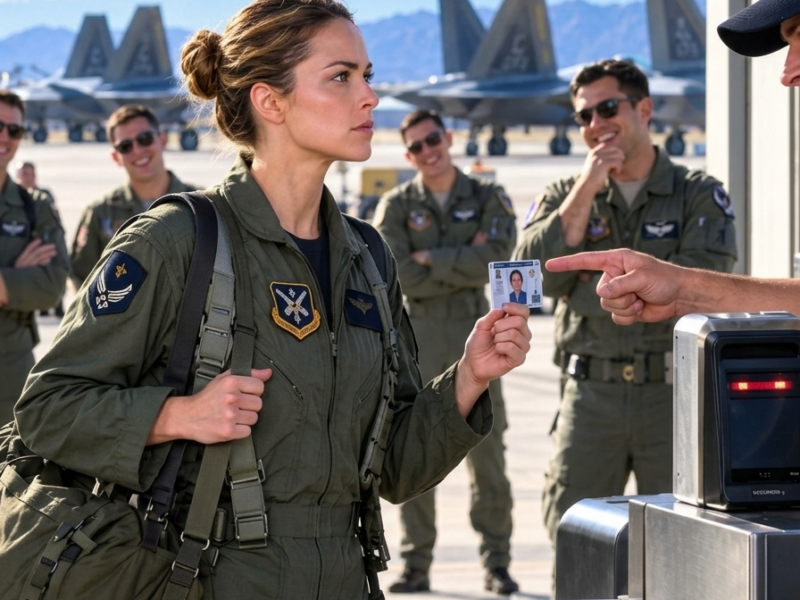
They laughed when the guard stopped me at the F-22 squadron gate and called my identification “fake,” but his smile disappeared
The salt-heavy wind blowing off the Chesapeake Bay carried the distinct smell of burnt jet fuel, ozone, and cold steel. Beneath the towering halogen security lights at the secondary perimeter gate of Langley Air Force Base, the humidity hung like a damp wool blanket. I stood motionless on the asphalt, my hands resting loosely at my sides, watching two junior Security Forces airmen examine my military identification card for the third time under a ultraviolet desk lamp.
“Ma’am, this clearance code doesn’t match your uniform patch,” the younger guard said, his tone straddling the line between routine boredom and subtle condescension. He looked up from my ID, scanning my worn, non-standard flight jacket and the plain dark trousers I wore instead of an operational flight suit.
The second guard, leaning against the door frame of the guard shack with an arm folded across his chest, smirked. “Maybe she took the wrong entrance. Civilian contractor entrance is two miles down the highway, lady.”
I said nothing. I kept my eyes fixed on the dark, cavernous outline of Hangar 4 in the distance. I had learned a long time ago—during twelve years of black-budget flight testing and high-altitude reconnaissance—that arguing with people who underestimated you only gave them an illusion of control. Confidence was quiet; ignorance was loud.
The first guard shrugged and slid my magnetic card through the high-security biometric terminal attached to the main gate barrier.
Beep.
The machine didn’t return the standard green confirmation chime. Instead, the terminal screen flickered wildly, the green backlight dying into a stark, pitch-black void. A second later, the liquid crystal display flared with a bright, solid red block of capitalized text.
CRITICAL OVERRIDE: STAND DOWN, COLONEL.
The guard’s smirk dissolved in an instant. His fingers froze above the key pad. The silence between us stretched, heavy and suffocating, broken only by the distant, low-frequency hum of twin Pratt & Whitney F119 engines idling on the far taxiway.
“Colonel?” the guard stammered, his eyes darting from the screen to my face, his posture snapping instantly from casual disrespect to rigid, trembling military posture.
“That’s what it says,” I said quietly.
He reached reflexively for the tactical radio mounted on his shoulder vest, his thumb hovering over the push-to-talk button. But before he could depress the switch, a motorized whirring cut through the damp air. Every high-definition pan-tilt-zoom camera mounted along the perimeter fence line pivoted simultaneously, locking their optical lenses directly onto our position at the gate.
A moment later, heavy footsteps crunched rapidly against the gravel and pavement. A senior officer—a Lieutenant Colonel wearing the patch of the 1st Fighter Wing—was half-running, half-marching across the apron from the main operations building. His flight suit was unzipped at the neck, his forehead slick with sweat despite the cool evening breeze.
He skidded to a halt in front of the gate, took one look at my face, and visibly paled.
“Colonel Hayes?” he asked, his voice strained.
I gave a single, firm nod. “Lieutenant Colonel Miller.”
Miller swallowed hard, glancing nervously at the two wide-eyed guards who were now standing at absolute attention. He lowered his voice into a harsh, frantic whisper. “We weren’t told you were coming, ma’am. Global Strike Command issued no visitor manifest for tonight.”
“I wasn’t supposed to come,” I said.
That single sentence hung in the air like a unexploded ordnance.
Three hours earlier, while sitting in my isolated cabin in the Blue Ridge Mountains—a place I had retreated to after taking early retirement four years ago—my encrypted legacy terminal had chimed. A priority-zero transmission had bypassed five layers of personal firewalls. It contained no name, no official seal, and no administrative header. Just an encrypted set of flight line coordinates at Langley, a specific tail number—F-22 Raptor #04-4082—and a stark, five-word warning:
Trust nobody inside the squadron.
I stepped past the paralyzed guards as Miller swiped his personal master card to open the pedestrian turnstile. I walked briskly toward Hangar 4, my boots hitting the concrete with a rhythmic, measured click. Miller followed three paces behind, his eyes darting toward the shadows between the maintenance structures, clearly terrified both by my presence and by whatever authority had triggered my clearance override.
The interior of Hangar 4 was vast, cool, and illuminated by dim, amber night-service halogen lamps. Suspended in the center of the bay sat the F-22 Raptor. It was an absolute masterwork of engineering—sleek, matte-gray, coated in radar-absorbent materials, looking like a sleeping predator carved from slate and carbon fiber.
I approached the airframe slowly, reaching out one hand to run my fingertips along the smooth composite skin near the port air intake. The metal was cold, but the subtle vibration of residual system power hummed faintly beneath the skin.
Something felt wrong.
I stepped closer to the underside of the left wing root, squinting against the harsh shadows cast by the overhead lights. A secondary avionics maintenance panel—one that should have been sealed with safety wire and stamped with a chief crew inspector’s seal—was set slightly askew. The latch was flush, but the rubber weather seal was pinched by less than a millimeter.
I drew a small tactical flashlight from my jacket pocket, clicked it on, and used a thin steel multi-tool from my belt to release the panel’s quick-turn fasteners. The panel swung open on its hinge.
Deep within the tangle of high-voltage fiber-optic lines and environmental control conduits, a non-standard component sat wedged against the primary flight-control computer interface. It was tiny, no larger than a thumb drive, wrapped in heat-resistant black tape, its microscopic LED light pulsing with a faint, rhythmically steady amber glow.
Miller leaned over my shoulder, his breath hitching in his throat as the flashlight beam illuminated the device. “What… what is that? Is that a diagnostic bypass?”
“It’s a rogue telemetry relay and remote actuator,” I said, my voice dropping into a register colder than the concrete beneath our feet. “It’s a tracker. And a flight-control override.”
Miller’s face drained of color entirely. “That… that’s impossible. This aircraft is scheduled for a classified operational deployment over the North Atlantic in forty-five minutes. Major Carter is supposed to—”
Before Miller could finish his sentence, a heavy, metallic bang echoed through the structure.
The massive, multi-ton corrugated steel hangar doors slammed shut with violent speed, sealing us inside. Simultaneously, the overhead amber lights died, plunging the vast space into pitch-black shadow, broken only by the narrow, white beam of my hand-held flashlight.
Then, from the dark perimeter of the hangar bay, the auxiliary power units of four surrounding F-22 Raptors roared to life in unison. The deafening, twin-engine turbine whine echoed off the steel girders above us, creating a chaotic vortex of noise and exhaust fumes.
My tactical radio headset, mounted inside my jacket collar, crackled with violent static. A low, gravelly man’s voice whispered directly into my earpiece, smooth, controlled, and utterly devoid of mercy.
“Colonel Hayes… you really should have stayed retired in the mountains.”
My fingers tightened around the extracted electronic tracker so hard the hard plastic housing bit into my palm. I knew that voice. I would know that voice if I heard it through a wall of flame or across forty years of dead time.
It was General Richard Vance—the man who, twelve years ago, had presided over the military board of inquiry following the mid-air destruction of an experimental fighter prototype over the Nevada test range. He was the man who had signed the official death certificate declaring my younger brother’s fatal crash a result of “pilot error and severe spatial disorientation.”
Case closed. Honor disgraced. Family shattered.
For twelve long years, I had forced myself to accept that official paper narrative, burying my grief under years of solitary service and eventual exile. But standing here in the dark, surrounded by roaring engines and smelling the ozone of a compromised squadron, the illusion evaporated.
My brother hadn’t made a mistake. He had found this exact same shadow inside the fleet.
And now, somewhere behind the darkened glass of the hangar control booth overlooking the floor, the man who had buried my brother was waiting to finish the job.
“Miller, get behind the main landing gear!” I barked over the deafening scream of the turbine engines, shoving the Lieutenant Colonel toward the heavy titanium wheel assembly of Raptor #082.
The hangar was a storm of noise and shadows. The high-pitched whine of four APUs running simultaneously inside an enclosed space was deafening, the vibration rattling the fillings in my teeth and shaking loose flakes of paint from the ceiling trusses seventy feet above. Red emergency strobe lights began to flash along the perimeter walls, casting long, grotesque crimson shadows across the silent aircraft.
Miller was trembling, his back pressed against the massive rubber tire of the main landing gear. “This… this is a containment breach! Security Forces will be breaking through those doors in thirty seconds!”
“Security Forces aren’t coming, Miller!” I shouted back, crouching low and sweeping my tactical flashlight across the dark catwalks attached to the upper walls of the hangar. “Look at the gate terminal! The main base security grid was overwritten the second I stepped through the turnstile. Whoever is running this operation controls the base network nodes!”
Suddenly, a sharp crack echoed above the roar of the engines, followed by the sound of metal splinters striking the concrete inches from my left boot. A high-velocity bullet had punched through the composite skin of the wing above us.
“Sniper in the overhead maintenance gantry!” I yelled, pulling Miller deeper into the shadow of the fuselage.
I drew my personal sidearm—a compact SIG Sauer P320 I carried in a concealed shoulder holster—and racked the slide. I didn’t have armor-piercing rounds, and shooting at a target illuminated only by flashing red emergency strobes seventy feet up in the iron rafters was a low-probability engagement. But I didn’t need to kill the shooter; I needed to move.
“Listen to me,” I said, grabbing Miller by the collar of his flight suit and pulling his face close to mine. “That device I pulled out of the avionics bay wasn’t just sending data out. It was designed to receive an external command signal once the jet reached international airspace over the Atlantic. If that plane took off tonight, whoever holds the master transmitter could have forced it down in foreign territory—or commanded it to dive into the ocean without leaving a trace of mechanical failure.”
Miller’s eyes widened in realization. “Just like… just like the prototype in Nevada twelve years ago.”
“Exactly like Nevada,” I said grimly. “Now, where is the manual override for the hangar ventilation and emergency fire suppression systems?”
Miller pointed a shaking finger toward the far eastern corner of the hangar, past two idling F-22s whose exhaust nozzles were shimmering with heat wash. “There… the master environmental control panel behind the crew chief station! But it’s seventy feet across open concrete! We’ll be cut down before we clear twenty paces!”
“Not if they can’t see us,” I replied.
I reached into my flight jacket pocket and pulled out two standard-issue M18 smoke grenades I had secured from my vehicle’s emergency kit before walking up to the gate. I pulled the ring pin on the first grenade, held the lever for a fraction of a second, and hurled it toward the center of the hangar floor. A second later, I threw the second grenade toward the base of the gantry ladder where the sniper was positioned.
Thick, billowing clouds of dense white chemical smoke erupted across the polished concrete floor, rapidly filling the bay and swirling into the jet intake currents of the idling engines. The flashing red strobe lights turned the smoke into a chaotic, disorienting fog of crimson light.
“Move!” I yelled.
Miller and I darted into the whiteout, keeping our heads low and our steps fast. High above, rapid automatic gunfire erupted from the upper gantry. Bullets ricocheted off the concrete deck, throwing sparks through the fog, but the shooter was firing blind, guessing our vectors.
I reached the crew chief station in eight seconds, slamming my back against the heavy steel housing of the environmental control console. I smashed the glass cover of the emergency suppression panel with the butt of my sidearm and reached inside, grabbing the heavy red pull-handle marked HALON / CO2 DISCHARGE – MANUAL OVERRIDE.
I yanked it down with all my weight.
A deafening, high-pressure roar erupted throughout the entire hangar as pressurized fire-extinguishing gas flooded out of hundreds of ceiling nozzles. The nitrogen-rich Halon gas rapidly displaced the air in the upper third of the hangar space, smothering the oxygen supply.
Above us, the sniper’s gunfire suddenly ceased as the shooter began coughing violently, gasping for air in the oxygen-depleted upper layer. Down on the floor, the auxiliary power units of the four F-22s sputtered, choked on the gas-heavy air mixture, and died one by one, dropping the hangar into a sudden, eerie silence.
Only the hiss of escaping gas and the heavy panting of my own breath remained.
“Miller,” I whispered into the haze. “Stay low. The Halon settles near the ceiling first, but it’ll sink. We have three minutes before this whole bay becomes unbreathable.”
I moved stealthily toward the glass-enclosed hangar control booth elevated twelve feet above the floor at the rear of the bay. The door to the booth was slightly ajar, a narrow beam of yellow light cutting through the dying smoke.
I climbed the open metal stairs, step by step, my pistol raised, my finger resting lightly against the trigger shoe.
I kicked the door open, swinging my sight line across the room.
The control booth was empty. But on the main console desk, three high-resolution computer monitors were active, displaying real-time satellite feeds, internal base security camera loops, and a secure data-transmission pipe uploading thousands of gigabytes of flight telemetry to an offshore IP address.
Beside the central keyboard lay a leather-bound military officer’s notebook. Its cover was embossed with a silver star and the name: GENERAL R. VANCE.
I stepped up to the desk, my eyes scanning the open page. Written in crisp, fountain-pen ink were flight schedules, financial transfer codes, and a list of seven airframes—including the F-22 sitting downstairs and the prototype my brother had flown twelve years ago.
At the bottom of the page, underlined twice, was a single handwritten note:
The sister is asking questions again. Terminate protocol legacy.
A cold, calm clarity washed over me. Vance hadn’t just been covering up a single past crime. For over a decade, he had been operating a shadow network inside the defense hierarchy, weaponizing flight-control overrides to sabotage advanced aircraft programs and sell the recovered technology to private foreign syndicates. My brother had been the first casualty. I was supposed to be the last.
Behind me, the metallic click of a revolver cocking echoed softly in the doorway.
“You always were remarkably stubborn, Emily,” General Vance’s voice spoke quietly from the threshold. “Just like Steven. Neither of you could ever accept that some secrets are far larger than individual lives.”
I didn’t turn around immediately. I looked at his reflection in the dark glass of the computer monitor before me. He was wearing his full dress uniform, his chest covered in rows of campaign ribbons, his hair silver, his face composed and cold.
“It wasn’t an accident,” I said, my voice steady. “You murdered him.”
“I protected the program,” Vance corrected softly. “And tonight, I protect myself.”
“Protecting yourself?” I said, slowly turning my head to face him, keeping my pistol lowered at my side where he couldn’t see the angle of my grip. “Is that what you call selling flight telemetry and remote control codes to foreign syndicates, General? Is that ‘protecting the program’?”
Vance stood six feet from me in the narrow doorway of the control booth. In his right hand, he held a sleek, silenced 9mm pistol pointed directly at my chest. His posture was relaxed, the absolute composure of a man who had commanded armies and manipulated military courts for thirty years without ever facing a single consequence.
“You view the world through the narrow lens of a tactical pilot, Colonel,” Vance said, his voice smooth and conversational, as if we were discussing flight doctrine in an air-conditioned briefing room. “You see flags, oaths, and clear lines between allies and adversaries. But at the executive level, technology development costs hundreds of billions of dollars. The budget cuts handed down by Congress ten years ago would have crippled our advanced aerospace research entirely.”
“So you privatized treason,” I said coldly.
“I monetized redundancies,” Vance replied, his eyes narrowing slightly. “By selectively leaking controlled telemetry to our international partners, I generated the off-the-books capital required to fund our black-budget stealth initiatives. Your brother discovered a transaction route that he wasn’t cleared to see. I offered him a place at the table. He refused. He chose to play the martyr.”
“He chose to be a soldier,” I snapped, my eyes locking onto his. “He had honor. You’re just a thief with four stars on your collar.”
Vance sighed softly, a subtle gesture of theatrical disappointment. “Honor doesn’t build fifth-generation fighters, Emily. It just fills graves in Arlington. Now, step away from the terminal.”
“Why Langley?” I asked, taking a tiny, deliberate half-step backward toward the console, my fingers feeling behind my hip for the edge of the heavy steel desk. “Why compromise an active operational squadron here tonight?”
“Because tonight marks the final phase,” Vance said, stepping further into the room to close the distance. “The Aegis-4 flight automation system installed in that Raptor downstairs is the crown jewel of autonomous combat systems. Once that aircraft takes off and its control is transferred to my offshore partners, my work is complete. I retire to a non-extradition country with two hundred million dollars. And you… you will be remembered as a disgraced, unstable former officer who broke into a secure hangar, executed Lieutenant Colonel Miller, and died in a tragic shootout with base security.”
“You forgot one thing, General,” I said softly.
Vance’s eyebrow twitched. “And what is that?”
“I’m not the only ghost in this base.”
Before Vance could pull the trigger, the glass window behind him exploded inward with a deafening crash.
Lieutenant Colonel Miller—having climbed up the exterior service ladder through the dense smoke—had used a heavy steel fire extinguisher to shatter the observation pane. The sudden shower of glass and the roaring pressure wave distracted Vance for a split second, his eye flicking reflexively toward the shattered window.
That was all the time I needed.
I lunged forward, slamming my left hand into Vance’s weapon arm, forcing the gun upward as a silenced round cracked through the air, punching a clean hole through the acoustic ceiling tiles above. I drove my right knee into his midsection, following up with a hard elbow strike across his jaw.
Vance stumbled back, his gun clattering to the linoleum floor. Despite his age, his military training took over; he recovered his balance quickly, reaching into his boot to draw a tactical combat knife, the six-inch steel blade glinting in the monitor light.
He slashed wildly across my chest. I leapt backward, the blade slicing through my flight jacket, missing my ribs by less than an inch.
“You’re not leaving this room, Emily!” Vance roared, lunging forward with a straight thrust aiming for my throat.
I parried his wrist with my left forearm, stepping inside his guard, grabbing his shoulder, and using his own momentum to execute a close-quarters hip throw. Vance flew over my shoulder, slamming hard onto the steel frame of the primary computer terminal. The force of the impact shattered the glass of two monitors and knocked the wind from his lungs in a wet, choking gasp.
The knife dropped from his hand. I immediately kicked it across the floor, through the shattered window, where it plummeted twelve feet into the darkness of the hangar floor below.
I retrieved my sidearm from the desk where I had laid it, holding it firmly in a two-handed grip centered on Vance’s chest as he lay groaning on the floor, clutching his fractured ribs.
Miller scrambled through the broken window frame, his flight suit torn and covered in glass dust, holding a heavy wrench in his hand. He looked down at the bleeding General, then up at me, his chest heaving.
“The… the main base security gate just responded to a hard-wire override!” Miller panted. “Federal marshals and Air Force Office of Special Investigations units are smashing through the perimeter barriers right now! They’ve surrounded the entire flight line!”
Vance let out a raspy, coughing laugh from the floor, wiping blood from his lip. “It doesn’t matter… you’re too late… the automated transmission… it’s already reached the uplink satellite… the flight data is gone…”
I looked down at the central terminal display. A green progress bar was sitting at 99%, flashing as it finalized the massive data transfer to an anonymous server array located in international waters.
“He’s right,” Miller said in horror, looking over my shoulder at the screen. “In four seconds, the complete control architecture for the entire F-22 fleet will be permanently downloaded to an untraceable foreign network.”
I reached into my pocket, pulled out the tiny black electronic tracker I had extracted from Raptor #082’s wing root, and held it above the open terminal circuit board.
“Not if I corrupt the hand-shake protocol,” I said quietly.
I slammed the rogue tracker directly into the primary fiber-optic bus of the master transmitter, forcing a massive, short-circuit feedback loop back into the satellite beam.
The console exploded in a shower of brilliant blue sparks and acrid white smoke.
The high-frequency whine of the satellite uplink dish mounted on the hangar roof shrieked through the building’s audio systems before cutting out entirely. On the main monitor, the green progress bar froze, shattered into corrupted blocks of red code, and vanished, replaced by a flashing, system-wide system error prompt:
TRANSMISSION ABORTED. HARDWARE SIGNATURE CORRUPTED. DATA PURGED.
General Vance stared up at the dying screen, his face turning an ashen, deathly gray. The arrogant composure that had sustained him for twelve years crumpled into absolute, helpless ruin.
“No…” Vance whispered, his voice trembling as he reached out a blood-stained hand toward the ruined console. “No… thirty years… thirty years of work…”
“It wasn’t work, Vance,” I said, stepping over him and retrieving the leather-bound notebook containing his handwritten records of the conspiracy. “It was treason. And it ends tonight.”
Down on the hangar floor, heavy steel rams smashed against the exterior personnel doors. The heavy doors gave way with a violent metallic screech, and bright white tactical spotlights flooded through the smoke. Dozens of heavily armed OSI agents and military police officers poured into the bay, their weapons raised, their tactical boots thunderous on the concrete.
“CLEAR THE BAY! HANDS IN THE AIR!” shouted a loudspeaker from the ground floor.
Miller leaned out of the shattered control booth window, waving his arms frantically. “UP HERE! hangar CONTROL BOOTH! WE HAVE GENERAL VANCE IN CUSTODY! STAND DOWN!”
Ten minutes later, the hangar was lit by bright, white floodlights. Federal agents in windbreakers marked OSI and FBI had completely cordoned off the facility. Technical teams were already securing the physical servers, cataloging the rogue hardware extracted from Raptor #082, and taking high-resolution photographs of the evidence scattered across the control room floor.
General Vance was led down the metal stairs in heavy steel handcuffs, flanked by four federal marshals. As he reached the bottom step, he paused, turning his head to look back at me one last time. His eyes were hollow, stripped of all authority, reduced to those of a bitter old man who had traded his legacy for money he would never spend.
I didn’t say a word to him. I just watched him go, standing beside the sleek, dark nose of the F-22 Raptor he had tried to weaponize against the country he had sworn to defend.
A senior special agent in a dark suit walked up to me, holding a tablet computer and a secure evidence bag containing Vance’s notebook.
“Colonel Hayes,” the agent said, extending a hand in genuine respect. “I’m Special Agent Miller with OSI Internal Affairs. We’ve been tracking small anomalies in the logistics chain for two years, but we could never bypass Vance’s security clearances to get the physical proof. What you did here tonight saved this entire wing.”
“I didn’t do it for the wing,” I said, taking a deep breath of the cool air blowing in through the open hangar doors. “I did it for my brother.”
“We found the original, unedited telemetry logs from your brother’s flight in Nevada hidden inside Vance’s private encrypted partition,” the agent said softly, his tone turning gentle. “Major Steven Hayes was a hero, Colonel. He realized his flight controls had been hacked, and instead of ejecting over a populated area, he stayed with the aircraft to force it down in an empty dry lake bed so the system couldn’t be recovered by Vance’s operatives. He sacrificed himself to protect the technology.”
My throat tightened. The knot of cold rage and unresolved grief that had sat deep in my chest for twelve long years slowly began to uncoil, replaced by a painful, beautiful sense of clarity.
Steven hadn’t failed. He hadn’t panicked. He had fought until the absolute last second, holding the line against the same shadow I had finally brought into the light tonight.
“Can I see his file?” I asked, my voice barely above a whisper.
The agent tapped his tablet screen and handed it to me. On the display was the revised, official Air Force incident report, its status updated in bold blue letters:
ACTION COMPLETE: MAJOR STEVEN HAYES. CLEARANCE: EXONERATED. CITATION FOR DISTINGUISHED FLYING CROSS PENDING.
I looked down at his portrait—a young man in a flight helmet, smiling confidently under the bright desert sun of Nevada—and felt a tear slip down my cheek, wiping it away before anyone could notice.
“Thank you,” I told the agent, handing the tablet back.
I walked out of Hangar 4, leaving behind the flashing emergency lights, the shouting federal agents, and the shattered pieces of a decade-long lie.
The dawn sky over Langley Air Force Base was breaking in long, breathtaking ribbons of gold, rose, and brilliant sapphire. The storm clouds that had hung low over the Chesapeake Bay overnight were dissipating into the morning wind, leaving the air clean, crisp, and clear.
I walked along the edge of the flight line, my flight jacket draped over my arm, the cool morning breeze catching my hair. Beside me walked Lieutenant Colonel Miller, carrying two paper cups of steaming black coffee he had picked up from the squadron lounge.
He handed one to me. “What happens now, Emily? The Department of the Air Force is already talking about reinstating your full rank and offering you command of the 1st Operations Group.”
I took a slow sip of the hot coffee, watching a pair of F-22 Raptors execute a perfectly synchronized tactical takeoff in the distance. They rocketed into the morning light, their twin afterburners glowing like bright orange stars against the blue sky before vanishing into the upper atmosphere.
“Command isn’t for me anymore, Miller,” I said, a soft, genuine smile touching my lips for the first time in years. “My war ended when the sun came up.”
“You’re going back to the Blue Ridge Mountains?” Miller asked.
“I am,” I replied. “I have a cabin to finish, some quiet roads to walk, and twelve years of peace to catch up on.”
Miller stopped walking and turned to face me, snapping a crisp, immaculate military salute. “It was an honor standing in the dark with you, Colonel.”
I returned his salute, holding it for a long moment under the bright light of the new day. “Keep your eye on those maintenance panels, Miller. Don’t let anyone tamper with your sky.”
“Yes, ma’am,” he said, smiling as he lowered his hand.
I turned and walked toward my old civilian truck parked near the main gate. The base was bustling with morning activity now—ground crews in bright vests wheeling equipment across the tarmac, young pilots carrying their flight helmets and mission boards, fire trucks returning to their stations after the night’s lockdown was lifted.
The shadows that had filled Langley Air Force Base were gone, cleared away by the light of truth and the quiet strength of those who refused to let honor be bought and sold.
As I climbed into the cab of my truck and started the engine, my eyes caught my reflection in the side mirror. For twelve years, I had seen a ghost staring back at me—a woman haunted by an unsolved tragedy, driven by suspicion, isolated from the world.
Now, looking into the mirror, I saw only myself: Colonel Emily Hayes, pilot, sister, survivor.
I shifted the truck into gear, turned onto the open highway leading west toward the mountains, and drove away into the morning sun, leaving the skies safe for those who flew them.
The end.









