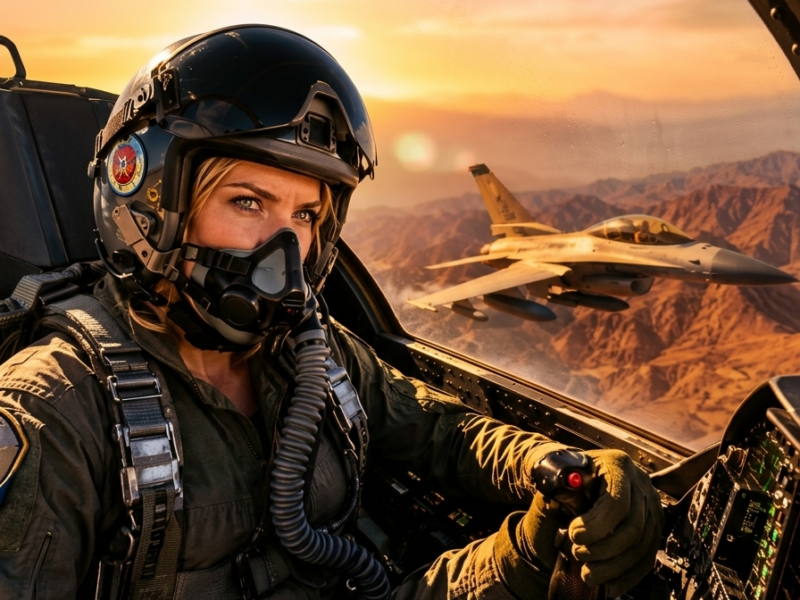
They laughed when my battered F-16 rolled onto the runway at Kandahar, calling it “just one Warthog,”
The morning sun over Kandahar did not warm the earth; it baked it until the horizon wavered like liquid glass. The flight line smelled of stale JP-8 jet fuel, scorched rubber, and the fine, chalky dust that drifted down from the jagged peaks of the Hindu Kush. Ground crews moved in deliberate, exhausted patterns, their flight suits soaked through with dark patches of sweat. Among the rows of pristine, slate-grey aircraft sitting under reinforced sunshades, my jet looked like an iron relic hauled out of an abandoned scrap depot.
Technically, she was designated an F-16C Fighting Falcon, Block 30, tail number 86-0241. But the ground crews had long since stripped her of modern decorum. During the brutal winter campaigns, she had taken heavy shrapnel to her engine cowlings and wings, patched over with unpainted riveted titanium plating salvaged from decommissioned A-10 Thunderbolts. The mechanics had laughed and chalked the word Warthog in grease pencil along the right intake duct. Over time, the insult stuck. She carried excessive weight, her flight control computers complained incessantly about drag discrepancies, and her faded paint bore the matte, oxidized texture of sandpaper.
I rested my gloved hand on the fuselage beneath the cockpit rail, feeling the deep, uneven ridges of an old weld seam. Twenty-four years of desert dirt and extreme thermal stress had etched their way into her metal skin. To the junior pilots fresh out of undergraduate pilot training at Sheppard, she was a death trap. To the logistics officers, she was an accounting error waiting to be written off. To me, she was the only cockpit on this base where I could breathe without feeling like an imposter.
“Captain Miller, you’re not seriously signing for this pig today,” Lieutenant Marcus “Ghost” Vance called out, jogging across the scorched tarmac with his helmet bag swinging against his knee. He was twenty-five, full of kinetic energy, and assigned as my wingman for the morning’s mission. He had been assigned to the pristine Block 50 parked two bays down—a machine with smooth conformal fuel tanks, high-definition displays, and avionics that practically flew the jet for you.
“Paperwork is already filed, Marcus,” I replied, not looking away from my walkaround inspection. I crouched beneath the belly, shining my penlight into the main landing gear bay. Hydraulic fluid had wept around an actuator seal, but it was within limits. Barely. “She’s armed, fueled, and her turbine runs within five degrees of baseline. That’s all we need.”
“Miller, look at her skin,” Marcus insisted, stopping beside the ladder and resting his hand on his hip. “She’s got riveted patch panels on her intake. The crew chiefs call her the Warthog because she flies like an armored tractor. Our frag order is an interdiction run over Sector Seven. The ridges are crawl spaces. If you get into high-G maneuvering at that density altitude, her flight computers might lock your control surfaces just to keep her wings from snapping off.”
“Then I won’t let the computers fly her,” I said, stepping back out from beneath the fuselage. I pulled my flight gloves tighter over my fingers, feeling the familiar tug of Nomex. “She brought me home last time we took ground fire over the Helmand valley. She has thick skin where it counts.”
Marcus let out a dry, nervous laugh that died instantly in the heavy heat. “Miller, they’re not just sending insurgent technicals with heavy machine guns today. Intel flashed an update while you were finishing preflight. A rogue squadron crossed the northern ridge an hour ago. Unmarked multirole fighters. Russian export models, upgraded radar suites, modern BVR missiles. They’re hunting.”
“I know,” I said quietly.
He stared at me, waiting for fear or surprise to crack my expression. When neither came, he shook his head and walked toward his aircraft. “You’re crazy. If we run into those bandits, that crate will be a fireball before your radar even paints them.”
I didn’t answer. I climbed the yellow crew ladder, one rung at a time, stepping into the narrow, familiar sanctuary of the cockpit. The interior of tail 86-0241 lacked the glass-cockpit gloss of newer variants. The analog attitude indicator sat heavy and central, flanked by green-tinted cathode ray multifunction displays that flickered with faint phosphor hums. Above the instrument glare shield, scratched into the matte-black metal frame by an unknown pilot decades ago, was a small, crudely carved phrase: Patience bites deeper than speed.
My father had said those exact words to me when I was ten years old, standing beside his wooden work desk in our garage in Colorado, showing me how to contour-fly a model plane through the narrow cracks of an uneven wooden shelf. He had disappeared in an operational deployment over these very mountains when I was twelve. No wreckage recovered. No body brought home. Just an empty flag presented to my mother and an official file stamped classified indefinitely.
“Crew chief, pin pulled,” I called down through the comms lead.
“Clear on start, Captain,” the chief responded through my headset.
I initiated the jet fuel starter. A low, guttural whine vibrated through the steel of my seat, building in pitch until the General Electric F110 turbofan caught ignition. A wall of heat and compressed air roared behind the aircraft. The engine instruments settled into steady green bands. No warnings. No red flags. The old girl was awake, her mechanical heart beating with a steady, uncompromising cadence.
Ten minutes later, we rolled onto the active runway at Kandahar. Over the tower frequency, I heard the faint chuckle of a controller who thought he was off-mic: “Look at that museum piece rolling. Bet twenty bucks Marcus has to haul her back on single engine.”
I ignored it, checked my trim settings, and pushed the throttle smoothly through the detent into full military power, then slammed it forward into full afterburner.
A violent, raw surge of thrust shoved me back into the seat cushions. The runway markers blurred into streaks of grey and white. At one hundred and forty knots, I eased back on the stick. The heavy nose pitched upward, the landing gear thudded into the wheel wells with mechanical finality, and we clawed our way into the pale blue morning sky.
Within fifteen minutes, we cleared the flatlands and entered the jagged labyrinth of the southern Hindu Kush. The jagged peaks rose up like the teeth of a giant beast, their jagged granite faces catching the sharp morning sun. Marcus flew off my right wing, his aircraft moving with sleek, effortless grace. Below us, the valleys were deep, shadowed trenches where radio signals bounced and died against sheer stone walls.
Our assignment had seemed straightforward on paper: provide top cover for an allied convoy traversing the Shah-i-Kot pass. But five minutes before we reached the ingress point, my cockpit erupted in noise.
A shrill, urgent tone sliced through my headset. My primary threat display—a small, circular screen designed to pick up radar emissions—lit up with three distinct strobes sweeping from the north.
“Vance, radar spike, bearing zero-one-zero,” I snapped, leaning forward against my harness.
“I see them!” Marcus shouted, his voice jumping an octave. “Three contacts! They’re fast, Miller. Mach one point two, descending out of thirty thousand feet. Bandits closing fast!”
I looked through the clear canopy toward the northern ridge. High above the snow-capped crests, three needle-like silhouettes punched through a thin layer of cirrus clouds. They were Flankers—heavy, twin-engine air superiority fighters designed specifically to slaughter aircraft like mine.
For five agonizing seconds, nobody spoke. The world seemed to hang in suspended animation, the distance closing at combined speeds exceeding fifteen hundred miles per hour. Then, the silence broke.
An open, unencrypted guard frequency crackled with a burst of static, followed by a voice speaking in accented, mocking English.
“Just one F-16 and a stray pup?”
A second voice chimed in, accompanied by the cold, dry sound of laughter. “Easy target. Take the lead first. Strip the old skin.”
I felt my jaw clench so hard my teeth ached. The flight computers began their frantic warning chimes, warning of incoming radar locks. The three Flankers fanned out into a wide combat spread, preparing to launch long-range missiles that would vaporize us before we could even close within visual range.
“Break right, Miller! Break right and pop chaff!” Marcus screamed, his jet already banking sharply away in panic.
“Negative,” I said, my voice dropping into a flat, icy calm. “Stay low. Cancel afterburner. Follow me down.”
“Down where? There’s nothing down there but rocks!”
“Trust me,” I said, gripping the control stick with both hands. “Stay tight, or you’re dead.”
Then, I cut the throttle and slammed the nose straight toward the abyss.
The world inverted. The pale sky vanished, replaced entirely by a wall of reddish-brown stone that rushed toward my faceplate at six hundred miles an hour.
G-forces drained the blood from my eyes for a fraction of a second, greying out my peripheral vision until the anti-G suit bladders inflated around my thighs and abdomen, violently squeezing the blood back toward my brain. I pulled the throttle out of idle just enough to keep the engine from flaming out in the turbulent mountain air, leveling the wings as we slipped beneath the rim of the canyon.
The canyon was known on tactical charts as the Devil’s Throat—a narrow, serpentine fracture carved into the granite by ancient glacial runoff. In most places, it was less than two hundred meters wide. The jagged rock walls shot straight up for thousands of feet on either side, completely blocking the sun and plunging us into deep, cold shadow.
“Miller! Pull up! Pull up, we’re going into the wall!” Marcus screamed over the tactical frequency. His voice was raw with terror.
“Keep your eyes on my tail,” I commanded, adjusting the rudder pedals with millimeter precision. “Do not look at the rock. Look at my exhaust nozzles. Fly the space between.”
Behind us, the three Flankers were not content to let their prey escape. Their pilots were confident, emboldened by their superior speed, thrust-vectoring engines, and modern avionics. Two of them pitched downward, diving after us into the jagged gorge, while their flight leader remained high, circling above the canyon like an eagle waiting for a rabbit to bolt from its hole.
A blaring audio tone warned of an infrared lock. The first chasing Flanker had squeezed into the chasm, diving hard, its pilot attempting to acquire a heater missile shot before the canyon’s twists broke line-of-sight.
“Break left, Marcus!” I barked.
We banked hard onto our sides, our wings cutting vertically through the narrow trench. The left wingtip passed within thirty feet of a protruding granite ledge, stripping away pine branches and kicking up a cloud of pulverized rock dust. Behind us, a heat-seeking missile slammed into the canyon wall where we had been a second earlier. The detonation echoed like rolling thunder through the gorge, a massive fireball erupting in our wake that sent shockwaves rippling through my flight surfaces.
Tail 86-0241 shuddered violently. The mechanical stick-shaker rattled against my palms, warning that the wing was approaching an aerodynamic stall. Modern F-16 flight computers would have automatically overridden my inputs to prevent the jet from exceeding safe limits, forcing the nose down and driving me directly into the rock face. But this aircraft had been modified. The override switches on my left console were toggle-flipped to manual; the safety nets had been cut years ago.
“How are you holding this thing?” Marcus shouted through heavy, labored gasps. He was fighting his Block 50’s computerized flight envelope, his jet twitching erratically as its automated systems tried to prevent him from flying dangerously close to the stone walls.
“Stop fighting the machine, Marcus! Let the air carry you!”
I knew this canyon. I had never flown it in a real combat aircraft, but I had flown it a thousand times in my sleep, mapped out in my father’s hand-drawn terrain notebooks that I kept locked in my footlocker at Kandahar. He had documented every bend, every blind thermal pocket, every blind alley in this mountain range during the border conflicts of the 1990s. He had written notes in the margins in blue ink: The draft at the third bend will lift you twenty feet if you cut the inner apex. Never use the brakes. Bank with the current.
Ahead, the canyon narrowed sharply into an S-curve that resembled an optical illusion—it looked like a solid rock wall with no exit.
“There’s no way through!” Marcus cried. “Miller, it’s a dead end!”
“Follow me!”
I pulled back slightly on the stick, trading forward velocity for lift, climbed thirty feet, and executed a radical four-G knife-edge roll to the right, slipping through a fissure in the rock barely wider than the F-16’s thirty-foot wingspan. Marcus followed on instinct, his Block 50 slipping through by inches.
The Flanker trailing immediately behind us was flying too fast.
Its pilot, intoxicated by the chase and relying on his modern avionics to compute a terrain-following flight path, did not anticipate the sudden blind angle of the gorge. In the narrow corridor, his radar failed to differentiate between the true exit and the sheer cliff face.
Through my rearview mirror, I saw the twin exhausts of the enemy jet attempt a desperate, high-G vertical pull. It was impossible. At five hundred knots, the physics were merciless.
The multi-million-dollar fighter struck the vertical granite face dead center.
The impact was instantaneous and silent to our ears, swallowed by our own engine roar. A brilliant orange sun exploded within the shadowed gorge, followed by a shockwave of pressurized air and shredded metal fragments that sprayed across the canyon floor.
“Contact one destroyed!” Marcus yelled, his voice cracking with disbelief. “Holy hell, Miller, one just vanished into the wall! How did you do that?”
“Check your six!” I interrupted, refusing to let adrenaline dull my focus. “The second one is still behind us, and he’s closing.”
The second Flanker had learned from his wingman’s death. He had dropped his speed, deployed his airbrakes, and was maintaining a steady four-hundred-knot crawl two thousand meters behind Marcus, waiting for the canyon to widen.
And it was widening. Just ahead, the Devil’s Throat emptied into an expansive, bowl-shaped glacial amphitheater surrounded by snow-covered ridges. If we broke into that open airspace, the chaser would have an open shot with his thirty-millimeter cannon, and the flight leader orbiting above would dive from the high perch to finish us.
“We can’t go out there,” Marcus said, breathing heavily. “They’ll pick us apart in the open.”
“We’re not running into the open,” I said. “We’re going to turn the trap around.”
“In this heavy pig? Miller, she can’t out-turn a twin-engine fighter in a flat circle!”
“She doesn’t have to out-turn him,” I murmured, watching the canyon walls begin to recede. “She just has to out-brake him.”
I reached for the speed brake switch on the throttle, resting my thumb over the toggle. The airframe vibrated around me, a continuous, deep resonance that felt less like steel and aluminum and more like an old warhorse gathering its muscles for a lethal leap.
“Get ready to punch through, Marcus,” I said. “When I say break, you climb straight into the sun. Don’t look back.”
“What about you?”
“I’m going to introduce him to the Warthog.”
We burst out of the canyon’s mouth into the blinding alpine light of the glacial basin. Behind me, the second Flanker surged forward, its twin afterburners igniting with blue diamond shocks as its pilot lined up his shot on my battered tail.
The transition from the shadowed trench to the blinding alpine glare was like stepping out of a dark room into an explosion. The snow-covered slopes of the basin reflected the sunlight with blinding intensity, searing through the tinted visor of my helmet.
“Break right, climb into the sun, now!” I roared over the radio.
Marcus reacted instantly. His sleek Block 50 banked hard, snapping into a seven-G vertical climb, chasing the blinding orb of the sun where enemy radar and optical trackers would struggle to follow his heat signature.
The pursuing Flanker didn’t even look at him.
Its pilot wanted me. To him, my battered, patch-plated F-16 was the easy kill, the wounded animal limping away from the pack. In my threat receiver, the launch tone shifted to a solid, deafening scream. The pilot had acquired a solid infrared track and was less than a mile off my tail, well within gun range and point-blank missile envelope.
I didn’t turn. I didn’t drop flares.
I pulled the throttle back to idle, popped the speed brakes full out, and simultaneously stomped the left rudder pedal while hauling the control stick straight back into my gut.
It was an aerodynamic maneuver that no computer-controlled fighter jet should have been allowed to execute. The Block 50 would have softened the inputs to prevent a catastrophic structural overload. But on tail 86-0241, with the flight limiter toggles disabled, the mechanical linkages answered with violent, unyielding compliance.
The heavy titanium-reinforced wings bit into the thin mountain air like broadswords. The jet pitched up sixty degrees in less than half a second, the speed brakes tearing into the slipstream with a sound like tearing canvas. The aerodynamic drag was monstrous. My airspeed plummeted from five hundred knots to two hundred in the space of three heartbeats.
The G-forces spiked instantly. Nine Gs crushed me into the ejection seat. The weight of my helmet drove my chin into my chest; my arms felt like they were cast in solid lead. The edges of my vision narrowed to a pinpoint tunnel of light, but through the top edge of my canopy, I saw the enemy Flanker.
He had not expected the sudden deceleration.
At five hundred knots, the Flanker shot directly underneath my belly, overshooting my jet by less than fifty feet. The wake turbulence from his twin engines slammed into my aircraft, rolling me twenty degrees to the side, but the extra armor plating and heavy forward balance kept the nose stable.
For half a second, the enemy pilot looked up through his clear canopy and saw me floating directly above him, upside down, matching his direction of travel while bleeding speed like an anchor dropped into the sea. I could see the dark silhouette of his helmet, the white flash of his oxygen mask as he turned his head in absolute, paralyzed astonishment.
“My turn,” I whispered through gritted teeth.
I slapped the speed brakes shut, shoved the throttle forward into full afterburner, and used the rudder to drop the nose onto his tail.
The old General Electric engine answered with a thunderous roar. The aircraft shuddered as fuel flooded the combustion chambers, kicking me forward with savage acceleration. The enemy fighter was desperately trying to recover, its pilot hauling his stick back to initiate an emergency vertical climb, but he was trapped in his own momentum.
I didn’t waste time with a missile lock. At this range, heat seekers could easily track onto the sunlit snowfields below.
I placed the green crosshairs of my head-up display directly across the junction where the Flanker’s left wing joined its fuselage.
I squeezed the trigger.
The M61A1 Vulcan twenty-millimeter cannon spooled up with an ear-shattering, guttural buzz that vibrated through every bolt, rivet, and bone in my body. A stream of high-explosive incendiary rounds ripped through the air at six thousand rounds per minute.
The tracer rounds walked straight across the Flanker’s port engine.
The effect was catastrophic. The armor-piercing shells shredded the titanium turbine blades, which instantly disintegrated at thirty thousand revolutions per minute, turning the engine into an internal fragmentation bomb. The entire left side of the aircraft erupted in a violent cascade of white fire and jagged metal fragments. The wing folded backward, snapped like dry timber, and the Flanker entered an uncontrollable, flat spin, cartwheeling into the frozen scree five thousand feet below.
A massive pillar of black smoke punched up into the mountain air.
“Splash two!” I breathed, fighting to keep my breath steady through the straining oxygen mask. “Bandit two is down.”
“Miller, that was impossible!” Marcus’s voice broke through the static, high-pitched with awe. “You just… you pulled a cobra on him in a thirty-year-old bird! Where did you learn that?”
“Save the talk,” I warned, sweeping my eyes across the empty sky. “Where is the leader?”
The third Flanker—the flight leader who had mocked us over the open frequency—had vanished from the upper atmosphere.
My cockpit fell eerily quiet. The only sound was the steady, rhythmic hiss of my oxygen regulator and the low, mechanical drone of the avionics cooling fans. The radar sweep line crossed the multifunction display back and forth, painting empty blue sky and jagged green ground returns. Nothing.
“Ghost, do you have visual on the lead?” I called out.
“Negative, Miller! My radar is clean. I’m at fifteen thousand feet. I don’t see—wait! Break! Miller, break!”
A shadow fell over my cockpit.
Out of the sun, diving straight down with his engines cut to reduce his heat signature, the enemy leader plunged like a falling dagger. He had masked his approach using the blinding solar glare and the sheer cliffs behind us, stalking down the backside of our blind spot.
Tracers sliced through the empty space where my right wing had been an instant before.
I jerked the stick, throwing the jet into an evasive roll, but the enemy pilot was an expert. He didn’t overshoot. He matched my bank, his thirty-millimeter rounds hammering into my right wing and rear fuselage.
Metal shrieked against metal. A series of heavy, sledgehammer blows rocked my aircraft. Alarms began to chime across my main console.
CAUTION: HYDRAULIC SYSTEM B LEAK.
CAUTION: RIGHT WING STABILITY LOSS.
ENGINE TEMPERATURE RISING.
Through the damaged canopy rail, I caught the smell of scorched synthetic oil and electrical insulation. My flight stick suddenly felt loose, spongy, stripped of its hydraulic authority. Tail 86-0241 began to drag its tail, losing altitude rapidly as the right control surfaces fluttered erratically in the slipstream.
The enemy leader pulled up alongside me, matching my speed at four hundred knots, barely forty feet off my left wingtip. He didn’t fire again. He was savoring the kill, his sleek, dark grey fighter hovering beside my smoking, crippled machine like a panther playing with an injured animal.
Through the glass of his bubble canopy, he leaned toward me, raised a gloved hand, and slowly made a cutting motion across his throat.
Then, the open guard channel crackled back to life.
“Who are you?” the enemy pilot asked. His voice was no longer laughing. It was cold, dark, and filled with genuine, razor-sharp confusion. “No pilot from Kandahar flies like that. That airframe should have broken apart in the canyon. Who is sitting in that cockpit?”
I held the spongy flight stick steady with both hands, feeling the old fighter trembling around me, her engine running hot, her hydraulic fluid bleeding into the mountain winds, but her structure holding true. She wasn’t dead yet. And neither was I.
I turned my head, looking straight into his eyes across the narrow expanse of freezing sky.
“Someone you should have respected,” I said.
And then, I pulled the one lever he didn’t know I had.
The lever sat low on the left pedestal, covered by a spring-loaded red guard that had not been lifted in over twenty years.
It was an emergency mechanical fuel cross-feed valve, an archaic bypass mechanism that modern F-16s had long since replaced with automated digital engine controllers. In this bird, my father had personally re-routed the emergency fuel lines during his depot tours, allowing the pilot to manually force high-pressure unmetered JP-8 straight into the afterburner manifold, bypassing the computerized safety cutoffs that throttled back an overheating engine.
If the engine core was intact, it would generate a brief, violent spike of thrust far beyond rated specifications. If the turbine blades were cracked, the entire engine would explode like a five-hundred-pound bomb strapped to my spine.
I flipped the red guard. I slammed the lever forward.
The effect was instantaneous and savage.
The General Electric turbofan didn’t accelerate; it detonated into life with a deafening roar that shook the very airframe down to its last titanium rivet. A ten-foot lance of blue-white flame erupted from the exhaust nozzle. The sudden, uncalculated burst of raw power slammed me backward so hard my vision blurred into black static.
The enemy leader, who had been cruising comfortably forty feet off my left wing waiting for me to lose altitude and crash, was caught completely flat-footed.
My scarred, smoking F-16 surged forward like a missile launched from a rail, rocketing out of his field of fire before his fire-control computers could compute an intercept solution.
“Miller! What did you just do?” Marcus’s voice shouted through my headset, but the sound was distant, drowned out by the screaming warning horns inside my cockpit.
MASTER CAUTION.
ENGINE FIRE: DETECTED.
HYDRAULIC FAILURE: TOTAL.
The engine was consuming itself. The exhaust gas temperature gauge was pinned against its maximum redline stop, vibrating so violently the needle broke off against the glass. White smoke poured into the cockpit through the environmental control vents, smelling of scorched turbine seal and burnt wire.
I didn’t care. I had the angle.
As my aircraft rocketed ahead and pitched upward into a high, climbing barrel roll, the enemy leader reacted by banking left to regain distance. For three precious seconds, his wide, twin-engine profile was completely exposed against the pale blue sky below me.
I held the stick with both hands, my muscles screaming under the strain as I fought the dead hydraulic controls. Tail 86-0241 responded with stubborn, mechanical loyalty, using the mechanical cable backups to bite into the air.
I squeezed the gun trigger one last time.
The Vulcan cannon spat out its remaining hundred rounds in a single, desperate, two-second burst.
The tracers tore across the enemy leader’s cockpit and left intake. The thick canopy glass shattered into a million sparkling diamonds of safety glass, and the port engine swallowed a storm of high-explosive fragments. The Flanker rolled violently inverted, its nose pitching straight down into the glacial bowl.
There was no ejection seat. No parachute bloomed against the stark white peaks.
The aircraft struck the frozen floor of the amphitheater at over six hundred miles an hour, disappearing in a sprawling, orange-red fireball that sent a shockwave rolling across the snow-covered valleys.
“Bandit leader destroyed,” I wheezed into the mask, my lungs burning from the smoke filling the cabin. “All threats eliminated.”
“Miller… God Almighty, Miller,” Marcus stammered, his Block 50 swooping in fifty yards off my starboard side. His voice was subdued, humbled, stripped of every trace of arrogance. “Look at your jet. You’re trailing fire. Your right horizontal stabilizer is half gone.”
“Engine is dying, Marcus,” I said, fighting to keep my voice steady. The vibration running through the rudder pedals had become a bone-shaking shudder. “Hydraulics are empty. We need to get back to the field before this turbine seizes.”
“Can you make it over the southern pass?”
“She’ll make it,” I said, resting my gloved fingers gently on the shaking glare shield. “She’s not going to quit now.”
The return flight to Kandahar was a forty-minute war against gravity. Every mile was bought with sweat and raw physical effort. Without hydraulic assist, keeping the wings level required me to exert constant, crushing pressure on the mechanical control cables. My flight suit was drenched in sweat; my forearms burned with lactic acid.
Below us, the jagged peaks slowly flattened into the sun-scorched, dusty plains of Kandahar.
“Kandahar Tower, this is Falcon Lead,” Marcus transmitted, declaring an emergency on my behalf. “I have one battle-damaged aircraft inbound. Heavy structural damage, hydraulic failure, cockpit smoke, trailing fuel and fire. Clear the field!”
The tower controller’s response was immediate and frantic: “Falcon Lead, runway zero-one is clear. Emergency vehicles are rolling. Crash crews standing by.”
As the long concrete strip of Kandahar came into view through the cracked, soot-stained canopy glass, the F110 engine gave a final, sickening metallic screech.
The turbine seized. The cockpit gauges went dark. The engine flame-out tone sounded its dull, persistent death knell.
“Flame out,” I reported calmly. “I’m dead-sticking her in.”
At two hundred knots, with no engine power and dead hydraulics, an F-16 glides with the aerodynamic efficiency of a dropped brick. I pointed the nose directly at the threshold of the runway, ignoring the frantic altimeter unwinding toward zero.
“Pull up, Miller! Flair!” Marcus called out from high above.
At fifty feet above the scorched concrete, I hauled the stick back with everything I had left in my exhausted body. The elevators caught the dense ground-effect air. The nose pitched up just enough to arrest the descent.
The main landing gear slammed onto the runway with a deafening crash of screaming rubber and metal. The left tire blew immediately, sending a shower of sparks across the asphalt, but the reinforced titanium strut held. The aircraft skidded sideways, yawing violently to the left as I stood on the right brake pedal with both feet, wrestling the machine down the center line until she finally groaned to a complete, shuddering halt.
Silence crashed over the cockpit.
The only sound left was the hiss of hydraulic fluid boiling off the hot engine casing and the rhythmic, hollow clank of cooling metal.
Through the smoked glass of my canopy, I saw the crash trucks racing toward me, their red lights flashing against the blinding desert sun. Behind them, standing near the edge of the hangar apron, was Colonel Harris, the wing commander, standing with his arms crossed, watching the battered, smoking carcass of tail 86-0241 with an expression that looked like he was staring at a ghost.
The ground crew didn’t use the standard ladder. They brought an entire mobile rescue platform, swarming over the scarred F-16 like ants around a fallen titan. Foam from the crash tenders hissed against the glowing-hot exhaust nozzle, filling the midday air with thick, chemical-smelling white clouds.
When the canopy was finally cranked open from the outside, the dry, hot air of Kandahar rushed in, carrying the scent of dust and freedom. I unclipped my oxygen mask, letting it dangle against my chest, and pulled off my helmet. My hair was plastered to my forehead with sweat, my hands were shaking from adrenaline depletion, but my breathing was slow and measured.
Marcus was already on the ground, having landed his pristine Block 50 five minutes after me. He stood beside the nose gear of my aircraft, staring up at the jagged, blackened holes where the twenty-millimeter rounds had punched through the right fuselage. He looked pale, almost reverent, as if he had just watched a corpse walk out of an open grave.
“Miller,” he said, his voice barely rising above the hiss of the cooling metal. “The crew chiefs… they’re saying the main spar took two direct hits. The wing should have folded in the canyon. Mechanically, it should have snapped off during the high-G turn.”
I stood up in the cockpit, balancing my boots on the narrow canopy sill, and stepped down onto the maintenance platform. My legs felt weak, the gravity of the earth returning with heavy, unforgiving weight. “Good steel,” I said quietly, running my hand along the soot-streaked paint of the cockpit rail. “That’s all it is. Good steel and a little luck.”
“That wasn’t luck,” a gruff, familiar voice cut through the noise of the crash crews.
Colonel Harris stepped past the firefighters, his desert camouflage uniform crisp despite the oppressive heat. His weathered face was set in hard, stony lines, but his eyes were wide, focused not on me, but on the scarred tail of the aircraft where the faded numbers 86-0241 were barely visible through layers of soot and dried hydraulic fluid.
“Sir,” I said, coming to attention on the tarmac, fighting the exhaustion that threatened to pull me to my knees. “Both bandits confirmed destroyed. The convoy in the pass is secure.”
Harris didn’t return the salute immediately. He walked slowly around the aircraft, his fingers lightly brushing over the riveted titanium patch panels that the mechanics had mocked that morning. He stopped near the horizontal stabilizer, examining the deep grooves carved by the enemy cannon fire.
“Forty years in this uniform,” Harris murmured, almost to himself. “I’ve seen three thousand combat sorties. I have never seen a Block 30 come back from a three-to-one intercept over the Hindu Kush. Not with those damage reports.”
“She’s an old airframe, sir,” Marcus piped up, stepping forward to defend me. “Captain Miller flew maneuvers today that… well, frankly, sir, the simulators say they can’t be done. He out-braked a Flanker in an open basin. He manual-fed the afterburner.”
Harris finally stopped in front of me. He reached into his left breast pocket, his fingers moving with an uncharacteristic hesitation. He was an old-school commander, a veteran of two wars who had never been known to hesitate in front of his men. But his hands were noticeably unsteady as he withdrew a small, worn object.
It was a photograph, its edges curled and yellowed with age, encased in a clear plastic protective sleeve.
He handed it to me without saying a single word.
I took the photograph, my sweat-stained gloves leaving smudges on the plastic. The bright desert sun illuminated the image.
My heart stopped. The sound of the ground crews, the roaring diesel engines of the crash trucks, the hiss of the foam—all of it faded into a hollow, distant roar, as if I had been suddenly plunged underwater.
The photograph showed an F-16 sitting on a dusty airfield runway in Turkey, dated May 1998. The tail number painted on the vertical stabilizer was unmistakable: 86-0241.
It was this exact aircraft.
The same tail number. The same irregular weld line along the right canopy sill where an old shrapnel strike had been repaired during the Gulf War. But that was not what made the breath catch in my throat.
Standing on the yellow crew ladder of that aircraft, his helmet tucked under his arm, smiling with the effortless, fearless grin that had haunted my childhood dreams, was my father. Major Thomas Miller.
He wore the same patch on his shoulder that I wore on mine today. He had the same jawline, the same focused, calculating eyes. And on the side of the cockpit, painted beneath his name, was the very same crude grease-pencil nickname that had survived through twenty years of depot overhauls and desert dust: Warthog.
“This… this was his aircraft,” I whispered, my voice trembling for the first time all day. “You assigned me his bird.”
“I didn’t assign it to you, Captain,” Harris said, his voice dropping into a tone that was almost a whisper. “That airframe was scheduled to be stripped for parts at Davis-Monthan ten years ago. It was ordered back to active inventory through a classified requisition directive three weeks before you arrived at this base. The orders came from outside the standard Air Force logistics chain.”
My head snapped up. “What are you talking about? Who ordered it?”
Harris didn’t answer. He reached out and tapped the back of the plastic sleeve with his thumb. “Turn it over, Miller.”
With trembling fingers, I turned the photograph around.
On the faded white backing of the paper, written in the dark blue, looping cursive ink that I had studied for decades in his hand-drawn flight journals, were four words:
Your father survived. Look.
The date scrawled beneath the ink was not twenty years ago.
The date was stamped three days prior.
I stared at the ink, my mind refusing to process the reality of the paper in my hands. “He survived? The crash in Sector Seven… the Air Force declared him dead. They gave my mother a flag. They told us there was no signal, no beacon, no body.”
“The Air Force reported what they were told to report,” Harris said quietly, his eyes drifting away from mine, looking out toward the jagged northern ridges of the mountains where we had just fought for our lives. “There are operations in these mountains that don’t exist on paper, Miller. Units that operate beyond the radar lines. Pilots who were ordered down so they could never come home.”
“Where is he?” I demanded, stepping forward, the military decorum vanishing in an instant. “Where is he, Colonel?”
Harris wouldn’t meet my eyes. He looked down at the scorched concrete beneath our boots, his jaw working silently. “I don’t know the coordinates. I was only instructed to deliver that photograph if you brought that aircraft back in one piece.”
Before I could speak, before the storm of questions could tear out of my throat, the emergency tactical radio pinned to my survival vest—the one keyed to an encrypted search-and-rescue frequency that had remained silent through the entire mission—suddenly hissed with static.
The squelch clicked once. Twice.
Marcus froze, his eyes darting to my chest. Harris didn’t move; his face remained cast in stone.
A low, gravelly voice cut through the hiss of the radio, distorted by distance and mountain atmospheric interference, but carrying the distinct, measured cadence of a man who had flown thousands of hours through the edge of the sky.
“Patience bites deeper than speed, son,” the voice whispered.
The static flared, surging like a wave over the frequency, followed by the faint, distinctive high-pitched whine of an auxiliary power unit spooling up somewhere high in the northern peaks.
“Good landing, David,” the voice said, softer this time, slipping into the fading crackle of the signal. “She always liked a heavy hand on the rudder. Now… come find me.”
The radio clicked off.
The frequency died into a flat, empty hiss.
I stood on the burning tarmac of Kandahar, the desert wind whipping hot dust across my face, staring up at the jagged, snow-capped teeth of the Hindu Kush. The battle was over, the aircraft was a smoking ruin, but as I clutched the photograph against my chest, I knew that my war had only just begun.
The end









