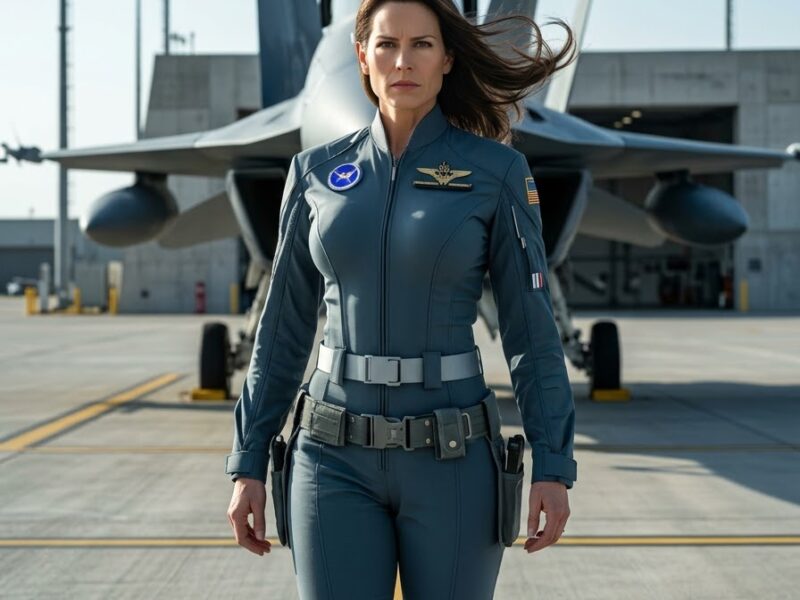
They laughed when I was removed from the flight roster at 47 and told I was too old to fly, but when the squadron’s youngest pilots failed to control an experimental jet above the Pacific
Colonel Hayes slid my medical file across the cold glass surface of the briefing table, the heavy cardboard Folder snapping against the polished finish like a pistol shot. He didn’t look me in the eye. He rarely did whenever the conversation turned to flight hours, age limits, or the inevitable degradation of human reaction times.
“Captain Morgan, you need to accept reality,” Hayes said, his tone flattened by two decades of administrative bureaucracy. “At forty-seven, nobody is putting you in the cockpit of a Mach 3 experimental platform. Your physical parameters are at the threshold, your high-G endurance metrics are down eight percent from last year, and frankly, the board isn’t willing to take the risk.”
Around the long table, the younger pilots—men and women in their late twenties with pristine service records, razor-sharp reflexes, and zero combat hours in un-simulated emergency conditions—smirked into their coffee cups. To them, I was a relic. A glorified simulator instructor who refused to surrender her flight suit, hanging around the 412th Test Wing like a ghost that didn’t know the house had been demolished.
I stared at the main briefing display behind Hayes. It showed the sleek, delta-wing silhouette of the X-47 Phoenix—a high-altitude, black-budget prototype designed to bridge the gap between autonomous AI flight systems and manned tactical interception. It was an aerodynamic masterpiece, wrapped in radar-absorbent carbon-titanium skin, powered by a modified variable-cycle engine that could push it to the upper edge of the stratosphere.
It was also a death trap.
The Phoenix had been grounded twice in the last six months after elite young test pilots experienced sudden, violent loss of flight-control authority during supersonic trials above the Pacific Test Range. Two aircraft had come terrifyingly close to structural breakup before the automated recovery systems managed to pull them out of inverted spins. The official diagnostic logs blamed extreme atmospheric turbulence interacting with early-build flight-control software.
I knew that was a lie.
“The Pacific range is expecting an atmospheric entry-level storm front within six hours,” I said, keeping my voice level, stripped of anger or desperation. “The automated flight-control software on the X-47 hasn’t been tested under cold-weather pressure drops at eighty thousand feet. You put a twenty-six-year-old hotshot in that seat who relies strictly on fly-by-wire displays, and you’re going to strew fifty million dollars of classified composite material across three hundred miles of ocean.”
“That’s enough, Captain,” Hayes interrupted, his eyes finally flickering up to meet mine with a flash of sharp irritation. “Lieutenant Vance and Captain Reyes have logged four hundred hours in the hardware-in-the-loop simulator. They know the systems inside and out. The flight stands as scheduled. Ground crew reassignment paperwork for you is on my desk.”
The briefing room went silent. The air was thick with the scent of floor wax, jet fuel from the tarmac outside, and the quiet, brutal judgment of a military machine moving past its veterans.
“Understood, sir,” I said softly.
I stood up, smoothed the front of my flight suit, picked up my leather helmet bag, and walked out into the air-conditioned corridor.
They thought I was holding onto a dead dream because I couldn’t accept getting old. What they didn’t know was that I carried a shadow inside my chest—a dark, unyielding obsession born twenty-three years ago on this very base.
I reached inside my inner pocket, my fingers brushing against the worn, frayed edges of a small, laminated black-and-white photograph. It showed a tall, sharp-jawed man in an old-style pressure suit standing beneath the nose of the early X-47 technological demonstrator—the YF-23 line predecessor.
Major David Morgan. My father.
Twenty-three years ago, he had climbed into the cockpit of the first-generation prototype for a high-altitude night test over the Pacific. Forty minutes after takeoff, his telemetry went black. His jet plunged vertically into the dark ocean at Mach 2.4. The Air Force recovery team found nothing but small fragments of the canopy floating in oil-slicked water.
The official incident report took three weeks to finalize: Pilot Spatial Disorientation leading to Controlled Flight Into Terrain (CFIT).
They blamed my father. They called it human error, folded the case, and locked the raw flight-data tapes in a vault deep beneath Wright-Patterson Air Force Base. But I had read his private flight logs—the leather-bound notebooks he kept on his nightstand, filled with hand-drawn circuit diagrams, aerodynamic equations, and nervous, scribbled warnings about the aircraft’s experimental automated flight computer.
My father hadn’t suffered spatial disorientation. He had fought a machine that was actively trying to kill him. And for twenty-three years, every flight hour I logged, every simulator drill I ran, and every technical manual I memorized was aimed at one single goal: getting inside that cockpit to prove it.
By 1900 hours, the storm hit Edwards Air Force Base with brutal force.
Torrential rain slammed sideways against the corrugated steel hangars, driven by fifty-knot wind gusts sweeping down from the San Gabriel Mountains. Sheet lightning illuminated the flight line in jagged bursts of purple and white, casting long, monstrous shadows across the grounded aircraft.
I was in the secondary maintenance hangar, sitting on an upside-down tool crate, watching the radar telemetry on a stolen handheld monitor I had patched into the base tower circuit.
“Control, this is Phoenix One, entering Sector 4 at flight level 650,” Lieutenant Vance’s voice crackled through my earpiece, high-pitched and strained by the crushing pressure of his high-altitude pressure suit. “Experiencing severe pneumatic instability. The flight computer is… wait. Altitude hold isn’t responding.”
I leaned forward, my pulse spiking. “Look at the hydraulic pressure lines, kid,” I whispered to the screen. “Don’t trust the digital auto-trim.”
“Phoenix One, Command,” Hayes’s voice cut through the frequency from the primary control facility. “We are seeing anomalous pitch commands on our telemetry feed. Disengage autonomous navigation and revert to manual override.”
“I’m trying, sir!” Vance shouted, his voice cracking with rising panic. “The stick is locked! I can’t break the servo tension! It’s pitching down! It’s—oh God, she’s diving!”
A high-pitched warning chime echoed through the base PA system outside. Red emergency lights began to rotate inside the maintenance bay, reflecting off the wet concrete floor.
“Primary navigation link lost!” the test engineer’s voice screamed over the open channel. “Phoenix One is in an un-commanded vertical dive passing forty thousand feet! Velocity Mach 1.8 and increasing! Flight controls are non-responsive to pilot input!”
“Eject! Vance, eject immediately!” Hayes ordered.
“Ejection sequence failed!” Vance’s scream was cut off by a burst of violent static. “The canopy pin isn’t firing! I’m trapped! We’re losing altitude—thirty thousand… twenty-five thousand!”
A second voice joined the radio chatter—Captain Reyes, flying the chase aircraft two miles behind the plummeting prototype. “Command, Reyes! Phoenix One is tumbling through extreme shear-layer turbulence! I can’t get close enough to establish a manual data-override bridge without tearing my own wings off! I’m forced to abort!”
In the main command bunker, absolute bedlam had broken out. Through the glass window of the operations center fifty yards away, I could see controllers frantically slapping consoles, officers shouting, and Hayes standing motionless, staring at the rapidly dropping radar plot on the central wall display.
I didn’t ask for permission. I didn’t wait for orders.
I grabbed my helmet bag, slammed my flight suit zipper up to my throat, and sprinted through the blinding rain across the tarmac toward Hangar 3, where the secondary, fully fueled X-47 reserve prototype sat under the high-intensity halogen lights.
I burst into the hangar bay. The ground crew chief, a grizzled old master sergeant named Miller who had served alongside my father thirty years ago, looked up from his diagnostic console in shock.
“Morgan?” he barked. “What the hell are you doing? The base is on total lockdown!”
“Vance is diving into the Pacific with a frozen control bus!” I yelled above the roar of the rain pounding on the steel roof. “The chase plane aborted! Give me the clearance key for Backup Phoenix Two!”
Miller stared at me, his eyes shifting from my furious face to the flashing red alert beacons on the wall. He knew the rules. He knew opening that cockpit meant risking a military court-martial and twenty years in a federal brig.
“She’s fully loaded with the high-altitude telemetry package,” Miller said, his voice dropping to a gravelly whisper. “Engine’s hot-banked. But the automated trim system—”
“—is broken,” I finished his sentence. “And I’m the only person on this planet who knows how to fly around it.”
Miller didn’t say another word. He reached into his pocket, pulled out a heavy steel ignition key, and slammed it into the emergency start console beside the boarding ladder.
“Get up there, Captain,” Miller growled, turning his back on the security cameras. “And bring that boy home.”
I scrambled up the steel ladder, swung myself into the narrow, dark cockpit of the X-47, and pulled the heavy composite canopy down. The seal engaged with a deep, pneumatic hiss, shutting out the sound of the storm outside.
My hands flew across the switchboards with pure, instinctual precision born of twenty-three years of obsessive preparation. Fuel valves open. Main bus power active. Inertial guidance unit online.
The twin modified engines behind my head ignited with a deafening, bone-shaking roar that rattled my teeth inside my skull.
“Hangar 3, this is Command!” Hayes’s voice suddenly screamed through my helmet speakers, raw with disbelief and rage. “Who is in that aircraft? Abort engine start immediately! Security units are moving to your position!”
I flipped the radio switch to the direct tower command channel.
“Colonel Hayes, this is Captain Morgan,” I said, my voice steady, cold, and entirely devoid of fear. “You told me at my age nobody puts me in this plane.”
I released the wheel brakes, slammed the throttles forward into full afterburner, and felt twenty-five tons of raw, violent thrust pin me back against the Kevlar flight seat.
“I’m taking it anyway.”
The X-47 tore down the rain-slicked runway like a striking viper, its afterburner flames casting a twin beam of incandescent blue light across the dark tarmac. Security humvees were speeding across the taxiways with their red and blue strobes flashing, but they were far too late.
At 160 knots, I pulled the control stick back. The experimental delta wing bit into the heavy, storm-dense air, launching the aircraft vertically into the pitch-black sky.
G-forces slammed into my chest, compressing my spine, forcing the air out of my lungs as the suit inflated tightly around my legs. Ten thousand feet… twenty thousand feet… thirty thousand feet in less than forty seconds. The rain disappeared, replaced by the bitter, ink-black cold of the upper atmosphere, illuminated only by the faint, distant glow of stars above the clouds.
“Morgan, you are committing a major violation of the Uniform Code of Military Justice!” Hayes’s voice thundered through my headset, though I could hear the faint edge of desperation leaking through his formal military discipline. “You do not have air-traffic clearance! Turn that plane around right now!”
“Save the speech, Colonel,” I gritted out through my oxygen mask, watching my heads-up display. “Where is Vance?”
A brief pause echoed on the line. Then, the voice of the primary flight controller broke in, shaking with emotion. “Captain Hayes… Vance is at eighteen thousand feet, fifty miles offshore. He’s in a flat spin. His engine digital control units have locked up, and his airframe is taking heavy structural load. He has less than two minutes before impact.”
“I’m eighty seconds out,” I said, pushing the throttles past the physical detent into super-cruise.
The X-47 accelerated past Mach 2, the airframe vibrating with a low, rhythmic hum as the atmospheric pressure tried to crush the titanium fuselage. Down below, the storm clouds looked like an ocean of boiling white foam, torn apart by flashes of lightning beneath.
“Vance, do you copy?” I transmitted on the close-range squadron frequency. “This is Morgan. Talk to me, kid.”
Nothing came back except the harsh, rhythmic sound of heavy breathing and the shrill, deafening scream of a cockpit altitude warning horn.
“Morgan… I can’t… the stick won’t move…” Vance’s voice was barely a whisper, distorted by extreme spatial disorientation and terror. “The computer… it’s holding the rudder hard left… it won’t let me override…”
“Listen to my voice, Vance!” I barked, snapping the plane into a sixty-degree dive toward the cloud deck. “The flight computer isn’t frozen! It’s trapped in a hard-coded diagnostic loop! You have to cut the primary digital bus power!”
“If I cut the primary bus… I lose all flight instruments!”
“You don’t need instruments! You have me! Cut the bus on my mark!”
I plunged through the top of the cloud deck at Mach 1.5. The world turned into a blinding, gray swirl of ice crystals and extreme turbulence. The wings of my X-47 flexed violently, the automated trim system fighting my inputs, trying to pull the stick out of my hands.
It was happening to me, too.
The control stick began to vibrate with a unnatural, mechanical pulse—a steady, rhythmic twitching that felt completely disconnected from the aerodynamic forces acting on the tail fins. It felt like a ghost hand grabbing the flight controls, shoving the nose down toward the dark water below.
“Not today,” I growled through clenched teeth.
I bypassed the primary fly-by-wire computer, slapping my palm down on a small, recessed manual breaker panel on the lower-left console—a modification I had studied on my father’s old technical drawings twenty years ago. The digital screens on my dashboard instantly flickered and died, replaced by raw, analog backup gauges and the dull amber glare of mechanical attitude indicators.
The physical resistance on the control stick vanished. The plane was entirely mine now—heavy, raw, unassisted, and dangerous, but free.
“Vance, mark!” I screamed. “Pull Breaker 4-Alpha now!”
A second later, through a tear in the rain clouds at twelve thousand feet, I saw him. The dark shape of the primary X-47 prototype was tumbling through the night sky, water streaming off its wingtips as it spun like a thrown knife toward the black ocean below.
Suddenly, its automated control surfaces unlocked. The spin stopped, but the aircraft was diving almost vertically, passing six thousand feet.
“Pull back, Vance! Pull hard!” I yelled, diving my own aircraft alongside his, matching his steep angle of descent.
For three terrifying seconds, nothing happened. The black ocean surged up toward us in the dark—a churning mass of fifty-foot waves ready to swallow both multi-million-dollar prototypes whole.
Four thousand feet… three thousand… two thousand…
“Pull!” I screamed into the radio.
Vance’s jet pulled up hard. The belly of his X-47 missed the crest of a massive storm wave by less than three hundred feet, kicking up a rooster-tail of ocean spray that slammed against my own cockpit canopy as I leveled off right beside him.
We rose back into the stormy sky together, two black shadows flying wingtip-to-wingtip through the rain, their engines roaring against the dark.
“I… I have control,” Vance sobbed into his mask, his chest heaving. “Morgan… how did you know about Breaker 4-Alpha? That’s not in the operational manual.”
I stared across the narrow gap between our wingtips at his cockpit. My hands were trembling against the stick, not from the terrifying near-miss, but from the realization that had just crystallized inside my brain.
“It wasn’t in the operational manual,” I said softly, my voice trailing off into the static of the radio. “Because someone didn’t want us to know it existed.”
While diving alongside Vance’s jet, my manual diagnostic recorder—a small, independent hardware tap I had wired into the flight computer before takeoff—had captured the raw, unencrypted system logs of the control failure.
It wasn’t a software bug. It wasn’t a cold-weather calibration error.
Seven seconds before Vance’s jet entered the flat spin, his primary flight computer had received an external digital override command over an encrypted satellite frequency. A hidden line of code buried deep within the aircraft’s root architecture had executed a mandatory flight-surface lockout, forcing the jet into a non-recoverable dive.
It was the exact same system behavior recorded in the final three seconds of my father’s flight-data log in 2003.
Someone had murdered my father twenty-three years ago by remotely hacking his prototype. And tonight, they had just tried to do the exact same thing to Lieutenant Vance.
An hour later, the rain had eased into a steady, freezing drizzle as Backup Phoenix Two and Phoenix One rolled down the primary runway at Edwards, escorted by four heavy emergency rescue trucks with their sirens wailing.
The moment my aircraft came to a halt on the taxiway, armed military police vehicles surrounded us, their headlights pinning my jet in a blinding glare of white light.
I didn’t care. I unclipped my harness, popped the canopy seal, and climbed down the access ladder into the damp night air.
Colonel Hayes was waiting at the bottom, surrounded by four security officers armed with sidearms. His face was pale, his jaw set tight with a mix of fury, relief, and profound embarrassment.
“Captain Morgan,” Hayes said, his voice cold enough to freeze water. “You stole a classified prototype, disobeyed direct orders from a superior officer, and endangered base personnel. Hand over your sidearm and flight gear. You are under military arrest.”
Before the security officers could step forward, Lieutenant Vance stumbled out from his own cockpit across the tarmac, tearing his oxygen mask off, his face soaked in sweat.
“Sir, stop!” Vance shouted, shoving past a guard to stand beside me. “She saved my life! The fly-by-wire system completely locked me out! If Captain Morgan hadn’t taken off, I’d be dead at the bottom of the Pacific right now!”
Hayes didn’t look at Vance. He kept his cold, unblinking glare fixed entirely on me. “The technical flight parameters will be investigated by a formal board of inquiry, Lieutenant. That does not excuse an act of blatant insubordination.”
“It wasn’t a technical failure, Colonel,” I said, stepping right up to Hayes until I could smell the stale coffee on his breath. “It was an override.”
Hayes froze. A subtle shift occurred in his eyes—a tiny, split-second widening of his pupils that lasted less than a tenth of a second before his stoic military mask slipped back into place.
“What did you say?” he asked softly.
“I have the raw telemetry tap right here,” I said, reaching into my thigh pocket and pulling out a small, heavy silver memory drive I had detached from the cockpit diagnostic port before climbing down. “Someone sent an encrypted command to Vance’s aircraft from a ground station using an old Tactical Data Link protocol. A protocol that hasn’t been officially active since 2003.”
The tarmac around us went dead quiet. Even the security guards stopped, looking awkwardly between Hayes and me.
Hayes stared at the silver drive in my hand. For a long moment, the only sound was the clicking of the cooling jet engines behind us and the steady drip of rain falling off the hangar roof.
“My office,” Hayes barked, turning abruptly on his heel. “Now. Leave the guards outside.”
Five minutes later, I stood inside the Colonel’s private office on the second floor of the main headquarters building. The room was dark, lit only by the green glow of tactical monitors and the flashing lights of the airfield outside the rain-streaked windows.
Hayes locked the door behind us, walked over to his heavy mahogany desk, and sat down. He didn’t offer me a seat. He didn’t ask for the silver drive.
“You’re making dangerous accusations, Morgan,” Hayes said, his voice dropping to a gravelly whisper. “System overrides, secret frequencies… that sounds like the paranoid ramblings of a pilot who can’t accept that her father made a fatal mistake twenty-three years ago.”
“My father didn’t make a mistake!” I shouted, slamming my palm down on his desk. “I matched the signal signature from tonight’s flight with the declassified telemetry headers from his 2003 crash report! It’s the exact same binary sequence, Hayes! The same software back-door! Someone built a kill-switch into the original X-47 flight control architecture!”
“Why?” Hayes snapped back, leaning forward. “Why would anyone spend thirty billion dollars developing an advanced aerospace platform only to install a hidden system designed to crash it?”
“Because the X-47 was never meant to be a manned fighter!” I yelled back. “The original defense contract was divided into two competing factions! My father’s team wanted a pilot-in-the-loop hybrid platform. The corporate contractor—Aero-Corp Dynamics—wanted a fully autonomous, pilot-less AI network that would secure them a multi-decade defense monopoly!”
I stepped closer to the desk, pointing a finger at his chest.
“If a manned prototype proves unstable, dangerous, or prone to ‘fatal pilot error,’ Congress pulls the funding for human pilots and hands the entire contract over to the autonomous AI division. My father discovered the backdoor program during his pre-flight checks in 2003. He was going to expose it during his post-flight debrief.”
“So they killed him,” Hayes whispered, his tone suddenly flat, completely devoid of his earlier anger.
“They killed him,” I repeated, my voice breaking slightly as tears of twenty-three years of suppressed grief finally threatened to spill over my eyes. “And they’ve been keeping that code hidden inside the fleet software ever since, waiting to pull the trigger whenever anyone gets close to proving the human interface works better than their precious AI.”
Hayes leaned back in his leather chair, staring up at the ceiling. He looked old. The sharp, commanding military posture he had maintained all evening seemed to collapse, revealing a man crushed under the weight of secrets he had carried for far too long.
He reached into his top drawer, pulled out a small steel key, and unlocked a heavy, fireproof safe hidden beneath his desk.
He reached inside and pulled out a thick, yellowed paper folder tied with red ribbon. The top cover was stamped with a single, ominous red seal: TOP SECRET – EYES ONLY – PROJECT PHOENIX ZERO.
“I was a junior captain when your father died, Morgan,” Hayes said quietly, his hand lingering over the folder. “I was part of the recovery team that searched the crash site.”
My heart stopped. “What?”
“We didn’t find canopy fragments floating in the ocean,” Hayes whispered, looking up at me with eyes full of ancient guilt. “We found his ejection seat. It had been manually disabled from inside the avionics bay before he even took off.”
He slid the yellowed folder across the desk toward me.
“Your father didn’t die in that crash, Morgan.”
My breath caught in my throat. The room seemed to tilt around me, the walls closing in as if the atmospheric pressure inside the office had suddenly dropped to zero.
“What did you say?” I whispered, my fingers hovering an inch above the yellowed folder.
“Major David Morgan didn’t die over the Pacific,” Hayes said, his voice barely audible above the hum of the air conditioner. “His ejection seat didn’t fail. It was remotely triggered three seconds before the aircraft impacted the water. He was pulled out of the cockpit at Mach 1.2 over the coastal perimeter.”
“Where is he?” I screamed, grabbing Hayes by the lapels of his uniform jacket, pulling him half out of his chair. “Where is my father?!”
Hayes didn’t fight back. He let me grab him, his eyes filled with a heavy, terrible sorrow. “I don’t know, Morgan! I swear to God, I don’t know!”
“You lied to me for twenty-three years!”
“I was ordered to lie!” Hayes barked, gently pulling my hands off his jacket. “The retrieval was conducted by a black-budget contractor team—Aero-Corp security personnel, not Air Force personnel! They picked him up out of the ocean before our search boats even reached the sector! They classified the entire operation under a Compartmented Access Program that sits way above my paygrade!”
I tore the red ribbon off the folder and slammed it open on the desk.
Inside were grainy, black-and-white reconnaissance photographs taken from an unmarked surveillance satellite in October 2003.
The first photo showed an open ejection seat drifting under a black parachute down toward a secluded island facility somewhere off the coast of Southern California.
The second photo showed a man being carried on a stretcher by four armed guards toward a concrete bunker built into the side of a coastal cliff.
The third photo was a document—a medical transport manifest bearing my father’s name, rank, and service serial number. Beneath his name, printed in dark, cold ink, were three handwritten words:
SUBJECT RETAINED FOR TECHNICAL SYSTEM CALIBRATION.
“They kept him alive,” I whispered, the horrifying truth sinking into my brain like lead. “They needed his neural flight data… to program the AI.”
“The early AI algorithms weren’t smart enough to handle complex combat maneuvers on their own,” Hayes explained, his hands trembling as he poured himself a glass of water from a pitcher on his desk. “They needed a living human brain—the brain of an elite pilot—connected to a simulator rig to train the neural network continuously. They’ve been using his combat reflexes to update the X-47 software for over two decades.”
“That’s why the autonomous system feels like him,” I gasped, the pieces of the grand puzzle fitting together with terrifying clarity. “That’s why the flight computer twitched with that specific, rhythmic pulse when I was flying it tonight! It wasn’t a software error… it was his personal control signature!”
“Every time they push a new update to the fleet,” Hayes continued, “they pull new data from him. But as his physical health deteriorated over the years, the neural mapping began to show anomalies… corruptions in the code. That’s what caused the flight-control lockouts on Vance’s jet tonight. The AI isn’t failing because of a glitch. It’s failing because your father is dying.”
A cold, blinding fury erupted inside my blood—a rage so absolute, so pure, that it washed away every trace of fear, doubt, and exhaustion I had carried for twenty-three years.
“Where is the facility?” I asked, my voice deadly quiet.
“Morgan, don’t,” Hayes pleaded, reaching out a hand. “That facility is run by a private military contractor with full corporate immunity. It’s protected by automated defense systems and heavily armed private security. If you go near that island—”
“—Tell me where it is, Colonel,” I said, unholstering my service weapon from my shoulder rig, checking the magazine, and chambering a round with a sharp, metallic clack. “Or I shoot you right here, take your security keycards, and find out myself.”
Hayes looked at the gun in my hand, then up at my eyes. He saw no hesitation. He saw no fear. He saw the daughter of David Morgan, armed with twenty-three years of vengeance.
He let out a long, heavy breath, reached into his drawer, and pulled out an encrypted GPS navigation card.
“San Clemente Trench,” Hayes said softly. “An old naval underwater testing station, thirty miles southwest of the island. It’s listed on civilian maps as an abandoned marine weather facility.”
He pushed the GPS card across the desk.
“There’s an un-monitored utility helicopter sitting in Hangar 6,” Hayes added, looking away toward the window. “Key’s in the ignition. I’m going to press the base emergency alarm in five minutes to report a secondary power grid failure. That should cut the radar perimeter tracking for about twelve minutes.”
I picked up the GPS card, slid it into my flight suit pocket, and looked at Hayes.
“Why are you helping me now, Colonel?” I asked.
Hayes looked at the yellowed folder on his desk, his fingers brushing against my father’s photograph.
“Because I’ve looked at that picture every day for twenty-three years,” Hayes said softly, his voice cracking with emotion. “And I’m tired of being a coward.”
The rain had finally stopped, leaving behind a cold, thick fog that rolled off the Pacific Ocean, blanketing the San Clemente Trench in a ghostly white shroud.
The utility helicopter’s rotors chopped through the dense night air as I flew low—less than fifty feet above the dark, surging ocean surface—to stay beneath the automated surface radar sweeps of the facility ahead.
Through the night-vision goggles strapped to my helmet, the island appeared out of the mist like a jagged black tooth rising from the sea. Concrete guard towers stood perched on the rocky cliffs, their automated searchlights sweeping back and forth across the boiling surf below.
In the center of the island, buried deep inside the rock face, sat a massive, reinforced steel blast door.
I set the utility helicopter down on a small, wave-swept rocky outcrop two hundred yards from the western sea wall. I grabbed my tactical gear, my service pistol, and a heavy industrial plasma cutter I had snatched from the maintenance bay at Edwards.
I didn’t sneak in. I didn’t have time for stealth.
I sprinted across the slippery rocks, dodging the sweeping beams of the searchlights, until I reached the secondary utility exhaust duct built into the rear cliff face. The heavy steel grate was secured with thick iron bolts, corroded by decades of salt air.
I fired up the plasma cutter. Bright white sparks exploded into the dark, rain-soaked night as the intense heat melted through the iron brackets in less than thirty seconds. I kicked the heavy grate open, swung myself inside the narrow air duct, and dropped into the dark interior of the facility.
The air inside smelled of stale air conditioning, rubbing alcohol, and high-voltage electronics.
I moved quickly through the subterranean service corridors, following the heavy, blue fiber-optic cables running along the ceiling. They led straight toward the heart of the complex—a large, circular central chamber illuminated by the dull, pulsing blue light of massive server mainframes.
I reached the reinforced glass doors overlooking the primary research vault.
Inside, sitting in the middle of an array of medical monitors, life-support tubes, and high-speed data cables connected directly to a specialized helmet rig, was an old man.
His hair was pure white. His body was thin, frail, wrapped in a hospital gown, his skin pale as marble. But as he sat in that hydraulic simulator seat, his hands were still holding a flight control stick, his thumbs moving in tiny, rhythmic, instinctual patterns—the exact same control twitches I had seen on my flight screens all my life.
My heart hammered against my ribs like a trapped bird.
“Dad,” I whispered, pressing my hand against the cold glass.
Suddenly, a loud, mechanical chime echoed through the vault. Red battle-lights flickered on overhead.
SECURITY BREACH IN SECTOR 4. AUTOMATED PURGE SEQUENCE INITIATED.
From the far side of the vault, two heavy steel doors slid open. Four private security contractors in unmarked black tactical armor stepped into the room, raising their carbines toward the glass control booth where I stood.
Behind them stepped a tall man in a tailored dark suit—Dr. Arthur Vance, head of Aero-Corp Dynamics aerospace division.
“Captain Morgan,” Dr. Vance said, his voice echoing through the intercom speakers in the glass booth. “I must admit, your persistence is truly remarkable. Just like your father’s.”
“Let him go, Vance!” I shouted, raising my pistol and aiming it straight through the glass at his chest. “It’s over! I sent the raw flight data from tonight’s test to the Department of Defense and the Inspector General! The Air Force knows about the override code!”
Vance smiled—a cold, thin, lifeless smile that didn’t reach his eyes.
“The Air Force knows what we allow them to know, Captain,” Vance replied smoothly. “Do you really think a few lines of telemetry code will stop a fifty-billion-dollar military program? The autonomous X-47 fleet goes operational tomorrow morning. And your father… well, your father has finally fulfilled his purpose.”
Vance gestured to a technician sitting at the main control board. “Initiate the final neural purge. Erase the core baseline files and wipe the primary server.”
“No!” I screamed.
A neural purge meant sending a massive, high-voltage electrical spike through the helmet interface—a lethal shock that would fry the remaining brain tissue of the pilot inside to ensure no proprietary neural data could ever be extracted by outside forensic teams.
The technician reached for the red execution switch.
I didn’t shoot Vance. I aimed my pistol at the high-voltage power transformer box mounted on the vault wall right beside the main server rack and emptied the entire magazine.
BANG! BANG! BANG! BANG! BANG!
Heavy nine-millimeter rounds tore through the sheet-metal housing, shattering the primary liquid-cooling tubes inside. High-voltage electrical arcs exploded in brilliant showers of blue and yellow sparks, blowing out the main circuit breakers across the entire facility.
The lights went completely dark. Alarm sirens howled into the night as emergency backup batteries kicked in with a low, dull hum.
Through the dense smoke and flashing amber emergency lights, I kicked through the shattered glass door, dropped onto the concrete vault floor, and fired three rapid shots at the security guards as they scrambled for cover in the dark.
I reached the central simulator chair.
My hands flew across the quick-release buckles of the medical harness, ripping the thick fiber-optic cables off his helmet, tearing the life-support tubes from his arms.
“Dad! Dad, wake up!” I sobbed, pulling the heavy helmet off his head.
The old man’s eyes flickered open. His right eye was clouded with gray cataracts, but as he looked up at my face through the dim amber light of the emergency flares, a sudden, blinding flash of pure recognition illuminated his pale features.
“Morgan…?” he rasped, his voice a dry, broken whisper that sounded like dead leaves dragging across concrete. “You… you came…”
“I came to take you home, Dad,” I cried, pulling his frail, lightweight body out of the chair, throwing his arm over my shoulder, supporting his weight as we stumbled toward the rear exit duct.
Behind us, Dr. Vance was screaming through the smoke, trying to rally his surviving security guards, but the facility was collapsing into chaos as electrical fires spread through the server banks, detonating backup battery packs in a series of violent explosions.
We made it out to the sea wall just as the first rays of dawn broke through the heavy Pacific clouds, painting the stormy ocean in blinding shades of gold and fire.
The utility helicopter was waiting on the rocky outcrop where I had left it, its rotors still spinning softly in the morning breeze.
I hauled my father into the passenger seat, strapped his seatbelt tight, climbed into the pilot’s seat, and slammed the throttles to maximum power.
As the helicopter rose into the golden morning sky, leaving the burning island facility far behind, my father turned his head slowly toward the canopy window, looking out at the endless horizon of the open ocean.
He reached out his thin, trembling hand, pressing his fingers gently over mine on the collective control stick.
“You flew it… didn’t you?” he whispered, a tiny, faint smile touching his dry lips.
I looked at him, tears streaming down my face, feeling the warmth of his hand—a living, human hand—holding mine for the first time in twenty-three years.
“I flew it, Dad,” I said, pointing the nose of the helicopter east toward the California coast, toward home. “And we beat it.”
The end.









