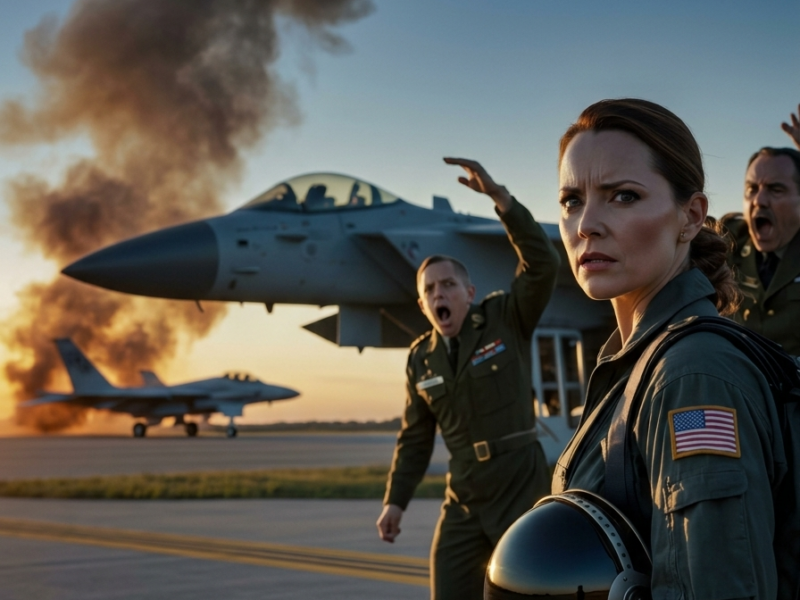
They laughed when I was pushed toward the cockpit of a crippled passenger jet over Nevada
The cabin of Flight 412 smelled of ozone, burnt plastic, and cold, metallic fear. Thirty thousand feet over the sun-scorched expanse of the Nevada desert, the Boeing 737 shuddered as if an invisible fist had struck its aluminum frame. Outside the oval windows, the left engine was engulfed in a mantle of dark, greasy smoke, streaked with sharp tongues of yellow flame.
Inside the main cabin, two hundred passengers screamed in a terrifying, synchronized crescendo. Overhead bins popped open, spilling hand luggage into the aisles. Oxygen masks dropped from the ceiling like ghostly, dangling limbs, swaying violently with every shudder of the airframe.
I stood in the galley, my back pressed hard against the metal drink cart to keep my balance. Underneath my worn denim jacket, the thick, jagged scar running from my left shoulder down to my wrist began to throb with a dull, phantom heat. For eight years, I had lived as Maya Vance—a quiet, background person who worked as a night-shift logistics manager in Reno. I was a ghost by choice, someone who took the bus, avoided eye contact, and never spoke about the sky.
Nobody on this flight knew that eight years ago, my name had been Call Sign Raven Six, a senior instructor pilot in the United States Air Force’s elite tactical strike group. Nobody knew that I had logged over two thousand hours in cockpits, or that my career had vanished overnight after a classified operation over the Black Sea went horribly wrong.
BAM.
A second explosion vibrated through the floorboards. The aircraft pitched sharply to the left, dropping five hundred feet in three seconds. My stomach lurched into my throat. The cabin lights flickered, died, and were instantly replaced by the eerie, pulsing red glow of the emergency lights.
Through the curtain separating the first-class cabin from the cockpit, I heard the frantic, strained voices of the flight crew. The first officer was shouting into his mask, his voice high-pitched and hysterical, while the captain fought to keep the heavy jet from entering a dead spiral.
I didn’t think. Eight years of deliberate civilian anonymity melted away in a single heartbeat as muscle memory—honed by thousands of hours of life-or-death decision-making—took complete control of my body.
I pushed through the blue curtain and stepped into the flight deck.
The cockpit was a blinding storm of red warning displays and blaring audio alarms. The master caution chimes were chiming in a relentless, maddening cadence. Outside the windshield, the horizon was tilted at a sickening forty-five-degree angle, the reddish-brown canyon floor of Nevada rising fast to meet us.
The first officer was slumped backward in his seat, his eyes rolled into his head, hyperventilating violently into his oxygen mask as panic overwhelmed him. Captain Robert Vance—no relation to my assumed name—was leaning over the yoke with both hands, his knuckles chalk-white, sweat pouring down his face, soaking his graying hair.
“We’re losing hydraulic pressure on system A!” the captain screamed, not even looking back as the cockpit door clicked behind me. “The rudder’s locked! We’re going down!”
I stepped forward, unbuckling the incapacitated first officer, dragging his limp body out of the right seat, and letting him slide onto the carpeted floor behind us.
“Get out of here!” the captain yelled, catching a glimpse of my civilian clothes in his side mirror. “Go back to your seat and strap in!”
“You’re over-correcting the roll,” I said, my voice unnaturally calm, dropping into the deep, flat, authoritative rhythm of a military flight leader. “You’re feeding the stall. Unload the stick.”
He stared at me, his eyes wide with disbelief and panic. “What?”
“Let go of the yoke for one second,” I ordered, stepping over the center pedestal and sliding into the right seat. I grabbed the shoulder harness, clicked the four-point buckle into place, and pulled the straps tight against my chest. “Let it drop. The airframe wants to fly. You’re forcing the nose into a high-alpha lockup.”
“I can’t hold her!” he shouted, his hands slipping on the leather grip of the controls as a fresh wave of violent turbulence slammed into the cockpit. “Who the hell are you?”
I grabbed the co-pilot’s yoke with my right hand. The moment my fingers wrapped around the rubberized grip, the noise, the vibration, and the overwhelming scent of danger ceased to be terrifying. They became data. For the first time in eight years, I felt whole again.
“Let me try,” I said softly.
“Are you a pilot?” he demanded, his voice cracking as the altimeter spun downward past fourteen thousand feet.
I hesitated, looking at the primary flight display. “I was.”
“What’s your experience?” he shouted as the jet dipped into a dense layer of grey clouds, cutting off all visual contact with the ground. “General aviation? Single engine?”
“Fighter aircraft,” I replied, my thumb instantly finding the trim switch and flicking it upward to rebalance the nose heavy airframe. “Eight years in tactical strike.”
His face went completely pale. The sheer absurdity of the statement—a young woman in a denim jacket claiming to be a fighter pilot in the middle of an airliner crash—would have made him laugh under any other circumstance. But as I smoothly eased the throttles back on the remaining good engine, caught the roll, and brought the artificial horizon back to level flight, his skepticism died instantly.
“Engine two is dead,” I reported rapidly, my eyes sweeping the glass cockpit instruments. “Engine one is producing sixty percent thrust, but thrust vectoring is unstable. Fuel flow is leaking from the port wing root. We have limited flight controls, but she’s flying.”
The jet stabilized, banking gently as I leveled the wings at eleven thousand feet.
The captain let out a long, shuddering breath, wiping the sweat from his eyes. “Where did you learn to handle a heavy airframe like that?”
“You don’t forget how to fly when the air turns dirty,” I said, staring into the gray soup outside the glass. “Now get on the radio and declare a Mayday. We need an emergency landing vector into Nellis Air Force Base or Reno-Tahoe immediately.”
The captain reached for his microphone, but before his hand touched the switch, the secondary radar screen—the tactical collision warning display—erupted with a bright, solid red diamond.
A high-pitched, warbling audio tone echoed through the cockpit speakers. It wasn’t a civilian air traffic control chime. It was a military radar lock warning.
“What is that?” the captain gasped, pointing at the radar display. “An airliner shouldn’t trigger an intercept warning!”
The red diamond was closing on our position at incredible speed—Mach 1.2. It had jumped straight out of the radar shadow of the mountain range to our west, tracking directly toward our nose.
“Collision course!” the captain shouted.
“He’s not going to hit us,” I muttered, my heart slamming against my ribs as I read the raw digital telemetry scrolling along the bottom of the military feed. The signal was encrypted using an old, highly specific NATO tactical protocol—a system that had been retired from public record nearly a decade ago.
A voice cut through the cockpit speakers, breaking through the heavy static. It wasn’t the voice of an air traffic controller. It was a voice that belonged to a ghost.
“Raven Six… if you’re hearing this, they finally found you.”
My hands went completely cold on the yoke. My breath caught in my throat, freezing like ice in my chest.
Raven Six.
That was my callsign. The callsign of a pilot who had been officially scrubbed from all Air Force rosters after a night mission over the Black Sea, where my entire three-ship formation was ambushed by unidentified interceptors.
I reached out with a trembling hand, hit the open frequency transmitter, and spoke into the boom mic. “Who is this?”
Heavy static answered. Then, the man’s voice returned, low, raspy, and laced with a terrifying, familiar weariness.
“The man who was blamed for your death.”
The captain looked at me, his eyes filled with sheer confusion and horror. “You know him? Who is that out there?”
I couldn’t speak. I couldn’t breathe.
I recognized that voice. It belonged to Major Daniel Vance—my former wingman, my flight leader, and the man I had watched descend in a ball of flame over dark waters eight years ago. The man whose death warrant I had signed by following a false order.
And according to every official military record I had spent eight years reading in secret, he had died that night.
The military jet outside swept past our starboard wing in a blinding blur of dark gray metal, its shockwave rattling our already damaged airliner. Over the comms, Daniel transmitted one final, chilling message.
“Don’t land at the airport, Maya. Look closely at the runway. They aren’t lights.”
I slammed the throttles forward, breaking through the bottom of the cloud deck at three thousand feet. The runway of the remote desert airbase appeared through the rain and fog straight ahead.
I looked through the glass. And as my eyes adjusted to the glare, my blood ran instantly cold.
The glowing lines lining the tarmac weren’t runway lights at all. They were the burning, thermal signatures of tactical defense turrets and armored vehicles, swept in a lethal crossfire pattern, waiting to destroy us the second our wheels touched the ground.
The cockpit fell into a suffocating, dead silence, broken only by the steady, rhythmic thump-thump-thump of our failing left engine.
“What… what are those?” Captain Vance whispered, his hands trembling as he leaned forward, staring at the blazing thermal signatures arrayed along the tarmac of the remote desert runway below us.
“Kill boxes,” I said, my voice dropping an octave into pure, cold tactical focus. “They aren’t preparing for an emergency landing. They’re preparing to eliminate a payload.”
“This is a commercial flight!” the captain yelled, panic rising in his chest again. “There are two hundred civilians on this plane! Why would anyone—”
“They don’t care about the civilians,” I interrupted, pulling back hard on the control stick to arrest our descent at fifteen hundred feet. “They care about who’s in this cockpit. And they care about keeping the truth buried.”
“Maya!” Daniel’s voice cracked through the emergency tactical frequency again, sharp and urgent. “Pull up! You have two surface-to-air tracking units powering up at your two o’clock! They’re locking onto your thermal exhaust!”
I didn’t ask questions. I didn’t hesitate. I slammed the single good throttle into full thrust, stomped hard on the right rudder pedal, and threw the heavy, fifty-ton Boeing 737 into a violent thirty-degree bank.
The cabin behind us erupted into collective screams as the passengers were slammed against the left side of the fuselage. Hand luggage, meal trays, and loose equipment crashed against the galley walls.
A second later, two bright streaks of orange fire erupted from the desert floor beneath the runway. Two surface-to-air missiles streaked upward through the fog, missing our tail by less than two hundred yards before detonating harmlessly in the thick cloud layer above us. The shockwaves slammed into our tail section, making the airframe groan under intense structural strain.
“They just fired at us!” Captain Vance screamed, staring at the expanding black clouds of flak in his side mirror. “Military assets just fired on an American airliner!”
“That’s not the military,” I growled, eyes scanning the instruments. “That’s a private contractor wing. The same shadow entity that set up my squadron eight years ago.” I pressed the mic button. “Daniel! Where are you?”
Through the side window, a sleek, unmarked black fighter jet—a heavily modified, demilitarized F-16 with no country markings or tail numbers—cut through the gray mist, dropping its speed to match our crippled airliner wing-tip to wing-tip.
Inside the bubble canopy of the fighter, the pilot turned his head toward us. Even through the dark tint of his flight helmet visor, I recognized the posture, the broad shoulders, and the calm, steady presence of Daniel Miller.
“I’ve been tracking this asset grid for three years, Maya,” Daniel’s voice filled my headset. “They knew you were on Flight 412. They sabotaged your port engine before you left Denver. The plan was to let you crash in the Nevada dry lakes, write it off as a structural failure, and clean up whatever was left.”
“Why now?” I demanded, fighting the yoke as a fresh wave of hydraulic fluid leaked from our primary lines, making the controls feel like frozen iron. “Why wait eight years?”
“Because the Black Sea records were unsealed yesterday by the Senate Intelligence Committee,” Daniel replied, his voice heavy with grim satisfaction. “The flight telemetry from our night intercept… the data that proves our squadron commander was executed by friendly fire to cover up an illegal arms transfer… it all points directly to the current Defense Logistics Director, General Mark Hayes.”
General Hayes. The man who had sat across the table from me during my discharge hearing. The man who had offered me a choice: sign a non-disclosure agreement, accept a medical discharge, and vanish into civilian life forever… or face a court-martial for treason and spend the rest of my life in a military prison.
“I signed the papers, Daniel,” I said, tears of old anger burning behind my eyes. “I gave up my life! I gave up everything to keep my team safe!”
“Hayes lied to you, Maya,” Daniel said softly. “He didn’t save us. He hunted down every surviving member of Raven Squadron. I’m the only one left. And when he found out you were still alive, he set this flight up to finalize the ledger.”
“Engine one is overheating!” Captain Vance suddenly shouted, pointing at the glowing red temperature gauge on the center display. “Turbine temperature is in the red zone! She’s going to seize in less than two minutes!”
A thick cloud of black smoke began pouring from our remaining engine. The airliner began to lose altitude rapidly, dropping through eight hundred feet, seven hundred, six hundred…
Below us, the vast, flat, bone-white expanse of the Salt Wells Dry Lake bed stretched out for miles into the desert rain.
“We can’t make an airport,” I said, my voice icy calm. “We’re putting her down on the salt flats.”
“On the salt?” Captain Vance gasped. “Without full hydraulics? We’ll flip the second the nose gear digs into the mud!”
“We aren’t dropping the landing gear,” I ordered, my thumb flicking the master switches to prepare the airframe for a belly landing. “We’re sliding her in. Keep the wings level, dump the remaining fuel from the starboard tank, and hold on.”
“Maya,” Daniel’s voice came over the radio, tense and fast. “You’ve got three armed strike buggies speeding across the salt flats from the base perimeter. They’re heading straight for your drop zone. They have heavy caliber machine guns.”
“Can you clear them?” I asked, looking out at his black fighter jet.
“I’m out of ordnance,” Daniel replied grimly. “All I have left is my internal cannon and twenty seconds of fuel before I hit dry tanks. But I’ll buy you as much time as I can.”
The black F-16 peeled away, its afterburner roaring as it dove low over the salt flats toward the approaching dust clouds of the contractor vehicles.
I locked my eyes on the flat white horizon ahead. I gripped the heavy yoke of the Boeing 737 with both hands, my scar throbbing, my heart pounding, and my soul finally waking up from an eight-year sleep.
“Brace for impact!” I shouted into the cabin PA system. “Brace! Brace! Brace!”
The belly of the Boeing 737 struck the hardened crust of the Salt Wells Dry Lake at one hundred and forty knots.
The sound was unimaginable—a deafening, screeching roar of tearing aluminum, shattering steel, and exploding fiberglass that drowned out the screams of the passengers. The force of the impact slammed me forward against my shoulder straps, burying my face within inches of the instrument panel as the airliner skidded across the white desert floor.
Plumes of white salt, mud, and sparks exploded around the cockpit windows, blinding us completely. The airframe twisted violently to the right as the starboard wing stub caught a mound of packed dirt, threatening to roll the entire aircraft inverted.
I fought the controls with every ounce of physical strength left in my body, stomping on the manual rudder cables, forcing the tail back into line until the tearing metal finally ran out of momentum.
The jet came to a violent, shuddering halt in a cloud of white dust and steam.
Silence fell over the cockpit—a heavy, suffocating silence broken only by the hiss of leaking hydraulic fluid and the distant sound of crying passengers from the main cabin.
“Is everyone… alive?” Captain Vance groaned, clutching his bruised ribs as he pushed himself upright in his seat.
“We’re alive,” I said, unbuckling my harness immediately and reaching for the emergency ax mounted on the rear bulkhead. “Move! We have less than two minutes before the fuel vapor ignites!”
I kicked open the cockpit door and stepped out into the cabin. The flight attendants were already doing an incredible job, popping the emergency over-wing hatches and deploying the inflatable slides into the blinding desert rain.
“Move down the slides!” I shouted to the terrified passengers, taking control of the evacuation. “Leave your bags! Move straight out into the desert away from the aircraft!”
As the passengers scrambled out into the cold rain, I heard the sharp, terrifying thud-thud-thud of heavy caliber gunfire echoing across the salt flats.
I ran to the open door and looked out.
A mile away, Daniel’s black F-16 was making a ultra-low-level strafing pass over two heavy armored civilian humvees that were speeding toward our crash site. His 20mm Vulcan cannon ripped up the salt, sending columns of white dirt into the air and forcing one of the vehicles to flip wildly onto its roof.
But the second vehicle kept coming. Mounted on its roof was a heavy .50-caliber machine gun, firing continuous bursts up at Daniel’s fighter.
A trail of white smoke suddenly erupted from Daniel’s engine. His jet wobbled, its thrust dying as the cannon fire tore through his belly intake.
“Raven Six… engine failure,” Daniel’s voice gasped through my hand-held emergency radio transceiver. “I’m… I’m out of air space, Maya. Ejecting!”
Through the rain, I watched the canopy of the F-16 blow clear, followed a fraction of a second later by the rocket-propelled arc of an ejection seat. The black jet slammed into a distant ridge, exploding in a massive fireball of orange flame and black smoke.
Daniel’s parachute opened two hundred feet above the ground, drifting down into the brush near the edge of the dry lake bed.
The remaining contractor humvee didn’t pursue the parachute. It turned its heavy chrome grill straight toward our downed airliner, its machine gun swinging toward the exposed, helpless passengers standing in the mud beside the fuselage.
“Get behind the wings!” I screamed to the passengers, jumping down from the emergency door into the cold, wet salt. “Get on the ground!”
Captain Vance dropped down beside me, his face bloodied but eyes fierce. “What do we do? We’re unarmed!”
“Not for long,” I said, my eyes locking onto the heavy flare kit and high-intensity signal launchers packed inside the airliner’s survival locker, which I had dragged out with me.
I pulled open the plastic case, pulling out two heavy, steel-bodied aviation signal pistols—designed to fire high-temperature magnesium flares capable of burning through thick metal at short range.
“You know how to use one of those?” Vance asked, staring at the orange launchers in my hands.
“I spent eight years pretending I was weak, Captain,” I said, cracking the action open, loading a pair of heavy magnesium shells, and looking out at the approaching armored vehicle with icy, unyielding hatred. “I’m done pretending.”
The contractor humvee roared across the white salt flats, its tires churning up a roostertail of thick gray mud. The heavy .50-caliber machine gun mounted on its ring frame opened fire, sending heavy armor-piercing rounds snapping through the air above our heads, tearing jagged holes through the empty tail section of our downed airliner.
The passengers were screaming, huddled in fear behind the heavy titanium wing structures.
I crouched behind the main landing gear assembly, the cold desert rain soaking through my denim jacket, plastering my hair to my face. The magnesium flare gun felt heavy and awkward compared to a military sidearm, but its internal ignition core burned at over two thousand degrees Celsius—more than enough to ignite a fuel line or blind a driver wearing night-vision optics.
“Wait for my mark!” I shouted to Captain Vance, who was holding the second flare gun with shaking hands twenty feet to my left. “Target the driver’s windshield! The magnesium heat will shatter the reinforced glass!”
The vehicle closed the distance with terrifying speed—three hundred yards, two hundred yards, one hundred yards.
Through the rain, I could see the driver: a heavily built man wearing unmarked black tactical gear, a ballistic helmet, and a dark radio headset. Beside him sat a tactical commander, holding an encrypted satellite tablet—the asset coordinator who was recording the execution.
“Now!” I screamed.
I stepped out from behind the landing gear, dropped into a low tactical stance, and pulled the trigger of the signal pistol.
A blinding sphere of brilliant, white-hot magnesium fire erupted from the barrel, streaking across the fifty-yard gap in a fraction of a second. The flare struck the center of the humvee’s front windshield, instantly shattering the multi-layered bulletproof glass into a web of white, opaque fractures and filling the cabin with blinding light and intense heat.
The driver shrieked, instinctively slamming on the brakes and yanking the steering wheel to the right.
The heavy armored vehicle skidded sideways across the slippery, wet salt, its tires losing traction completely. It slammed sideways into the wreckage of our starboard engine casing, flipping over onto its side with a deafening metallic crash, its wheels spinning uselessly in the air.
“Vance! Cover the passenger line!” I shouted, dropping the spent flare casing and sprinting toward the overturned vehicle before the contractors inside could recover.
I grabbed a heavy steel crowbar from the airliner’s emergency tool kit, smashed the shattered side window of the humvee, reached inside, and dragged the dazed driver out onto the mud. I kicked his sidearm away across the salt, then reached in and ripped the encrypted satellite tablet from the tactical commander’s hands.
The tablet screen was still active, displaying a live, high-definition satellite feed of our crash site. At the top of the secure connection, an active video link was running, displaying the stern, cold face of a man sitting in a high-tech office in Washington D.C.
General Mark Hayes.
I held the tablet up, holding the camera directly in front of my face. Rain washed the dirt and salt from my cheeks, exposing the thin scar along my jawline.
General Hayes froze on the screen, his dark eyes widening in genuine, shock-filled horror as he recognized the woman standing over his destroyed strike team.
“Maya…” Hayes whispered through the tablet’s speaker, his voice trembling slightly despite his effort to maintain control. “You… you were supposed to be dead eight years ago.”
“I was dead, General,” I said, my voice cold, steady, and terrifyingly calm as I stared straight into his eyes through the camera lens. “You buried my career. You murdered my wingmen. You tried to execute two hundred innocent people today just to keep your secret safe.”
“Maya, listen to me,” Hayes said rapidly, his posture breaking as he realized the tactical coordinator’s tablet was routing the data stream through an un-interceptable satellite relay. “We can make a deal. Whatever money you want… whatever identity you want… I can clear your records! I can give you back your life!”
“I already have my life back, General,” I said softly.
I reached down to my wrist, pulling back my sleeve to expose the jagged scar from the night my jet went down over the Black Sea.
“And I’m coming to collect the debt.”
I raised the heavy steel crowbar and smashed the tablet screen into a thousand pieces, cutting the connection forever.
Ten minutes later, the distant thrum of heavy rotor blades echoed through the rain-soaked desert clouds.
Four heavy CH-47 Chinook transport helicopters, escorted by two fully armed Air Force A-10 Warthogs, broke through the overcast ceiling. They weren’t contractor assets. They were active-duty military units dispatched directly by the Federal Aviation Administration and the Department of Homeland Security after our initial Mayday broadcast had bypassed Hayes’s local jamming grid.
The heavy helicopters landed on the salt flats in a cloud of spray, medical teams and armed Air Force Security Forces swarming out to secure the perimeter and attend to the passengers.
I stood near the wing of the downed airliner, wrapped in a heavy olive-green wool blanket an airman had placed over my shoulders.
Across the mud, a lone figure walked slowly toward me, supported by two paramedics. He was limping heavily, his flight suit torn and covered in soot from his ejection, but his eyes were bright, clear, and fixed entirely on me.
Daniel.
He stopped three feet away, pushing the paramedics aside, and looked at me for a long, silent moment.
“You haven’t lost your touch, Six,” Daniel said, a faint, worn smile breaking through the grime on his face.
“You fly like an old man, Miller,” I replied, a quiet laugh escaping my chest—the first genuine laugh I had uttered in eight long years.
He reached into his flight suit pocket and pulled out a small, metallic object, holding it out to me on his open palm.
It was my old flight wings—the silver, dual-winged emblem I had surrendered on the night General Hayes forced me into silence.
“I kept them,” Daniel said softly. “I knew one day you’d need them again.”
I picked up the cold silver metal, my fingers wrapping tightly around it.
An hour later, as federal agents placed the surviving contractors in custody and secured the evidence from the crash site, an Air Force Brigadier General stepped out of the command helicopter, walking straight up to where Daniel and I were sitting on the edge of a transport crate.
He held a secure communications tablet in his hand, his face gravely serious.
“Captain Vance… Major Miller,” the General said, offering a crisp, respectful salute. “I just received a direct transmission from the Pentagon. General Mark Hayes has been arrested by Federal Marshals at his office in Langley. The satellite logs and telemetry data you broadcast from this crash site have already initiated a full military tribunal.”
He paused, looking down at the scarred Boeing 737 resting on the salt flats, then back at me.
“The President has personally ordered the immediate reinstatement of your ranks, your flight clearances, and your honors,” the General continued. “The Air Force owes you both an apology that words will never be enough to fulfill.”
I looked down at the silver wings in my hand, feeling the sharp edges press into my skin, then looked up at the vast, grey Nevada sky above us. The rain was finally stopping. Sunlight was breaking through the heavy clouds, sending long, brilliant beams of golden light across the white salt desert.
“Thank you, General,” I said, standing tall and returning his salute with absolute, flawless precision. “But I don’t need an apology.”
“What do you need, Captain?” he asked.
I took off the heavy wool blanket, letting it drop to the ground, revealing my soaked denim jacket and the worn flight harness I had strapped over my chest. I looked out at the two A-10 strike jets circling high above the desert in a perfect, peaceful formation.
“A fresh airframe,” I said, a cold, beautiful smile spreading across my face. “And a clear flight plan.”
Daniel stepped up beside me, placing his hand on my shoulder as the wind blew off the flats, cold and pure.
“Where are we flying, Lead?” Daniel asked softly.
I looked into the bright, endless expanse of the blue sky opening up above the clouds.
“Home, Daniel,” I whispered. “We’re flying home.”
The end.









