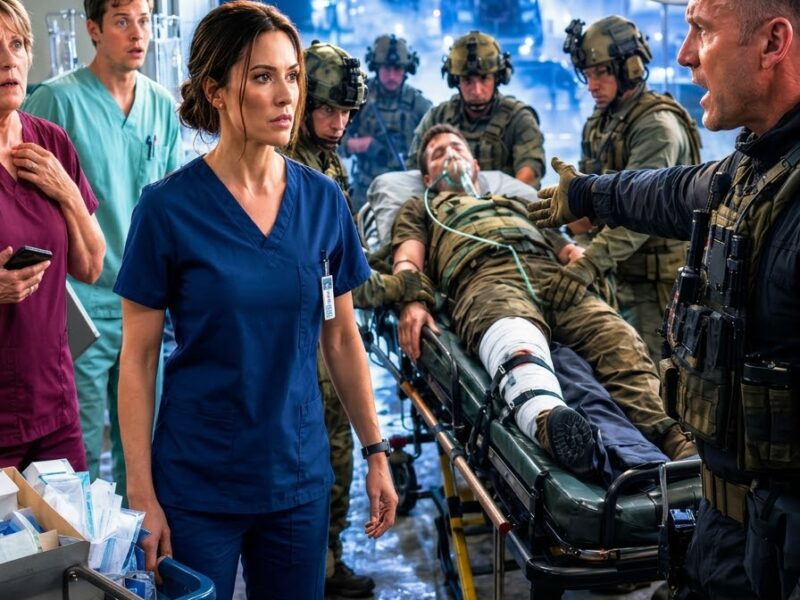
They laughed when I was pushed aside at the trauma bay and called “just a float nurse,”
The scent of rubbing alcohol, copper, and damp rain always hung heavy over St. Vincent Medical Center’s emergency department, but tonight, the air tasted like ozone and static. Outside, the San Diego sky had emptied itself in a relentless torrential downpour. Inside, the trauma bay was an engine on the verge of throwing a rod.
I had learned a long time ago not to correct people when they underestimated me. Silence was cheaper than explaining a past you couldn’t quite put into words.
At St. Vincent, I was the nurse they called when someone called out sick, when a shift was impossible to fill, or when nobody else wanted the assignment. I had no permanent station, no desk framed with family photos, no regular shift group that went for drinks after sunrise. I was just the float nurse. A nameless face in blue scrubs pushing carts of saline and running blood bags between rooms.
“Hey! Float!”
Nurse Brenda, the floor supervisor whose posture could curdle milk, motioned aggressively toward Bed 4. She didn’t bother using my name. To Brenda, I was a temp body filling an operational gap.
“Get over here and wipe down the chest tube tray for Bay 2, then scrub into Bay 1. We’ve got a multi-car pileup on Interstate 5 coming in. Five minutes out. Don’t get in the way of the real trauma team.”
“Understood,” I said softly, stepping around a discarded roll of medical tape.
I slipped into sterile gloves, my movements deliberate and smooth. There was a rhythm to high-stress medicine, a cadence that felt entirely natural to me—almost like a muscle memory I couldn’t quite place. While the resident doctors paced and snapped orders, my heart rate actually dropped whenever the red wall-phones rang.
The double doors burst open. The smell of burning rubber, wet pavement, and raw blood flooded the hallway. Paramedics rolled in three gurneys back-to-back. The ER descended into controlled chaos.
“Seventeen-year-old male, unrestrained driver, open tibia fracture, low pressure, dropping fast!” a paramedic yelled over the noise.
“Take him to Bay 1!” Brenda barked, shoving me slightly as she moved past. “Out of the way, float. Dr. Vance needs a senior surgical tech, not a floater.”
I stepped back without a word, taking up a position near the foot of the boy’s bed. The kid was terrified. His knuckles were white against the vinyl mattress, his chest heaving as his pulse monitor shrieked a frantic tempo.
“Look at me,” I murmured, leaning over his blood-smeared face. I took his hand, applying gentle, firm pressure to his carotid artery with my free fingers. “Stay right here with me. Focus on my voice. You’re in the building now. The hard part is over.”
He locked eyes with mine, his chest settling just a fraction.
Suddenly, the heavy glass doors leading to the main ambulance bay vibrated.
It wasn’t a rumble from the street. It was a rhythmic, bone-deep thrumming that rattled the suspended fluorescent light panels overhead. The noise grew exponentially, swallowing the sound of the blaring monitors and shouting staff.
A security officer stepped out into the bay, radio pressed tightly against his ear. He froze, his face draining of color. He turned back toward the ER, waving his arms in a panic.
“Everyone step back from the glass! Step back now!”
Nobody moved. The shock was too dense.
Then the floor shook. Outside the third-floor windows, blinding searchlights slashed through the storm. Three massive, matte-black military helicopters—RCS stealth variants with no country markings—hovered low over the parking lot, their heavy blades washing thousands of gallons of rainwater against the building’s facade. The force of the downwash shattered the glass in the waiting room doors.
The trauma bay went completely silent, save for the electronic beep of the patient monitors.
The emergency doors weren’t pushed open; they were taken off their tracks. Six men in pitch-black tactical gear rushed inside, weapons held at low-ready, forming a defensive perimeter around the entrance. Behind them stepped a tall man. He wore an unbadged commander’s field uniform soaked through with rain and dried dark blood. A thick, faded scar ran from his jawline down into his collar.
His eyes were cold, razor-sharp, and exhausted. He scanned the frantic, frozen faces of doctors, techs, and nurses.
“Where’s Beacon?” his voice boomed over the whine of the idling rotors outside.
Brenda stepped forward, her hands trembling as she held a clipboard like a shield. “Who? This is a civilian trauma center! You can’t just—”
“Where is Beacon?” he repeated, louder this time. His voice didn’t carry anger; it carried absolute, uncompromising authority.
His eyes swept across every face in the bay. The surgical residents, the attending physicians, the orderlies clinging to the walls.
Then his gaze locked onto me.
My stomach dropped into a bottomless void. Cold sweat broke out along the back of my neck.
He walked directly toward me, his heavy combat boots crunching over the glass fragments on the tile floor. The five tactical operators fell into formation behind him, moving with precise, deadly fluidity.
He stopped three feet away.
“You,” he said.
I slowly lowered my bloody gloves, my breath catching in my throat. “Me?”
He gave a single, tight nod. “You’re Beacon.”
Behind me, one of the surgical residents let out a nervous, disbelieving laugh. “She’s just a float nurse. She started here three months ago. You have the wrong person.”
The commander didn’t turn around. His expression simply hardened into iron. “She’s the only reason my entire strike team is still alive.”
Silence pressed down on the room like a physical weight.
The commander reached inside his tactical vest, pulled out a clear waterproof pouch, and extracted a single, yellowed photograph. He handed it to me.
My hands began to tremble so violently that the paper rustled in the air.
The photo showed a ruined, smoke-filled courtyard in some unnamed desert city. Brick structures were crumbled into ash. In the background, an armored transport burned. In the foreground stood a young woman wearing stained medical scrubs, carrying a heavy military-grade field trauma kit over her shoulder.
It was me.
There was no denying the eyes, the sharp jaw, the faint notch in my left eyebrow. But the date stamped in red ink at the bottom corner of the print read: 12/04/2014.
Twelve years ago.
“I’ve never been there,” I whispered, my voice cracked and unfamiliar to my own ears. “I’ve lived in California my whole life. I was in nursing school twelve years ago. I’ve never left the country.”
The commander looked at me quietly, his dark eyes brimming with a terrifying pity. “That’s what they made you believe.”
Suddenly, a searing pain spiked behind my temples. It hit like a lightning strike, burning through the fog of my mind.
Images snapped into my head with violent clarity—not like thoughts, but like cinematic flashbulbs bursting inside my skull. A burning room. The deafening roar of jet engines. A child’s small, warm hand clutching mine in the dark. A radio screaming through static: “Beacon is compromised! Repeat, Beacon is dark!”
I gasped, stumbling back against the metal tray table. The medical instruments rattled loudly. I had spent my entire adult life believing those images were just recurring nightmares—the residue of a traumatic childhood illness that had left me with severe amnesia prior to age twenty.
The commander leaned closer, lowering his voice so only I could hear. “Your real name isn’t Maya Vance. Your real name isn’t on any state registry. And your life didn’t start in a California suburb.”
My heart pounded so hard against my ribs it felt structural. “Who am I?”
Before he could answer, a high-pitched, electronic frequency shrieked through the hospital’s PA system.
CLICK.
Every light in the building died simultaneously.
Emergency generators failed to kick on. Darkness swallowed the room, illuminated only by the rhythmic sweeping light of the helicopters outside. Then, with a series of loud, mechanical thuds, the heavy fire doors at every exit slammed shut, their magnetic locks engaging with a permanent, ominous click.
In the sudden shadow, a sound rose from my hip pocket.
It was an old, heavy pagers—a model 90s-era device I had found in my storage unit years ago and kept as a silent clock, despite it having no active network service or battery connection.
The screen glowed a toxic neon green.
A single line of text scrolled across the tiny LCD display:
BEACON, THEY FOUND YOU.
The commander glanced down at the green light illuminating my chest. He took a slow breath, his hand resting on the grip of his sidearm. He leaned down, his mouth near my ear, and whispered five words that stripped every drop of warmth from my blood.
“Your daughter is still alive.”
“My… what?” The word barely escaped my throat.
The ground beneath my feet felt unstable, as if the concrete floor of the hospital were dissolving into ocean water. “I don’t have a child. I’ve never been pregnant.”
“You were,” Commander Vance said, his hand closing firmly around my forearm. Not to restrain me, but to keep me upright. “They wiped twelve years of operational memory, Maya—or whatever you call yourself now. They gave you a quiet life, a fake background, a float position in a mid-level hospital so you’d stay dormant. But the code didn’t take completely, did it? You still know how to save a life under fire.”
“Who locked the doors?” Brenda shrieked from the corner. “What is happening?! Someone call the police!”
“The police aren’t coming, ma’am,” one of the tactical operators said without breaking his stance toward the sealed glass doors. “This building just went into Level-4 Blackout isolation. The grid was cut from the main substation outside.”
A sharp, metallic click rang through the room as the commander racked the slide of his pistol. “He’s here.”
“Who?” I gasped, holding the glowing pager against my chest like a shield.
“The man who built you,” the commander said. “We call him the Architect. He runs the extraction program for Black-Tier medical assets. Twelve years ago, you defied a direct order to abandon a covert field clinic in the Syrian basin. You saved twenty-two men from my unit—and you hid a child who wasn’t supposed to exist.”
My head pulsed with a blinding, unbearable migraine. Memory fragments cascaded through my consciousness like broken glass sliding down a hill.
A concrete cellar.
The smell of gunpowder and baby formula.
A pair of small, bright green eyes looking up at me through the darkness of a bunker.
“Keep her safe, Beacon. No matter what they burn.”
“No,” I choked out, tears finally breaking through my paralysis. “No, I remember… I remember a car crash when I was twenty. My parents…”
“Your ‘parents’ were retired agency handlers tasked with keeping you placated,” Vance said coldly. “They died three years ago of natural causes. Their job was done. You were supposed to spend the rest of your life moving from shift to shift, tired, isolated, and forgotten.”
Suddenly, the overhead emergency lights didn’t turn back on—instead, the ceiling speakers cracked to life with a burst of high-frequency white noise.
A voice cut through the static. It was smooth, cultured, entirely devoid of emotion, and echoed through every dark hallway of St. Vincent Medical Center.
“Good evening, Beacon,” the voice murmured. “I must confess, I am disappointed. You maintained your cover for four thousand, three hundred and eighty-two days. A remarkable period of stability for an asset with your level of neural reconfiguration.”
The ER staff whimpered. The resident doctor shrank behind an ultrasound machine.
“Who are you?!” I shouted toward the ceiling speaker, my voice trembling with rage and terror.
“I am the man who gave you a life when your country considered you collateral damage,” the voice replied calmly. “And I am the man who comes to collect when a debt expires. Commander Miller’s presence in your trauma bay was… unexpected, but mathematically irrelevant. He brought five men. I brought forty.”
Outside, the heavy thump of the helicopter rotors suddenly changed pitch. A series of muted suppressed pops echoed from the roof.
Through the shattered glass of the front lobby, we saw one of the black helicopters spin out of control, its tail rotor erupting in a shower of sparks before it plunged down into the parking lot below. A massive fireball illuminated the darkened bay, casting long, grotesque shadows across the walls.
“The perimeter is lost,” one of Miller’s operators grunted, checking his wrist monitor. “Hostiles moving down the stairwells from the roof and coming up from the basement level. We’re boxed in, Commander.”
Miller didn’t flinch. He grabbed a heavy tactical rig from his shoulder and threw it over my head, cinching the straps down against my scrubs before I could protest. He jammed a trauma pack and two magazines into the front pouches.
“Listen to me,” Miller said, gripping my shoulders so hard it bruised. “You are not a civilian, Maya. You were the chief surgical officer for Special Operations Command Detachment 9. You’ve performed arterial repairs in the back of moving humvees under mortar fire. You’ve taken lives to save lives. That instincts didn’t die—it’s just sleeping.”
“I can’t shoot a gun!” I cried out.
“You don’t have to,” Miller snapped. “You just have to keep moving. Your daughter—her name is Clara. She’s eleven years old. She’s being held in the lower level of the research lab three miles from here. They kept her as leverage in case your memory ever returned.”
The words hit me like a physical blow to the sternum. Clara.
The name felt like a key turning in a long-rusted lock inside my mind. A flash of memory returned: holding a tiny, fragile bundle wrapped in a scratchy military wool blanket, pressing my lips to her forehead while tear gas burned my eyes.
“Clara,” I whispered. The fear that had paralyzed me for the last ten minutes suddenly evaporated, replaced by an ice-cold, blinding clarity.
“They’re breaching the North corridor!” an operator shouted.
The heavy double doors of the trauma bay erupted inward under a hail of suppressed automatic gunfire. Wood chips, drywall, and glass rained down through the dark.
“Move!” Miller roared, firing his weapon back down the hallway as he shoved me toward the rear service exit. “Get her to the subterranean access tunnel! Go!”
The service stairwell was a vertical tunnel of concrete, echoing with the distant sound of gunfire and screaming sirens from the streets outside.
I sprinted down the concrete steps, my feet moving with an uncanny, automatic efficiency. Behind me, Miller and two surviving operators covered our descent, firing short, controlled bursts up the stairwell shaft every time a tactical flashlight swept down from the upper landings.
“They’re using thermal imaging!” Miller called out as we reached Basement Level 2. “Keep moving! Don’t stop for anything!”
We burst through a door marked Sub-Utility / Maintenance Only. The warm, damp air of the hospital’s underground infrastructure enveloped us. Giant yellow steam pipes ran along the ceiling like exposed veins, hissing rhythmically in the dark.
My breathing was fast, but my mind had stopped panicking. It was the strangest sensation—a split consciousness. One half of me was Maya Vance, the tired float nurse who cried over sad commercials and worried about paying rent. The other half was Beacon—an asset who automatically evaluated every doorway for tactical cover, calculated blood-loss rates by the color of liquid on concrete, and felt no fear, only objective necessity.
“Stop,” I said abruptly, grabbing Miller’s shoulder.
Miller paused, raising his weapon toward the dark corridor ahead. “What is it?”
“The air pressure changed,” I murmured, staring into the dark hallway lined with electrical breakers. “The exhaust fans down here are reversed. They’re pumping gas through the HVAC system.”
Miller glanced at me, a sharp, grim smile touching his lips. “There she is. Welcome back, Beacon.”
He pulled a pair of compact rebreathers from his belt, slapping one into my hand. We pulled them over our faces just as a sweet, chemical odor drifted down from the ceiling vents.
Behind us, the heavy steel door of the stairwell buckled under an explosion. The frame warped outward, and three men in unmarked black body armor tumbled through the smoke, weapons raised.
Before Miller could fire, I swung a heavy brass pipe valve off the wall rack next to me. I didn’t think; my body simply moved. I hurled the heavy iron fitting directly into the high-pressure steam line running above the doorway.
BOOM-HISSSSS!
Superheated steam erupted from the ruptured pipe in a roaring wall of white heat. The three attackers screamed as thousands of pounds of pressure scorched their tactical suits, blinding them instantly in the narrow space.
Miller stared at me for a fraction of a second, his eyes wide behind his eye protection. “Remind me never to get on your bad side.”
“Where is the tunnel exit?” I demanded, my voice raspy through the rebreather. “You said she was three miles away. We aren’t going to make three miles on foot in a city locked down by black-budget mercenaries.”
“There’s an old subway drainage line beneath the boiler room,” Miller said, pulling out a ruggedized tablet screen. The map showed a network of pre-Cold War tunnels beneath San Diego. “It leads directly beneath the facility where Clara is being kept. But the facility isn’t a lab.”
“What is it?”
“It’s a private medical extraction facility owned by Apex Synthesis,” Miller said, guiding me down a narrow metal gangway over pools of murky water. “The company that funded your memory suppression. They don’t just clear memories, Maya. They harvest specialized skills. You were their best trauma surgeon. When you went rogue to save my team, they decided if they couldn’t control your mind, they’d keep your child as collateral until they needed your hands again.”
“My hands,” I looked down at my fingers. The calluses weren’t from pushing gurneys. They were from thousands of hours holding scalpeled steel and suture threads under artillery fire.
“They brought you out of dormancy tonight because the Architect is dying,” Miller added grimly as we reached the entrance to the dark drainage tunnel. “He has an aortic dissection. He needs the best surgeon in the world to fix it—someone who can operate without a full surgical suite. He woke you up to save his own life.”
I stopped at the threshold of the dark tunnel. The sound of water dripping echoed in the blackness ahead.
“He thinks I’ll save him?” I asked quietly.
Miller looked at me, his face illuminated only by the faint green light of my pager, which was still glowing in my vest pocket.
“Will you?” he asked.
I pulled a heavy surgical scalpel from the medical kit pinned to my vest, feeling the familiar, terrifying balance of the steel in my palm.
“I’m going to perform an operation,” I said, my voice as cold as deep water. “But not the one he’s expecting.”
The underground drainage tunnel opened into a subterranean maintenance chamber beneath a sprawling industrial complex on the outskirts of the city. Rain seeped through the storm grates above, creating a steady curtain of falling water.
Miller and his one remaining operator, a quiet soldier named Santos, took positions by the heavy steel gate that led up to the facility’s lower levels. Santos was bleeding badly from a gunshot wound to his side; his breaths were shallow and wet.
“He won’t last another twenty minutes without an chest tube,” Miller grunted, pressing a wad of gauze against Santos’s side.
“Move his arm,” I ordered, dropping to my knees beside Santos without hesitation.
My hands moved before my brain could process the steps. I sliced open my sterile kit with my teeth, prepped a curved plastic tube, and made a clean, two-centimeter incision between Santos’s fifth and sixth ribs. Santos groaned through gritted teeth as I slipped the tube into his pleural cavity. Air and dark blood hissed out into the collection bag. His breathing instantly stabilized.
Santos looked up at me, his eyes wide through his sweat-soaked hair. “Thanks… Doc.”
“Save your breath,” I said, wiping my blood-stained hands on a sterile wipe. “Miller, how many guards inside?”
“At least twenty in the core facility,” Miller said, looking at a stolen access card. “The Architect has transformed the lower level into a high-grade sterile suite. He’s hooked up to a temporary bypass machine right now, waiting for you to perform the repair.”
“And Clara?”
“She’s in the adjacent recovery room. They’re keeping her sedated so her stress markers don’t interfere with the neural link they used to monitor your memory suppression.”
A cold rage, sharper and purer than any emotion I had ever known, settled deep inside my chest. They hadn’t just taken my past; they had turned my child into an instrument of my imprisonment.
“Here’s what we do,” I said, leaning toward Miller and mapping out the facility floorplan in the dirt with my scalpel point. “They expect me to walk through the front doors of the surgical suite as a broken asset whose memories just shattered. They think I’m weak, confused, and desperate to save my daughter.”
“Aren’t you desperate?” Miller asked gently.
“Desperate people make mistakes,” I replied, looking him dead in the eye. “I’m not desperate. I’m precise.”
I grabbed a pair of surgical clamps, two bottles of concentrated sterile iodine, and a high-voltage industrial battery lead from the wall generator.
“Santos stays here to hold the extraction point,” I said. “Miller, you take out the main breaker for their medical backup systems on my mark. When the room goes dark, I’ll be inside.”
“Maya,” Miller held my arm as I turned toward the heavy access ladder. “The Architect—he’s a master manipulator. He built your entire personality for five years. He knows how you think.”
“He knows how Maya thinks,” I corrected him, pulling the dark rebreather mask back over my mouth. “He doesn’t know what Beacon does when she’s protecting her own.”
I climbed the ladder into the dark service shaft above.
Every step felt like shedding an old skin. The float nurse who apologized for being in the way, who took the worst shifts, who lived a quiet, lonely life in a small apartment with no pictures on the walls—she was gone. In her place stood the surgeon who had survived hell, and who was about to march straight back into it.
I breached the ceiling grate of the facility’s utility room and dropped lightly onto the polished linoleum floor. The corridor was silent, bathed in the harsh blue glow of ultraviolet sterilizing lamps.
Ahead, through a thick set of reinforced observation windows, lay the central operating theater.
In the center of the room sat a massive surgical table surrounded by advanced heart-lung monitors. Lying on the table, surrounded by three terrified civilian doctors, was an elderly man with pale skin, thin white hair, and a ruthless, brilliant gaze.
The Architect.
And in a small glass room off to the side, fast asleep beneath a white blanket, lay a little girl with light brown hair and a face that matched my own in every detail.
My daughter.
I stepped through the automated double doors of the operating room.
The three civilian doctors jumped, dropping their instruments onto the stainless-steel trays with a loud metallic clatter. The tactical guards standing at the corners of the room raised their weapons, but a weak gesture from the man on the table made them hold their fire.
The Architect looked at me, a pale, terrible smile spreading across his blue-tinted lips.
“Maya,” he rasped, his voice vibrating through an external vocal amplifier strapped to his throat. “Or should I say… Beacon. You look well. A bit tired from your commute, but your motor functions seem entirely unimpaired.”
I walked slowly toward the operating table, stopping just out of reach of his monitoring lines. I didn’t look at Clara yet; to look at her would be to show him my heart, and I needed my heart to be made of stone.
“You’re dying, Arthur,” I said quietly, reading the digital arterial pressure gauges on his monitor wall with a single glance. “Your ascending aorta has a six-centimeter tear. You have less than thirty minutes before the vessel ruptures completely and fills your chest cavity with blood.”
“Which is why you are going to repair it,” the Architect said, his breathing shallow. “You are the only surgeon alive who has successfully executed a suture-less aortic graft under field conditions. I built those hands, Beacon. I paid for every hour of your training. I owns the very neural pathways that allow you to hold a scalpel without shaking.”
“You don’t own anything,” I said softly.
He chuckled, a wet, rattling sound. “Look to your right, my dear.”
He gestured toward the glass chamber where Clara lay. A digital timer above her bed was counting down from twenty minutes in bright red numbers.
“If my heart stops beating before that timer reaches zero,” he murmured, “the automated sedative drip in her IV will change from a tranquilizer to a lethal paralytic. My life is hardwired to hers. You save me… she walks out of here with you. You kill me, or let me die… and you watch your daughter follow me into the grave five seconds later.”
The three civilian doctors shivered, backing away toward the wall.
“You’re a monster,” I said, my voice barely above a whisper.
“I am a pragmatic man,” he corrected me. “Now… scrub in. Your gloves are waiting.”
I stared at his chest, then at the timer ticking down above my daughter’s bed.
19:42… 19:41… 19:40…
“Very well,” I said.
I stepped over to the scrub sink, turning on the water with my knee. I washed my hands with deliberate, rhythmic care, letting the hot water scold my skin. I slipped on the sterile gown and pulled latex gloves over my fingers.
I stepped up to the surgical table, selecting a heavy-duty titanium retractor and a curved scalpel from the tray.
“No anesthesia?” the Architect asked, his eyes narrowing slightly.
“The tear is too advanced,” I said calmly, positioning the blade over his exposed chest. “Anesthesia will drop your blood pressure below the threshold needed to keep your brain oxygenated during the graft. You’re going to have to stay conscious for the first five minutes.”
He swallowed hard, his confidence flickering for the very first time. “Begin.”
I lowered the blade.
BOOM!
The entire room plunged into pitch darkness as Miller hit the primary power junction outside.
The emergency monitors shrieked as their batteries kicked in, casting a strobe-like red light across the operating room. The guards shouted, their weapon lights cutting through the darkness.
“Hold your fire!” the Architect screamed in agony.
In the fraction of a second the darkness had provided, I hadn’t cut his aorta.
My hands, moving with precise, lethal speed, had driven the heavy titanium retractor directly into the junction box of the heart-lung machine beside his bed, jamming the gears and short-circuiting the automated telemetry link connected to Clara’s IV system.
The red timer above her bed froze instantly at 18:12.
“What did you do?!” the Architect shrieked, clutching his chest as his real heart faltered.
“I disconnected the circuit,” I whispered into his ear as I leaned over him in the flashing red darkness. “You thought you programmed me to save lives at all costs. But you forgot the first rule of triage.”
I reached down and clamped his main arterial line with a pair of heavy surgical forceps, stopping the blood flow to his brain.
“You prioritize the patients who can be saved,” I whispered. “And you leave the lost causes behind.”
Before the guards could react to the failure of his heart monitor, Miller burst through the side doors, his weapon clearing the room in three swift, terrifying bursts. The guards crumpled to the floor.
I tore off my sterile gloves, threw open the door to the glass chamber, and scooped my daughter into my arms.
Clara stirred, her eyes fluttering open slowly. She looked up at me through the dim red emergency lights, her small hand reaching up to touch my face—just like in the memory from twelve years ago.
“Mommy?” she whispered, her voice fragile and small.
Tears finally spilled over my eyelashes, hot and real, burning away the last remnants of the cold, artificial life I had lived for a decade.
“I’m here, baby,” I sobbed, pulling her tightly against my chest and wrapping my tactical jacket around her tiny frame. “I’m right here. It’s over.”
Miller stepped to the doorway, his weapon lowered, looking down at the silent form of the Architect on the operating table, then back at me.
“Where to now, Beacon?” he asked quietly.
I looked down at my daughter, holding her close as her breathing synchronized with mine. I looked at my hands—stained with blood, but completely steady.
“Nowhere,” I said, stepping past him into the rain-washed night air waiting outside the shattered doors. “Beacon is gone. My name is Maya. And we’re going home.”
The end.









