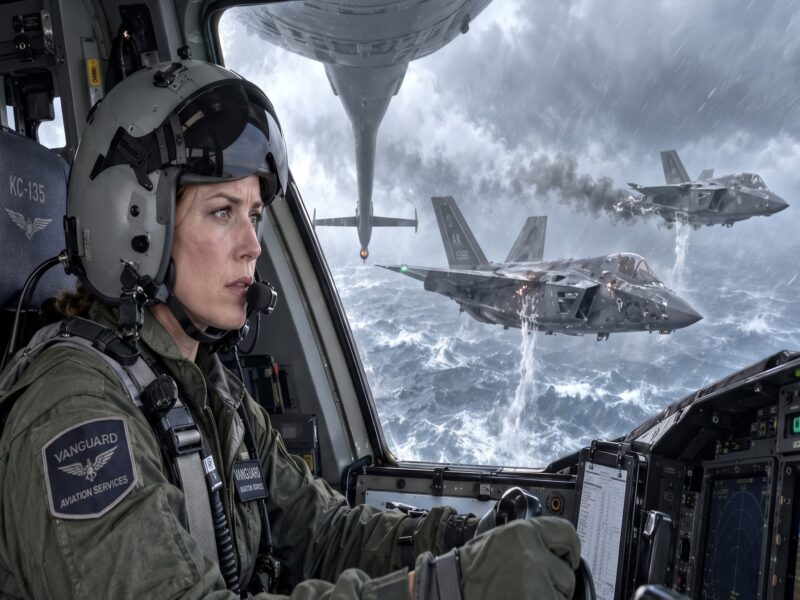
They laughed when I was publicly removed from the flight line at Nellis Air Force Base and called a washed-up pilot who had forgotten how to fly
The humiliation of that morning at Nellis Air Force Base didn’t come with shouting or dramatic gestures. It came with the dry, sterile rustle of paper and the heavy, suffocating silence of an office where decades of service were quietly erased.
I stood rigidly at attention in front of the polished oak desk, my eyes fixed on the blank wall behind Colonel Vance’s head. Outside the double-paned glass window of the Operations Command Center, the desert sun beat down mercilessly on the tarmac, reflecting off the sleek, razor-thin noses of three dozen F-35 Lightning IIs. Young pilots in flight suits walked past in pairs, their laughter carrying faintly through the glass. When they looked up toward the second-floor corner office, they didn’t wave or nod. They looked away quickly, as if disgrace were a contagious airborne disease.
On the desk between us lay my silver flight wings, unpinned from my chest moments earlier with a sharp, metallic tug that had torn two small threads from my uniform fabric.
“You’re finished, Miller,” Colonel Vance said, his voice flat, stripped of all personal history. He didn’t look at me as he slid my service file into a red manila folder. “The medical evaluation board came back. Unexplained spatial disorientation during high-G combat maneuvers. Nervous hesitation during low-altitude terrain masking. You’re a liability to this wing, and I won’t have a washed-up pilot who’s forgotten how to handle an airframe dragging down the operational readiness of Nellis.”
“Colonel,” I said, my voice tight, forcing the air past a cold lump in my throat. “The flight data recorder from that exercise—”
“The flight data recorder shows you broke formation at four thousand feet over the Nevada Test and Training Range and sat in a level drift for forty-eight seconds,” Vance cut in, his eyes snapping up to meet mine. They were cold, grey, and completely unyielding. “In a modern stealth jet, forty-eight seconds is an eternity. It’s a death sentence. You had your time, Captain. Now hand over your flight line badge and step off my deck.”
I wanted to tell him he was wrong. I wanted to slam my fist on his desk and scream the truth at him—that I hadn’t lost my orientation, that my mind hadn’t snapped, and that I wasn’t afraid of the aircraft. I wanted to tell him about the phantom sensor blips that had glitched on my tactical display three seconds before I broke formation, the exact same electronic anomaly that had flashed across my scope three years ago on the night my wingman, Lieutenant Daniel “Ghost” Park, vanished into the jagged black jaws of the Pahranagat Canyon.
Instead, I said nothing.
I stood there, swallowed the burning bile in my throat, reached up, and unclipped my heavy plastic clearance badge. I laid it on the desk beside my severed wings, rendered a stiff, mechanical salute, and turned on my heel.
As I walked down the long, linoleum-tiled hallway, the news of my removal had already spread like wildfire through the squadron. Two junior pilots—twenty-four-year-olds fresh out of Euro-NATO Joint Jet Pilot Training—were standing near the coffee station. When they saw me approaching, they fell silent. One of them snickered softly under his breath, leaning over to whisper something about “the ghost-chaser finally getting grounded.”
I kept my head up, my jaw clenched so hard my teeth ached, and walked out into the blinding Nevada heat.
Nobody on that base knew why I had stopped flying aggressively. Nobody knew about the haunting nightmare that visited me every time I pulled the stick back past four Gs—the radio static, the sudden drop in hydraulic pressure, and Daniel’s final, terrified voice crackling through my helmet before his signal was swallowed by thirty miles of solid granite and silence. I had spent three endless years blaming myself for taking Daniel into that treacherous, unmapped sector during a midnight low-observable exercise. I had accepted the blame, the whispers, the demotion to administrative duties, and now, the total stripping of my status as an aviator.
I walked away from the flight line, taking a low-level civilian logistics desk in the base’s underground operations building—a windowless bunker built deep beneath the desert floor where old flight paths went to be archived and forgotten.
Three years passed. Three years of signing fuel requisitions, filing airspace reservation logs for visiting units, and watching the sky through radar screens instead of a canopy glass. I became a ghost in the building, the quiet guy in the corner who never spoke about dogfights or tactical maneuvers.
Then came a Tuesday morning in late October.
The ambient noise in the main radar room was normal—the steady hum of cooling racks, the soft murmurs of air traffic controllers managing the commercial corridors over Las Vegas, and the intermittent ping of the regional primary search radar.
At 0914 hours, Chief Radar Operator Sarah Jenkins froze. Her fingers stopped over her mechanical keyboard.
“Sector Four… I’ve got a transponder drop,” she announced, her voice calm but sharp enough to cut through the room’s low chatter. “Viper Flight, two F-35 Lightning IIs on a low-altitude terrain-masking route. Primary transponders just went dark.”
“Check secondary telemetry,” a sergeant nearby said, not yet looking up from his coffee.
“Secondary is dark. Auxiliary emergency beacons are dark,” Jenkins replied, her tone rising in pitch. “I’ve lost radio contact. Viper One, this is Nellis Operations, report status. Viper Two, report status.”
Nothing came back through the overhead speakers except the flat, hiss of cosmic static.
Within forty-five seconds, the room exploded into chaotic movement. Red warning lights flared along the perimeter walls. The primary tactical display flipped from standard surveillance mode to Emergency Track Integration. Huge, high-resolution satellite maps of the Nevada Test and Training Range bloomed across the twenty-foot main wall screen.
Colonel Vance burst through the double doors of the command gallery, his combat boots clicking heavily on the raised floor panels. “Report!” he barked, shoving his way to the center of the pit.
“Two F-35s from the 57th Wing vanished off radar three minutes into their low-altitude ingress,” Jenkins reported, her hands moving frantically across her control board. “Last known position was thirty miles east of the central range grid. Altitude was eight hundred feet Above Ground Level, speed four hundred and fifty knots.”
Vance leaned heavily over the master console, his forehead slick with sudden sweat. “Where are they? Pull up their secondary GPS satellite telemetry!”
“Satellite feed is scrambled, sir! Localized radio frequency interference is blanking out the whole sector!”
I stood near the back of the gallery, holding a stack of routine weather logs. My stomach tightened into a hard, frozen knot as I looked up at the glowing red coordinates flashing on the main screen.
Grid 44-Delta. The eastern lip of the Pahranagat Ridge.
I didn’t need a computer to map those numbers. I knew every jagged wall, every radar-blind crease, and every narrow notch of that canyon. I had flown down its throat a hundred times. I had lost my wingman in its shadow.
“Pull up the terrain elevation profile for Sector Four,” I said. My voice was quiet, but in the tense, silent gap between alarm beeps, it carried across the entire room.
Nobody moved. A few junior officers turned to look at me in confusion, wondering why an administrative clerk was speaking up during a Category-One emergency.
I dropped the weather logs onto a nearby table, stepped down into the command pit, and raised my voice, stripping it of all administrative passivity. “Pull up the three-dimensional terrain elevation profile for Sector Four. Now.”
Colonel Vance turned around, his eyes narrowing as he recognized me. “Miller? What the hell are you doing down here? Stand back from the consoles.”
“You want to find those two sixty-million-dollar jets before they hit a cliff wall, Colonel?” I asked, stepping right up to the edge of his command desk and staring him directly in the eye. “Then pull up the terrain profile.”
“Why?” Vance snapped.
“Because they’re not crashed, and they’re not lost,” I said, pointing a finger at the center of the glowing map. “They’re flying down the centerline of the Pahranagat Slot. That canyon is lined with iron-rich basalt rock and heavy mineral deposits. At eight hundred feet, the canyon walls form a natural electromagnetic cage. It creates a complete radar shadow at this sweep angle. You won’t pick them up on primary radar, and their satellite links will be completely severed as long as they stay below the rim.”
One of the senior intelligence staff officers frowned, looking up from his tablet. “That shouldn’t be possible. The F-35’s distributed aperture system is designed to bounce signals through terrain masking.”
“It is possible,” I fired back, my voice cold and precise. “Because the algorithms in the F-35’s terrain-following radar use a pre-programmed surface elevation database. If someone jammed their forward optical array right as they entered the slot, the automated flight control system would force the aircraft down into the shadow to avoid what it thinks is an oncoming obstacle.”
Colonel Vance stared at me for three long, agonizing seconds. The entire room hung in suspense, waiting for him to throw me out of the bunker. But as he looked at the coordinates, a flicker of cold realization crossed his face.
He looked at Jenkins. “Pull up the 3D terrain profile for the Pahranagat Slot.”
The main screen flashed, shifting from a flat two-dimensional map to a dark blue, three-dimensional wireframe rendering of the desert canyon. The last recorded flight path of the two missing F-35s ran in a straight, terrifying line right into the narrowest gap of the canyon walls.
Suddenly, the secondary radio console crackled with heavy, violent static. A voice cut through—high-pitched, breathless, and dripping with raw terror.
“Mayday! Mayday! Nellis Ops, this is Viper Flight Lead! We’ve lost primary flight displays! Terrain awareness system is throwing false warnings! We’re blind in the canyon! I repeat, we are blind!”
Vance lunged for the master transmitter microphone. “Viper Lead, this is Nellis Ops! Maintain current heading and climb to ten thousand feet!”
“Negative, Ops! We can’t climb!” the young pilot screamed over the radio, the roar of a laboring jet engine audible in the background. “Our flight controls are locked in a low-altitude override! Every time I pull back on the stick, the automated system pushes the nose down! We’re going to strike the canyon wall!”
Vance looked at the console in sheer horror, his hands shaking. He didn’t know what to say. The standard emergency checklists were completely useless against a hardline flight-control computer lock.
I didn’t ask for permission. I reached across the desk, snatched the primary command headset directly out of Colonel Vance’s hands, and slammed it over my ears.
“Viper Lead, this is Captain Miller,” I said, my voice dropping into an icy, steady baseline that cut straight through the pilot’s panic. “Listen to my voice and do not touch your stick.”
There was a brief, confused pause on the radio. “Who… who is this? Ops, who is this?”
I closed my eyes for a fraction of a second, letting the dark memories of three years ago flood my mind, filtering out the fear and leaving only the math.
“I’m someone who has been in that exact canyon before,” I said into the microphone. “Your flight control computer is reading a spoofed optical return from the canyon floor. Reach down to your lower left pedestal, pull the circuit breaker labeled ‘AUX TERRAIN OPTICS’, and manually cycle your primary flight computer switch to STORES MANAGEMENT OVERRIDE. It will force the system into raw manual control. Do it now.”
For four agonizing seconds, the only sound in the bunker was the rushing wind over the pilot’s open microphone.
Then, a sharp metallic click echoed over the channel.
“Auxiliary optics bypassed!” the pilot yelled. “Flight controls are responsive! Pulling up… pulling up NOW!”
On the main wall screen, two small green blips suddenly burst out of the dark blue canyon wireframe, shooting straight up through the radar floor into the clear airspace at twelve thousand feet.
“Radar contact re-established!” Jenkins shouted, clapping her hands together. “Viper One and Viper Two are airborne and stable! Transponders are back online!”
A massive sigh of relief swept through the operations room. Several young controllers let out short cheers, and Vance leaned against the desk, wiping his forehead with the back of his hand.
But I didn’t cheer. I stood staring at the primary telemetry data streaming off the returning aircraft.
Something was deeply, terribly wrong.
The diagnostic telemetry showing on my auxiliary screen showed that the F-35s’ emergency navigation backup systems hadn’t just glitched or suffered a short circuit. The encryption keys for their low-altitude flight management software had been manually altered prior to takeoff from the Nellis flight line. Someone had deliberately reprogrammed their computers to lock them into that canyon.
Someone had sent those two young pilots into the Pahranagat Slot knowing precisely that they would be blinded and driven into the granite walls.
Colonel Vance stood up slowly, looking at me with a complex mix of shock, embarrassment, and sudden dread. “Miller… how did you know about the auxiliary optics bypass? That procedure isn’t in the standard F-35 emergency manual.”
I slowly unclipped the headset and laid it on the desk. “Because three years ago, when Daniel Park went down in that exact same canyon, I recovered his flight recorder from the wreckage myself before your crash investigation team locked it in a vault.”
Vance’s face drained of all color. “What?”
I reached into my inner jacket pocket and pulled out an old, worn photograph I had carried every single day for three years. It was a reconnaissance satellite printout of the Pahranagat Range from the night Daniel died. Marked across the terrain in faded red ink was a flight path—a route that matched the F-35s’ route today down to the exact GPS waypoint.
I turned the photograph over. Tacked to the back was a yellowed piece of notepad paper containing a handwritten coordinate string and four words written in dark, sharp cursive that I had spent three years trying to decipher.
I laid it on the desk directly in front of Colonel Vance.
The handwriting belonged to Vance himself. And beneath the flight coordinates were four words that made the room feel as cold as a grave:
Make sure she survives.
Before Vance could speak, before I could demand an answer, the radio console burst into life once again. The Viper Flight Lead’s voice came back, stripped of all relief, filled with a fresh, terrifying panic.
“Nellis Ops… Viper Lead! We’ve got a visual on our tail!”
I lunged back toward the microphone. “Viper Lead, report! What do you see?”
“There’s an unidentified airframe trailing us out of the canyon!” the pilot stammered. “No transponder, no optical signature on our threat display… but I have visual contact! It’s a black delta-wing jet, sitting right on our six o’clock!”
I froze. My eyes locked onto the primary search radar screen.
The sky above the Pahranagat Range was completely empty on radar. But two miles behind our sixty-million-dollar stealth fighters, something was hunting them in plain sight.
The silence inside the Nellis Operations Bunker felt heavier than the mountain above us.
“Viper Lead, verify contact,” I commanded, my thumb pressing hard against the microphone switch. “Is the aircraft engaging?”
“Negative, Ops!” the pilot’s voice crackled back, heavy with altitude static and rapid breathing. “It’s… it’s just holding formation! Fifty yards behind my wingman’s tail nozzle. It matched our climb rate out of the canyon perfectly, but my radar warning receiver isn’t even chirping! It’s like the airframe doesn’t exist to my sensors!”
“It doesn’t,” I muttered, my eyes sweeping across the raw telemetry data streaming from the Pahranagat radar relay station.
Commander Vance stepped up beside me, his hands trembling as he stared at the red document on his desk, then up at the empty primary display screen. The humiliation he had inflicted on me three years ago had completely dissolved, replaced by the hollow, desperate terror of a man whose carefully constructed web of lies was collapsing around his ears.
“Miller,” Vance whispered, his voice barely audible to the rest of the room. “You need to order Viper Flight to return to base immediately. Land them on Runway Two-One Left under armed guard.”
I turned my head and looked at him, my eyes narrowing. “Who wrote that note, Vance? Why were Daniel Park’s coordinates on a piece of paper signed by your hand three years ago? And who is ‘she’?”
“That is classified at a level you don’t possess, Captain!” Vance hissed, attempting to summon his old authority, though his eyes darted nervously toward the junior officers in the gallery.
“Classified?” I let out a short, bitter laugh. “Two of our primary air-dominance fighters were just redirected into a dead-end canyon by tampered flight software, and there is an dark stealth prototype sitting on their tails right now over open Nevada airspace! You’re out of time for classification, Colonel. Speak, or I order those jets to engage.”
Vance swallowed hard, his throat clicking. He looked around the room, seeing forty pairs of eyes fixed on him. The controllers had stopped typing. The intelligence staff had lowered their tablets. The entire nerve center of the base was waiting for his answer.
“The pilot in Viper Two,” Vance said, his voice dropping into a raspy whisper. “Lieutenant Maya Park. She’s Daniel’s younger sister.”
The words hit me like a physical blow. The air seemed to leave my lungs instantly.
Maya Park.
Three years ago, she had been a cadet at the Air Force Academy—a brilliant, fierce young woman who had sent me a letter after Daniel’s death, asking me why her brother had died in a routine training exercise. I had never answered her letter. I hadn’t been able to bring myself to write the words.
“She transferred to the 57th Wing three months ago,” Vance continued, his eyes fixed on the floor panels. “She didn’t use her family connection. She qualified on the F-35 on her own merit. But three weeks ago, I received a hand-delivered directive from an unlisted intelligence task force in Washington. They told me that if Maya Park ever flew a low-altitude ingress profile over the Pahranagat Range, I was to ensure her telemetry was routed through a private server.”
“And the note?” I pressed, stepping closer to him, pointing at the yellowed paper.
“That note was given to me the night Daniel died!” Vance admitted, his composure finally shattering. “Daniel wasn’t on a routine exercise three years ago, Miller! He was flying escort for an unauthorized weapons test! An experimental black-project drone developed by a private defense contractor operating out of Area 51! The test went wrong! The drone’s guidance system inverted, locked onto Daniel’s tail, and forced him into the mountain wall!”
I grabbed Vance by the front of his uniform jacket, pulling him inches from my face. “And you covered it up? You framed me for pilot error and spatial disorientation to hide a defense contractor’s hardware failure?”
Vance didn’t pull away. He looked at me with a desperate, pathetic pleading in his eyes. “If the truth came out, the entire wing command would have been court-martialed! The contractor—Aegis Recon Systems—holds high-level clearance across the Department of Defense. They threatened to destroy every career in this building if we leaked the telemetry! I wrote that note to my line chief to make sure Maya Park was never assigned to that specific flight corridor! But someone bypassed my order today!”
“They didn’t bypass it,” I said, releasing his jacket and turning back to the main console. “They used it. They wanted her in that canyon. They wanted to finish what they started three years ago.”
Before Vance could respond, Sarah Jenkins yelled from the radar station.
“Ops! The unidentified target just shifted formation! It’s moving to an attack position behind Viper Two!”
“Viper Two, break right!” I yelled into the headset microphone. “Maya! Break right NOW!”
Over the radio speaker, a young female voice—crisp, sharp, and unmistakably carrying the same inflection as her late brother—cut through the static.
“I can’t break right, Ops!” Maya Park shouted. “My port engine is surging! Hydraulic line pressure in my left wing is dropping fast! Something is draining my primary flight bus!”
“It’s an active directed-energy jammer,” I realized instantly, my mind racing through the technical schematics of non-lethal electronic warfare weapons. “The tailing aircraft isn’t firing missiles. It’s using a high-power microwave beam targeted at her flight control surfaces! It’s frying her avionics from fifty yards away!”
“Viper One, engage the target!” Vance ordered into his secondary microphone. “Execute a kinetic intercept!”
“Negative, Viper One, do NOT fire!” I countermanded immediately. “If you fire a heat-seeking missile at that proximity, the microwave beam will bend the missile’s guidance sensor straight back onto your own airframe! You’ll shoot yourself down!”
“Then what do we do?” Viper Flight Lead screamed over the radio. “Viper Two is losing altitude! Her nose is dropping! She’s down to six thousand feet and falling!”
I looked at the master board. The nearest active tactical fighter units were forty miles away over Lake Mead, completely out of range to provide immediate support. The ground-based surface-to-air missile batteries at Nellis couldn’t lock onto a dark radar target.
There was only one aircraft on the entire continent that could intervene—an airframe that didn’t rely on modern microprocessor flight buses, an airframe sitting in the dark storage bay of Hangar 9 at the far end of the Nellis tarmac.
I turned to Vance. “Where is the old F-15C Aggressor hulk we pulled out of the Tonopah Test Range last year?”
Vance blinked, stunned. “In Hangar 9. It’s a stripped maintenance trainer, Miller! It’s slated for scrap next month!”
“Does it have fuel in the auxiliary tanks?”
“I… I think so, but the radar array is an old mechanical-scan unit! The flight control system uses mechanical push-rods and hydraulic cables!”
“Which means a high-power microwave beam won’t do a damn thing to it,” I said, snatching my flight cap from the chair. “Get Hangar 9 open. Tell the ground crew to connect a starter cart to that F-15.”
Vance grabbed my arm as I turned toward the exit. “Miller… you haven’t flown in three years! Your medical clearance is revoked! If you crash that plane, you’ll die, and if you survive, you’ll spend the rest of your life in Leavenworth!”
I looked down at his hand on my sleeve, then up into his eyes.
“Three years ago, I let Daniel Park fly into the dark alone because I trusted your orders,” I said, my voice cold as ice. “I’m not letting his sister die to protect your career.”
I shoved his hand away, slammed open the heavy steel blast door of the operations bunker, and sprinted out into the blinding Nevada heat toward Hangar 9.
The smell inside Hangar 9 was an intoxicating mixture of dry hydraulic fluid, high-octane jet fuel, and hot metal.
Standing in the center of the dusty, concrete bay was the towering, angular silhouette of an F-15C Eagle—an old double-tailed air-superiority fighter painted in the blue-and-grey digital camouflage pattern of the Nellis Aggressor Squadron. Its skin was scratched, its panel lines worn, and its cockpit canopy covered in a thin layer of fine desert dust.
“Who the hell authorized this?” a master sergeant yelled, running out from behind a tool bench with a wrench in his hand as I burst through the side access door.
“Captain Miller, Nellis Ops!” I roared, unbuttoning my administrative uniform shirt and tossing it onto the floor, revealing the olive-drab standard flight harness I had kept tucked in my desk drawer for three long years. “Connect the external power unit to that Eagle! Start the fuel boost pumps!”
“Sir, this airframe is grounded!” the sergeant protested. “The radar software hasn’t been updated since 2018!”
“I don’t need updated software, Sergeant! I need two Pratt & Whitney engines and a mechanical stick!” I yelled, swinging myself up the access ladder and dropping into the cramped, analog cockpit.
The cockpit of the F-15C was a sanctuary of mechanical simplicity compared to the sleek, glass-screened cockpits of the F-35. Rows of round dials, mechanical needles, heavy steel toggle switches, and a thick, rubber-coated flight stick sat between my knees. No touchscreen displays to freeze under electronic attack. No fly-by-wire computers to override my inputs. Just steel cables, hydraulic fluid, and raw, unadulterated thrust.
Outside the hangar, the yellow external power cart let out a deafening, high-pitched whine as high-voltage electricity flooded into the aircraft’s electrical bus.
I pulled the heavy leather flight helmet over my ears, snapped the oxygen mask over my mouth and nose, and flipped the twin engine start switches on the left console.
WHIRRRR-CLICK-ROAR!
The right engine spooled up first, a deep, mechanical growl that vibrated through the metal floorboards of the cockpit and rattled the teeth in my jaw. Fuel pressure needles jumped into the green. Oil pressure stabilized. A second later, the left engine caught fire with a violent, coughing roar that blew a cloud of dust and dry leaves across the hangar floor.
“Hangar doors opening!” the chief mechanic yelled over his headset, scrambling down the ladder and pulling the ground-power cable free. “Godspeed, Captain!”
The heavy steel hangar doors slid back, revealing the long, sun-baked concrete of Runway Three-Three.
I didn’t wait for air traffic control clearance. I didn’t wait for a taxi ramp assignment. I shoved both throttle levers past the military power detent and slammed them hard into full afterburner.
BOOM!
Two massive, thirty-foot plumes of blue and orange flame erupted from the F-15’s tailpipes. The heavy fighter leaped forward like a starved predator, its tires screaming against the asphalt as fifteen tons of raw mechanical force slammed me back into the hard foam padding of the ejection seat.
The g-force hit my body like a heavy wall. My lungs compressed, my heart hammered against my ribs, and my vision narrowed into a sharp, clear tunnel. For three years, my body had been decaying behind a desk, but as the needle on the airspeed indicator swept past one hundred and eighty knots, every instinct, every muscle memory, and every drop of adrenaline came flooding back with terrifying intensity.
I pulled back hard on the stick.
The F-15’s nose pitched up sharply, its wings slicing through the desert air as it left the ground in a near-vertical climb, screaming into the cloudless Nevada sky at eight hundred feet per second.
“Nellis Control, this is Aggressor Zero-One,” I said into my mask, my voice steady despite the brutal acceleration forces pulling at my face. “I am airborne, passing six thousand feet, vectoring zero-four-zero toward the Pahranagat sector.”
In my helmet speakers, Colonel Vance’s voice came through, strained and trembling. “Aggressor Zero-One… Ops copy. Target is currently at eight thousand feet, ten miles north of the range boundary. Viper Two’s flight controls are completely unresponsive! She’s drifting toward the ridge line!”
“Maya, do you read me?” I called out, switching my radio frequency to the tactical flight channel. “This is Captain Miller. I am ten miles out, closing at Mach one-point-two. Hold your altitude!”
A weak, terrified voice answered through heavy electronic noise. “Captain Miller? My… my primary flight display is dead! The stick is frozen! I can’t pitch up!”
“I see you, Maya,” I said, my eyes scanning the high blue horizon ahead of me.
Ten miles out, high above the brown, jagged teeth of the Pahranagat Mountains, I saw them.
Two aircraft locked in a terrifying aerial dance.
Ahead was Maya’s sleek, grey F-35, its engine smoking slightly, its tail dipping dangerously as its computer systems failed one by one. And fifty yards directly behind her tail, riding in her aerodynamic wake, was a jet I had never seen in any official threat manual.
It was painted a matte, non-reflective jet black—a flat, diamond-shaped delta-wing design without vertical stabilizers. Its surface was completely smooth, devoid of glass canopy seams or exhaust nozzles. It looked less like an airplane and more like a razor blade slicing through the sky.
A thin, shimmering pale-blue beam of ionized air was stretching from a housing beneath the black jet’s nose directly onto the upper fuselage of Maya’s aircraft—the directed-energy weapon, frying her systems in real time.
“Aggressor Zero-One, target locked visually,” I declared, my thumb flipping the weapon arming switch on my stick. “Engaging.”
I didn’t have modern radar-guided missiles. I didn’t have optical tracking. I had two AIM-9L Sidewinder heat-seeking missiles mounted under my wings—forty-year-old technology that looked for one thing and one thing only: the intense heat of an engine exhaust.
I dove out of the sun, pushing the F-15’s throttles to the wall, descending on the black drone like a falling anvil.
The pilot of the dark jet—or the remote automated system controlling it—realized I was there a fraction of a second too late. As my massive blue fighter swept out of the glare, the high-pitched growl of my Sidewinders’ infrared search heads suddenly screamed in my headset—a solid, continuous tone indicating a hard thermal lock.
“Brave one!” I growled, squeezing the missile launch trigger.
The right-wing Sidewinder detached with a loud WHOOSH, its rocket motor igniting in a blinding flash of white smoke as it streaked straight toward the black delta wing.
The air-to-air missile didn’t hit the black drone directly, but its continuous-rod warhead detonated fifteen feet from the drone’s left elevon. The blast wave tore through the air, shattering the carbon-composite trim tabs and disrupting the focused microwave beam instantly.
The pale-blue light vanished.
“Systems recovering!” Maya screamed over the radio, her voice filled with sudden shock and adrenaline. “Flight controls are back online! Pitching up!”
Her grey F-35 banked sharply to the left, pulling away from the danger zone and climbing toward safety.
The black delta-wing drone, its left wingtip smoking and frayed from the missile blast, didn’t break away or retreat toward international airspace. Instead, it executed a maneuver that defied every law of classical aerodynamics.
It didn’t bank or roll. It pivoted instantly on its central axis, its nose snapping around a full one hundred and eighty degrees in less than half a second—a vector change so violent it would have crushed a human pilot under thirty Gs of force.
“Warning! Unmanned aerial system exhibiting non-human performance metrics!” the automated defense voice in my cockpit chattered.
“I can see that!” I grunted, slamming my flight stick to the left to avoid a head-on collision as the black drone shot directly past my canopy, less than twenty yards away.
The wind wash from the drone hit my F-15 like a physical sledgehammer, violently shaking my airframe and throwing my nose off target.
“Miller!” Vance’s voice barked from the bunker. “That thing isn’t manned! It’s an autonomous AI flight prototype developed by Aegis Recon Systems! It doesn’t have a pilot inside to black out!”
“I figured that out, Colonel!” I yelled back, wrestling with the heavy mechanical flight stick as I pulled my fighter into a sharp, five-G turn to stay on the drone’s tail.
The black drone banked, diving straight back down toward the jagged granite teeth of the Pahranagat Canyon—the exact same canyon where Daniel Park had died three years ago.
“It’s heading back into the slot!” Maya warned, her F-35 circling high above us. “Captain, don’t follow it down there! The canyon walls will cut off your visual lines!”
I looked down at the dark, narrow fissure in the desert floor below me. The brown rock walls looked like an open, razor-lined mouth waiting to swallow anything that entered.
Three years ago, I had turned away at the lip of that canyon. I had hesitated for forty-eight seconds, listening to Daniel’s panicked voice, afraid to follow him into the blind darkness. That hesitation had cost Daniel his life, destroyed my career, and haunted my dreams for a thousand nights.
“I’m not staying outside this time,” I said softly into my mask.
I pulled the throttles back to flight idle, extended my airbrakes, and dropped the F-15’s nose straight down into the mouth of the canyon.
The canyon walls rushed up on both sides of my canopy, towering hundreds of feet above my wings, blocking out the sun and plunging the cockpit into a cold, shadowy twilight. The air inside the slot was violent, turbulent, and bouncing wildly off the rock faces.
Ahead of me, floating fifty feet above the canyon floor, was the black drone. It was navigating the narrow turns with terrifying, computer-calculated perfection, banking around granite outcroppings at four hundred knots, using the canyon’s iron-rich rock walls to block all external radio signals.
My primary radio went dead. The static returned—flat, cold, and absolute.
I was alone in the dark with the machine that had killed my best friend.
“Come on, you cold piece of metal,” I growled, my muscles straining as I manhandled the heavy flight stick, matching the drone’s erratic, sharp turns through pure instinct and visual tracking.
The drone realized it couldn’t shake me using terrain masking alone. A small panel on its lower fuselage slid open, revealing a high-rate 20mm rotary cannon. It executed a sudden, violent deceleration, pitching its nose up to force me to overshoot, setting up a kill-shot from behind my tail.
It was the exact same maneuver that had trapped Daniel three years ago—a predatory trap designed to exploit a human pilot’s natural delay in reaction time.
But I wasn’t a computer, and I wasn’t relying on a reaction time calculation. I had anticipated the move before its panels had even opened.
Instead of pulling up or trying to airbrake, I shoved the stick forward, diving my F-15 down until my belly was skimming less than ten feet above the rocky canyon floor, passing directly beneath the ascending drone.
As I shot underneath its black fuselage, I flipped the weapon selector to my internal 20mm Vulcan cannon.
I looked up through the glass top of my canopy, lined up the drone’s exposed belly in my optical sight reticle, and pulled the gun trigger.
BRRRRRRRRRRRRRRRRRRRRRRP!
The Vulcan cannon roared with a deafening, terrifying sound that shook the entire airframe, spewing one hundred rounds of high-explosive armor-piercing shells per second.
The stream of glowing red tracer rounds ripped directly through the drone’s central processing core and main fuel cell. The black stealth jet exploded in a massive, blinding fireball that lit up the dark walls of the canyon like a sudden sunrise.
Shockwaves from the explosion slammed into my F-15, cracking the right side of my canopy glass and tearing away my left wing fence, but I held the stick firm, pulling up hard to clear the burning debris.
My fighter shot out of the canyon’s eastern exit, breaking out into the brilliant, open Nevada sunlight at ten thousand feet.
Behind me, a thick plume of black smoke rose from the Pahranagat Slot, marking the final burial ground of the phantom drone.
The radio crackled back to life.
“Aggressor Zero-One! Aggressor Zero-One!” Maya’s voice burst through the static, filled with pure, overwhelming relief. “I have visual on you! Target destroyed! Repeat, target destroyed!”
I leaned back against my headrest, gasping for air, my oxygen mask wet with sweat, my hands trembling as the adrenaline slowly drained from my veins.
I looked out the right side of my canopy at the open sky.
“We got him, Daniel,” I whispered into the quiet of my cockpit. “We finally got him.”
Two days later, the atmosphere at Nellis Air Force Base was unnaturally quiet.
Three black suburban SUVs bearing federal government plates were parked outside the main administration building. Federal investigators from the Department of Defense Inspector General’s office had taken over the second-floor offices, seizing server hard drives, flight logs, and encryption keys.
The public news reports that morning had mentioned a “routine technical failure during a live-fire exercise on the Nevada range, resulting in the destruction of an uncrewed target drone.” There were no public press conferences, no media cameras, and no mention of the black delta-wing jet.
Some truths were too dangerous to be spoken on the evening news.
I stood on the tarmac outside Hangar 9, wearing a clean, fresh flight suit—the silver captain’s wings pinned firmly back over my left breast pocket. Beside me stood Lieutenant Maya Park, her flight helmet resting under her arm, looking out over the long runway where four F-35s were preparing for afternoon sorties.
Colonel Vance had been quietly removed from his command an hour earlier, escorted off the base in the back seat of one of the black SUVs, facing court-martial charges for obstruction of justice, falsification of official military records, and hazardous endangerment of military personnel.
“He signed the order three years ago because he was terrified of losing his star,” Maya said softly, her eyes fixed on the distant mountains. “He let my family believe Daniel died because he made a stupid piloting mistake in a storm.”
“Fear makes men do terrible things, Maya,” I replied, looking down at the scarred blue metal of the F-15C sitting inside the open hangar behind us. “Especially men who care more about their ranks than the people flying under their command.”
Maya turned to face me, her eyes bright with tears she refused to let fall. She reached into her pocket and pulled out a small, velvet-lined box, holding it out toward me.
Inside lay Daniel’s original Air Force Academy graduation ring—the ring he had been wearing on the night he died, recovered from the crash site three years ago and kept in a secure evidence locker until this morning.
“The investigators gave this back to my mother an hour ago,” Maya whispered. “She wanted you to have it.”
I looked at the silver ring, feeling a heavy, warm lump rise in my throat. I shook my head gently. “Maya… I can’t take that. That belongs to your family.”
“You are family, Captain,” Maya said firmly, taking my hand and placing the ring into my palm, closing my fingers over it. “Daniel trusted you. He knew that if anything ever went wrong out there, you were the only pilot who would come back into the dark to bring him home. You brought his memory home today.”
I looked down at the ring in my hand, feeling the cold, polished metal against my skin, and nodded slowly. “Thank you, Maya.”
A sharp shadow fell over the tarmac as a sleek, twin-engine C-21 transport jet touched down on Runway Three-Three, its thrust reversers roaring as it slowed down near the main terminal.
A senior officer in a dark blue uniform stepped off the transport’s air stairs—a three-star general bearing the crest of the Air Force Global Strike Command. He walked directly across the tarmac toward Hangar 9, accompanied by two aides.
General Thomas halted three feet in front of me, his weathered face solemn as his sharp eyes assessed my flight suit and the old F-15 sitting in the bay.
“Captain Miller,” General Thomas said, his voice deep and authoritative.
I snapped to rigid attention, rendering a crisp, perfect military salute. “General.”
General Thomas returned the salute slowly, then lowered his hand and looked at Maya, then back at me.
“I’ve spent the last forty-eight hours reading the unredacted telemetry logs from the Pahranagat Range,” the General said flatly. “And I’ve read the original 2023 crash report filed by Colonel Vance.”
“Sir,” I began.
General Thomas raised a hand to quiet me. “You don’t need to explain anything, Captain. The Secretary of the Air Force has officially expunged the reprimand from your permanent service record. Your flight status has been fully reinstated, effective immediately.”
He reached into his pocket and pulled out an official leather folder bearing the gold seal of the Department of the Air Force.
“Furthermore,” Thomas continued, handing the folder to me, “the 57th Adversary Tactics Group needs a new Squadron Commander—someone who knows how to spot unconventional threats, someone who doesn’t rely blindly on computer screens, and someone who knows how to keep young pilots alive when everything goes wrong.”
I opened the folder. Inside was an official assignment order appointing me as Commander of the 65th Aggressor Squadron at Nellis, along with a promotion to the rank of Major.
I looked up from the paper, stunned. “General… I’m an old-school mechanical aviator. Half the aircraft in this wing are fifth-generation stealth platforms.”
General Thomas smiled—a rare, genuine expression that softened his stern features.
“That’s precisely why you’re taking the command, Major Miller,” Thomas said firmly. “Stealth technology and artificial intelligence are incredible tools, but when the systems fail—and as you proved two days ago, they will fail—we need men and women in those cockpits who remember how to fly the airframe with their hands, their eyes, and their hearts.”
He stepped closer, tapping his finger against the folder in my hands.
“Report to the 65th Squadron building at 0800 hours tomorrow, Major. Your pilots are waiting for their first briefing.”
“Yes, General!” I replied, coming to attention.
General Thomas nodded to Maya, turned on his heel, and walked back toward his transport jet.
I stood on the tarmac, holding the promotion orders in one hand and Daniel’s ring in the other, feeling the desert wind brush against my face. The oppressive heat that had suffocated me for three long years was gone, replaced by a fresh, cool breeze sweeping down from the distant, clear mountains.
Maya looked up at the sky, where two F-35s were banking into a high, graceful turn over the valley, their engines singing a high, sweet song that echoed off the rocks.
“Looks like a good day for flying, Commander,” she said with a grin.
I looked up at the open blue expanse—vast, clean, and entirely free of shadows.
“Yes, it is, Lieutenant,” I smiled, slipping the ring into my pocket and adjusting my flight cap. “Yes, it is.”
The end.









