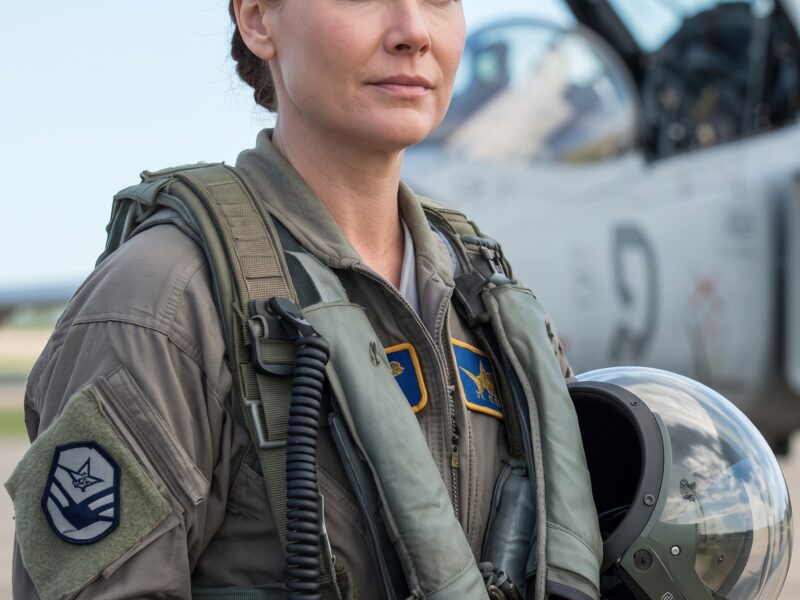
They laughed when I was ordered to leave the emergency runway at Edwards Air Force Base, but when a military jet began falling from the sky
The dry Mojave wind rattled the corrugated steel walls of Hangar 4 at Edwards Air Force Base, carrying with it the scorched smell of aviation fuel and sun-baked concrete. Outside, the shimmering heat waves distorted the endless expanse of dry lake bed, where decades of aviation history had been carved into the earth by the tires of experimental aircraft.
Inside the facility, I sat at a cluttered metal desk, surrounded by stacks of paper flight logs, maintenance manifests, and diagnostic schematics. My blue civilian contractor coveralls were stained with hydraulic fluid, completely devoid of rank insignia or unit patches. To the young officers and hotshot pilots walking through the corridors, I was just David: the quiet mid-thirties civilian mechanic who spent his days auditing airframe stress reports and double-checking turbine clearance values.
They saw a man who spent his life holding a wrench. They didn’t know that every weld, every copper sensor, and every line of flight-control code in the experimental birds parked outside was something I could trace by memory with my eyes closed.
The morning had started like any other, wrapped in the dull routine of administrative reviews, until 0914 hours, when the primary emergency Klaxon shattered the quiet inside the operations tower.
The piercing, rhythmic howl echoed across the concrete aprons, instantly silencing the idle chatter in the central control room. Officers scrambled toward their assigned workstations, headsets were snapped into place, and the primary radar telemetry array flared bright red.
“Mayday, Mayday! All stations, this is Apex-1! We have a critical systems failure! Primary flight controls are unresponsive! I am losing altitude over Sector 4!”
Every head in the command pit turned toward the central communications console. On the main tactical display, a single glowing blue icon—representing an F-35 Lightning II returning from a routine avionics evaluation—was flickering wildly, its altitude readout tumbling through a rapid, terrifying descent.
Commander Vance rushed to the front of the dais, his hands gripping the brass railing of the observation deck. “Get me every available chase plane on the line!” Vance bellowed, his voice straining against the rising tide of panic in the room. “I want an instructor bird or a safety escort airborne right now to guide him in!”
The communications officer’s fingers flew across his terminal, his headset buzzing with overlapping transmissions.
“Bagram-Tower, negative—our ready-five flight is down for scheduled engine maintenance.”
“Palmdale approach, we have nothing in the immediate area under ten thousand feet!”
“Vandenberg control, our flight is thirty minutes out on a transit vector!”
One by one, the responses came back like doors slamming shut in a burning house. Unavailable. Too far away. Already airborne on unalterable test tracks.
The jet continued dropping—fifteen thousand feet, fourteen thousand, thirteen thousand—spiraling down through the clear blue California sky toward the densely populated residential housing quarters lining the southern edge of the base perimeter.
I stood up from my desk at the back of the room, my boots echoing against the polished concrete as I stepped down into the lower command pit. My heart wasn’t racing with the frantic energy of the young technicians; it was locked into the cold, surgical clarity that only comes when you are watching a tragedy you have already lived through once before.
“Let me talk to him,” I said, my voice cutting cleanly through the ambient noise of shouting controllers.
A young lieutenant at the primary radio console turned, glancing up at my faded coveralls, my oil-stained hands, and the civilian contractor ID badge swinging from my belt. A condescending smirk pulled at the corner of his mouth.
“You’re maintenance staff,” he snapped, pointing a finger back toward the rear filing cabinets. “Step back, civilian. We’re handling a live tactical emergency.”
“I know what I am, Lieutenant,” I replied, my voice dropping an octave, completely devoid of tremor.
“Then fix a wrench, not a fighter jet,” he sneered.
A couple of junior staff officers nearby chuckled nervously, exchanging amused, dismissive glances. I swallowed the familiar humiliation, ignoring their laughter the same way I had ignored every whispered rumor and side-eye for the past fourteen years.
I looked past the lieutenant, my eyes locking onto the primary telemetry readout on the wall screen. The aircraft wasn’t tumbling in a flat spin, nor was it showing the thermal signature of an engine fire. Its control surfaces were oscillating in a precise, high-frequency square wave pattern.
“He’s not losing both engines,” I said, pointing directly at the rolling pitch and yaw vectors displayed on the screen.
Commander Vance turned his head toward me, his brow furrowed in anger. “What did you say?”
“Look at the pitch-axis feedback loop,” I said, taking two deliberate steps toward the console. “If he had a hydraulic failure or a flameout, the control surfaces would go limp or lock hard against the stops. His surfaces are fluttering at forty hertz. His flight controls are being overridden by an secondary command bus.”
The room fell completely silent. The laughter died in the throats of the junior officers. The communications sergeant froze with his hand hovering over the broadcast toggle.
Before anyone could stop me, I reached past the stunned lieutenant, picked up the primary radio headset from its cradle, and pressed the master push-to-talk button.
“Apex-1, this is Edwards Ground,” I said into the microphone. “Disengage the secondary control channel on your digital flight-control computer. Toggle flight-computer circuit breaker Alpha-4 under the left console switch panel.”
Static hissed through the overhead speakers, followed by the heavy, ragged breathing of a pilot pulling continuous high Gs as he fought his stick.
“I… I can’t!” the pilot screamed through the radio, the background mechanical warning chimes blaring in his cockpit. “The primary bus is locked! The system isn’t accepting manual breaker overrides!”
My fingers tightened around the hard plastic of the microphone until my knuckles turned white. My blood ran cold as a sudden, agonizing wave of memory washed over me.
Fourteen years ago, my father—Colonel Richard Vance, one of the finest test pilots the Air Force had ever produced—had died in the exact same airspace, flying a prototype stealth interceptor. The official military board of inquiry had closed the investigation within six weeks, stamping the file with a final, damning verdict: Pilot Error due to Spatial Disorientation.
They buried him with full honors, handed my mother a folded flag, and closed the book. But I had spent fourteen years crawling through archived server nodes, studying discarded flight-control source code, and analyzing raw flight data logs that were never supposed to see the light of day. I knew the truth. My father hadn’t made a mistake. His plane’s digital control architecture had been remotely hijacked from the ground, locking him into an unrecoverable dive to protect a secret that worth billions of dollars.
And now, looking at the screen in front of me, I was watching the exact same signature strike again.
“He’s not going to pull out using standard procedures,” I said, turning to Vance. “Try manual hydromechanic override,” I spoke back into the mic.
“I already did!” the pilot yelled, his voice cracking with sheer panic. “The stick is frozen!”
“Then listen to me very carefully,” I ordered, my voice cutting through his panic like a scalpel. “Pull the emergency spin-chute lever three-quarters of an inch—do not lock it out. Force the flight computer into an air-data fault mode by manually shutting off the pitot heater. It will force the fly-by-wire system to drop into direct mechanical control.”
For three agonizing seconds, there was nothing over the speaker except the scream of jet fuel and rushing wind.
Then, on the screen, the blue icon stopped its lethal spin. The nose of the F-35 pitched up, leveling out at four thousand feet above the desert floor, leaving a long trail of black vapor behind it as it stabilized into a clean glide path.
Silence descended upon the command center so absolute you could hear the hum of the fluorescent lights overhead.
Commander Vance stepped down from the dais, his eyes wide, staring at me as if he were seeing a ghost. “How do you know that override sequence?” Vance whispered, his voice trembling slightly. “That emergency sequence isn’t in any standard technical manual for the F-35.”
I didn’t look away from the radar screen. “Because fourteen years ago, I helped write the core flight logic for that control architecture.”
Nobody smirked. Nobody chuckled. The lieutenant who had told me to hold a wrench backed away from the console, his face pale.
Over the radio speaker, the pilot’s ragged breathing slowly stabilized. “Edwards Ground… altitude is holding at four thousand. Flight controls are back in manual mode. I… I have the aircraft. Who the hell just saved my life?”
I stood there holding the microphone, my chest heaving, staring at the blue icon on the display. There were names I had sworn never to speak again—names connected to a classified black-budget program known only as Project Aether, a program that officially had never existed, buried beneath layers of executive privilege and state-sanctioned silence.
Then, without warning, the F-35’s altitude readout on the wall screen dropped another thousand feet in a sudden, violent step.
The emergency warnings blared back to life, shrieking like wounded animals.
“Control failure!” the pilot screamed, his voice filled with absolute horror. “It’s back! The override just re-engaged from an external source! Something is steering me straight down into the main bunker complex!”
My eyes widened. The threat wasn’t a mechanical glitch; it was an active, real-time cyber attack originating from an unauthorized transmitter within range of the base.
I closed my eyes, took a deep, steadying breath, and reached for the high-frequency encrypted knob on the side of the console—a dial that hadn’t been turned in over a decade.
I clicked the switch to an unlisted frequency and whispered the call sign I hadn’t used since the day we lowered my father’s casket into the earth.
“Ghost to Raven Control.”
The entire communications room froze. Every screen on the main wall flickered, their graphical interfaces momentarily dissolving into lines of raw green code.
Commander Vance dropped his headset onto the floor, his face draining of all color. “That’s impossible…” Vance stammered, stepping back. “That call sign was struck from the Air Force register in 2012!”
A second later, a voice answered through the speaker. It wasn’t the metallic, synthesized tone of a digital system. It was a raspy, aged human voice, dripping with quiet satisfaction, transmitting over an ultra-secure quantum-encrypted satellite link.
“Ghost… we’ve been waiting for you for fourteen years.”
My blood turned to pure ice in my veins.
Because I recognized that voice instantly. It belonged to General Arthur Sterling—the man who had personally delivered the news of my father’s death to our doorstep, the man who had signed my father’s death certificate, and the man who, according to every official military record in existence, had died in a private plane crash fourteen years ago.
The static on the secure channel hissed like a coiled viper, echoing through the speakers of the command center. Outside, the low, distant roar of the struggling F-35 vibrated through the reinforced walls of the building, a stark reminder that a forty-million-dollar aircraft and its pilot were seconds away from being vaporized.
“General Sterling…” I whispered into the microphone, my voice barely audible over the hum of the electronic consoles. “You’re dead.”
A cold, dry laugh rattled through the speaker, sounding like dry leaves scraping across concrete.
“Official records are written for the public, David,” Sterling’s voice replied, entirely unbothered by the chaos he was causing. “Dead men pay no taxes, answer to no congressional committees, and carry no legal liability. Now, release the primary encryption key for Project Aether, or I will drive this multi-million-dollar fighter jet directly into the main intelligence vault at Edwards.”
Commander Vance slammed his hands down on the control panel, leaning over my shoulder toward the microphone. “This is Commander Vance, Edwards Operational Command! Identify yourself, intruder! You are interfering with an active United States military operation! We are tracing your signal right now!”
“Trace all you like, Commander,” Sterling sneered through the static. “Your ground-based telemetry array is running on a twelve-second lag. By the time your technicians pin down my uplink, Captain Miller will have impacted Hangar 3 at Mach 1.2. David knows I don’t bluff.”
I looked up at the wall display. The blue icon was dropping through three thousand feet now, its nose pointed dead-center at the concrete bunker housing the base’s primary classified data servers—the very servers containing the original, unredacted records of Project Aether.
“He’s using the original back-door access code,” I said, turning to face Vance. “When my father and I built the flight-control logic for Aether, Sterling forced us to hardcode a master override into the microprocessors. It was supposed to be an emergency kill-switch in case a prototype was captured behind enemy lines. Sterling didn’t die fourteen years ago—he faked his death, went underground with a syndicate of private defense contractors, and took the master key with him.”
“Why now?” Vance demanded, his forehead beaded with sweat. “Why come after an F-35 today?”
“Because the F-35’s latest avionics patch restored the legacy Aether codebase,” I realized, the horrifying truth dawning on me. “They didn’t realize they were reinstalling Sterling’s back door. The moment that jet took off today, Sterling’s automated systems picked up the signal from a mobile transmitter nearby. He doesn’t just want to destroy the jet, Commander—he’s using the jet’s onboard computer as a trojan horse to wipe the base mainframe before we can prove what he did to my father!”
Over the radio, Captain Miller’s panicked voice broke through. “Ground, I’ve lost pitch authority again! The flight stick is completely dead! I am passing two thousand feet! Permission to eject! Permission to eject!”
“Negative, Apex-1, hold your eject!” Vance yelled into his headset, looking frantically at me. “David, can you block him?”
“Not from this console,” I said, stepping back from the desk and reaching for my heavy canvas tool bag on the floor. “The primary radio array is running through the tower’s digital router, which Sterling has already compromised. The only way to break his signal is to send a hard-wired localized pulse directly into the aircraft’s belly-mounted receiver.”
“How?” Vance asked, staring at me as if I had gone mad. “The plane is moving at three hundred knots at fifteen hundred feet!”
I unzipped my tool bag, pulling out a custom-built, gray aluminum diagnostic unit covered in toggle switches and a high-frequency directional antenna—a device I had carried in my truck for fourteen years, waiting for the day my father’s killer resurfaced.
“We have a modified T-38 Talon standing by on Runway Zero-Two,” I said, looking Vance dead in the eye. “It’s equipped with an external diagnostic pod. I need you to order the flight line to fuel it, spool the engines, and clear the airspace.”
Vance blinked in sheer disbelief. “You want to take a retired T-38 chase plane airborne to intercept an out-of-control stealth fighter? You’re a civilian contractor! You haven’t flown in fourteen years!”
“I spent four years at the Air Force Academy, Commander,” I snapped, my eyes flashing with a cold, dangerous fire. “I held a commercial jet rating before I was twenty-two, and I logged two hundred hours in the cockpit of the Aether prototype sitting right beside my father. I am the only person on this base who knows how to manually handshake with that aircraft’s avionics. You either put me in that cockpit right now, or you explain to the Secretary of Defense why four square miles of Edwards Air Force Base just became a smoking crater.”
Vance looked at the falling blue icon on the radar screen, then at the terrified faces of his junior officers, and finally back at me. He slammed his hand down on the red intercom button.
“Flight line, this is Vance! Prep Chase-1 for immediate scramble! Get David a helmet and a flight harness! Move, move, move!”
Two minutes later, I was sprinting across the scorching tarmac toward the sleek, white T-38 Talon idling on the taxiway. The twin GE J85 turbojet engines were screaming, throwing waves of heat into the desert air. Flight line technicians rushed forward, helping me buckle into the rear ejection seat, snapping the heavy chest harness shut, and securing my diagnostic unit into the auxiliary telemetry bay beneath the dashboard.
I pulled the oxygen mask over my face, the rubber smelling strongly of store-bought alcohol and synthetic leather. The canopy hissed as it lowered and locked into place, sealing me inside the cramped, vibrating glass bubble.
In the front seat, Major Sarah Lin—one of the base’s top test pilots—turned her helmet to look back at me, her eyes visible through her clear visor.
“I hope you know what you’re doing, Mechanic,” Lin said over the internal comms, her hands flying across the engine control panels. “Because if that F-35 clips us at low altitude, we won’t even have time to pull the ejection handles.”
“Just get us within fifty feet of his belly, Major,” I replied, adjusting the frequency dials on my diagnostic unit. “I’ll do the rest.”
Lin didn’t waste another second. She shoved the twin throttles forward into full afterburner.
The T-38 leaped forward like an arrow shot from a bow, pinning us back against our seats as two long tongues of blue flame erupted from the exhaust nozzles. The yellow runway lines blurred into a single solid strip, and then the desert floor dropped away beneath us as we pitched up steeply into the blinding California sun.
“Talon-1, you are cleared hot,” Vance’s voice crackled through our helmets. “Apex-1 is at twelve hundred feet, heading two-seven-zero, vectoring directly toward Hangar 3. You have less than ninety seconds before impact.”
Lin banked the T-38 hard to the left, the G-forces pressing down on my shoulders like a lead weight. Through the plexiglass canopy, I saw the gray, sleek silhouette of the F-35 streaking through the heat haze ahead of us, its nose pointed downward in a steep, unnatural dive toward the base facilities below.
“I see him!” Lin shouted. “Closing fast! Range five hundred yards!”
“Get us underneath him!” I demanded, my hands working the frequency controls on my aluminum box. “I need line-of-sight to his belly array to inject the clean flight code!”
The T-38 closed the distance at blistering speed. Lin smoothly maneuvered our aircraft directly beneath the falling stealth fighter. Above us, less than sixty feet away, the massive, dark belly of the F-35 loomed like a falling anvil, its engine heat causing our aircraft to shake violently in the turbulent wash.
I flipped the master toggle switch on my diagnostic box and aimed the directional antenna straight up through the top of our canopy.
“Commencing signal override,” I reported into the mic.
Suddenly, the voice of General Sterling broke through our internal flight net, overriding our secure frequencies with a burst of deafening static.
“You are as foolish as your father, David,” Sterling whispered, his voice dripping with malice. “Did you really think I didn’t anticipate you bringing an auxiliary transmitter airborne? Look at your primary fuel panel, Major Lin.”
Lin gasped over the intercom. “What the hell? My fuel shut-off valves just tripped! Engine one is flamed out! Engine two is losing pressure!”
My heart stopped in my chest. Sterling hadn’t just compromised the F-35. He had hijacked the digital engine control unit of our T-38 through the base’s tactical network before we even left the runway.
The twin engines behind us sputtered, died, and the loud, terrifying warning horns of a double flameout filled our cockpit as our aircraft began to fall out of the sky alongside the jet we had come to save.
The silence following a double engine flameout at fifteen hundred feet is sudden, absolute, and terrifying.
The roaring thunder of the twin J85 turbojets vanished, replaced instantly by the eerie, high-pitched hiss of rushing wind scraping against the plexiglass canopy. On the dashboard in front of Major Lin, the primary glass displays flickered, died, and rebooted into a blinding array of red fault indicators.
“Emergency fuel valves are locked shut!” Lin shouted, her hands moving in a blurred sequence across the emergency control panels, frantically toggling the mechanical override switches. “The digital engine control computer is refusing my restart commands! We are dead in the air!”
Below us, the desert floor was rising at a sickening speed. The grey, sprawling footprint of Hangar 3 and the primary intelligence vault loomed larger every second. Above us, the heavy, dark mass of the hijacked F-35 was still descending on a parallel trajectory, locked into Sterling’s lethal flight path.
“He’s running a localized tactical network exploit,” I realized, my mind racing through the system schematics. “The moment we got within two hundred yards of that F-35, our aircraft’s wireless telemetry receiver automatically attempted to handshake with its signal! Sterling used that automatic handshake to upload a bricking script into our engine control unit!”
“Goodbye, David,” Sterling’s voice rasped through our dying radio, cold and mocking. “You can join your father in the dry lake bed. History will record this as another tragic family trait: pilot error.”
“Not today, you bastard,” I growled between my teeth.
I reached down to my diagnostic box, ripped the main signal cable out of the side port, and jammed it directly into the T-38’s emergency hard-wired maintenance bus beneath my seat—a physical, analog connection that completely bypassed the aircraft’s wireless telemetry receiver and digital flight computers.
“Lin! Pull the manual air-turbine lever!” I yelled over the internal comms. “Give me emergency hydraulic pressure for five seconds!”
“Deploying ram-air turbine!” Lin shouted, reaching down to her right console and violently yanking a heavy mechanical T-handle.
Beneath the belly of our T-38, a small, two-bladed wooden turbine dropped down into the rushing airstream. The rushing wind spun the small blades instantly, generating a brief, raw surge of mechanical hydraulic pressure and basic electrical power that bypassed every computer chip in the plane.
I jammed my thumb down on the master override button on my diagnostic box.
A raw, unformatted electromagnetic pulse—a massive burst of garbage code designed to temporarily blind any digital receiver within fifty feet—erupted from our directional antenna.
The effect was instantaneous.
The wireless link connecting Sterling’s ground transmitter to both aircraft was shattered. The red fault lights on our dashboard flickered once and died.
“I have engine control back!” Lin screamed, shoving the throttles forward into ignition.
The twin turbojets behind us coughed, spat a cloud of unburnt fuel into the air, and erupted back to life with a deafening roar that slammed us back into our seats. Lin pulled back hard on the stick, clearing the perimeter fence of Hangar 3 by less than eighty feet, the jet wash blowing a cloud of dust and debris across the concrete apron.
Above us, the F-35’s digital controls went into an automatic safety fail-soft state due to the sudden loss of signal. Its nose pitched up automatically, coming out of its steep dive and leveling out at six hundred feet above the runway, floating aimlessly in a high-drag glide.
“Apex-1, this is Ground!” Vance’s voice burst through our headsets, sounding breathless and half-crazed with relief. “The jet has leveled out! His descent has stopped!”
“He’s not safe yet, Commander!” I shouted, watching my diagnostic screen. “Sterling’s computer is already attempting to re-establish the connection on a secondary frequency hopping band! I only blinded him for thirty seconds! Captain Miller, can you hear me?!”
Over the radio, Captain Miller’s voice finally came back, weak and trembling with exhaustion. “I… I hear you, Ground. Control stick is still stiff, but the dive has stopped. What do I do?”
“Eject, Miller!” Vance ordered over the command net. “Eject now while you have the altitude!”
“Negative!” I interjected, leaning forward against my harness straps. “If Miller ejects now, the aircraft’s automated flight system will default to its last received command string—which was a full-throttle dive into the intelligence vault! Miller has to stay in the seat and manually lock out the primary flight-control computer!”
“I can’t lock it out!” Miller cried out. “The physical breaker panel on my left console is melted shut! I can’t pull the Alpha-4 circuit breaker!”
I looked out the canopy at the F-35 flying less than a hundred yards ahead of us. My mind flashed back to a night fourteen years ago—a dark, cold night in our garage when my father and I were reviewing the physical blueprints of the Aether prototype. I remembered my father pointing at a small, yellow-painted access panel located just behind the canopy rail on the port side of the fuselage.
“If the digital breakers ever melt in a thermal fire, David,” my father had told me, tapping the blueprint with his grease-stained finger, “there’s a hard-wired manual battery disconnect right behind the auxiliary pitot tube. But you can only hit it from the outside.”
“Lin,” I said, my voice dropping into a quiet, chilling calm. “I need you to pull us up alongside his port wing.”
Lin turned her head back, staring at me through her visor with utter horror. “What did you say? Side-by-side? At three hundred knots at five hundred feet?!”
“Pull us up alongside him, Lin,” I repeated, my hands reaching down to unclip the primary chest harness securing me to my ejection seat. “I’m going to pop the rear canopy and manually trigger his external emergency cut-off.”
“Are you insane?!” Lin screamed. “If you unbuckle at this speed, the wind pressure will rip you right out of the cockpit! You’ll fall to your death!”
“Not if you hold this plane rock-solid,” I said, pulling a heavy steel maintenance latch tool from my coverall pocket and wrapping its leather strap securely around my wrist. “My father died because nobody was there to hit that switch for him fourteen years ago. I am not going to watch another pilot die today.”
Lin looked at me for two long, terrifying seconds. She saw the absolute determination in my eyes—a determination born from fourteen years of grief, pain, and buried truth.
She took a deep breath, her hands tightening around the control stick.
“May God have mercy on us both,” Lin whispered. “Talon-1, going close formation.”
The T-38 accelerated smoothly, pulling up alongside the gliding stealth fighter. The two aircraft flew wingtip to wingtip, separated by less than twelve feet of roaring air. Through the glass of the F-35’s canopy, I could see Captain Miller staring out at us, his eyes wide with disbelief as he saw me standing up in the rear cockpit of the T-38, holding a steel tool in my hand, completely unbuckled.
“Opening rear canopy!” Lin yelled.
The glass bubble above my head unlatched with a sharp mechanical bang, and the full, terrifying fury of the five-hundred-knot wind hit me like a solid brick wall.
The violent impact of the wind nearly tore my grip from the windshield frame.
The roar was deafening, a crushing wave of kinetic noise that ripped the breath straight from my lungs. The freezing high-altitude air smashed against my face, tearing at my coveralls as I stood up in the open cockpit, my boots jammed against the structural frame of the rear seat for leverage.
Below us, the desert floor was a blinding, yellow blur of sand and scrub brush, rushing past at three hundred miles an hour.
“Hold her steady, Lin!” I screamed into my helmet microphone, though my voice was swallowed almost instantly by the hurricane of rushing wind.
Through her visor, Lin was working the throttles with micro-millimeter precision, keeping the T-38 locked in a terrifyingly tight formation with the rogue F-35. The two aircraft were moving as a single, fragile unit, separated by a distance so small that a single stray gust of wind would cause their wings to overlap and send both planes tumbling to the earth in a fiery explosion.
Twelve feet away, Captain Miller sat paralyzed inside his cockpit, watching me through his glass canopy.
I raised my right arm, fighting against the crushing drag of the slipstream that felt like a hundred-pound weight pulling on my shoulder. I pointed the steel maintenance tool directly at the yellow-painted panel located on the port side of his nose cone, just behind the auxiliary pitot tube.
Miller realized instantly what I was trying to do. He leaned over in his seat, tapping his helmet visor, then pointed down at his console to signal that Sterling’s signal was returning—the digital displays inside his cockpit were beginning to flash red again as the intruder re-established the remote control link.
On the main wall display inside the distant command center, Vance watched the telemetry in horror. “David! Sterling has re-acquired the uplink!” Vance yelled over the radio. “He’s commanding a full-throttle nose-down vector right now! You have five seconds before the flight computer executes the dive!”
“Lin, push us in three feet closer!” I roared over the comms.
“If I go any closer, our vertical tail will clip his wing!” Lin screamed back, her face dripping with sweat as she fought the turbulence. “I can’t give you any more room!”
“Do it!”
Lin slammed her jaw shut, took a short breath, and nudged the flight stick a fraction of a millimeter to the right.
The T-38 dipped sideways. The dark, composite-fiber skin of the F-35 surged toward us, closing the gap until its smooth metal hull was less than four feet from my outstretched hand. The heat radiating off the stealth fighter’s skin hit my face like an open furnace.
I leaned out into the open void between the two aircraft, my body hanging out over the roaring abyss, anchored only by my left boot wedged beneath the T-38’s ejection seat frame.
“Reach… David… reach!” I screamed to myself.
I swung the heavy steel maintenance tool forward with all the force left in my body, striking the yellow access panel on the side of the F-35’s nose.
BANG.
The thin aluminum cover sheared off in the wind, flying back into the slipstream and vanishing into the desert air. Behind it, exposed to the sky, was a small red mechanical T-handle connected to a heavy copper wiring harness—the hard-wired physical battery disconnect that my father had designed fourteen years ago.
I lunged forward a second time, jamming the curved hook of my maintenance tool inside the loop of the red handle.
“I’ve got it!” I yelled.
I yanked back with every ounce of strength in my arms.
The red handle snapped outward, severing the physical copper connections supplying power to the aircraft’s primary fly-by-wire flight computers.
Instantly, every electronic display inside the F-35 went dark. Sterling’s remote signal hit a dead end, bouncing harmlessly off a dead processor. The digital override collapsed, and control of the aircraft returned entirely to the raw, unassisted mechanical hydraulics.
Inside the cockpit, Captain Miller felt the stick go limp, then firm up as the mechanical backup system engaged. He grabbed the flight stick with both hands, pulling back with all his might.
The nose of the F-35 pitched up smoothly, climbing away from the ground, clearing the top of the perimeter hills by three hundred feet before entering a wide, stable bank toward the emergency runway.
“Control restored!” Miller shouted over his emergency radio, his voice cracking with pure, unadulterated joy. “I have the aircraft! I am landing on Runway Zero-Two!”
In the rear seat of the T-38, I collapsed back into the cockpit frame, my lungs burning, my arms trembling so violently I couldn’t hold onto the steel tool.
Lin pulled the canopy shut, sealing out the roaring wind, and banked our T-38 away from the stealth fighter, aligning us for a parallel landing approach.
“Ground… Talon-1,” Lin said, her breathing heavy and ragged over the intercom. “Target has been neutralized. We are coming home.”
Over the radio, the entire Edwards Air Force Base command pit erupted into a storm of cheers, applause, and emotional shouting. Officers were hugging each other, controllers were wiping tears from their eyes, and Vance was standing at the edge of the dais, staring at the telemetry screen in utter awe.
Except for one voice.
A low, furious hiss broke through the secondary comms line—a final, dying transmission from the mobile transmitter hidden out in the desert.
“You think you’ve won, David?” Sterling’s voice rasped, filled with a bitter, toxic hatred. “You saved one plane. But you opened the vault. Everyone knows who you are now. The ghost is out of the grave.”
I picked up my headset, holding it to my lips as Lin touched our tires down onto the concrete runway in a cloud of white rubber smoke.
“I’m not hiding in the grave anymore, Sterling,” I said, my voice cold, sharp, and hard as tempered steel. “And now… I’m coming for you.”
The golden heat of the late afternoon sun was turning the western sky into a bruised shade of purple and orange as Chase-1 rolled to a stop on the main apron in front of Hangar 4.
The moment the twin turbojets shut down, the flight line was flooded with emergency vehicles, fire trucks, and military police sedans, their red and blue lights flashing against the white concrete. Medical personnel rushed forward with stretchers, but I waved them away as I unclipped my helmet and stepped down off the T-38’s ladder under my own power.
My coveralls were soaked with sweat, my hands were covered in grease and rust from the maintenance tool, but for the first time in fourteen years, my head was held high.
Across the tarmac, the black F-35 was idling on the emergency overflow taxiway, surrounded by security personnel. Captain Miller stepped down from his ladder, pushed past the medics, and walked directly toward me through the swirling dust.
He didn’t say a word. He walked up, stopped two feet in front of me, came to crisp attention, and delivered a formal, sharp hand salute to a civilian contractor in oil-stained clothes.
“Thank you, sir,” Miller said, his voice thick with emotion. “I don’t know who you really are, but I owe you my life.”
I looked at the young pilot, then returned his salute with a quiet, respectful nod. “Just doing my job, Captain. Get yourself to the infirmary.”
As Miller was escorted away by the flight surgeons, a sleek black federal sedan pulled up to the edge of the apron. Two men in dark suits stepped out, followed by Commander Vance, who was holding a thick, red-stamped file folder under his arm.
The two agents stood at attention as I approached, their eyes filled with a newfound, profound respect.
“David Vance,” the lead agent said smoothly, holding out a gold badge. “I am Special Agent Harris, Department of Defense Inspector General. Commander Vance has just briefed us on the events of the past two hours—and delivered the diagnostic logs from your airborne transmitter.”
“Did you trace Sterling’s signal?” I asked, wiping my brow with the back of my sleeve.
“We did,” Harris replied, his jaw tightening. “The transmission was bounced through an automated mobile relay rig mounted on an abandoned radio tower twelve miles north of the base in the Boron scrubland. By the time our tactical team breached the perimeter, the equipment had self-destructed. But your diagnostic box captured his primary quantum encryption signature before the relay burned.”
He looked down at the red file folder Vance was holding.
“We have his digital footprint now, David,” Harris continued. “For fourteen years, Sterling operated in the shadows because everyone believed he was dead and that Project Aether was just a conspiracy theory. You proved he exists. You proved the project was real. As of twenty minutes ago, the Secretary of Defense has initiated a global, black-level manhunt for Arthur Sterling and every defense contractor associated with his syndicate.”
Vance stepped forward, handing me the red file folder.
I opened it. Inside were the original, unredacted flight logs of my father’s final flight on October 14, 2012. Below the official signatures was a newly stamped, gold-leaf seal from the Air Force Board for Correction of Military Records.
The old verdict—Pilot Error—had been struck out with a thick black line.
In its place, printed in sharp, crisp black ink, was a new official entry:
CASUALTY OF WAR — ACTION IN DEFENSE OF THE UNITED STATES OF AMERICA.
AWARDED THE AIR FORCE CROSS (POSTHUMOUS).
Tears welled up in the corners of my eyes, blurring the printed text on the page. Fourteen years of carrying the weight of my father’s ruined reputation, fourteen years of feeling the cold shoulder of the military community, fourteen years of being told that my father had made a amateur mistake—it was all gone, washed away by a single sheet of paper.
“We’re restoring your father’s full honors at Arlington next month,” Vance said softly, placing a heavy, warm hand on my shoulder. “And the Chief of Staff of the Air Force has personally authorized me to make you an offer.”
Vance pulled a second document from inside his jacket—a set of active-duty commission papers bearing the rank insignia of a Lieutenant Colonel in the United States Air Force Reserve, along with a appointment letter as Chief Technical Director of the Air Force Flight Test Center at Edwards.
“We need you back in the light, David,” Vance said, looking out over the airfield where the aircraft were parked under the setting sun. “We have a lot of broken flight systems to fix, a lot of compromised code to rewrite, and a ghost hunter to lead.”
I held the red folder against my chest, feeling the cool desert breeze blowing across the tarmac. I looked up at the sky, where the first stars of the evening were beginning to appear through the purple haze—the same stars my father and I had stared at when I was just a boy dreaming of flying among them.
I reached into my coverall pocket, pulled out my faded civilian contractor badge, and unclipped it from my belt.
I dropped the plastic badge into Vance’s hand, then looked him dead in the eye with a quiet, unshakable smile.
“I’ll accept the commission, Commander,” I said, my voice echoing clearly across the tarmac. “On one condition.”
Vance smiled slightly. “Name it.”
“Give me a T-38, a fresh coat of paint, and put my old call sign back on the primary board in the tower.”
Vance stood at crisp attention, bringing his hand up to his brow in a flawless, slow salute.
“Welcome back to the Air Force, Ghost,” Vance said. “Your airspace is cleared.”
The end.









