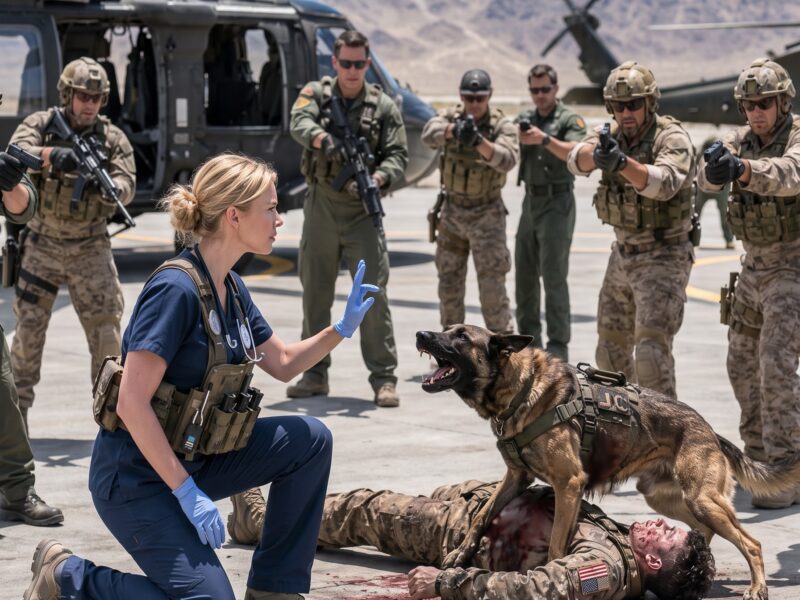
They laughed when I was ordered to leave the command tent at Fort Bragg, calling me “just a civilian nurse,”
The storm broke over Fort Bragg with the fury of a ruptured sky. Rain drove hard against the heavy olive canvas of the triage tent, beating a deafening, rhythmic roar that drowned out the low rumble of diesel generators and distant thunder. Inside, the humid air smelled heavily of iodine, wet wool, and the coppery tang of freshly spilled blood.
I pressed two fingers against the femoral artery of a young corporal whose uniform had been torn into shreds by shrapnel during a live-fire training exercise gone terribly wrong. My plain navy civilian scrubs were already soaked through at the knees and sleeves, heavy with dark, drying stains. The floor beneath my rubber-soled shoes had turned into slick red mud as rainwater seeped under the sidewalls, mingling with the mess of emergency care.
“Get your hands out of his wound, civilian,” Captain Harris barked. He stepped into my peripheral vision, his combat uniform pristine beneath an unbuttoned rain poncho. His sidearm was holstered tight against his hip, his arms crossed over a bulletproof vest that smelled of brand-new Cordura. “This is an active tactical operations area. Medical assistance was requested from the clinic for basic inventory and fluid lines, not surgical interventions.”
I didn’t lift my gaze from the torn flesh beneath my hands. “If I take my hands away, Captain, his mean arterial pressure will drop below sixty within forty-five seconds. He will arrest before your transport medic finishes smoking his cigarette behind the motor pool.”
“Watch your tongue,” Harris snarled, stepping closer until his combat boot was inches from my knee. “You work on contract. You distribute antibiotics and sign flu shot rosters. You don’t direct traffic in a command installation, and you don’t dictate medical protocol to commissioned officers. When Lieutenant Vance arrives, you will clear out and walk back to the primary clinic.”
“He’s bleeding out,” I said quietly, feeling the frantic, fluttering pulse beneath my knuckles. “Hand me the hemcon bandage from that tray, or do it yourself.”
Harris didn’t move. He looked down at my blood-spattered forearms with open contempt, his mouth curling into a sneer that dismissed every ounce of authority I possessed. To him, I was Clara Miller: a quiet thirty-two-year-old nurse who kept her head down, lived alone in a nondescript clapboard house off base, and never attended the unit social gatherings. I was background noise. A replaceable body filling a bureaucratic civilian vacancy.
Before he could speak again, the tent flap whipped open, letting in a gust of chilling, rain-soaked air. Staff Sergeant Miller—no relation, just a towering handler with three tours in the Helmand Province—stumbled inside, fighting to hold the harness of a massive, black-and-tan Belgian Malinois.
It was Ranger.
The dog was vibrating with nervous energy, his claws tearing into the wooden planking laid over the mud. His deep brown eyes weren’t focused on the wounded soldier or the bright surgical lamps swinging from the overhead ribs. He ignored the smell of blood. His snout was elevated, flared wide, working the turbulent currents of damp air cutting through the shelter.
“Sergeant, secure that animal,” Colonel Sterling’s voice cut through the chaos from the far side of the tent, where communications gear sat mounted on folding tables. Sterling was an imposing figure with iron-gray hair shaved high and tight, his eyes cold and chronically exhausted. “We have an unsecured breach on the wire three clicks north. I don’t need a stray canine causing a panic in the operations tent.”
“He won’t heel, sir,” Sergeant Miller shouted back, struggling against the heavy braided lead. “He picked up something off the eastern drainage ditch. He’s locking up.”
I glanced over my shoulder, my fingers maintaining steady pressure on the corporal’s artery as a junior medic finally hurried over with a fresh clamp and sterile packing gauze. “Take the pressure,” I whispered to the young private. “Right here. Firm. Don’t release until the clamp catches the vessel.”
The private nodded nervously, his hands trembling as he took my place.
I stood up, wiping my wet, crimson-stained palms on a towel. My eyes never left the dog.
Ranger was not acting like a patrol animal hunting an intruder. If he were tracking a human scent cone carried on the wind, his ears would be pinned, his neck muscles corded for a forward strike, his weight biased forward on his toes. Instead, his ears were cupped forward like small radar dishes, his brow furrowed in intense, analytical concentration. His nose dropped suddenly toward the floorboards, sweeping in a tight, mechanical arc—two inches left, two inches right.
He was sorting layers.
I took three rapid steps toward the entryway.
“Where do you think you’re going?” Captain Harris grabbed my elbow, his grip tight and hard through my soaked scrub top. “I gave you an order to report back to the clinic.”
“Get your hands off me, Captain,” I said. My voice dropped in pitch, shedding the soft, deferential tone of a clinic nurse. It was the flat, low baritone used on training fields when lives hung on milliseconds.
Harris blinked, startled by the sudden shift in my posture, but his grip didn’t loosen. “You are interfering with an active command protocol—”
“Your dog isn’t alerting to an approaching perimeter breach,” I said, pointing directly out into the blinding sheets of rain. “He’s trailing an outflow. The threat isn’t outside trying to get in. It was inside this compound ten minutes ago, and it is moving directly toward the munitions depot.”
Harris let out a dry, incredulous laugh. “You’re delusional. We have three squads sweeping the outer fence. There’s nothing inside.”
“Look at the ground,” I said, twisting my arm out of his grasp with a sharp, rotational jerk that broke his thumb leverage—a simple, reflexive biomechanical escape that left him staring at his empty hand in shock.
I didn’t wait for him to recover. I stepped past Sergeant Miller and pushed through the heavy vinyl storm flaps into the downpour. The cold rain hit my face like needles, washing the blood from my forearms in pale pink streams.
Ranger surged forward, nearly pulling Miller off his feet, and lunged straight toward the mud path separating the medical station from the tactical vehicle park. I dropped into a crouch right at the edge of the crushed gravel runoff.
The rain was washing away surface impressions at a terrifying rate, turning tire ruts into miniature brown rivers. But beneath the edge of an upturned wooden pallet, sheltered from the direct deluge, lay a partial print.
Not a standard issue Belleville or Danner military boot. The lug pattern was distinct: a diamond grid bordered by deep horizontal sipes, the unmistakable sole of a heavy civilian logging boot. But that wasn’t what stopped my breath.
The left heel bore a slight, distinct indentation—a millimeter-deep circular gouge near the outer rim, where a steel shank had once been ground down to clear a custom orthotic brace.
My heart slammed against my ribs with such force that my vision tunneled. I reached out, my fingertips hovering a fraction of an inch above the impression.
“Miller! Get away from there!” Colonel Sterling’s voice boomed from the doorway of the tent. He was striding toward me through the rain, an unbuttoned field jacket billowing behind him, flanked by Harris and two armed military policemen. “This area is an active staging ground. You have crossed the line for the last time.”
“Lock down the eastern perimeter,” I said without looking back. My voice was steady, cutting cleanly through the drum of the rain. “Shut the gates to the Class V munitions storage. Cut all power to the secondary maintenance tunnels right now.”
Harris caught up, his face red with fury. “Colonel, she’s out of her mind. She assaulted an officer and broke protocol—”
“Shut up, Captain,” I said coldly, rising to my full height.
I turned to look at Ranger. The dog had gone completely motionless five paces ahead of me. His muzzle was pressed against the bottom edge of a rusted metal drainage pipe.
On the black leather of his nostrils sat a faint, crystalline dust. It wasn’t chalk, and it wasn’t limestone gravel. It held a subtle, yellowish tint that resisted the ambient moisture.
PETN. Pentaerythritol tetranitrate. The signature stabilizer used in specialized industrial blasting caps and old-stock foreign military ordnance.
“Sergeant,” I called out to the handler, my tone crisp and absolute. “What is Ranger’s alert indication for nitrate-based accelerants?”
Sergeant Miller frowned, looking between me and his commanding officer, visibly torn. “He… he sits and faces north, ma’am. Passive alert.”
“Look at him,” I said.
Ranger had lowered his haunches into the mud. His spine was stiff, his eyes locked dead north toward the low-slung, corrugated roof of Maintenance Shed Four—an abandoned refrigeration structure scheduled for demolition at the end of the fiscal year.
Colonel Sterling paused mid-stride. His combat experience was vast, and whatever he thought of civilian nurses, he knew a working dog’s posture when he saw it. His gaze shifted from Ranger to the faint yellow powder clinging to the dog’s wet muzzle.
“Sergeant Miller,” Sterling said, his voice dropping into dangerous calm. “Is that an active explosive alert?”
“Yes, sir,” Miller whispered, his knuckles white on the lead. “He’s confirmed. Solid signal.”
Sterling didn’t hesitate. He reached for the tactical radio clipped to his collar. “All call, this is Sierra-Six. Lock down Grid Echo-Seven. Weapons storage perimeter goes to condition red. Seal the eastern gate and get a technical response team to Maintenance Four immediately. Move.”
Sirens began to wail across the installation, their mechanical howls rising and falling against the roar of the storm. Armored Humvees rumbled to life across the motor pool, headlights cutting wide swathes through the darkness and rain.
Sergeant Miller let Ranger lead. The dog lunged forward, dragging him toward the rusted door of Shed Four. I followed close behind, Harris and Sterling matching my pace with their hands on their holstered weapons.
The heavy steel door of the shed was secured from the outside with a thick chain, but the padlock hung open, its shackle resting loosely in the housing.
Sterling unholstered his Beretta, motioning for the two MPs to stack on the left frame. One of them kicked the door inward with a sharp metallic crash.
The room inside was dark, smelling of damp mold, machine oil, and stale cigarette smoke.
An MP swept a tactical flashlight across the interior. The beam caught an overturned wooden crate in the center of the concrete floor.
On top of the crate sat an operational shortwave frequency scanner, its green LED display quietly cycling through military air traffic channels. Next to it lay three laminated security passes bearing official Department of Defense watermarks—passes that granted unrestricted access to the subterranean storage vaults beneath the airfield.
And pinned to the wall directly above the radio was an eight-by-ten surveillance photograph of Colonel Sterling himself, taken through a long-range telescopic lens. His face was circled in red grease pencil.
The breath went out of Captain Harris in a quiet hiss. “Jesus Christ. We’ve been monitored from inside the fence.”
Sterling didn’t touch the table. He stood entirely still, the cold rain dripping from the brim of his cap onto his collar. Then, slowly, he turned his head and fixed his piercing gray eyes on me.
“A civilian nurse doesn’t recognize an obscure explosive residue from five yards away in the pouring rain,” Sterling said. The air between us felt thin, charged with a sudden, suffocating weight. “A civilian nurse doesn’t read the gait of a Tier-One tracking K9 before his own handler notices the shift. And she certainly doesn’t recognize a custom-soled boot track that hasn’t been in commercial production for a decade.”
He stepped forward until he was standing directly over me, his shadow falling across my face in the beam of the flashlight.
“Who are you?” Sterling demanded. “And how did you know?”
Sergeant Miller was staring at me too, his mouth slightly open. He looked from my muddy scrubs down to Ranger, who had quietly stepped away from the handler’s side and sat down directly beside my right knee, resting his massive head against my thigh without a single command.
“She didn’t train Ranger, sir,” Miller whispered, his voice cracking with sudden realization. “Ranger was bred and started at the Special Tactics Kennel in North Carolina six years ago. His foundation stock was trained by the black-budget unit out of Fort Meade.”
Miller swallowed hard, looking at me with a reverence that bordered on fear. “You were Ironwood.”
The word hung in the air like poison.
“Ironwood was shuttered,” Sterling said, though his eyes widened almost imperceptibly. “All personnel were reassigned, retired, or buried after the disaster in the Korengal Valley. There were no survivors from the final reconnaissance team.”
“One survived,” I said, my voice hollow. “I wasn’t in the valley when the ambush happened. I was at the forward operating base, listening over the radio while they burned.”
I didn’t tell them that the man who led that team, the man who had founded the tracking methodology they still used in secret, was my older brother, David. I didn’t tell them that I had spent the last six years trying to drown the memories of those dying screams under the sterile, meaningless routine of hospital wards and civilian clinics.
Before Sterling could press further, a sharp, guttural sound broke the silence.
Ranger leaped to his feet.
The hair along the dog’s spine stood up like a row of razor blades. His lips pulled back over clean white teeth, exposing his gums in a deep, vibrating snarl that rattled in his chest.
He wasn’t looking at the radio. He wasn’t looking at us.
He was staring directly at the narrow gap beneath the closed back door of the shed—a door that opened out into the dense pine woods bordering the military reservation.
Every man in the room drew his weapon in unison. The click of safeties coming off sounded unnaturally loud.
“Step back,” Sterling ordered, raising his sidearm toward the door.
Ranger didn’t retreat. He took one step forward, his low growl sharpening into a frantic whine of confusion and distress. A dog only made that sound when confronted with a scent that violated its natural understanding of reality—a scent it knew, loved, and feared all at once.
Then, from beneath the warped wooden edge of the exterior door, something moved.
A small, rectangular piece of plastic was shoved through the crack, sliding across the damp concrete floor until it came to rest against the toe of my shoe.
I looked down.
It was an old, heavily scratched military identification badge. The laminate was cracked, yellowed with age, and stained around the edges with dry, dark soil. The photograph showed a younger version of myself in desert camouflage, bearing the classified unit insignia of Project Ironwood.
My breath stopped entirely.
I knelt down with trembling hands and picked up the card.
On the back, written across the magnetic strip in fresh, wet black marker, were six words:
YOU SHOULD HAVE STAYED GONE, CLARA.
The ink was so fresh it smeared beneath my thumb.
The handwriting didn’t belong to an unknown infiltrator. It was slanted hard to the right, the crossbar of the letter T slashing long and low across the text, the distinctive, unmistakable scrawl of my brother, Captain David Miller.
The brother whose charred remains I had officially identified and buried at Arlington six years ago.
From the dark woods outside the door, an engine turned over—low, heavy, and vanishing into the storm.
The silence inside the maintenance shed was heavy, broken only by the steady drip of rain through a rusted seam in the ceiling. Colonel Sterling snatched the card from my fingers, his eyes narrowing as he read the smeared ink.
“Secure the woodline!” Sterling roared into his radio. “We have an active runner moving north-northwest into Sector Nine. Use night-vision assets. Bring thermal optics online right now!”
Sergeant Miller was already fighting to control Ranger, who was throwing his entire seventy-pound frame against the rear door, his nails gouging deep splinters into the rotting wood. “Ma’am,” Miller stammered, looking at me with wild eyes. “He knows that scent. Ranger doesn’t hit on strangers like this. He’s going out of his mind.”
“He knows it because it’s the template,” I whispered, my voice barely audible beneath the wail of sirens across the base. “Ranger was bred from David’s primary tracking dog, Castor. David imprinted that lineage himself. Every dog from that line was conditioned to track the specific pheromonal signature and chemical mix David wore in the field. To Ranger, that isn’t an enemy. It’s God coming back from the dead.”
Captain Harris grabbed my shoulder, his fingers digging into my collarbone. “You’re telling us your dead brother just walked onto a restricted military post, planted surveillance on the base commander, and left a note addressed to you? Who are you working with, Miller? What is this?”
“Let go of her, Captain,” Sterling commanded. His voice was dangerously quiet.
Harris immediately dropped his hand, taking a step back, but his jaw remained clenched in tight, paranoid anger.
Sterling looked down at the card, then back at me. His expression was completely stripped of his earlier condescension. There was only the cold, calculating focus of a man who suddenly realized he was standing on an unexploded landmine.
“My office. Five minutes,” Sterling said, turning on his heel. “Harris, bring the handler and the dog. Miller, you don’t speak to anyone. If a single word about this leaves this room before I debrief the regional command, I will have you locked in an interrogation cell until you’re ninety. Do you understand me?”
“Yes, sir,” I said, my voice steady despite the violent trembling in my hands.
The walk to the headquarters building was a blur of blinding searchlights, shouting soldiers, and the deep, throbbing thrum of Black Hawk helicopters lifting off into the stormy sky. Rotors chopped through the sheets of rain, their downwash churning the mud into brown spray. The entire base was locking down like an iron vault, yet I knew with absolute, terrifying certainty that the woods were already empty.
David had written the operational doctrine for escape and evasion across this very terrain. When Fort Bragg had redesigned its perimeter defense systems a decade ago, David was the technical advisor who had tested them. He knew every blind spot in the radar array, every seasonal drainage culvert that bypassed the motion sensors, and every shift change of the guard towers.
If David Miller didn’t want to be found in the pine barrens of North Carolina, the entire United States Army couldn’t find him.
We entered the command suite through a side door. Water pooled around our feet on the polished linoleum floor. Sterling closed the heavy oak door behind us and threw the deadbolt, immediately walking to his desk and hitting a switch on a secure console. A low hum filled the room as the counter-surveillance scrambler activated.
“Sit,” Sterling ordered.
I sat in the cold leather chair across from his desk. Sergeant Miller remained standing near the door, his hand resting on the back of Ranger’s neck. The dog had finally stopped whining, but his body remained rigid, his nose pointed toward the rain-streaked window.
Sterling threw the laminated Ironwood badge onto the desk between us. “Six years ago, I was a deputy director at USASOC. I read the casualty report from the Korengal ambush. Team Ironwood was inserted to track a high-value courier through the mountains. They were compromised. An improvised thermobaric device detonated inside the cave system where they had taken shelter. The heat was intense enough to melt structural steel.”
He leaned forward, placing both palms flat on the desk. “The forensic team recovered bone fragments and dental remains. DNA matched Captain David Miller. I signed the paperwork that released his remains to you for burial. So tell me, Clara: why is a dead man leaving notes on my base?”
“The DNA,” I said, looking up into his eyes. “Who processed the samples?”
Sterling’s eyes flickered. “The regional medical examiner at Bagram.”
“No,” I corrected, my voice cold. “It wasn’t Bagram. Ironwood was compartmentalized under a special access program code-named Black Briar. All recovery operations were handled internally by the program’s director. We never saw the autopsy files. We were handed a sealed metal casket and told that opening it was a federal offense under national security statutes.”
“You accepted it,” Harris interjected from the corner, his arms crossed over his chest. “You buried him. You took the survivor’s pension and went to nursing school.”
“What choice did I have?” I snapped, turning on him. “I was twenty-six years old! My brother was the only family I had left. They told me that if I asked questions, they would strip his military honors and classify his service as an act of treason. They said he made an operational error that cost four men their lives.”
I turned back to Sterling, my heart pounding against my ribs. “He didn’t make an error, did he, Colonel? What was David carrying in that valley?”
Sterling looked away. He reached into his desk drawer, pulled out a pack of cigarettes, realized he was indoors, and tossed them back inside with a frustrated sigh.
“Ironwood wasn’t just a tracking program, was it?” Sergeant Miller asked quietly from the door. He was looking at me with wide, haunted eyes. “The legends about the handler units… they said you weren’t tracking men. You were tracking payloads.”
“David was an expert in bio-chemical weapons transit,” I said, the long-buried secrets tasting like ash in my mouth. “He could smell the precursor chemicals of nerve agents on a man’s boots from thirty paces away. His dogs were trained to detect biological vectors—weaponized pathogens that standard sensors couldn’t pick up until it was too late. If David was in that shed tonight, he didn’t come to assassinate you, Colonel. He came because something is already on this base.”
The room plunged into absolute silence.
Outside, a roll of thunder shook the windowpanes, rattling the glass in its frame.
Sterling’s face had drained of color. He slowly sank back into his leather executive chair, his gaze fixed on the map of the installation hanging on the wall behind him.
“Two days ago,” Sterling said, his voice barely louder than a whisper, “a transport flight arrived from an undisclosed staging area in Eastern Europe. It carried four sealed containers slated for transfer to the medical research facility at Fort Detrick. They were placed in cold storage beneath the munitions depot. Under my personal supervision.”
“What was in them?” I asked.
“A modified strain of hemorrhagic fever,” Sterling said. “Recovered from an illicit manufacturing lab in an abandoned Soviet bunker. It was supposed to be completely secure. The perimeter was reinforced with elite security details.”
“Then David isn’t the infiltrator,” I realized, the horror blooming in my chest like an open wound. “David is the hunter.”
Suddenly, the lights flickered.
Across the compound, a massive dull thump reverberated through the concrete foundation of the building. It wasn’t thunder. It was the distinct, low-frequency shockwave of a localized explosive charge.
The green lights on the console died instantly. The room was plunged into pitch-black darkness, save for the violent flashes of lightning outside the window.
A split second later, the emergency red backup lights hummed to life, bathing the room in a bloody, crimson glow.
The fire alarm began to shriek—a piercing, mechanical scream that echoed through the ventilation shafts. Over the emergency PA system, an automated voice repeated a chilling warning:
WARNING. CONTAINMENT BREACH IN SECTOR FOUR. SUBTERRANEAN ACCESS RESTRICTED. EVACUATE LEVEL TWO IMMEDIATELY.
“Sector Four,” Harris stammered, reaching for his sidearm. “That’s… that’s the cold storage bunker beneath the depot.”
“Someone just blew the vault doors,” Sterling said, grabbing an assault rifle from the weapons rack behind his desk. He slammed a magazine into the receiver with a loud, metallic clack. “Harris, sound the general quarters alarm. Every available unit to the depot.”
“Sir, wait!” Sergeant Miller shouted.
Ranger was standing near the door, his body trembling violently. He wasn’t growling anymore. He had lowered his head to the crack beneath the office door, inhaling deeply.
Then, with horrifying clarity, I smelled it too.
Through the ventilation system, carried on the damp air of the air conditioning ducts, came a scent I had not encountered in six long years.
It smelled like sweet almonds, scorched copper, and rotting citrus.
The signature stabilizing aerosol for weaponized biological containment units.
“Don’t open that door!” I screamed, lunging across the room and tackling Sergeant Miller just as his hand touched the brass handle.
We crashed to the floor together, Ranger barking frantically as we hit the linoleum.
A fraction of a second later, a deafening hiss erupted from the air vents above our heads. A thick, white vapor began to pour from the ceiling grates, drifting downward like heavy morning fog, settling over the chairs and the desk.
“Masks!” Sterling shouted, scrambling toward an emergency locker in the corner of the room. “Get the filters on!”
He threw a protective mask toward me, but as I caught the rubber facepiece, I looked at the glass observation panel built into the heavy oak door leading to the hallway.
Standing on the other side of the reinforced glass was a figure dressed in dark, sterile protective gear. The face behind the clear polycarbonate visor was obscured by shadows and condensation.
The figure didn’t try to force the door open.
Instead, he slowly raised his right hand and pressed his palm flat against the glass.
On the back of his tactical glove was a strip of faded yellow reflective tape, marked with three hand-drawn black crosses—the personal field mark of Team Ironwood’s lead scout.
The man tilted his head slightly, his eyes visible for a single, terrifying second in the crimson emergency light.
They were bright, pale blue, framed by deep scars that ran from his temple down into the collar of his suit.
David.
He didn’t run. He didn’t reach for a weapon. He looked directly at me through the glass, raised two fingers to his forehead in a brief, familiar salute that we had shared since childhood, and then dropped a small metal canister onto the hallway floor.
The canister began to vent a thick, opaque gray smoke, completely obscuring the glass.
“David!” I screamed, scrambling to my feet, the gas mask hanging uselessly in my hand. “David, stop!”
Behind me, the white mist from the ceiling vents hit the floor, expanding outward in a silent, suffocating wave.
“Put the mask on, Clara!” Sterling yelled, his voice muffled behind the heavy rubber and glass of his own protective gear. He lunged toward me, forcing the respirator over my mouth and nose, pulling the elastic straps tight against the back of my skull.
The chemical smell was instantly cut off, replaced by the dry, synthetic taste of activated charcoal. I drew in a ragged breath, coughing violently as the seal seated against my skin.
Beside us, Sergeant Miller was struggling to fit a canine deployment mask over Ranger’s muzzle. The Malinois fought against the strange apparatus for a few frantic seconds before the training kicked in; he yielded, letting out a sharp, muffled sneeze through the rubber diaphragm as the handler tightened the head harness.
“We have to move,” Harris shouted, his voice distorted through his mask. He had his sidearm drawn, pointing it erratically toward the smoke-filled hallway window. “They’re gassing the command block! We’re trapped in here!”
“It isn’t poison,” I said, my voice sounding hollow inside my own respirator. I pointed toward the ceiling vent. The white vapor was dissipating rapidly, leaving no oily film, no caustic burning on our exposed skin. “It’s an inert aerosol suppressant. It’s designed to purge automated fire suppression systems and blind infrared sensors. David didn’t release it to kill us. He released it to disable the thermal cameras in the corridors.”
Sterling racked the bolt of his rifle. “Why would he want the base cameras blind if he’s trying to escape?”
“He isn’t trying to escape,” I said, stepping toward the door. “He’s hunting the people who are.”
I turned the heavy brass handle and shoved the office door open.
The hallway was choked with swirling gray smoke from the canister David had dropped. The red emergency lights cast long, distorted shadows through the haze. On the floor, rolling slowly toward the far wall, was the empty aluminum shell of an M18 screening grenade.
Ranger surged past me, his padded paws gripping the slick tiles. Even through the specialized canine respirator, the dog’s tracking drive was overwhelming. He kept his nose low, tracing the invisible line of footsteps cutting straight down the central corridor toward the freight elevators that led to the subterranean logistics level.
“Stay tight,” Sterling ordered, falling in behind me with his rifle raised to his shoulder. “Harris, watch our six. Miller, keep that dog on a short lead.”
We moved through the smoke in silence, our boots splashing through water from the triggered overhead sprinklers. The hallway was completely abandoned; the automated lockdown had sealed the side offices, trapping the administrative staff behind heavy fire doors. Only the main tactical route remained open, kept operational by the emergency override codes David had clearly entered into the central terminal.
We reached the heavy steel doors of Freight Elevator Two. The indicator light above the frame was dead, the call button smashed into pieces by a heavy blunt instrument.
Beside the elevator was the access door to the maintenance stairwell. It hung open by an inch, the heavy steel latch taped over with industrial friction tape.
Ranger scratched at the base of the door, letting out a low, urgent whine.
“He went down,” Sergeant Miller whispered. “Down to Level Two.”
“That level houses the backup generators and the drainage access for the entire installation,” Sterling said, his eyes hard behind his visor. “It connects directly to the Cape Fear River basin through three miles of storm-overflow conduits. If whoever stole those containers gets into the drainage network, we will never find them. They can drift downstream on a flat-bottom skiff and be in international waters by morning.”
“Then we go down,” I said, reaching for the steel door handle.
“Miller, wait,” Harris said, his hand catching my wrist. His eyes were wide with panic behind his mask. “You’re a nurse! You don’t have a weapon, you don’t have body armor. You shouldn’t even be in this building!”
I pulled my arm free from his grip with cold precision. “Captain, the person down there has my brother’s face, my brother’s tactics, and a biological weapon capable of killing every living thing within fifty miles. If you want to stay up here and wait for a response team that won’t arrive until the power grid is restored, be my guest. But I’m going down.”
I pulled the heavy door open and stepped onto the metal grating of the stairwell.
The air rising from the depths was ice-cold and heavy with the scent of damp concrete, rust, and stagnant water. Beneath the ambient hum of the distant generators, I could hear the faint, rhythmic echo of boots moving rapidly across metal down below.
“Two targets,” Sergeant Miller said, leaning over the railing with Ranger tight at his side. “Listen. The cadence is off. One is moving with a heavy, deliberate stride. The other is dragging a foot.”
“The civilian boots,” I said. “The ones from the footprint outside the tent. The steel-shank orthotic.”
“David doesn’t wear an orthotic,” Sterling said, descending the stairs behind me, his weapon angled downward into the darkness. “His medical records never indicated an orthopedic injury.”
“Because it isn’t David,” I said, the realization settling heavily into my gut like lead. “The man we saw in the hallway… the handwriting on the card… it was designed to pull me here. Whoever is down there knew that if I recognized David’s trail, I would come. They knew the base would hesitate, that you would question my loyalties, that the confusion would buy them time.”
“Then who was that in the corridor?” Harris asked, his voice shaking as he followed us down the spiral stairs.
“A ghost,” I muttered. “Or the man who killed him.”
We descended three flights of stairs in total darkness, guided only by the narrow beam of the tactical flashlight mounted under Sterling’s rifle barrel. The red emergency lights had not extended to the lower utility tiers. Here, the walls were bare, unpainted cinder block, sweating with condensation and covered in thick black conduits.
We reached the base of the stairwell. The heavy fire door had been blown entirely off its hinges, the concrete frame cracked by a focused cutting charge. The smell of scorched explosive filler was overwhelming.
Beyond the doorway lay the vast expanse of Level Two.
It was a cavernous, subterranean labyrinth of massive green air-handling units, roaring water chillers, and rows of towering electrical transformers. Giant yellow overhead pipes transported steam, while gray pipes carried chilled water to the server rooms above. The noise of the machinery was deafening, a relentless, mechanical thrum that vibrated through the soles of our boots.
Ranger pulled hard against the lead, dragging Sergeant Miller toward a long, narrow service aisle that ran between two massive diesel generators.
Suddenly, the dog stopped dead in his tracks.
Sergeant Miller threw out his arm, halting our advance. “Ranger’s got a hard alert. Tripwire.”
Sterling knelt down, sweeping his light across the floor.
Three inches above the concrete, stretched taut between the legs of a steel workbench, was a strand of high-tensile monofilament fishing line. It was virtually invisible in the dark. The far end of the line was attached to the pull-ring of a modified fragmentation grenade secured to an overhead steam pipe with duct tape.
“Amateur work,” Harris muttered, exhaling a shaky breath. “Desperate.”
“No,” I said, grabbing Harris’s collar and pulling him backward with all my strength. “It’s a misdirection!”
Before Harris could complain, a deafening crack shattered the roar of the generators.
A high-caliber rifle round struck the concrete floor right where Harris had been standing a second before, sending sharp stone fragments whistling through the air. The impact threw up a cloud of pulverized dust.
“Sniper!” Sterling yelled, shoving me behind the reinforced steel housing of the generator as another round tore through the sheet metal inches above our heads.
The gunshot had come from the far end of the service corridor, elevated high—likely from the catwalks running beneath the ceiling.
“Sergeant, keep that dog down!” Sterling shouted, raising his rifle and firing three controlled bursts toward the dark rafters above. The muzzle flashes illuminated the industrial ceiling in rapid, violent strobes, but there was no cry of pain, no sound of a body falling.
Through the ringing in my ears, I heard the sharp, metallic sound of a fresh magazine being loaded into a bolt-action rifle somewhere in the shadows above us.
“He has the high ground,” Miller gasped, holding Ranger tight against his chest behind the engine block. “We can’t cross this corridor without taking fire, and the storm drainage entrance is directly behind him!”
I looked at the monofilament tripwire still stretched across the path ten feet away. Then I looked at the overhead steam pipes running along the ceiling directly above the shooter’s suspected position.
“Colonel,” I whispered, leaning close to Sterling’s ear. “The large yellow valve on the wall to your left. What does it control?”
Sterling glanced at the valve, his eyes widening behind his mask. “High-pressure auxiliary steam. Three hundred pounds per square inch. If I open that, it will blow the seals on the secondary manifold above the catwalk.”
“Open it,” I said.
“Clara, the thermal backdraft could cook us alive if the vents don’t clear,” Sterling warned.
“We have respirators. He’s looking through an optical scope,” I said coldly. “He doesn’t have a thermal sight, or he would have shot us through the sheet metal already. Blind him.”
Sterling didn’t argue. He shifted his weight, reached out with his left hand, and caught the rim of the yellow iron wheel.
With a deep grunt of exertion, he wrenched the valve counterclockwise.
A metallic groan echoed through the pipes, followed instantly by a sound like a jet engine igniting.
A catastrophic rupture tore through the overhead manifold fifty feet down the corridor. A blinding, deafening wall of superheated white steam exploded into the darkness, completely engulfing the upper catwalks in an impenetrable cloud of roaring white vapor.
A sharp, agonized scream echoed from the ceiling.
A heavy object crashed downward through the mist, followed immediately by the sound of a human body slamming violently onto the concrete floor.
“Move!” Sterling barked.
We surged from behind the generator, our weapons raised. Ranger leaped over the tripwire with effortless grace, pulling Miller behind him.
Lying in the center of the aisle, writhing in pain beneath the hissing cloud of steam, was a man in dark tactical clothing. His rifle lay ten feet away, its wooden stock splintered by the fall. His right leg was bent at an unnatural, sickening angle, the bone visibly pressing against the fabric of his trousers.
Sterling kicked the rifle further away, keeping his weapon trained on the man’s chest. “Don’t move! Keep your hands where I can see them!”
I stepped forward through the thinning steam, my eyes locked on the fallen shooter.
He had torn his respirator off as he fell. His face was twisted in agony, sweat pouring down his pale, weathered skin. He had a deep, jagged scar running from his left temple down across his cheek, ending at the corner of his mouth.
He looked up at me through pain-clouded eyes.
It wasn’t David.
The facial structure was similar—the same broad jaw, the same hollow cheekbones—but this man was older, his hair completely white at the temples.
“Who are you?” Sterling demanded, pressing the muzzle of his rifle against the man’s throat. “Where are the containment canisters?”
The wounded man let out a wet, rattling laugh, blood bubbling at the corners of his lips from an internal injury sustained in the fall.
“You’re… you’re too late, Sterling,” the man wheezed, his voice thick with a harsh, foreign accent. “The courier… is already in the main tunnel. The payload is gone.”
“Who sent you?” I asked, kneeling beside him, my voice trembling with suppressed rage. “Why did you have my identification card? Why did you write David’s words on it?”
The man turned his head slowly, fixing his pale gray eyes on mine. A cruel, dying smile spread across his bloody lips.
“David didn’t die in the cave, little sister,” he whispered, coughing violently as a spasm racked his chest. “David was the one who sold the payload to us.”
Before I could grab his collar, the man’s body stiffened. His eyes rolled back into his head, his jaw locking tight as a violent seizure seized his limbs.
A faint, bitter smell of crushed peach pits escaped his mouth.
Cyanide.
Within five seconds, his body went limp, his unblinking eyes staring blankly up at the steam-filled ceiling.
“He took a capsule,” Harris whispered, horror coating his voice. “He had a secondary suicide rig in his molar.”
“Look at his boots,” Sergeant Miller said quietly, pointing his flashlight down at the dead man’s feet.
Standard tactical boots. Clean soles. No steel-shank modification.
This wasn’t the man who had left the footprint by the medical tent. This wasn’t the man who had pressed his hand against the glass door of the command suite.
From the dark, yawning mouth of the storm drainage conduit at the far end of the hall came the sudden, unmistakable sound of a heavy iron hatch slamming shut, followed by the metallic clatter of a locking bar dropping into place.
Ranger barked fiercely, lunging toward the tunnel entrance.
The courier was still moving. And he was carrying the apocalypse with him into the dark.
The heavy steel storm door leading into the drainage conduits was sealed from the inside. A mechanical wheel-lock sat dead center on the reinforced plate, its heavy locking bars driven deep into the concrete masonry.
“It’s jammed,” Captain Harris said, desperately wrenching at the wheel with both hands. His knuckles were bruised, the veins standing out on his neck. “He dogged it down from the other side! We need a breaching torch or high explosives to crack this!”
“We don’t have time for a breaching team,” Sterling said grimly. He tapped the external pressure gauge mounted beside the frame. “Look at the water levels. The storm above has pushed the Cape Fear tributaries past flood stage. These overflow tunnels are designed to vent eighty thousand gallons of runoff per minute directly away from the airfield. In twenty minutes, this entire subterranean network will be completely submerged.”
“Then whoever is in there will drown,” Harris gasped, letting go of the wheel and leaning against the wall, chest heaving. “The courier… your brother, or whoever that monster is… he’s trapped himself in a watery tomb. The canisters are hermetically sealed. We can recover them from the river grates tomorrow when the flood recedes.”
“You don’t understand,” I said, stepping past him and inspecting the concrete lintel above the doorway. “Those containers aren’t meant to survive a flood. The containment system uses a magnesium-activated water-soluble seal. If those canisters are submerged in rushing water, the pressure valves will dissolve within ten minutes to prevent localized high-pressure detonation. The pathogen will be dumped directly into the Cape Fear watershed.”
Sterling stared at me, his face turning an ashen gray in the tactical flashlight’s beam. “The river feeds the municipal water supply for three counties. Over two million people.”
“David designed the containment protocol,” I said, my voice shaking with a cold, terrifying fury. “He knew exactly how the runoff system worked. He didn’t lock this door to save himself. He locked it to guarantee that no one could reach him before the water hit the release threshold.”
I turned to Sergeant Miller. “Where is the secondary intake? Every primary flood gate has an emergency pressure-relief bypass for maintenance crews.”
Miller closed his eyes, mentally visualizing the schematics of the installation’s infrastructure. “The auxiliary silt trap. It’s an unmapped ventilation shaft half a mile east, near the old motor pool wash racks. But it’s an eighteen-inch vertical culvert. A man in full gear can’t fit down that pipe.”
“I don’t have gear,” I said, instantly stripping off the heavy rubberized medical apron and the outer utility vest I had grabbed from the command suite. I stood in only my thin, blood-stained scrubs and rubber-soled shoes. “I can fit.”
“Clara, no,” Sterling commanded, reaching for my arm. “You’re going into an unlit, flooding tunnel with an armed combatant who may or may not be your brother—a man who has already demonstrated zero regard for human life. That is suicide.”
“You have two choices, Colonel,” I said, staring directly into his cold gray eyes until he dropped his hand. “You can stand here with your sidearms and wait for two million civilians to drown in their own blood, or you can let me and Ranger go down that bypass. Ranger has the scent. He can navigate the conduit in total darkness. I can secure the canisters.”
Sterling looked at the dead man on the floor, then at the heavy steel door, and finally at the frantic, determined expression on the Malinois’s face.
“Miller,” Sterling said, his voice dropping into a low, gravelly rasp. “Unclip the dog. Give Clara the tactical harness lead and your sidearm.”
“Sir!” Harris protested. “She’s a civilian!”
“She’s Ironwood, Captain,” Sterling snapped, his voice carrying the full weight of thirty years of command authority. “And right now, she’s the only soldier in this room who knows how to fight this war.”
Sergeant Miller unclipped his backup weapon—a compact Glock 19 in a polymer holster—and handed it to me along with two spare magazines and a lightweight headlamp. He looked at me with deep, sorrowful eyes. “He responds to two hand signals for silent tracking, ma’am. Double tap on the left flank means hold and lie flat. A sweep across his shoulder means take point. Don’t let him drink the water.”
“I know,” I said softly.
I clipped Ranger’s lead to my belt, switched on the headlamp, and began to run back up the concrete corridor toward the service exit.
Five minutes later, the freezing rain hit us once again like a physical blow as we emerged into the darkness of the motor pool yard. The floodwaters were already ankle-deep across the asphalt, rushing in turbulent brown sheets toward the storm drains.
We found the auxiliary silt trap behind a row of rusted shipping containers. It was a circular iron grate set into a raised concrete collar, secured with four rusted wing nuts.
Sterling and Miller wrenched the nuts free, lifting the heavy iron grating away with a loud scrape of rust on stone.
Beneath it lay a pitch-black, vertical shaft lined with slippery ceramic tile. The sound of rushing, roaring water echoed up from the bottom like the growl of a subterranean beast.
“It drops twelve feet into the primary bypass tunnel,” Miller yelled over the howling storm. “Once you drop down, the current will be moving at six knots toward the river output. You’ll have less than fifteen minutes before the main surge hits the chamber.”
I didn’t hesitate. I sat on the edge of the wet concrete, looked down into the dark abyss, and adjusted my headlamp.
“Ranger,” I commanded, using the old Ironwood verbal cue for confined-space insertion. “Hinein.”
The Malinois didn’t flinch. Without a fraction of a second’s hesitation, the dog dropped his front paws over the edge and slid into the vertical pipe, his muscular body disappearing into the dark.
I dropped down immediately behind him.
The slide was a terrifying, disorienting blur of cold, slime-coated tile and rushing air. I hit the bottom with a jarring splash, plunging waist-deep into freezing, fast-moving brown water. The current slammed against my hips, nearly ripping my feet out from beneath me, but my hand found a rusted iron conduit pipe along the wall, anchoring me against the torrent.
Ranger was already beside me, his head held high above the churning water, paddling powerfully against the current.
The beam of my headlamp cut through the heavy, humid fog hanging over the water.
We were in an arched concrete tunnel twelve feet wide, completely cut off from the surface world. Massive electrical cables ran along the ceiling, sparking occasionally where water leaked through the expansion joints. Ahead of us, the tunnel sloped downward, carrying the roaring torrent deeper into the earth toward the Cape Fear drainage basin.
Ranger shook his head, clearing his eyes, and instantly turned his nose against the rushing air moving above the water.
He let out a sharp, decisive bark that echoed off the curved concrete walls like a gunshot.
He had the scent.
We moved forward, fighting every inch of the way against the swirling, ice-cold current. The water was rising with terrifying speed; within three minutes, it was pressing against my lower ribs, soaking my scrubs and chilling my muscles until my legs felt like heavy blocks of wood.
Every breath was a struggle against the deafening roar of the flood.
Fifty yards down the conduit, the tunnel opened into a massive, octagonal junction chamber where four secondary overflow lines converged into the main drainage main. In the center of the chamber sat an elevated concrete platform housing the massive mechanical sluice gates designed to control the flow of floodwaters.
Standing on that elevated platform, illuminated by the cold, pale glow of a chemical light stick, was a man.
He had removed his tactical helmet. He wore a dark, waterproof field jacket, his back turned toward the tunnel entrance as he worked frantically on a heavy, olive-drab steel case secured to the sluice gate mechanism.
My headlamp beam caught his silhouette.
He was tall, broad-shouldered, with the distinct, slightly asymmetric stance of a man whose right shoulder had been rebuilt with surgical pins—an injury David had sustained during a parachute malfunction at Fort Bragg eight years ago.
“David!” I screamed, my voice tearing through the sound of the rushing water.
The man froze.
Slowly, deliberately, he stopped his work on the metal case and turned around.
The beam of my headlamp hit his face.
The breath left my lungs in a violent, ragged gasp.
It was David.
The same intense, sea-blue eyes. The same crooked nose that had been broken twice during hand-to-hand combat training. The same dark, unruly hair plastered against his forehead by the humid mist. He looked older, his face lined with deep, exhausting creases and pale scars, but there was no mistaking the man standing ten feet above me on that concrete ledge.
“You shouldn’t have followed me, Clara,” David said. His voice was raw, stripped of all emotion, sounding like grinding stones across the roaring water. “I left the card so you would take your car and drive. I gave you six hours to get out of the fallout radius.”
“David… how?” Tears blurred my vision, hot against the freezing water splashing onto my face. “We buried you. I held your flag. I sat in that church and listened to them fire three volleys over an empty coffin!”
“It wasn’t empty,” David said quietly, his gaze steady and merciless. “There were three men in that cave who refused to let the program die. They thought our research belonged to the Pentagon. They thought weaponizing biological vectors was an acceptable instrument of state policy.”
He gestured toward the olive-drab case resting on the platform beside him. The lid was open, revealing four cylindrical glass canisters filled with an amber, glowing liquid, secured within a complex array of electronic timing circuits and explosive demolition blocks.
“I burned them, Clara,” David whispered, his eyes widening with a terrifying, religious zeal. “I locked the cave from the outside and detonated the thermobaric charge. I took the payload and I walked into the mountains. I spent six years watching them rebuild the program from the shadows, waiting for them to bring the final strain to this base.”
“You stole it,” I choked out, stepping onto the submerged concrete stairs that led up to his platform. Ranger followed close at my heels, his paws scrambling for purchase on the slick, algae-covered steps. “You’re going to dump it into the river. You’re going to kill two million innocent people!”
“Innocent?” David laughed, a sharp, broken sound that echoed madness across the concrete chamber. “There are no innocent people in this machine, Clara! If this city dies, the world will finally see what they’ve been manufacturing beneath their feet! The program will be exposed. It will be burned to the ground, just like I burned the Korengal!”
He reached into his pocket and pulled out a small, handheld radio detonator. His thumb rested directly on the red arming toggle.
“David, please,” I begged, taking another step up the stairs, my hand hovering near the Glock tucked into the waistband of my scrubs. “Look at me. Look at Ranger. He knows you. You trained him. You taught him to protect life, not destroy it!”
David glanced down at the Malinois. For a split second, a flicker of human agony crossed his scarred face. His fingers tightened on the plastic housing of the detonator.
“Ranger was a good dog,” David whispered softly, his voice cracking. “The best I ever worked. But everything from that life has to burn, Clara. Even you.”
His thumb pressed down on the toggle.
A high-pitched, electronic whine began to rise from the metal case, and the digital display on the demolition block began counting down from sixty seconds.
“Ranger, strike!” I screamed.
The dog didn’t hesitate. He launched himself from the stairs, a blur of muscle and fury, crossing the ten-foot gap straight for David’s throat.
The impact threw David violently backward onto the wet concrete of the platform. Ranger’s jaws clamped hard onto his left forearm, the heavy canvas of his tactical jacket tearing with a sickening rip as the dog’s weight dragged him toward the edge of the sluice gate opening.
David cried out in pain, dropping the radio detonator. The small plastic device clattered across the slick platform and tumbled over the concrete lip, vanishing into the churning, roaring floodwaters below.
“Get off me!” David roared, his right hand clawing at his tactical belt for his sidearm.
I lunged forward, throwing my entire body weight onto David’s chest before he could clear his holster. My knees drove into his ribs, knocking the wind from his lungs in a sharp, explosive gasp. I grabbed his right wrist with both hands, twisting the joint violently against the concrete floor until his fingers opened and his combat knife skittered away into the dark.
“Ranger, out!” I screamed.
The dog instantly released his bite, snapping back onto his haunches, his lips pulled back in a fierce, trembling snarl, his chest heaving as he stood guard over David’s shoulders.
“Clara…” David gasped, blood pooling beneath his torn sleeve where Ranger’s teeth had punctured the muscle. He looked up at me, his face inches from mine, his blue eyes wild and bloodshot in the harsh beam of my headlamp. “You don’t understand… what they made. If those canisters leave this room… they will deploy it in Europe. They will deploy it in Asia. Millions will die in secret, with no one to hold them accountable!”
“And your answer is to slaughter the people you swore to defend?” I shouted, my tears falling onto his bruised cheek. “Look at yourself! You didn’t survive the Korengal, David! You died in that cave with the rest of them! You let the poison turn you into the very monster you were hunting!”
Beside us, the timer on the demolition block hit thirty seconds.
The high-pitched electronic whine grew deafening, pulsing in rapid, frantic intervals.
I scrambled off his chest and threw myself over the open steel case.
My hands were covered in freezing mud and David’s blood. Inside the case, four glass cylinders sat secured in heavy rubberized shock collars. Beneath them, wired directly to the pressure-release valves, were two blocks of C-4 explosive wired to an improvised electronic blasting cap.
A nest of colored wires ran from the digital timer into the firing assembly.
Blue. Yellow. Braided copper.
“You can’t disarm it,” David rasped, pushing himself up onto his elbows, his breath coming in ragged, painful wheezes. “I designed the fail-safe myself. If you cut the wrong trace, the blasting cap fires instantly. The blast will shatter the glass and atomize the aerosol into the tunnel’s airflow.”
“You taught me how to read your rigs, David!” I yelled, pulling the combat knife from the floor and wedging the blade beneath the battery casing. “You taught me when I was nineteen! You always bypass the primary circuit through the grounding lug!”
“I changed the architecture, Clara!” David cried out, his voice suddenly stripped of all fanaticism, replaced by pure, naked terror. “It’s not an Ironwood rig! It’s a dead-man circuit! If the timer reaches zero, it triggers the secondary detonator in the drainage conduit! The whole floor is going to collapse!”
Twenty seconds.
“Then tell me how to cut it!” I screamed, holding the blade steady above the braided copper wire. “Tell me, David! Or we all die right here, right now!”
David looked at me, his gaze locking with mine through the mist and the spray. He looked at Ranger, who was watching him with wide, intelligent brown eyes, whining softly in the dark.
Then he looked past us, down into the black, churning water rising steadily up the steps of the platform.
“The white wire,” David whispered, his voice trembling violently. “Behind the central capacitor. You have to strip the insulation and ground it against the frame before you sever the copper lead. If you don’t ground it, the static charge from your fingers will bridge the gap and fire the cap.”
Fifteen seconds.
I jammed my thumb behind the capacitor. My wet, numb fingers slipped against the cold plastic, my nails tearing as I clawed at the tightly bundled harness.
My fingers caught a thin, slick wire.
White.
I didn’t have wire strippers. I leaned down and clamped my teeth onto the plastic shielding, ripping the insulation away with a violent jerk of my neck until the bare silver strands touched my tongue, tasting of bitter copper and electricity.
Ten seconds.
I pressed the exposed silver wire hard against the unpainted steel hinge of the ammo case, holding it down with my bare, bleeding thumb.
“Now!” David yelled. “Cut the copper!”
I brought the sharp edge of the combat knife down across the braided copper wire.
The blade sliced through the metal strands with a dull, sickening crunch.
The digital timer instantly froze.
00:06.
The high-pitched electronic whine cut out, plunging the chamber back into the overwhelming, natural roar of the rushing floodwaters.
I collapsed forward across the open case, my forehead resting against the cold steel rim, my chest heaving with violent, ragged sobs. The silence of the disarmed bomb felt louder than any explosion.
Ranger stepped forward, his cold, wet snout pressing gently against my neck, his tail giving two slow, hesitant wags against the concrete.
“You did it,” David whispered from the floor behind me. “You always were faster with your hands than I was.”
I slowly pushed myself up, wiping the cold sweat and tears from my eyes. I picked up the Glock from the floor and turned to face him, the barrel pointed directly at his chest.
“Get up,” I said, my voice dead and completely devoid of warmth.
David looked at the gun, then slowly raised his eyes to mine. A sad, tired smile appeared on his lips. “You’re not going to shoot me, Clara. You’re a healer. You couldn’t even drown the sick barn cats when we were kids.”
“The girl who couldn’t drown the cats spent the last six years burying the memory of her brother,” I said, stepping closer until the weapon was inches from his forehead. “The brother I loved died in Afghanistan. You’re just a ghost who brought a biological weapon to my doorstep.”
David’s smile faded. He looked down at the platform, his shoulders slumping in complete, crushing defeat.
“Sterling will lock me in a hole so deep the sun will never reach it,” David said softly. “They will take these canisters, Clara. They will say they were destroyed, and then they will put them right back into cold storage beneath the base. Nothing changes. Nothing ever changes.”
“That’s not your choice to make anymore,” I said.
Suddenly, a loud metallic screech tore through the chamber.
The main sluice gate mechanism above our heads, weakened by the initial explosion and strained by the massive pressure of the rising flood, sheared its mounting bolts.
A massive wall of brown, debris-choked water crashed through the broken gate, a six-foot wave of pure hydrostatic fury slamming directly toward the platform.
“Look out!” David screamed.
He didn’t run. He didn’t reach for the weapon.
With a final, desperate burst of strength, David threw his entire body forward, shoving me and Ranger off the far side of the platform toward the raised maintenance ledge that bordered the primary ventilation shaft.
We hit the narrow ledge hard, my hands instinctively grabbing the iron rungs of the escape ladder set into the wall.
An instant later, the wall of water struck the central platform.
The impact sounded like a freight train colliding with concrete. The heavy steel ammo case was swept away into the roaring vortex like a toy, tumbling into the deep, churning drain.
David stood in the center of the torrent for a single, fleeting second.
The water hit him at waist height, then swept his feet out from under him. He caught the edge of the broken sluice gate with one hand, his fingers slipping against the algae-coated metal.
“David!” I screamed, leaning out over the railing, my hand reaching down toward him through the blinding spray. “Take my hand! Grab it!”
He looked up at me through the roaring cascade of water.
His face was completely calm. The madness, the terror, the fanatical fury that had haunted his eyes—all of it was gone. There was only the quiet, protective older brother who had held my hand when our mother died, the boy who had promised that nothing would ever hurt me as long as he was alive.
“Take care of the dog, Clara,” he said. His voice was carried clearly across the roar of the water, gentle and clear.
He didn’t reach for my hand.
Instead, David let his fingers slip from the iron gate.
The torrent dragged him under in a fraction of a second. His dark jacket disappeared beneath the churning, foamy brown water, swept away into the subterranean conduit that plunged three miles out into the raging, flooded expanse of the Cape Fear River.
“David!”
My scream tore from my throat, raw and meaningless, swallowed completely by the relentless thunder of the flood.
There was nothing left. Only the rising water, the smell of mud and cold concrete, and the steady, rhythmic breathing of the Malinois pressing his flank tight against my trembling legs.
I buried my face in Ranger’s thick, wet fur, clinging to the iron rungs of the escape ladder as the floodwaters churned beneath us.
Twenty minutes later, the flashing tactical lights of a military search-and-rescue team cut through the darkness of the ventilation shaft above. Ropes were dropped, shouting voices echoed down through the pipe, and heavy hands pulled me and Ranger up into the cold, clean air of the surface world.
The rain had stopped.
The clouds had parted over Fort Bragg, revealing a cold, pale dawn breaking across the horizon in long streaks of pale gray and gold.
Colonel Sterling was waiting at the edge of the pit, flanked by dozens of armed soldiers and three military ambulances. When he saw me emerge, covered in mud and blood, with the heavy military respirator slung over my shoulder, he stepped forward and caught my arm to steady me.
“The canisters?” Sterling asked, his voice low and urgent.
“Gone,” I said, my voice hollow, looking him dead in the eyes. “The sluice gate collapsed. The entire payload was swept out into the main channel. But the timer was disarmed. The containment seals held.”
Sterling stared at me for a long, agonizing moment, searching my face for any sign of deception. He looked down at Ranger, who sat quietly beside me, his head resting against my knee.
“And your brother?” Sterling asked softly.
I looked out toward the dark pine forests bordering the base, stretching endlessly toward the swollen, muddy waters of the river in the distance.
“My brother died six years ago in the Korengal Valley,” I said, my voice steady, cold, and final. “There was nobody down there, Colonel. Just the river.”
Sterling stood silent for a moment. Then, slowly, he raised his right hand to the brim of his cap and rendered a slow, formal salute.
“Understood, Nurse Miller,” Sterling said quietly. “Your contract with the clinic is terminated. As of this morning, you are reassigned to the Special Tactics Working Dog Division as Lead Technical Advisor. Effective immediately.”
He turned and walked away toward his command vehicle, barking orders to the perimeter security teams to stand down the alert.
Captain Harris stood by the ambulance, staring at me with a mixture of shame and awe, unable to meet my eyes as I walked past him.
I didn’t care about Harris. I didn’t care about Sterling, or the Pentagon, or the secrets buried beneath the concrete of Fort Bragg.
I walked toward the back of the open field ambulance, sat down on the metal bumper, and wrapped a coarse wool blanket around my shivering shoulders.
Ranger hopped up beside me, his heavy head resting firmly across my lap. I placed my hand on his broad neck, feeling the steady, rhythmic thump of his heartbeat against my palm.
The storm was over.
And for the first time in six long years, the ghosts had finally stopped hunting.
The end.









