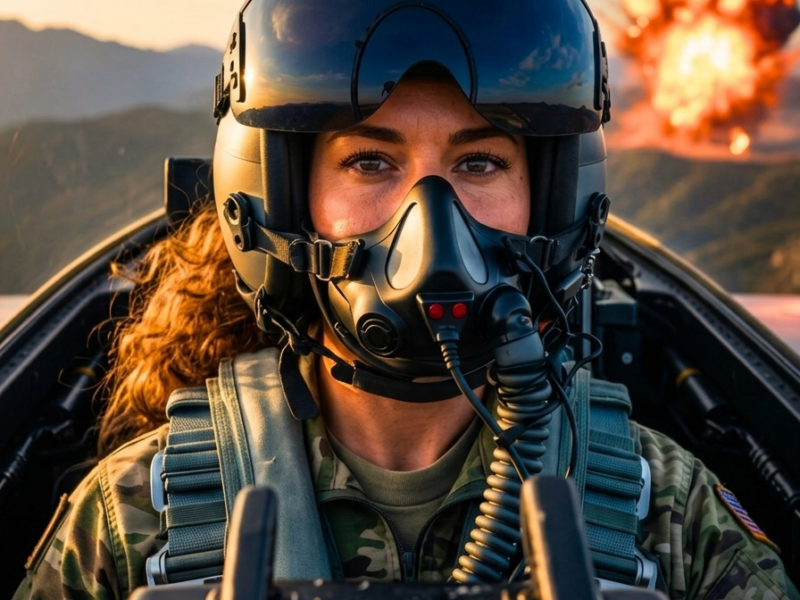
They laughed when I was ordered out of the briefing room at Naval Air Station Oceana, calling me “the SEAL’s mascot” as my commander stripped my flight status in front of everyone
The fluorescent lights of the main briefing room at Naval Air Station Oceana hummed with a low, relentless vibration that seemed to buzz right through the soles of my flight boots. It was 0800 on a Tuesday, and the air inside the room was thick with the scent of stale breakroom coffee, jet fuel from the flight line outside, and an unmistakable, suffocating arrogance.
I stood at absolute attention near the back of the auditorium, my eyes fixed straight ahead on the massive digital tactical map projected against the wall. Around me sat thirty-four pilots, radar intercept officers, and tactical strike coordinators. They wore their flight suits with practiced, casual indifference, their shoulders relaxed, their faces relaxed with the quiet confidence that comes from belonging to one of the most elite naval aviation squadrons in the United States military.
And then there was me.
“Look at her,” a voice whispered two rows ahead of me. It was Lieutenant Miller, a strike pilot who had spent the last two years making sure I knew exactly where I stood in the squadron hierarchy. He didn’t even bother lowering his voice. “The mascot showed up. Did someone forget to leash the SEALs’ dog?”
A ripples of low, muffled laughter cascaded through the surrounding seats. I didn’t blink. I didn’t break focus. I kept my jaw clamped tight until the muscles in my cheeks throbbed.
I was a Navy pilot assigned to directly support a naval special warfare development unit—specifically, a high-threat SEAL team. In theory, it was a high-visibility, prestigious assignment that required surgical flying precision and absolute nerves of steel. In reality, it placed me in a professional no-man’s-land. To the mainline carrier pilots, I was a glorified bus driver who spent too much time rolling around in the dirt with ground troops, adopting their reckless, aggressive tactics. To the SEALs, I was a blue-suiter, an outsider who wore a clean flight suit and slept in air-conditioned quarters while they bled in the mud. I was too aggressive for the aviators, too cautious for the operators, and too stubborn for anyone in command to handle comfortably.
I had spent eight years proving I belonged in the cockpit of a fighter jet. Eight years of flying twice as hard, landing twice as smooth, and studying tactical manuals until my eyes bled. None of it mattered today.
The heavy double doors at the front of the briefing room swung open with a loud thud, hitting the magnetic stop against the wall. Commander Reeves walked in.
Reeves was a towering man with a face carved out of weather-worn granite and eyes that rarely held any warmth. As the commanding officer of Strike Fighter Squadron 83, his word was absolute law. He carried a thick yellow personnel binder under his left arm. The room fell dead silent instantly.
“At ease,” Reeves barked, though no one had been standing except me. He walked up to the podium, set the binder down with a heavy, deliberate slap, and gripped the edges of the wooden stand. His eyes scanned the room, bypassing every senior flight leader until they landed directly on me.
“Lieutenant Vance,” Reeves said, his voice echoing off the concrete walls. “Front and center.”
Every head in the auditorium turned toward me. I could feel sixty eyes drilling into the side of my face. I didn’t hesitate. I unbuckled my posture, stepped out of the aisle, and marched down the carpeted steps toward the front of the room. My boots clicked with sharp, rhythmic precision against the floor. I stopped three feet from the podium, came to a razor-sharp halt, and snapped a salute.
“Lieutenant Vance reporting, sir,” I said. My voice was steady, even, and devoid of fear.
Reeves didn’t return the salute. He leaned over the podium, staring down at me with cold, unyielding disgust.
“Three nights ago,” Reeves began, his voice amplified by the room’s acoustics, “a Joint Special Operations task force conducted an insertion inside the northern sector of the Al-Hajar mountain range. The weather conditions were classified as marginal to severe. Low-level cloud ceilings, localized microbursts, and heavy sand dispersion.”
My pulse spiked, but my face remained an unreadable mask. I remembered that night with terrifying clarity. I had been sitting in the flight planning room when the mission parameters were pushed down from theater command. I had stared at the thermal radar overlays, watched the barometric pressure drop like a stone, and immediately flagged the route as an aviation death trap.
“Lieutenant Vance was assigned as the primary air support coordinator for the extraction package,” Reeves continued, turning to face the rest of the room. “Prior to launch, Lieutenant Vance repeatedly challenged the authority of the mission commander. She argued that the weather profile rendered low-altitude helicopter extraction impossible. She went so far as to delay the primary launch window by forty-five minutes while demanding a secondary routing protocol.”
“Sir,” I spoke up, keeping my tone respectful but firm. “The atmospheric data indicated a 90% probability of severe rotor-blade stall due to localized mountain-wave turbulence. I requested a fifteen-minute hold to let the front clear.”
“You delayed a combat mission, Lieutenant!” Reeves roared, slamming his open palm against the wood of the podium. The sharp sound vibrated through the room like a pistol shot. “You second-guessed operational intelligence handed down directly from Task Force Command! You let your arrogance dictate mission timing!”
“And what happened when the secondary unit launched, sir?” I asked, stepping right up to the line of insubordination. “What happened to the extraction bird?”
The entire briefing room held its breath. The air grew icy cold.
Reeves’s eyes narrowed into slit-like daggers. “The MH-60 Blackhawk carrying six members of SEAL Team 3 suffered a catastrophic flight-control failure four miles out from the objective. The aircraft went down. All six operators on board are currently classified as Missing in Action, presumed dead.”
A collective murmur rippled through the pilots behind me. I felt a sudden, sickening weight drop straight into the pit of my stomach. Six men. Six operators I had shared breakfast with at the mess hall three days prior. Men who had wives, children, and lives waiting for them back home.
“You panicked in the planning room, Vance,” Reeves spat, ignoring the truth of the atmospheric reports that proved my warning was entirely accurate. “Your hesitation created chaos in the launch sequence. You broke the chain of trust that holds this wing together. You proved that you do not possess the discipline, the temperament, or the loyalty required to sit in the cockpit of a United States Navy aircraft.”
Reeves reached down, opened the yellow binder, and pulled out an official administrative order stamped with red ink.
“By order of Naval Air Forces Atlantic,” Reeves read loudly, “Lieutenant Maya Vance is hereby stripped of flight status, pending a formal board of inquiry. You are grounded indefinitely.”
He stepped out from behind the podium and walked directly up to me. He reached out with two fingers, grabbed the embroidered leather pilot wings velcroed to the chest of my flight suit, and ripped them off with a sharp, tearing sound. The hook-and-loop fabric screamed in the silent room.
Reeves held my wings in front of my face for a fraction of a second before tossing them casually onto the wooden podium behind him.
“Hand over your flight gear by 1200,” Reeves said softly, his voice dripping with malice. “You’re on desk duty in administrative logistics until the board decides whether to dishnorsably discharge you or throw you in the brig. Dismissed.”
Someone in the third row let out a soft, mocking laugh. “Mascot’s going back to her dog house,” a voice snickered.
I didn’t look at them. I didn’t look at Reeves. I snapped a crisp, perfect salute to the officer who had just destroyed my life, turned on my heel, and marched out of the briefing room. The heavy wooden doors slammed shut behind me, sealing off the laughter of my peers, but doing nothing to silence the overwhelming, deafening noise of a career reduced to ashes in less than five minutes.
The administrative wing of Naval Air Station Oceana was a graveyard for forgotten sailors. Located in the basement of Building 402, far away from the thunderous, inspiring roar of twin-engine F/A-18 Super Hornets taking off from the runways, it was a dark, windowless labyrinth of filing cabinets, flickering fluorescent tubes, and yellowing linoleum floors.
For three months, that basement was my entire world.
My daily routine was a soul-crushing exercise in humiliation. I woke up at 0430, put on a sharp, perfectly pressed dress uniform instead of my beloved flight suit, and reported to a battered metal desk that sat right next to an ancient, clanking coffee machine. My job consisted of sorting through stacks of logistics reports, filing supply requisitions for aviation spare parts, and typing out weather logs for flights I was no longer allowed to fly.
Every afternoon, around 1400, the younger pilots would walk through the basement corridor on their way to the tactical simulator bays. They were fresh out of flight school, full of swagger and unearned confidence, wearing bright, pristine flight suits with shiny gold wings pinned to their chests. They were flying the very missions I had spent my entire adult life training for.
Whenever they walked past my desk, they made a point of laughing a little louder, dropping off unnecessary stacks of paperwork on my desk, or sarcastically asking if I needed help reading the aviation supply codes.
“Hey, Vance,” Miller said one afternoon, leaning against my desk with a smirk on his face while holding a steaming mug of coffee. “Make sure you order extra titanium bolts for the Squadron 83 birds. We’re heading out to the Middle East next week on an emergency deployment. Real pilot stuff. Wouldn’t want us falling out of the sky because the logistics clerk forgot to stamp a form.”
I kept my eyes locked on my computer screen, my fingers flying across the keyboard with methodical speed. “The requisition form was signed and approved two hours ago, Lieutenant Miller. You’re free to go play in the clouds.”
Miller chuckled, taking a slow sip of his coffee. “You really think you were right about that night in the mountains, don’t you? You still think you’re smarter than Reeves, smarter than the entire command structure.”
I stopped typing. I slowly turned my head and looked Miller dead in the eye. The cold, unyielding intensity in my gaze made his smirk flicker for a fraction of a second.
“Six men were lost because command ignored an atmospheric microburst warning that any half-decent pilot could see on a basic radar sweep,” I said, my voice dangerously low. “Reeves needed a scapegoat to cover his operational oversight, and he picked me because I didn’t fit into his little boys’ club. You know it. I know it. And deep down under that shiny flight suit, Miller, you know you wouldn’t have had the guts to speak up like I did.”
Miller’s face flushed bright red. He straightened up, setting his mug down so hard a bit of black coffee spilled onto my desk. “Enjoy your paperwork, Vance. Because that’s the closest you’re ever going to get to an aircraft for the rest of your natural life.”
He turned and walked away, his heavy flight boots echoing down the hallway.
I took a deep breath, picked up a napkin, and carefully wiped the spilled coffee off my desk. I didn’t let a single tear fall. Crying was a luxury I couldn’t afford, a weakness that would only give them the satisfaction they desperately wanted.
Instead, every single night after my twelve-hour desk shift ended, I went straight to the base gym. While the rest of the station was asleep, I spent two hours running until my lungs burned, lifting weights until my muscles trembled, and sitting in a dark corner studying classified flight manuals, radar intercept patterns, and evasive flight maneuvers that I had memorized down to the exact degree of stick input.
They had taken my wings. They had taken my status. They had taken my pride. But they hadn’t taken my mind, and they hadn’t taken the muscle memory carved into my very soul.
On the eighty-ninth day of my banishment, the atmosphere on the base changed drastically.
The calm, routine rhythm of NAS Oceana was shattered by a series of high-priority encrypted transmissions coming out of the United States Central Command in the Middle East. The news spread through the corridors like wildfire: Squadron 83, which had deployed to an advance forward operating base in the Syrian desert three weeks prior, had been thrown into a massive, unexpected combat engagement.
A high-value joint task force operation deep inside enemy-controlled territory had catastrophically collapsed.
Information was scarce, but rumor had it that a violent, unpredicted sandstorm combined with an unexpected concentration of advanced mobile surface-to-air missile systems had caught the assault force completely off guard. Two strike aircraft were reportedly hit and forced to eject. Tactical communications had gone completely dead across the entire sector.
And trapped right in the middle of a rocky, fire-swept valley deep behind enemy lines was a stranded unit of six U.S. Navy SEALs, surrounded on all sides by hundreds of heavily armed insurgent fighters.
Down in my dark basement office, I sat alone beside the clanking coffee machine, watching the classified red alert notifications blink steadily on my logistics terminal. My heart pounded furiously against my ribs. I knew the terrain of that desert valley better than anyone in that squadron. I had spent months analyzing its topographical maps during my flight officer training.
Suddenly, the heavy metal door at the end of the basement hallway was thrown open with violent force. Fast, heavy footsteps pounded against the linoleum floor.
I turned around, expecting to see a supply clerk bringing in another stack of shipping manifests.
Instead, Commander Reeves stood in the doorway.
His flight suit was wrinkled, his hair was disheveled, and his eyes were bloodshot with absolute terror and exhaustion. He looked like a man who had been staring directly into the abyss for hours.
He stood there in the doorway, breathing heavily, staring at me as I sat behind my metal desk in my pristine dress uniform.
“Maya,” he gasped out, using my first name for the very first time in my entire military career.
I stood up slowly, keeping my hands resting flat on the surface of my desk. “Commander Reeves. If you’re looking for the quarterly maintenance logs, they were uploaded to the server an hour ago.”
Reeves took three quick steps into the room, stopping right in front of my desk. His hands were trembling slightly.
“The operational sector in Sector 4 is completely compromised,” Reeves said, his voice raw and shaking. “Miller and his wingman were driven off by a dense network of SA-22 missile batteries. They can’t get low enough to locate the team. The weather is collapsing. Communications are jammed. The ground team has four minutes before they’re completely overrun.”
I stared at him, my expression completely unreadable. “Send in the reserve strike package from the carrier group.”
“They’re two hundred miles out!” Reeves almost screamed, his composure completely shattering. “They won’t make it in time! You’re the only pilot on this entire base who has logged over two hundred hours navigating low-altitude terrain in zero-visibility conditions using manual terrain-following radar!”
I let out a low, cold, bitter laugh. “You fired me, Commander. You called me a liability. You took my wings in front of thirty pilots and told me I didn’t have the discipline to sit in a cockpit.”
Reeves swallowed hard. The silence in the small basement office was so thick you could hear the electrical hum of the fluorescent lights overhead.
“I was wrong,” Reeves whispered.
Those four words hung in the air between us like heavy iron weights. They were the exact words I had dreamed of hearing for three agonizing months. But as I looked into the eyes of the man who had ruined my life, I felt no joy, no triumph, and no vindication.
Because I knew that those four words didn’t come from a place of genuine remorse. They came from absolute desperation. Six young men were dying in a dark, burning desert thousands of miles away, and their blood was about to stain his hands forever.
“Get your flight gear,” Reeves said, his voice choked with emotion. “An F/A-18F Super Hornet is idling on Runway 2 Right. The jet is armed, fueled, and waiting for you.”
I didn’t answer him with words. I unbuttoned the jacket of my dress uniform, threw it over the back of my chair, grabbed my helmet bag from the corner of the room, and walked right past my commander without giving him a second glance.
The pitch-black sky over the Syrian desert was alive with the violent, terrifying geometry of modern warfare.
At twenty-eight thousand feet, the air was freezing cold and smooth as glass, but five thousand feet below me lay a swirling, turbulent sea of dust, smoke, and burning debris. The sky was ripped apart at irregular intervals by the bright, blinding orange streaks of tracer fire and the wicked, curving vapor trails of surface-to-air missiles reaching up into the night like reaching fingers of death.
I sat in the cockpit of the F/A-18F Super Hornet, my hands firmly gripping the control stick and throttle. The familiar, rhythmic hum of the twin General Electric F414 engines thundered behind me, pushing the aircraft forward at nearly nine hundred miles per hour. The cockpit was illuminated only by the soft, green glow of the Heads-Up Display (HUD) and the multi-function tactical screens surrounding my seat.
Three months away from the stick had disappeared the moment my wheels left the tarmac at Oceana. My instincts were razor-sharp, my mind hyper-focused, and my heart beat with a slow, cold, mathematical rhythm.
“Vance, this is Tactical Air Control,” a frantic voice crackled through my helmet speakers. It was the controller aboard the AWACS aircraft orbiting forty miles to the west. “Be advised, Sector 4 is a complete non-permissive environment! Radar indicates at least three active mobile missile radars painting your sector. You are cleared to abort and wait for carrier reinforcement!”
“Negative, Control,” I replied, my voice calm, clear, and steady despite the chaos around me. “Carrier birds are twenty minutes out. The ground team doesn’t have twenty seconds. I am descending into the target area now.”
“Vance, you’re below safety altitude! Pull up!”
“Switching to manual flight control,” I answered, slamming my thumb down on the tactical mode selector. “Out.”
I yanked the control stick back and to the left, rolling the fifty-thousand-pound fighter jet inverted before pulling hard into a steep, nose-down dive. The cockpit rattled violently as the Super Hornet plunged through the thick layer of desert dust and cloud cover, screaming down toward the jagged rock formations of the canyon floor below.
The terrain-following radar warnings screamed in my ears, flashing bright red danger symbols across my HUD. PULL UP! PULL UP! TERRAIN AHEAD!
I ignored the computer warnings, overriding the automatic flight control systems with raw, physical stick input. I leveled the jet out just two hundred feet above the desert floor, flying so low that the jet blast from my engines kicked up a massive wake of dust and gravel across the sand dunes.
Ahead of me, the canyon walls rose like towering black shadows on either side of my canopy. Navigating a high-performance fighter jet through a narrow canyon at four hundred knots in pitch darkness was a suicidal maneuver that broke every single regulation in the Navy handbook. A mistake of three inches on the control stick would turn the jet into a fiery smear against the granite cliffs.
Suddenly, my tactical radio frequency exploded with static, followed by the sound of heavy automatic weapons fire, screaming men, and deafening explosions.
“Any allied air, this is Team Alpha!” a voice shouted over the radio. The speaker was breathing heavily, his voice choked with smoke and panic. “We are pinned down in the dry riverbed at Grid November-Seven! Enemy force has us surrounded on three sides! We are out of heavy munitions! I repeat, we are out of heavy anti-tank weapons! They are closing in!”
I recognized that voice instantly.
It belonged to Lieutenant Commander Mark Miller—no relation to the pilot back at Oceana—the hardened SEAL team leader who had stood in the briefing room months ago and casually referred to me as a liability who didn’t belong in their operational environment.
“Alpha Leader, this is Strike Flight One-One,” I radioed, clicking my throttle transmit switch. “Hold your position. I have visual on your infrared strobe.”
There was a brief, stunned silence on the other end of the line. “One-One? Who is this? Where is the strike package?”
“You’re looking at it,” I replied, pushing the throttle forward into full military power. “How long can you hold?”
“Maybe four minutes!” Miller yelled back, the sound of an RPG exploding near his position drowning out his voice for a second. “They’ve got two armored personnel carriers pushing right down the main trench toward us! If those vehicles clear the ridge, we’re done! Maya… is that you?”
“Keep your heads down, Commander,” I said, my voice dropping an octave into a cold, lethal calm. “I’m coming in.”
Through the green-tinted night-vision goggles attached to my helmet, I spotted the tiny, pulsing infrared light placed by the trapped SEALs on top of a ruined stone structure. Surrounding them on three sides were dozens of dark thermal signatures—insurgent infantry advancing behind two massive, heavily armored Russian-made BTR vehicles that were pumping heavy cannon fire into the team’s position.
“Target acquired,” I muttered to myself.
I lined up the nose of my aircraft with the narrow trench leading directly to the armored vehicles. I flipped the Master Arm switch to ON. The tactical screens in front of me illuminated with weapon target tracking data.
“Warning! Radar Lock!” a synthetic female voice chimed inside my helmet.
A high-altitude radar from an enemy SA-22 missile launcher on the surrounding ridge had just painted my jet. Two seconds later, a bright, blinding white streak of fire erupted from the darkness ahead. A surface-to-air missile was flying directly toward my nose at three times the speed of sound.
“Maya, break off!” Reeves’s voice suddenly broke through the command override frequency from the base operations room thousands of miles away. “You’ve got a missile inbound! Pull back now! That’s an order!”
I looked at the incoming missile. I looked at the six tiny thermal signatures crouching behind the crumbling stone wall below.
“No,” I said quietly into my oxygen mask.
I didn’t break away. I didn’t pull back. Instead, I pushed the stick forward, diving even lower to the ground, using the natural contour of the canyon floor to break the missile’s radar lock.
The missile passed so close over my canopy that the sonic boom rocked my entire aircraft, shattering the front glass of my tactical display screen and shaking my teeth in my skull. But the missile missed, slamming into the granite wall behind me with a deafening roar that lit up the entire valley in a blinding flash of yellow flame.
Before the smoke could clear, I pressed the red launch button on my control stick.
Two laser-guided AGM-114 bombs detached from the pylons under my wings, dropping into the dark abyss below.
The precision-guided munitions struck the lead BTR vehicle with surgical, terrifying accuracy.
A massive fireball ripped through the narrow desert trench, blowing the heavy armored vehicle into burning fragments of steel and sending a massive shockwave tumbling across the desert floor. The second armored carrier, blinded by the blast and smoke, attempted to reverse up the steep embankment, but I was already banking hard for a secondary strike pass.
I pulled the Super Hornet into a tight, six-G turn, the extreme force pressing my body down into the ejection seat with suffocating weight. Blood rushed out of my brain, darkening my peripheral vision, but I squeezed my lower abdomen and legs, fighting off the intense physical strain as I brought the nose of the jet back around to face the target area.
I lined up the secondary gun reticle on my HUD and squeezed the trigger.
The 20mm M61A2 Vulcan cannon mounted in the nose of my aircraft roared to life, firing twenty-five hundred rounds of armor-piercing shells per minute. The sound inside the cockpit was like thick canvas ripping right in front of my face. The heavy high-explosive rounds chewed through the second armored vehicle, detonating its fuel tank in a brilliant flash of light that lit up the entire canyon wall.
The remaining enemy infantry force, stripped of their heavy armor support and paralyzed by the sheer, terrifying suddenness of the low-altitude air attack, began scattering in complete panic, retreating back up the rocky slopes into the dark surrounding hills.
“Alpha Leader,” I called out, my breathing heavy and shallow as I brought the jet back into a level altitude. “The armor threat is neutralized. Your southern extraction route is clear.”
The radio crackled softly. For three long seconds, no one spoke. Then, Lieutenant Commander Miller’s voice broke through the static, completely devoid of the cocky, arrogant tone he had used with me for months.
“Direct hits on both targets,” Miller breathed out, his voice shaking with disbelief and overwhelming relief. “One-One… Maya… you just saved every single one of my men. The LZ is clear. The extraction chopper is coming in now.”
“Get your men home, Commander,” I replied smoothly. “I’m covering your exit.”
I banked the aircraft to orbit over the valley, watching through my thermal sensor as a heavy MH-47 Chinook helicopter dropped down through the dust cloud, settled onto the rocky riverbed, and loaded the six stranded SEALs onto its rear ramp. Within ninety seconds, the helicopter was airborne again, climbing out of the valley and heading west toward friendly territory.
“Task Force, this is Alpha Leader,” Miller radioed as his transport cleared the ridge. “We are all aboard. All six accounted for. We are coming home.”
I breathed a long, slow sigh of relief inside my oxygen mask. The mission was accomplished. The men were safe.
Then, three red diamond symbols flashed simultaneously onto my tactical radar screen.
“Warning! Multiple airborne tracks identified!” the automated computer voice warned. “Threat level: Critical.”
I looked down at my radar display. Three enemy fighter jets—advanced, high-maneuverability Russian-built Su-35s—had just crested the northern ridge line at twenty thousand feet. They were flying in a tight battle formation, moving at supersonic speeds, and diving straight toward my position.
They had deliberately waited for me to expend my primary heavy air-to-ground ordnance on the armored vehicles below. Now, I was low on fuel, stripped of my heaviest missiles, and trapped in a low-altitude canyon against three superior air-to-air fighters.
“Vance!” the controller from the AWACS screamed into my ear. “You have three bandits closing on your six o’clock! They have full radar lock! Disengage immediately! Eject if you have to!”
I checked my fuel gauge. The digital counter was blinking amber. I had barely enough fuel to make it back to the forward operating base, and engaging three advanced fighters in a dogfight would burn through my remaining jet fuel in less than sixty seconds.
For a brief, agonizing moment, the cold reality of my situation settled over me. I was completely alone in the sky. My aircraft was damaged, my fuel was running out, and three deadly predators were swooping down to finish me off. This was where my career, my flight status, and my life were supposed to end.
I looked at the fuel gauge again. Then I looked out the left side of my canopy at the narrow, twisting, granite gorge known as the Devil’s Teeth—a dangerous, twenty-mile-long canyon with vertical thousand-foot walls and tight, ninety-degree turns that no sane pilot would ever dare to enter.
A cold, ruthless smile spread across my face behind my oxygen mask.
I didn’t turn away from the three incoming enemy fighters. I didn’t dive toward friendly lines. I didn’t pull the yellow ejection handle sitting between my knees.
I pulled the control stick hard to the right, engaged full afterburners, and turned my aircraft straight toward them.
The three enemy Su-35s rolled into a defensive formation, caught completely unprepared by the suicidal boldness of an F/A-18 turning directly into a three-on-one engagement.
Twin trails of blue-orange flame shot out from the back of my engines as the afterburners engaged, pushing my speed past Mach 1. The Super Hornet accelerated with terrifying force, slamming me back into my seat as I charged straight up the valley toward the lead enemy aircraft.
At a closure rate of over twelve hundred miles per hour, the distance between my jet and the lead enemy fighter evaporated in seconds. The lead Su-35 fired a short-range infrared missile directly at my nose.
I waited until the precise fraction of a second before impact, then kicked the left rudder pedal down with all my strength while rolling the stick hard to the right.
The Super Hornet executed a violent, bone-crushing barrel roll, dodging the incoming missile by a matter of yards. The missile detonated in the air behind me, the shockwave violently rattling my tail fins, but I was already past the lead fighter.
Before the remaining two enemy jets could turn to acquire a secondary radar lock on my tail, I shoved the nose of my aircraft down, diving straight into the narrow entrance of the Devil’s Teeth canyon.
“She’s suicide-diving into the gorge!” one of the radar controllers back at base shouted over the open tactical network. “She’s going to hit the walls!”
Inside the gorge, the world contracted into a terrifying tunnel of jagged black granite and flashing red warning lights. The canyon walls swept past my wingtips with less than thirty feet of clearance on either side. I turned off my primary flight radar, relying entirely on my own night-vision goggles, raw human reflexes, and the photographic memory I had cultivated during those long, lonely nights studying topographical maps in the base gym.
Behind me, all three enemy fighters plunged into the canyon in pursuit. Their pilots were highly trained, but their aircraft were significantly larger, heavier, and far less nimble in tight, low-altitude spaces than my Super Hornet.
I pulled the stick hard, throwing the jet into a sharp, eighty-degree bank to round a blind granite turn. The outer tip of my right wing brushed against a protruding rock formation, sending a shower of bright yellow sparks flying into the night air, but the aircraft held together.
Behind me, the lead enemy Su-35 tried to match my tight turning radius. Its massive wing structure caught the edge of the canyon cliff.
A massive, blinding explosion filled my rear-view mirrors as the jet detonated instantly against the rock face, turning into a fiery cloud of debris that illuminated the entire canyon floor.
The second enemy fighter, blinded by the sudden wall of fire and debris from its wingman’s destruction, panicked. The pilot pulled hard on his flight stick to climb vertically out of the gorge, but his aircraft lacked the airspeed to clear the overhang. The jet stalled in mid-air, flipped backward, and slammed nose-first into the canyon floor below, exploding in a secondary column of fire.
The third enemy pilot didn’t hesitate. Recognizing that he had been lured into an absolute death trap by a pilot who knew the terrain infinitely better than he did, he aborted the pursuit, turned his aircraft sharply, and fled back into the safety of the upper atmosphere.
I popped up out of the northern exit of the canyon, leveled my wings, and reduced the throttle back to cruise power.
My tactical radar screen cleared. The threat markers disappeared. The desert sky was silent once again.
“Target area is clear,” I said quietly into my helmet microphone. “All hostiles disengaged or destroyed. Flight One-One is bingo fuel, returning to base.”
For ten full seconds, absolute silence reigned across the tactical radio network. Then, the entire frequency exploded into a roaring wave of cheers, applause, and disbelieving laughter from the crew back at the base control center and the operators aboard the AWACS aircraft.
I didn’t join in the celebration. I kept my eyes fixed on the horizon as the eastern sky began to glow with the pale, amber light of dawn.
Twenty minutes later, my Super Hornet touched down softly on the concrete runway at the forward operating base. I taxiied the battle-damaged aircraft toward the main hangar bay, where dozens of ground crew members, mechanics, and off-duty personnel had gathered to watch me roll in.
I shut down the twin engines, popped the canopy seal, and listened as the heavy acrylic glass lifted into the morning air.
As I unclipped my oxygen mask and stepped out of the cockpit onto the metal maintenance ladder, nobody cheered. The gathered crowd simply stood there in stunned, reverent silence, staring up at me. Among them stood Lieutenant Miller and the five SEAL operators I had saved from the valley floor. Miller stepped forward, snapped a slow, deeply respectful salute, and nodded his head once.
Commander Reeves walked slowly out of the hangar doors, stepping through the crowd until he stood at the base of my ladder. He looked older, broken, and hollow.
“You saved everyone, Maya,” Reeves said softly, his voice trembling as he looked up at me. “You saved the team. You saved the squadron.”
I climbed down the final rungs of the ladder, set my flight helmet down on the edge of the boarding stair, and looked Reeves directly in the eyes.
“No, Commander,” I said, my voice completely devoid of anger or triumph. “I didn’t save anyone. You finally just stopped getting in my way.”
Reeves opened his mouth as if to offer a defense, an excuse, or another apology, but no words came out. He stood there, completely silenced by the sheer truth of what had just transpired.
I turned and walked past him into the quiet sanctuary of the pilot debriefing room.
Years later, people would tell the story of that night in different ways. Around the flight decks of aircraft carriers and in the ready rooms of naval air stations across the country, pilots would call me fearless. They would call me the pilot who mastered the canyon, the legend who dominated the skies when everything else had failed.
But as I sat alone in that debriefing room after the mission, staring at my reflection in the dark glass of the window, I didn’t feel like a hero. I felt a cold, sharp, terrifying realization settling deep into my core.
I remembered the exact wording of the administrative order Reeves had used to strip my flight wings three months prior. I remembered how quickly the mission parameters had been changed, how conveniently the weather warnings had been erased from the official logbooks, and how precisely my career had been dismantled before I could ever reach the rank of squadron commander.
I realized then something far more painful and far more dangerous than simply being underestimated by my peers.
Someone high up in Naval Air Command hadn’t grounded me because they thought I was a bad pilot.
They had known exactly what I was capable of all along. They knew the depth of my skill, the relentless nature of my mind, and the secrets I was bound to discover if I remained in that cockpit.
And they had spent the last three years doing everything in their power to keep me out of the sky for a reason.
The end









