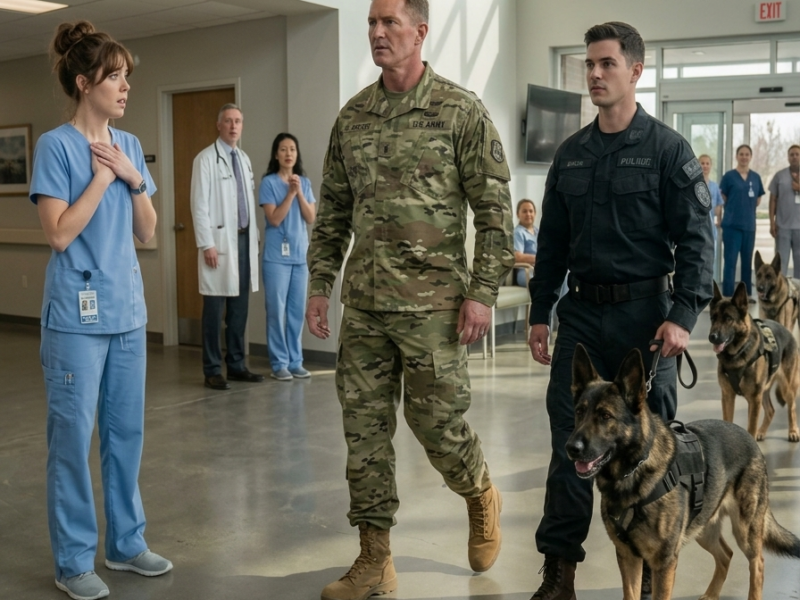
They laughed when I was assigned to the federal K9 unit as a “rookie nurse,” but the moment twelve trained dogs broke formation and surrounded me instead of their handlers
The winter air inside Hangar 4 at Fort Bragg was thick with the scent of diesel fuel, wet concrete, and cold leather. The vast steel ceiling arches magnified every sound—the heavy footfalls of tactical boots, the sharp metallic snap of leash carabiners, and the echoing murmurs of thirty federal handlers lined up in precise formation. Outside, a bitter North Carolina wind whipped across the tarmac, rattling the corrugated walls of the facility.
I walked through the side entry frame holding a heavy aluminum medical transport case in one hand and a digital clipboard in the other. My dark blue scrub top bore a crisp white patch: DEPARTMENT OF HOMELAND SECURITY – SPECIAL K9 VETERINARY DIVISION. I was twenty-six, small-framed, and had transferred into the tactical medical unit less than forty-eight hours ago.
To the senior handlers of the Federal Joint Task Force, I was nothing more than an uninvited bureaucrat with a stethoscope.
“Look at this,” Agent Miller, a broad-shouldered senior handler from the Charlotte field office, muttered loudly enough for his words to bounce off the concrete floor. He glanced sideways at my brand-new agency badge clipped to my lapel. “A rookie nurse. Fresh out of clinical rotation.”
A couple of younger agents down the line chuckled nervously. Agent Miller’s partner, a burly handler named Vance with a scar running across his eyebrow, shook his head with an arrogant smirk. “Hope she knows which end of the dog bites. These aren’t golden retrievers from the suburbs, sweetheart. These are assault animals.”
I kept my eyes fixed ahead, my footsteps steady. I had heard worse. Much worse. For two years, I had trained myself to absorb insults like armor, hiding behind a wall of professional detachment. My mandate was simple and routine: perform a post-exercise triage, check paw pads for shrapnel or chemical exposure following a five-day field training operation in the pine forests, and clear the units for deployment.
Nothing more. Nothing complex. Just a job to fill the quiet, hollow space my life had become.
I approached the first station on the left. The line consisted of twelve elite federal K9s—Belgian Malinois and German Shepherds—standing in rigid, disciplined heel positions beside their respective handlers. These were the country’s top interdiction and explosive-detection animals, trained to ignore gunfire, chaotic crowds, and extreme pain.
Then, as I pulled a penlight from my pocket, the giant Malinois at the head of the line lifted his head.
His ears twitched forward, sharp as daggers. His dark, intelligent eyes locked onto my face.
A second later, the German Shepherd beside him shifted his posture, his nostrils flaring as he sniffed the air current blowing from the open hangar doors behind me. Then the third dog turned. Then the fourth.
Within ten seconds, a uncanny, heavy quiet fell over the massive hangar. The low hum of human conversation died instantly. All twelve federal K9s had ceased watching their handlers. Every single animal had turned its head, their eyes burning with a strange, collective intensity, locked entirely onto me.
The handlers noticed the sudden break in discipline immediately.
“Vanguard, heel!” Miller barked, tugging sharply on his leather lead. The Malinois ignored him completely, his body leaning forward, tension straining the heavy nylon harness across his chest.
“Atlas, sit!” Vance shouted at his Shepherd, his voice echoing nervously against the steel rafters. “What the hell is wrong with these dogs?”
I froze in the center of the concrete aisle, three feet away from the line. The air in my lungs felt suddenly freezing.
“What’s happening?” a junior handler whispered from the far end of the line, his hand instinctively dropping toward his sidearm retention strap. “They’re acting like they hit a biological trace.”
Before anyone could react, the oldest K9 in the unit—a massive, grey-muzzled German Shepherd bearing deep operational scars across his broad snout—stepped forward. He did not growl. He did not bark. With deliberate, powerful strides, he snapped his leather lead straight out of Vance’s grip.
“Rex, heel!” Vance roared, reaching out to grab the dog’s heavy collar. “Rex, halt!”
Rex ignored the command entirely. He walked directly toward me, his heavy paws clicking against the concrete floor like steady drumbeats.
The surrounding agents shifted nervously, several stepping back, their hands hovering near their tactical holsters. A rogue assault dog was a lethal weapon.
Rex stopped inches from my knees. He didn’t lung. He didn’t snap. Slowly, deliberately, the massive animal leaned his broad, heavy head forward and pressed his wet nose firmly against the left side of my chest—directly over my heart.
The breath caught in my throat. My fingers trembled as the heavy aluminum medical kit slipped from my hand, clattering loudly against the hard floor.
The latch on the kit popped open from the impact. Supplies spilled across the floor—rolls of sterile gauze, antiseptic wipes, a silver penlight, and a small, worn leather pouch that unzipped as it hit the concrete. Out of the pouch tumbled a single, tarnished silver pendant strung on a heavy ball chain. It was a military-issue canine identification capsule, scratched and darkened by fire.
The moment the silver metal clinked against the floor, Rex let out a low, shuddering whine—a sound so full of profound, heartbreaking grief that it sounded almost human.
Then, as if a silent signal had been transmitted across the hangar, the other eleven dogs broke formation simultaneously.
Leashes snapped taut and slipped from stunned fingers. Ignoring the frantic, shouted commands of their handlers, twelve elite federal K9s broke ranks and surged forward. They didn’t attack. They didn’t show aggression. They swept around me in a tight, protective ring, closing off the aisle, their heavy bodies pressing against my legs, forming a living wall between me and the rest of the agents in the room.
Silence descended upon Hangar 4—a thick, suffocating silence so absolute you could hear the rain beginning to lash against the high skylights above.
Nobody moved. Handlers stood frozen, their mouths slightly open, staring in absolute disbelief at their uncontrollable animals.
I dropped slowly to my knees in the center of the circle, my hands shaking so violently I could barely function. My fingers brushed through Rex’s thick, coarse fur.
“Easy, boys,” I whispered, my voice cracking under the weight of a sudden, suffocating tide of memory. “Easy…”
Rex lowered his broad head directly into my lap, closing his eyes, letting out another long, trembling sigh as he pressed his weight against my knees.
Agent Miller stepped forward, his eyes wide as he stared at the silver pendant resting on the cold floor between my knees. “Where did you get that?” he asked, his former arrogance completely replaced by an edge of deep, suspicious tension.
I closed my trembling hand around the cold piece of metal, the sharp edges digging into my palm.
“It belonged to my brother,” I whispered, looking up through a blur of unshed tears.
The energy in the hangar shifted instantly, turning cold as iron.
My brother, Caleb Vance, had been the master handler for this exact federal unit. Two years ago, he was declared dead following a catastrophic warehouse explosion during a joint task force raid on an illegal arms depot near the Wilmington docks. The official military and federal reports had been released within forty-eight hours: an accidental ignition of volatile chemical accelerants caused by a faulty electrical conduit. Case closed. Sealed. Archived.
Caleb was buried in a closed casket. They told my family he had died instantly while protecting his team.
I had never believed a single word of it.
And neither had Rex.
Rex had been Caleb’s primary operational partner that night. He was the only survivor pulled from the burning rubble of the warehouse, his lungs scorched, his ears torn by blast shrapnel. After the explosion, the agency had tried to reassign Rex to Vance, but the dog had turned sullen and dangerous, refusing to work, refusing to track, standing like a statue during operational drills. The agency had been days away from decommissioning him permanently.
Until this morning.
Rex suddenly snapped his head up from my lap. His golden eyes locked onto the far dark corner of the hangar, where a row of decommissioned equipment lockers stood beneath a layer of dust and grime.
The dog stood up on all four legs, his muscles rippling with a sudden, electric intent. He let out a sharp, ear-splitting bark that vibrated through the steel girders of the roof.
The other eleven dogs immediately turned in unison, following Rex as he trotted briskly across the concrete floor toward the shadow of the rear wall. They gathered around an old, reinforced steel storage locker marked with a faded red stencil: LOGISTICS – ARCHIVE 09.
Rex raised his right front paw and scratched the heavy steel door.
Scratch.
He paused, sniffing the rusted seam deeply.
Scratch.
Then, the dog sat down heavily on his haunches, turned his head, and fixed his dark, intelligent eyes directly on me.
Agent Miller walked over slowly, pulling a heavy tactical master key ring from his belt. “That locker was sealed two years ago after the Wilmington incident,” Miller said, his knuckles turning white as he selected a heavy brass key. “It’s off-limits to general staff.”
“Open it,” I said, my voice dropping an octave, carrying a terrifying, steady quiet that made Miller pause. “Open it now, Agent.”
Miller swallowed hard, inserted the key into the heavy padlock, and twisted it. The lock popped open with a heavy metallic clack. He pulled the steel door open.
Inside, resting on a rusted shelf amidst dusty cables and old tires, was a single, heavy-duty plastic evidence container wrapped in yellow tamper-evident tape. Written across the top surface in bold, faded black permanent marker was a name:
CPO CALEB VANCE – FIELD GEAR / PENDING DISPOSAL.
My hands trembled violently as I stepped forward and pulled the heavy box off the shelf. I set it down on a nearby wooden workbench. The twelve dogs stood in a tight semicircle behind me, a silent, watchful guard.
I snapped the plastic latches open.
Inside lay Caleb’s charred tactical vest, a shattered wrist compass, training logs, a heavily damaged mobile phone with a cracked screen… and a small, sealed waterproof document pouch.
I pulled the pouch out and unzipped it. Inside was a single piece of yellowed notebook paper, folded twice.
My heart hammered against my ribs like a battering ram as I unfolded the sheet. Written in Caleb’s sharp, precise, military handwriting were four lines:
If they tell you I died by accident, don’t believe them. The chemical trail was planted. They locked us inside from the outside.
I couldn’t breathe. The air in the room felt entirely depleted.
My eyes dropped to the final line written at the bottom of the page, the ink dug deep into the paper as if written in extreme haste:
The nurse knows why.
Everyone in the hangar turned to look at me. The silence was terrifying.
I stared at those four words, my mind spinning backward through two years of grief, trauma, and suppressed horror, until a dark, terrifying door in my memory suddenly swung wide open.
I hadn’t been in Raleigh the night Caleb died, as I had spent two years telling the grief counselors and federal investigators.
I had been there. In Wilmington. Standing in the rain near the perimeter fence, waiting to bring Caleb his spare medical kit before his team breached the facility.
I had seen the dark, unmarked sedan parked in the shadows of the alleyway. I had seen a figure in a federal tactical windbreaker step up to the warehouse’s secondary emergency exit, slide a heavy steel security bar across the door brackets, and padlock it shut from the outside seconds before the building detonated into a blinding fireball.
And as I slowly turned around in the cold light of Hangar 4, my eyes moved past the dogs, past the silver pendant, and locked directly onto the man standing near the open hangar door.
The man who had barred that door two years ago was standing right in front of me, wearing a senior agent’s badge on his chest.
The cold wind howling through the open hangar doors sounded like a distant scream.
I stood paralyzed beside the workbench, the paper clutching in my hand until the edges crumpled against my knuckles. My gaze was locked onto Agent Vance.
He was standing near the hydraulic door controls, his right hand resting casually near his sidearm holster. The silver light from the overcast sky outside hit his face, highlighting the deep, jagged scar across his eyebrow—the exact scar I had seen illuminated by the orange flare of the Wilmington explosion two years ago as he fled the scene.
“Clara?” Agent Miller asked softly, taking a step toward me, noticing the sudden, deathly pallor of my face. “What does it mean? What nurse is he talking about?”
I didn’t answer Miller. I couldn’t. My throat felt as if it were coated in glass.
For two years, my brain had buried that night under a heavy, psychological wall of trauma-induced amnesia. The shock of the explosion, the horrific concussive wave that had thrown me against the perimeter fence, and the months of intense grief had fractured my memory into jagged, disconnected pieces. The doctors had called it dissociative shock. I had remembered driving to Wilmington, remembered the sudden flash of light, and then nothing until I woke up in a hospital bed forty-eight hours later being told my brother was dead.
Until now. Until Rex brought me back to the truth.
Vance’s eyes narrowed into dangerous, calculating slits as he registered the change in my stance. His posture shifted instantly from arrogant indifference to a cold, predatory alertness.
“This is ridiculous,” Vance said, his voice loud and clear, stepping forward into the center of the aisle. “That box was supposed to be incinerated six months ago under standard evidentiary disposal protocols. Whatever’s in that note is the rambling of a stressed operative written during an active operation.”
“He wrote it thirty minutes before the building exploded, Vance,” I said, my voice trembling, though every word cut through the vast space of the hangar like a blade. “He knew someone on his team was setting him up.”
“Your brother was paranoid, rookie,” Vance spat back, taking another slow, deliberate step toward the workbench. “Operation Deepwater was a chaotic mess. Caleb made mistakes on the ground. He got himself cornered in a hazardous storage room.”
“He didn’t make a mistake,” I said, stepping around the workbench, my eyes fixed on Vance’s face. “He was executed. Because he found out that the illegal weapons in that warehouse weren’t being smuggled in by foreign syndicates. They were being sold out of federal evidence lockers by agents inside this division.”
A sudden, sharp murmur erupted among the thirty handlers gathered in the room. Several agents exchanged shocked, uneasy glances.
“Shut your mouth,” Vance growled, his hand tightening subtly over his holster strap. “You’re a civilian medical assistant throwing around insane accusations in a military facility. Miller, secure that evidence box and clear this room now.”
Agent Miller hesitated. He looked at the crumpled note in my hand, then at Vance, and finally down at Rex.
Rex hadn’t moved from my side. The massive German Shepherd was standing in a low, offensive crouch, his lips pulled back over his teeth, a guttural, terrifying growl vibrating deep within his chest. The other eleven K9s remained positioned around us, their ears flat, their bodies locked in a defensive ring targeting Vance.
“Miller,” Vance snapped, his voice rising in pitch. “That’s an order! Secure the room!”
“Hold on a second, Vance,” Miller said quietly, taking a step back from the workbench, his hand moving away from the evidence box. “Why was this box in an unindexed archive locker? Standard evidence disposal requires two senior officer signatures and a chain-of-custody log. Where’s the log?”
“I don’t answer to you, Miller!” Vance barked.
Before anyone could react, Vance reached down to his belt, pulling a small, black electronic device from a pouch—a high-frequency directional acoustic transmitter used by specialized tactical units to disorient military working dogs during room-clearing operations.
He pressed the primary toggle switch.
An ear-splitting, ultra-high-frequency tone—inaudible to human ears but agonizing to canine hearing—shattered the air inside the hangar.
The reaction was instant and violent. All twelve K9s let out sharp, pained whines, dropping their heads, several thrashing against the floor as their sensitive ears were slammed by the concentrated acoustic wave.
“Get down!” Miller yelled, covering his ears instinctively as the sudden chaotic noise reflected off the steel walls.
Vance pulled his standard-issue Glock 19 from his holster, pointing the barrel straight at my chest.
“Nobody move!” Vance screamed over the chaos, his eyes wild and bloodshot. “Step away from the box, nurse! Hand over the pouch and the note!”
“Vance, what the hell are you doing?!” Miller shouted, reaching for his own sidearm.
“Draw your weapon, Miller, and I swear to God I’ll put a round through her head!” Vance yelled, his finger taking up the slack on the trigger. “She was at the site! I saw her car parked near the access road two years ago! I thought she was just an innocent civilian who got lucky when the blast went off, but she’s been a threat to this operation since day one!”
“You killed him,” I whispered, standing my ground, refusing to step back. “My brother trusted you. He took a bullet for you in Kabul four years ago, and you locked him in a furnace for money!”
“He was going to ruin everything!” Vance sneered, his grip on the pistol white-knuckle tight. “Fifty million dollars in high-grade military hardware was moving through that port! Caleb was an idealist idiot who couldn’t see the bigger picture! He wouldn’t take a cut, so he had to be removed!”
The acoustic device in Vance’s left hand continued to emit its agonizing frequency. The dogs were squirming in pain, kicking frantically against the concrete.
Except for Rex.
The old, scarred German Shepherd, his ears torn and deafened by the very explosion Vance had caused two years ago, was partially immune to the high-frequency tone.
Rex lifted his heavy head from the floor. Through eyes blurred with pain and age, he saw the gun pointed at my chest. He recognized the posture. He recognized the threat.
With a deep, primal roar that echoed above the screaming wind, Rex launched his broad, heavy body through the air.
He didn’t aim for Vance’s gun arm. He launched himself straight at Vance’s throat.
Vance fired a panicked shot—the round snapping past my ear to shatter a glass window high on the hangar wall—before Rex’s seventy-pound frame slammed directly into his chest.
The impact threw Vance backward off his feet. They both crashed violently into the open hydraulic door control console, hitting the emergency lowering bar.
With a deafening, mechanical groan, the massive steel hangar doors began to slowly grind shut, cutting off the grey light from the tarmac outside, plunging Hangar 4 into a shadowy, flickering gloom.
The heavy steel doors gritted against their tracks as they slid shut, casting long, swaying shadows across the concrete floor. The emergency backup lights clicked on overhead, bathing the vast room in an eerie, amber glow.
Vance hit the floor hard, the acoustic transmitter slipping from his grip and smashing into pieces against the steel console. The unbearable high-frequency tone stopped instantly.
The eleven federal K9s shook their heads, instantly recovering their bearings. Their heads snapped toward the fight near the door, their instincts driving them into tactical formation.
Vance fought frantically beneath Rex’s heavy weight, bringing his heavy combat boot up to kick the dog off his chest. Rex let out a sharp yelp as he was thrown backward against the metal wall, but he instantly scrambled back to his feet, positioning himself between Vance and me, his jaws dripping with foam, his growl vibrating the floorboards.
Vance scrambled to his feet, blood streaming from a deep tear on his left forearm where Rex’s teeth had grazed him. He scrambled toward the secondary exit corridor—the narrow, dark hallway that led to the underground armory and administrative offices.
“Miller!” Vance screamed back over his shoulder as he ran. “She’s lying! She’s an unvetted intruder trying to compromise federal property! Secure the perimeter!”
Vance vanished into the dark corridor, the heavy steel door slamming shut behind him.
“Miller, listen to me!” I shouted, rushing toward the senior handler as he stood frozen in the middle of the aisle, his weapon half-drawn, his mind reeling from Vance’s confession. “You heard him! He admitted to the explosion! He admitted to setting up Caleb!”
Miller looked at the shattered acoustic device on the floor, then at the bullet hole in the high window, and finally at Rex, who was scratching wildly at the closed corridor door.
“God almighty,” Miller whispered, his face pale as chalk. He looked around at the other ten handlers in the room. “Vance isn’t working alone. He’s the regional logistics coordinator. If he’s compromised, the administrative floor is locked down under his security codes.”
“He’s going to wipe the central server,” I said, the medical training in my brain forcing me into cold, analytical focus. “Caleb’s encrypted mobile phone was in that box. If Vance reaches the central mainframe in the basement, he can trigger a remote wipe of every archive file connected to Operation Deepwater!”
Miller turned to his unit, his voice snapping back into command authority. “Team! Form up! Full tactical alert! We secure the administrative corridor and isolate the server vault! Nobody leaves this building!”
“Wait!” I called out, reaching into Caleb’s evidence box and pulling out the cracked mobile phone. “The phone is damaged, but the micro-SD storage card inside is military-grade titanium encased. It holds the original audio logs Caleb recorded inside the warehouse before the blast.”
I looked down at Rex. The dog was standing at the corridor door, his nose pressed to the rubber seal at the bottom, sniffing frantically. He let out two short, sharp barks.
“He knows the layout of the administrative floor,” I said, looking Miller straight in the eyes. “Caleb trained him in these corridors for three years. He can bypass the electronic security locks through the maintenance ventilation access.”
Miller looked at the scarred German Shepherd, then reached down and unclipped a secondary tactical lead from his own vest, snapping it onto Rex’s collar. “Lead the way, nurse. Let’s go finish what your brother started.”
We pushed through the corridor door, stepping into the narrow, dimly lit hallway. The air inside the administrative section was cold and smelled of ozone and damp paper. The main fluorescent lights had been cut, leaving only the red exit signs casting a bloody hue over the floor.
Rex moved with silent, lethal grace. He led us down the main hallway, past empty office bays and glass-walled conference rooms, his nose sweeping the baseboards.
Suddenly, Rex stopped near a junction in the hall where a set of heavy fire doors led down to the subterranean server vault.
The electronic keypad beside the fire door was glowing red, its digital screen reading: LOCKDOWN – ACCESS DENIED.
“He’s locked himself inside the server room,” Miller muttered, punching his master override code into the keypad. The unit beeped thrice in error: INVALID CLEARANCE. “He’s initiated a level-four security purge. We have less than five minutes before the mainframe automatically formats the localized drives.”
“There’s another way in,” I said, pointing up toward a low-hanging aluminum ventilation duct running along the corridor ceiling. “Caleb showed me the blueprints of Hangar 4 when it was renovated. The primary air-handling duct connects directly to the server vault’s cooling manifold.”
Rex looked up at the vent, his tail giving a single, powerful thump against the wall.
“He’s too big to fit through the standard ductwork,” Miller said, looking at the narrow metal square.
“He doesn’t need to go all the way through,” I said, stepping beneath the vent. “He just needs to reach the manual damper release inside the shaft. If we pop the intake cover, he can pull the mechanical latch from the inside.”
Miller didn’t argue. He unholstered his combat knife, inserted the tip beneath the aluminum intake grate, and popped the four corner retention clips. The metal cover clattered to the floor.
I dropped to one knee, looking Rex straight in his dark, golden eyes. I reached out, framing his broad face with my hands.
“Rex,” I whispered, my voice trembling with emotion. “Find Caleb’s work, boy. Go get him.”
The dog let out a low, determined huff of air. With incredible agility, Rex leaped off Miller’s shoulder, thrusting his front legs and broad chest up into the dark, narrow ventilation shaft. He pulled his hind legs up, his claws scraping against the sheet metal as he disappeared into the darkness above.
The sound of his heavy paws echoing through the metal ductwork faded into the distance.
We stood in the red-lit hallway, waiting, our hearts pounding in our chests, listening to the ticking clock of the automated server purge.
Thirty seconds passed. Forty.
Then, from deep inside the sealed server room behind the heavy fire doors, we heard the sudden, unmistakable sound of crashing glass, followed by a man’s frantic, terrified scream:
“Get off me! Get off!”
SNAP.
The heavy electronic lock on the fire door clicked green. The magnetic seals released with a loud pneumatic hiss.
Miller slammed his shoulder against the door, throwing it wide open.
The central server room was a cold, cavernous vault filled with rows of towering black server racks, their blue and green indicator lights blinking in rapid, chaotic patterns. The air was frigid, driven by massive industrial cooling fans that hummed like a jet engine.
In the center of the room, illuminated by the harsh glow of a master control monitor, Vance was pinned flat against the anti-static floor tiles.
Rex was standing directly over him, his massive front paws pressed heavy against Vance’s shoulders. The dog’s jaws were clamped tightly around Vance’s right wrist, pinning the agent’s hand inches away from a bright red plastic button marked: MANUAL SYSTEM PURGE – CONFIRM.
“Don’t move!” Miller screamed, rushing into the vault with his sidearm raised, followed by three other handlers. “Vance! Don’t you dare move!”
Vance lay on the floor, his face twisted in pain and rage, blood dripping from his arm onto the white floor tiles. “Call him off! Miller, call this damn animal off me!”
I walked into the vault slowly, my steps echoing against the raised floor panels. I pulled the cracked mobile phone from my pocket, stepped over to the main master console, and plugged the military micro-SD card directly into the universal diagnostic port.
“Initiating data retrieval,” I said, my voice completely devoid of fear.
“It doesn’t matter!” Vance spat, wincing as Rex tightened his grip slightly on his wrist. “That data is encrypted with high-level federal military keys! You can’t open those files without a master clearance code from headquarters!”
“He’s right, Clara,” Miller said quietly, keeping his weapon trained on Vance’s head. “Federal encryption requires a two-factor biometric override from an active team lead.”
I didn’t answer. I looked down at the screen. A large red prompt appeared on the master monitor:
ENCRYPTED FILE DETECTED: OPERATION DEEPWATER – AUDIO LOG 04.
INSERT BIOMETRIC VERIFICATION OR MASTER PASSPHRASE.
I stepped back from the console and looked down at Rex.
“Rex,” I whispered softly.
The dog slowly released Vance’s wrist, leaving the agent gasping on the floor. Rex stepped over to the console, stood up on his hind legs, and rested his broad front paws heavily against the edge of the control desk.
He lowered his dark snout until his nose was pressed directly against the console’s integrated optical biometric scanner—the very scanner Caleb had registered him to three years ago as an active tactical asset.
A thin green laser line swept over the dog’s nose and face.
The monitor beeped twice with a high-pitched, melodic chime. The red lockdown screen vanished, replaced by a bright blue confirmation window:
BIOMETRIC MATCH CONFIRMED: K9 UNIT 09 – REX.
DECRYPTION SUCCESSFUL. PLAYING AUDIO STREAM…
Vance’s face drained of every last drop of color. He collapsed back against the floor, his eyes wide with hollow, absolute despair.
The server room speakers crackled with static, and then a voice echoed through the cold vault—a clear, strong, familiar voice that made my heart leap and break all at once.
It was Caleb.
“This is Chief Petty Officer Caleb Vance, log entry 44,” the recording began, accompanied by the background sound of rain lashing against a metal roof. “If this audio is being played, I am likely dead. Agent Richard Vance has compromised Operation Deepwater. He has been diverting seized automatic weapons and explosive materials into private channels for eighteen months.”
The room was dead silent. The handlers stood like stone statues as Caleb’s voice filled the space.
“I have secured the manifest logs and hidden the physical backup drive inside Hangar 4, Archive 09,” Caleb’s voice continued, a slight tremor of emotion showing through his professional tone. “Vance knows I have the evidence. He has locked the primary exits of the Wilmington warehouse. Rex and I are trapped in the hazardous materials bay. I am releasing Rex through the loading chute now… Boy, run. Find Clara. Tell her I’m sorry.”
The recording ended with a loud, metallic bang, followed by the deafening roar of an explosion, and then static.
A long, suffocating quiet descended upon the server vault.
Miller looked down at Vance with an expression of pure, unadulterated disgust. “You monster,” Miller whispered.
Miller stepped forward, pulled Vance up from the floor by his collar, slammed him face-first against the nearest server rack, and snapped heavy steel handcuffs around his wrists with a sharp, violent clack.
“Richard Vance,” Miller growled into his ear, “you are under arrest for federal treason, grand larceny, and the murder of Chief Petty Officer Caleb Vance. You have the right to remain silent.”
Two other handlers stepped up, grabbing Vance by the arms and dragging him roughly out of the server room. Vance didn’t say a word. He kept his head down, staring blankly at the floor as he was led away into the dark corridor.
I stood before the glowing screen, tears finally streaming freely down my cheeks, washing away two years of doubt, pain, and buried grief.
I felt a warm, heavy weight press against my right leg.
I looked down. Rex was standing beside me, his head resting gently against my hip. He looked up at me with his intelligent, golden eyes, his tail giving a soft, slow thump against the floor.
I dropped to my knees, wrapped my arms tightly around his broad neck, and buried my face into his thick, grey-muzzled fur, weeping openly in the quiet chill of the server vault.
He had fulfilled his final order. He had brought the truth home.
Six months later, the spring morning sun broke brightly over the green parade grounds of Fort Bragg, casting long, golden light across the manicured turf and the clear blue sky above.
The air was fresh, filled with the scent of blooming azaleas and pine needles.
The entire federal K9 division was drawn up in full ceremonial dress uniform—thirty handlers standing in pristine rows, their silver badges gleaming in the sunlight. Standing at the head of the formation, wearing a dark blue medical officer’s dress uniform with silver captain’s bars on her collar, was me.
Beside my right leg, standing in perfect, proud heel position, was Rex.
His coat had been brushed until it shone like velvet. Across his broad chest he wore a custom tactical ceremonial harness fitted with a bright gold medal—the Department of Homeland Security Distinguished Service Cross, the highest honor ever awarded to a military working animal.
A high-ranking federal director stood at the microphone on the wooden dais, his voice echoing across the parade ground through the public address system.
“Today,” the director announced, his voice ringing with solemn pride, “we officially decommission K9 Rex from active federal service following eight years of heroic duty. And by order of the Secretary of Homeland Security, full legal guardianship and lifetime medical care of K9 Rex is officially transferred to his permanent handler… Captain Clara Vance.”
A roar of applause erupted from the stands and the formation of handlers. Handlers raised their hands in crisp salutes.
I looked down at Rex. The old dog lifted his head, his dark eyes looking up into mine, his ears twitched forward in quiet contentment. He didn’t look like the broken, sullen animal they had tried to put down two years ago. His posture was proud, his spirit unbroken.
After the ceremony ended, the crowds dispersed, leaving the parade field quiet and serene in the warm afternoon light.
I walked slowly along the tree-lined path leading toward the memorial wall at the edge of the base. Rex walked right beside me, his leash slack in my hand, his steps matched perfectly to mine.
We stopped in front of a smooth, polished black granite wall etched with dozens of names.
Halfway down the middle panel, carved deep into the stone and filled with gold leaf, were the words:
CHIEF PETTY OFFICER CALEB VANCE
MASTER K9 HANDLER – SPECIAL OPERATIONAL DIVISION
FAITHFUL UNTO DEATH
I reached out, my fingers tracing the smooth, cool letters of my brother’s name.
“We did it, Caleb,” I whispered into the soft spring breeze. “The truth is out. You’re home.”
Rex stepped forward, raising his broad front paws to rest them gently against the concrete base of the memorial wall, directly beneath Caleb’s name. He let out a low, soft huff of air, resting his nose against the cool stone for a long, peaceful moment.
A soft breeze rustled through the high pine trees above us, carrying away the last cold memories of the dark warehouse, the steel hangar, and the long silence that had nearly broken us both.
I smiled, reaching down to pat Rex’s broad head.
“Come on, boy,” I said softly, stepping back onto the sunlit path. “Let’s go home.”
Rex dropped his paws to the grass, turned his head toward me, and let out a single, happy bark that echoed brightly across the open field, before trotting proudly by my side into the warm afternoon sun.
The end.









