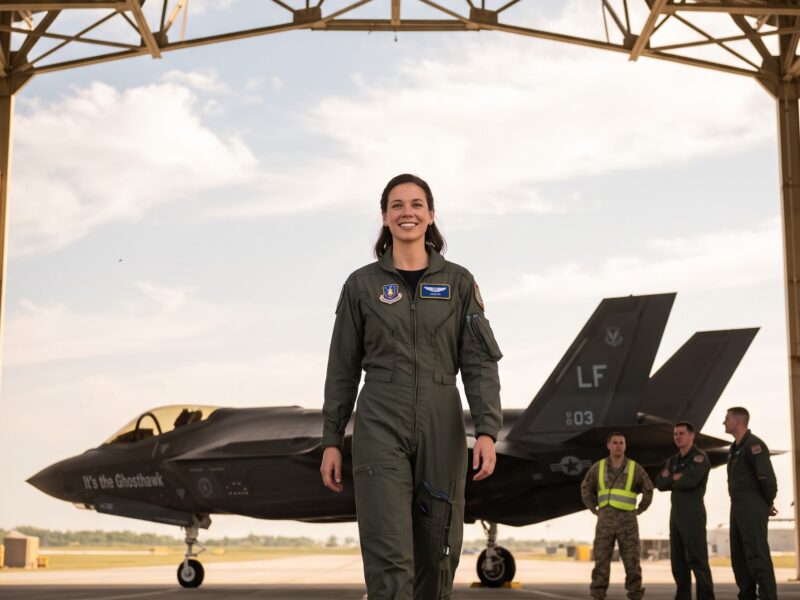
They laughed when I walked toward my battered jet at the Nevada airfield, calling it a useless relic
The concrete apron of the remote Nevada testing facility hummed with heat and hostility. The sun was beating down, turning the blacktop into a shimmering lake of false water, but the chill in my chest had nothing to do with the desert temperature.
“Look at that flying coffin,” a young strike pilot sneered, leaning against the fuel bowser with a helmet resting on his hip. “Hey, Miller! You taking that museum piece out, or are you just giving it a dust off?”
Laughter rippled down the flight line. I kept my head down, my flight suit damp with sweat, my heavy helmet bag swinging at my side.
My aircraft sat beneath the shadows of Hangar 4—a battered, scarred F-18 Hornet. Its radar nose cone was a mismatched shade of matte gray, its wings bore the visible welds of heavy structural patches, and its tail assembly carried no squadron insignia, no colored striping, and no proudly painted call signs. It was an orphan. To the rest of the 42nd Tactical Wing, it was the “Ghosthawk.”
They didn’t call it that because it was a stealth marvel. They called it that because, according to official Air Force logistics databases, the airframe didn’t exist. Seven years ago, during a heavily compartmentalized black-budget operation over the Hindu Kush, this exact airframe had gone off the scope. The official report said it suffered structural failure and disintegrated over deep hostile territory. Yet, three years ago, it had inexplicably turned up in a storage depot at Davis-Monthan, stripped of its original avionics, sealed in grease, and assigned to secondary reserve status.
And now, as the lowest-ranked test pilot on base—a woman with a black mark on her record for asking too many questions about old mission logs—it was mine.
“Keep walking, Miller,” Captain Mason Reed had told me during the morning brief, his eyes cold behind his golden aviators. “It’s a secondary backup asset. You’re flying weather reconnaissance and target tow duties. Don’t embarrass yourself, and don’t try to be a hero like your old man.”
My father, Major Richard Miller, had been the pilot who took a similar jet dark seven years ago. They gave my mother a folded flag, a sealed envelope, and a stern warning never to inquire about the geographic coordinates of his last ping.
I hauled myself up the steel boarding ladder, my gloved hands gripping the canopy sill. The cockpit smelled of old hydraulic fluid, ozone, and aged leather. It was a mechanical relic, stripped of modern digital glass displays and refitted with analog gauges and retrofitted green-monochrome cathode-ray screens.
“Ghosthawk, Ground Control,” the radio crackled through my custom helmet liner. “Check your ground power unit. You’ve got an avionics power draw warning on your secondary bus.”
“Copy, Control,” I replied, my voice steady as I flipped the battery switches. “Just phantom power in the old wiring. She’s fine.”
I strapped into the ejection seat, pulled the five-point harness tight across my chest, and started the right engine. The GE F404 turbofan whined, a high-pitched metallic scream that smoothed into a thunderous rumble as fuel ignited in the combustion chamber. The left engine followed. The entire airframe vibrated, a deep, living pulse that vibrated through my boots.
Suddenly, the red emergency warning stroboscopes on top of the air traffic control tower began to flash in a frantic, blinding rhythm. The air raid sirens tore through the desert air—a long, agonizing wail that drowned out the jet engines.
Over the base tactical network, the radio exploded into chaotic, overlapping shouts.
“All units, all units! Red Flash priority! Command post has taken a hard disconnect from Sector Seven!”
“We have a downed transport! Repeat, downed Osprey inside the valley corridor!”
“SEAL Team 3 is pinned down! Heavy ground fire, multiple casualties!”
I froze, my hand hovering over the throttle assembly. Through the tinted canopy glass, I saw pilots running across the tarmac toward the front-line F-35s and F-22s parked in the primary alert shelters. ground crews were scrambling, pulling off intake covers and wheel chocks.
Then, one by one, the multi-million-dollar stealth jets went dark.
The primary strike fighters, loaded with advanced digital flight-control software and networked tactical links, began flashing error codes across their glass screens. A massive, localized cyber-jamming wave—a high-altitude electromagnetic pulse or a sophisticated satellite signal kill-switch—had fried the flight computers of every modern aircraft on the line. Turbofans sputtered and died. Modern glass cockpits rebooted into endless blue error loops.
Captain Mason Reed slammed open the side door of the operations trailer, his face pale, frantically looking down the line of dead, high-tech aircraft.
“What happened?!” Reed screamed into his hand-held radio. “Get those engines back online! We have eight men dying in a canyon!”
“It’s a complete bus failure, Captain!” a crew chief yelled back, throwing his helmet to the ground in frustration. “The digital flight control computers are locked out! The network is compromised!”
Reed turned, his desperate eyes sweeping across the tarmac until they landed on Hangar 4.
The Ghosthawk was still running.
Its ancient, analog hydromechanical flight controls and shielded mechanical gyros didn’t rely on the base’s satellite network. The green CRT screens flickered, but the engines roared with furious, uninterrupted power.
For the first time that day, nobody laughed.
Reed sprinted across the concrete, his boots pounding against the blacktop until he was standing at the base of my boarding ladder. The commander who had spent six months mocking my assignment looked up at me, his eyes wide with a terrifying mixture of dread and desperation.
“Miller,” he panted, his hand gripping the aluminum rung so hard his knuckles turned white. “The main strike division is dead in the water. We have a dark extraction in the eastern mountains of Afghanistan. A SEAL element went down, and the whole valley is crawling with heavy armor and frequency-scramblers.”
“I heard,” I said, pulling my oxygen mask up and clicking it into place.
Reed leaned closer, his voice dropping into a harsh, trembling whisper that barely carried over the roar of my engines. “Listen to me… that’s not just a surplus F-18. That’s the Ghosthawk. It’s the only frame left with an un-networked analog tactical suite. It was built for this exact mission… because your father designed its loadout before he died.”
My breath hitched behind my mask. “What?”
“Get in the air!” Reed ordered, throwing himself backward off the ladder. “Authorize your own flight path! Get those men out!”
I didn’t wait for a formal tower clearance. I slammed the throttles forward into full afterburner. Twin tongues of orange flame blasted out of the exhaust nozzles, pinning me back into the ejection seat as the Ghosthawk shot down the taxiway, roaring past the dead, silent billion-dollar stealth fighters, and threw itself into the sky.
The climb out of the Nevada staging sector and the long, high-altitude transit through the refueled dark corridor were blur of adrenaline and freezing cockpit temperatures. The Ghosthawk flew heavy. Its mechanical controls required raw physical strength to turn, unlike the feather-light joystick of a modern fly-by-wire system. Every bump in the upper atmosphere vibrated directly into my hands and feet.
By the time I crossed the jagged, snow-capped ridges of eastern Afghanistan, the night had turned completely jet-black. A brutal mountain thunderstorm had swallowed the valley below. Jagged bolts of blue lightning sliced through the thick cloud layer, illuminating peaks that jutted up like broken teeth.
My CRT display flickered wildly. The terrain-following radar was dead, blinded by the dense electrical storm and heavy enemy jamming. I was flying blind inside a mountain gorge, relying purely on old-fashioned barometric altimeters and visual contact through the rain-streaked canopy.
Suddenly, my tactical headset crackled with a burst of heavy, shredded static.
“Unknown aircraft… unknown aircraft… turn back… this is restricted airspace…”
I pressed the radio transmit button on the throttle grip. “This is Ghosthawk, inbound for close air support. Identify yourself.”
A long, agonizing silence followed. The only sound was the heavy thump of rain against my acrylic canopy and the roar of my twin engines bouncing off the sheer rock faces on either side of the jet.
Then, a new voice broke through the static—strained, raspy, and choked with blood and smoke.
“Ghosthawk?… Did… did you say Ghosthawk?”
“That’s affirmative,” I replied, banking the jet hard to the left to avoid a dark rock wall that suddenly loomed out of the fog. “I am holding over the northern valley ridge. SEAL team, state your status.”
“This is Apex-6,” the voice gasped. “We’re pinned… lower canyon floor beneath the collapsed bridge. Primary transport down… five wounded, three mobile. Enemy forces have heavy machine guns and armored vehicles on the high ground. We’re running out of ammunition… please… we’re running out of time!”
I pushed the throttles forward, tipping the nose of the F-18 straight down into the pitch-black abyss of the canyon.
The aircraft shook violently as it broke through the lower cloud ceiling. The scene below was a nightmare painted in fire and tracer rounds. Red and green streams of heavy caliber machine-gun fire crisscrossed the valley floor. In the center of the kill box lay the burning, twisted wreckage of a heavy transport helicopter, its rotor blades snapped like matchsticks.
“Apex-6, I have visual on your tracers,” I called out, my hands moving with surgical precision across the weapon arming panels. “Mark your positions with infrared strobes. I’m coming in low.”
“Strobes active! Watch your six, pilot—they’ve got shoulder-fired AA!”
I didn’t have smart bombs or satellite-guided missiles. The digital links were dead. I had to do this old-school—eyeball, reticle, and manual trigger release.
I lined the Ghosthawk’s nose up with the flashing muzzle flares on the eastern ridge. The aircraft screamed over the valley floor at four hundred knots, mere fifty feet above the jagged rocks. I pulled the trigger.
The twenty-millimeter Vulcan cannon beneath my nose roared to life—a terrifying, earth-shattering sound that vibrated straight through the floorboards. A hail of armor-piercing high-explosive rounds tore into the enemy positions on the ridge, lighting up the dark rocks in a series of bright, violent detonations.
I pulled back hard on the stick, pulling six Gs as the jet climbed back into the clouds, escaping the wave of heavy machine-gun fire that erupted from the valley floor.
“Target destroyed on eastern ridge,” I panted, fighting the blackout creeping into the edges of my vision. “Apex-6, clear the LZ. I’m making a second pass on the armored vehicle.”
“Copy that, Ghosthawk! Good hit, brilliant hit! Secondary rescue chopper is five minutes out on our tail—clear us a hole!”
I banked the jet hard, rolling inverted before dropping back down through the clouds. On the canyon floor, parked near the burning transport, was an enemy armored personnel carrier, its heavy gun turret spinning to track the incoming noise of my engines.
I lined up the reticle, flicked the switch for my unguided rocket pods, and fired. Six rockets tore off the wing pylons, leaving thick white trails of smoke before slamming directly into the hull of the armored vehicle. A massive fireball erupted into the night air, blowing the heavy turret forty feet into the cliffside.
“Clear!” I shouted into the mic. “LZ is clear! Get that rescue chopper in now!”
Through my canopy glass, I watched the dark silhouette of a secondary rescue helicopter sweep over the valley ridge, dropping low to hover over the landing zone. The surviving SEALs broke from their cover beneath the bridge, carrying their wounded across the rocks toward the open cabin door.
One soldier—a tall man wearing commander’s insignia—didn’t immediately get into the helicopter. He ran over to the smoking wreckage of the crashed transport, tearing at a tangled piece of metal near the cockpit door. He pulled something free, held it up to his tactical light, and then sprinted into the rescue chopper.
A moment later, the rescue chopper lifted off, banking hard to escape the canyon.
My radio crackled. It was the SEAL commander from inside the rescue bird. His voice wasn’t filled with relief. It was filled with sheer, unadulterated shock.
“Ghosthawk pilot… do you read me?”
“I read you, Apex-1,” I replied, circling high above them to provide air cover. “Glad to see you walking.”
“Pilot…” the commander’s voice trembled. “Do you know who flew this crashed transport down here? The one that was shot down seven years ago?”
I paused, my hand tightening on the stick. “No. That crashed frame was listed as classified debris.”
“I just pulled the maintenance tail plate off the engine housing,” the commander choked out, the sound of the helicopter rotors pounding in his background. “This isn’t an Afghan transport. It’s a USAF modified frame… tail number 77-014. Emily… your father flew this aircraft.”
The world inside my cockpit stopped moving. The roar of the twin F404 engines, the rushing wind against the canopy, the steady flash of lightning outside—it all faded into a distant, muffled hum.
“What did you say?” my voice came out as a thin, brittle whisper.
“Tail number 77-014,” the SEAL commander repeated, his words cutting through my headset like a razor blade. “Major Richard Miller. This was his aircraft. It didn’t disintegrate over the mountains seven years ago, Emily. He landed it right here. He brought it down in this valley.”
I stared down through the cloud break at the burning remains of the old transport. Seven years of grief, seven years of official lies, seven years of being told my father was dust scatter across an unmapped mountain range—all of it collapsed in a single, terrifying second.
“That’s… that’s impossible,” I stammered, my heart hammering wildly against my ribs. “The Air Force… the Department of Defense… they gave us a official casualty report. They said his airframe broke apart at thirty thousand feet!”
“They lied to you,” the commander said firmly. “I’m looking at his flight log container right now. It was locked inside the armored avionics safe beneath his seat. It’s marked with top-tier security seals. He didn’t crash because of an accident, Emily. He was shot down… by an American missile.”
Before I could digest the horror of his words, the main green CRT screen on my console flickered violently.
The digital jamming that had paralyzed the rest of the base hadn’t died—it had morphed. The green monochrome monitor rebooted, clearing away the standard flight data and displaying a single, cascading line of text in bold, retro block letters:
ENCRYPTED DATA LINK ESTABLISHED: TAIL NO. 84-018 (GHOSTHAWK).
AUTHORIZATION CODE: MILLER-R-0941.
It was my father’s service number.
The Ghosthawk’s internal storage drive—a hidden, hardwired physical recorder that Reed had claimed was just old wiring—had unlocked itself. The system wasn’t responding to base command. It was responding to a pre-programmed biometric and tail-number trigger that had been waiting inside this jet’s computer for seven long years.
Suddenly, a voice cut through my helmet earpieces.
It wasn’t the SEAL commander. It wasn’t base control.
It was a recording. A cold, crisp, remarkably clear radio recording of Captain Mason Reed—speaking seven years ago.
“Asset 1, this is Reed,” the recorded voice of my commander echoed in my ears. “You are operating outside your approved flight corridor. Turn around immediately and surrender the hard drive.”
Then, a second voice answered the recording. A voice I would know anywhere in the universe. My father.
“Negative, Mason,” my father’s recorded voice replied, calm, resolute, and completely devoid of fear. “I’ve seen the manifest. I know what you’re shipping out of these black sites. I know about the weapon sales, and I know about the treason. I’m taking this drive directly to the Senate Intelligence Committee.”
“You won’t make it out of the canyon, Richard,” Reed’s recorded voice snapped back. “I’ve already scrubbed your flight plan from the central database. As far as the Pentagon is concerned, you don’t exist anymore. Your jet is a ghost. And ghosts don’t come home.”
The recording ended with the screech of missile lock alarms and the roaring blast of an explosion.
I sat frozen in my seat, my knuckles white on the flight stick, tears burning behind my eyes. The man who had spent six months smiling at me, calling my jet a relic, telling me not to embarrass myself—Mason Reed had personally ordered the execution of my father. He had erased his name, buried his aircraft, and then put me—Richard Miller’s daughter—into the very same cockpit to ensure the last remaining piece of evidence stayed firmly under his thumb.
Suddenly, the primary command channel blasted over my radio, shattering the silence.
“Ghosthawk, this is Captain Mason Reed at Operations Control! Do you copy?!”
I took a deep, shuddering breath, pulling my mask tight against my face, forcing the rage down into a cold, lethal focus.
“I read you, Captain Reed,” I said, my voice dead and smooth as ice.
“Miller, we’ve recovered satellite telemetry!” Reed lied, his voice laced with false urgency. “The SEAL rescue chopper is clear, but we’re picking up a secondary hostile threat moving toward your position. You are ordered to set your weapons to jettison, initiate your onboard flight computer wipe, and return to base immediately! Do not attempt to inspect the wreckage on the valley floor!”
I looked down at the green CRT display. The hard drive had finished decrypting. Scrolling across the screen were thousands of pages of financial logs, illegal weapons transfers, and the names of every officer involved in Project Black-Wing—with Mason Reed’s signature at the top of every document.
“I can’t do that, Captain,” I said softly.
Silence fell over the radio line. When Reed answered, his conversational tone was completely gone. The warm, authority-figure mask had slipped away, leaving only the cold, mechanical voice of a killer.
“You looked at the drive, didn’t you, Emily?” Reed whispered.
“My father didn’t crash,” I said, leaning the F-18 into a wide, sweeping turn above the valley. “You murdered him. And then you put me in his jet thinking I’d never figure it out.”
“Your father was a fool who thought he could stop a machine bigger than the military itself,” Reed said coldly. “And you’re just like him. You think that old relic can save you? Look at your radar, Captain.”
A piercing, high-pitched alarm screeched inside my helmet.
WARNING: HARD RADAR LOCK. TWO CONTACTS. BEARING 180. HIGH SPEED.
Out of the high storm clouds above, two dark, needle-nosed stealth fighters—modern, unmanned combat drones operating on a private, unlisted tactical network—dropped into the canyon. They weren’t Air Force assets. They were Reed’s personal clean-up crew.
“You’re flying a thirty-year-old museum piece with unguided weapons and a patched wing, Emily,” Reed’s voice chuckled darkly over the encrypted channel. “You can’t outrun them, you can’t out-turn them, and nobody can hear you die down there. Ghosthawk is finally going down for good.”
The screen flickered black. And then, from deep within the hard drive’s secondary emergency partition, an automated message popped up on my screen—a final, personal note left by my father seven years ago:
Emily… if you’re reading this, they think this jet is obsolete. They don’t know about the analog override I installed in the manual flight control bay. Flip the emergency Red Switch on your left panel. Show them what the Ghosthawk can really do.
My hand flew to the lower left instrument console. Hidden beneath a flipped-up guard plate was an unpainted, heavy-duty industrial toggle switch—the Red Switch. It wasn’t standard military issue. It was a custom, hand-wired mechanical bypass my father had built into the flight control hydraulic manifolds.
I flipped it.
The Ghosthawk didn’t just respond; it transformed.
A loud, mechanical clunk echoed through the airframe as the digital limiters—the automated safety software that restricted standard F-18s from pulling dangerous maneuvers—were completely physically bypassed. The twin engines changed pitch, their fuel control valves opening up to raw, unregulated flow. The analog flight control surfaces unlocked their full hydraulic throw.
The jet was no longer being flown by a cautious computer. It was bound directly to my physical strength, my reflexes, and my willingness to push my body to the absolute brink of human endurance.
“Let’s finish this, Dad,” I growled into my mask.
The two stealth drones swooped down through the rain, their automated cannons firing streams of synthetic tracer rounds that chewed through the cloud layer around me. One drone banked hard to my right, setting up a crossfire, while the other locked its missile guidance laser directly onto my tail exhaust.
WARNING: MISSILE LAUNCH.
A infrared missile detached from the lead drone, its bright rocket motor ignition lighting up the dark clouds as it streaked straight for my tail.
In a standard F-18, pulling a hard break at four hundred knots would trigger the flight computer to damp the control inputs to prevent structural damage. But the Ghosthawk had no computer to hold it back.
I hauled the stick violently back and to the left, stomping the left rudder pedal down with all my weight.
The jet did something mathematically insane. It pitched up nearly ninety degrees in a fraction of a second, the nose slamming skyward while the tail slid sideways through the air—a violent, flat cobra maneuver that defied standard aerodynamics. The missile shot harmlessly beneath my belly, exploding against the cliff wall behind me.
The sudden, brutal deceleration forced my blood straight into my feet. My vision narrowed into a tiny, black tunnel as nine Gs crushed my lungs, pressing my chest into my spine. I gritted my teeth, performing the anti-G straining maneuver, forcing air into my lungs to keep from passing out.
The lead stealth drone overshot me, sailing straight beneath my nose, its automated flight computer unable to process an aircraft stopping dead in mid-air.
I aligned the mechanical gun reticle on the drone’s sleek, black wing root and slammed the cannon trigger.
The Vulcan cannon screamed. A continuous stream of twenty-millimeter depleted-uranium rounds slammed into the drone’s composite wing, ripping it completely off the fuselage. The unmanned fighter spun wildly out of control, slamming into the mountain wall in a massive ball of orange flame.
“One down!” I yelled through the agony of the G-forces, snapping the stick back to level the jet.
“What?! What happened to Drone One?!” Reed’s voice panicked over the tactical channel, monitoring the telemetry from his base terminal. “Drone Two, execute engagement protocol Alpha! Shoot her down!”
The second drone didn’t try to dogfight. It climbed high into the cloud layer, using its superior speed and stealth geometry to position itself directly above me for a dive-attack.
My CRT radar was completely blinded by the drone’s radar-absorbent skin. I couldn’t see it on my screen. I couldn’t lock onto it with conventional sensors.
I closed my eyes for a fraction of a second, listening to the roar of the wind against my canopy, remembering my father’s voice from my early training days: When the glass screens fail you, Emily, stop looking at the instruments and start feeling the sky.
I felt the sudden change in ambient air pressure against my control stick—a micro-turbulence wave caused by a heavy object descending rapidly from the clouds directly behind me.
I didn’t break away. I didn’t deploy flares.
I cut the throttles to idle, extended the dorsal airbrakes, and pulled the nose straight up into a vertical climb, flying directly into the path of the diving drone.
The drone rushed out of the clouds, its nose cannon firing blind. We were converging on a head-on collision path at over eight hundred miles per hour. A game of mid-air chicken in pitch darkness.
Five hundred yards. Four hundred yards. Three hundred yards.
At the absolute last split second, when I could visually see the dark composite intake of the drone through my windscreen, I slammed the throttles back into full afterburner, kicked the right rudder, and executed a sharp, barrel-roll around the drone’s wingtips.
As the Ghosthawk rolled past the unmanned fighter, the jet’s massive afterburner heat plume passed inches from the drone’s forward optical sensors. The extreme thermal shock blinded its guidance system, while the violent wake turbulence tossed the light stealth frame upside down.
Before the drone’s computer could recover its balance, I pulled the stick hard, looping back around, and fired three unguided rockets point-blank into its belly.
The second drone exploded into a shower of burning carbon-fiber fragments that rained down into the dark valley below.
The sky above the canyon went completely quiet.
I pulled the Ghosthawk out of its turn, leveling the wings at eight thousand feet, my breath coming in ragged, heavy gasps inside my mask. Sweat poured down my forehead, stinging my eyes, but my hands on the flight controls were completely steady.
I tapped my tactical comms panel, switching back to the base wide-band emergency channel.
“Captain Reed,” I said, my voice echoing clearly across every monitor and speaker in the Nevada operations room. “Your clean-up crew is scattered across the canyon floor. And the Ghosthawk is coming home.”
The sky over the Nevada desert was just beginning to break into thin, pale purple lines of dawn when I brought the Ghosthawk back over the base flight corridor.
The base was lit up like a Christmas tree. Federal security vehicles, Military Police sedans with flashing red-and-blue emergency lights, and armored transport trucks lined the primary runway.
Word of the transmission had spread. The encrypted file uploaded from my father’s drive hadn’t just reached Reed’s terminal—when I unlocked the drive using the Red Switch, the aircraft’s high-power emergency relay had automatically broadcasted the entire Black-Wing master manifest directly to the Department of Defense Inspector General and the Federal Bureau of Investigation.
As I lowered my landing gear, the green three-in-the-green lights illuminated on my panel. The hydraulic pumps whined, the patched wings catching the cool morning desert air.
“Ghosthawk, Base Control,” a new voice came through my headset—not Reed, but a senior military police commander. “You are clear to land on Runway 21-Right. Emergency teams are standing by. Captain Reed has been taken into custody.”
“Copy, Control,” I replied calmly. “Ghosthawk on final approach.”
I lined the old F-18 up with the centerline of the runway. The jet flew smooth, steady, and proud, as if the spirit of the man who had modified it seven years ago was resting his hands right alongside mine on the stick.
The tires touched the concrete with a soft chirp-chirp, smoke puffing from the rubber as the main gear absorbed the impact. I deployed the speedbrakes, brought the throttles back to idle, and let the aircraft roll to a gentle stop right in front of Hangar 4.
As I shut down the twin engines, the high-pitched whine slowly faded away, leaving the cockpit in a peaceful, profound silence.
I unclipped my oxygen mask, pulled off my helmet, and cracked open the canopy. The cool, crisp morning air rushed into the cockpit, carrying the clean scent of the desert floor.
A dozen federal agents and military police officers were surrounding Hangar 4. In the center of the tarmac, handcuffed and flanked by two heavily armed guards, was Captain Mason Reed. He was being led toward a black SUV. As he passed my ladder, he stopped, turning his head to glare up at me. His face was twisted in bitter defeat, his career, his freedom, and his shadow empire completely destroyed.
I didn’t say a word to him. I didn’t need to. I just sat in the cockpit, looking down at him with quiet, unyielding triumph.
The SEAL team’s rescue helicopter landed twenty yards away. Captain Mason—the SEAL commander—stepped off the transport ramp, holding the metal flight log container he had pulled from my father’s crashed transport. He walked up to my ladder, climbing up the rungs until his head was level with my canopy sill.
He didn’t offer a formal salute. Instead, he reached out his hand, placing the heavy, scarred metal flight log directly into my lap.
“He saved eight lives seven years ago, Emily,” the SEAL commander said softly, his eyes filled with immense, genuine respect. “And today, his daughter saved eight more. Your father’s name was cleared the second that file hit the Pentagon servers.”
I reached down, my trembling gloved fingers touching the worn steel plate of the flight log. Carved into the corner of the metal box were my father’s initials: R.M.
“Thank you, Captain,” I whispered, holding the box against my chest.
“What happens to the jet?” the commander asked, looking at the scarred, oil-stained nose of the F-18.
I looked down the length of the aircraft—at its patched wings, its mismatched nose cone, and its unpainted fuselage. The other pilots had called it a relic, a useless piece of scrap, a ghost destined for the boneyard. But it had flown through the storm, broken through the jamming, fought off modern stealth drones, and brought the truth back into the light.
“She’s not going to the boneyard,” I said, a soft, genuine smile finally touching my lips as the sun broke over the mountain horizon, bathing the aircraft in golden light. “She’s going back on the flight line. And whenever they need a real pilot… we’ll be ready.”
I stepped out of the cockpit, descending the ladder to stand on the sunlit tarmac. The Ghosthawk sat silent behind me, its wings gleaming in the morning sun—no longer a secret, no longer a ghost, but a legend that would never be forgotten.
The end.









