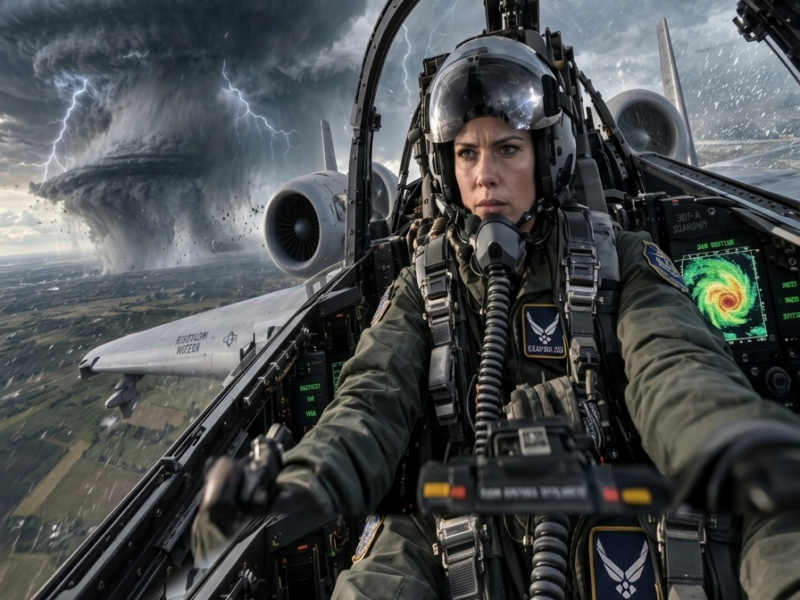
They laughed when I walked into the Oklahoma storm command center wearing a faded flight jacket, calling me a “weather pilot” in front of forty airmen
The command center at Vance Air Force Base smelled of ozone, burnt coffee, and the distinct, metallic tang of fear. Outside, the sky above Oklahoma had turned a bruised, unnatural shade of violet-black, heavy with the promise of tornadic violence. Inside, forty airmen and officers crowded around the main radar array, their voices a rising crescendo of panic as red and purple velocity couplets bloomed across the screens.
I walked through the double doors wearing my faded, salt-stained flight jacket. The leather was scuffed at the elbows, the patches faded from years of penetrating high-altitude squall lines and hurricane eyewalls.
“Look who decided to show up,” Captain Vance sneered, turning from the tactical display. He didn’t bother lowering his voice. “It’s the cloud chaser. What’s the matter, Major? Is the weather getting a little too real for your rain gauge?”
A quiet, nervous ripple of laughter passed through the younger airmen. To them, my years in weather reconnaissance—flying stripped-down C-130s and experimental prop planes directly into the teeth of Category 5 typhoons—were a curiosity. To the tactical guys, I was an outsider, a glorified weather girl given a cockpit.
I ignored him, stepping past his shoulder to look at the primary Doppler feed. “Where’s the raw radar sweep?” I asked, my voice flat.
“This is the Doppler feed, Major,” Vance said, crossing his arms. “It shows a standard hook echo moving northeast at thirty knots. We’ve got time.”
“Look at the reflectivity index at ten thousand feet,” I said, pointing a finger at a subtle, dark notch tucked behind the main precipitation core. “That isn’t rain shadow. That’s signal attenuation. The storm is so dense, it’s devouring the radar beam before it can bounce back. The rotation isn’t five miles out—it’s tightening right over our heads.”
At precisely 6:42 p.m., the base sirens began their high-pitched, warbling scream.
Outside, forty airmen were still on the tarmac, securing light transport aircraft and setting up temporary field shelters for the week’s training exercise.
“Get them into the shelters now!” I shouted over the noise of the siren.
Captain Vance laughed nervously, though his eyes darted toward the window. “We’ve got at least fifteen minutes according to the weather wing’s timeline, Major. We have time to clear the equipment.”
I didn’t take my eyes off the display. “No, we don’t.”
The room went dead silent.
The storm wasn’t tracking like a normal atmospheric anomaly. On the monitor, the supercell’s outer bands seemed to buckle inward, contracting with horrifying speed. Then, without warning, every glass panel in the command center flickered wildly. The main radar array let out a loud, electrical whine, and the primary feed died, replaced by a wall of static.
Someone cursed loudly in the back. “We lost the radar feed! Main tower generator just tripped!”
“Auxiliary power!” Colonel Miller, the commanding officer, barked, stepping into the center of the room. “Get those screens back up!”
“Auxiliary will take three minutes!” the technician yelled back. “The storm knocked out the local relay!”
Three minutes was an eternity. In three minutes, a wedge tornado could chew a military runway into confetti.
I grabbed my flight helmet from the rack near the door.
Colonel Miller saw the movement and stepped directly into my path, his towering frame blocking the exit. “Where do you think you’re going, Major?”
“Up,” I said, buckling the chin strap.
His face hardened into stone. “Absolutely not. The field is under yellow alert. All aircraft are grounded.”
“Your ground radar is blind, Colonel,” I said, stepping closer until I was looking him dead in the eye. “If I don’t get eyes inside that storm, those forty men on the northern tarmac won’t know what’s coming. The shelters they’re running toward are right in the path of the secondary inflow.”
“You’ll die,” Miller said flatly. “No aircraft can sustain the vertical shear inside a supercell of this magnitude.”
I looked past him, through the reinforced glass doors toward the dark silhouette of my modified WC-130J sitting on the taxiway, its turboprops already idle-spinning in the rising gale.
“Maybe,” I said.
Before he could order the guards to seize me, I ducked around his left side, hit the crash bar on the exit door, and burst into the howling wind outside.
The air smelled like crushed leaves and raw electricity. Rain hit my face like gravel thrown from a speeding truck. I sprinted across the tarmac, my flight boots sloshing through rising water, and hauled myself up the crew ladder of my aircraft.
“You’re late, Boss!” my co-pilot, Lieutenant Knox, yelled from the right seat. He was already working through the emergency engine-start checklist, his fingers moving across the overhead switches with practiced, twitchy speed.
“Radar is dead on the ground!” I shouted back, sliding into the left seat and strapping my harness tight until the belts bit into my shoulders. “We’re flying visual and raw onboard thermal!”
“In this black hole?” Knox yelled as the twin Allison engines roared to life, their props cutting into the dark storm air. “We won’t see a damn thing until we hit it!”
“Then we hit it!” I shoved the throttles forward.
The aircraft surged down the rain-slicked runway, lifting off just as a massive bolt of cloud-to-ground lightning struck the control tower behind us. The world outside the windshield turned completely pitch black, save for the violent flashes of blue lightning illuminating a wall of cloud that stretched from the dirt all the way into the stratosphere.
We climbed hard, the engines screaming under maximum continuous power. Rain hammered the reinforced windshield so hard the thick glass vibrated against its seals.
“Passing six thousand feet!” Knox called out, his voice straining against the violently shaking cockpit. “Turbulence is hitting Severe! Vertical draft is twenty feet per second and rising!”
“Hold her steady!” I gritted my teeth, both hands locked onto the yoke as the storm seized the fifty-ton plane and slammed it sideways. My restraints bit into my chest, leaving immediate bruises.
At 14,000 feet, we punched through the lower cloud deck into the interior vault of the supercell. What I saw through the rain-streaked canopy made my stomach drop into my boots.
The ground radar hadn’t just been attenuated—it had been completely deceived. The main supercell had split into two distinct, counter-rotating vortices. Between them lay a narrow, vacuum-like corridor of clear air. And tucked inside that corridor, completely invisible to standard meteorological sweeps, was a massive, pitch-black multi-vortex tornado already grinding its way across the ground.
It was heading straight for the base’s northern shelters.
I grabbed the emergency radio handset. “Base Command, this is Recon One! Evacuate the north shelters immediately! I repeat, evacuate the north shelters!”
Static screamed back through my headset.
“Base, do you copy?!” I yelled, flipping the frequency switches. “The rotation is in the north quadrant! Get those men south!”
Nothing but white noise. The storm’s electromagnetic pulse had fried the long-range VHF relays.
I looked down through the clear-air corridor. Below us, forty tiny, yellow-jacketed figures were running directly toward the corrugated steel shelters on the north side of the airfield—stepping straight into the mouth of the beast.
“We have seconds!” I shouted to Knox. “I’m taking us down!”
“Are you insane?!” Knox screamed back, grabbing his side of the yoke. “If we drop into the downdraft corridor at this altitude, the shear will rip our wings off!”
“We go low enough to hit them with the short-range directional beacon, or forty airmen die in thirty seconds!” I didn’t wait for his answer. I pulled the throttles back and shoved the nose straight down into the vortex.
The descent was pure chaos. The heavy aircraft dropped like an anvil through a washing machine full of ice and metal. Alarm horns screamed through the cockpit—terrain avoidance warnings, bank-angle alerts, stall indicators—all blending into a horrifying chorus of impending destruction.
“Ten thousand feet!” Knox yelled, his face pale in the dim green light of the instrument panel. “Eight thousand! Boss, pull up!”
“Not yet!” I gritted my teeth, fighting the control wheel with every ounce of physical strength I possessed. The yoke whipped back and forth, brutalizing my wrists as vertical wind shear tried to flip the aircraft inverted.
At three thousand feet, we broke through the lowest condensation ceiling. The airfield was right beneath us, engulfed in rain and flying debris. I slammed the short-range tactical radio button, overriding every emergency frequency on the base.
“All ground personnel! This is Recon One!” my voice boomed through the local tower relay, echoing off the base loudspeakers below. “The north shelters are compromised! Move SOUTH! Run for the concrete hangers NOW! MOVE!”
On the tarmac below, I saw the tiny yellow shapes stop. For two terrifying seconds, they hesitated. Then, as one, the group turned and sprinted toward the massive, blast-reinforced concrete maintenance hangars half a mile to the south.
Three seconds later, the wedge tornado struck the northern shelters.
From fourteen hundred feet, I watched in horrifying silence as the heavy corrugated steel structures were ripped from their concrete footings as if they were made of damp tissue paper. They exploded into millions of jagged metal splinters, swallowed instantly into the churning black wall of dust and debris that tore across the field.
If those men had been inside, none of them would have survived.
“We did it,” Knox gasped, leaning back in his harness, sweat dripping off his nose. “They made it. Look, they’re inside the hanger.”
I pulled the yoke back, leveling the aircraft off at two thousand feet and climbing back into the safety of the upper cloud deck. The engines groaned as we fought our way out of the storm’s downdraft, slowly ascending back toward the relative stability of fourteen thousand feet.
My radio crackled to life. Ground communications were restored.
“Recon One, this is Base Command,” Colonel Miller’s voice came through, thick with static and heavy emotion. He paused, the background noise of the command center filled with stunned silence. “Recon One… the northern shelters are gone. Forty personnel accounted for inside Hangar Three. How… how did you know?”
I looked down at the spinning, black monster churning up the earth below us.
“Because storms don’t lie, Colonel,” I said softly into the microphone. “They have rules. People just forget to read them.”
“Return to base immediately, Major. We’ll find a way to clear a runway for you.”
“Negative, Base,” I replied, watching our onboard fuel gauges. “We still have half a tank. I’m going to track this cell until it clears the residential limits.”
I thought the nightmare was over. I thought my only fight that night was against the fury of nature.
Then, the tactical radar screen in the center of my instrument panel let out a sharp, metallic ping.
A single, solid radar signature appeared on the edge of the screen, approaching the supercell from the east at eight hundred knots.
I frowned, tapping the screen. “Knox, check the transponder receiver. Do we have a military flight plan active in this sector?”
Knox flipped through his digital clipboard. “Negative, Boss. Air Traffic Control cleared the airspace within fifty miles three hours ago. Nothing is supposed to be in the air except us.”
“It’s moving fast,” I murmured, watching the blip. “No transponder signal. No IFF tag.”
“Could it be a stray drone?” Knox asked.
“Drones don’t fly straight into a Category 5 supercell at low altitude,” I said, my chest tightening. I reached for the radio handset. “Base Command, Recon One. We have an unidentified radar contact entering the cell from Sector Four. No transponder. Please confirm.”
A long silence followed. When Colonel Miller’s voice returned, it sounded strangely hollow. “Recon One, radar displays at Base Command show clear airspace. You are the only track in the quadrant.”
“I’m looking at him on raw microwave sweep, Colonel,” I insisted, my eyes locked on the screen. “He’s five miles out, closing fast on my six o’clock.”
“That’s impossible, Major,” Miller said quietly. “Nothing is flying out there.”
Suddenly, a bright flash of lightning illuminated the sky directly outside my left cockpit window.
Out of the wall of black rain, a sleek, matte-black jet emerged. It had no military markings, no unit insignia, and no running lights. Its airframe was angular and strange—a stealth craft that wasn’t supposed to exist on any official inventory. It banked sharply, flying parallel to my lumbering C-130, less than fifty feet from my wingtip.
Through the rain-streaked canopy of the unknown aircraft, I could see the silhouette of a single pilot, their helmet completely blacked out by a dark visor.
Static popped inside my helmet. A voice cut through my private headset frequency—a frequency reserved exclusively for classified military test flights.
The voice was cold, slow, and completely devoid of emotion.
“Tell the weather pilot she wasn’t supposed to survive tonight.”
My hands froze on the controls. The air inside the cockpit suddenly felt ice-cold.
“Who is this?” I demanded, my thumb hammering the transmit button. “Identify yourself!”
Before I could complete the sentence, the black jet pulled its nose up, slammed its afterburners, and vanished straight into the roaring heart of the supercell above us.
“Boss… what was that?” Knox’s voice was barely a whisper. His hands were shaking so badly he could barely keep them on his flight logs. “Did you hear what he said?”
“I heard it,” I said, my heart hammering against my ribs like a trapped bird.
“Recon One, state your status,” Colonel Miller’s voice crackled through the comms again, entirely oblivious to what had just occurred. “We are clearing Runway Two-Left for your emergency landing.”
I looked at the radar display. The phantom jet hadn’t left the area. It was circling above us inside the main wall cloud, using the massive radar noise of the storm to hide its position from ground tracking stations.
This wasn’t a rescue mission anymore. It was an ambush hidden inside a natural disaster.
“Base Command,” I said, keeping my voice as steady as I could. “Who authorized the field exercise for tonight?”
“It was a standard readiness drill, Major,” Miller replied, sounding confused by the question. “Orders came down from Sector Headquarters yesterday morning.”
“Who signed the directive?”
A pause on the line. “Major General Vance’s office. Why are you asking this now?”
Major General Vance. Captain Vance’s father. The head of the Air Force Atmospheric Defense Directorate—the very department that had spent the last three years trying to shut down my weather reconnaissance wing and seize our long-range atmospheric research data.
“No reason, Base,” I lied, looking back at Knox. “We are turning inbound for Runway Two-Left.”
As I banked the heavy C-130 toward the airfield, the radar pinged again.
The black jet was diving out of the storm cloud directly above us. It wasn’t firing missiles—that would leave a thermal footprint that even ground radar couldn’t miss. Instead, it was positioning itself directly in our wake turbulence, using the extreme atmospheric pressure of the supercell to push us down into a stall.
“He’s riding our upper air stream!” Knox yelled as the plane violently pitched forward. “We’re losing lift on the left wing!”
“Dump the fuel from the port tanks!” I barked. “Lighten the load!”
“If I dump fuel with lightning strikes this close, we could ignite!”
“Do it, Knox! Or we crash into the tree line right now!”
Knox slammed his hand onto the emergency fuel dump valve. Thousands of gallons of aviation fuel spewed out of the left wing nozzles, vaporizing instantly into the violent wind.
The loss of weight allowed me to yank the nose back up just as the dark shadow of the phantom jet swept over our cockpit roof, missing our tail fin by less than ten feet. The force of its pass threw our aircraft into a violent spiral.
I fought the controls, screaming through gritted teeth as I forced the heavy turboprop back into horizontal flight. We cleared the tree line at the edge of the airfield by no more than thirty feet, our landing gear clipping the upper branches before slamming hard onto the flooded asphalt of Runway Two-Left.
The tires screeched, sending massive plumes of water into the air as I slammed the prop pitch into reverse and hit the brakes. The C-130 skidded wildly down the wet runway before finally coming to a halt near the edge of the primary tarmac.
Outside, the storm was still howling, but the eye of the supercell was moving past the base, leaving behind a cold, torrential rain.
Emergency vehicles sped toward us, their red and blue lights flashing against the wet pavement.
Knox slumped in his seat, chest heaving. “We’re alive… sweet lord, we’re alive.”
I didn’t answer. I unbuckled my harness, reached into my flight bag, and pulled out a small, encrypted hard drive—the raw data recorder that had captured everything during the flight: the storm’s artificial rotation metrics, the radar frequency interference, and the audio recording of the phantom pilot’s message.
When the side crew door opened, Colonel Miller and Captain Vance were standing at the bottom of the air-stairs, surrounded by armed Air Police officers.
“Major,” Miller said, stepping up to the ladder, his face pale but stern. “You defied a direct order to stay grounded. You put a multi-million-dollar military asset at risk.”
“I saved forty airmen, Colonel,” I said, stepping down the ladder and locking eyes with him.
“That doesn’t excuse insubordination,” Captain Vance interjected, stepping forward with a pair of handcuffs hanging from his belt. “Under base protocol, you are to be relieved of command immediately pending a military tribunal.”
I stopped on the bottom step and looked directly at Captain Vance. “Your father sent that plane, didn’t he?”
Vance’s face flinched—just a tiny, fraction-of-a-second twitch of his left eye, but it was all the confirmation I needed.
“I don’t know what you’re talking about, Major,” Vance said smoothly, though his voice sounded strained. “You’re suffering from hypoxia. Hand over your flight logs and step into the vehicle.”
“No,” I said, reaching into my jacket pocket.
The Air Police officers instantly moved their hands toward their holstered sidearms.
“Hold your positions!” Colonel Miller barked at the guards, stepping between them and me. He turned to me, his brow furrowed with deep suspicion. “Major… what are you talking about? What plane?”
Instead of pulling a weapon, I pulled out the small, sealed hard drive and held it out toward Miller.
“This is the raw telemetry from my cockpit,” I said, my voice cutting through the sound of the falling rain. “The supercell that hit this base tonight wasn’t a natural formation, Colonel. It was seeded. Advanced silver iodide micro-dispersion mixed with localized high-frequency electromagnetic pulses.”
Captain Vance’s face turned bright red. “She’s insane! Colonel, order the guards to arrest her! She’s making wild accusations to cover up her court-martial!”
“Shut up, Captain!” Miller snapped, not taking his eyes off me. “Go on, Major.”
“Three years ago, the Atmospheric Defense Directorate started Project Aeolus,” I continued, holding Miller’s gaze. “They claimed it was a defensive system designed to dissipate severe weather over military bases. But it wasn’t designed to dissipate storms, Colonel. It was designed to steer them. To turn atmospheric supercells into untraceable weapons.”
The air around us seemed to freeze. The guards looked at each other nervously, their hands drifting away from their weapons.
“Tonight was the final field test,” I said. “They aimed this cell directly at Vance Air Force Base to test its destructive potential against hardened military targets. But they made a mistake. They didn’t count on me taking an aircraft up to measure the interior rotation.”
“And the aircraft you mentioned?” Miller asked, his voice dropping to a low rumble.
“A stealth drone prototype,” I answered. “Sent to make sure my plane crashed inside the vortex so the raw atmospheric data on this drive would be destroyed along with me. The pilot’s voice is recorded right here on this drive.”
Captain Vance suddenly reached into his coat pocket, pulling out a small, black radio transmitter. “Guard team, secure the drive!” he yelled into the mic.
Four guards from the secondary security detail—men wearing non-standard tactical gear without base unit patches—stepped forward, raising their carbines directly at Colonel Miller and me.
“Captain Vance, what is the meaning of this?!” Colonel Miller demanded, his hand dropping toward his service pistol.
“Stand down, Colonel!” Vance shouted, his usual nervous demeanor vanishing, replaced by a desperate, violent madness. “This entire base is under the direct jurisdiction of the Atmospheric Defense Directorate under Executive Protocol 9! That drive contains top-secret military research. Hand it over, Major, or every person on this tarmac will be charged with high treason!”
“Executive Protocol 9 was suspended six months ago, Vance,” I said calmly, stepping forward. “Your father lost his funding when the Senate Armed Services Committee found out he was selling the technology to private defense contractors.”
Vance’s eyes widened in sheer panic. “You… you don’t know anything!”
“I know enough,” I said. “I know that the plane circling above us wasn’t just a drone. It was a manned prototype flying out of a private contractor airbase in Texas. And I know that in about forty seconds, the ground team from the Inspector General’s office is going to land right behind us.”
As if on cue, the sound of heavy twin rotors echoed through the rain-soaked sky.
Two massive, dark green VH-60 Blackhawk helicopters broke through the low cloud layer, their powerful searchlights sweeping across the tarmac and pinning Captain Vance and his rogue guards in bright, blinding white light.
The searchlights illuminated every corner of the tarmac. Over the loudspeakers of the lead helicopter, a voice boomed: “All personnel on the ground, drop your weapons immediately! This is the United States Department of Defense Inspector General’s office! Stand down!”
The four rogue security guards lowered their carbines instantly, throwing their hands into the air. Captain Vance looked wildly around him, his face pale and dripping with sweat, before dropping his radio onto the wet asphalt.
Colonel Miller stepped forward, picking up the radio and tossing it to one of his trusted base guards. He turned to me, his eyes filled with a mixture of shock and profound respect.
“How long have you known about this, Major?” Miller asked as the Blackhawks landed, their rotors creating a massive spray of mist across the runway.
“I’ve been tracking the illegal weather modification signatures for six months, Colonel,” I said, handing him the hard drive. “Every time a supercell did something physically impossible over an Air Force installation, Aeolus left a specific thermal signature behind. Tonight, I finally got the raw, mid-vortex data to prove it.”
A team of federal agents in dark suits poured out of the helicopters, quickly securing Captain Vance and his men in heavy restraints. A senior official walked up to us, extending his hand.
“Major,” the official said. “We got your encrypted signal from 14,000 feet. Good work holding the line.”
“What about the black jet?” Knox asked, stepping out of the C-130’s side door, still looking shaken. “It vanished into the storm.”
The official looked up at the clearing night sky. “Radar units from NORAD picked him up as soon as he broke out of the supercell’s cloud deck. Two F-22 interceptors forced him down at an airstrip fifty miles south. The pilot is in custody, and Major General Vance has just been arrested at his home in Virginia.”
The tarmac fell quiet, save for the rhythmic patter of the dying rain.
Colonel Miller walked over to where I stood next to my battered, fuel-stained aircraft. He looked at the scorched fuselage, then at the damaged left wing, and finally at me.
He slowly raised his hand to his brow, delivering a crisp, formal salute.
“I owe you an apology, Major,” Miller said, his voice deep and sincere. “I called you a cloud chaser. But tonight, you saved forty of my men, uncovered a treasonous plot, and flew through hell to bring back the truth.”
I returned the salute, feeling the heavy exhaustion of the night finally creeping into my muscles. “Just doing my job, Colonel. Weather pilots don’t just chase clouds. We read them.”
He smiled faintly. “I don’t think anyone on this base will ever make the mistake of laughing at your jacket again.”
The sun began to peek over the eastern horizon, casting a warm, golden light across the torn-up airfield. The dark, terrifying supercell that had threatened to destroy us was now nothing more than a distant, crumbling anvil on the far edge of the sky, harmlessly dissipating into the morning air.
I looked down at my faded flight jacket, brushing a few drops of rainwater off the leather.
Storms are chaotic, dangerous, and unpredictable. But if you know how to look at them, if you respect their power and learn their language, they will always tell you the truth.
And as long as there are people trying to hide their darkest secrets behind the clouds, someone has to be crazy enough to fly directly into the storm.
The end









