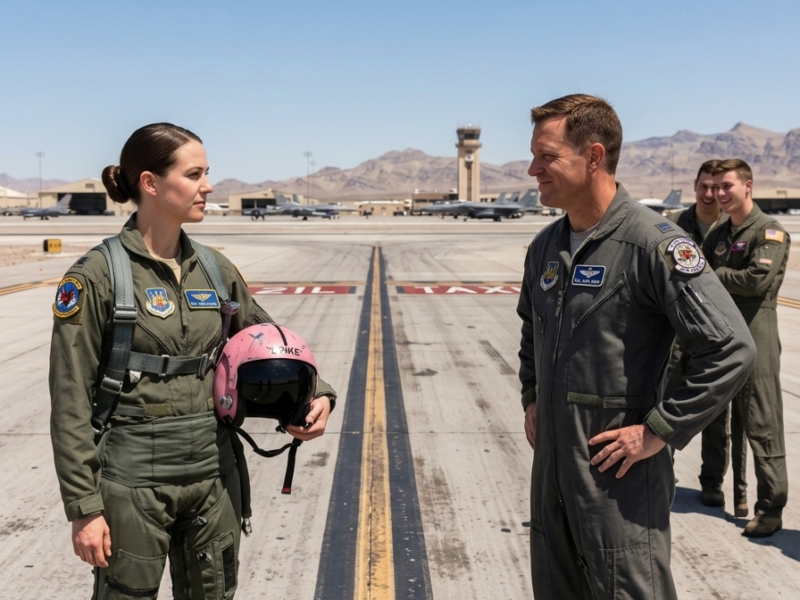
They laughed when I walked across the flight line at Nellis Air Force Base wearing a bright pink helmet, and one mechanic actually called me a joke, but when the commander whispered, “That’s Valkyrie,”
The dry Nevada heat radiated off the tarmac in shimmering waves, baking the desert air until every breath tasted faintly of JP-8 jet fuel and scorched asphalt. I walked across the flight line at Nellis Air Force Base with my flight bag slung over my left shoulder, keeping my eyes fixed straight ahead. Beneath my right arm, tucked against my ribs, was my helmet.
It was neon pink.
Not military subdued, not desert tan, not matte tactical gray. It was an unapologetic, vivid streak of bubblegum magenta, covered in rough, amateur brushstrokes, clear-coated over hand-painted white stars along the visor rim. Two crew chiefs leaning against an auxiliary power unit broke into quiet snickers as I passed. Near an open maintenance bay, a young mechanic wiping hydraulic fluid from his wrenches stopped, nudged his partner with a greasy elbow, and let out a full, barking laugh.
“Check out Barbie,” the mechanic sneered, making zero effort to lower his voice. “What is this, flight school dress-up day? What kind of joke walks onto a Nellis line looking like a neon target?”
I didn’t break stride. My combat boots hit the concrete with a steady, rhythmic cadence.
I never answered them. I never corrected the assumptions. Let them think it was vanity. Let them think it was some rebellious stunt pulled by an entitled transfer from the coast. None of them knew that six years ago, my eight-year-old sister, Lily, had sat on the floor of our kitchen with two cans of acrylic model paint, diligently transforming my standard issue HGU-55/P helmet into what she proudly declared “an armor piece for the sky.” She made me promise to wear it so she could spot me from the ground. Three months later, a sudden pediatric leukemia diagnosis took her before I even returned from my first operational deployment.
After Lily died, the helmet stopped being an object. It became an anchor. Every crack in the paint, every chip where the gray Kevlar showed through beneath the pink, was sacred ground.
During my first week at Nellis, the whispers had been constant. The pilots of the Red Flag adversary squadrons were elite, ruthless, and guarded about their fraternity. A transfer brought in under closed orders, assigned directly to an advanced tactical evaluation slot without passing through the usual pipeline, was already suspect. Add a neon pink helmet, and the skepticism turned into disdain.
“Who does she think she is?”
“Probably someone’s favorite back in D.C.”
“Bet she washes out before the first live-fire exercise.”
I carried the noise like dead weight and focused on the jets.
The real test came on a moonless Thursday during a night intercept evaluation over the Nevada Test and Training Range. The airspace was pitch-black, an ink-stained void between two mountain ridges where the horizon vanished entirely. I was flying lead in a clean-configured F-15EX, running simulated radar intercepts against a pair of F-16s playing aggressors.
At 23:14 hours, the simulated exercise came to a sudden, violent halt.
A sharp burst of static hissed across the guard frequency, followed by an automated master caution alert tone—harsh, staccato, and real.
“Mayday, Mayday… Viper Two-One, uncommanded yaw… engine fire light on the left… hydraulic failure across System A…”
The voice belonged to Captain Miller, a seasoned instructor pilot. The tone wasn’t simulated panic. It was the frantic, hyperventilating breath of a pilot whose aircraft was falling apart in the dark.
Radar telemetry lit up my heads-up display. Ten miles south of my position, Miller’s F-16 had plunged out of its assigned block. It had dropped four thousand feet in under eight seconds, leaving an erratic spiral on the tactical scope.
“Viper Two-One, Nellis Tower, punch out! Eject immediately!” the voice of the operations controller cracked over the radio.
“Ejection seat handle is jammed… canopy jettison uncoupled… I can’t blow the hatch!” Miller choked out, his voice suffocating under heavy G-forces. “She’s tumbling… I can’t hold her!”
The burning jet was falling directly toward the southern perimeter of the base, on a vector that pointed straight toward the populated housing annex outside North Las Vegas.
“All aircraft hold vector,” Command blared. “Search and rescue is spooling. Do not attempt approach. Do not engage.”
I looked out into the black canopy. Far to the south, a bright orange spark flickered against the void—a trail of raw flame burning against the dark desert floor.
Do not engage.
Every protocol told me to maintain altitude, orbit, and let the crash crews pick up the pieces. But protocol hadn’t painted my helmet. Protocol hadn’t taught me how to fly.
Then, through the static of the dying jet’s radio, came a faint, half-delirious gasp from Miller.
“Valkyrie…?”
My hands went entirely rigid on the throttle.
My pulse surged violently against my temples. Nobody had called me that in six years. It was a ghost callsign, an operational designation sealed in black ink by the Department of the Air Force before I had even completed my primary training.
I shoved the twin throttles forward through the detent and into full afterburner.
The two GE engines behind me ignited, kicking my back into the seat with nine thousand pounds of raw thrust. The F-15 leaped forward, slicing through the sound barrier with a muted shudder. I dove straight down into the ink-black night, dropping through fifteen thousand feet, my radar altimeter winding down at a sickening speed.
I caught sight of the burning Viper at five thousand feet. The left engine was an open torch of white-hot fire, the control surfaces fluttering violently. Miller was in an unrecoverable inverted spin.
“Viper Two-One, listen to my voice,” I commanded over the tactical net, my voice level, dropping into an absolute, razor-sharp calm. “I am on your starboard wing. Uncage your standby artificial horizon and look at my navigation lights. Do not touch the stick. Trim nose-up three units and dump your external stores.”
“I can’t see… the cockpit’s full of smoke…” Miller wheezed.
I matched his descent rate, bringing my massive twin-engine fighter within six feet of his wingtip. The wash of his burning fuel scorched across my cockpit glass. It was an insane aerodynamic gamble—using the low-pressure pocket of my own jet’s slipstream to stabilize the airflow over his dead stabilizers. I dragged him through the air, forcing his tumbling jet to align with my wings by sheer proximity and aerodynamic brute force.
Every second felt impossible. The ground was rushing up at four hundred knots. The master warning in my own cockpit shrieked: PULL UP. PULL UP.
“Now, Miller! Left rudder, ease the throttle, let the wing breathe!”
With a sickening lurch, the airflow caught his damaged stabilizers. The spin stopped. The burning jet settled onto a straight, flat descent path.
“I’ve got authority,” Miller gasped, coughing hard. “Flight controls responding… barely.”
“Runway two-one left is cleared,” I said coldly. “Keep your glide slope. I’m escorting you to the threshold.”
We hit the runway minutes apart. Miller’s jet skidded across the tarmac in a shower of sparks as fire trucks and foam trucks swarmed the runway, dousing the burning airframe in seconds. I taxied my F-15 off the high-speed turnoff, brought the engines down to idle, and popped the canopy.
When I climbed down the ladder, the entire flight line had ground to an absolute halt.
Fire crews, crew chiefs, weapons loaders, and senior pilots stood frozen under the blinding amber maintenance floodlights. The young mechanic who had laughed at me hours ago was standing near the fire truck, his jaw hanging slack, his hands limp at his sides.
A heavy pair of combat boots clicked across the damp tarmac. Brigadier General Marcus Vance, the base commander, walked straight toward me, flanked by two armed security officers. His face was gray, his mouth a razor-thin line.
He didn’t look at my flight suit. He looked at the bright pink helmet resting in the crook of my arm.
“Where did you learn that maneuver, Captain?” Vance asked, his voice low, carrying across the dead silence of the tarmac. “That low-altitude slipstream capture hasn’t been flown since Operation Black Raven thirty years ago.”
I met his gaze dead-on.
“My father taught me, sir.”
The commander’s eyes narrowed, then widened in sudden, horrifying comprehension.
“Colonel Hayes?” he breathed.
“Yes, sir.”
Vance reached out, his fingers hovering inches above the scratched, pink paint of my helmet, as if touching it might burn him. He looked up at the circle of pilots and mechanics who were watching us in stunned disbelief.
“My God,” Vance whispered, loud enough to cut through the quiet desert breeze. “Your father didn’t just teach you that. Your father created Valkyrie.”
A collective shiver ran through the crowd. The mechanic who had mocked me took a step backward, his face draining of all color.
Years earlier, Valkyrie had been the legendary callsign of an experimental test pilot who flew an unsanctioned, impossible rescue behind deep Soviet lines, pulling out five downed airmen before vanishing into the Arctic ocean. Officially, she had died in the freezing water. Officially, the airframe was never recovered, the file classified under presidential lock.
The military thought the legend was buried.
They didn’t know the truth. Valkyrie wasn’t a myth. She was my mother, Major Sarah Hayes. She had survived the Arctic crash, pulled from the ice by my father in a covert operation that defied the entire chain of command. Before disappearing into a ghost existence, she had forced my father to swear an oath: our daughter would never touch a stick, would never put on a flight suit, would never enter the meat grinder of black-budget military aviation.
My father tried. But the sky was in my marrow.
Later that night, long after the debriefing rooms had emptied and the incident reports had been locked into the vaults, General Vance summoned me to his private office. The blinds were drawn. The room was dark, lit only by a single green desk lamp.
Without a word, Vance slid a thick, yellowed Manila envelope across the polished mahogany desk. The seal was stamped with a faded red wax crest from thirty years ago.
“This was delivered to my safe when I took command of Nellis,” Vance said, his voice strained with exhaustion. “It had instructions to be handed to you only if you ever flew that profile. Only if you became Valkyrie.”
My hands shook as I slit the wax seal with my thumb. Inside was a single black-and-white photograph. It showed a young, sharp-eyed woman standing beside an unmarked, delta-wing black jet in an Arctic hangar. She was smiling, leaning against the ladder.
I turned the photograph over. Scrawled across the back in faded, hurried ink were seven words in my mother’s handwriting:
If you’re reading this, they found me.
I looked up, my throat constricting into a tight knot. “Who found her, General? Where is she?”
General Vance didn’t answer. He turned his chair toward the large window overlooking the north maintenance hangar. He raised an arm and simply pointed into the gloom.
A lone figure was standing in the shadows just inside the open hangar bay.
The figure was dressed in an unmarked olive flight suit.
And tucked beneath the figure’s arm was a helmet.
Neon pink. Covered in the exact same rough, amateur brushstrokes, the exact same white stars painted along the visor.
The exact helmet my sister had supposedly painted for me.
And then, through the cracked base radio sitting on Vance’s desk, an encrypted whisper bled through the speaker, speaking directly into the quiet room.
“Avery… run.”
The sound of my own name whispering from that dead radio speaker sent an electric shock straight through my spine.
I didn’t think. Training and pure survival instinct took over. I shoved the photograph into the inner pocket of my flight suit, grabbed my helmet off General Vance’s desk, and sprinted for the office door.
“Hayes, stand down!” Vance shouted, lunging out of his chair with unexpected speed. “Do not go out there! You don’t understand the chain of custody on that file!”
I wrenched the door open, ignoring him completely. The administrative corridor was deserted, illuminated only by the dim red glow of the airfield night-lighting system. My boots hammered against the linoleum. Behind me, Vance was already shouting into his intercom, calling for base security to lock down the command sector.
I burst through the double glass doors of the operations building and out onto the tarmac.
The night wind had picked up, sweeping across the desert floor with a dry, bitter chill. Fifty yards ahead of me, Hangar 18 loomed like a black cavern against the star-strewn sky. Its massive steel doors were rolled halfway open. The figure I had seen from the window was gone, but a faint, rhythmic clicking sound echoed from within the darkness of the bay—the cooling titanium of a recently shut-down turbine engine.
I slowed my pace, dropping my center of gravity, moving along the line of yellow painted caution lines. My hand hovered over the standard-issue sidearm holstered at my hip.
“Mom?” The word felt foreign, jagged, like swallowing broken glass. I hadn’t spoken it aloud in fifteen years.
Silence answered. Only the hum of the transformer banks along the wall and the distant howl of a coyote out on the gunnery range.
I stepped over the threshold into Hangar 18.
The interior was pitch-black. Nellis had over fifty hangars, but Hangar 18 was historically an annex for transient test aircraft, usually kept locked and dark unless an exercise required extra staging space. In the center of the bay, resting on heavy hydraulic jacks, was an aircraft I had never seen in any standard technical manual.
It was a twin-engine airframe with forward-swept wings, entirely coated in a radar-absorbent, velvet-black finish that seemed to swallow the ambient light. It bore no tail numbers. No Air Force roundels. No national flags. The canopy was open, and the pilot’s ladder was down.
On the ground, directly beneath the ladder, sat the second pink helmet.
I walked toward it as if approaching an unexploded munition. I knelt down, my heart pounding a frantic cadence against my ribs. I picked it up.
The paint was identical. The same fluorescent magenta, the same thick brush marks around the chin strap, the same five-pointed stars along the brow. But when I turned it over, my thumb brushed against the base of the neck skirt.
The paint here was weathered, chipped, and faded by decades of UV exposure. The Kevlar beneath was brittle with age.
This helmet hadn’t been painted six years ago by my little sister.
It had been painted thirty years ago.
A horrifying realization began to crawl through my mind, peeling away every truth I had built my life upon. Lily hadn’t painted my helmet out of nowhere. She had copied it. She had found this helmet hidden somewhere in our father’s house, in some padlocked trunk or attic floorboard, and had painstakingly duplicated it onto my flight gear before I deployed.
“She was always an artist, wasn’t she?”
The voice came from the deep shadows near the port turbine intake of the black jet.
I spun around, drawing my service pistol in a single, fluid motion, bringing the sights up to eye level. “Step into the light! Hands where I can see them!”
A woman stepped out of the darkness.
She wore an old, unbadged nomex flight suit, faded from olive to a washed-out sage green. Her hair was shot with silver, cut short to the jawline, and her face was weathered by sun, wind, and the undeniable imprint of extreme altitude. A deep, jagged scar ran from the edge of her left collarbone up to the angle of her jaw.
Her eyes were mine. The same steel-gray irises, the same slight downturn at the outer corners.
“Lower the weapon, Avery,” she said quietly. “If I wanted you dead, Vance’s security detail would have put two rounds in your chest before you cleared the office threshold.”
My hands shook, but the front sight post remained locked on her sternum. “Who are you?”
“You know who I am,” she said, her voice gravelly, stripped of all sentimentality. “And you know who gave you that callsign. Put the gun away. We don’t have twenty minutes before the recovery team arrives.”
“My mother died in the Beaufort Sea,” I whispered, my voice cracking despite my desperate attempt to sound like an officer. “My father brought back her service tags. We held a full military burial.”
“Your father buried sixty pounds of lead weights and an empty uniform,” the woman said, taking a slow step forward. She didn’t look at my gun. She looked at my face with an intensity that felt like a physical blow. “Because the alternative was letting the Defense Intelligence Agency put me in a subterranean vault at Groom Lake for the rest of my natural life. Arthur lied to protect you. And I stayed dead to keep you out of the crosshairs.”
“You abandoned us,” I said, the venom rising before I could stop it. “Lily died, damn you! She died in an isolation ward while Dad drank himself to death in an empty house, and you were—what? Playing ghost in an unlisted hangar?”
For the first time, the woman’s stone expression fractured. A flicker of raw, unbearable agony crossed her eyes, aging her ten years in a fraction of a second. She closed her eyes briefly, breathing in the cold air of the hangar.
“I know about Lily,” she said, her voice dropping to a harsh whisper. “Do you think I wasn’t there? I stood two hundred yards from the cemetery behind a pair of sunglasses, watching Arthur hold you while they lowered the coffin into the dirt. I lived five miles from your house for three years, watching you grow up through a telephoto lens, knowing that if I ever crossed the threshold of that front door, the strike team assigned to monitor me would wipe your father’s pension, revoke your academy appointment, and bury both of you under a treason indictment.”
She reached into her flight suit pocket. I tightened my finger on the trigger.
“Easy,” she murmured.
She pulled out a small, worn silver medallion on a ball chain. It was an old St. Christopher medal—the one my father had carried during the Gulf War, the one that had vanished from his nightstand the night my mother allegedly went missing.
“Arthur kept his word until the day he died,” she continued, holding the medallion up so the hangar lights caught its silver edge. “He kept you off the experimental roster. He kept you in standard tactical wings. But then you had to go and pull a slipstream capture over the Nellis range in front of Marcus Vance.”
“Miller was going to die,” I snapped.
“Miller was bait,” she countered sharply, her eyes flashing with cold, tactical fury. “His flight control computer didn’t fail. It was remotely cycled through an overridden datalink node from an airborne platform orbiting forty miles south. They knew you were here, Avery. They knew Colonel Hayes had a daughter who flew like a demon, and they engineered a catastrophe that only one pilot in the world was trained to counter. You flew my profile. You used my signature technique. And the second you did, the telemetry flagged your jet in the DIA’s central server at the Pentagon.”
The air in my lungs turned to stone. “Vance… Vance set this up?”
“Vance didn’t know the full scope, but he knew enough to watch you,” she said, stepping closer. “The men who hunted me thirty years ago aren’t retired, Avery. They’re running the defense contracting firms that build the software for every jet on this base. Project Valkyrie wasn’t an airplane. It was a fly-by-wire neural intercept program designed to override pilot authority during combat missions. I stole the prototype flight logs thirty years ago because the system had a ninety percent fatal error rate during high-stress maneuvers. They killed three test pilots and covered it up as pilot error.”
“And that’s why you ran?”
“That’s why I survived,” she corrected. “And that’s why they want this airframe back.” She gestured toward the forward-swept black jet behind her. “This is the only surviving operational testbed containing the uncorrupted flight code. The master archive that proves the software currently running on the Air Force’s next-generation fighters has a hardcoded back-door override owned by a private board of directors.”
Suddenly, the red emergency lights on the hangar walls flickered once, twice, and died.
The hangar plunged into absolute, pitch-black darkness.
The heavy steel doors behind me began to grind shut with the deafening, mechanical shriek of automated motors.
From the tarmac outside, the heavy, rhythmic thrum of an unlighted helicopter rotor began to vibrate the concrete floor beneath our boots.
My mother didn’t hesitate. She grabbed my wrist with a grip of pure steel, wrenching me toward the boarding ladder of the black jet.
“They’re not waiting for morning,” she said, her voice entirely devoid of panic, replaced by the lethal, mechanical calm of an operator under fire. “Get in the rear seat, Avery. It’s time you learn what your callsign actually means.”
The cockpit of the black aircraft was unlike anything I had ever strapped into. There were no analog dials, no steam gauges, not even the conventional multi-function displays of an F-15 or F-22. The entire instrument panel was a seamless, curved pane of matte black glass that remained dead until my mother slammed the canopy switch shut.
With a pressurized thunk, the thick acrylic canopy locked into the frame, sealing out the deafening roar of the outside world.
The glass panel came alive instantly.
Not with neon green flight data, but with pale, amber alphanumeric code cascading in vertical rivers across the displays. The aircraft didn’t whine to life like a standard turbofan; it hummed with a deep, subterranean vibration that resonated directly in my teeth and collarbone.
“Auxiliary power online,” my mother spoke through the internal comm system. Her voice was crystal clear, piped directly into the pink helmet I had shoved over my head. “Datalink severed. Internal inertial guidance aligning. Avery, check the circuit breaker panel on your right console. Pull the third toggle from the top—the one marked AURORA-SEC.”
My fingers moved on instinct. I found the toggle and yanked it out. A red warning light flashed on my console, then went dark.
“What did that do?” I asked, cinching the five-point harness tight across my chest, the unfamiliar G-suit bladders squeezing my thighs.
“It kills our transponder and blinds the base’s ground-control radar for eighty seconds,” she replied, her hands flying across the control panel with thirty years of muscle memory. “They’re going to think we had a catastrophic battery failure.”
Through the dark canopy, I saw the headlights of three black Chevy Suburbans tear across the tarmac, their tires squealing on the fuel-slick concrete. They skidded into a blocking formation fifty yards in front of the hangar doors, which were now three-quarters of the way down. Armed men in sterile, dark gray tactical gear leaped from the vehicles, raising short-barreled carbines.
“They’re blocking the exit!” I yelled into the comms. “We don’t have the roll space to clear the threshold!”
“We don’t need roll space,” she said calmly.
She slammed two red switches on the center console and hauled back on the throttle.
A deafening, chest-compressing shockwave ripped through the jet. The forward-swept wings flexed violently. Two directional thrust nozzles embedded in the ventral fuselage ignited with a blinding flash of blue plasma, lifting the thirty-ton aircraft vertically off its landing jacks. The G-force slammed me down into the seat like an anvil.
We hovered for half a second three feet above the hangar floor, dust and debris blasting out in a hurricane-force ring.
My mother punched the main engine igniters.
The twin vectoring engines engaged with a terrifying roar. The jet rocketed forward horizontally, clearing the closing hangar door by less than six inches. The ventral exhaust blast flipped the three Suburbans onto their roofs like toy cars, sending sparks and flaming fuel across the tarmac.
We cleared the roofline of Hangar 18, pitching up into a vertical climb at an angle that should have torn the wings off any conventional airframe.
My vision narrowed to a gray tunnel as seven Gs pressed against my chest. The altitude display on the amber screen was a blur: five thousand… ten thousand… twenty thousand feet in under twelve seconds. The lights of the Las Vegas strip shrank below us, turning into a tiny, glittering circuit board surrounded by the vast, black emptiness of the desert.
“Leveling off at angels thirty-five,” my mother said, easing the stick forward. The violent G-forces subsided, leaving my lungs screaming for air. “Good evening, Valkyrie Two. Welcome to the other side of the looking glass.”
I leaned my head back against the seat rest, my breath coming in ragged, shallow gasps. “Who were those men? That wasn’t base security.”
“Special Activities Center, Defense Intelligence Agency,” she said, her voice flat. “Contracted through a private security firm called Praetorian Dynamics. They’ve been hunting this airframe for twenty-eight years. When your father hid this bird in Hangar 18 under a falsified decommissioning manifest, he signed his own death warrant. He died of what the coroner called a stroke, Avery. But it wasn’t a stroke. They poisoned him with an organophosphate compound that mimics cerebral hemorrhage.”
Tears pricked my eyes, hot and angry behind my visor. “They killed him? They killed Dad?”
“Yes,” she said. The word was cold, heavy, and final. “Because he refused to give up the encryption keys to this airframe’s flight computer. The only copy of that key was split into three fragments. Arthur kept one. I kept one. And he gave the third one to Lily.”
My chest seized. “Lily was eight years old!”
“And she was the only person in our family nobody would ever suspect of carrying classified defense data,” my mother replied, her voice breaking slightly. “Arthur didn’t give her a flash drive, Avery. He gave her a set of paints. The pigment in that pink acrylic paint you’re wearing on your head right now isn’t standard hobby store paint. The medium is infused with microscopic magnetic ferrite particles. It’s an analog optical storage strip. If you run a high-resolution laser scanner over the brushstrokes on your helmet, it outputs seventy terabytes of encrypted source code.”
I raised my trembling hand, touching the rough, uneven surface of the neon pink shell resting over my skull.
Lily’s stars. Her crooked brushstrokes. The afternoons she spent sitting on the kitchen rug with her tongue poked out in concentration, painting my helmet. She hadn’t just been making me an armor piece for the sky. She had been carrying the master key to the most dangerous intelligence leak in American military history.
“That’s why Lily died,” I whispered, the horror rising like bile in my throat. “They poisoned her too, didn’t they?”
“No,” my mother said softly. “The leukemia was real. A cruel, senseless, random tragedy. But when she got sick, Arthur panicked. He knew that if she died in a military hospital, the DIA would inventory her personal effects. So he had her paint your helmet before she passed, transferring the data to you. He knew you were entering the flight program. He knew you would keep it with you, protect it, and that no military investigator would dare confiscate a grieving sister’s tribute helmet without causing an administrative riot.”
Before I could speak, a sharp, piercing alarm shrieked through our headsets.
The amber screens flashed violently, displaying two solid red triangles approaching from our six o’clock position at Mach 2.4.
“We’ve got company,” my mother said, her tone instantly snapping back to operational combat mode. “Two F-22 Raptors out of the 422nd Test and Evaluation Squadron. But they aren’t squawking standard transponder codes.”
“They’re Praetorian pilots,” I said, leaning forward against the straps.
“Worse,” my mother replied, throwing the flight stick hard to the left as a radar lock warning screamed in our ears. “They’re running the autonomous neural intercept software. Those jets aren’t being flown by men, Avery. They’re being flown by the program your father and I tried to bury.”
The night sky outside the canopy erupted into a web of silent, blinding fury.
An AIM-120D missile streaked past our port wing, its solid-fuel rocket motor leaving a searing white trail through the thin air at thirty-five thousand feet. The missile detonated two hundred yards ahead of us in a defensive proxy burst, the supersonic shockwave rattling our forward-swept wings and sending a violent shudder through the airframe.
“Missile defeated!” my mother called out, her hands moving with terrifying, practiced efficiency across the controls. “They fired without active radar acquisition. They’re slaved to an infrared optical array. The computers aren’t guessing where we are; they’re calculating our thermal vector based on our engine core temperature.”
I gripped the side consoles, my tactical training fighting through the dizzying speed of the engagement. “If they’re fully autonomous, they don’t have human G-limits! They can pull fourteen Gs without blacking out! We can’t out-turn them in a conventional scissors maneuver!”
“Then we don’t fight them conventionally,” she said, her voice cutting through the cockpit alarms like a scalpel. “The neural software has an optimization flaw. It calculates the most efficient mathematical path to intercept. It assumes the target pilot will always obey the laws of physics and aerodynamics. It doesn’t account for insanity.”
She reached down to the throttle quadrant and pulled a heavy, yellow-striped emergency lever.
“Engine core bypass open,” the digitized voice of our aircraft announced.
“Avery! Take the rear weapons control station!” she barked. “The display in front of you—switch it to manual sensor slaving! Do you see the optical turret tracking our tail?”
I tapped the glass panel frantically. The display shifted from code to a high-definition infrared feed looking backward. Two sleek, angular F-22 Raptors were closing fast, their gray composite skins gleaming under the cold moonlight. They moved with an eerie, insectoid precision—no micro-corrections, no human hesitation. They flew in absolute, perfect unison, locked six hundred feet apart, closing the distance at seven hundred knots.
“I have visual on both bogeys!” I yelled. “They’re entering gun range! Break right! Break right!”
“Not yet,” she whispered.
“Mom! They have a firing solution!”
“Not yet…”
A burst of 20mm Vulcan cannon fire erupted from the starboard Raptor’s nose, a glittering stream of high-explosive incendiary rounds slicing through the empty space inches above our canopy.
“Now!” my mother screamed.
She didn’t bank. She didn’t roll.
She slammed the engine thrust-reversers into full deployment at Mach 1.6 and kicked full opposite rudder while pulling the stick all the way into her chest.
No human-crewed jet in the history of aviation was designed to survive that input. The aerodynamic drag was instantaneous, catastrophic, and violent. The forward-swept wings groaned, the titanium spars screaming under a sudden, bone-crushing twelve-G deceleration. My chin slammed into my chest, the blood draining from my eyes until the world dissolved into a wash of gray static.
The two autonomous Raptors, calculating an intercept on an accelerating target, had zero computational buffer for an aircraft that literally stopped dead in mid-air.
They overshot.
They flashed past us on either side, their twin exhaust plumes scorching our wingtips. In a fraction of a second, the hunters had become the hunted.
“Recovering flight path!” my mother wheezed, her voice thick with the strain of blood pooling in her lower extremities. “Avery! The helmet! Place your helmet against the data-transfer node on your right bulkhead! Now!”
I shook my head, fighting through the gray-out, my vision slowly returning in spots of blurry light. “What?!”
“The data on your helmet! It contains the shutdown subroutines for the neural architecture! We have to broadcast it over the local Link-16 datalink net, or those Raptors will circle back and tear us apart with their cannons!”
I unstrapped my helmet.
The wind roaring outside the canopy sounded like a howling beast through the thin composite skin. With my bare hands, I ripped the neon pink helmet from my head, exposing my face to the cold, pressurized air of the cockpit. I slammed the side of the helmet—where Lily’s hand-painted stars curved along the visor ring—directly against the circular magnetic coupling on the starboard bulkhead.
A sharp, high-pitched electronic hum resonated through the airframe.
On my console screen, a progress bar flashed into existence, screaming through percentages at light speed:
OPTICAL SCAN COMPLETE. FERRITE ARRAY DECRYPTED.
TRANSMITTING BROADCAST PACKET: VALKYRIE-ALPHA.
Ahead of us, the two F-22s had already recovered from their overshoot, banking with impossible, violent ninety-degree snap-turns, their noses pointing straight back at our cockpit. Their internal weapons bays snapped open, exposing the dark cylinders of their remaining air-to-air missiles.
“Broadcast transmitting!” I screamed. “Come on, Lily… come on!”
For two agonizing seconds, nothing happened. The Raptors’ missile rails extended.
Then, simultaneously, both F-22s shuddered.
The red sensor arrays on their noses flickered, turned green, and then went completely dark. Their control surfaces went limp in the airstream, fluttering wildly like dead leaves. The autonomous computers, struck by their own uncorrupted master code, executed a hard system reboot. Both multi-million-dollar stealth fighters pitched nose-down, tumbling blindly into the empty night sky toward the desert below.
Through the radio, two automated, mechanical emergency broadcasts chirped across the emergency frequency:
SYSTEM FAULT 0x0000. SYSTEM ABORT. MANUAL CONTROL RESTORED.
Below us, two parachutes deployed automatically as the aircraft’s fail-safe systems ejected their emergency telemetry pods over the unpopulated salt flats.
The sky went dead silent.
The only sound in my ears was the heavy, ragged breathing of my mother in the front seat, and the steady, quiet hum of the black jet’s twin engines cruising at thirty thousand feet.
I sat there in the dim amber light, holding the scratched, neon pink helmet against my chest like a newborn child. My knuckles were white. My entire body was trembling with an exhaustion so profound it felt like my bones were turning to ash.
“They’re down,” I whispered, my voice barely audible over the intercom. “They’re gone.”
My mother didn’t celebrate. She didn’t let out a breath of relief. She leveled the aircraft, banking toward the dark, unmapped northern horizon where the lights of civilization ended and the endless expanses of the Great Basin began.
“Those two are down,” she said quietly. “But the transmission we just sent didn’t just reboot their flight computers, Avery.”
I looked down at the console. The amber text had ceased scrolling. A single message was blinking in the center of the glass:
GLOBAL BROADCAST SUCCESSFUL. 4,112 MILITARY NODES COMPROMISED. ARCHIVE UNLOCKED.
“You didn’t just save us,” my mother said, turning her head slightly so I could see her silhouette against the starry canopy. “You just dismantled their entire shadow network. Every base from Nellis to Ramstein just received the unredacted truth about Project Valkyrie. In ten minutes, the Pentagon is going to enter a state of complete, uncontrolled civil war.”
“Then where are we going?” I asked, staring out into the infinite black void ahead.
She pushed the throttle forward, setting a course straight into the dark.
“Where ghosts go,” she answered. “To finish what your father started.”
Dawn broke over the high desert of central Idaho in shades of bruised violet and burning gold.
The unmarked black jet sat silent on an ancient, cracked asphalt runway—an abandoned World War II auxiliary landing strip hidden deep within a box canyon of the Sawtooth Mountains. The morning frost had begun to form on the sleek leading edges of the forward-swept wings, glistening like scattered diamonds under the rising sun.
The canopy was open. I sat on the wing, my legs dangling over the edge, cold air biting at my cheeks. The neon pink helmet rested beside me on the black composite skin, its colors absurdly bright against the desolate mountain landscape.
Inside the small, rusted maintenance shack bordering the airstrip, an old shortwave radio receiver hummed with static, broadcasting the chaotic aftermath of the night’s events.
“…unprecedented stand-down order issued by the Chairman of the Joint Chiefs of Staff,” an exhausted news anchor’s voice crackled across the speaker. “The Department of Defense has grounded all tactical aviation wings across the continental United States following what officials are calling a ‘massive, catastrophic software corruption event.’ Simultaneously, federal marshals have executed emergency arrest warrants at the headquarters of defense contractor Praetorian Dynamics, taking six senior executives into custody under federal treason statutes…”
I listened to the voice fade in and out of the radio frequency, feeling strangely detached from the words. The world was tearing itself apart down there, but up here, six thousand feet above sea level, the only sound was the wind whispering through the lodgepole pines.
Footsteps approached from behind. My mother climbed up the maintenance ladder, carrying two battered tin mugs of black coffee. She handed one to me, then sat down on the edge of the wing beside me.
She had washed the grease from her face, but the deep lines of exhaustion around her eyes remained. She looked at the pink helmet sitting between us.
“Your father kept that paint in the refrigerator,” she said softly, staring out at the mountain peaks. “He thought the cold would keep the magnetic particles from degrading before you were old enough to understand.”
I wrapped both hands around the hot tin mug, the steam warming my face. “He knew I would join the Air Force, didn’t he?”
“He knew you couldn’t be kept on the ground,” she said, a faint, sad smile touching the corner of her lips. “He tried to steer you away. He pushed you toward engineering, toward medicine, toward anything that didn’t have wings. But you had my eyes. And you had his stubbornness. The day you got your academy appointment, he called me on an encrypted satellite phone. He didn’t say hello. He just said, ‘She’s Valkyrie, Sarah. God help us, she’s going up.'”
“Why didn’t you come home then?” I asked, the question no longer carrying the anger from the night before, only a quiet, hollow ache. “Before Lily got sick. Before everything fell apart.”
“Because the moment I appeared, your lives would have become a battlefield,” she answered, looking directly at me. “The men who built that software had judges in their pockets, senators on their payroll, and hit teams on call. If I had walked back into your kitchen, they wouldn’t have just arrested me. They would have killed all three of you to ensure the source code was never found. The only shield I could give you was my own death.”
She reached out, her rough, calloused fingers gently touching the chipped paint on the helmet’s rim.
“I traded my life as your mother so you could have a life as a pilot,” she whispered. “And I have regretted it every single day for thirty years.”
Tears slipped down my cheeks, cold and quiet in the morning air. All the years of wondering why, all the late nights staring at the empty chairs at Thanksgiving, all the whispered rumors in the flight locker rooms—it all boiled down to this. A mother who had buried herself alive to build an invisible wall around her children.
“What do we do now?” I asked, wiping my face with the back of my sleeve. “The software is exposed. The network is down. But we can’t go back to Nellis. We can’t go back to our lives.”
“No,” she agreed, taking a sip of the bitter coffee. “Avery Hayes is officially listed as missing in action, presumed lost over the Nevada desert during an unrecoverable aircraft spin. General Vance has already sealed the crash report. He owes your father a debt, and that was his way of paying it.”
She set her mug down on the wing and stood up, looking out over the vast, untamed wilderness stretching toward the Canadian border.
“You’re a ghost now, Avery. Just like me.”
“I don’t know how to be a ghost,” I said, looking down at my hands.
“You’ve been one since the moment you strapped that pink helmet on your head,” she said, offering me a hand to pull me up. “A ghost isn’t dead. A ghost is just someone who moves through the shadows so the people in the light don’t have to see the monsters.”
She pointed toward the mountain pass behind the runway. A beat-up, dust-covered green pickup truck was parked near a dirt trail, its engine idling quietly.
“There’s a cabin twenty miles north,” she said. “Off the grid. Well water, solar banks, and no fiber-optic cables for fifty miles. We lay low until the tribunals finish in Washington. We let the corrupt pieces fall where they may. And then… we decide what comes next.”
I looked at the black jet sitting on the runway. The weapon that had defined our family’s tragedy for three decades was now silent, its mission completed, its secrets laid bare before the entire world.
I picked up the pink helmet.
The paint was chipped. The white stars along the visor were scuffed with carbon soot from the missile blast. But in the golden light of the morning sun, it didn’t look like an amateur project anymore. It looked like armor.
I set the helmet down on the cockpit coaming of the black aircraft, leaving it there, right on the sill of the open canopy.
“You’re leaving it?” my mother asked, surprised.
“Lily made it to protect me while I was in the sky,” I said, turning my back on the jet and walking toward the ladder. “I’m on the ground now. Her mission is done.”
My mother smiled—a real, genuine smile that reached her eyes for the first time. She slung her arm over my shoulder, the heavy wool of her jacket pressing against mine, and together we climbed down to the frozen earth.
We walked away from the runway, leaving the black aircraft, the legend of Valkyrie, and thirty years of lies behind us in the quiet mountain canyon. Ahead of us, the dirt road wound through the pines, climbing steady and clear toward the sun.
The end









