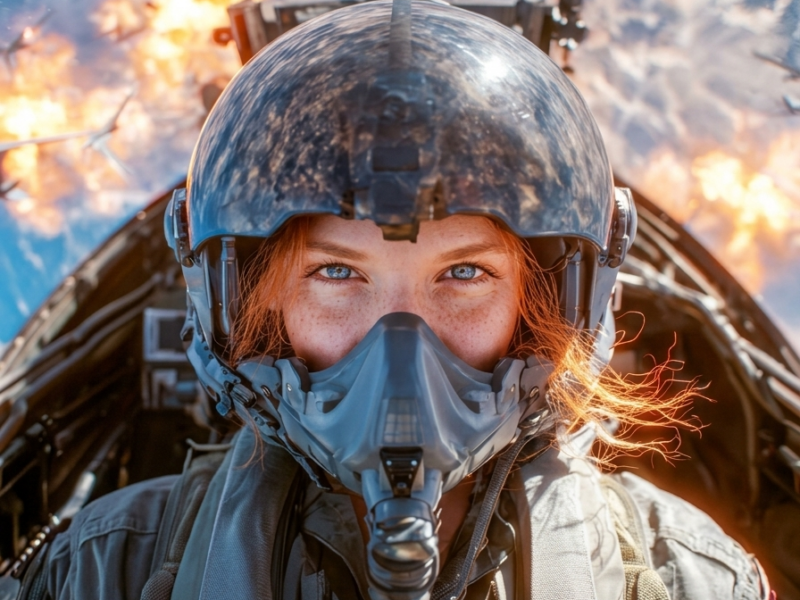
They laughed when I told them I could fly stealth through the mountain pass, but twenty minutes later
The briefing room at Edwards Air Force Base smelled of stale coffee, cold floor wax, and the dry, metallic heat radiating from the overhead projector. Fluorescent lights hummed a low, hypnotic tone that usually drowned out the desert wind scouring the windows. Today, however, the room was charged with a heavy, restless tension.
I stood at the podium, my flight suit damp between my shoulder blades, pointing a worn laser pointer at the topographical map of the southern ridge. The red dot trembled slightly, not from fear, but from the raw, surging adrenaline of a point I knew was right—and a audience that was determined to watch me fail.
“The radar dead-zone isn’t a theoretical anomaly,” I said, my voice echoing off the cinderblock walls. “It’s an atmospheric wave guide created by the thermal inversion layer hitting the canyon wall at three hundred knots. If you enter the canyon at seventy feet ground clearance and maintain a sixty-degree bank through the turns, the pulse-Doppler radar array at the border won’t register a jet. It registers a cluster of terrain clutter. You don’t need stealth coating. You just need to know how to fly underneath their math.”
A quiet beat settled over the room. Then someone near the back snorted.
“An F-16 isn’t invisible, Lawson,” Captain Reed said. He leaned back in his leather chair, interlocking his fingers over a clipboard. He looked at me with the polite, weary condescension he usually reserved for second-lieutenants who had lost their map cases. “You’re talking about flying blind through an unlit canyon in zero-illumination conditions, seventy feet above granite boulders, off the radio grid, based on a atmospheric variable that shifts with the wind. That isn’t tactics. That’s suicide with extra steps.”
“I didn’t say invisible,” I said, holding his gaze. “I said unseeable. There’s a difference. And I’ve flown that precise line in the simulator forty-two times.”
“Simulators don’t have gravity, Lawson. Or sudden downdrafts,” Reed replied, a smirk playing at the edge of his mouth. A low ripple of laughter passed through the row of senior pilots behind him.
I had spent four years studying radar gaps, terrain masking, micro-barometric shifts, and the strange, undocumented blind spots of foreign radar arrays. I had built custom algorithms on my personal laptop to predict radar bounce off high-density mineral deposits in the desert rock. But none of that mattered to men who had already decided what a woman in a flight suit was capable of—men who saw my legacy as a favor granted to the daughter of a dead legend rather than a seat earned through blood and sweat.
Before I could speak, the room went dark red.
A klaxon shattered the silence, a piercing, two-tone howl that vibrated through the concrete floor. The projector died, replaced by the flashing red emergency lights of the base alert system.
The door burst open, and a intelligence officer stepped in, his face flushed and sweating. “Command team, we have a red alert. Multiple fast-movers crossing the border near Sector Four. Fifteen radar signatures, high subsonic, maintaining a dense tactical delta formation. They just crossed the fence into the test range.”
The room transformed instantly. Chairs scraped backward. Laughter died instantly, replaced by the crisp, cold efficiency of combat doctrine. Men reached for their caps and flight bags, the air suddenly thick with urgency.
Reed stood up, his demeanor snapping into sharp focus. He looked down the table at the tracking map, then looked up at me. The smugness was gone, replaced by a dark, calculated appraisal. He knew as well as I did that the main fighter wing was currently grounded three hundred miles north for airframe upgrades. We had three ready-alert F-16s on the line, and only two instructors present.
“Fifteen contacts,” Reed said quietly, stepping toward me. “They’re using the terrain to screen their approach, pushing toward the research labs. If we launch conventional interceptors, they’ll see us coming on the high-frequency radar fifty miles out and split up. We won’t catch them all.”
He leaned in close enough for me to see the red emergency light reflecting in his eyes. “You wanted a chance to prove your math wasn’t fiction. The Viper on Spot Three is fueled and armed with training rounds and live short-range Sidewinders. Get in the air. Prove it, or die trying.”
“Yes, sir,” I said, not missing a beat.
Ten minutes later, the earth was shaking beneath me.
The canopy of my F-16 C-Block locked down with a heavy hydraulic thud. The engine hummed behind my head like a caged beast, a deep, throat-rattling roar that filled my teeth. The smell of JP-8 jet fuel and pure, cool oxygen swept into my mask as I tightened my harness straps until they bit into my shoulders.
“Viper Zero-One, cleared for immediate departure, runway zero-nine right,” the tower crackled through my helmet. “Godspeed, Lawson.”
I slammed the throttle forward into full afterburner. A wall of force slammed into my chest as two thousand pounds of thrust flung the aircraft down the black asphalt. The runway lights blurred into solid white streaks, and then the ground fell away. I pulled the gear up, slammed the stick left, and banked hard toward the dark, jagged teeth of the mountain range screaming toward me under the moonless night.
I clicked my master arm switch to live.
The world outside turned into a eerie, phosphor-green painting through my Night Vision Goggles. The desert floor dropped away as I entered the mouth of the canyon, lowering the jet’s nose until the altitude radar screamed a continuous, angry warning: ALTITUDE. ALTITUDE. PULL UP.
I overrode the voice warning with a flick of my thumb. Sixty feet. Fifty feet.
The sheer granite walls swept past my wings like knife blades, so close I felt the turbulence of my own air wash bouncing off the rock and buffeting the wings. Down here, in the dark belly of the earth, the high-altitude radar sweeps swept right over me, bouncing harmlessly off the canyon rim. I was invisible. I was a ghost riding a shockwave.
I crested the northern pass and popped up over the ridge for a fraction of a second to sweep the sky with a passive infrared sensor.
There they were.
Fifteen hostile jets, flying in a tight, arrogant wedge formation, confidence dripping from their flight path. They thought they had swept the skies clear. They thought nobody was down here.
I dropped back beneath the radar horizon, throttled back, and slid into the shadow of their flight path from behind.
I came up from the deep canyon floor like a shark rising from the dark ocean. One by one, I slipped behind their formation. They never saw me on radar. They never checked their six, assuming the mountain flank was an impassable wall.
Tone.
A high-pitched, steady whine screamed in my headset as my infrared system locked onto the tailpipe of the rearmost jet. I pulled the trigger. A streak of white flame ripped through the night as the Sidewinder missile leapt off my wing root.
Impact.
A sudden burst of orange light illuminated the clouds as the enemy tail-end jet pitched out of control, its engine destroyed. Before the splash from the debris hit the ground, I swerved, slid under the slipstream of the next aircraft, and locked on again.
Tone. Trigger. Strike.
Panicked voice chatter burst through the open airwaves in a foreign language. The formation broke apart in chaos, jets diving, banking, releasing flares into the empty sky, searching for an enemy they couldn’t find on their screens. They were looking up, looking out—never realizing the attack was coming from thirty feet above the canyon floor, rising like a shadow from the rocks below.
Three. Four. Five.
I hit them with relentless, surgical precision, using their own panic to guide my positioning. I thrust through their chaotic flight paths, firing, breaking away, disappearing into the dark canyons, and rising again in their blind spots.
Within twelve agonizing, beautiful minutes, the skies over the range were clear of hostiles. Fifteen burning trails of smoke marked the descent of fifteen enemy aircraft, their pilots floating down toward the white desert floor beneath silk parachutes.
Silence settled over the radio waves. My breath rasped heavy and fast inside my mask. My knuckles were white against the flight stick.
“Edwards Command, Viper Zero-One,” I breathed into the microphone, my heart hammering against my ribs. “Threat neutralized. Fifteen contacts down or disengaged. Returning to base.”
For three long seconds, there was nothing but static. Then, the base commander’s voice broke through, raw and disbelieving. “Copy… copy that, Viper Zero-One. Confirm… all targets down?”
“Confirmed, Command. Clear sky.”
Back at Edwards, I thought. Nobody was going to laugh anymore.
I banked the aircraft hard to turn back toward the home air strip, easing the throttle back to save what little fuel I had left. The adrenaline was beginning to drain, leaving my limbs heavy and shaking with relief.
Then, my radar warning receiver didn’t chime. It didn’t beep. It emitted a single, flat, continuous tone that I had never heard in ten years of flying.
My main screen flickered once, twice, and then went completely dark before rebooting into a static haze.
I whipped my head around, looking out past the tail fin into the pitch-black sky behind me.
There, floating less than two hundred yards behind my left wing, was an aircraft.
My stomach dropped into a cold, bottomless pit.
It had no running lights. No visible engine heat signature on my thermal scope. No tail fins. Its frame was an impossible, razor-sharp geometric shape that seemed to absorb the starlight around it, leaving a hole in the night sky. It flew with a terrifying, absolute silence, matching my speed precisely without any visible control surfaces moving.
“Command, Viper Zero-One!” I yelled, slamming my thumb onto the transmission button. “I have an unknown contact! Direct tail, distance under two hundred feet! Request immediate vector guidance!”
Static answered. Cold, dead, heavy static that sounded like rushing water.
Then, the static parted. A voice came through my headphones—not through the radio waves, but with a horrifying, crisp clarity that sounded as if someone were sitting directly behind me in the cockpit, leaning close to my ear.
The voice was low, distorted, like two metal plates grinding together over a whisper.
“You were never supposed to survive tonight, Clara.”
My blood turned to ice. They used my name.
“Who is this?” I slammed the throttle forward, pulling the stick back into a vertical climb to break away from the shadow. The G-forces smashed me down into my seat, six times the weight of my own body pressing my chest flat.
I looked up through the glass canopy.
The dark aircraft was still there. It hadn’t chased me; it had simply appeared above me, perfectly inverted, hovering over my cockpit like a coffin lid, matching my vertical ascent frame for frame.
Then, my instrument panel died completely. Every gauge went dark. The engine roared once, sputtered, and died.
I was falling through the night, thousands of feet above the desert, trapped in a dead glider with a phantom floating above me.
I closed my eyes, braced my hand on the ejection handle between my thighs, and pulled my breath in through my teeth.
When I opened my eyes a second later, the phantom was gone.
The sky was empty. My engine roared back to life with a sudden, violent surge of power, the instruments flashing back on in a cascade of green and white lights.
I sat there, trembling violently in the dark cockpit, my plane flying steady on autopilot, the cold desert wind howling outside the canopy.
The landing was sloppy, a rough, rubber-burning bounce off the tarmac that nearly sent the F-16 skidding into the dirt banks beyond the runway. I didn’t care. I barely felt the impact. My hands were still shaking so violently I could hardly manipulate the taxying levers.
The ground crew didn’t meet me with banners or cheers. The base was under a total communications blackout. Red emergency lights still spun slowly inside the open arch of Hangar Four, casting long, bloody shadows across the concrete floor.
I cut the engine. The high-pitched whine of the turbine slowly spun down into a quiet, metallic ticking as the metal cooled.
I popped the canopy latch and pushed the glass up. The cold desert night air hit my face, carrying the scent of burned jet fuel and hot brakes.
Captain Reed was standing at the ladder’s base. He wasn’t wearing his flight cap. His hair was disheveled, his eyes wide and bloodshot in the dim light. He looked smaller, stripped of his usual air of easy authority. Beside him stood two armed Air Force Security Forces airmen, their hands resting heavy on the grips of their holstered side arms.
“Lawson,” Reed said. His voice was barely above a whisper, lacking any of the sharp, mocking bite from two hours ago.
“Captain,” I said, my voice hoarse as I unclipped my helmet mask and let it dangle from my helmet. “There was… there was a sixteenth contact. It wasn’t on the ground tracking. It disabled my systems. It spoke on a secure band.”
Reed didn’t answer. He didn’t ask if I was hurt. He didn’t congratulate me for saving fifteen targets from an strike on the test facility.
He reached into his leather flight jacket, pulled out a yellowed paper envelope, and held it up to me.
“Get down off the ladder, Lawson,” he said softly.
I climbed down, my flight boots hitting the concrete with a dull thud. The security guards shifted their weight, their eyes fixed on me, nervous and tense.
“What is this?” I asked, looking from the guards back to Reed. “Is this about the foreign strike package? Who sent those jets?”
“The strike package wasn’t foreign,” Reed said quietly.
The world seemed to stop moving. The wind howling outside the hangar doors died away into a eerie silence.
“What did you say?” I asked.
“Those jets were unflagged airframes from a classified testing facility in Nevada,” Reed said, his eyes darting toward the open hangar doors as if checking the shadows. “They were remote-piloted targets, Clara. Someone programmed them to execute a live attack vector against this base to force a scram-launch.”
“To force me to launch,” I corrected, the realization hitting me like a physical blow to the chest. “They wanted me in the air. Who?”
Reed didn’t answer with words. He handed me the envelope.
My fingers were stiff as I slid the contents out. It wasn’t an official military debriefing form or an intelligence report. It was a physical, gloss-finish photograph, faded at the edges, the corners curled from age and moisture.
I looked at the image, and my breath hitched in my throat.
The photo showed a young man standing in front of an early-model F-16 on a sun-drenched tarmac. He was wearing an old-style flight suit, a wide, confident grin spread across his face, one hand resting casually on the nose cone of the aircraft.
It was my father, Major Marcus Lawson.
He had died twenty years ago in a classified training crash over the Nevada test range when I was six years old. The Air Force had given my mother a folded flag, a closed coffin, and a brief statement about structural failure during a high-G maneuver.
I stared at his face, feeling the sudden, painful sting of tears in the back of my throat. I had spent my entire life trying to walk in the long shadow of the smile in that picture.
Then, my eyes drifted to the background of the photo.
Parked in the shadows of the dark hangar behind my father’s jet was an aircraft.
It was black, angular, lacking tail fins, visible control surfaces, or exhaust ports. The exact same razor-sharp, light-absorbing geometric craft that had hovered over my cockpit twenty minutes ago.
The photo had been taken two decades ago.
My thumb trembled against the paper. I turned the photograph over.
Written across the back in dark, faded blue ink—in my father’s distinct, angular handwriting—were six words:
She’ll finish what he started.
“Where did you get this?” I demanded, my head snapping up to face Reed. “Where did this come from?”
“It was locked in a Class-Five safe in the Commandant’s office,” Reed said, his voice trembling slightly. “It came with an envelope marked with your name, to be opened only in the event of an unscheduled tactical scram by a Lawson airframe. Clara… your father didn’t die in a crash.”
“What happened to him?”
“He didn’t crash,” a new voice broke in from the back of the hangar.
A man stepped out of the shadow of a fuel truck. He was tall, thin, wearing a dark gray suit with no military pins or identification badges. His hair was silver-white, cropped short, and his face was lined with deep, harsh scars that ran from his ear down into his collar.
The two security guards instantly snapped to attention, but they didn’t look at him with respect—they looked at him with absolute, paralyzing fear.
“Your father was the first pilot to fly the Astraea prototype,” the man in the suit said, walking slowly toward us. His boots clicked rhythmically against the floor. “And he was the first pilot who realized what the system was actually designed to do.”
“Who are you?” I asked, stepping back against the warm metal of my jet’s ladder.
“My name is Director Vance,” the man said. “I run the division that built the plane you saw tonight. The plane your father stole twenty years ago.”
“Stole?” I spat out. “My father was a decorated officer!”
“Your father was a visionary who lost his nerve,” Vance replied coldly. He stopped five feet from me, his gray eyes completely devoid of human warmth. “He realized that the Astraea wasn’t an interceptor. It wasn’t built to defend airspace. It was designed as an automated, pilot-less regional control platform—a system capable of overriding the flight computers of every aircraft within a five-hundred-mile radius and forcing them into collision courses.”
Vance stepped closer, pointing a long, thin finger at the photo in my hand.
“Twenty years ago, your father attempted to destroy the control core before we could operationalize it. He failed. He hid the core, and he died protecting the location. For twenty years, we have been waiting for the only piece of hardware that can unlock that core’s location.”
I narrowed my eyes. “What piece of hardware?”
Vance smiled—a cold, terrifying stretch of thin lips that didn’t reach his eyes.
“Your flight helmet, Clara. The biometric telemetry rig your father built for you before he died. The one you’ve been wearing for every simulator run and live flight since you were eighteen.”
My hand flew up to the helmet dangling from my hand.
The custom neural-interface liner. The one my father had spent months crafting in his home workshop before his death, the one my mother had sworn to me was just a lucky charm designed to monitor my stress responses.
“It’s not a monitor,” I whispered, the realization striking me like thunder. “It’s a key.”
“And tonight,” Vance said, reaching into his coat pocket, “you brought it right back to us.”
Before I could move, before I could drop the helmet or run, the two security guards stepped forward, raising their weapons. But they didn’t point them at Vance.
They pointed them at Captain Reed.
“What is this?” Reed shouted, raising his hands, his face turning pale. “Vance, this wasn’t part of the debrief! I was told this was an internal security evaluation!”
“You were told what was necessary to get her into the air, Captain,” Vance said smoothly without looking at him. “Thank you for your service to the program. You are dismissed.”
One of the guards stepped up behind Reed, slammed the butt of his rifle into the back of Reed’s neck, and caught him as he collapsed unconscious to the floor. They dragged him away into the darkness of the rear offices like a sack of laundry.
I backed up until my spine hit the cold steel of the F-16’s ventral fin. “You’re out of your mind. You can’t do this on a United States Air Force base.”
“This base ceased to be under standard command ninety minutes ago, Clara,” Vance said quietly. He held out his hand. “Give me the helmet.”
“No.”
Vance sighed, a soft, weary sound. He pulled a small, silver control fob from his pocket and pressed a single button.
Instantly, a high-frequency whine pierced my skull.
It didn’t come from the room. It came from inside my head. The helmet I was holding vibrated violently, a sharp, white-hot surge of electromagnetic radiation pulsing out from the gel-pads in the lining. The pain was instant and total, blinding me with a flash of light behind my eyes that brought me to my knees on the cold concrete.
I screamed, dropping the helmet. It tumbled across the floor, glowing with a soft, pulsing blue light from its internal sensors.
“The neural interface isn’t just a receiver,” Vance said, stepping over me as I gasped for air, my vision swimming with black spots. “It’s a two-way bio-digital conduit. Your father mapped his own neural pathways into the encryption key. He knew that only someone with his exact genetic sequence and brainwave signature could activate the decryption sequence without burning out the memory core.”
He picked up the helmet from the floor, holding it like a prized trophy.
“He built the key in your brain, Clara. You are the living password.”
“He… he wouldn’t…” I gasped, pressing my forehead against the cool floor, fighting the nausea tearing through my stomach. “He loved me.”
“He used you,” Vance corrected softly. “He hid the most dangerous weapon on Earth inside his daughter’s mind, knowing we would eventually come to claim it.”
Vance turned toward the entrance of the hangar.
Out in the dark, the sound of jet engines flared—not the high, ripping scream of the F-16, but a deep, resonant, unnatural thrumming that made the concrete vibrate beneath my knees.
The razor-sharp black aircraft slid into the hangar, floating three feet above the ground, completely silent except for the low vibration in the air. Its dark hull seemed to ripple, absorbing the light around it, casting no shadow on the bright floor.
A hatch on the top of the dark craft slid open with a soft hiss of released pressure.
“Get her up,” Vance commanded the remaining guard.
A pair of rough hands grabbed my shoulders, dragging me to my feet. My legs felt like lead, my head throbbing with a dull, sickening ache where the neural shock had fried my sensory nerves.
“Where are you taking me?” I spat out, wiping a line of blood from my nose with the back of my flight glove.
“To the vault,” Vance said, plugging a heavy data cable from the helmet into a side terminal on the black craft. “To the deep trench in Nevada where your father buried the primary control array. You are going to open it for us.”
“And if I refuse?”
Vance turned back to look at me, his scarred face twisted into a grotesque shadow of empathy.
“You won’t refuse, Clara. Because the neural link is already active. If you refuse to align your brainwaves with the core, the feedback loop will expand your cerebral blood vessels until you suffer a massive, fatal stroke in three minutes.”
He pointed toward the open hatch of the phantom craft.
“Options are very limited for you now. Step inside, or die here on the floor, knowing your father’s legacy died with you.”
I looked at the guard holding my arm. I looked at Vance. Then, I looked down at my own hand, still covered in the dirt and oil of the jet I had just flown.
Deep inside my mind, behind the screaming pain of the neural shock, a voice echoed—a voice from twenty years ago, sitting in the cockpit of a parked plane, holding my tiny six-year-old hands over the flight stick.
Always keep a spare knife in your boot, birdy. And never let them see which way you’re leaning.
I looked up at Vance, my eyes narrowing, forcing the pain down into a tiny, cold box in the back of my soul.
“Lead the way, Director,” I whispered.
The flight inside the Astraea prototype was unlike anything known to aviation science.
There were no windows. No instrument panels. No seats with seatbelts or ejector rigs. The interior was a smooth, seamless sphere of dull gray composite material that seemed to flex slightly with every movement of the craft. I sat on the floor, strapped into a heavy steel restraint harness, while Vance sat opposite me, monitoring a floating holographic display that projected light directly from the air.
There was no sensation of movement. No G-forces pressing against my chest. No engine sound. Only a strange, sickening feeling of weightlessness, as if the world outside had ceased to exist and we were falling through an endless void.
“We are currently flying at Mach Eight,” Vance said casually, his eyes fixed on the floating data streams. “Thirty thousand feet above the Nevada badlands. No radar on Earth knows we are in the sky. In four minutes, we will land at Site Zero.”
“Why?” I asked, my voice flat, my eyes tracking the movement of his fingers on the holographic screen. “Why build something like this? What is the point of a weapon that turns every plane into a bomb?”
Vance didn’t look up. “Control, Clara. War is chaotic. Pilots make mistakes. Politics change. Fear makes men unpredictable. But an automated network that commands the skies through pure, unyielding code? That brings absolute order. No dogfights. No grandstanding. No heroes. Just absolute obedience.”
“My father fought for freedom, not order,” I said.
“Your father was a fool who thought human instinct was superior to algorithmic perfection,” Vance snapped, his head jerking toward me. “And it cost him his life.”
“How did he die?” I demanded, leaning forward against the heavy steel straps. “Tell me the truth, Vance. You owe me that much before you kill me.”
Vance stared at me for a long moment, the cool blue light of the holographic screen washing over his scarred face.
“He died because he tried to take the core out of the facility by hand,” Vance said quietly. “The radiation from the experimental power cell burned his nervous system out in forty-eight hours. He didn’t die in a crash. He died in a hospital bed in an underground bunker, bleeding from his eyes, writing code on paper until his fingers stopped moving.”
He pointed a finger at my head.
“He spent his last living hours building the neural map inside your helmet. He sacrificed his life to lock the core away—and he sacrificed yours to ensure nobody else could ever touch it without your consent.”
A cold, heavy stone settled in my chest.
He didn’t abandon me, I thought. He didn’t crash because of a pilot mistake. He died fighting them. And he left me the weapon to finish it.
The light inside the cabin shifted from pale blue to a deep, ominous red.
“We have arrived,” Vance said, standing up and smoothing his suit jacket.
The bottom floor of the sphere opened with a low, hydraulic hiss. Cold, dry desert air rushed into the cabin, carrying the unmistakable scent of dust, ancient sagebrush, and dry pine.
We were deep inside a massive, natural underground cavern. Huge rock pillars stretched up into the pitch-black void above, lit only by high-intensity floodlights mounted on heavy steel scaffolding that crisscrossed the cave floor.
In the center of the cavern sat a massive steel structure—a subterranean bunker built like an inverted pyramid, half-buried in the solid granite rock floor.
This was Site Zero. The grave of my father’s mission.
The guard unclipped my restraints and dragged me out of the craft down a steel ramp. My boots hit the metal grating with a loud, ringing echo that bounced off the cavern walls.
Vance walked ahead, holding my helmet in one hand and his control fob in the other. He approached a massive, circular steel blast door set into the face of the subterranean pyramid.
In the center of the door was a glowing glass interface plate, surrounded by copper coils and high-voltage conduit lines.
“This is the vault,” Vance said, turning back to face me. “The primary array is behind this door. Place your head inside the telemetry interface, align your brainwaves with the key sequence, and the door opens.”
I looked at the glass plate. I looked at the dark wires running into the rock.
“And if I don’t?” I asked again.
Vance pressed a button on his fob.
The sharp, excruciating pain returned instantly, tearing through my brain like white-hot needles. I fell to my knees on the metal floor, my breath catching in a ragged, agonized gasp as my vision went entirely red.
“You have sixty seconds before the vascular damage becomes permanent, Clara,” Vance said, his voice cold and devoid of passion. “Make your choice.”
Through the blinding haze of pain, I looked at the floor grating beneath my knees.
Sitting in the shadow of the steel ramp was a small, discarded maintenance tool—a heavy, steel torque wrench left behind by the construction crews.
My father’s voice rang through my head once more, clear and sharp as a bugle call in the morning air.
When you’re outmatched on power, birdy… change the rules of the dogfight.
I looked up at Vance through my tears, forcing my shaking body to stand.
“Alright,” I gasped out, clutching my head with both hands. “I’ll do it. Just… stop the pulse.”
Vance smiled, satisfied, and clicked the fob to kill the neural signal.
The pain faded instantly into a dull, throbbing ache. I stumbled forward toward the circular steel door, my hands reaching out toward the glowing glass interface plate.
“Smart girl,” Vance murmured, stepping close behind me to watch the display. “Just like your father.”
I put my hands on the frame of the interface plate.
Then, with every ounce of strength left in my body, I didn’t press my head to the glass.
I reached down, grabbed the heavy steel torque wrench off the floor, turned around in a single, fluid motion, and shattered the control fob in Vance’s hand into a hundred flying pieces of plastic and wire.
Vance screamed as the heavy steel wrench smashed into his hand, blood bursting from his broken fingers as the fob disintegrated against the floor grating.
“Kill her!” he roared, clutching his shattered hand to his chest, falling backward into the dust.
The security guard raised his rifle, but I didn’t wait for him to clear the safety.
I threw the heavy wrench straight into his face.
It struck him hard across the jaw with a sickening crunch. He stumbled backward, his rifle discharging a wild volley of bullets into the cavern ceiling that echoed like thunder, before he tripped over the steel ramp and fell into the dark canyon below.
I gasped for air, my heart hammering against my ribs like a trapped bird.
Vance was on the ground, groaning in agony, his gray suit covered in red dust. He looked up at me with eyes full of pure, unadulterated venom.
“You fool!” he wheezed, spit flying from his lips. “Without the fob, the neural lock on the helmet is permanently engaged! The safety override is gone! In three minutes, the internal battery will trigger a continuous discharge that will fry your brain!”
I picked up my helmet off the floor. The blue light on the gel-pads was flashing red now, pulsing faster and faster in a terrifying rhythm.
“My father built this,” I said, looking down at the scarred old visor. “He didn’t build it to kill me, Vance. He built it so I could finish what he started.”
I didn’t put the helmet on my head.
Instead, I jammed the helmet directly into the central glass interface plate on the blast door, forcing the gel-pads against the biometric sensors.
“What are you doing?!” Vance screamed, trying to crawl toward me on his knees. “That will overload the entire system! It’ll cause a catastrophic power feedback!”
“I know,” I said.
I grabbed the thick, heavy high-voltage conduit wire running from the cavern generator into the door interface. With a furious, roaring effort, I ripped the cable free from its housing, exposing the thick copper core sparking with thousands of volts of blue electricity.
I looked down at Vance.
“You said my father lost his nerve,” I said, my voice cold and calm. “You were wrong. He just knew when to pull the ejection handle.”
I jammed the live electrical cable directly into my helmet’s neural interface port.
A blinding flash of white light erupted from the door.
A sound like a lightning strike inside a sealed metal room shattered the silence of the cavern. Thousands of volts of electricity surged through the helmet’s neural processors, blowing out the encryption lock in a cascading chain reaction of green sparks and thick, acrid white smoke.
The massive steel blast door groaned.
The heavy locking pins, ancient and rusted, retracted into the frame with a violent series of heavy mechanical thuds. The door split down the middle and swung open into the dark, exposing the heart of Site Zero.
Inside sat the primary control array—a massive, glowing cylinder of blue light and crystalline glass, pulsing with the power to control the skies of the world.
And beneath it, wired directly into the main power terminal, was a heavy block of military-grade C4 explosive, its timer display dark, waiting for a signal that had been delayed for twenty years.
My father hadn’t just hidden the core. He had rigged it to blow the moment the door was opened without his safety codes.
The red digital timer on the explosive pack suddenly sprang to life.
00:00:10
00:00:09
“No!” Vance screamed, staring into the room at the red numbers counting down. “No, no, no!”
I didn’t hesitate.
I turned around, grabbed Vance by the collar of his suit, and dragged his heavy, broken body toward the open hatch of the floating Astraea prototype parked on the metal ramp.
“Get in!” I yelled, throwing him up the ramp into the interior sphere.
“It’s too late!” Vance sobbed, his composure completely gone, his face pale with terror as he looked at the counting clock. “We can’t clear the blast radius!”
00:00:05
I leaped into the pilot’s position of the dark craft, slamming my hands onto the control surface. Without the helmet’s neural link, the ship’s automated systems hesitated—then, recognizing my bloodline signature from the open interface port, the interior illuminated with a bright, emerald-green light.
00:00:03
“Manual override,” I yelled into the air. “Vector ninety! Full atmospheric thrust! NOW!”
The dark craft didn’t roar. It didn’t warm up.
It simply vanished from the spot.
A split-second later, a mountain of fire erupted behind us as the subterranean vault exploded. Millions of tons of granite, steel, and advanced technology were vaporized in a blinding, white-hot nuclear-grade chemical firestorm that collapsed the entire cavern system into a crater three hundred feet deep.
The shockwave hit us as we cleared the surface, launching the black craft up into the night sky like a stone fired from a slingshot.
We rocketed through the clouds, five hundred, a thousand, ten thousand feet per second, shooting straight toward the edge of space until the blue curve of the Earth appeared below us under a blanket of cold, silent stars.
Inside the quiet sphere, the green lights pulsed slowly, steady and calm.
The primary array was gone. The threat to the sky was destroyed forever. My father’s work was finally finished.
I leaned back against the composite bulkhead, breathing heavily, watching the stars through the dark craft’s crystal canopy.
Beside me, Vance lay collapsed on the floor, weeping softly into his hands, broken, defeated, and stripped of everything he had spent thirty years building.
I reached into my flight boot, pulled out a small, worn silver compass my mother had given me when I graduated from the Air Force Academy, and held it in my hand.
The needle spun wild for a second, then pointed steadily north.
I looked out at the vast, silent horizon stretching over the dark continent below.
The sky was empty. The sky was free.
And for the first time in my life, as I banked the dark shadow toward the dawn breaking over the horizon, I wasn’t running from the past anymore.
I was flying home.
The end.









