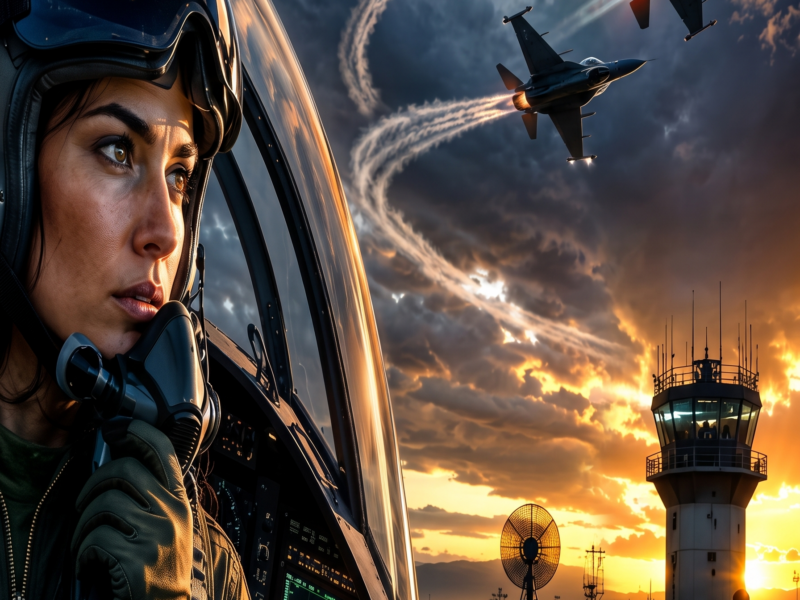
They laughed when I struggled to land my F-16 during my first week at the Nevada training range, and the squadron commander called me a liability in front of everyone
They laughed when I struggled to land my F-16 Fighting Falcon during my first week at the Nevada training range, and the squadron commander called me a liability in front of everyone, but hours later, one distress call from my cockpit made three fighter jets abruptly turn around because they recognized who was speaking.
The landing had been agonizingly ugly.
The hot desert crosswinds sweeping off the Nellis Air Force Base flats had caught my ventral fins on final approach. I overcorrected by a fraction of an inch, sending the multi-million-dollar supersonic jet bouncing violently off the asphalt. The nose gear slammed down with a sickening, metallic screech that echoed across the entire flight line, burning rubber and kicking up clouds of blue smoke before I finally managed to wrangle the beast to a halt near the tactical hangars.
When I finally popped the plexiglas canopy and climbed down the yellow ladder, the relentless mockery hit me before I had even unclipped my oxygen mask or pulled off my helmet.
“Nice landing, rookie!” a senior lieutenant barked from the shade of the tarmac shelter, triggering a wave of snickering among the assembled maintenance crews and veteran pilots. “Did you learn to land on a trampoline, Carter? Maybe we should attach training wheels to those airframe struts!”
I kept my mouth shut, wiping cold sweat from my forehead as I unbuckled my g-suit straps. I walked straight past them toward the flight line office, where Colonel Vance Montgomery stood waiting with his arms crossed over his chest, his face carved from angry granite.
“You’re too slow, Carter,” Montgomery said, his voice dropping like an anvil onto the tarmac. “You hesitated on the flare, you misjudged the glide slope, and you nearly tore off my nose gear. You’re flying a front-line multirole fighter, not a crop duster. In a real combat environment, that level of hesitation gets you and your wingman killed. Right now, you are a distinct liability to this squadron.”
I lowered my eyes, my jaw clenching until my teeth ached. “Yes, sir. I understand, sir.”
He didn’t offer a word of constructive critique. He just shook his head in disgust and walked away, his tactical boots crunching loudly on the gravel.
Nobody in that briefing room knew that I had barely slept five hours total in the last three days. Nobody knew why my hands were trembling beneath my tactical gloves.
For seventy-two hours, my personal computer had been bombarded with anonymous, encrypted data packets originating from untraceable military satellite relays. Every file contained redacted flight logs, corrupted radar telemetry, and frantic audio logs dating back exactly twelve years. Someone was feeding me fragments of the night my father, Major David Carter, vanished off the coast of Alaska during a highly classified, deep-black interception mission.
That night, despite my disastrous performance on the runway, I was assigned to a routine low-altitude tactical patrol over the northern test corridors of the Nevada desert. It was a punishment shift—a midnight sweep designed to keep the struggling rookie away from prime operational hours.
I strapped into the cockpit of Falcon Seven at 23:00 hours. The jet lifted off into the moonless sky, its powerful Pratt & Whitney engine scorching the dark air with a brilliant blue afterburner plume.
Twenty minutes into the flight, cruising at twenty-four thousand feet above the pitch-black desert floor, my tactical radar display suddenly flashed violently yellow, then blood red.
Three unidentified aircraft had popped up out of a radar-blind valley at Mach 1.4, closing fast on my six o’clock position. They had no transponder signals, no flight plans, and were flying in a tight, offensive wedge formation.
“Nellis Control, this is Falcon Seven,” I radioed, my voice tight as I adjusted my throttle. “Confirm contacts at sector Grid November-Nine. I have three unidentified fast movers closing rapidly.”
Static answered. A dense, unnatural white noise hissed through my helmet speakers, totally drowning out the base frequency.
A second later, my threat warning receiver screamed a high-pitched, steady tone.
Missile lock.
“Control, I am painted! I repeat, I am painted!” I yelled into the mask, yanking the stick hard to the left and dumping a cloud of burning magnesium flares into the night sky.
A thermal air-to-air missile tore through the darkness behind my tail, missing my starboard wingtip by less than thirty feet before exploding against a distant ridge line in a blinding flash of orange fire.
“Mayday, mayday, this is Falcon Seven! I am under active attack!” I shouted, pulling seven Gs as I dropped the nose to slide between the mountain peaks.
No response came from base. The jammer was absolute.
“Falcon Seven requesting immediate assistance!” I pleaded, my heart hammering against my ribs like a trapped bird.
Still, nothing but cold, synthetic static filled my ears.
The three fighters closed the distance with terrifying precision. They were sleek, delta-winged interceptors—paint so dark they swallowed the starlight. They moved with a fluidity that defied standard military maneuvers. I knew the flight characteristics of my F-16 inside out; I knew beyond a shadow of a doubt that I could not outrun three high-altitude interceptors working in a coordinated pincer.
Then, something utterly inexplicable happened.
One of the hostile fighters broke formation, pulled up alongside my cockpit at terrifyingly close range, and tapped into an unassigned emergency frequency.
“Falcon Seven,” a low, rasping voice spoke over the clear channel, speaking English with a heavy, unidentifiable accent. “Identify yourself immediately. State your full military registry name.”
I hesitated, my thumb trembling over the push-to-talk button on my throttle. I was facing certain death; keeping secrets seemed entirely pointless.
“Captain Emily Carter,” I breathed into the mask. “United States Air Force.”
The radio frequency went completely, dead silent for three agonizing seconds. The heavy breathing of the hostile lead pilot was the only sound echoing through my headset.
Then the pilot spoke again, his voice cracking with a sudden, palpable tremor of shock.
“Say your name again, pilot.”
My blood chilled. “Emily Carter. I am Emily Carter.”
Instantly, the lead jet violently broke its bank, dropping its left wing and executing an extreme hard turn away from my airframe. The other two interceptors immediately followed suit, aborting their missile locks, pulling out of their lethal attack vectors, and sweeping their nose cones hard toward the northern border.
They stopped pursuing me entirely.
Within ten seconds, all three black jets hit their afterburners, streaking across the sky like dark streaks of lightning until their thermal signatures blinked off my radar screen completely.
I stared at the green radar scope in absolute, paralyzed disbelief, my hands trembling violently on the flight stick.
“Why are they retreating?” I whispered into the empty cabin. “Why did they stop?”
Nobody answered. The quiet of the high night air settled over my canopy like a heavy woolen blanket.
When I touched down on the Nellis tarmac twenty minutes later, I didn’t care about my landing. I brought the F-16 down hard, taxied straight to the primary hangar apron, and popped the canopy before the ground crew could even position the chocks.
Colonel Vance Montgomery was waiting at the edge of the taxiway. He wasn’t accompanied by his usual entourage of arrogant instructors or clipboard-bearing officers. He stood alone in the dim glow of the sodium security lights, his flight jacket open, his hands thrust deep into his pockets.
He wasn’t angry anymore. The sharp, condescending scowl that had defined his face for the past week was completely gone.
He looked utterly, profoundly terrified.
I unbuckled my harness and climbed down the access ladder, my boots slapping against the damp concrete.
“Captain,” Montgomery said, his voice stripped of all its military thunder. He stepped toward me, his eyes darting frantically around the empty tarmac to ensure no crewmen were within earshot. “Where did you get that call sign?”
I stopped dead in my tracks, my helmet clutched tightly under my arm. “What are you talking about, Colonel? Falcon Seven is the designated tactical call sign assigned to my flight block for tonight’s sweep.”
He stepped closer, his shadow stretching long across the pavement. “Don’t lie to me, Emily. I checked the flight logs five minutes ago. Your assigned call sign for tonight’s sweep was Cobra Four. You manually changed your transponder registration to Falcon Seven right before you cleared the runway.”
My throat tightened. “I… I’ve always used Falcon Seven in my private simulation runs. It was a habit.”
“It wasn’t a habit,” Montgomery whispered, his eyes narrowing into cold slits. “Your father used that exact same call sign twelve years ago.”
A wave of icy numbness washed over my chest, freezing the air in my lungs. I had spent my entire military career deliberately hiding my lineage. I had enlisted under my mother’s maiden name, kept my records spotless, and never mentioned my father to a single soul in the Air Force.
Major David Carter was a legend who had been turned into a ghost. Twelve years ago, the Pentagon told my mother that his aircraft had suffered a catastrophic engine failure during a classified arctic reconnaissance flight over the Bering Sea. They said his airframe sank four thousand feet into freezing water, and no body was ever recovered. I was ten years old when they handed my mother a folded flag and a polished mahogany box containing an empty grave.
“I never told anyone about my father,” I said, my voice barely audible over the hum of the taxiway generators. “Not on my entrance forms. Not on my security clearance paperwork. How do you know about him?”
Montgomery looked away, staring into the vast, dark desert horizon where the mountains met the night sky.
“Because I was his wingman the night he disappeared,” Montgomery said softly. “And because those three unidentified jets that jumped you tonight… they weren’t foreign mercenaries, Emily. They were advanced prototype interceptors operating out of a black site facility.”
My brain struggled to process his words. “If they were black-site assets, why did they attack me? And why did they turn around the second I gave them my name?”
Montgomery leaned in, his face pale under the amber security lamps. “Those three pilots weren’t afraid of an F-16, Emily. They weren’t afraid of Nellis Air Force Base. They heard the call sign ‘Falcon Seven’ combined with the name ‘Emily Carter’—and they realized they were about to murder the daughter of the man who built their entire network.”
“What?” I gasped. “What are you saying?”
“They weren’t afraid of you,” Montgomery whispered, his jaw trembling slightly. “They were afraid of him.”
I stood frozen on the tarmac, the world spinning beneath my feet. Before I could demand a straight answer, a sudden burst of high-frequency feedback shrieked through the flight line PA speakers mounted on the hangar wall behind us.
Simultaneously, the tactical emergency radio receiver clamped to my flight vest crackled to life.
A voice spilled out of the tiny speaker.
It was weak. It was heavily distorted by analog encryption and satellite delay. But it was unmistakably, unequivocally human—and the cadence of the speech sent a bolt of pure electricity straight down my spine.
“Emily…” the voice rasped, fighting against a wave of overwhelming static. “Emily… if you’re hearing this… do not trust your commander. Vance is lying to you. Get out of Nellis… now…”
I spun around and stared at Colonel Montgomery.
His face had gone completely, ghostly white. All the color had drained from his lips, and his right hand subconsciously reached for the sidearm holstered at his hip.
The radio transmission cut out with a sharp, metallic pop.
For five terrifying seconds, neither of us breathed. The wind howled through the open hangar bays, rattling the steel chains against the flight equipment.
Then, Colonel Montgomery lowered his hand from his holster, looked me dead in the eye, and whispered four words that shattered my entire reality into a thousand jagged pieces:
“Your father is alive.”
“Come with me. Right now,” Montgomery growled, his fear instantly transforming into urgent, ruthless efficiency. He grabbed me by the shoulder of my flight suit and pulled me toward the darkened rear entrance of the primary hangar, away from the security cameras mounted along the main flight line.
“Where are we going?” I demanded, pulling against his grip. “You just told me my father is alive after twelve years of lies! You told me he died in the Arctic! Who was on that radio, Colonel?!”
“If you don’t keep your mouth shut and move your feet, neither of us will live long enough to see the sunrise!” Montgomery snapped, shoving open a heavy steel door that led into a subterranean maintenance bunker beneath the airbase.
We hurried down a dimly lit concrete corridor lined with heavy high-voltage cables and hydraulic pipes. Montgomery pulled an electronic keycard from his breast pocket, swiped it through a secure reader, and punched a six-digit code into a stainless-steel keypad. A heavy blast door hissed open, revealing a dusty, abandoned command center filled with vintage radar monitors and classified filing cabinets.
“What is this place?” I asked, looking around the cold, concrete bunker.
“This is the original Operations Hub for Project Coldfire,” Montgomery said, shutting the blast door behind us and slamming the manual locking wheel into place. “The black-budget program your father commanded before he ‘disappeared.'”
He walked over to an ancient terminal, flipped three heavy toggle switches, and tapped rapidly on a mechanical keyboard. A monochrome green monitor flickered to life, casting an eerie glow over his weathered face.
“Twelve years ago,” Montgomery began, his voice tight with suppressed emotion, “your father discovered that high-ranking officials within the Department of Defense were diverting advanced aerospace technology, stealth materials, and weapons platforms to a private global syndicate known as the Iron Vanguard. They were building a shadow air force, completely independent of government oversight.”
I leaned over the terminal, watching green columns of classified flight data and logistics ledgers scroll across the CRT screen. “And my father tried to stop them?”
“He tried to expose them,” Montgomery corrected me. “He gathered mountains of encrypted evidence. But the night he was scheduled to deliver the data to the Senate Select Committee on Intelligence, his flight route was compromised. His wing was intercepted over the Bering Sea by rogue contractor assets.”
“The three jets from tonight,” I whispered, the puzzle pieces slamming together in my mind.
“Yes,” Montgomery said softly. “I was flying his left wing that night, Emily. I was ordered by base command to stand down and break off my escort. I was terrified. I was a young captain with a family, and they threatened to erase me if I didn’t follow orders. I watched your father’s jet get forced down into Russian airspace. He didn’t crash. He was captured.”
Tears of pure, unadulterated rage burned at the back of my eyes. I grabbed Montgomery by the collar of his flight jacket, slamming him back against the concrete wall.
“You left him!” I screamed, my voice echoing off the cold walls. “You let them take my father, and then you spent twelve years pretending to be my commander, calling me a liability, treating me like garbage!”
“I spent twelve years keeping you alive!” Montgomery yelled back, not trying to break my grip. “Do you think it was a coincidence that you were assigned to my squadron? Do you think it was an accident that your application to the F-16 program was approved despite the red flags in your file? I spent twelve years monitoring the Iron Vanguard’s surveillance network, waiting for the day your father made his move!”
I slowly released his collar, my breathing heavy and ragged. “He sent those data packets to my laptop, didn’t he? He was trying to reach me.”
“He knew you were flying,” Montgomery said, turning back to the green monitor. “He knew that once you reached operational status, the Vanguard would try to eliminate you to ensure his silence. But he didn’t just send you data, Emily. He sent you an activation code.”
“Activation code for what?”
Montgomery typed a final command into the terminal. A map of the western United States appeared on the screen, centered on an unmarked, desolate stretch of the Nevada-Utah border known as Sector 13.
A single red marker was blinking in the center of the desert map.
“A hidden automated hangar,” Montgomery said. “Your father hid an advanced prototype airframe inside a decommissioned nuclear silo twelve years ago. It holds the original, uncorrupted master drive containing the names, bank accounts, and locations of every single traitor inside the Pentagon.”
Suddenly, the red emergency lights inside our bunker began to flash violently. A loud, mechanical klaxon split the silence, howling through the concrete corridors.
WARNING: PERIMETER BREACH. SECURITY LEVEL ALPHA COMPROMISED.
Montgomery looked up at the ceiling, his face turning pale once again. “They know we’re down here. Vance’s private security team just locked down the base.”
“Vance?” I asked, confused. “Colonel Vance Montgomery… you?”
Montgomery shook his head bitterly. “Not me, Emily. General Marcus Vance—my superior officer, and the man who ordered me to leave your father behind twelve years ago. He just arrived at Nellis on a direct flight from Washington.”
“Take this,” Montgomery ordered, ripping a hard-shell tactical data drive out of the terminal console and slamming it into the front pocket of my flight vest. “This drive contains the GPS coordinates and the override key for Sector 13.”
“I’m not leaving without answers!” I yelled over the deafening blare of the alarm sirens. “If my father is alive, where is he being held?”
“He’s being held at the Iron Vanguard’s primary subterranean installation in Sector 13—right beneath the silo where his prototype jet is stored!” Montgomery shouted, grabbing an M4 carbine from a weapons rack mounted near the blast door. “He was radioing you from inside their comms facility! He knew they were going to jump you tonight!”
The steel blast door shuddered violently under a heavy, explosive thud. Sparks rained down from the door frame as breaching charges were placed on the external hinges.
“They’re blowing the door!” Montgomery yelled, racking the bolt of his rifle. “There’s an old subterranean fuel transport tunnel at the back of this bunker! It leads directly to the secondary alert apron on the south runway! There’s an armed, fully fueled F-16 C-block sitting on Pad 4!”
“What about you?!” I shouted as a second explosion buckled the center of the steel door.
“I’m going to buy you five minutes!” Montgomery said, taking cover behind a heavy steel workbench and aiming his rifle at the buckling door. “You get to that jet, Emily! You hit the afterburner, drop to fifty feet above ground level to stay under their radar, and you fly straight to Sector 13! You finish what your father started!”
“Colonel—”
“Go! That’s an order, Captain!” Montgomery screamed.
I turned and sprinted toward the narrow access tunnel at the rear of the bunker just as the blast door blew inward with a deafening roar. Heavy automatic gunfire erupted behind me, the sharp cracks of 5.56mm rounds echoing down the concrete shaft along with the booming shouts of heavily armored tactical guards.
I didn’t look back. I ran through the dark, damp fuel tunnel, my flight boots pounding against the rusted iron grates, my lungs burning with smoke and adrenaline.
Thirty seconds later, I burst out of an access hatch on the edge of the dark airfield.
The base was in absolute chaos. Red warning lights spun atop every hangar tower, and the roaring engines of two heavy transport helicopters echoed from the main tarmac. Armed men in unmarked black tactical uniforms were sweeping the flight line with heavy automatic weapons.
I kept low, sprinting through the deep shadows behind the maintenance sheds until I reached Alert Pad 4.
Sitting under the dim floodlights was an F-16C Fighting Falcon, fully armed with external fuel tanks, AIM-120 AMRAAM missiles, and a centerline target pod. Ground crewmen were scattering in panic as the base alarms howled.
I didn’t wait for a crew chief. I scrambled up the ladder, threw myself into the ejection seat, and slammed the canopy down.
My fingers flew across the cockpit panels with a speed born of absolute survival instinct. Battery switches: ON. Jet Fuel Starter: ENGAGED. The massive turbine engine behind my back roared to life with a deep, vibrating whine that shook the airframe.
“Nellis Tower, this is Falcon Seven, rolling now!” I shouted into my oxygen mask, ignoring the dead static on the radio.
I didn’t wait for taxi clearance. I slammed the throttle forward, kicking the rudder pedal to spin the heavy fighter off the pad and straight onto the active runway.
Behind me, two black tactical SUVs tore onto the asphalt, their passenger windows rolling down as gunmen opened fire on my airframe. Muzzle flashes flickered in the darkness, and several small-caliber rounds pinged loudly against my titanium tail section.
I slammed the throttle past the detent into full afterburner.
A twenty-foot shaft of raw blue fire erupted from the tailpipe. The F-16 launched down the runway like a rocket, slamming me back into the seat as the airspeed indicator shot past one hundred, two hundred, three hundred knots.
I pulled back hard on the stick. The fighter shot into the midnight sky, clearing the base perimeter fence by mere feet, before I violently rolled the aircraft upside down, pulled the nose down, and dropped into a deep mountain canyon at three hundred feet above ground level.
I flipped my radar switch to silent, turned off all external navigation lights, and set my trajectory toward Sector 13.
I was no longer just a struggling rookie pilot. I was a rogue asset flying into the heart of a twelve-year-old war.
The flight across the Nevada desert was a terrifying, high-speed game of Russian roulette. I flew Falcon Seven at Mach 1.1, hugging the jagged terrain at less than two hundred feet above the desert floor, using the massive granite canyons to block the search radars sweeping down from Nellis.
Thirty minutes later, the digital topographical map on my center console flashed green.
I had arrived at Sector 13.
Outwardly, it looked like an abandoned Cold War nuclear test site—a barren expanse of cracked alkaline flats surrounded by razor-sharp salt ridges and decaying concrete observation bunkers.
I pulled the F-16 into a steep climb, throttling back the engine, and pulled out the hard-shell tactical data drive Montgomery had given me. I plugged it into the auxiliary data port beneath my main Multi-Function Display.
The system chirped loudly. A green progress bar filled the screen:
OVERRIDE KEY ACCEPTED. UNLOCKING SILO ZERO-NINE.
Below my aircraft, in the middle of a massive dry lakebed, a section of the cracked desert earth began to slide slowly apart. Hydraulic arms groaned under the salt crust as two massive, steel blast doors slid back, revealing a subterranean hangar illuminated by rows of blinding white halogen lights.
I lowered my landing gear, deployed my airbrakes, and brought the F-16 down into a tight, vertical hover-drop approach, settling the fighter smoothly onto the concrete elevator pad inside the open silo.
The moment my tires touched the concrete, the heavy blast doors above my head began to slide shut, sealing out the night sky and plunging the elevator into a descent deep into the earth.
The elevator platform ground to a halt fifty feet below the surface.
I popped the canopy, unbuckled my harness, and drew my service sidearm from my shoulder holster. I dropped over the side of the jet, my boots landing quietly on the polished epoxy floor of a massive underground hangar.
The place was surreal. Advanced computer servers lined the walls, humming quietly in climate-controlled glass rooms. But standing in the absolute center of the hangar was an aircraft that made my breath catch in my throat.
It was an experimental stealth fighter—a forward-swept wing prototype painted in pitch-black radar-absorbent coating, bearing the original tactical call sign FALCON-07 painted in bold white letters across its twin vertical stabilizers.
“She’s still as fast as the day I locked her in here,” a quiet, raspy voice echoed from the shadows behind the black jet.
I froze. Every muscle in my body locked in place. My hand trembled violently as I brought my sidearm up, aiming it toward the dark corner of the hangar.
A man stepped out of the shadows into the bright halogen light.
He was wearing a faded, worn olive-drab flight suit stripped of all unit patches. His hair was completely silver, his face lined with deep, painful scars, and his left leg moved with a pronounced, limping drag. But his eyes—piercing, icy blue—were entirely unmistakable.
The gun in my hand slipped from my fingers, clattering loudly against the concrete floor.
“Dad?” I whispered, my voice breaking into a ragged sob.
Major David Carter offered a small, tired smile, tears welling in his aged eyes as he took a slow, painful step toward me.
“You bounced the landing tonight, kiddo,” he said softly, his voice trembling with emotion. “Your flare was a second late. I watched the telemetry from my terminal.”
I didn’t care about the landing. I didn’t care about the Air Force, Colonel Montgomery, or the traitors inside the Pentagon. I covered the distance between us in three strides and threw my arms around his neck, burying my face into his shoulder. He held me tightly, his thin, scarred arms wrapping around me like a shield, his breathing ragged as he wept quietly into my hair.
“I thought you were dead,” I sobbed, holding onto him as if he might vanish into thin air if I let go. “They told us you were at the bottom of the sea.”
“I spent twelve years locked in a subterranean holding cell three levels below this hangar, Emily,” my father whispered, pulling back to look at my face, his hands resting gently on my shoulders. “Vance kept me alive because I was the only one who held the master encryption keys to the project’s data banks. They couldn’t access the network without my biometrics.”
“Montgomery gave me the override drive,” I said, pulling the hard-shell drive from my vest. “He bought me time to get here.”
My father’s expression darkened. “Vance knows you’re here, Emily. The moment you opened those silo doors, your flight path triggered an automatic satellite alert. He has a full tactical strike team inbound on two heavy transports right now. They’ll be here in ten minutes.”
“Then we take your jet and we fly,” I said, pointing at the black prototype standing in the center of the room.
My father shook his head, looking down at his crippled left leg. “I can’t fly an interceptor anymore, Emily. My left leg is ruined from the crash, and my reaction time is gone. I can’t pull Gs.”
He stepped toward the black jet, placing his hand against its cold, composite wing.
“I built this aircraft for one specific purpose,” he said, turning back to me with a fierce, proud light burning in his blue eyes. “I built her so that when the day finally came, someone with real courage could take her up, upload the master drive to the global military satellite network, and expose every single traitor in the sky.”
He reached into his pocket, pulled out a custom tactical flight helmet bearing a faded stencil of a striking falcon, and handed it to me.
“She’s yours now, Captain Carter,” my father said, his voice ringing with absolute, unwavering pride. “Show them how a Carter lands.”
I looked at the helmet, then at the sleek, black stealth fighter waiting in the halogen lights, and finally at my father.
The fear, the hesitation, and the self-doubt that had plagued me all week melted away, replaced by an icy, unstoppable focus.
“Fire up the turbines, Dad,” I said, strapping the helmet beneath my chin and climbing the ladder toward the black cockpit. “Let me go clear our skies.”
The end









