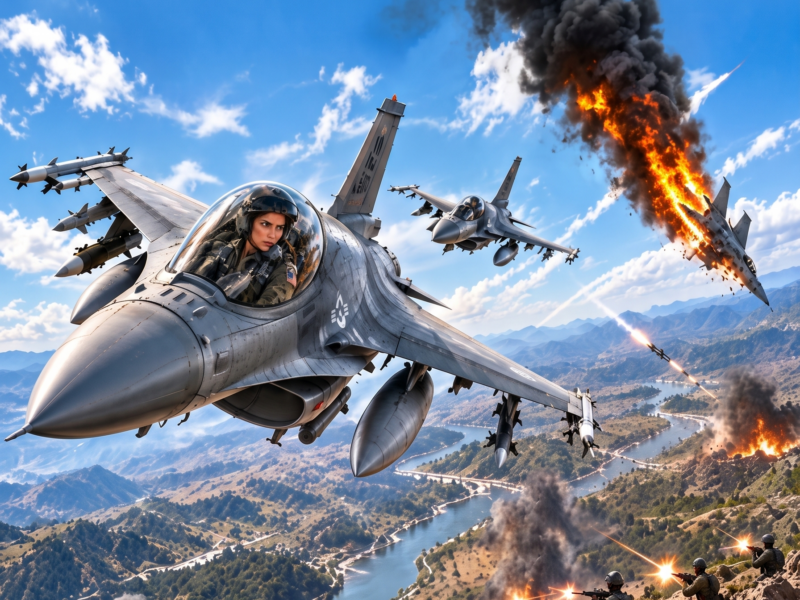
They laughed when I stood beside my F-15 at the Nevada airfield and told me I would never survive an enemy airspace mission
The briefing room in the underground bunker at the Nevada airfield went dead silent when my name flashed across the main projector screen. The cold neon lights hummed above us, casting stark shadows over the faces of twelve seasoned combat pilots.
“You’re not flying this mission, Captain Vance,” Colonel Hayes said, his hands resting flat on the steel conference table. His voice was a flatline—devoid of anger, devoid of hesitation.
I stared across the table at him, my gloved fingers tightening around the edge of my flight helmet. “Why, sir?”
“Because the odds are unacceptable,” Hayes replied, glaring at me through narrow, tired eyes. “The target sector is locked down under an active SA-21 surface-to-air missile envelope. It’s a suicide run.”
Behind him, sitting in the dark second row of theater chairs, Major Miller leaned over to his wingman and muttered loudly enough for the entire room to hear: “She won’t make it ten minutes out there. She’s a simulator ace, not a killer.”
I heard it. Every word burned into my chest like acid, but I didn’t turn my head. I kept my eyes locked on Colonel Hayes. I pretended I didn’t hear the snickers that followed.
For three brutal years, I had trained at Nellis Air Force Base for deep-penetration, low-altitude interdiction missions. I had logged more high-g centrifuge hours, more simulated night engagements, and more blind-cockpit instrument drills than anyone else in my squadron. Yet every time combat orders came down from Air Combat Command, someone else was chosen. I was kept on the tarmac, relegated to ferry duty, training flights, and PR photo ops standing beside my immaculate F-15E Strike Eagle. To them, I was a political token—the daughter of a legendary defense contractor who was too valuable to risk losing in a hot war zone.
Until that morning.
Three hours before dawn, an American reconnaissance pilot—Lieutenant Marcus Vance, my cousin and former wingman—had vanished over the jagged, contested border of the Kharan mountain range in South Asia. His last transmission hadn’t been an ejection code, a set of coordinates, or an emergency locator ping. It had contained only six whispered, distorted words that left the Pentagon in absolute chaos:
Don’t let them find the second aircraft.
Nobody in the intelligence wing knew what those six words meant. They assumed Marcus was delirious, suffering from oxygen deprivation or trauma after his plane took a missile hit.
Except me.
I knew exactly what he meant because six months ago, while performing a routine routine audit of archived satellite imagery in the base intel vault, I had stumbled across a classified photograph that shouldn’t have existed. It showed a remote, snow-dusted ravine deep within hostile territory. Half-buried under a limestone shelf sat a crashed American jet. But it wasn’t a modern reconnaissance plane. It was an older, unmarked black variant of the F-15. And when I checked the flight logs for that specific serial number, I found that the entire mission record had been deliberately deleted from the Air Force central database.
Someone had deliberately erased an entire warplane—and its pilot—from history.
Colonel Hayes slid a thick, red-stamped classified folder across the steel table toward me. “Your reassignment orders to the training wing in Arizona, Captain. You’re staying here.”
I looked down at the folder, then raised my eyes back to the man who had overseen my career for four years. “No, sir.”
His jaw muscles twitched. A dangerous stillness settled over the room. “That’s an order, Captain Vance.”
I stood up straight, pulling my flight gloves on, clicking the Velcro straps into place with a sharp, crisp sound. “Then relieve me of duty, Colonel. Court-martial me. Put me in the brig. Because unless you have armed guards in this room right now, I am walking onto that tarmac.”
Colonel Hayes didn’t answer. He didn’t call the military police. He just stared at me with an unreadable, icy glare, his hands clenched into tight fists at his sides.
Twenty minutes later, the roaring whine of two Pratt & Whitney F100 turbofan engines shattered the morning stillness of the Nevada desert. I was strapped tightly into the cockpit of my F-15E Strike Eagle, oxygen mask clamped over my face, watching the digital multi-function displays light up in sharp emerald green.
The runway lights blurred beneath my wheels as I shoved the throttles forward into full military afterburner. The force slammed my back deep into the ejection seat, and the ground fell away as the Strike Eagle tore into the dark morning sky, climbing rapidly into the upper atmosphere.
My hands on the control stick were steady, disciplined, and calm. My heart was pounding like a sledgehammer against my ribs.
Stealth ingress into non-permissive airspace felt entirely different from every simulator drill I had ever aced. Crossing the border into the Kharan mountains, the cockpit radio fell silent as I went to full emission control—no radar, no external radio chatter, no transponder. The world outside my canopy dissolved into a sea of churning, dark gray storm clouds that swallowed my aircraft whole.
Suddenly, a series of sharp, high-pitched warning tones erupted inside my helmet. The Radar Warning Receiver on my instrument panel flashed violently in amber and red.
THREAT DETECTED. AIR-TO-AIR LOCK.
Three enemy Su-35 fighters dropped out of the cloud layer above me, forming a lethal wedge formation behind my tail. They had been waiting for me.
“Unidentified American aircraft,” a cold, accented voice crackled over the emergency international frequency. “You are in restricted airspace. You are surrounded. Disarm your weapons systems and prepare to be escorted, or you will be destroyed.”
I stared at the tactical radar scope. The three contacts split. Two stayed on my tail while the third swept wide to cut off my escape route. Then, two more contacts materialized on my long-range sensors, rising from a mountain airbase below. Three contacts became five. Then seven.
My breathing grew shallow and rapid, condensation fogging the edge of my visor.
I can’t outrun them in the open, I thought. Not against seven.
Then, through the static in my mind, I remembered my old flight instructor’s voice from my first year at the academy—a voice I hadn’t heard in years. “When you’re scared, Captain, don’t fight the fear. Fear makes your reflexes faster. Use it.”
I slammed the stick to the left, pulling eight g’s as I dove the F-15 hard toward the jagged mountain range below. The anti-g suit squeezed my legs and abdomen like a vice, forcing blood back into my head.
“She’s diving!” an enemy pilot barked over the open channel.
A bright white flash ignited behind me. A infrared-guided air-to-air missile dropped from the wing of the lead Su-35, its rocket motor roaring to life as it tracked my heat signature.
“Missile launch!” I gritted my teeth, throwing the F-15 into a violent barrel roll while dropping a dense cluster of magnesium flares. The missile sucked into the bright heat of the flares, detonating fifty yards off my starboard wing and shaking my airframe violently.
Another missile dropped from the second fighter, coming from the opposite direction.
I didn’t deploy flares this time. Instead, I pushed the nose straight down, dropping lower and lower until the jagged, snow-capped peaks of the mountain valley filled my entire windshield. I was flying under two hundred feet off the deck, navigating through narrow, twisting rock canyons at near-supersonic speeds. The enemy fighters hesitated, their larger airframes struggling to maintain maneuverability in the tight, turbulent valley.
I rounded a steep ridge, banking the jet hard on its side, and there, nestled beneath a massive overhang of sheer granite cliffs, I saw it.
A trail of broken pine trees led to a charred, wreckage-strewn clearing. Sitting in the snow was Marcus’s downed reconnaissance aircraft, its left wing torn away.
My missing pilot was alive. I could see the bright orange fabric of his survival shelter set up beside the fuselage.
But as I swept low over the canyon floor, my thermal sensors picked up two distinct heat signatures standing together beside the wreckage. Two men.
I brought the F-15 into a tight, low-altitude orbit, staring down through the high-magnification targeting pod display on my screen.
The second figure stood tall beside Marcus, wearing an all-black flight suit with a distinctive, custom-fitted high-altitude helmet unit. My blood ran completely cold, the oxygen suddenly feeling thin inside my mask.
I recognized that flight suit. I had seen it in old family photographs and classified squadron ledgers. It belonged to Major Daniel Vance—my father. The pilot who had supposedly died in a classified mid-air collision over the Pacific two years earlier.
Before I could comprehend what I was seeing, my radio headset crackled with a low, static-laced voice broadcasting on a short-range survival frequency.
“Don’t come any closer,” the voice warned. It was Marcus.
I slammed the radio toggle on my throttle. “Marcus! I’m overhead! I have a rescue chopper twenty minutes behind me! Who is the other man?”
Silence filled the channel for three agonizing seconds, punctuated only by the whistle of the wind through the canyon below.
Then Marcus answered, his voice trembling with a mixture of terror and disbelief. “It’s your commander.”
My stomach dropped into a bottomless pit. “What? That’s impossible… Colonel Hayes is in Nevada!”
Behind me, at the edge of the mountain ridge, the radar warning receiver screamed again. The five remaining enemy Su-35s were descending into the valley, locking their fire-control radars onto my tail. I had less than thirty seconds before they closed the distance and blew me out of the sky.
I looked down at the valley floor, watching the two figures standing beside the burning wreckage. Then I looked at the approaching red dots on my radar screen.
Someone had lied about this entire mission from the very beginning. This wasn’t a search-and-rescue operation. It was an execution.
I flipped the safety cover off my master arm switch, target-locking my last remaining radar-guided countermeasures onto the canyon entrance.
“Get ready,” I whispered into the mic.
“Get ready for what, Vance?” Marcus called back frantically.
I turned my fighter straight toward the incoming formation of enemy jets, pushing the throttles into full military power. “For the truth.”
And as I rolled my F-15 upside down to engage the lead enemy fighter, another voice suddenly broke through my encrypted headset—a voice that was crystal clear, completely unbothered by static, broadcasting from right inside my cockpit frequency.
It was Colonel Hayes’s voice.
“Abort immediately, Captain Vance. Stand down.”
I froze, my hand locking on the stick.
Because through my targeting display on the valley floor below, I could see the man standing in the black flight suit beside my crashed cousin. He was holding a short-range tactical radio up to his helmet.
And through his gold-tinted visor, I could see him looking straight up at my jet.
He was smiling.
The world inside my cockpit narrowed to the sharp, green outline of the man on my targeting screen. Down in the snow, two hundred feet below my wingtips, the figure in the black flight suit stood motionless, holding the radio to his cheek while five enemy Su-35s closed in on my tail at eight hundred miles per hour.
“Colonel Hayes?” I whispered, my finger hovering over the red weapons release button on my stick. “How are you on this channel?”
“I told you the odds were unacceptable, Captain,” the voice replied through my helmet speakers. It wasn’t coming from Nevada via satellite relay. The signal strength was local, transmitting from less than a mile away. “I told you to stay in the briefing room.”
“You’re down there,” I breathed, the realization striking me like a physical blow. “The man who walked into the briefing room this morning… that was a proxy. A distraction.”
“A necessity,” Hayes replied smoothly. “You were never meant to find this canyon, Maya. You were meant to be grounded in Nevada while we cleaned up Marcus’s mistake.”
“Marcus didn’t make a mistake!” I yelled back, pulling the F-15 into a sharp, rising turn to evade a radar lock from the lead enemy jet. “He found the second plane! He found the aircraft you erased from the Air Force database two years ago!”
On the radio, Hayes let out a dry, humorless laugh that crackled with static. “You always were too smart for your own good, Captain. Just like your father.”
Before I could ask what he meant, the radar warning receiver screamed a continuous, ear-splitting tone.
WARNING. INCOMING MISSILE. IMPACT IN FOUR SECONDS.
“Break!” I shouted to myself, throwing the Strike Eagle into a violent, negative-g plunge toward the canyon wall.
A radar-guided R-77 missile streaked past my canopy, missing my tail by less than thirty feet, crashing into the rock face behind me in a blinding explosion of fire and shattered granite. The shockwave slammed into my right wing, sending the heavy fighter into a terrifying lateral roll.
I fought the controls, my muscles screaming under the force of six g’s, hauling the stick back until the nose leveled off just fifty feet above the trees.
“Maya, listen to me!” Marcus’s voice broke through the static on the survival frequency. “Don’t fight them! The enemy jets… they’re not hostile to Hayes!”
I blinked, re-aligning my targeting pod on the valley floor.
The five Su-35s weren’t firing on the crash site. They weren’t bombing the canyon. They were flying a tight, protective combat air patrol overhead, forming an impenetrable defensive shield around Colonel Hayes and the crashed reconnaissance plane.
They weren’t enemy fighters. They were his escorts.
“What is this?” I demanded, my hands trembling against the throttle quadrant. “Colonel, who are those aircraft?”
“They belong to a unit that doesn’t exist on any military ledger, Captain,” Hayes’s voice came through cold and precise. “Project Rogue Trident. An integrated, cross-border tactical force operating outside the jurisdiction of the Pentagon, the UN, or any civilian government. We maintain balance in regions where politicians are too cowardly to act.”
“You’re traitors,” I spat, my blood boiling. “You’re flying unauthorized ops in foreign airspace using stolen military assets!”
“We are keeping this nation alive!” Hayes snapped back, his calm facade dropping for a brief second. “Two years ago, your father realized what we were building. He tried to take an F-15 and deliver our operational data to foreign intelligence. I had to shoot him down myself over the Pacific.”
The words hit me like a physical blow. The air in my lungs felt like ice. “You… you killed him?”
“I did what was required to protect the network,” Hayes said. “And today, your cousin Marcus flew his recce plane into our restricted air corridor and took high-resolution photography of our staging base. He forced my hand, Maya. He was never going to leave this valley alive.”
Down in the snow, I saw Hayes slowly raise his sidearm, pointing the barrel directly at the back of Marcus’s head. Marcus was on his knees, his hands locked behind his neck, his red survival suit stark against the white terrain.
“No!” I screamed into my mask.
“You have a choice, Captain Vance,” Hayes said, his voice dropping into a chilling, soft whisper. “You have one AGM-65 Maverick missile remaining under your port wing. You can turn your jet around, fly back to Nevada, and tell them Marcus crashed due to spatial disorientation. Or you can attempt to strike me—and watch my escort fighters tear your aircraft to shreds before your missile even leaves the rail.”
I stared at the multi-function display screen. The green crosshairs of my Maverick missile were locked directly onto Colonel Hayes’s chest. My finger rested on the trigger.
If I fired, the high-explosive warhead would obliterate Hayes and everything within fifty yards—including Marcus.
If I didn’t fire, Hayes would put a bullet in Marcus’s head, slide into the cockpit of an escort transport, and vanish back into the shadows of his illegal war, leaving me to take the blame for an unauthorized border breach.
The red warning lights flashed across my dashboard as the Su-35s above swept into firing positions behind my tail. Five radar locks. Five missiles ready to launch.
Think, Maya, think, I ordered myself, my heart hammering against my ribs. There’s always another option. Look at the terrain.
I looked at the synthetic vision display on my main helmet visor. The high-resolution radar map showed the structure of the canyon walls. Above Hayes and Marcus sat a massive, overhanging shelf of unstable limestone and glacial ice—a three-hundred-ton overhang holding back thousands of tons of loose mountain scree.
My Maverick missile wasn’t aimed at Hayes.
“Captain Vance, you have five seconds to declare your intent,” Hayes said over the radio. “Four… three…”
“I declare my intent,” I whispered softly.
I pulled the nose of the F-15 up twenty degrees, shifting my targeting laser away from Hayes, locking the infrared seeker directly onto the base of the massive limestone shelf four hundred feet above his head.
“Maya, what are you doing?” Marcus yelled over the comms.
“Cover your head!” I shouted.
I slammed my thumb down on the red button.
The AGM-65 Maverick missile ignited under my left wing with a thunderous roar, leaving a thick trail of white smoke as it streaked through the freezing mountain air, accelerating to Mach 2 in a fraction of a second.
“She fired!” an enemy pilot screamed over the open channel. “Destroy her!”
Five air-to-air missiles detached from the Su-35s above, their rocket motors igniting in a blinding flash of orange fire as they tracked my tail.
I didn’t watch them. I watched my Maverick missile.
It struck the base of the limestone overhang with surgical precision. The thousand-pound high-explosive warhead detonated inside a natural fault line in the rock, shattering the granite structure into millions of fragments.
A deafening, earth-shaking roar echoed through the valley as the entire side of the mountain collapsed inward. A massive, roaring avalanche of ice, rock, and snow cascaded down the cliff face, creating a blinding, three-hundred-foot wall of white powder that swept across the canyon floor, burying Hayes’s position, the crashed jet, and Marcus beneath an impenetrable shield of snow.
The shockwave hit my F-15 like a physical wall, tossing the sixty-thousand-pound fighter sideways into the canyon air.
Behind me, the five incoming enemy missiles lost their infrared targets in the massive cloud of frozen dust, exploding harmlessly against the canyon walls in a series of bright, blinding orange fireballs.
I slammed the throttles forward into full afterburner, hauling the stick back into my stomach as I pushed the F-15 straight up through the cloud layer, breaking into the clear, bright blue sky above the storm.
“Marcus!” I yelled into the radio, my voice hoarse from the g-forces. “Marcus, respond!”
For five long, terrifying seconds, there was only static.
Then, a weak, coughing voice crackled through my helmet. “I’m… I’m alive, Maya. The overhang… it buried the wreckage, but it formed a cave over my ejection seat. Hayes… he got swept into the ravine.”
I let out a gasping breath of relief, wiping the sweat from my eyes. “Stay down, Marcus. I’m calling in the real rescue package.”
“Maya, look at your radar!” Marcus suddenly shouted. “It’s not over!”
I looked down at my tactical display.
Rising through the cloud layer right behind me, breaking through the white mist like a predator emerging from the deep, was a single, unmarked black F-15.
It didn’t have any squadron markings. It didn’t have a national roundel.
And as it pulled up alongside my wing, its canopy glinted in the sunlight, revealing a pilot wearing a black flight suit and a gold-tinted helmet.
The pilot turned his head and looked directly at me.
And then, his voice came through my private, encrypted family frequency—a voice I hadn’t heard in two long, painful years.
“You’ve grown up to be a fine pilot, Maya,” my father said. “Now drop your weapons and follow me, or I will be forced to shoot down my own daughter.”
The silence inside my helmet was absolute, broken only by the rhythmic, heavy hiss of my own oxygen regulator.
I turned my head to the left, staring across fifty feet of open air at the sleek, pitch-black F-15 flying formation with my starboard wingtip. The aircraft was identical to mine in airframe geometry, but its surface was coated in a dark, light-absorbing radar-absorbent material that seemed to swallow the morning sun.
“Dad?” I whispered, my voice breaking on the single syllable.
“Maintain your altitude and heading, Captain,” the voice replied over the private family frequency. It was smooth, steady, and possessed the exact same authoritative cadence I remembered from my childhood mornings in Nevada. “We are crossing back into international airspace in three minutes. Do not make any sudden control inputs.”
“You’re alive,” I choked out, tears finally breaking past my discipline, stinging my eyes beneath my flight visor. “Hayes told me he killed you over the Pacific two years ago!”
“Hayes is a politician who happens to wear a uniform, Maya,” my father answered flatly. “He thinks in terms of assets and liabilities. He thought he shot me down. He didn’t check the canopy ejection log before the airframe hit the water.”
“Then why didn’t you come home?” I screamed into the mask, my hand shaking against the throttle control. “You let Mom die believing you were burned alive in a crash! You let me live for two years thinking I was the daughter of a disgraced dead pilot!”
A long pause stretched over the radio link. On the black jet alongside me, I saw the pilot’s helmet shift slightly, looking down toward the snow-covered mountains below us.
“Because if I came home, Maya, Hayes would have put a target on your back the very next day,” he said, his voice dropping into a quiet, raspy register. “The only way to keep you safe was to let the world believe Daniel Vance was dust. I took shelter inside the Rogue Trident network, gathering proof of what Hayes and his backers in the defense sector were planning.”
“And what are they planning?” I demanded. “Hayes said you were a traitor! He said you tried to sell military tech to foreign buyers!”
“Hayes was building a private air force that answers to no commander-in-chief, no Senate oversight committee, and no international law,” my father explained, his black jet hovering with mathematical precision beside mine. “They have three rogue staging airbases hidden across Central Asia and Africa. They use unauthorized strike missions to manipulate regional oil markets and defense budgets. Marcus stumbled onto their main logistics hub yesterday morning. That recce flight wasn’t an accident—Marcus was working with me.”
I blinked, processing the information as my tactical displays flickered. “Marcus was working with you?”
“I gave him the flight corridor to take those satellite photos,” Daniel Vance said. “We were seventy-two hours away from presenting the complete evidence package to the Chairman of the Joint Chiefs. But Hayes intercepted Marcus’s plane early. If you hadn’t flown into that valley today, Maya, Marcus would be dead, and the drive containing the encryption keys would be at the bottom of that ravine.”
“The drive?” I asked, looking down at my instrument panel.
“Marcus has the master drive sealed inside his flight suit pocket,” my father said. “That’s why Hayes was down there in person. He needed that drive back before the Pentagon realized it was missing from the vault.”
Suddenly, my rear-facing warning sensors chimed a sharp, double-beep.
I glanced at my long-range radar display. Four fast-moving radar contacts were climbing rapidly from the valley below us, breaking through the cloud deck at Mach 1.5.
“We have company,” I warned, my combat instincts taking over instantly. “The Su-35 escorts… they survived the avalanche.”
“They’re not after us,” my father replied calmly. “Look at their vector.”
I looked at the tactical screen. The four enemy fighters weren’t climbing toward our high-altitude vector. They were descending back toward the crash site in the canyon floor—toward Marcus.
“They’re going to liquidate the crash site,” I realized with a sudden, icy wave of dread. “They’re going to carpet-bomb the canyon to destroy Marcus and the drive!”
“Maya, listen to me,” my father’s voice cut through my panic, sharp and commanding. “My black airframe has an experimental radar-jamming suite that can blind their targeting systems for ninety seconds. But it requires a dual-stage emitter. I need an F-15 with an active APG-82 radar array to link with my data bus and act as the transmitter hub.”
“I have that radar,” I said instantly.
“If we do this, we have to fly a tight, synchronized trail formation straight down their intercept axis,” he warned. “We will be flying into their crosshairs while completely un-defended until the jammer locks. One mistake from either of us, and both our airframes go down in flames.”
I looked across the fifty feet of freezing air at the black canopy of his jet. For two years, I had flown alone, carrying the weight of his missing legacy. For two years, everyone had told me I wasn’t good enough, that I was just a liability pushed through the pipeline because of his name.
“I’ve logged twelve hundred hours in the simulator flying lead-trail formation, Major,” I said, my voice hardening into absolute steel. “Try to keep up with me.”
For the first time over the radio, I heard my father chuckle—a warm, proud sound that shattered two years of grief in a single second. “Copy that, Captain. Form up on my left wing. On my mark… push throttles to full afterburner.”
I slammed the twin throttles forward. The two F-15s—one bright operational gray, one pitch-black—ignited four massive rings of orange afterburner fire in unison, slicing through the high-altitude cloud deck like a twin pair of daggers, pitching their noses straight down into the dark, storm-wracked canyon below.
“Jamming link established,” my cockpit display chimed as green data lines connected my avionics to his black jet. “Awaiting signal pulse.”
Below us, the four Su-35s were lining up in a broad front formation, their belly bays opening as they prepared to drop heavy laser-guided munitions straight onto Marcus’s position in the snow.
“Three… two… one…” my father counted down over the comms. “Pulse now!”
I slammed the radar pulse switch on my stick.
A massive, invisible wall of high-frequency electromagnetic energy erupted from the nose of my Strike Eagle, amplified ten-fold by the black jet’s experimental suite.
Across the valley, all four enemy Su-35s instantly lost their radar locks, their flight displays flickering wildly as their fire-control computers crashed under the sheer volume of static. Their dropped munitions lost tracking, tumbling harmlessly into the empty forest miles away from the crash site.
“What is that?” an enemy pilot screamed over the panicked radio chatter. “My avionics are dead! I have total system failure!”
“Now, Maya!” my father barked. “Pincer maneuver! Clear the skies!”
We broke formation simultaneously. My father’s black jet pulled hard to the right, while I threw my Strike Eagle to the left, trapping the blinded, confused enemy fighters in a lethal crossfire.
I locked my helmet-mounted sight onto the lead Su-35’s engine exhaust.
BEEP-BEEP-BEEP-BEEP.
“FOX TWO!” I shouted, hitting the red trigger.
A Sidewinder heat-seeking missile shot from my right wingtip, trailing a bright ribbon of white smoke across the dark canyon, striking the lead fighter’s port engine with lethal precision. The Su-35 exploded into a massive fireball, its pilot ejecting into the storm clouds above.
Simultaneously, two rapid flashes from my father’s black jet lit up the opposite side of the valley as he took down the second and third fighters in less than four seconds.
The fourth remaining Su-35 broke hard, dumping all its fuel and flares as it fled at supersonic speed toward the southern border, completely abandoning the engagement.
The skies over the valley suddenly fell quiet, save for the deep, twin hum of our turbofan engines as my father and I brought our jets into a synchronized victory orbit over the crash site.
“Target area clear,” I reported, wiping the sweat from my forehead, my heart hammering with intense triumph. “Marcus… do you copy?”
“I copy, Maya,” Marcus’s voice came through, weak but laughing with relief. “That… that was the most insane piece of flying I’ve ever seen in my life.”
“Hold tight, Marcus,” my father said, bringing his black jet low over the snow. “An American Joint Special Operations command helicopter is three minutes out. They received our automated intel broadcast the moment we fired that pulse. Hayes’s network is finished.”
I looked over at my father’s black aircraft as it pulled up alongside mine once again, our wingtips flying inches apart in the crisp, high-altitude air.
“Dad?” I asked softly. “Are you coming back with us this time?”
The black jet dipped its wings once in a slow, elegant salute against the blue sky.
“The drive Marcus has will clean our name, Maya,” my father said, his voice full of warmth and peace. “You’re going home as a hero. But there are still two more Rogue Trident bases out there in the world… and somebody has to make sure they never threaten my daughter again.”
“Dad, wait—”
“You’re a brilliant pilot, Captain Vance,” he interrupted gently. “Your mother would be so proud of you. I know I am.”
Before I could reply, the black F-15 slammed its throttles into full afterburner, climbing straight up into the blinding glare of the morning sun at Mach 2, disappearing into the upper atmosphere like a phantom returning to the shadows.
I sat in my cockpit, watching the contrail fade into the vast, open sky.
I was no longer the girl they laughed at on the Nevada tarmac. I was no longer the liability. I was an Air Force fighter pilot who had flown into the dark, faced the ghosts of the past, and brought the truth back into the light.
Below me, the green rescue helicopter broke through the clouds, descending toward Marcus’s position.
I smiled beneath my oxygen mask, banked my Strike Eagle toward the east, and set my course for home.
The heavy oak doors of the Pentagon’s main tribunal chamber slammed shut with a reverberating thud that sounded like a rifle shot.
Three weeks had passed since the dogfight in the Kharan mountains. The freezing snows of South Asia were gone, replaced by the sterile, air-conditioned chill of Room 3E912 deep within the ring structure of the Department of Defense.
I sat alone at a long mahogany defense table, wearing my pristine Air Force Service Dress uniform. The silver Captain’s bars on my epaulets caught the harsh glare of the overhead recessed lighting. My hands rested flat on the polished wood. My knuckles were clear, but my posture was rigid, locked into military attention.
Across the elevated judicial bench sat five senior military officers—three generals, an admiral, and a presiding judge advocate colonel whose face looked as if it had been carved out of grey granite.
“Captain Maya Vance,” the presiding judge barked, his voice amplified by the room’s acoustic paneling. “You are charged with six counts under the Uniform Code of Military Justice, including unauthorized departure from a continental U.S. airbase, willful violation of restricted foreign airspace, engaging unapproved aerial targets, and the destruction of classified military hardware.”
He leaned over his reading glasses, his cold eyes staring down at me. “How do you plead?”
I didn’t hesitate. I didn’t glance at the civilian military lawyer sitting beside me. “Not guilty by reason of operational necessity, sir.”
A low murmur rippled through the gallery behind me. Sitting in the front row of the spectator section, wearing a neck brace and supporting his left arm in a sling, was Marcus. He gave me a sharp, subtle nod of encouragement.
“Operational necessity?” the presiding general scoffed, slamming a thick manila folder onto his desk. “You stole a sixty-million-dollar strike fighter from Nellis Air Force Base, crossed three international borders without diplomatic clearance, and triggered a high-level diplomatic crisis!”
“With respect, General,” I replied, my voice steady, carrying clearly across the silent chamber, “I did not steal an aircraft. I executed a combat search-and-rescue mission to recover an American pilot whose location had been deliberately suppressed by a compromised commanding officer.”
“You refer to Colonel Marcus Hayes,” the judge advocate said, turning a page in his ledger. “A officer who is currently listed as Missing in Action following a mountain rockslide in the target sector.”
“He isn’t missing, Colonel,” I countered sharply. “He was buried while attempting to extrajudicially execute an American officer to cover up the existence of Project Rogue Trident.”
The mention of the name Rogue Trident caused an immediate, tense stillness to wash over the panel of judges. The presiding general narrowed his eyes, leaning forward into his microphone.
“That term is classified at the highest compartmentalized level, Captain,” the general warned in a low, dangerous tone. “You are in an open military tribunal. Mentioning unverified black-budget designations will result in immediate gag orders and private confinement.”
“It isn’t unverified, sir,” I said quietly.
I reached into my brass-buttoned coat pocket, pulled out a sleek, black titanium thumb drive—the duplicate storage unit Marcus had handed me inside the medical evacuation helicopter—and placed it gently on the wooden table before the judges.
“That drive contains twenty-four gigabytes of encrypted flight logs, offshore bank routing numbers, and satellite telemetry,” I stated, my voice ringing with absolute confidence. “It documents forty-two unauthorized combat sorties flown by unmarked F-15 airframes over five years. It contains the voice recordings of Colonel Hayes authorizing the shoot-down of my father’s aircraft two years ago, as well as the financial records connecting six defense contractors to shadow airbases in three foreign sectors.”
The five judges stared at the small black drive resting on the table as if it were a live grenade.
“Where did you acquire this data, Captain?” the judge advocate asked, his voice suddenly losing its aggressive edge, replaced by a deep, cautious hesitation.
“From the crash site of Lieutenant Marcus Vance’s reconnaissance plane,” I replied. “And from the pilot of the second aircraft.”
“The second aircraft,” the general repeated, his fingers twitching above his desk. “Your official mission debrief states that an unmarked black F-15 assisted you in engaging four hostiles. Who was piloting that aircraft?”
The room held its breath. This was the moment. This was the question the Pentagon brass had been terrified to ask publicly for three weeks. They wanted a name. They wanted me to confirm that Major Daniel Vance—a dead hero—was alive and operating as a rogue vigilante in international airspace.
If I gave them his name, they would issue a global red notice. They would hunt him with every drone, satellite, and strike asset in the Western hemisphere. They would turn my father into a fugitive for the rest of his life.
If I didn’t give them his name, I was facing twenty years in the military penitentiary at Fort Leavenworth for obstruction of justice.
I looked the general straight in the eye, my face an unreadable mask of military discipline.
“The pilot of the second aircraft was an unidentified ally, General,” I said calmly. “He wore no insignia. His radio was fully encrypted. He assisted in neutralizing hostile assets that were attempting to destroy American lives and classified intelligence. Upon completion of the engagement, he departed international airspace.”
“You expect this panel to believe you did not recognize the pilot?” the general demanded, slamming his fist onto the mahogany table. “A pilot who flew a synchronized two-ship tactical formation with you? A pilot who used specialized family frequency channels?”
“I am stating facts for the record, sir,” I answered without flinching. “The sky over the Kharan mountains was chaotic. I focused on my mission, my cousin, and the survival of my aircraft. If you wish to identify the second pilot, I suggest you analyze the data on that drive. It contains everything you need to know about the men who built that shadow squadron.”
The presiding judge advocate stared at me for a long, agonizing minute. The tension in the room was so thick it felt like the heavy atmospheric pressure inside a cockpit at forty thousand feet.
Slowly, the judge advocate reached out, picked up the black titanium drive, and slid it into his dress uniform pocket.
“This tribunal will recess for two hours while the panel reviews this material in a secure SCIF facility,” the judge announced, striking his gavel against the wooden block with a loud CRACK. “Captain Vance, you will remain in the custody of the bailiff.”
The five officers stood, gathered their folders, and exited through a side door, their faces pale and drawn.
I turned around to face the gallery. Marcus stood up, limped over to the wooden partition, and looked at me through the glass barrier, a huge smile breaking across his face.
“You nailed them, Maya,” he whispered. “They know if they push this court-martial, that data goes straight to the Senate Armed Services Committee.”
“I didn’t do it to beat the court-martial, Marcus,” I said softly, looking up at the high ceiling of the Pentagon chamber. “I did it to finish what Dad started.”
“Do you think he’s safe out there?” Marcus asked quietly.
I thought about the black F-15 climbing into the morning sun at Mach 2, its twin afterburners cutting through the clouds, free and unbound by geographical borders or military politics.
“He’s where he belongs,” I replied. “In the sky.”
Two months later.
The heat of the Nevada desert rose off the concrete tarmac in shimmering, liquid waves. The afternoon sun beat down relentlessly on the flight line at Nellis Air Force Base, baking the smell of jet fuel, hot rubber, and desert sage into the air.
I stood beside the nose gear of my newly refurbished F-15E Strike Eagle—Tail Number 88-014. The airframe had been completely overhauled, its battle damage repaired, its gray skin polished until it gleamed like liquid steel under the desert sun.
On the side of the cockpit fuselage, right beneath the canopy rail, two crisp new additions had been painted in bold black stencil.
The first was a row of four small silhouettes of Su-35 fighters—my official air-to-air victory credits from the Kharan valley engagement.
The second was my call sign, freshly painted in sharp capital letters: CAPTAIN MAYA “PHANTOM” VANCE.
The court-martial had ended not with a prison sentence, but with a quiet, closed-door dismissal of all charges “in the interest of national security.” Colonel Hayes’s Rogue Trident network had been systematically dismantled by Air Force Office of Special Investigations, its shadow facilities seized, its high-ranking co-conspirators quietly forced into early retirement or federal custody.
The story fed to the media was simple: a training accident during a joint exercise in international airspace, followed by a heroic rescue mission executed by a single F-15 pilot.
I was awarded the Distinguished Flying Cross in a private ceremony at the White House, but I didn’t care about the ribbon resting in my locker. The only thing that mattered was sitting right here in front of me: my aircraft, fueled, armed, and cleared for flight.
“Pre-flight checks complete, Captain,” Staff Sergeant Martinez called out, stepping down from the maintenance ladder, handing me the digital flight ledger. “She’s purring like a kitten today. Systems are green across the board.”
“Thanks, Martinez,” I said, signing the ledger with a quick stroke of my pen. “How’s the new long-range telemetry link?”
“Rock solid,” Martinez grinned. “You can pick up a bird singing in Tokyo with this new radar suite.”
I strapped my flight helmet under my arm, zipped up my G-suit, and climbed the yellow maintenance ladder into the cockpit. The familiar, comforting scent of pressurized oxygen, leather, and electronics wrapped around me like a shield.
I seated myself deep into the ejection seat, connecting my chest harness, leg restraints, and comms cords with practiced, rhythmic efficiency.
I flipped the battery switches on. The multi-function displays flickered to life in their familiar emerald glow. I brought the twin Pratt & Whitney engines online, feeling the deep, thrumming vibration reverberate through the airframe and straight up into my spine.
“Nellis Control, Strike One-One requesting taxi clearance for Sector 4 training route,” I spoke into my oxygen mask, my voice steady and calm.
“Strike One-One, Nellis Control,” the tower operator crackled back over my headset. “You are cleared for taxi to Runway 03 Right. Winds three-zero-zero at ten knots. Altimeter two-nine-nine-two. Clear for takeoff upon reaching the line.”
“Strike One-One, copy all.”
I released the parking brake and advanced the throttles slightly. The heavy fighter rolled smoothly off the staging ramp and onto the long taxiway, its nose wheel tracking the yellow line painted on the dark asphalt.
As I reached the threshold of Runway 03 Right, I looked up through the clear composite glass of my canopy.
The Nevada sky stretched out above me—an endless, brilliant expanse of deep sapphire blue, reaching all the way to the horizon, where the distant, purple-tinged mountain ranges met the edge of the earth.
There were no shadows here today. No secrets buried in snow. No erased mission reports. Just the open air and the horizon.
I pulled my oxygen mask tight over my nose and mouth, clicking the bayonet clasps into place. I checked my instrument panel one last time: fuel state optimal, weapons master disarmed, radar sweeping sixty miles out into the desert training range.
“Strike One-One, cleared for departure,” the tower radioed. “Good hunting, Captain.”
“Strike One-One rolling,” I replied.
I slammed the throttles forward into full military afterburner.
The twin engines roared behind me with fifty thousand pounds of thrust, slamming my body hard against the seat back. The runway lights turned into a blinding white blur on either side of my wheels as the speed indicator swept past one hundred, one hundred and fifty, two hundred knots.
I pulled back gently on the control stick.
The nose of the Strike Eagle pitched up, the main gear lifted off the concrete, and the aircraft shot into the sky like an arrow released from a bow.
I didn’t fly level. I kept the nose pointing straight up, climbing vertically into the thin, cold air at forty thousand feet, leaving the desert floor far below.
As I leveled off at the ceiling of the flight corridor, rolling the jet flat against the dark blue upper atmosphere, a faint, rhythmic double-beep chimed on my secondary communications display.
It wasn’t a military frequency. It wasn’t a signal from Nellis Control.
It was an encrypted, short-range transmission popping up on my private avionics channel—a signal transmitting from somewhere way out past the edge of the radar range, high above the clouds where satellite surveillance couldn’t reach.
I reached out and tapped the multi-function display glass.
A single line of text flashed across the emerald screen, written in dark, crisp digital characters:
CONTACT ESTABLISHED. ALL SYSTEMS CLEAR. KEEP YOUR WINGS LEVEL, PHANTOM.
I looked out through my canopy, staring past my starboard wingtip into the vast, bright infinity of the sky.
I didn’t see a jet. I didn’t see contrails. But I knew he was out there—watching the horizons, guarding the shadows, flying the long guard so I could fly in the light.
A small, proud smile broke across my face inside my mask.
I toggled my transmitter switch, sending a single, short-burst reply across the private frequency:
COPY THAT, LEADER. WINGS LEVEL.
I pulled the F-15 into a long, sweeping bank to the west, locking my radar onto the horizon, and flew straight into the bright, endless sun.
The end,









