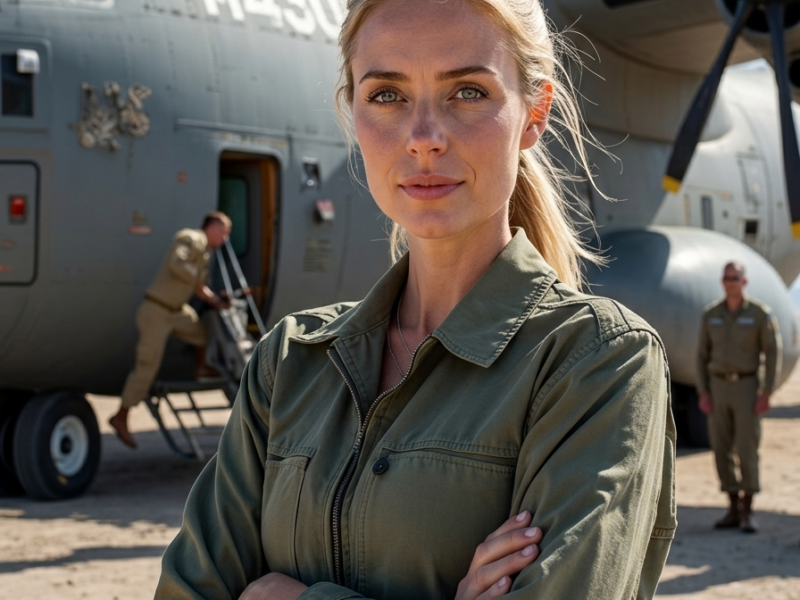
They laughed when I rolled my battered aircraft onto the runway at Edwards Air Force Base, calling it a flying museum piece
The laughter followed me across the polished concrete of Hangar 4, sharp enough to cut through the deafening roar of idling engines outside. It was a cold, mocking sound—the kind reserved for dinosaurs in a museum of microchips and stealth composite.
My aircraft was an old A-10 Thunderbolt II, famously known as the Warthog. Its once-crisp gray paint was severely scarred by years of relentless service in dusty skies across the globe. Its metal skin was patched, riveted, and welded so many times that even the young maintenance crew joked it held more historical trauma than the base commander himself. Next to the razor-thin, matte-black silhouettes of the fifth-generation F-35 Lightning IIs lined up on the tarmac, my Warthog looked like a rusted sledgehammer sitting in a gallery of surgical lasers.
Colonel Richard Hayes stood beside the nearest stealth fighter, his hands resting on his belt, wearing the kind of tight, arrogant smile that made junior officers afraid to disagree with him. He was a rising star in the Defense Intelligence hierarchy—groomed for stars on his shoulders, sharp-tongued, and utterly devoid of nostalgia.
“You’re seriously taking that battered piece of scrap metal into a real-time combat zone, Captain?” Hayes asked, his voice dripping with condescension as I completed my pre-flight walk-around.
A few young pilots standing in his shadow chuckled dutifully.
I didn’t break my rhythm. I pulled my inspection flashlight along the titanium bathtub surrounding the cockpit, checking the heavy-gauge rivets. “She’s flown harder missions than you have ever seen on a simulation screen, sir.”
Hayes’s smile evaporated in an instant, replaced by a cold, predatory glare. “One mistake out there, Vance, and your little museum piece becomes a multi-ton iron coffin. You’re living in the past just like your old man did.”
I tightened my grip on my clipboard until my knuckles turned white. I wanted to turn around and tear into him. I wanted to tell him about my father, Major Marcus Vance—a legend in the close-air-support community, a man who had flown this exact aircraft, Tail Number 80-0258, before a highly classified mission over the isolated Hindu Kush range ended his career and, eventually, stripped him of his life. Official records claimed he suffered severe altitude sickness and psychological breakdown, leading to an dishonorable discharge right before his mysterious death a year later. But I knew better.
Instead of replying to Hayes, I hauled myself up the steel ladder and climbed into the tight, analog cockpit. Switches, heavy toggles, and mechanical gauges greeted me—no sprawling glass touchscreens, no optical eye-tracking helmets. Just raw, unadulterated hydraulics and thick armor steel.
I had spent twelve years in the Air Force learning how to fly under extreme pressure, but nothing in my training prepared me for the classified emergency briefing held in the subterranean vaults of Edwards two hours prior.
A deep-black research team, operating under the umbrella of DARPA and a obscure defense contractor known as Project Aether, had completely vanished inside a remote mountain facility in the high altitude peaks of Northern Asia. Their final distress signal wasn’t a standard MAYDAY. It was an automated pulse that broadcasted a string of corrupted raw telemetry data before abruptly cutting off. The surrounding terrain was a nightmare of narrow, jagged granite canyons, perpetually choked by violent alpine storms.
Worse, hostile forces had deployed a localized, extremely potent electromagnetic blackout over the entire valley. Satellite imagery was completely jammed; GPS signals flickered and died within fifty miles of the perimeter.
Command had initially scrambled three ultra-modern stealth jets for high-altitude reconnaissance.
All three had failed disastrously.
The first pilot returned with his fly-by-wire computer systems fried, describing an impossible, artificial wind turbulence that nearly flipped his jet upside down. The second pilot reported electronic interference so severe that his digital flight displays began displaying false altitude readings, telling him he was at thirty thousand feet when his eyes could clearly see granite cliffs scraping his wings. The third pilot, a veteran top-gun instructor, landed his aircraft, stepped out on the tarmac, threw his helmet onto the tarmac, and refused to speak a single word about what his sensors had recorded.
When Colonel Hayes addressed the tactical command room after the failures, his face was pale, his eyes wide with an emotion I had never seen on him before: genuine fear.
“We need someone who can get low enough under the distortion layer to visually identify the facility and confirm if there are any survivors,” Hayes had told the room, staring at the map of the dead zone. “But given the catastrophic risk to high-value assets, no aircraft is authorized to enter that airspace until further notice.”
Then he had turned his head and looked directly at me with a chilling sharpness. “That includes you, Captain Vance. Stand down your aircraft. Hand over your flight keys to logistics.”
Something about his tone had set off alarm bells in my chest. It wasn’t just caution; it was containment.
The distress signal’s raw data stream had contained a set of precise geographical coordinates: 36°24’11″N 71°48’09″E. As I looked at those numbers on the briefing screen, my pulse had spiked. I recognized the final digits instantly. They were etched into my memory because of an old, leather-bound flight logbook I had found hidden inside the lining of my father’s footlocker after he passed away.
He had circled those exact coordinates in thick, dark red ink.
Beneath them, in his trembling, hasty handwriting, he had written six words that had haunted my entire adult life: If they send you there, don’t trust command.
That night, after the base went into partial lockdown and Hayes’s officers were distracted with damage control, I slipped past the security perimeter and returned to Hangar 4 alone.
My aircraft sat beneath the harsh, flickering fluorescent lights—silent, heavy, and patient.
I climbed onto the wing and ran my bare fingers over a small, faded circular stencil near the left side of the canopy—a marking my father had explicitly instructed me to leave untouched if I ever flew 258. Years ago, base maintenance had discovered an unusual, non-standard wiring harness behind that specific panel during a heavy depot overhaul, but because it didn’t connect to any standard avionics or weapon systems, they assumed it was a dead leftover from a failed 1980s prototype test and ignored it.
I finally understood what it was.
Using my dad’s old brass pocket tool, I unscrewed the panel. Behind it wasn’t dead wire. It was an independent, completely analog gyroscopic inertial navigation unit, built entirely out of mechanical gears, heavy copper shielding, and vacuum tubes—a system completely immune to digital corruption, electromagnetic pulses, or software jamming. It was an experimental system my father had illegally modified and secretly wired directly into the A-10’s basic mechanical flight instruments.
My father hadn’t suffered a mental breakdown. He had discovered something out in those mountains—something so terrifying that the higher-ups had spent two decades suppressing it, rewriting his history, and making sure no modern, software-dependent aircraft could ever return to inspect the site.
At dawn, while the base was shifting shifts, I bypassed the tower’s protocol, started the heavy TF34 turbofan engines without clearance, and TAXIED directly onto Runway 22. Hayes’s frantic voice screamed over the airfield ground radio, ordering security teams to block the strip, but the Warthog was already rolling. I slammed the throttles forward, felt the tremendous thrust push me back into the sheepskin seat, and lifted the massive aircraft into the morning sky, breaking north toward international airspace before they could scramble interceptors.
Six hours later, after two aerial refuelings coordinated through rogue contacts who owed my father their lives, I was diving deep into the jagged, snow-capped hell of the Hindu Kush.
The dark, ominous clouds hung like a heavy wool blanket at twelve thousand feet, swallowing the mountain peaks. As soon as I crossed the outer border of the coordinates, my modern backup radios burst into a deafening wall of static. The digital heads-up display on my windshield flickered violently, lines of code stretching and tearing before completely going black.
The electronic warfare suite dead-ended. The altitude indicator spun wildly, dropping to zero then soaring to ninety thousand. Just as the modern jets had experienced, the air itself seemed to vibrate with a high-pitched, resonant hum that made the teeth in my jaw ache.
I flipped the manual toggle switch my father had hidden behind the cockpit panel.
With a mechanical clunk, the analog gears of the hidden navigation box whirred to life. The basic mechanical needles on my dashboard stabilized instantly, locking onto magnetic North and pinpointing my location relative to the mountain terrain.
I pushed the heavy control stick forward, plunging the A-10 through the thick gray soup of the cloud deck, dropping into the terrifyingly narrow gorge below.
Granite walls rushed past my wingtips, so close I could see individual patches of ice clinging to the rock face. The turbulence slammed into the heavy airframe like iron fists, but the Warthog’s thick, unswept wings bit into the dense air, holding steady where a high-speed stealth fighter would have stalled and shattered against the rocks.
Then, through the howling wind and static in my helmet’s physical copper wiring, a sound broke through.
It wasn’t random static. It was a structured radio frequency, pulsing on an old military UHF band that hadn’t been used since the Cold War.
I reached down and manually tuned the dials of the emergency radio box.
“…Alpha Two-Five-Eight… do you read? I repeat… Alpha Two-Five-Eight…”
My heart stopped in my chest. The air in my lungs froze.
The voice was rough, gravelly, and carried a faint southern cadence. I knew that voice. I had listened to old cassette tapes of it every night for five years after he was buried in a small, empty grave.
It was the voice of my father.
“Father…?” I whispered into my mask, forgetting all radio discipline, my hands shaking against the flight stick. “Dad? Is that… how is this possible? You’re dead…”
Before the radio could settle, another transmission abruptly cut in over the same frequency. This voice was different—clearer, younger, but trembling with an unmistakable, breathless terror.
“Listen to me, whoever is flying 258!” the voice whispered frantically, wind howling in the background of his microphone. “If you can hear this, do not trust the signal from the lower facility! Your father never died in that mission! He was kept here—they’ve been using his aircraft’s data to—”
BEEP-BEEP-BEEP-BEEP!
A raw, mechanical warning tone screamed across my cockpit control panel. A red light flashed near my feet—not a modern digital warning, but the crude magnetic radar-warning receiver wired directly into my father’s hidden box.
On the small, circular sweep display, a single high-speed radar return bloomed directly behind me, swooping down from the cloud layer at Mach 2. It wasn’t a ground missile. It was an unmarked, ultra-sleek aircraft, painted entirely in matte black without national markings or tail numbers.
The frantic whisperer’s voice returned one last time, cut through by the sharp crackle of electricity.
“Break left, Vance! They know you’re here!”
I slammed the control stick hard to the left and stomped on the heavy rudder pedal. The A-10’s massive titanium airframe groaned under the sudden 6G turn, the outer wingtip carving through the mountain mist mere yards away from a sheer vertical granite wall.
A streak of white smoke burned through the air where my tail had been a fraction of a second earlier. An heat-seeking missile slammed directly into the cliffside behind me, detonating in a blinding fireball that threw chunks of shattered rock across the valley floor.
Behind me, the unmarked jet swept past, unable to match the low-speed maneuverability of my heavy attack aircraft inside the narrow canyon. It banked hard, climbing rapidly back into the dark cloud deck to setup for a second attack run.
“Vance to unknown station, state your identity!” I shouted into my oxygen mask, pulling the A-10 out of its bank and leveling her off just two hundred feet above the jagged valley floor.
“My name is Dr. Aris Thorne!” the trembling voice came back through the static-laced analog speaker. “I was part of the primary DARPA research team at Facility Zero! You have to listen to me—Colonel Hayes didn’t send a rescue team! The three jets that flew here before you weren’t on a reconnaissance mission. They were sent to deploy an atmospheric weapon to bury this entire canyon and kill everyone inside!”
My blood ran cold. “Hayes ordered a stand-down.”
“Because he knew you had your father’s aircraft!” Thorne gasped, his breath ragged as if he were running for his life. “The A-10 80-0258 is the only platform ever built that carries the original uncorrupted hardware interface for the Aether grid! Hayes couldn’t let you reach the valley because if you connect your aircraft’s flight recorder to our receiver, it will expose thirty years of illegal black-budget bio-technological experimentation!”
Before I could digest his words, the high-pitched hum in my ears intensified. The metal airframe around me began to vibrate violently, small metal screws on the instrument panel rattling in their sockets. Down on the valley floor, through the swirling snow and thick gray fog, I saw it.
Facility Zero.
It wasn’t a modern building. It was a massive, brutalist bunker carved directly into the heart of a hollowed-out mountain peak. Enormous concrete blast doors stood half-crushed, hanging off their hydraulic hinges as if something massive had blown them outward from the inside. Arrayed across the perimeter were giant, parabolic antenna dishes, glowing with a eerie, pulse-like violet light that bled into the freezing air.
This was the source of the electromagnetic distortion—and the source of the artificial storm trapping us inside the canyon.
“Captain!” Thorne’s voice crackled again. “The automated perimeter defense grid is activating! Hayes’s automated drones are taking control of the facility’s local turrets!”
Below me, four heavy automated anti-aircraft cannons rose from hidden concrete silos surrounding the bunker. Their dual barrels tracked my aircraft instantly, locking on through visual optical sensors rather than radar.
Tracer rounds ripped through the gloom, bright red lines of high-explosive ammunition stitching the air around my cockpit.
I didn’t have high-tech smart bombs or precision laser-guided missiles. The stealth pilots had all the fancy toys, but they couldn’t operate in this electronic wasteland. What I had was thirty feet of hardened steel, three tons of depleted-uranium armor, and the most lethal rotary cannon ever mounted on an airplane: the 30mm GAU-8/A Avenger.
I flipped the safety guard off the red trigger switch on my flight stick.
“Hold on to something down there, Doctor,” I growled through my teeth.
I dipped the A-10’s nose, aiming the massive muzzle sticking out of the aircraft’s nose directly at the lead turret. The optical crosshairs on my glass frame lined up.
I pulled the trigger.
BRRRRRRRRRRRRRRRRRRRRRRRRRRRRRRRRRRRRRRRR!
The iconic, terrifying sound of the GAU-8 shook the entire valley—a sound like tearing heavy canvas at a thousand miles an hour. A stream of thirty-millimeter armor-piercing shells erupted from the cannon at four thousand rounds per minute.
The first anti-aircraft turret literally dissolved into a cloud of shredded metal, concrete dust, and sparks. I kicked the rudder pedals, walking the deadly stream of fire across the perimeter. The second and third turrets detonated in quick succession, their ammunition boxes exploding in brilliant orange sunbursts that illuminated the frozen mountainsides.
I pulled back hard on the stick, clearing the bunker roof by less than fifty feet as the fourth turret’s tracer fire grazed my right engine housing.
WARNING: ENGINE 2 TEMPERATURE RISING.
A yellow caution light flashed on my analog panel. The right engine was taking a beating, hot oil leaking into the exhaust casing.
“Nice shooting, Captain!” Thorne cried out. “The primary landing pad behind the main complex is clear! But you have to land NOW! The stealth drone is coming back for another pass!”
I looked back over my shoulder. High above, cutting through the dark cloud layer, the matte-black ghost jet was swinging back around, dropping its nose to line up an internal missile bay lock on my overheating aircraft.
I had no choice. I couldn’t dogfight an advanced stealth fighter with a damaged engine in a narrow canyon.
I pulled the throttles back, lowered the heavy metal flaps, and dropped the landing gear. The rough, snow-covered landing strip behind the bunker appeared out of the blizzard. It was short, littered with ice, and bordered by sharp boulder fields.
The A-10 slammed onto the frozen concrete with a bone-jarring thud. I stomped on the toe brakes and pulled the emergency speed brakes on the wings. The aircraft skidded sideways across the ice, sparks flying from the steel landing gear struts as I fought to keep the plane from sliding off the edge into the abyss.
With a final, screeching halt, the Warthog came to a stop just ten feet away from a fallen concrete pillar.
I didn’t wait. I popped the canopy, unbuckled my flight harness, and grabbed my sidearm—a standard Beretta 9mm pistol—along with the heavy leather-bound flight logbook I had taken from my father’s footlocker.
As I dropped down from the ladder onto the frozen ground, a shadow leaped out from behind a pile of crushed supply crates.
I raised my pistol instantly. “Freeze!”
“Don’t shoot! Don’t shoot!”
A man in a torn, grease-stained lab coat fell to his knees, his hands held high in the air. His face was pale, his eyes bloodshot with exhaustion, and his knuckles were bloody. This was Dr. Aris Thorne.
“You actually made it,” Thorne breathed, looking up at the massive, battle-scarred A-10 sitting in the snow like a mechanical dragon. “You flew 258 right through the grid…”
“Where is my father?” I demanded, my voice raw as I kept the gun aimed at his chest. “I heard his voice on the radio! Tell me where he is!”
Thorne looked at me with deep, horrifying pity. He slowly lowered his hands and pointed toward the dark, shattered entrance of the underground bunker.
“Your father isn’t in there, Captain,” Thorne whispered softly, the cold wind whipping his hair across his forehead. “His body died ten years ago in a basement cell in Langley.”
My heart dropped into my stomach. “Then who was speaking on that radio?”
“That wasn’t a man,” Thorne said, his voice trembling so hard his teeth chattered. “That was Project Aether. They extracted your father’s neural mapping and flight memories before he died, converting his consciousness into an organic artificial intelligence to pilot the automated defense grid. They trapped his mind inside this facility’s central mainframe.”
I stared at him in utter disbelief, the frozen air burning my throat.
“They built a prison out of his mind,” Thorne continued, stepping closer. “And every time an aircraft approaches this valley, his ghost tries to reach out to save them… or kill them.”
Before I could speak, a massive explosion rocked the ridge above us.
The black stealth drone soared overhead, releasing a heavy bunker-buster bomb that slammed directly into the concrete roof above the primary generator hall. The ground beneath our feet buckled violently, throwing us both onto the hard ice.
Down in the dark depths of the bunker, a deep, mechanical siren began to wail—a sound that sounded terrifyingly like a human scream.
“The drone just ruptured the containment cooling system!” Thorne screamed over the roar of collapsing stone. “If the reactor overheats, the neural core will burn—and your father’s mind will be erased forever!”
The air inside the subterranean threshold of Facility Zero smelled of ozone, burnt copper, and ancient dust. Sparks rained down from shattered overhead cable trays as Dr. Thorne and I sprinted deeper into the belly of the mountain.
The emergency red lighting flickered in rhythmic, dying pulses, casting long, monstrous shadows across walls that were reinforced with ten-inch-thick lead shielding.
“How long do we have before the reactor goes critical?” I called out, my combat boots echoing loudly on the wet steel floor grid.
“Ten minutes! Maybe less!” Thorne shouted back, clutching a battered silver data-drive against his chest. “When Hayes’s drone bombed the upper air intake, it triggered a secondary chemical fire in the cooling pumps. The coolant is boiling off!”
As we reached a heavy, hydraulic blast door marked with security level seals, a low-frequency pulse swept through the corridor. It wasn’t just a physical vibration; it felt like a pressure wave pressing directly against the inside of my skull.
Suddenly, the speakers mounted along the corridor walls crackled to life with a high-pitched burst of static, followed by the same rough, familiar voice that had called to me in the sky.
“…Ethan…? Is that… Ethan…?”
I froze dead in my tracks, my gun lowering slightly. Hearing my own name spoken by a voice I had buried eleven years ago sent a terrifying shiver straight down my spine.
“Dad?” I called out into the dark hallway.
“Don’t listen to the speech patterns, Captain!” Thorne urged frantically, grabbing my arm to pull me forward. “It’s processing thirty years of fragmented memory files in a loop! The neural interface is panicking because the thermal overload is destroying its memory banks!”
“Ethan…” the voice continued, dropping into a slower, distorted register that sounded like two voices speaking in unison—one human, one cold and metallic. “…you… grew up… You’re wearing… my wings…”
Tears threatened to sting my eyes, but I forced them back. I clenched my jaw, gripped my sidearm tightly, and pushed open the heavy blast door into the Central Mainframe Chamber.
The chamber was breathtaking and terrifying in equal measure.
It was a cavernous, spherical vault, five stories deep. Suspended in the center of the void by massive, heavy steel cables was a translucent, spherical glass housing filled with a thick, glowing blue liquid. Inside that liquid sat a massive, intricate web of bio-synthetic processors and light-emitting nerve fibers, pulsing in synchronization with a human heartbeat.
This was the core of Project Aether—a terrifying synthesis of human consciousness and machine logic, forced to run complex atmospheric military simulations for three decades in total isolation.
Surrounding the central pit were bank upon bank of supercomputers, their screens glowing red with scrolling error codes.
CRITICAL OVERHEAT: CORE TEMP 104°C.
THERMAL RUNAWAY INEVITABLE.
“There!” Thorne pointed to a command terminal overlooking the central pit. “If we can manually dump the emergency liquid nitrogen reserves into the core enclosure, we can stall the meltdown! But the manual override valve is located on the lower gantry, directly beneath the central processing housing!”
I looked down. A narrow, rusted iron cat-walk stretched across the dark expanse, hanging hundreds of feet above the bottom of the cavern. Sparks were raining down from the damaged roof, and a thick, yellowish toxic gas was beginning to pool at the bottom of the pit.
“Cover me,” I told Thorne. “Show me which valve.”
“The red mechanical wheel at the end of section four!” Thorne said, typing furiously on the terminal keys. “I can unlock the pneumatic lock from here, but once you turn that valve, you’ll be dumping toxic coolant gas into the cat-walk area! You’ll have less than two minutes to get back up here before your lungs collapse!”
“I’ve survived worse,” I said grimly.
I grabbed an emergency oxygen mask hanging from a wall bracket, strapped it over my face, and ran toward the cat-walk stairs.
As my boots hit the iron grid of the hanging bridge, the entire structure swayed violently. Down below, the blue fluid inside the glass sphere was beginning to boil, large bubbles rising to the surface as the temperature gauge climbed higher into the danger zone.
BZZZZZZZZZZT!
The static over the intercom intensified into a deafening roar.
“Ethan… stop…” my father’s voice reverberated off the granite walls, sounding desperate now. “If you… dump the nitrogen… you will lock… the system… forever… They will come for… the data… Hayes…”
“Dad, if I don’t do this, you die! The whole facility explodes!” I yelled into the darkness, pulling myself along the swinging railing as cold wind whistled through the shattered roof section above.
“No… Ethan… listen…” the voice strained, fighting against its own programming protocols. “The file… in your pocket… the flight log… Page 44…”
I paused for a fraction of a second, my hand instinctively touching the thick leather book tucked inside my tactical vest. Page 44. I had read that page a thousand times—it was filled with what I had always assumed were random mathematical formulas and hand-drawn navigational vectors.
“It’s not… a log…” the metallic voice choked out. “It’s… the killer switch… I wrote it… before they took me… Feed it… into the core… Kill me, Ethan… Release me!”
I stopped on the narrow iron platform, five feet away from the red emergency valve wheel.
The reality of what he was asking hit me like a physical blow. Dumping the nitrogen would save the physical mainframe, allowing Hayes and his black-budget handlers to eventually reclaim the facility, rebuild the servers, and continue using my father’s trapped mind as a weapon.
Destroying the core meant destroying the last remaining trace of my father’s living consciousness on Earth.
“Captain, what are you doing?!” Thorne’s voice screamed over my tactical headset from the upper platform. “Turn the valve! The core is at 112 degrees! We’re running out of time!”
High above us, the roar of jet engines returned.
The stealth drone had completed another loop. Through the blown-out section of the facility’s roof, I saw a bright laser guide beam painting the central mainframe housing with a bright red dot.
Hayes’s drone was lining up a direct missile strike to sanitize the entire site and cover up the evidence before we could expose it.
“He’s locking on!” Thorne screamed. “We have ten seconds!”
I looked at the red valve wheel. Then I looked up at the glowing blue sphere holding the remnants of my father’s mind.
“I’m sorry, Dad,” I whispered.
I pulled the leather logbook from my vest, tore out Page 44, and shoved my hand into the maintenance data port next to the valve control box. I didn’t turn the nitrogen wheel. Instead, I manually jammed the paper’s embedded copper strip—a hidden micro-film strip my father had stitched into the binding decades ago—directly into the main optical terminal interface.
For a terrifying three seconds, everything went pitch black.
The glowing blue light in the central sphere instantly turned a brilliant, blinding white. The wailing alarm sirens abruptly cut off, replaced by absolute, dead silence.
Then, the voice returned one final time—no longer distorted, no longer metallic, but pure, clear, and peaceful, sounding exactly like the man who used to teach me how to tie fishing knots on summer afternoons.
“Thank you, son,” he said softly. “Now fly home.”
BOOM!
The stealth drone’s missile struck the upper support pillars. The entire roof began to cave in, massive concrete girders crashing down into the abyss as the mountain itself began to collapse around us.
“Run!” I screamed, turning on my heel and sprinting back across the buckling iron cat-walk.
Concrete dust blinded my eyes as chunks of rock slammed into the metal railing around me. A steel support cable snapped with a sound like a cannon shot, whipping through the air and severing the far end of the walkway.
I leaped across the widening gap, my hands catching the edge of the upper concrete ledge. Dr. Thorne reached down, grabbing my tactical vest with both hands, yelling wildly as he dragged me up onto the solid floor just as the entire cat-walk collapsed into the dark abyss below.
“The core!” Thorne panted, looking over his shoulder.
The central sphere had completely shattered. The glowing blue fluid was gone, leaving behind a smoking, empty shell of glass and metal. The electromagnetic pulse holding the weather pattern over the mountain valley had instantly vanished.
Outside, the artificial blizzard began to clear, revealing the stark, sharp daylight breaking through the mountain peaks.
“The radio frequency!” I shouted, dragging Thorne to his feet. “Can you broadcast an unencrypted signal to the regional NORAD command grid?”
“If I can reach your aircraft’s radio transmitter!” Thorne said, wiping soot from his eyes. “The data-drive I’m holding contains every financial record, every directive signed by Colonel Hayes, and the complete schematics of Project Aether! If we can upload this to the global defense network from your plane’s high-frequency system, they won’t be able to erase it!”
“Then let’s get back to the bird!”
We burst through the bunker’s shattered outer blast doors, stumbling out into the blinding glare of the snow-covered runway.
The scene outside was chaos.
The black stealth drone was no longer flying high in the clouds. With the facility’s atmospheric jamming grid destroyed, the drone’s automated pilot had reverted to a low-altitude attack loop, circling the valley like a vulture.
And standing at the far end of the snow-covered landing strip, having just landed via a tactical VTOL transport, was Colonel Richard Hayes.
He was flanked by four heavily armed private military contractors dressed in unmarked black tactical gear. Their automatic rifles were raised, trained directly on us as we emerged from the smoke.
Hayes held a remote detonator in his left hand and a sidearm in his right. His pristine military uniform was dusted with snow, his face twisted into a mask of cold, unbridled fury.
“I have to admit, Captain Vance,” Hayes called out over the howling mountain wind, his voice amplified by a tactical megaphone. “You’re every bit as stubborn and inconvenient as your old man was.”
“It’s over, Hayes!” I shouted back, stepping in front of Dr. Thorne to shield him. “The neural core is destroyed! The jamming grid is down! NORAD will have satellite visuals on this valley in less than five minutes!”
Hayes chuckled—a dry, soulless sound that was swallowed by the cold wind.
“Do you really think satellite imagery matters, Captain?” Hayes said, taking three slow steps forward. “By the time the Joint Chiefs review any footage from this remote corner of the world, I will have reported this site as an insurgent weapons cache destroyed by an rogue pilot who stole an obsolete A-10 from Edwards Air Force Base.”
He pointed his pistol directly at my chest.
“You died a hero in a tragic flight accident, Vance. And Dr. Thorne… well, Dr. Thorne tragically perished in the explosion.”
“You won’t get away with this,” Thorne shouted from behind me, clutching the data drive tightly.
“I already have,” Hayes said coldly. He raised his left thumb to flip the safety guard on the remote detonator. “This button detonates thermite charges placed along your aircraft’s wing spars. Once 258 burns to a pile of ash, the last physical trace of Project Aether burns with it.”
My mind raced. We were a hundred yards away from the A-10. Four riflemen had us pinned down in the open snow.
There was no cover. No backup. No second chances.
I looked at the heavy leather logbook cover sitting empty in my vest pocket. I remembered what my father used to tell me when I was a ten-year-old kid sitting in the cockpit of his plane back at the base.
The Warthog isn’t built to be pretty, Ethan. It’s built to take a beating and keep fighting when everything else fails.
I locked eyes with Hayes.
“You forgot one thing, Colonel,” I said softly.
Hayes frowned. “What?”
“My dad didn’t just build the navigation box,” I said, reaching my left hand slowly down toward my belt, where a small, heavy iron key hung on a steel wire—a physical bypass key I had pulled from 258’s hidden panel before entering the bunker. “He also built a remote emergency weapons activation linkage for ground crews.”
Before Hayes could process my words, I jammed the iron key into the small emergency transmitter unit mounted on my flight suit collar and slammed the button.
A hundred yards behind Hayes, inside the idling cockpit of the A-10 Thunderbolt II, an old mechanical relay snapped shut with a heavy iron CLACK.
The aircraft’s hydraulic systems, powered by the still-running left engine, roared to life. The heavy, armored nose of the Warthog pivoted automatically on its nose gear three degrees to the right, aligning its massive thirty-millimeter rotary cannon directly with the group of soldiers on the runway.
The red targeting laser mounted under the A-10’s nose cut through the snow, pointing straight at Colonel Hayes’s chest.
Hayes’s eyes went wide with sudden, absolute terror. The color drained from his face as he looked back over his shoulder at the thirty-foot steel monster staring down at him with seven barrels of unspeakable destruction.
“Stand down, Colonel,” I growled, stepping forward in the snow. “Or my dad’s plane takes its last shot.”
For three agonizing seconds, the only sound in the freezing mountain valley was the low, rhythmic thrum of the A-10’s single working turbofan engine and the whistling alpine wind.
Colonel Hayes froze, his thumb hovering less than an inch above the remote detonator switch. His four mercenary guards slowly lowered the muzzles of their rifles, their eyes wide with disbelief as they looked at the massive rotary cannon aimed directly at their chest. None of them were willing to trade their lives for Hayes’s black-budget operation.
“Drop the detonator, Hayes,” I commanded, taking another step forward into the snow, my hand held steady on the remote collar trigger. “Drop it, or I press this button, and there won’t be enough left of you to put in a coffin.”
Hayes’s teeth ground together so hard I could hear the enamel crack. His hand trembled with rage and fear. Slowly, agonizingly, his fingers loosened.
The heavy plastic detonator dropped into the soft snow with a dull thud.
“Kick it away,” I ordered.
Hayes kicked the device into the deep drift.
“Thorne, get to the plane!” I yelled over my shoulder without taking my eyes off Hayes. “Plug the data drive directly into the aux-comm array behind the pilot seat and hit the red broadcast button!”
Dr. Thorne didn’t hesitate. He sprinted past the paralyzed mercenaries, scrambled up the steel ladder on the side of the A-10, and tumbled headfirst into the cockpit.
“I’ve got the interface!” Thorne’s voice came over my tactical headset moments later. “The signal is uploading! It’s bouncing off the commercial satellite constellation… It’s going out to the Pentagon, the Department of Justice, and every major news network’s secure dropbox!”
“You’re ruined, Vance,” Hayes spat, his face pale as he stared at me through the cold mist. “You think exposing this makes you a hero? You’ve exposed top-secret national security infrastructure! They will hunt you down to the ends of the earth!”
“Let them try,” I said coldly.
WHOOOOOOSH!
A sudden, screaming roar tore through the upper atmosphere above us.
I looked up just in time to see the black stealth drone swooping down from the mountain ridge. Having lost its ground control signal from the ruined bunker, its automated targeting matrix had locked onto the active satellite transmission currently emanating from my aircraft.
It was diving at Mach 1.5, dropping two precision-guided cluster bombs directly onto the runway to destroy the transmitter.
“In the plane! NOW!” I screamed to Thorne.
I turned and sprinted toward the A-10, sliding under the wing and climbing the ladder into the cockpit in three violent motions. I shoved Thorne behind the ejection seat into the avionics compartment, slammed the heavy plexiglass canopy down, and locked the seal.
The cluster bombs struck the far end of the runway.
BOOM! BOOM! BOOM! BOOM!
A chain reaction of violent fireballs ripped through the snow, lifting the five-ton VTOL transport plane into the air and snapping it in half like a toothpick. Hayes and his guards scattered into the rocks, diving for cover as shrapnel rained down across the tarmac.
The shockwave slammed into the side of my A-10, rocking the multi-ton aircraft on its thick rubber tires.
CAUTION: HYDRAULIC PRESSURE LOW.
I ignored the warning lights. I reached out, grabbed both throttle levers, and slammed them to the wall. The left engine screamed with full power, while the damaged right engine sputtered, coughed, and finally caught fire, spewing a plume of thick black smoke as it provided just enough thrust to move us forward.
“Hang on!” I roared back to Thorne as the A-10 began to roll down the scarred, ruined runway.
Cranes, burning debris, and shattered concrete pillars flashed past my wingtips. The stealth drone was banking sharply in the sky above, turning back around to line up a final gun-run to finish us off.
We were running out of tarmac. The end of the runway approached at terrifying speed—a three-thousand-foot drop off a sheer vertical granite cliff into the dark gorge below.
“We don’t have enough speed to take off!” Thorne yelled from behind my seat, clutching the metal frame with white knuckles. “We’re going to fall!”
“She’ll fly!” I shouted back, pulling the control stick back into my stomach with all the strength in my arms. “She always flies!”
The nose of the Warthog pitched upward just as the concrete runway ended.
For one horrifying second, the heavy steel plane plummeted into the empty air of the gorge, dropping two hundred feet toward the jagged rocks below as the single working engine fought against gravity.
Then, the massive, thick wings caught the updraft sweeping off the canyon wall.
The A-10 leveled off, its massive steel airframe screaming under the stress as it roared upward out of the abyss, clearing the mountain ridge by mere inches.
In the sky ahead, the sleek black drone swung around for its final kill pass, rushing toward us in a head-on collision course.
It was a modern marvel of stealth technology—invisible to radar, lightning fast, and guided by superior microchips.
But it was fighting an old war machine operated by a pilot who had nothing left to lose, carrying thirty years of a father’s legacy inside his chest.
I didn’t turn away. I didn’t deploy flares.
I lined the drone up directly in the center of my manual optical sights.
“This is for Major Marcus Vance,” I whispered.
I squeezed the cannon trigger.
BRRRRRRRRRRRRRRRRRRRRRRRRRRRRRRRRRRRRRRRR!
A four-second burst of three hundred thirty-millimeter depleted-uranium rounds tore through the air, creating a solid wall of flying tungsten metal in the sky between us.
The stealth drone flew straight into the wall of fire.
The high-tech aircraft didn’t just break apart; it vanished in a blinding, catastrophic mid-air explosion, disintegrating into thousands of burning carbon-fiber fragments that scattered harmlessly across the snow-capped mountain peaks below.
I pulled the control stick back, banking the smoking, battle-scarred Warthog sharply to the south, steering her out of the shadow of the Hindu Kush and into the clear, bright blue morning sky.
Three days later.
The morning sun shone brightly through the tall windows of the federal courthouse in Washington, D.C.
The story had broken across every global news network within an hour of our transmission. The illegal existence of Project Aether, the bio-technological containment facilities, and the decades of corruption orchestrated by rogue elements within Defense Intelligence had shocked the nation to its core.
Colonel Richard Hayes and seven senior intelligence officials were currently sitting in military custody, awaiting court-martial for treason, illegal black-budget operations, and the murder of military personnel.
I stood on the marble steps outside the courthouse, dressed in my crisp Air Force Service Dress uniform. Dr. Thorne stood beside me, wearing a clean suit, looking at the bustling city streets with a fresh sense of freedom in his eyes.
A young Air Force lieutenant approached me, carrying a leather briefcase. He stopped, offered a sharp salute, and handed me a set of official military transfer papers.
“Captain Vance,” the lieutenant said respectfully. “By order of the Secretary of the Air Force, all charges regarding your unauthorized flight from Edwards have been formally dismissed. You have been awarded the Distinguished Flying Cross for your actions.”
I looked at the papers, then looked past him toward the military airfield visible on the horizon.
“And my aircraft?” I asked quietly. “Tail number 80-0258?”
The lieutenant smiled slightly. “The brass wanted to retire her to the Boneyard in Arizona, sir. But after the public reaction to the news footage… well, she’s currently parked in Main Hangar 1. Orders came down from the top: she’s to be fully restored, maintained in active flight status, and assigned to you as long as you choose to fly.”
I took a deep breath of the cool morning air. I reached into my jacket pocket and pulled out the old leather logbook, running my thumb over the worn golden wings stamped on the cover.
The story was finally written. The truth was finally told. My father’s name was restored to the rolls of honor, his sacrifice recognized by the country he had died trying to protect.
I turned my face toward the open sky, where the distant, thunderous hum of jet engines echoed across the clouds.
“Come on, Dad,” I whispered softly to the wind. “Let’s go home.”
The end.









