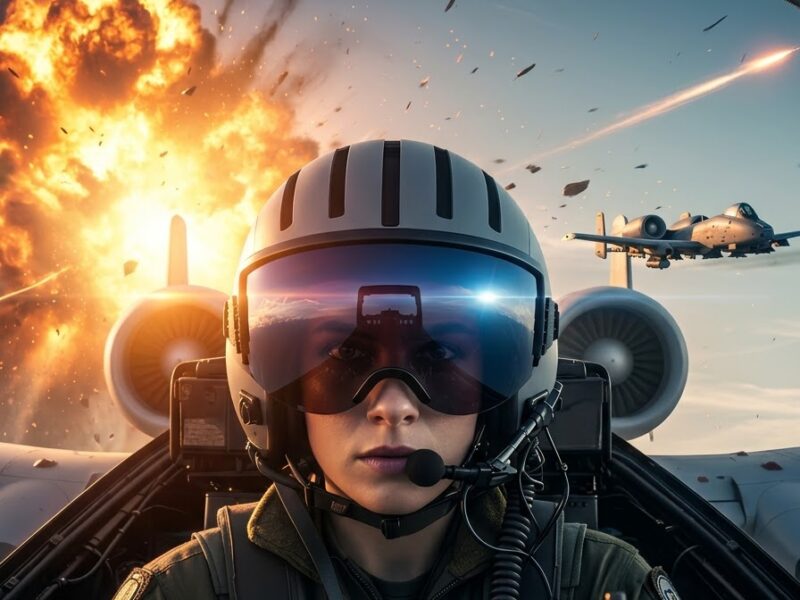
They laughed when I froze during a live-fire exercise at Coronado, calling me a coward in front of the entire SEAL team
The morning fog rolled off the Pacific in thick, gray sheets, blanketing the kill-house corridors at Naval Amphibious Base Coronado. It tasted of salt, damp sulfur, and copper.
I stood on line four, my hands wrapped around the pistol grip of a customized Mk 18 rifle, my boots planted firmly on the packed earth of the live-fire range. Thirty yards ahead, steel pop-up silhouettes gleamed dully through the haze.
A steel target snapped up in bay three. A standard three-round response drill.
I raised the weapon, aligned the front sight post within the optic, and felt the familiar, ice-cold stillness settle into my chest. But as my finger met the flat face of the trigger, a phantom memory flickered behind my eyes—a flash of green laser light, the sound of tearing metal, and the sickening thud of a man collapsing into wet sand.
My finger locked. The trigger didn’t move.
Crack!
A high-velocity round ricocheted off the steel baffle six inches from my head, spraying microscopic fragments of lead across my cheekbone. The heat of the near-miss stung my skin.
I didn’t flinch. I didn’t duck. I simply lowered my rifle, pointing the muzzle toward the ground, safety engaged.
“That’s enough!” the range safety officer barked, slamming his timer against his chest.
Behind the safety rail, six members of SEAL Team 7 lowered their weapons. A couple of them exchanged snide glances. A broad-shouldered sniper named Miller spat a brown stream of tobacco juice onto the dirt and chuckled under his breath.
“Hope she doesn’t freeze like that when we hit the beach,” Miller muttered, loud enough for the entire line to hear. “Delivery girl’s got cold feet. Stick to flying box-haulers, Captain.”
A few low laughs rippled through the squad. I stood straight, my five-foot-seven frame rigid, grease on my collar and braid pinned tight, refusing to yield an inch of ground to them.
Commander Mason Hayes stepped forward, his arms crossed over his chest, his weathered face carved into a stern frown. He looked at me as if I had personally wasted his morning, his dark eyes searching my face for any sign of weakness.
“Captain Morgan,” Hayes said, his voice deep and raspy from thirty years of inhaled propellant and salt air. “If you’re afraid of live fire, say so now. I’ll sign your transfer back to logistics before the sun hits the water.”
I looked past him, staring directly at the gray steel target downrange.
“I’m not afraid, Commander,” I replied softly.
“Then prove it,” Hayes snapped, stepping back. “Raise your weapon and execute the drill.”
I brought the rifle back up, lock-stock-and-barrel aligning with my eye. But before my pad could contact the trigger, a low, unnatural whine vibrated through the fog overhead.
The range officer’s whistle blew violently. “Cease fire! Cease fire! Unidentified air track inside the restricted perimeter!”
Every head turned upward. A carbon-fiber quadcopter drone, painted matte black with no military markings, drifted out of the sea fog fifty feet above the target bays. It hovered silently, its optical camera lens swiveling left and right.
Before anyone could call base security, the main power grid died. The heavy floodlights along the perimeter fence went black. The digital targets dropped into their pits with a loud mechanical clatter.
Thump-thump-thump!
Heavy automatic fire erupted from the tree line edging the beach. Heavy 7.62mm rounds slammed into the concrete firing benches, sending chunks of stone exploding through the air.
The laughter died instantly.
“Contact left! Tree line! Get down!” Hayes bellowed, drawing his SIG Sauer sidearm as the SEALs dropped like rocks into the dirt cover behind the benches.
Rounds whipped over our heads with wicked snap-crack sounds. I dropped to one knee behind a heavy sandbag wall, my heartbeat pounding in my ears, but my mind stayed unnaturally clear, dropping into that familiar, razor-sharp operational focus.
Through the drifting cordite smoke, my eyes locked onto the black drone hovering twenty feet above the sand. Beneath its belly, a small, rhythmic red light pulsed.
It wasn’t a surveillance drone. Mounted between its landing skids was a block of gray C4 explosive with an electronic detonator.
And it was accelerating straight toward the range’s main bunker—where three tons of live ammunition and mortar shells were stacked.
“Commander!” I shouted, pointing through the smoke. “The drone! It’s rigged with a payload!”
Hayes looked up, his face paling as he spotted the blinking red beacon heading directly for the bunker doors. “Shoot it down! Take it out now!”
Three SEALs popped up from behind the sandbags, firing rapid bursts from their rifles. But the drone was moving in an erratic, zigzag pattern, tossed by the coastal crosswinds. Every shot ripped through empty air. The aircraft dipped lower, fifteen yards from the bunker’s open intake vents.
“Stand down, Morgan! Stay behind cover!” Hayes yelled over the roar of gunfire.
I didn’t listen.
I shifted my stance, bringing my Mk 18 up into the pocket of my shoulder. I didn’t see a drone; I saw a vector line moving through space. Eleven years of calculating wind shear, thermal currents, and lead angles in the cockpits of military transport planes transformed the world into pure physics.
Wind: eight knots from the southwest. Distance: forty-two yards. Target velocity: twelve knots, descending.
I led the target by three inches, inhaled half a breath, and squeezed the trigger.
POP.
A single 5.56mm round punched clean through the drone’s carbon-fiber control assembly. The rotors seized instantly. The drone flipped violently in mid-air, plummeted into the empty sand of the impact pit, and exploded into a fireball thirty yards short of the ammunition bunker.
The shockwave rattled the concrete benches. Burning debris rained down across the range.
Smoke rolled thick and dark across the field. For five agonizing seconds, nobody moved. The gunfire from the tree line abruptly ceased as a high-speed insertion boat roared away into the offshore fog.
Hayes slowly lowered his handgun. He stared at the smoking crater in the impact pit, then turned his head to look at me. The harsh, critical glare in his eyes was gone, replaced by utter disbelief.
“God…” Hayes whispered, his voice trembling slightly. “Good shooting.”
I didn’t answer. I stood in the swirling smoke, my weapon held at low ready, my knuckles white on the handguard.
Because I knew that shot hadn’t been about skill. It was the echo of a nightmare. Seven years ago, I had frozen on a ridge in Kunar Province, refusing to pull the trigger on an ambiguous target—and that single moment of hesitation had cost my brother his life.
A young SEAL, his face smeared with mud and carbon soot, crawled over the sandbag barricade and looked at me, his eyes wide with newfound respect.
“Ma’am… how did you calculate that lead in the fog?” he stammered. “That thing was dropping like a rock.”
I cleared the chamber of my rifle and locked the bolt back. “Experience,” I said flatly, keeping my tone cold and detached.
He opened his mouth to ask more, but Hayes cut him off. The commander wasn’t listening to the chatter. He was marching through the settling smoke straight toward the smoldering crater where the drone had detonated.
A tactical technician named Miller was already kneeling beside the wreckage, using insulated pliers to sift through the melted plastic and twisted aluminum.
“Perimeter team is clearing the beach,” Miller reported, holding up a small, rectangular object encased in heat-resistant military casing. “Attacker craft fled seaward. But look at this, Commander. The main housing survived. I just pulled the internal flight-memory chip.”
Hayes took the scorched micro-chip, his gloved fingers turning it over under the dim light of the returning auxiliary power grids. His jaw hardened into iron.
“What is it, Commander?” I asked, stepping up to the edge of the pit.
Hayes didn’t look up immediately. When he finally raised his head, his face looked fifteen years older, the skin around his eyes tight with suppressed fury.
“The flight path in this telemetry log… it wasn’t programmed to hit the ammo bunker,” Hayes said softly.
My stomach tightened into a knot. “What do you mean? It was flying straight for the bunker doors.”
“It was flying a vector loop,” Hayes corrected, pointing at the burnt wiring on the frame. “It was using a short-range infrared laser illuminator. It wasn’t targeting the munitions, Evelyn. It was painting a specific micro-transponder on this range.”
He reached into his pocket and pulled out a small, brass-encased range pass—the electronic ID tag pinned to my flight harness.
“It was targeting your exact coordinates,” Hayes said.
The words felt like ice water poured down my spine. I stared at the charred wreckage, the memories rushing back like a dam breaking. Seven years ago, when my brother’s unit was ambushed in Afghanistan, the official military investigation concluded that an enemy mortar had struck his command post due to bad luck. But I had seen the classified wreckage photos. I had seen the same micro-laser burns on the frame of his collapsed shelter.
Someone had tagged him. And now, seven years later, someone was using the exact same playbook on me.
“Hayes,” I said, my voice dropping to a harsh whisper. “You knew about this.”
The commander looked around the range. The SEALs were busy securing the perimeter and checking for secondary devices, out of earshot. He motioned for me to follow him into the concrete tactical office at the back of the range house.
He slammed the heavy steel door shut, locking us inside the quiet room.
“Seven years is a long time to wait for answers, Commander,” I said, stepping right up to his desk. “My brother died because a ‘rogue’ signal guided an strike onto his position. I spent seven years being shoved into cargo units and logistics outfits because every time I asked questions, my flight status was threatened. Now someone tries to blow me up on a live-fire range at Coronado, and you don’t even look surprised.”
Hayes stood behind the desk, resting his heavy hands on the wood. He took a long, slow breath.
“I didn’t know they would track you here,” Hayes said quietly. “I thought bringing you into this unit under the cover of a routine transport transfer would keep you hidden long enough for us to pull the old files.”
“Who are ‘they’?” I demanded. “And what did my brother find in Kunar?”
Hayes hesitated, his eyes darting to the floor. “Arthur didn’t die because of an enemy mortar, Evelyn. He found a black-budget logistics leak inside Naval Special Warfare. Someone was diverting advanced weapons systems—including autonomous guidance packages—to off-grid contractors. He was about to turn over the encrypted ledger to the Inspector General.”
My breath caught in my throat. My hands trembled, fists clenching at my sides. “And you let them cover it up? You let them call him a casualty of war?!”
“I didn’t have a choice!” Hayes snapped, his eyes flashing with sudden emotion. “The man who signed off on that scrubbed report wasn’t an insurgent in Afghanistan. He was sitting in the Pentagon! If I had pushed back then, they would have put a bullet in your head when you were twenty-one years old!”
Before I could fire back, the secure tactical radio sitting on Hayes’ desk crackled with sharp, violent static.
BZZZZ-CRACKLE.
A synthesized, metallic voice cut through the speaker, distorted by an electronic voice changer.
“Commander Hayes… Captain Morgan’s reflexes are impressive,” the voice rasped out. “But static targets are easy. Tell Morgan the second shot is coming.”
The line went dead with a loud click.
Hayes stared at the radio, his face drained of all color. For the first time since I had met him, I saw genuine, unadulterated fear in the old commander’s eyes.
The base went into immediate lockdown. Red warning lights spun along the corridors of Hangar 3, and armed sentries were posted every fifty yards along the perimeter road.
Inside the secure underground armory, I sat on a steel supply crate, cleaning the carbon out of my Mk 18 bolt carrier group with methodical, furious motions. My hands were steady now. The doubt that had plagued me for seven years had burned away, replaced by an absolute, icy clarity.
The door hissed open. Captain Vance, the SEAL team leader who had mocked me during our transport mission two days prior, stepped inside. He had stripped off his tactical vest, wearing only his damp black utility shirt. He carried two mugs of steaming coffee.
He walked over and set one down on the crate beside me.
“Miller told me what happened on the range,” Vance said quietly, leaning his back against a rack of sniper rifles. “And what you did with that iron sight.”
I didn’t look up from my work. “I hit a target. That’s what we’re paid to do.”
“No,” Vance said, his voice completely devoid of the arrogance he had displayed before. “You made a three-millisecond lead calculation on a moving drone in heavy fog while under direct fire. There are three guys in DevGru who can make that shot, and all of them have spent twenty years on a rifle. I owe you an apology, Captain. I called you a box-hauler.”
“You were right,” I said, sliding the bolt back into the receiver with a sharp clack. “I haul boxes. Sometimes those boxes carry secrets that get people killed.”
Vance sat down on an adjacent crate, his expression hardening. “Hayes filled me in on the radio transmission. He told me about your brother.”
I paused, looking up at him. “Why are you still here, Vance? If there’s a syndicate inside the command structure targeting me, standing next to me is a good way to get court-martialed or shot.”
Vance pulled a silver dog tag from beneath his collar and tossed it to me. I caught it in mid-air. Engraved on the steel was the name: LT. MARCUS VANCE – SEAL TEAM 3 – KIA KUNAR PROVINCE.
“Marcus was my younger brother,” Vance said softly, his eyes dark with an old, unhealed wound. “He was on Arthur’s team in the valley seven years ago. When the mortar hit their position, they told my family it was friendly fire. I’ve spent seven years knowing that was a lie.”
He reached down, picked up his primary rifle, and checked the chamber.
“You’re not fighting these ghosts alone, Morgan,” Vance said. “My team is operational. Whatever is coming for you has to go through us first.”
Before I could answer, the armory door burst open. Commander Hayes strode in, accompanied by a young communications technician carrying a portable encrypted server terminal.
“We traced the routing hub of that radio transmission,” Hayes said, slamming a digital map onto the workbench. “It didn’t come from an overseas satellite or a local burner cell. The signal was bounced off a relay node mounted inside a naval vessel docked less than two miles from here.”
I stood up instantly. “Which vessel?”
“The USNS Goliath,” Hayes said. “A decommissioned naval supply ship waiting for scrap in the auxiliary bay. She’s supposed to be empty, sitting on skeleton power. But three minutes ago, her radar array silently turned on.”
“That’s where the second shot is coming from,” I realized, grabbing my tactical harness and slipping it over my shoulders. “They’re using the ship’s heavy comms suite to coordinate an automated strike grid.”
“We take a squad in by fast-boat,” Vance said, his hand snapping onto his rifle’s foregrip. “Board her from the stern, clear the decks, and take down whoever is running that node.”
“No,” Hayes said sharply. “If a full SEAL squad approaches that ship, they’ll scrub the hard drives and sink the vessel before you clear the gangway. They want Evelyn. She has to be the one to board first.”
I looked at Hayes, my eyes narrowing. “You want me to act as bait.”
“I want you to finish this,” Hayes said, reaching into his desk and pulling out a heavy, matte-black sniper rifle—a McMillan TAC-50 anti-materiel rifle. He laid it across the table. “Your brother built this custom trigger assembly before he shipped out to Afghanistan. He wanted you to have it.”
I ran my fingers over the cold, custom-milled aluminum receiver. Embedded near the stock was a tiny, hand-carved inscription: NEVER MISS THE SKY.
I looked up at Hayes and Vance, my heart steady, my pulse slowing to an absolute, lethal rhythm.
“Get the boat ready,” I said.
The midnight sea off Coronado was black as pitch, the waves chopping violently against the rubber hull of our Rigid Inflatable Boat (RIB).
The USNS Goliath loomed out of the darkness like a rusted iron mountain. Her three-hundred-foot hull groaned against the mooring cables, her dark superstructure towering over the ocean. Only a single red navigation light flickered at her mainmast.
Vance cut the RIB’s engine two hundred yards out. We drifted silently through the ink-black water, utilizing night-vision goggles that turned the world into a sharp, emerald-green nightmare.
“Stern ladder is clear,” Vance whispered over the encrypted comms, his rifle trained on the upper crane deck. “No thermal signatures on the outer walkway. But the lower cargo hold is glowing like a Christmas tree on infrared.”
I hoisted the heavy TAC-50 rifle across my back, securing it with a three-point harness, and grabbed the steel rungs of the ship’s emergency boarding ladder.
“I’m going up,” I whispered into my throat mic. “Hold perimeter at the waterline. If I don’t signal in ten minutes, blow the engine room.”
“Copy that, Captain,” Vance replied. “Happy hunting.”
I climbed silently, my combat boots finding purchase on the slick, barnacle-encrusted steel. Within thirty seconds, I cleared the deck rail, rolling low into the shadow of a heavy cargo winch.
The ship was far from abandoned.
The faint, rhythmic hum of auxiliary diesel generators vibrated through the steel deck beneath my boots. Thick cables snaked along the corridors, leading down into the forward cargo hold.
I unholstered my suppressed sidearm, moving like a phantom through the narrow, rusted passageways. The smell of old fuel, sea salt, and fresh machine oil hung heavy in the air.
I reached the upper gallery of Hold 2, crouching behind a stack of steel shipping containers, looking down into the brightly lit interior below.
My breath caught in my throat.
The hold had been converted into a high-tech tactical command center. Dozens of computer monitors lined the walls, tracking satellite telemetry, air-defense grids, and naval shipping lanes across the entire Pacific coast. Sitting in the center of the room was a massive satellite uplink server—and sitting at the main console was a man in a crisp, dark naval officer’s uniform.
He turned his chair slightly to look at a secondary monitor.
My blood ran cold.
It was Admiral Thomas Sterling—the Vice Chief of Naval Operations, the very man who had presided over my brother’s memorial service seven years ago, the man who had personally handed my mother the folded flag.
“Positioning sequence complete,” Sterling said into a headset, his voice calm, cultured, and devoid of all humanity. “Target acquisition locked on Coronado Command Center. Initiate secondary drone swarm as soon as the signal clears.”
I didn’t hesitate. I unslung the heavy TAC-50 sniper rifle, deployed the bipod onto the steel railing of the gallery, and brought the high-powered optic up to my right eye.
The crosshairs centered perfectly on the back of Sterling’s head.
My finger rested against the flat face of my brother’s custom trigger. The distance was eighty yards. An impossible shot to miss.
“Step away from the console, Admiral,” I said over the ship’s internal PA system, my voice echoing loudly off the cold steel walls of the hold.
Sterling didn’t jump. He didn’t panic. He slowly reached down, pressed a button on his desk, and turned his chair to face the upper gallery, looking straight up into the darkness where my barrel was pointed.
“Captain Morgan,” Sterling said, smiling coldly into the empty air. “I was wondering when you would find your way aboard my ship.”
“Hands where I can see them, Sterling!” I ordered through the microphone, my eye locked onto the crosshairs. “One move toward that console and I’ll put a fifty-caliber round through your chest.”
Sterling chuckled, a dry, rattling sound that filled the cavernous hold. He slowly raised his hands, resting them casually on the armrests of his leather chair.
“You won’t shoot, Evelyn,” Sterling said calmly. “You’re just like your brother. Arthur had his crosshairs on me in the Kunar valley seven years ago. He had all the evidence. He had the high ground. And do you know why he didn’t pull the trigger?”
My finger tightened on the steel blade of the trigger. “Shut up.”
“He hesitated,” Sterling continued, his voice dripping with sinister confidence. “He hesitated because he believed in the system. He believed in rules, honor, and due process. He wanted to bring me to a court-martial. And while he was waiting for confirmation… my strike drone took out his entire shelter.”
“He didn’t hesitate because he was weak!” I roared, my voice shaking with suppressed fury. “He hesitated because he was a soldier, not a murderer!”
“And that is why he is dead in a nameless trench, and I am sitting in command of a three-billion-dollar network,” Sterling countered, his eyes hardening into flint. “You think this is about money? This is about control, Captain. The world is falling apart. Governments are weak. The military needs men who are willing to do whatever it takes to secure the future—without being bound by politicians or ethics boards.”
Sterling’s eyes flicked subtly toward a digital countdown timer flickering on the wall monitor behind him.
[AUTOMATED STRIKE LAUNCH: 00:15 SECONDS]
“In fifteen seconds,” Sterling whispered, “a cluster of autonomous strike drones will launch from the submerged bays of this ship. They will strike the Coronado command facility, erasing Hayes, Vance, and every file connecting me to Project Boreas. And you will take the blame as a rogue pilot who lost her mind.”
“Cancel the launch sequence!” I demanded.
“Make your choice, Evelyn,” Sterling smiled, his hand slowly drifting down toward a red manual override button on his desktop. “Pull the trigger and become a murderer… or watch your friends die.”
His hand darted toward the button.
In that fraction of a second, the world slowed down to an absolute standstill.
The phantom memory of the Kunar valley flared in my mind one last time—the green laser, the sound of tearing metal, my brother’s voice echoing across seven years of silence: NEVER MISS THE SKY.
I didn’t hesitate. I didn’t lock up. I squeezed the trigger.
BOOOM!
The heavy TAC-50 roared like a cannon shot inside the enclosed hold. The massive recoil slammed into my shoulder, but the barrel barely rose an inch.
The armor-piercing .50-caliber round didn’t strike Sterling’s chest.
It punched clean through the desktop console two inches beneath his hand, shattering the main circuit board, severing the satellite uplink cables, and exploding into the master power junction behind the desk in a blinding shower of blue sparks.
The digital countdown timer froze at 00:02.
The computer monitors went pitch black. The automated drone bay doors ground to a sudden, violent halt.
Sterling was thrown backward out of his chair by the kinetic shockwave, landing hard on the steel floor, his dark uniform covered in shattered plastic and molten copper. He stared in absolute terror at the ruined console, then looked up at the upper gallery.
The heavy steel doors of the lower hold were kicked off their hinges with a deafening crash.
Captain Vance and six fully armed SEALs flooded into the room, their weapons raised, flashlights carving through the smoke as they pinned Sterling to the floor.
“Clear! Clear! Target secured!” Vance bellowed, snapping heavy plastic flex-cuffs around Sterling’s wrists.
Hayes stepped into the hold through the side hatch, holding a secure satellite phone connected directly to the Chairman of the Joint Chiefs of Staff. He looked at the ruined console, then looked up at me standing on the gallery rail above.
“The network is dead,” Hayes announced into the phone. “We have Vice Chief Sterling in custody. Send the Federal Marshals to the dock immediately.”
Hayes lowered the phone, looking up into the shadows where I stood, my rifle lowered, my breathing smooth and steady.
“Captain Morgan,” Hayes called out, his raspy voice echoing through the massive room. “You could have taken his head off from that range.”
I stepped back from the gallery rail, unslung my brother’s rifle, and looked down at the hand-carved inscription on the stock.
“My brother didn’t miss because he was afraid,” I said quietly, stepping toward the exit stairwell. “He missed because he knew there were some lines you don’t cross. I just made sure nobody ever crosses them again.”
Ten minutes later, I stood on the open deck of the Goliath, looking out across the dark Pacific. The morning fog was finally beginning to break, revealing a brilliant, golden sunrise spilling across the ocean horizon.
Vance walked up beside me, leaning against the rusty deck rail, offering me a fresh cup of hot black coffee.
“Where to now, Captain?” Vance asked, a genuine smile on his face. “Command is reinstating your primary flight status. They want you back in the air by Monday.”
I took the cup, taking a slow sip as the warm wind blew through my hair.
I looked up into the endless, open sky—clean, clear, and finally free of ghosts.
“Wherever the wind wants me to go,” I said.
The end.









