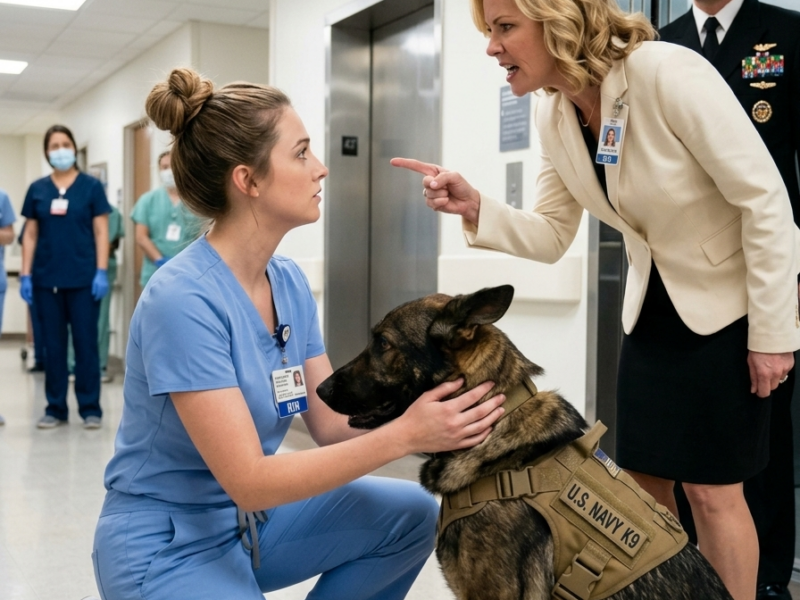
They laughed when I dropped a tray in the hospital cafeteria and called me “the useless nurse,” but their laughter died when my Navy SEAL husband walked through the doors with his scarred K9
The heavy plastic tray rattled on the stainless-steel counter before slipping from my numb fingers. The crash reverberated through the bright, sterile fluorescent lights of the St. Vincent’s Hospital cafeteria, shattering the mid-morning hum of quiet conversations and clinking cutlery. Hot filter coffee splashed across my white medical clogs, soaking into the hem of my pale blue scrubs. A bowl of vegetable soup flipped upside down, sending dark, glistening broth pooling over the polished vinyl floor tiles.
I stood paralyzed for a fraction of a second, my heart hammering against my ribs like a trapped bird. My hands were shaking—not just from the sudden shock, but from the bone-deep, chronic exhaustion that had wrapped around me over the last three months.
Across the room, near the senior staff tables, a wave of cruel, sharp laughter erupted.
“Careful, sweetheart,” called out Brenda, a senior surgical nurse whose sharp demeanor was as cold as her scalpel technique. She wiped her mouth with a napkin, her eyes glinting with malicious amusement as she turned to her tablemates. “You’re always shaking. Honestly, I don’t know how you manage to insert an IV line without puncturing a main artery. Maybe St. Vincent’s should reassign you to filing paper records in the basement.”
Dr. Richard Mason, the chief attending physician of the trauma ward, sat right beside her. He leaned back in his leather-backed chair, swirling a cup of espresso, his lips curled in a relaxed, patronizing smirk that made my stomach churn into a hard knot.
“Leave her be, Brenda,” Mason said, his smooth, baritone voice carrying effortlessly across the cafeteria. He didn’t look at my face; his dark, calculating eyes swept over my hands, my posture, and the subtle, nervous way I tugged my long scrub sleeves down over my wrists. “Nurse Clara is simply fragile. Some people just aren’t built for the pressure of a real hospital. We can’t all possess fortitude.”
A few junior residents chuckled nervously, eager to curry favor with the chief attending. I dropped to my knees, taking a handful of paper napkins from a nearby dispenser, blindly wiping at the warm liquid on the floor. My teeth dug into the inside of my lower lip until I tasted salt.
Stay quiet, I reminded myself, the phrase repeating like a rhythmic pulse behind my eyes. Quiet nurses are invisible. Invisible people stay safe.
“Look at her,” Brenda mocked lower, though loud enough for the surrounding tables to hear. “She looks like a frightened field mouse. I hear her husband is off playing hero in the military somewhere. Imagine coming home to a useless wife who can’t even hold a breakfast tray.”
I kept my head down, my hair falling forward like a protective curtain to hide the heat burning in my cheeks. They didn’t know anything. They didn’t know about the phantom footsteps that followed me down the dark corridors of the parking garage at two in the morning. They didn’t know about the unlocked doors I found pushed slightly open when I came home to my empty apartment, or the feeling of cold, invisible eyes watching me through the blinds while I tried to sleep.
Suddenly, the heavy double doors at the main entrance of the cafeteria swung open with a deep, pneumatic thud.
The cold winter air from the glass atrium swept into the heated room, bringing with it a sudden, sharp silence that swallowed the laughter instantly.
A tall man stepped through the threshold. He wore his Navy Working Uniform—the crisp Type III woodland camouflage pattern—with three gold trident pins glinting subtly against his collar. His shoulders were broad, filling the doorway, and his jawline was cut from hard, unforgiving granite. A faint, silver operational scar ran from the edge of his left cheekbone down toward his throat.
Beside his left leg, walking in absolute, synchronized perfection, was a massive, pitch-black German Shepherd. The dog wore a heavy nylon tactical vest fitted with metal D-rings, a handle, and a military-grade patch that read: WORKING K9 – DO NOT PET. The dog’s dark coat was immaculate, but his left ear bore a notched tear, and his right flank carried a long patch of lighter, scarred skin where fur had grown back over an old shrapnel wound.
It was my husband, Master Chief Daniel Vance, and his retired Navy SEAL K9, Ranger.
Daniel didn’t look at the doctors. He didn’t look at the nurses who had frozen with their forks halfway to their mouths. His intense, steel-grey eyes scanned the room with practiced, tactical speed until they locked onto me kneeling on the floor surrounded by wet paper towels and spilled soup.
He didn’t ask what happened. He didn’t demand to know why my hands were trembling so violently that I could barely grip the napkins.
“Clara,” Daniel said. His voice was low, deep, and steady, carrying an absolute authority that commanded immediate respect. “Come here.”
I stood up slowly, my legs feeling like lead. I dropped the soaked napkins into a trash bin and wiped my palms against my scrub pants. As I took a step toward him, the entire cafeteria remained utterly silent. Brenda’s mouth was slightly open; Dr. Mason’s smirk had stiffened into a rigid, unnatural mask.
I walked toward Daniel, but before I could reach his arms, Ranger suddenly stopped dead in his tracks.
The dark German Shepherd’s body went completely rigid. His notched ears swiveled forward, pinning straight up. The relaxed posture of a traveling working dog vanished, replaced in a single millisecond by the taut, terrifying tension of a predator locking onto a target.
Ranger slowly turned his head away from me. His dark eyes narrowed, scanning the room until they locked onto the senior staff table.
Directly onto Dr. Richard Mason.
A low, guttural vibration began deep within Ranger’s chest—a sound so pure, deep, and menacing that it caused several nurses at nearby tables to flinch backward.
Dr. Mason attempted a nervous, dismissive laugh, leaning back further into his chair, though the blood had visibly drained from his face. “Well,” Mason stammered, raising a hand in a dismissive gesture. “That’s… quite an intense welcome for a hospital dining hall. Perhaps military dogs shouldn’t be brought into sterile civilian environments.”
Daniel’s expression didn’t soften. It hardened into something cold, sharp, and terrifyingly dangerous. He held Ranger’s lead with a loose, relaxed grip, but his eyes never left the doctor.
“Ranger spent six years with Team Eight in combat zones,” Daniel said softly, his voice dropping an octave. “He doesn’t growl without a reason, Doctor.”
Mason cleared his throat, trying to regain his dominant posture in front of his staff, but his hands betrayed him, twitching slightly against his coffee cup. “I assure you, Officer, I haven’t done anything to your dog.”
Mason made a sudden, abrupt movement to stand up, pushing his chair back against the vinyl floor with a harsh screech.
The moment the metal chair legs grated against the floor, Ranger lunged forward to the full length of his tactical lead, his jaws snapping shut with a sound like a cracking whip. The dog didn’t bark wildly; he dropped low, his chest hovering inches off the ground, a deep, continuous rumble vibrating through his throat as he fixed Mason with an unblinking, predatory stare.
Panic flared in my chest. I knew what Ranger was capable of when he sensed a threat. “Daniel, please,” I whispered, reaching out to touch my husband’s forearm. “Don’t. Not here.”
Daniel turned his eyes to me. The harshness in his face melted slightly, replaced by a profound, piercing concern that cut straight through my defenses. He looked at my face, then down at my arms.
In my haste to clean the spilled coffee, my right scrub sleeve had ridden up past my wrist. Beneath the soft fabric, exposed under the harsh fluorescent lights, was a deep, purplish-yellow bruise shaped unmistakably like four fingers and a thumb, dug violently into my skin.
Daniel’s breath hitched. His eyes locked onto the mark.
“How long?” he asked quietly.
I couldn’t answer. My throat felt like it was filled with dry sand. I instinctively pulled the fabric down, hiding the bruise back in the shadows of my clothing.
Daniel took a step closer, his eyes burning with a silent, terrifying rage. “Clara… who did that to you?”
“Nobody,” I squeaked out, shaking my head frantically. “It was… I bumped into a supply cart in the ER last night. It was an accident, Daniel. I swear.”
Beside us, Ranger stopped growling. The dog let out a sharp, high-pitched whine. He broke away from Daniel’s side and trotted directly toward Dr. Mason’s table.
Mason froze, his breath hitching in his throat as the massive black dog approached. But Ranger didn’t jump at Mason’s throat. Instead, the K9 dropped his nose down to the vinyl floor directly beneath Mason’s chair.
Ranger sniffed intensely, his nostrils working in rapid, rhythmic bursts. He moved his snout along the narrow gap where the floor tile met the decorative wooden baseboard beneath the doctor’s table.
Scratch.
Ranger brought his right front paw up, digging his heavy black nails once into the floor seam.
Scratch.
Then, the dog sat down heavily on his haunches, raised his head, and stared directly at me with dark, intelligent eyes.
My blood ran cold. The ambient noise of the cafeteria seemed to fade into a hollow, distant roar. I had lived with Daniel and Ranger for four years. I knew that posture. I knew that exact behavioral sequence.
Ranger was a multi-purpose assault and detection K9. That specific silent alert—sniffing, scratching twice, and holding a freeze-stare at his handler—was his trained signal for detected biological traces, chemical accelerants, or concealed forensic evidence.
Daniel crouched down beside the dog, his gloved hand resting gently on Ranger’s broad neck. “Show me, boy.”
Ranger didn’t hesitate. He reached out with his paw again, thrusting his nose back into the small, nearly invisible gap beneath the baseboard tile right beside Dr. Mason’s boots.
Dr. Mason’s face turned from pale to an ash-grey mask of absolute terror. “What is this nonsense? Get this animal away from my chair immediately!”
“Sit down, Doctor,” Daniel commanded. The tone of his voice was so absolute, so heavy with implicit violence, that Mason’s knees buckled, forcing him back into his seat.
A maintenance worker who had been clearing a nearby tray rack walked over cautiously, carrying a small metal tool roll. Daniel looked up at him. “Lift that access panel.”
The worker looked at Mason, then at Daniel’s trident pins, and quickly nodded. He knelt down, inserted a flat metal lever into the subtle seam beneath the baseboard, and popped the small decorative panel loose.
Inside the dark, recessed cavity beneath the cafeteria floor lay a small, heavy-duty ziplock plastic bag, sealed tight against moisture.
The entire cafeteria leaned forward, a collective gasp echoing through the room.
Daniel reached into the wall, pulling the plastic bag out into the harsh light.
My breath caught in my chest, a choking sensation seizing my lungs.
Inside the clear plastic container were dozens of high-resolution, color photographs.
The top photo showed me walking alone through the hospital parking garage at two in the morning, my head down, my arms wrapped around my chest.
The second photo showed me entering the front door of my apartment building.
The third photo was taken from outside my ground-floor bedroom window—it showed me asleep in my bed, bathed in the soft blue light of a digital alarm clock.
And the fourth photograph made my knees finally give out.
It was a picture of Daniel standing in full tactical gear on the tarmac of Naval Air Station Oceana three months ago, stepping onto a military transport plane for his overseas deployment.
Scrawled across the back of the photograph in thick, black permanent marker was a single, terrifying sentence written in precise, block letters:
SHE TALKS, HE DIES.
Daniel stared at the photograph in his hand for a long, agonizing moment. The silence in the hospital cafeteria was absolute; even the low hum of the commercial refrigerators seemed to mute itself.
I fell forward, my hands gripping Daniel’s tactical vest to keep from hitting the floor. The dam holding back three months of silent, suffocating terror broke entirely, and hot tears spilled down my cheeks, soaking into his military uniform.
“I was scared,” I sobbed, my voice cracking into jagged pieces. “Daniel, I was so scared. I didn’t know what to do.”
Daniel dropped to his knees right there on the wet floor, wrapping his strong arms around me, pulling me tight against his chest. Ranger moved in close, pressing his cold nose against my neck, letting out a low, comforting whine.
“I thought they’d kill you if I said anything,” I wept into his shoulder. “Every time I tried to report the strange calls, or the feeling that someone was in the house, a new photo would show up in my locker… or under my windshield wiper. They knew your unit’s deployment schedule. They knew where you were deployed before I even did.”
Daniel’s jaw muscles flexed, a hard, murderous focus taking over his features. “You should have told me, Clara. No matter what, you should have told me.”
“They threatened your life, Daniel!” I cried, pulling back to look into his eyes. “They said if I made a sound, a sniper would take you out during an operation overseas! How could I risk that? How could I live if my words got you killed?”
Dr. Mason suddenly pushed his chair back with violent force. “This is absurd! This is a complete setup! I have no idea how those photographs got under that floor panel! Someone put them there to frame me!”
Daniel slowly stood up, holding the plastic bag securely in his grip. His eyes locked onto Mason with a predatory stillness that made the senior physician take two rapid steps backward.
“You were sitting right over the concealment spot, Doctor,” Daniel said, his voice terrifyingly calm. “And Ranger traced the scent profile straight from my wife’s bruised wrist… to your hands.”
“That’s circumstantial nonsense!” Mason shouted, his voice cracking with hysteria as he looked around at his staff for support. “Brenda, tell him! I’ve been in surgery all morning! I don’t know anything about these photos!”
Brenda didn’t say a word. She shrank back in her chair, her eyes wide with shock and sudden, nauseating realization as she looked at the man she had been sitting beside every morning.
Suddenly, Ranger let out a sharp, ear-splitting bark, spinning around toward the main exit doors of the cafeteria.
The sudden sound made everyone flinch. Daniel’s head snapped toward the doorway.
Dr. Mason took advantage of the split-second distraction. He turned on his heel, shoved past two frightened nursing assistants, and sprinted frantically through the side service exit that led toward the hospital’s basement utility corridors.
“Mason!” Daniel roared.
He made a move to chase after him, but Ranger didn’t follow the doctor toward the basement door. Instead, the German Shepherd remained glued to the main entrance, his ears pinned back, his body trembling with an entirely different kind of tension.
Before Daniel could take three steps, my cell phone chimed in my scrub pocket.
It wasn’t a standard ringtone; it was the sharp, metallic ping of an encrypted multimedia message.
My hands shook so violently I nearly dropped the phone as I pulled it out. Daniel stepped beside me, his hand settling heavily on my shoulder as we both looked at the glowing screen.
The text was a photograph taken less than ten seconds ago.
It was a high-angle photo taken from the upper mezzanine balcony overlooking the cafeteria. It showed Daniel kneeling on the floor, holding me in his arms while Ranger stood guard beside us.
Underneath the high-resolution image were five chilling words:
NOW YOU KNOW WHY SHE STAYED QUIET.
A cold spike of pure adrenaline shot through my veins. I looked up frantically toward the glass mezzanine floor three stories above the dining hall. The balcony was empty, save for the slow swaying of a decorative hanging plant near the emergency stairwell door.
“He wasn’t running away,” I whispered, the realization hitting me like a physical blow. “Mason wasn’t acting alone. He was just the handler on the ground.”
Daniel took the phone from my hand, his thumb tracing the encrypted number on the screen. His eyes met mine, cold and resolute.
“The person who was watching you wasn’t trying to intimidate you into leaving, Clara,” Daniel said, his voice dropping to a dangerous, precise whisper. “They were using you as bait. They were waiting for me to complete my deployment and come home.”
Ranger let out a deep, commanding bark, turning toward the double glass doors leading out into the main hospital atrium. The dog didn’t wait for a command; he took off at a full trot, pulling the lead taut in Daniel’s hand.
“Stay behind me,” Daniel ordered, pulling me firmly behind his shoulder as we followed the K9 out into the busy hospital lobby.
The atrium was filled with patients, visitors, and medical staff moving between appointments. High above, vaulted glass ceilings let in the pale, cold winter sunlight.
Ranger stopped in the center of the marble lobby, his head turning rapidly from left to right. He caught a scent in the air stream generated by the massive revolving entrance doors. The dog lifted his nose, took three deep breaths, and then let out a low, mournful howl that echoed off the high glass walls.
“What is it, Ranger?” Daniel asked, dropping low to read the dog’s body language.
Ranger moved toward a public trash receptacle near the information desk. He nudged the heavy swinging lid open with his snout.
Inside lay a black tactical handheld radio, its green power light blinking rhythmically, paired with a small, disposable burner phone.
Daniel pulled a pair of nitrile gloves from my scrub pocket, slipped them on, and carefully lifted the radio from the trash bin. As soon as he touched it, a static-filled voice burst through the small speaker:
“Master Chief Vance. Welcome home.”
The voice was synthesized, electronically distorted into a flat, robotic monotone that made the hair on the back of my neck stand up.
Daniel brought the radio to his lips, his grip tightening until the plastic casing groaned. “Who is this?”
“A ghost from your past, Master Chief,” the distorted voice replied softly. “Three years ago, in the Helmand Province. You took something that belonged to us. You thought it was buried in an after-action report. But debts in our line of work are always collected.”
Daniel’s face drained of color. For the first time since he walked into the hospital, I saw a flicker of raw, unadulterated recognition cross his features.
“Operation Shadowfall,” Daniel breathed, his voice barely audible above the lobby noise. “The illegal weapons cache.”
“Your wife has been very cooperative,” the voice continued, cold and mocking. “She kept your secret remarkably well. But now that you’re here, the game moves to its final phase. Look up, Master Chief.”
Daniel and I both snapped our heads upward toward the fourth-floor glass catwalk that connected the main hospital building to the adjacent medical research wing.
Standing behind the tinted glass, silhouetted against the bright afternoon sun, was a lone figure wearing a dark coat. He was holding a small remote control unit in his gloved hand.
Next to him, tied to a wheelchair with heavy nylon webbing, was Dr. Richard Mason. Mason’s mouth was covered with thick silver duct tape, his eyes wide with wild, frantic terror as he struggled uselessly against his restraints.
“Daniel!” I gasped, clutching his arm.
“Dr. Mason served his purpose well,” the radio crackled again, the robotic voice devoid of any human warmth. “He provided access to the hospital’s security network, monitored your wife’s movements, and ensured she remained isolated. But loose ends are an unacceptable liability.”
On the catwalk above, the dark figure raised the remote control and pressed a button.
A loud, mechanical clicking noise echoed from beneath Dr. Mason’s wheelchair. A small red digital timer mounted to the axle lit up, rapidly counting down from sixty seconds:
00:59… 00:58… 00:57…
Panic erupted across the fourth-floor hallway as a passing nurse spotted the digital display and screamed. People began scattering in every direction, tripping over one another to reach the fire exit stairs.
“Evacuate the lobby!” Daniel roared at the top of his lungs, pointing toward the hospital security guards standing near the front desk. “Bomb threat! Clear the building now!”
The security guards immediately sprang into action, blowing whistles and directing the crowd toward the automatic exit doors. Alarms began to blare overhead, a loud, pulsing tone accompanied by flashing yellow strobe lights that painted the marble floor in chaotic flashes.
“Clara, get outside with the security team!” Daniel ordered, turning to face the stairwell.
“No!” I shouted, grabbing his tactical vest with both hands. “I am not leaving you again! I spent three months feeling helpless, Daniel! I’m coming with you!”
Daniel looked into my eyes, seeing the absolute, unwavering defiance staring back at him. He realized in that instant that I was done running, done staying quiet, and done hiding in the shadows.
“Ranger! Stairwell! Search!” Daniel barked.
The black German Shepherd didn’t hesitate. He bounded forward, slamming his heavy body against the crash bar of the fire stairwell door, bursting through into the concrete shaft. We took the stairs three at a time, our boots echoing loudly against the hard walls as we raced upward toward the fourth floor.
00:35… 00:34… 00:33…
As we reached the third-floor landing, the heavy fire door above us creaked open. The silhouetted figure in the dark coat stepped into the stairwell, raising a silenced compact submachine gun.
“Down!” Daniel yelled, shoving me flat against the concrete landing while drawing his own sidearm from his concealed holster in one fluid, terrifyingly fast motion.
Thwip! Thwip! Thwip!
Three suppressed rounds slammed into the concrete wall inches above my head, showering us with grey dust and pulverized plaster.
Before the shooter could adjust his aim, Ranger lunged up the stairs like a black missile. The dog ignored the steep incline, clearing four steps at a time, his jaws wide as he launched his seventy-pound frame directly at the gunman’s torso.
The dog collided with the attacker with brutal force. The shooter let out a strangled cry as Ranger’s jaws locked onto his tactical forearm sleeve, dragging him down the flight of stairs. The submachine gun clattered out of his grip, bouncing down the concrete steps to land right at my feet.
Without thinking, driven by pure survival instinct, I kicked the weapon down the stairwell shaft, sending it falling three stories to the basement floor below.
Daniel stepped up, bringing the butt of his sidearm down squarely across the attacker’s jaw, rendering him instantly unconscious.
“Clear!” Daniel yelled, grabbing Ranger’s lead.
We burst through the fourth-floor fire exit onto the glass catwalk.
Dr. Mason was sitting in the wheelchair in the center of the glass bridge, sobbing uncontrollably behind his duct tape, his body shaking so violently the chair trembled.
The digital timer on the wheelchair axle was down to single digits:
00:08… 00:07… 00:06…
Daniel rushed forward, dropping to his knees beside the chair. I sprinted right behind him, pulling my trauma shears from my scrub pocket.
“It’s a road flare and a secondary receiver!” Daniel shouted, examining the device taped beneath the seat. “It’s not a high-explosive bomb—it’s an incendiary device designed to destroy evidence and burn the catwalk!”
“Cut the blue wire on the relay!” I yelled, recognizing the industrial wiring setup from the hospital’s backup generator systems. “The red is the primary loop!”
Daniel used the tip of his tactical knife to slice clean through the blue wire just as the digital display ticked down:
00:01…
The timer went black. The loud clicking stopped instantly.
Dr. Mason let out a long, shuddering breath and slumped forward in the chair, fainting from sheer terror.
Daniel pulled the duct tape roughly off Mason’s mouth. The doctor slowly opened his eyes, trembling, looking up at Daniel and me with utter brokenness.
“Who paid you?” Daniel demanded, grabbing Mason by his lab coat collar and pulling him up until their faces were inches apart. “Who gave you those photos? Who gave you access to my military deployment logs?”
Mason swallowed hard, his voice trembling so violently he could barely articulate the words. “I… I had gambling debts,” he confessed, tears streaming down his face. “Heavy debts to an international syndicate operating out of the shipping docks. Three months ago, a man approached me. He said if I monitored Clara, placed tracking software on her phone, and kept her terrified and isolated, my debts would be completely forgiven.”
“What’s his name?” Daniel growled, his grip tightening.
“I don’t know his real name!” Mason squealed. “He called himself the Broker! He said… he said he was working for a former Navy Commander who was court-martialed after Operation Shadowfall! He wanted revenge on the team that turned state’s evidence against him!”
Daniel’s eyes narrowed into slits of pure ice. “Commander Harrison.”
Suddenly, Ranger let out a sharp, urgent bark, pointing his snout toward the end of the catwalk that led into the hospital’s administrative wing.
The heavy oak doors of the Chief Executive Officer’s office at the far end of the hall clicked open.
Standing in the doorway, wearing a tailored navy suit and holding a heavy leather briefcase, was the Hospital Administrator himself—Arthur Vance, Daniel’s estranged uncle.
Arthur held a sleek, black detonator in his right hand.
“Uncle Arthur?” Daniel said, his voice laced with pure shock.
Arthur looked at Daniel, then at me, a cold, bitter smile spreading across his weathered face. “I told you years ago, Daniel… family loyalty doesn’t pay for defense contracts. You should have stayed in the desert.”
The air on the glass catwalk turned instantly arctic.
I stared at Arthur Vance in total disbelief. He was a respected figure in the city, a philanthropist who raised millions for the hospital, and Daniel’s only living paternal relative. He had attended our wedding four years ago, giving a glowing toast about honor, family, and service.
“You…” I breathed, the horrific puzzle pieces suddenly locking into place. “You were the one who authorized my shift rotations. You were the one who assigned me to the graveyard shifts in the ER alone.”
Arthur shrugged lightly, his expression completely vacant of remorse. “It was remarkably simple, Clara. As hospital administrator, I had complete control over your schedules, your locker assignments, and the security camera feeds. When Commander Harrison’s network approached me looking for leverage against Daniel, I realized I was holding the ultimate trump card.”
“Why, Arthur?” Daniel asked, his voice dead and dangerous as he took a slow, deliberate step forward, keeping his body positioned between Arthur and me. “You have wealth. You have status. Why align yourself with arms traffickers and disgraced officers?”
“Because your little ‘moral crusade’ during Operation Shadowfall cost me fifty million dollars in private defense shares!” Arthur snapped, his smooth veneer cracking to reveal a bitter, raging greed underneath. “That weapons cache in Helmand wasn’t just illegal ordnance, Daniel—it was the prototype for an autonomous targeting system my firm spent a decade developing! You seized it, handed it over to Internal Affairs, and ruined my life’s work!”
Arthur lifted the black detonator in his hand. A small green LED light on the top of the casing pulsed steadily.
“Mason’s little chair toy was just a distraction to pull you onto this bridge,” Arthur said, his thumb hovering over the primary toggle switch. “The real charges are placed on the structural support pins directly beneath this catwalk. When I press this button, the entire glass span collapses into the courtyard below. It will be reported as a catastrophic structural failure caused by a gas line explosion. Tragic… but clean.”
Beside me, Ranger didn’t bark. The black K9 lowered his head until his nose was nearly touching the glass floor. He began to creep forward, step by step, his claws making soft, rhythmic clicking sounds against the glass tiles.
Arthur’s eyes darted down to the dog. “Keep that beast back, Daniel, or I press it right now!”
“Arthur, look at me,” I said, stepping out from behind Daniel’s shoulder.
Arthur’s eyes flicked to my face for a fraction of a second. “Stay out of this, girl.”
“I spent three months terrified of shadows,” I said, my voice steady, clear, and ringing with absolute confidence. “I thought I was weak because my hands were shaking. I thought I was useless because I couldn’t stop the threats. But I realized something today when my husband walked through those cafeteria doors.”
I took a deliberate step forward, standing right alongside Daniel and Ranger.
“I wasn’t shaking because I was weak,” I said, looking Arthur dead in the eyes. “I was shaking because I was holding back the truth. And the truth is going to destroy you.”
“Fools,” Arthur sneered, his thumb pressing down hard on the red toggle switch.
Click.
Nothing happened.
No explosion. No structural shudder. No roar of collapsing steel.
Arthur’s face twisted in sudden confusion. He smashed his thumb down onto the button again and again. “What? Why isn’t it detonating?!”
From the ceiling access panel directly above Arthur’s head, a heavy steel cable dropped down, followed instantly by the rapid, rhythmic thud of tactical boots.
Four heavily armed Navy SEALs from Daniel’s unit slammed onto the catwalk floor, their primary weapons raised, green laser sights locking instantly onto Arthur’s chest and head.
“Federal agents! Drop the device! Hands on your head now!” barked Lieutenant Miller, Daniel’s second-in-command.
Arthur froze, the detonator slipping from his trembling, bloodless fingers to clatter uselessly onto the glass floor.
Ranger leaped forward, snatching the detonator in his jaws before Arthur could even think of reaching for it, trotting back to drop the device safely at Daniel’s feet.
“Did you really think I came to this hospital alone, Arthur?” Daniel said softly, stepping forward as his teammates forced Arthur down onto his knees and snapped heavy steel handcuffs around his wrists. “When Clara’s phone received that encrypted message in the lobby, my unit was already tracking the signal routing through the hospital’s central server room. Lieutenant Miller disarmed your charges three minutes ago.”
Dr. Mason was dragged away by two city police officers who had just reached the fourth-floor landing, while Arthur was hauled up by the tactical team, his face pale, his empire crumbling into dust around him.
As they led Arthur away in chains, he turned his head to glare at me one last time. “You were supposed to be quiet…” he hissed through his teeth.
I looked at him with cold, unyielding pity. “The quiet nurse is gone, Arthur. You lost.”
Two months later, the early morning sun broke brightly over the Atlantic coastline, painting the rolling waves of Virginia Beach in brilliant shades of amber, gold, and soft pink.
The salt breeze was crisp and invigorating, blowing away the last lingering shadows of winter.
I sat on the wooden deck of our beachfront home, wrapped in a warm knitted sweater, sipping a hot cup of coffee. The trauma of St. Vincent’s Hospital was slowly fading into history. The federal investigation sparked by Daniel’s unit had completely dismantled the remainder of Commander Harrison’s illegal network, placing Arthur Vance, Dr. Mason, and dozens of corrupt associates behind bars for decades.
I had resigned from St. Vincent’s three weeks after the arrest. Next month, I was starting a new position as a pediatric nurse coordinator at a local military family clinic—a place where my skills were respected, my voice was heard, and my hands were steady.
Footsteps echoed softly against the wooden deck boards behind me.
Daniel walked out, wearing a comfortable grey hoodie and jeans. He carried two fresh breakfast plates loaded with eggs, toast, and fruit.
Beside him, walking with his head held high and his tail giving a rhythmic, happy thump against the deck, was Ranger. The black German Shepherd didn’t wear his tactical vest today; he wore a simple, dark leather collar with a polished brass tag that glinted in the sunlight.
“Breakfast is served,” Daniel said, setting the plates down on the outdoor table before sitting beside me.
Ranger trotted over, resting his massive, scarred head directly onto my lap. I smiled, running my fingers through his thick black fur, feeling the warm, steady rhythm of his breathing. The dog let out a deep, contented sigh and closed his eyes.
Daniel reached across the table, taking my hand in his. His grip was warm, strong, and protective—not a cage, but an anchor.
“Hands are completely steady today,” Daniel noted softly, a gentle smile touching the corners of his eyes as he looked at my fingers resting over his.
“They haven’t shaken once since that day,” I replied, looking out over the endless blue ocean. “It’s amazing how easy it is to stand tall when you aren’t carrying a secret alone anymore.”
Daniel raised my hand to his lips, kissing the soft skin of my knuckles right where the bruises had long since faded away. “You were never weak, Clara. Carrying that terror alone for three months to protect me… that was the braves thing I’ve ever seen.”
“We protect each other,” I said, squeezing his hand tight. “That’s the deal.”
Ranger let out a sharp, happy bark, nudging my hand with his nose as if demanding his share of the bacon on my plate.
We both laughed—a bright, clear, effortless sound that swept out over the waves, completely swallowing the last echoes of the silence that had almost broken us.
The end.









