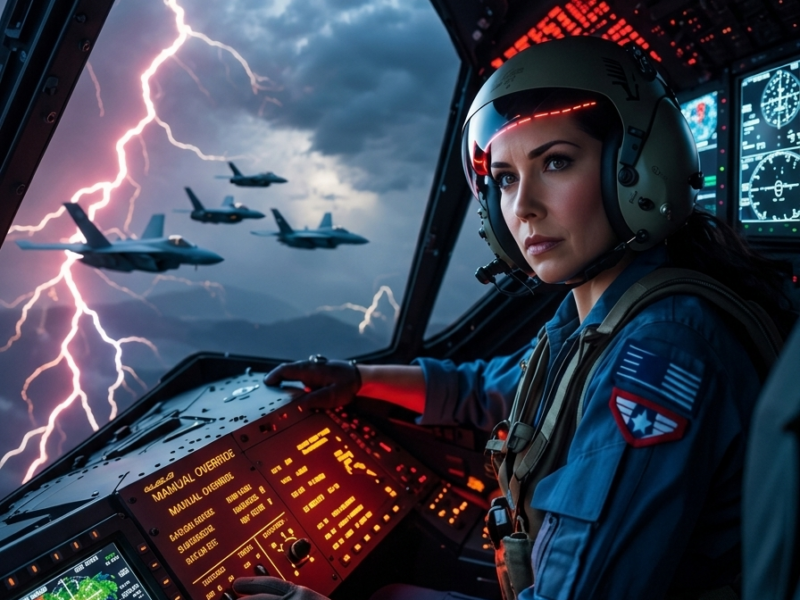
They laughed when I climbed into the rust-streaked F-14 at Naval Air Station Fallon, calling it a flying coffin while the enemy’s newest fighter tore across the sky
The morning heat at Naval Air Station Fallon, Nevada, was already cooking the asphalt when I walked onto the high-desert flight apron. Out on the main runway, the air vibrated with the heavy, bone-rattling roar of two F/A-18E Super Hornets taxiing toward the departure line. Their twin engines screamed in high-pitched harmony, their pristine gray fuselages shimmering in the pale sunlight. They were sixty-million-dollar masterpieces of modern warfare—stealth-coated, radar-guided, and flawless.
And then, parked away from the primary taxiways in the shadow of Hangar B, sat the ghost.
It was an old F-14D Tomcat, its sweep-wing twin-engine silhouette looking heavy, ancient, and dangerous. The Navy had officially retired the platform decades ago, but this specific airframe had been dragged out of the Boneyard at Davis-Monthan years prior to serve as a static radar target and ground instructional trainer. Its dark gray paint was blistered and flaking from years under the brutal desert sun; rust-colored streaks of iron residue ran down the speed brakes, and thick layers of beige sand dusted the canopy glass. Hanging from its nose gear strut was a heavy, plastic-laminated red tag that read: RED—DO NOT FLY. PERMANENT GROUND STATUS.
I set my heavy flight bag down on the cracked concrete, my combat boots dusting off a small puff of alkaline sand. My flight suit felt stiff against my ribs, and my hands were cold despite the ninety-degree heat.
“You’ve got to be out of your mind, Vance,” a voice boomed out from behind me.
Captain Reeves, the base operations commander, walked up to the edge of the shadow cast by the hangar roof. He was a broad-shouldered aviator with silver hair cropped close to his skull and a face that looked as though it had been carved out of granite by thirty years of carrier landings. He held a steaming metal mug of black coffee in his hand, looking at the old Tomcat with an expression that bordered on disgust.
“She’s a museum piece, Sarah,” Reeves said, taking a sip and waving his hand toward the red tag. “She’s been sitting on this line long before you were pinned with your wings. Her hydraulic seals are probably dried out, her wiring looms are bird nests, and her radar is two generations behind anything floating in the Pacific.”
“The airframe is structurally solid, Captain,” I said, my voice flat, calm, and steady. I didn’t look at him; my eyes were locked on the long, needle-sharp nose of the fighter. “The twin General Electric F110 engines were overhauled four months ago by the depot maintenance team for static tests. The fuel bladders were flushed last week.”
Reeves laughed—a sharp, cynical bark that echoed off the metal corrugated walls of the hangar. A couple of junior maintenance technicians working on a nearby utility cart stopped what they were doing, grinning as they looked over at us.
“You’re actually climbing into that cockpit?” Reeves asked, stepping closer and glancing down at my flight suit. He smirked, shaking his head. “Ma’am, this isn’t an airshow demo. You’re supposed to be running ground-control simulations for the strike fighter tactics instructor unit.”
“I know what my orders were,” I replied, grabbing the metal rungs of the ladder folded down from the Tomcat’s left intake. “And I know what this bird can do.”
“That aircraft hasn’t seen combat in twenty years,” Reeves grunted, his smile fading slightly into annoyance.
I paused with my boot on the first rung, turned my head, and looked directly into his eyes through my dark visor.
“Neither have most pilots,” I said.
The laugh died in Reeves’s throat. The technicians near the utility cart suddenly found themselves very busy examining their torque wrenches. Nobody spoke another word.
I pulled myself up the ladder, stepping over the rail and dropping down into the cramped, retro-styled cockpit of the F-14. The smell inside hit me instantly—a familiar, sharp mixture of old leather, hydraulic fluid, ozone, and dried desert dust. Unlike the sleek, multi-function glass displays of modern fighters, the Tomcat’s pit was a dense, intimidating wall of analog gauges, heavy toggle switches, and hard-edged metal instruments.
I sat down in the Martin-Baker ejection seat and strapped myself in. My fingers moved automatically across the left console, touching the heavy brass switches, checking the throttle detents, feeling the worn grip of the flight stick between my knees.
Most people in military aviation looked at the Tomcat and saw an overgrown, heavy relic of the Cold War—a flying coffin that demanded too much maintenance and killed pilots who didn’t treat her with respect. But I didn’t see a relic. I saw my childhood.
I remembered sitting in the dark of our garage in San Diego when I was nine years old, holding a flash lamp while my father, Major Daniel Vance, flipped through stacks of yellowed flight manuals. He had spent his entire life in the cockpit of this exact machine. He used to tell me that modern jets were computers that happened to fly, but the Tomcat was a wild animal—if you relied on screens to tell you what she was doing, she would bite your head off. But if you listened to the air frame, if you felt the strain in the wings, she would carry you through hell and bring you back home.
Twelve years ago, my father’s jet went down off the coast of Point Mugu during a classified late-night training mission. The Navy called it structural failure caused by pilot error. They never recovered the wreckage. They gave my mother a folded flag, a boxed medal, and a polite letter of condolence.
I took a deep breath, pulling down the heavy plexiglass canopy. The seal hissed as it locked into place, cutting off the noise of the airfield, leaving me alone with the low, rhythmic sound of my own breathing.
Suddenly, the red emergency strobe lights mounted along the roof of Hangar B began to flash in violent, crimson pulses.
Through the canopy, I watched Captain Reeves turn toward the operations tower. A second later, the high-pitched, metallic wail of the air base scramble siren tore through the desert air. It was a sound I had never heard at Fallon—not a drill siren, but the real, high-priority defense scramble.
Outside, ground crew members were sprinting across the apron, screaming into their radio headsets.
I reached for my helmet, pulled it over my head, and slammed the radio cable into the console jack. The tactical frequency was a wall of chaotic, frantic shouting.
“—all station, all stations! This is Fallon Tower! We have an unscheduled inbound track! High altitude, speed exceeding Mach 3.2, crossing the northern restricted boundary!”
“Is it an civilian airliner?” someone yelled over the net.
“Negative! Negative! RCS indicates a single target, zero transponder! It just executed a ninety-degree vector turn without losing velocity! I repeat, zero velocity drop! It’s not a drone, I say again, it’s an unidentified fighter!”
Through the glass of my cockpit, I saw two F/A-18s on the main runway launch their afterburners. Twin long tongues of blue and yellow flame erupted from their tails, and the two jets leaped into the sky, banking hard toward the north to intercept the intruder.
I sat in the cockpit of the old F-14, listening to the radio traffic.
Five minutes passed. Then six.
“Ghost Leader, this is Tower! Do you have visual on the bandit?”
“Tower, Ghost Leader! We have… god, what is that thing?! It’s silver! No visible control surfaces—”
A burst of harsh, terrible static shattered the radio link, followed by a high-pitched electronic screech that made me wince inside my helmet.
“—he’s on my tail! How did he get behind me?! He’s locking—”
“EJECT! EJECT! E—”
The line went dead.
Silence fell over the radio frequency. On the distant flight line, Captain Reeves was standing motionless, his coffee mug shattered on the pavement at his feet, staring up into the empty blue sky. Seven minutes after launch, two of the Navy’s most advanced fighters had vanished from the radar screens completely.
The radio crackled back to life. It was the base commander’s voice, shaking, stripped of all military decorum.
“Any available aircraft on the ramp… we have no airborne assets left in Sector Four. Is there anything that can turn a rotor?”
I looked down at the red tag hanging outside my canopy. Then I looked at the master fuel control switches on my left panel.
I flipped the battery master on. The analog gauges flicked to life, their needles trembling.
I clicked my mask into place and keyed my mic.
“Tower, this is Vance,” I said. My voice was low, slow, and ice cold. “You said that old bird could fly.”
There was a long pause on the radio. I could hear the commander swallowing hard over the open line.
“Can you get her in the air, Captain?” he asked softly.
“Give me the clearance,” I replied. “And I’ll prove it.”
The starter cartridges inside the F-14’s right engine housing detonated with a heavy, metallic thud that shook the entire fuselage.
A cloud of black, unburnt fuel smoke belched out of the exhaust nozzles behind me, swirling past the rusted speed brakes. For three agonizing seconds, the engine groaned, the compressor blades turning slowly, fighting against decades of stillness and dried grease.
Then, with a deafening, thunderous roar that shattered three glass windows in the ground control hut fifty yards away, the right General Electric turbine caught fire and howled to life.
I didn’t wait for the engine temperatures to stabilize. I slammed the left engine starter switch. The second turbine caught instantly, its deep, guttural bass joining the first, vibrating through the metal floorboards, through my flight boots, and straight into my spine. The old girl wasn’t just running—she was screaming.
Outside, Captain Reeves stood frozen on the tarmac, his uniform shirt whipped violently by the massive jet wash rolling off my tail. I gave him a single, rigid salute through the canopy. He didn’t return it; he just stared at the ancient, red-tagged warship pulling out of the shadows, its sweep wings extending out to their full width as if stretching after a long, dark sleep.
“Fallon Tower, Vance requesting immediate emergency takeoff from taxiway Bravo,” I radioed, steering the massive fighter onto the yellow centerline.
“Vance, you are cleared for immediate departure,” the tower controller stammered, his voice laced with absolute disbelief. “Wind is three-two-zero at twelve knots. God speed, Captain.”
I lined the nose wheel up with the concrete, locked the wheel brakes, and slammed both throttles forward past the military power detent, straight into full afterburner.
The twin engines erupted with massive, blue-orange shock diamonds stretching twenty feet behind the tail. The thirty-ton jet strained against its brakes like an angry bull held behind a gate. I released the brakes.
The acceleration wasn’t smooth like a modern jet; it was violent, raw, and terrifying. The Tomcat slammed me back into the hard padding of the ejection seat, its tires screaming as they grabbed the asphalt. Within twelve hundred feet, the nose strut extended, the airspeed indicator needle whipped past one hundred and eighty knots, and I pulled back hard on the stick.
The old fighter tore itself away from the earth, climbing almost vertically into the clear, cloudless Nevada sky.
As I passed ten thousand feet, I slammed the wing-sweep control lever into AUTO. With a heavy, mechanical clunk that sent a shudder through the airframe, the massive wings swept backward, tucking into their high-speed Delta configuration. The airspeed needle surged past Mach 1, breaking the sound barrier with a sharp double-boom that rolled across the desert basin below.
“Command, Vance is passing angels twenty,” I reported, watching the altimeter spin like a casino slot machine. “Where is the target?”
“Vance, Command!” the controller yelled. “Target is at angels thirty-two, bearing zero-one-zero, speed Mach 3.5! He’s executing a wide orbit over the northern range… wait! He sees you! He’s turning straight toward you!”
I pulled the nose up, climbing through thirty thousand feet, leveling off just above a thin, wispy deck of white cirrus clouds.
And then I saw it.
It came out of the sun—a blinding, razor-thin silver streak that left no contrail. It moved with a terrifying, unnatural fluidity, gliding across the sky like a knife cutting through silk. It didn’t look like any Russian or Chinese stealth aircraft I had studied in intelligence briefings. It was smooth, dark silver, with angled twin tails and an elongated fuselage that seemed to absorb the sunlight.
As it closed the distance, my tactical radar display—the old, round green cathode-ray tube between my knees—remained completely blank. The intruder didn’t exist to radar. It was a ghost.
Suddenly, a loud, warbling audio tone shrieked inside my helmet.
LOCKED. ENEMY RADAR LOCK.
A bright red warning lamp labeled THREAT DIRECT began to flash frantically on my instrument panel.
“Break off! Vance, break off!” the command operator screamed into my headset. “He’s got a hard weapons-grade lock on you! You can’t out-turn a fifth-gen missile in that airframe!”
My heart was pounding against my ribs like a trapped bird. My hands were soaked in sweat inside my flight gloves. The enemy jet was closing at four thousand feet per second, its sleek nose pointed directly at my cockpit, ready to launch a missile that would turn my thirty-year-old aircraft into a cloud of burning aluminum.
Don’t panic, a voice whispered in the back of my mind.
It was my father’s voice, clear and quiet, coming out of the shadows of my memory.
They build these new jets to fight other modern jets, Sarah. They rely on computers to predict where you’re going to turn. They think in geometry and radar cross-sections. But a dogfight isn’t math. It’s violent, unpredictable, and dirty. Never chase the fastest thing in the sky. Make him slow down to fight you.
The enemy jet was two miles out. One second from missile release.
I didn’t turn left. I didn’t turn right.
I pulled both throttles completely out of afterburner, slammed them back to IDLE, and yanked the heavy speed brake lever all the way back while pulling the flight stick straight into my stomach.
The F-14 didn’t just slow down; it hit an invisible wall in the sky.
The massive tail speed brakes popped open, the airframe groaned in agony, and the wings automatically swung outward to their full width, grabbing the thin air at thirty thousand feet. The nose swept up to an impossible eighty-degree angle of attack—a maneuver the flight manuals said was impossible in a heavy Tomcat without causing a compressor stall.
The silver enemy jet flew right past me.
It moved so close to my canopy that I could see the heat distortion from its engine bay and the dark, tinted visor of the pilot inside the cockpit. He had expected me to dive or turn. He had never imagined that a thirty-ton mechanical dinosaur would simply stop dead in mid-air.
“Now, baby,” I growled through my teeth, my body straining against six Gs of force as gravity dragged my face down.
I slammed the stick forward, kicking the left rudder pedal with everything I had. The Tomcat rolled onto its back, dropping its nose down into the thick cloud layer below.
We tumbled out of the sky, falling like a leaf through the white fog, completely breaking the enemy’s visual lock.
Below the clouds, I leveled the wings, pushed the throttle back into full afterburner, and pulled the nose up into a vertical climb, pointing the jet directly toward the open space where I knew the enemy pilot would have to turn to relocate me.
I was coming up directly beneath his blind spot—right under his belly, where his sleek radar arrays couldn’t look down through his own engines.
For three glorious, heart-stopping seconds, everything inside the cockpit went silent. The threat tones stopped. The wind quieted down. The green tactical scope remained blank.
I didn’t need radar. I had him in my crosshairs through the heavy glass windscreen.
I squeezed the red trigger on the front of the flight stick.
“Fox Two.”
A heavy Sidewinder heat-seeking missile detached from the glove vane under my left wing. Its solid-rocket motor ignited with a blinding white flash, trailing a thick spiral of gray smoke as it streaked through the clear air.
The missile struck the enemy fighter’s right engine bay with catastrophic force.
A giant ball of bright orange fire and black smoke erupted against the crisp blue Nevada sky. Shockwaves slammed into my F-14, rattling the canopy, but I kept my hands steady, rolling the jet around the burning debris as the enemy aircraft broke into three spiraling pieces, plunging toward the desert floor below.
I pulled the throttles back, watching the wreckage hit the ground five miles west of the target range, sending a plume of black smoke rising into the desert air.
I keyed my mic. My breath was ragged, coming in short, gasping gulps.
“Command, Vance,” I whispered. “Bandit splash. The range is clear.”
For ten long seconds, there was no reply from Fallon. Then, the radio erupted into a deafening storm of cheering, shouting, and clapping from every controller in the operations tower.
I looked down at my fuel gauge. The red warning light was flickering. I had less than four hundred pounds of jet fuel left in the tanks—barely enough to glide back to the runway.
“Bringing the old girl home,” I said softly, touching the metal frame of the canopy. “Bringing her home.”
The landing was anything but graceful.
The F-14 slammed onto the concrete of Runway 32 like a falling anvil, its main tires exploding in twin clouds of burning rubber as the heavy airframe bounced once, twice, before the hook caught the emergency arresting cable stretched across the asphalt.
The wire screeched in protest, pulling taut and dragging thirty tons of metal to a dead, shivering stop just fifty yards from the end of the overrun strip.
The left engine coughed once, sputtered a cloud of grey smoke, and died from fuel starvation. The right engine ran for another three seconds before its fuel lines ran completely dry, shutting down with a low, descending whine that sounded like a weary sigh.
The silence that followed was absolute.
I sat in the cockpit, my arms limp at my sides, my hands trembling so violently that I couldn’t unbuckle the chest harness. Sweat was pouring off my forehead, stinging my eyes, and my flight suit was soaked through. But inside my chest, my heart was beating with a quiet, fierce pride.
Through the canopy, I saw three fire trucks, two emergency ambulances, and four military police humvees speeding across the airfield toward me, their red and blue lights flashing against the blinding desert sun. Behind them came Captain Reeves’s black staff vehicle, kicking up a massive cloud of beige dust.
I reached up, unlatched the canopy seal, and pushed the heavy glass bubble upward.
The hot desert air rushed into the cockpit, bringing with it the familiar smell of burnt rubber, hot hydraulic oil, and scorched desert bushes.
Captain Reeves was the first to reach the ladder. He climbed up three steps at a time, stopping at the rim of the cockpit. His hair was disheveled, his eyes wide with a combination of lingering shock, absolute awe, and something else—something that looked suspiciously like fear.
He stared at me, then looked down at the dead instrument panel, then back at my face.
“How in God’s name did you do that?” Reeves whispered, his voice trembling slightly. “That prototype fighter was flying circles around our best tactical radars. How did you know where he’d turn?”
I pulled off my helmet, letting my wet hair drop down over my shoulders, and looked at him.
“My father taught me,” I said quietly.
Reeves’s expression changed instantly. The color drained from his weathered face, leaving his skin looking ash-gray in the desert glare. He dropped his hands from the canopy rail, taking a half-step down the metal ladder.
“Your father?” he asked softly.
I nodded, unbuckling my leg straps. “Major Daniel Vance. He flew this exact airframe during the late nineties before he died.”
Reeves didn’t answer right away. He looked toward the tail of the F-14, staring at the faded Navy serial number painted near the rudder—BuNo 164601. He swallowed hard, his throat moving nervously.
“Sarah,” Reeves said, his voice dropping so low that only I could hear him over the idling engines of the fire trucks below. “Your father didn’t die in a flight accident.”
My hands went completely numb. The metal buckle of my shoulder harness slipped from my fingers, clattering against the cockpit floorboards.
“What did you say?” I asked, leaning forward, my eyes burning into his.
Reeves reached into the inner pocket of his heavy leather flight jacket. His fingers pulled out a small, yellowed envelope that looked like it had been sitting in a secure safe for decades. From inside the envelope, he retrieved a single, weathered black-and-white photograph.
He didn’t hand it to me immediately. He held it in his hand, looking down at it with an expression of deep, lingering regret.
“When your father went missing twelve years ago, the Navy sealed his operational files under Executive Authority,” Reeves said, his voice barely audible over the wind. “They told your mother it was an engine failure because the truth would have started a war.”
“What truth?” I demanded, my voice cracking with anger. “Tell me, Reeves!”
He handed me the photograph.
It showed two men standing in front of this very same F-14 on a rain-slicked runway at night. On the left was my father—younger, smiling, wearing his green flight suit with his helmet tucked under his arm.
And standing right next to him, with his arm slung casually over my father’s shoulder, was a tall, sharp-featured pilot wearing an unbadged, dark gray flight suit.
My heart stopped.
The pilot standing beside my father was wearing the exact same dark silver helmet design as the pilot of the stealth jet I had just shot out of the sky ten minutes ago.
I turned the photograph over in my trembling hands.
Written on the back in dark, blue ink was my father’s unmistakable handwriting—the precise, slanted script I had seen on dozens of birthday cards and flight logbooks throughout my childhood.
There was a date written at the top.
I stared at the numbers. My blood ran cold.
The date written on the back of the photograph wasn’t twelve years ago. It wasn’t twenty years ago.
It was TOMORROW’S DATE.
October 8th.
And underneath the date, written in bold, jagged lines that looked as though they had been scratched into the paper in a state of absolute desperation, were six words that made my world crumble into dust:
“If she flies it, they’ll come.”
My fingers clutched the yellowed photograph so tightly that the edges crumpled against my flight gloves.
The hot desert wind whistled through the open cockpit of the dead F-14, but I felt as though I was standing in the middle of a blizzard. The sun beating down on my head felt cold, distant, and meaningless.
“Where did you get this, Reeves?” I whispered, my voice shaking so hard I could barely articulate the words. “Where did you get this photo?”
Captain Reeves looked around the flight line frantically. Three military police officers were standing near the nose gear, while the crash crew was busy securing a tow bar to the front wheel strut.
“Not here,” Reeves said, grabbing my arm with a firm, urgent grip. “Get down from this aircraft. Now.”
I unbuckled the remaining safety straps, swung my legs over the canopy rail, and climbed down the metal ladder. My feet hit the hot asphalt, but my legs felt weak, like rubber beneath my weight. Reeves didn’t lead me toward the main operations building or the medical triage tent. Instead, he steered me toward a small, unmarked concrete bunker located behind the liquid oxygen storage tanks—an old Cold War-era secure communications vault that had been out of service for ten years.
He pulled a heavy keycard from his pocket, swiped it through the rusty electronic lock, and shoved the heavy steel door open.
Inside, the bunker was cool, smelling of damp concrete, old copper wire, and stale air. A single fluorescent tube flickered on the ceiling, casting long, harsh shadows across a rusted steel desk and a bank of decommissioned reel-to-reel tape recorders.
Reeves slammed the heavy door shut, locking the deadbolt from the inside.
“Talk to me,” I said, stepping toward him, holding the photograph in his face. “Tomorrow’s date? My father wrote tomorrow’s date on a photo taken twenty years ago? That’s impossible! It’s a fake!”
“It’s not a fake, Sarah,” Reeves said, leaning back against the steel desk, looking exhausted, old, and defeated. “Your father didn’t die during a routine training mission off Point Mugu. Operation Deep Shield was never a training drill. It was an extraction.”
“An extraction of who?”
“Of him,” Reeves pointed at the dark figure standing next to my father in the photograph. “The man in that picture is Colonel Viktor Reznov—a former Soviet prototype test pilot who disappeared in 1994 with the primary blueprints for a revolutionary, radar-absorbing propulsion system. A system that didn’t just hide an aircraft from electronic sensors—it manipulated radar frequencies, creating false signatures miles away from the real airframe.”
I stared at him, trying to piece the fragments together in my mind. “My father was helping him defect?”
“Your father was his assigned contact,” Reeves said, nodding slowly. “They trained together at a black site in Alaska for two years. They knew each other’s flight habits better than brothers. But on the night of the extraction, something went wrong. Someone inside Defense Intelligence leaked the flight plan. Reznov’s aircraft was intercepted over the Pacific by an unidentified flight of unmarked fighters.”
“And my father?” I asked, my heart pounding in my throat. “What happened to my father?”
Reeves took a deep breath, staring down at the concrete floor. “Daniel realized they were walked into a trap. He used his F-14 to draw the interceptors away from Reznov’s prototype. He took three air-to-air missiles in his tail assembly. His jet went down sixty miles off the coast.”
“Then he died!” I shouted, tears finally breaking through my composure, hot and angry against my cheeks. “He died in the ocean!”
“We thought he did,” Reeves said quietly. “Until three weeks ago.”
Reeves reached into his desk drawer, pulled out a small, portable digital audio recorder, and pressed the PLAY button.
A loud burst of radio static filled the small concrete room, followed by the deep, mechanical hum of a cockpit environment—the sound of an oxygen regulator clicking rhythmically, the whistling of high-altitude wind against glass.
Then, a voice came through the speaker.
It was older, raspy, and worn by years of hardship, but the tone, the rhythm, the slight southern drawl—it was unmistakable. It was my father.
“Fallon Command… if this recording is playing, then the decoy protocol has failed,” my father’s voice said through the static, sounding as though he was speaking from inside a deep, metallic tomb. “They didn’t destroy the prototype in ’08. They captured it. And they’ve been building a fleet of them at an undisclosed facility in the Arctic circle.”
I covered my mouth with both hands, a choked sob escaping my throat.
“I managed to escape the facility six months ago,” the recording continued, the voice growing weaker, interrupted by a sharp cough. “I’m holding out at the old auxiliary radar station near Sector Nine. But they know I’m here. They know I have the master override codes for their flight guidance network. They’re sending a hunter-killer sweep to eliminate this position.”
The recording paused for three agonizing seconds. Then my father spoke again, his voice dropping into a quiet, intensely personal register that broke my heart into a thousand pieces.
“If anyone is listening to this… if my daughter Sarah ever made it to the cockpit… tell her I’m sorry I missed her graduation. Tell her the old Tomcat still has one last flight in her. If she flies it… if she puts that old bird in the air… the radio signature from her radar transponder will trigger the master beacon at Sector Nine. They’ll come for her. But she’s the only one who can finish this.”
The recording ended with a sharp, metallic click, leaving the room in total, suffocating silence.
I stood there, paralyzed, my tears dropping onto the cold concrete floor.
He was alive.
My father was alive, hiding in a frozen, forgotten bunker in the desert mountains of Sector Nine, surrounded by an enemy force that was coming to erase him from existence.
“Where is Sector Nine?” I asked, wiping my face with the sleeve of my flight suit, my voice turning from grief into pure, unadulterated steel.
Reeves looked at me, his eyes filled with sorrow. “It’s an abandoned Cold War radar installation forty miles north of here, in the middle of the bombing range. But Sarah… you can’t go there. That silver jet you shot down? That was just the scout. Radar just picked up three more unidentified signals crossing the northern border.”
He stepped toward me, grabbing both of my shoulders. “They’re coming for the base, Sarah. They’re coming to destroy that F-14 and eliminate every piece of evidence.”
I looked down at the photograph in my hand. I looked at tomorrow’s date written on the back.
My father hadn’t predicted the future. He had set a trap. He knew that the moment I flew that red-tagged F-14, the unique signal from its vintage radar unit would ping the satellite network, alerting the enemy that the ghost had awakened—and drawing them away from his position straight into Fallon.
Tomorrow wasn’t the day he wrote the note. Tomorrow was the day he knew I would come for him.
“Refuel my jet,” I said, looking Reeves dead in the eye.
“Sarah, did you not hear me?!” Reeves yelled. “You have no fuel! Your airframe is stressed to its limit! The main landing gear is cracked from that cable arrest! If you take that bird up again, she’ll disintegrate in mid-air!”
“Then she’ll disintegrate,” I said, ripping my shoulders away from his grip and stepping toward the bunker door. “Because my father is waiting for me. And I’m not leaving him behind again.”
The maintenance hangar at NAS Fallon was a madhouse.
Mechanics were hauling high-pressure fuel hoses across the concrete, slamming armaments racks into place under the F-14’s belly, and patching the cracked fuselage panels with emergency speed tape. The old Tomcat sat in the center of the bay like a wounded predator, her engines smoking, her red status tag torn away and lying trampled on the grease-stained floor.
Captain Reeves stood at the base of the ladder, holding two heavy tactical flight helmets. He wasn’t wearing his commander’s cap anymore; he was wearing a flight suit, his harness buckled tight across his chest.
I stopped in front of him, surprised. “What are you doing, Captain?”
“You can’t fly a Tomcat into a three-on-one dogfight without a Radar Intercept Officer in the back seat,” Reeves said grimly, sliding his helmet over his head and locking the visor into place. “You need someone to handle the tactical weapons suite while you keep us from crashing into the mountains.”
I looked at the old veteran for three seconds, then gave him a sharp, respectful nod. “Welcome aboard, RIO.”
We scrambled up the ladders, dropping into our respective cockpits—me in the front, Reeves in the back.
“Fuel load is at sixty percent!” the crew chief shouted from the tarmac, pulling the grounding cables away from the landing gear. “That’s all the aviation gas we have left in the storage tanks! You’ve got twenty minutes of flight time before you’re gliders!”
“Twenty minutes is plenty!” I yelled back, slamming the canopy down and locking the seals.
The twin General Electric engines roared to life once more, their deep, metallic thud shaking the hangar walls. I didn’t wait for taxi clearance. I slammed the throttles forward, steering the massive fighter straight out of the hangar doors and onto the active runway.
Outside, the sky over Fallon had turned a dark, bruised purple as the sun began to dip below the western mountains.
“Vance, Reeves, this is Tower!” the emergency controller screamed over the comms. “Three targets incoming! Range fifteen miles, altitude twelve thousand feet, speed Mach 2.8! They are locked onto the airfield!”
“Let’s go get my father,” I muttered through gritted teeth.
I pushed the throttles past the detent, engaging full afterburner. The F-14 leaped off the asphalt, her damaged landing gear retracting with a heavy, metallic groan as we rocketed straight into the darkening sky.
“I’ve got them on raw infrared!” Reeves shouted from the back seat, his fingers working frantically across the tactical weapons panel. “Three silver ghosts, flying in a tight wedge formation! They’re preparing to drop precision ordnance on the base!”
“Not today!” I roared, pulling the flight stick hard to the left and plunging the jet into a high-speed bank.
We intercepted the three enemy fighters ten miles north of the base, right over the jagged peaks of Sector Nine.
The air battle was a chaotic, terrifying blur of fire, smoke, and screaming metal.
The three silver jets split apart instantly, moving like living shadows across the sky. But this time, I wasn’t alone. Reeves was locked into the old analog weapons system, pulsing high-frequency radar beams directly into their stealth coatings, forcing their electronic systems to overload.
“Target one locked!” Reeves barked. “Shoot! Shoot!”
I slammed the firing button. A long-range Phoenix missile detached from the stomach bay, its engine igniting with the force of a thunderclap. The heavy missile streaked through the twilight sky, striking the lead enemy jet dead center, blowing it into a shower of white-hot magnesium fragments.
“Target two is on our tail!” Reeves yelled. “Break right! Break right!”
I kicked the right rudder pedal, slamming the throttles into idle and popping the air brakes just as I had done before. The F-14 shivered violently, her airframe screaming under eight Gs of pressure. A stream of heavy cannon fire ripped through the air where my cockpit had been a split-second before, tearing off a section of my left vertical stabilizer.
Alarm buzzers shrieked inside my helmet. Red lights flashed across my panel like a Christmas tree.
“We’re losing hydraulic pressure in the flight controls!” I gasped, fighting the stick with both hands as the jet began to roll out of control.
“Hang on!” Reeves screamed. “I’ve got a lock on target two!”
He fired a Sidewinder heat-seeker off our wingtip. The missile guided straight into the second enemy jet’s intake, exploding its engine and sending it tumbling down into the rocky canyons below.
The third enemy fighter—the flight leader—didn’t stay to fight. Seeing his wingmen destroyed, he engaged his afterburners, executing a high-speed climb toward the stratosphere, disappearing into the dark blue sky toward the north.
“He’s running,” Reeves gasped, his breath ragged over the intercom. “We did it… Sarah, we did it.”
“Not yet,” I said, looking down through the floorboards of my cockpit.
Below us, nestled in a deep, narrow canyon between two jagged granite peaks of Sector Nine, sat a small, dome-shaped concrete structure. A single, weak green signal flare was burning bright on a flat patch of sand right beside the building.
Standing near the green light, holding a flare gun pointed toward the sky, was a tall, lone figure in an old, faded flight suit.
My heart swelled with a feeling so intense it almost brought me to my knees.
“Hydraulics are at ten percent, Sarah!” Reeves warned from the back seat. “We can’t land this bird on a runway, let alone in a canyon! We have to eject!”
“No,” I said, my voice steady, filled with absolute resolve. “This old girl brought us this far. She gets to finish the mission.”
I pulled the throttles back, lowered the wing flaps manually using the mechanical emergency override, and lined the nose of the broken, smoking F-14 up with the narrow, sandy floor of the canyon.
The jet dropped out of the sky like a stone. The trees flashed past my canopy in a green blur. The granite walls of the canyon loomed on either side of us, less than fifty feet from our wingtips.
“BRACE!” I screamed into the mic.
The F-14 slammed into the desert sand, her landing gear collapsing instantly under the immense force. The belly of the heavy fighter skidded across the rocks, showering the dark canyon with a fountain of blinding yellow sparks and red dust. The airframe groaned, twisted, and spun around twice before finally coming to a dead stop just twenty feet from the concrete bunker.
Silence returned to the desert.
Smoke billowed off the scorched fuselage as the canopy seal unlatched with a quiet hiss.
I pushed the glass open, pulled off my helmet, and looked down over the side of the shattered cockpit.
The lone figure stepped out of the shadow of the bunker, walking slowly across the sand toward the smoking wreckage. He walked with a slight limp, his hair completely white, his face lined with twelve years of hardship, cold, and survival.
He stopped ten feet from the nose of the aircraft, looking up at the cockpit. His bright blue eyes—the exact same eyes I saw every morning in the mirror—filled with quiet, overwhelmed tears.
He looked at the shattered wings, then at the smoking engines, and finally at my face.
Major Daniel Vance raised his right hand to his brow, offering his daughter a slow, crisp, and perfect military salute.
I climbed out of the cockpit, stepped down onto the warm desert sand, and ran toward him.
The sky above Sector Nine was completely quiet now, filled with a million brilliant, shining stars, lighting up the dark Nevada wilderness as the old ghost of the sky finally rested in the quiet earth below.
The end.









