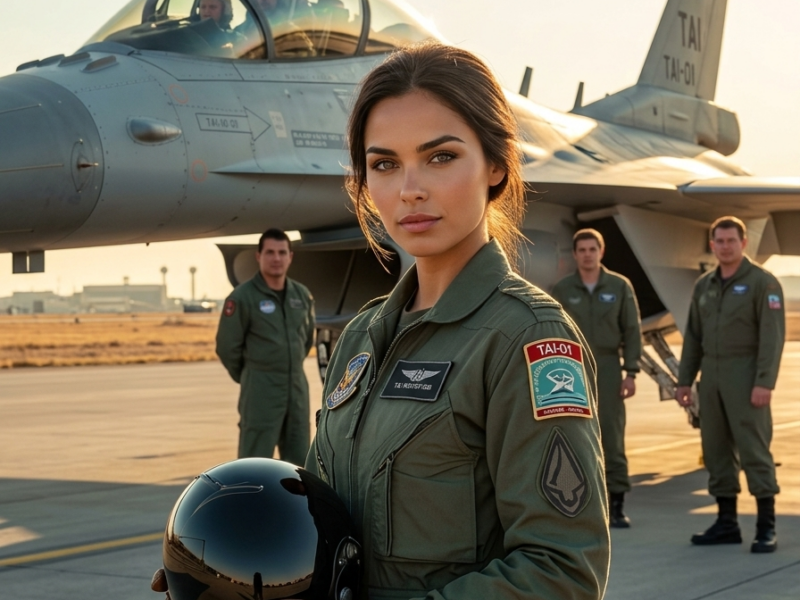
They laughed when I climbed into the F-14 at Naval Air Station Miramar, calling me obsolete before the canopy even closed
The briefing room at Naval Air Station Miramar always carried the heavy, lingering scent of stale coffee, jet propellant, and the quiet tension of men who lived on the edge of sound. Morning light cut through the high windows, illuminating dust motes dancing over the tactical maps. Commander Hayes stood at the front, laser pointer in hand, tapping against a whiteboard that detailed the morning’s simulated intercept package over the Pacific Ocean.
“We have two elements going up today,” Hayes announced, his voice like gravel scraping over cement. “Element One is led by Captain Cole Mercer, flying the shiny new F/A-18 Block III Super Hornet. Element Two… well, Element Two will be providing target tracking and legacy support.”
Hayes turned, his pointer landing on a faded photograph taped to the wall—a massive, sweep-wing F-14 Tomcat sitting on the tarmac. A quiet ripple of laughter swept through the back row of desks.
“That jet belongs in a museum, Ryan,” Hayes said, looking straight at me. “I don’t know who you begged at NAVAIR to get permission to fly that relic out of the boneyard, but don’t break it. Parts are hard to come by, and so is my patience.”
I sat in the third row, my flight suit zipped to the chin, helmet resting on my knee. I felt every eye in the room slide toward me, heavy with silent amusement. I didn’t flinch. I had heard worse. For two years, ever since I transferred back to active duty after my father’s death, I had been the ghost in the squadron—the guy who clung to mechanical levers, hydromechanical flight controls, and twin Pratt & Whitney engines while everyone else flew digital computer platforms.
What cut deep wasn’t Hayes’s cynicism. What hurt was seeing Captain Cole Mercer smiling in the front row.
Cole had been my instructor when I first earned my wings. He was the man who had stayed up until three in the morning with me in the ready room, drawing flight diagrams on paper napkins when I was struggling with carrier landings. He had been my father’s friend, my mentor, and the man who had stood at my father’s grave, placed a hand on my shoulder, and swore he would never let anyone bury my career.
Yet there he sat, flashing that easy, perfect smile, basking in the light of being the Navy’s golden boy flying the newest strike fighter in the inventory.
“Alright, hotshots,” Hayes grunted, shutting off the projector. “Simple exercise. Standard intercept. Track the high-altitude target, vector in, execute mock engagement, head home for lunch. Try not to embarrass yourself out there, Ryan.”
“Understood, Commander,” I said quietly.
As the pilots filed out, chair legs scraping against linoleum, Cole lingered near the doorway. He waited until the room cleared before leaning against the doorframe, crossing his arms.
“You really don’t make it easy on yourself, Jack,” Cole said, his tone casual, almost playful. “You could be flying a Super Hornet right now if you stopped playing the grieving son. That old bird is a coffin with wings.”
“She’s got soul, Cole,” I replied, picking up my helmet. “And she flies when the digital stuff fails.”
“Nothing fails on these new jets,” Cole laughed softly, slapping my shoulder as we walked down the polished corridor toward the flight line. “Just keep up today, alright? Try not to fall behind on the climb.”
Outside, the California sun beat down relentlessly on the tarmac. Heat shimmered off the concrete. Walking up to the F-14 was like approaching a sleeping beast. Her grey paint was faded, scratched, and patched with dull primer in places, but her lines were sharp, dangerous, and proud. Her variable-sweep wings were tucked back, ready to bite the sky.
I conducted my pre-flight walkaround with meticulous care. I checked the landing gear hydraulics, traced the rim of the massive engine intakes, and inspected the flight control surfaces. As I stepped under the belly near the starboard avionics bay, I paused.
I reached up and brushed my gloved hand against a small access panel near the main radar housing.
It was warm.
Not just sunlight-warm, but radiating an internal, mechanical heat—as if power had been running through the system long before the ground crew connected the external power cart. I frowned, shining my flashlight into the seal gap. Nothing looked out of place, but a cold prickle of unease rippled down my spine.
“Everything alright, Lieutenant?” called out Chief Miller, the lead mechanic, leaning against his toolbox.
“This panel feels warm, Chief. Did someone run a diagnostic this morning?”
Miller shrugged, wiping grease off his knuckles with a rag. “Avionics tech was in there at 0400 running a routine sweep. Standard check. She’s good to go, Ryan.”
I hesitated, staring at the warm metal. A memory flashed in my mind—my father, Captain Marcus Ryan, standing in our garage late at night, holding a burnt circuit board, his eyes dark with worry. If the metal talks to you, Jack, listen to it. The Navy runs on protocol, but survival runs on instinct.
“Jack! Canopy’s opening!” Cole yelled from three spots down, sitting high in the cockpit of his gleaming F/A-18. “Let’s move!”
I shook off the chill, climbed the narrow metal ladder, and settled into the ejection seat of the Tomcat. The smell instantly grounded me—worn leather, hydraulic fluid, ozone, and old plastic. I strapped in, connected my oxygen mask, and began the startup sequence.
The twin engines roared to life with a primal, chest-thumping vibration that no digital jet could replicate. The canopy came down with a heavy mechanical latch.
“Miramar Tower, Victory 104 ready for taxi,” I radioed.
“Victory 104, cleared runway 24 Left. Clear for takeoff.”
We taxied out in formation. Cole’s Super Hornet moved with crisp, computer-assisted perfection. My Tomcat felt heavy, alive, and restless beneath my boots. We lined up on the runway, heat waves washing behind us.
“Ready to see what the future looks like, Jack?” Cole’s voice crackled over the tactical frequency.
“Just don’t leave me in your dust, Captain,” I replied, pushing the throttles forward.
The twin afterburners ignited with a thunderous boom. The F-14 surged forward, pinning me back into my seat as the airspeed indicator climbed rapidly. 100 knots. 150 knots. Rotate. The wheels left the tarmac, and the Pacific coastline dropped away beneath us in a blur of blue and brown.
We climbed through twenty thousand feet, punching through a thick layer of white overcast into the crisp, brilliant blue of the upper atmosphere. The Pacific stretched out endlessly to the horizon.
“Victory Flight, split formation,” Cole commanded over the comms. “Vector 270. Let’s initiate the radar search grid.”
“Copy, vector 270,” I responded, turning my aircraft west.
I reached down to activate the AWG-9 radar system—the legendary long-range tracker that gave the Tomcat its lethal reach. The screen flickered green. A line of light swept across the display once… twice…
Then, the radar screen went completely black.
I stared at the CRT tube. I flipped the master radar switch off, waited three seconds, and flipped it back on. Nothing. The digital readouts flickered violently, displaying gibberish code before dying entirely.
“Cole, I’ve got a radar failure,” I said, keeping my voice level. “AWG-9 just went dark. Switching to backup bus.”
I toggled the emergency circuit breaker on the right console. A faint burning smell—sharp and metallic—filled the oxygen mask. The backup display didn’t even light up.
Someone hadn’t just forgotten to check the avionics. The warm panel in the hangar returned to my mind with terrifying clarity. The radar feed hadn’t failed; it had been deliberately fried by a high-voltage short wired directly into the main power bus.
“Victory 104, say again?” Cole’s voice came back, laced with static. “Your signal is breaking up.”
“My radar is completely dead, Cole. I’m blind up here. Aborting the exercise. Rejoining on your wing.”
I looked out my canopy, scanning the sky for Cole’s gray jet. He had been five miles off my port wing just moments ago.
The sky was empty.
“Cole, do you have eyes on me?” I asked, turning the Tomcat in a wide banking curve.
Silence.
“Cole?”
I looked down at my tactical navigation screen. The GPS coordinates were glitching, the numbers rolling wildly. The altimeter bounced up and down.
For one terrifying second, the vast sky felt utterly silent and hollow. No radar. No GPS. No wingman. No ground control. Just a thirty-ton iron fighter drifting twenty-five thousand feet above a cloud bank, utterly alone.
Suddenly, a bursts of heavy static broke through my helmet headset. It wasn’t the crisp digital encryption of the tactical channel. It was an old, unencrypted emergency frequency—a low-frequency band almost nobody used anymore.
Underneath the harsh hiss of radio noise, a voice whispered. It was raspy, urgent, and terrified.
“Victory 104… if you can hear this… do not execute the turn… repeat, do not follow the vector…”
My heart slammed against my ribs. “Who is this? Identify!”
“They changed your flight coordinates… ground tech at Miramar… don’t trust the exercise… get out of the box… they fried your—”
The transmission was abruptly cut off by a high-pitched screeching tone that burned my ears.
I gripped the flight stick until my knuckles turned white. My breathing came fast and shallow inside the rubber mask. My mind raced through the facts: my radar was dead, my backup navigation was scrambled, my wingman had vanished, and someone on the ground had just risked their life to give me a warning.
This wasn’t a training flight. It was an execution.
The clouds below me looked like a solid floor of cold, white cotton, stretching out for hundreds of miles toward the horizon. Without radar or GPS, I was flying blind in a sovereign military airspace that had suddenly turned hostile.
I forced myself to breathe. Inhale for four seconds, hold for four, exhale for four. My father’s training kicked in automatically. When the electronics lie to you, turn them off. Trust the air, trust the gauges, trust your eyes.
I reached over and slammed the switch for the digital flight computer and main avionics grid, cutting power to the fried boards. The cockpit went semi-dark, leaving only the analog, mechanical gauges glowing green in the shadows. The airspeed indicator, the magnetic compass, the artificial horizon, and the mechanical altimeter—the analog heart of the F-14.
“Alright, old girl,” I muttered, laying a gloved hand on the canopy frame. “Show me what you’ve got.”
I banked the Tomcat left, relying purely on the magnetic compass to head east, back toward the California coast. But as I rolled out of the turn, I caught a glint of reflected sunlight in my rearview mirror.
Something was trailing me.
I looked over my shoulder, straining against the shoulder harness. High at my seven o’clock position, emerging from the bright glare of the sun, was a sleek, silver shape. A jet. No external markings. No national insignia.
It wasn’t a friend. It wasn’t Cole.
The mysterious aircraft dipped its nose, diving straight toward my tail. A bright flash erupted from its wing root—a missile launch.
“Tracer! Missile in the air!” I yelled to myself, slamming the throttles straight into full afterburner.
The twin engines roared, dumping raw fuel into the exhaust. The F-14 surged forward, the force slamming my chest against the harness. I pulled hard on the flight stick, yanking the heavy fighter into a vertical climb.
The variable wings swept back automatically to 68 degrees, transforming the Tomcat into a darting arrow.
The heat-seeking missile streaked beneath my tail, missing my exhaust nozzles by less than fifty feet before detonating harmlessly in the thin air above the clouds. The shockwave rattled the Tomcat’s airframe, making the metal skin groan under the stress.
“Who the hell are you?” I growled, rolling the aircraft inverted at thirty thousand feet to keep eyes on the attacker.
The dark jet pulled up hard, executing an aggressive High Yo-Yo maneuver to stay on my tail. It was fast, agile, and clearly equipped with modern fly-by-wire flight control systems. In a conventional dogfight, my heavy, analog F-14 should have been easy prey.
But whoever was flying that jet didn’t know the Tomcat. And they didn’t know how my father had trained me to fly it.
I pulled back on the throttles, dropping speed rapidly, and stomped hard on the left rudder pedal while pulling the stick back into my lap. I executed a classic, violent Flat Scissors maneuver—forcing the old bird to slip sideways through the air like a skidding car.
The dark jet couldn’t slow down in time. It shot past my nose in a blur of gray metal and dark glass.
For half a second, we were canopy-to-canopy. I looked across the short gap of air and saw the pilot in the dark cockpit. He was wearing a unmarked black helmet with a darkened visor.
I shoved the throttles forward again, swinging the Tomcat’s nose around to lock onto his tail. I didn’t have radar-guided missiles—my weapons system was dead. But I had my manual reticle and the internal M61 Vulcan 20mm cannon.
I lined up the mechanical crosshairs on his tail pipe.
“Say night-night,” I muttered, my finger hovering over the trigger on the flight stick.
Before I could pull it, the dark jet suddenly flipped its wings, dumped flares, and dove straight down into the thick cloud layer below, disappearing instantly into the blinding white soup.
I pulled up, soaring back into the sunlight, my heart hammering like a jackhammer against my ribs.
Why didn’t he stay and finish the fight? Why dive away when he had the technological advantage?
Then, my tactical radio crackled again. Not the emergency frequency this time, but Cole’s channel—faint, distorted, and heavy with static.
“…mayday… Mayday… Victory 101… taking fire… engine two on fire… controls unresponsive…”
It was Cole.
“Cole! Cole, this is Jack! Give me your coordinates!” I yelled into the mask, scanning the clouds below.
“…off the coast… grid sector… four-zero… losing altitude fast… Jack, if you’re out there… I can’t hold her…”
His voice wasn’t the arrogant, smooth voice of the Golden Boy who had mocked my jet in the briefing room. It was the raw, trembling voice of a man who realized he was about to crash into the freezing waters of the ocean.
I checked my fuel gauge. The afterburner burn had consumed a quarter of my tanks. My radar was useless, my navigation was gone, and someone was actively hunting us in the sky. Protocol demanded I climb to high altitude, fly east, and make an emergency landing at the nearest military base.
I looked down at the dark, cold blanket of clouds below.
Cole had abandoned me. He had smiled while Hayes ridiculed me. He had let me fly a sabotaged aircraft.
“He was your instructor, Jack,” my father’s voice echoed in my mind. “In the air, we don’t settle debts. We bring each other home.”
“Dammit,” I swore loudly, grabbing the stick.
I jammed the nose down and plunged the Tomcat straight into the wall of clouds.
The world turned completely gray. Water droplets violently smeared across the plexiglas canopy as the F-14 sliced through the dense storm cloud at four hundred knots. Turbulence shook the aircraft violently, rattling the instrument panel so hard the needles blurred.
I broke through the bottom of the cloud deck at barely fifteen hundred feet above the water.
The Pacific Ocean below was a dark, angry grey, whipped into white-capped waves by high winds. I scanned the misty horizon, my eyes straining against the glare of the low ceiling.
“Cole! I’m under the soup. Say your altitude and visual markers!”
“…eight hundred feet… passing six hundred…” Cole’s voice was wet, panicked. “Smoke in the cockpit… visual is zero… I’m going to have to eject, Jack!”
“Negative! Do not eject in these sea conditions, Cole! The swell will drown you before a SAR chopper can scramble!” I scanned the water frantically. “Look for my lights!”
I hit the switch for the external landing lights, flashing two powerful beams of light through the gray haze.
Two miles to my right, a black plume of oil smoke rose from the water’s surface. Beneath the smoke, a gray shape was skimming dangerously close to the waves. It was Cole’s Super Hornet. His right engine was a roaring mass of yellow flame, leaving a trail of black soot behind it. His left elevator was shattered, dangling uselessly.
He was flying on one engine, losing speed and altitude by the second.
I banked hard, sliding my massive Tomcat alongside his burning fighter. I was flying so close I could see Cole inside his cockpit, his head turned toward me, his hands shaking as he struggled with the control stick.
“I’ve got you, Cole,” I said, matching his speed at two hundred knots—dangerously close to the Tomcat’s stall speed. “Your right wing is torched, and your hydraulics are leaking. You’re flying on borrowed time.”
“The flight computer is shut down!” Cole screamed into the radio, panic stripping away all his professionalism. “The fly-by-wire system locked up! It won’t let me pitch up! It thinks I’m already on the ground!”
My blood ran cold. The digital safety limiters in his brand-new aircraft—designed to prevent pilot error—had glitched due to the engine fire. The computer was forcing the plane down into the water, overriding his manual inputs.
“Override the computer!” I shouted.
“I can’t! The master switch melted in the fire!”
He had thirty seconds before he impacted the ocean.
“Listen to me, Cole!” I yelled. “Pull your emergency control breaker behind your left elbow! It’ll force the flight surfaces into analog manual bypass!”
“That’s not in the manual, Jack!”
“DO IT NOW!”
Through his canopy, I saw Cole reach back frantically, ripping off an emergency panel and pulling a yellow handle.
Instantly, his jet twitched violently. The computer release allowed his tail controls to catch the air again, stopping his descent at barely three hundred feet above the crashing waves. But his remaining engine was sputtering, choking on fire suppressant fluid.
“I can’t maintain airspeed!” Cole gasped. “I’m stalling!”
“Form up on my left wing,” I ordered, my voice dropping into a low, steady rhythm. “We’re going to do an escort glide. I’ll push the air off my wing to give you lift.”
“You’re crazy! If our wings touch at this altitude, we both die!”
“Shut up and fly, Captain!”
I pulled the Tomcat within five feet of his damaged jet. The air turbulence off my massive, swept-out wings caught his lifting surfaces, buoying his failing aircraft up like a leaf on a draft of wind.
Together, side-by-side, an ancient iron monster and a broken modern marvel, we dragged ourselves up through the sky, climbing slowly away from the sea.
” Jack…” Cole’s voice was trembling, stripped of all pride. “The jet… it didn’t just fail. The engine didn’t overheat.”
“I know,” I said, keeping my eyes locked on his wingtip. “My radar was sabotaged before takeoff.”
“No… you don’t understand,” Cole whispered, his voice cracking over the static. “The mission parameters… Hayes gave us modified coordinates… we were supposed to be out of radio contact over the target zone…”
I turned my head, looking straight into Cole’s visor through the dark glass. “Why?”
“Because of your father,” Cole said, his breath hitching. “Marcus didn’t die from a mechanical failure ten years ago, Jack. He found out about the defense contracts… the illegal tech transfers… He was going to the Inspector General.”
The cockpit seemed to shrink around me. The roar of the engines faded into a dull drone in my ears.
“And you?” I asked softly. “What did you do, Cole?”
Cole didn’t answer immediately. He looked away, staring out over the gray horizon. “They told me if I kept quiet… if I helped them write off the old legacy jets… I’d get the squadron command. I’d get the promotions.”
Tears streamed down my face beneath my flight goggles, hot and bitter. My mentor. My father’s friend.
“Jack… behind us!” Cole suddenly screamed over the radio.
I glanced at my rearview mirrors.
Emerging from the clouds above us was the unmarked black jet. Its nose was pointed straight at Cole’s helpless, burning aircraft. A red tracking light was glowing on its chin intake.
They weren’t just trying to sink my F-14. They were coming to finish the witness.
“He’s locking on me!” Cole shrieked. “I don’t have flares left!”
There was no time to think. No time to weigh betrayals or demand answers. In the air, there was only the living and the dead.
I pulled back hard on the stick, snapping the F-14 into a violent roll that sheared off from Cole’s side. I threw the Tomcat directly into the path between the attacker and Cole’s engine smoke.
The black jet fired a short burst from its nose cannon.
Armor-piercing 20mm rounds ripped through the sky, punching a line of jagged holes through my port wing and shattering my left navigation light. The impact slammed through the airframe, sending a shudder up the stick into my hands.
” Jack!” Cole cried out.
“Keep flying east, Cole! Don’t look back!” I roared.
I pulled the Tomcat up into a soaring climb, forcing the black jet to abandon its target and engage me.
We were under a thousand feet now. Below us, the jagged rocks of the California coastline were starting to appear through the ocean fog. There was no room for error. A single mistake at this altitude meant instant vaporization against the cliffs or the water.
The black jet was faster, but I had one advantage: my aircraft didn’t rely on computers to tell me what was possible.
I pulled the throttle back into idle, pulled the airbrake lever, and yanked the stick all the way back into my stomach.
The F-14 did something modern computer-controlled jets were programmed never to allow. The nose rose straight up into the sky while the plane continued sliding forward on its belly—a dramatic, aerodynamic maneuver known as the Cobra.
The black jet, expecting me to turn, overshoot straight past my canopy at over four hundred knots.
“My turn,” I hissed.
I slammed the throttles back into full afterburner. The Pratt & Whitney engines howled, spitting twin spears of blue fire. The wings swept forward to maximize lift, catching the dense, low-altitude air.
I locked my eye onto the mechanical crosshair painted on my windscreen. I adjusted the manual rudder pedals, aligning the crosshairs directly with the black jet’s tailpipe.
Click.
I squeezed the trigger on the stick.
The M61 Vulcan cannon beneath my nose erupted with a deafening, mechanical roar—six hundred rounds of heavy vulcan ammunition streaming out in a solid line of fire.
The bullets struck the black jet’s engine housing. Sparks, metal fragments, and black smoke erupted from its tail. The dark aircraft wobbled violently, its control surfaces fluttering as its sleek digital systems failed under structural collapse.
The pilot didn’t risk a second pass. Unable to maintain lift, the dark jet rolled inverted, dove low over the water, and retreated at high speed into the bank of thick offshore fog, fleeing west toward international waters.
Silence returned to the cockpit, broken only by the heavy rasp of my own breathing and the dull rattle of my damaged left wing.
I checked my fuel indicator. The needle was touching the red reserve line. My hydraulic pressure was dropping slowly from the bullet holes in my wing.
“Cole,” I breathed into the radio. “Are you still airborne?”
“… barely,” Cole’s voice came back, weak and exhausted. “I can see the runway lights at Miramar. Jack… my landing gear won’t drop.”
I looked ahead through the mist. The long runways of Naval Air Station Miramar were visible three miles out, glowing like yellow beacons in the dim light of the overcast morning. Emergency trucks with flashing red lights were already lining up along the tarmac.
“Put her down on her belly on the foam, Cole,” I said softly. “You’ve done it in the simulator a hundred times.”
“I don’t think I can… my hands are shaking too bad…”
“Yes, you can,” I said, bringing my damaged Tomcat alongside him once more, our wings almost touching in the grey air. “Follow me down. Touchdown together.”
Side by side, we descended over the airfield perimeter fence. The ground rushed up to meet us.
Cole’s jet hit the foam-covered runway first, metal scraping against concrete with a shower of brilliant orange sparks and thick white smoke. My F-14 touched down a second later, tire rubber screaming as the heavy landing gear absorbed the violent impact.
I slammed on the wheel brakes, fighting the rudder to keep the skidding Tomcat from spinning off the runway as hydraulics bled out onto the hot asphalt.
Finally, three thousand feet down the runway, both aircraft came to a complete halt.
Fire trucks immediately swarmed Cole’s burning Super Hornet, spraying foam over his scorched engines. ground crews rushed toward my cockpit with ladders.
I popped the canopy latch. The cool, crisp land air rushed into the cockpit, smelling of burnt rubber, foam, and rain. I pulled off my helmet and let my head fall back against the headrest, staring up at the quiet California sky.
I had survived.
The base was eerily quiet despite the chaos on the tarmac.
When I climbed down the metal ladder of my scarred, bullet-riddled F-14, I didn’t see the usual crowd of cheering mechanics or curious pilots.
Standing fifty yards away, beside three black government sedans parked near the main hangar, was Commander Hayes. Beside him stood four armed Naval Criminal Investigative Service (NCIS) officers, their faces cold and unreadable.
I stood on the tarmac, wiping sweat and oil from my forehead with the back of my flight glove.
Cole was being helped out of his cockpit by two paramedics. His flight suit was torn, stained with soot and blood from a small cut on his forehead. He refused the stretcher, pushing the medics away, and walked slowly toward me. His legs were shaking so badly he could barely keep his balance.
Commander Hayes stepped forward, his eyes scanning the gaping bullet holes in my Tomcat’s wing. His face was pale, his jaw clenched tight.
“Lieutenant Ryan,” Hayes said, his voice flat, trying to maintain authority. “You disobeyed direct flight vectors, destroyed military equipment during an unauthorized engagement, and endangered squad assets. You are under arrest.”
The two NCIS officers stepped forward, reaching for their handcuffs.
“Stand down, Commander,” a voice called out.
Cole stepped between the officers and me. He was breathing heavily, his chest heaving under his survival vest.
“Cole, get out of the way,” Hayes snapped, his eyes narrowing. “You’re in shock. Go to medical.”
“I’m not going anywhere, Hayes,” Cole said, his voice quiet, but carrying across the open tarmac with lethal clarity. “It’s over.”
Hayes froze. “What did you say?”
Cole reached into the inner breast pocket of his leather flight suit. His hand was trembling violently. He pulled out a worn, yellowed envelope, folded in half and sealed with plastic tape.
“Ten years ago, Marcus Ryan found the altered maintenance logs for the fleet’s carrier jets,” Cole said, looking directly at Hayes. “He knew someone in the procurement board was signing off on defective avionics parts in exchange for offshore payouts. He was going to turn over the evidence.”
Cole turned to me, tears cutting clean tracks through the black soot on his face.
“The night before your father’s jet went down, Jack… he called me. He knew they were coming for him. He gave me a sealed copy of his personal logbook and a flight telemetry disk. He told me to keep it safe, to use it if they ever tried to ruin you.”
Cole held the envelope out to me.
“Why didn’t you give this to the authorities ten years ago, Cole?” I asked, my voice barely a whisper, the pain burning far deeper than any physical fatigue.
“Because they threatened my family, Jack!” Cole sobbed, his composure breaking entirely. “Hayes told me if I spoke up, I’d be court-martialed for treason! They promised me a career, a command… if I just kept my mouth shut and helped them phase out the old aircraft that still had the real maintenance records!”
Hayes’s face turned from pale to an ashen, ghostly gray. He took a step backward toward his staff car, his hand reflexively going toward his belt.
Before Hayes could move another inch, two black sedans pulled up fast, blocking his car. Four plainclothes Federal agents stepped out, badges drawn, moving with lethal precision.
“Commander Thomas Hayes,” the lead agent announced, her voice booming over the wind. “You are under arrest for conspiracy, treason, and the murder of Captain Marcus Ryan.”
Hayes didn’t say a word. As the federal agents forced his arms behind his back and clicked the handcuffs into place, he stared at me with pure, unadulterated hatred. I stood tall, staring back into his eyes until they shoved him into the back seat of the car and slammed the door shut.
The tarmac fell silent again.
Cole stood before me, his head bowed, holding out the folded photograph and the logbook.
“I’m sorry, Jack,” Cole whispered, his voice broken. “I was a coward. I let them kill your father’s memory, and I almost let them kill you today.”
I reached out and took the envelope from his hand. I unfolded the photograph inside.
It was an old, faded glossy picture of my father standing in front of his F-14 on the deck of an aircraft carrier, smiling, his arm slung over a young Cole Mercer’s shoulders. On the back, written in my father’s dark blue ink, were six words:
“Cole knows why they killed me.”
Beneath it, my father had added a date—the date of his last flight.
I looked up at Cole. “You finally did the right thing, Captain.”
Cole wiped his face, nodding slowly. “I’m handing in my wings today, Jack. I don’t deserve to fly anymore.”
He turned and walked slowly toward the security detail waiting to take his statement, a broken man finally laying down a burden he had carried for a decade.
I turned back toward my aircraft.
The F-14 sat on the tarmac, smoke still wisping gently from its twin engine exhausts, bullet holes peppering its wings, its paint scorched and battered. The ground crew stood around it in silent awe. No one was laughing now. No one was calling her a relic.
I walked up to the nose of the fighter, laying my bare palm against the warm metal skin beneath the canopy.
The wind blew off the ocean, cold and fresh, clearing away the smell of smoke and oil. For the first time in ten years, the weight in my chest lifted.
“We brought him home, Dad,” I whispered to the sky.
The old Tomcat stood silent in the California sun, strong, unbeaten, and finally at peace.
The end.









