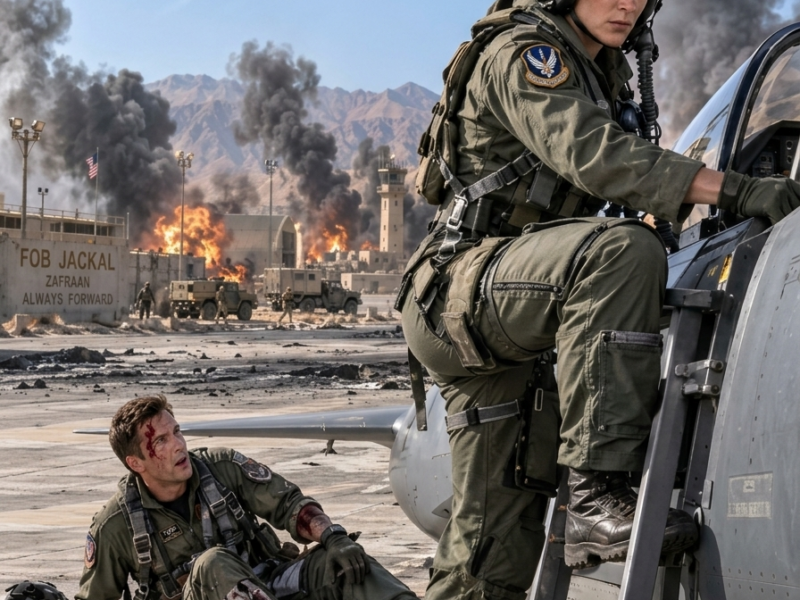
They laughed when I climbed into the battered transport aircraft at Fort Campbell and called me “just a cargo pilot,” but their smiles disappeared eight hours later
They laughed when I climbed into the battered transport aircraft at Fort Campbell and called me “just a cargo pilot,” but their smiles disappeared eight hours later when I returned alone, covered in smoke, with eight enemy jets confirmed destroyed and one terrifying secret still locked inside my cockpit.
The morning had started with the usual condescending smirks from the fighter jocks over at 160th Special Operations Aviation Regiment. I was Captain Sarah “Ghostwriter” Miller, flying a modified, heavily aged C-130 Hercules—a four-engine turboprop fat-cow built for hauling boxes, palletized rations, and spare diesel engines. To the F-22 and F-35 pilots strutting around the briefing room in their G-suits, I was glorified air-FedEx.
I wasn’t supposed to be anywhere near the fight. My job was simple: deliver the supplies to a forward tactical landing strip, stay low, avoid radar coverage, and come home. At least, that was what everyone believed. What the hotshot jet pilots didn’t know was that my tail number—Eagle Seven—did not belong to a standard cargo wing. Beneath the chipped grey paint and oil-stained aluminum fuselage, my Hercules was packed with millions of dollars in black-budget electronic warfare suites, prototype signal-jamming arrays, and an encrypted hard-line node that bypassed every standard chain of command.
Four hours into the flight, as the craggy, snow-dusted peaks of the foreign mountain range swallowed the horizon, the quiet hum of our four Allison turboprop engines was shattered by a deafening squawk over the radio.
“Multiple aircraft approaching,” my flight engineer shouted, his fingers flying across the secondary radar console. “Unknown signatures! High speed, zero transponders!”
I snapped my eyes to the tactical display. Eight contacts. Fast. Heavily armed. And coming straight for us from the northern corridor.
My crew chief, Master Sergeant Frank Vance, unbuckled from his jump seat and rushed to the cockpit doorway, his hands trembling slightly as he held onto the steel frame. “Ma’am… we’re a transport aircraft. We’re carrying rations, medical crates, and a sealed black box in the hold.”
“I know,” I said, my voice dropping into a flat, steady tone that masked the spike of adrenaline hitting my bloodstream.
“So what do we do?” Frank pressed, his eyes wide through his flight goggles. “Turn back to the blue zone?”
I tightened my grip on the heavy yoke, feeling every vibration of the four massive propellers pulsing straight through the leather of my gloves and into my jawbone. “We keep flying.”
Before Frank could respond, the radar warning receiver shrieked with a solid lock-on tone.
“Missile launch! Missile launch! Inbound from six o’clock high!”
“Hang on!” I yelled, pulling the heavy yolk back and stomping hard on the left rudder pedal.
The forty-ton cargo plane groaned in protest as I threw it into a violent, nose-down dive, aiming straight for a rocky ravine beneath us. The first heat-seeking missile streaked past our left wing, missing the number-two engine by mere yards before detonating harmlessly against a stone cliff face. The shockwave slammed into the side of the plane, sending a shudder through the metal floorboards that rattled every tooth in my head.
“Second missile incoming! Right side!” Frank screamed.
I didn’t have flares left to waste. I pulled the throttles back to idle, letting gravity pull the fat nose of the Hercules down into a terrifying vertical plummet, rolling the aircraft nearly ninety degrees onto its side. The second missile passed directly underneath our starboard wing—so close I could hear the screeching roar of its motor through the thick aluminum skin.
“Ma’am, you’re going to tear the wings off!” the co-pilot yelled, clutching his harness as the altimeter spun out of control.
“She’ll hold!” I snapped, leveling the wings just thirty feet above the floor of the narrow canyon.
As the two enemy fighters overshot us, sweeping past our canopy in a twin burst of silver speed, I noticed something deeply disturbing. They were modern, multi-role air-superiority fighters—fast enough to erase a lumbering transport from the sky with a single button press. Yet, they weren’t firing cannon rounds into our massive tail section. They were maneuvering aggressively to push us away from the open plains and herd us into the tight, winding mountain pass ahead.
They weren’t attacking randomly. They were protecting something.
A narrow corridor through the mountains lay directly ahead. I remembered the classified, eyes-only briefing I had been handed thirty minutes before engine start at Campbell. There was an Allied armored convoy moving down that exact pass—hundreds of ground troops trapped between two vertical walls of rock. And someone had deliberately leaked their exact grid coordinates, setting them up for total execution.
I looked at the glowing red icons on my tactical screen. The eight enemy jets had reformed their attack package, fanning out above the ridge to block every high-altitude escape route.
They wanted me to turn back. They wanted the sky clear so they could rain hell down on the trapped convoy below.
“Hold on back there!” I called out over the internal intercom. “I’m taking us into the gulch!”
“Captain, that’s suicide!” Frank shouted from the cargo bay. “We can’t dogfight fighters in a canyon!”
“We aren’t dogfighting,” I gritted out, pushing the throttles to emergency war-power. “We’re shutting down the theater.”
I shoved the nose of the Hercules straight into the shadow of the mountain pass. The enemy jets followed, diving in after us like wolves entering a narrow trap.
The canyon walls rushed past our cockpit windows like gray, blur-streaked tombstones. At eighty feet off the deck, the turbulence was brutal, smashing the C-130 around like a wooden toy in a hurricane.
Behind us, the eight enemy fighters squeezed into the narrow corridor in two tactical elements of four. Their pilots were confident, closing the distance fast, their radar locks buzzing continuously inside my helmet.
They thought they were cornering a defenseless target. What they didn’t realize was that in a narrow mountain pass, high speed and agility become deadly liabilities—and a cargo plane isn’t just a container; it’s a massive wall of metal moving through narrow air.
“Activate the AN/ALQ-250 suite,” I commanded, reaching for the secondary overhead console and flipping three guarded red switches. “Full power to all omni-directional emitters. Burn their retina screens.”
The co-pilot hesitated for a fraction of a second. “Cap, that system hasn’t been field-tested at low altitude! It could fry our own avionics!”
“Do it!”
He slammed the breaker home.
Instantly, a high-frequency electromagnetic pulse radiated outward from the belly pod of our Hercules. The prototype electronic countermeasures system flooded the airwaves with millions of watts of directed radio frequency noise, ghost signals, and false radar returns.
The results down the canyon were instant and chaotic.
The enemy fighters’ advanced helmet-mounted targeting displays went completely white with static. Their automated flight control computers, suddenly flooded with hundreds of false terrain warnings and ghost obstacles, began throwing out emergency override signals.
In a narrow canyon where the rock walls were less than two hundred yards apart, a two-second loss of spatial orientation was a death sentence.
“Bandit one is going down!” Frank screamed over the intercom.
Through my side window, I saw the lead enemy jet wobble violently as its pilot lost his synthetic vision display. His left wingtip clipped an overhanging limestone outcrop at four hundred miles per hour. The aircraft disintegrated instantly into a brilliant orange fireball that painted the canyon walls in bright flame.
“Bandit two just pulled up hard to avoid the debris!” the co-pilot yelled. “He’s… he’s clipping the canopy of Bandit three!”
The second jet’s tail section slammed directly into the cockpit of the fighter flying in close formation beside him. Both aircraft locked together in a tangle of screaming metal before plummeting into the floor of the ravine, exploding into a twin column of dark smoke.
Three down. Five left.
“They’re breaking formation!” I shouted, pulling the yoke back to crest a sharp ridge inside the pass. “They’re trying to clear the jammer beam!”
Two of the surviving fighters pushed their throttles into full afterburner, climbing vertically to break out of the canyon’s electromagnetic envelope. But as they pulled ninety degrees nose-up, their engines sucked in the thick, oxygen-starved smoke cloud left behind by the first three explosions.
The engine compressor blades on both jets stalled simultaneously. Their thrust dropped to zero. Deprived of airspeed and lift, both multi-million-dollar fighters turned into two-ton bricks, tumbling backward through the sky before crashing into the rock face below.
Five gone. Three left.
The remaining three enemy pilots were veterans. Realizing that electronic lock-ons were impossible inside my jammer bubble, they switched to manual iron-sights, dropping into a single-file line behind my tail ramp, preparing to shred our four unarmored engines with 30mm cannon fire.
“Frank!” I yelled over the intercom, my ears ringing from the deafening roar of wind and alarms. “Open the rear cargo ramp!”
“What?!” Frank’s voice was sheer panic. “Ma’am, if I open the ramp at this speed, the tail section will tear apart!”
“Open the ramp and cut the tie-down straps on Pallet Four and Five! Now!”
In the cargo bay, Frank didn’t ask another question. He scrambled back to the loadmaster panel, slammed the emergency release lever, and unlocked the hydraulic seals.
With a deafening mechanical hiss, the massive rear ramp swung open into the roaring slipstream. The freezing mountain air rushed into the cabin, sending loose paper, insulation, and straps flying into the void.
Pallets Four and Five didn’t contain medical supplies. They were loaded with six thousand pounds of heavy industrial steel girders intended for forward base construction.
Frank slammed his combat boot against the manual emergency release hook.
The heavy steel pallets slid backward along the roller rails, shooting out the back of the open ramp straight into the face of the three pursuing fighters.
The lead pilot had less than twenty feet of clearance. The three-ton steel pallet struck his nose cone full-force, crushing his radome and caving in his cockpit canopy. The jet flipped end over end, smashing into the canyon wall behind us.
The trailing two fighters, blinded by the sudden rain of steel and debris, swerved wildly to avoid the impact. One swerved too far left, digging its engine intake directly into the dirt embankment at five hundred knots. The last jet, trying desperately to roll clear, clipped its vertical stabilizer against a high-tension power line strung across the canyon. The wire snapped, wrapping around the jet’s engine intake like a whip, dragging the aircraft straight down into the rocky riverbed below.
Eight contacts.
Eight flashes of fire in my rear-view mirrors.
Eight gone.
Silence settled over the cockpit, broken only by the rhythmic, labored pounding of our four turboprop engines and the howling wind tearing through the open rear ramp.
We cleared the mouth of the mountain pass, emerging into the gray, open expanse of the northern plain. Below us, the Allied armored convoy was moving safely down the road, completely untouched, their commanders entirely unaware of the slaughter that had just taken place inside the gorge behind them.
I pulled the throttles back, leveling the wings at three thousand feet, my hands trembling violently against the yoke as the adrenaline began to bleed out of my veins.
I reached up and clicked the long-range tactical radio toggle. “Command, this is Eagle Seven. Canyon corridor is clear. Convoy is unhindered.”
The radio sat silent for five long seconds. Static hummed over the encrypted channel.
Finally, the crackling voice of the theater controller came through, sounding hollow and bewildered. “Eagle Seven… we copy. Radar shows all eight hostile signatures erased from the board. What fighter unit provided your air cover?”
I looked down at my hands. “Negative, Command. No air cover. We are alone.”
There was another long, suffocating pause.
“Ident yourself, Eagle Seven,” the voice said quietly. “You’re the only aircraft left on the board.”
I looked out at the empty, quiet blue sky stretching out ahead of me.
“No,” I whispered to myself, my eyes dropping down to the secondary avionics terminal on my right console.
A red warning light was blinking silently on the encrypted data panel—a local network connection that was still active inside my own plane.
“I’m not.”
A second transmission cut through my helmet speakers—not over the long-range military frequency, but over a closed-circuit, short-range intercom channel that was hard-wired exclusively into the plane’s internal wiring.
The voice was cold, calm, and muffled through an oxygen mask.
“You weren’t supposed to survive that canyon, Captain Miller.”
My blood ran cold, freezing the air in my lungs.
I whipped my head around to look at my co-pilot. His hands were on his controls, his face pale, his eyes wide with absolute horror as he heard the same voice echoing inside his headset.
“Who is that?” the co-pilot stammered, his fingers hovering over the radio frequencies. “That’s coming from inside the plane!”
I unbuckled my shoulder harness, pulling my service pistol from its chest holster and racking the slide with a sharp, metallic clack.
“Stay on the controls,” I ordered the co-pilot, my voice dripping with ice. “Keep her flying level toward friendly territory. If anyone tries to enter this cockpit from behind, depressurize the cabin.”
“Sarah, wait—”
I didn’t wait. I pushed open the armored cockpit door, stepping back into the drafty, dimly lit belly of the C-130 Hercules.
The cargo bay was a disaster zone. Loose webbing hung from the ceiling, metal tie-down rings had been torn from the floorboards, and the smell of raw hydraulic fluid and cold wind filled the space. Down near the back of the bay, Master Sergeant Frank Vance was kneeling near the open ramp, holding a steel cable to keep himself from being sucked out into the clouds.
Sitting in the middle of the floor, right where the sealed black-box cargo container had been chained prior to takeoff, was an empty steel pallet.
The tie-down chains had been cleanly severed—not snapped by turbulence, but cut through with a high-heat thermite torch.
The classified black-box payload was gone.
And standing beside the emergency exit ladder, holding an unholstered suppressed pistol aimed straight at my chest, was a figure in an unmarked black flight suit.
I raised my M9 pistol, leveling the sights directly between the intruder’s night-vision visor.
“Drop the weapon!” I shouted over the roar of the slipstream. “Drop it now!”
The figure didn’t flinch. Slowly, with a calm, deliberate movement, the intruder reached up with one gloved hand and unlatched the heavy flight helmet, pulling it off to reveal a face covered in sweat and grease.
I gasped, my grip on my pistol faltering for a fraction of a second.
It was Captain Marcus Vance—Frank’s younger brother, a decorated air-intelligence officer who was supposed to be stationed six hundred miles away at the European Air Operations Center in Ramstein.
“Marcus?” Frank screamed from the back of the bay, trying to scramble up off his knees. “What the hell are you doing on this plane?!”
“Stay down, Frank!” Marcus shouted back, his voice strained against the rushing wind. “Stay down or I swear to God I’ll put a round through your chest!”
“Lower your gun, Marcus,” I said, taking a slow, calculated step forward, my boots biting into the anti-slip floor tape. “Where is the black box? What was inside that container?”
Marcus let out a bitter, breathless laugh, his eyes darting frantically between me and the open ramp behind him. “You think you were hauling radio parts, Sarah? You think Fort Campbell loaded this bird with electronic gear just to save a ground convoy?”
“What was in the box?” I repeated, my finger tightening on the trigger.
“The master decryption key for the entire Allied air-defense grid,” Marcus gritted out. “The software protocols that keep our radar stations from identifying friendly planes as hostiles. Vance and his friends in High Command sold it three days ago. Those eight jets in the canyon weren’t sent to shoot down a cargo plane. They were sent to act as an escort package while I dropped the package to a ground team in the pass!”
The truth hit me like a physical blow to the chest.
The entire mission was a setup. The leaked coordinates of the convoy, the sudden deployment of my modified C-130, the eight “hostile” jets that had aggressively herded us into the canyon—it was all a staged extraction operation. Marcus had stowed away in the cargo bay at Campbell, cut the black box loose during the flight, and was supposed to drop it via parachute into the valley below while the eight jets covered his exit.
“They were supposed to disable your engines, force you to crash-land in the gorge, and sweep the wreck,” Marcus whispered, his hand trembling as he held the gun on me. “It was clean. A tragical operational loss. A cargo plane downed by surface-to-air fire in hostile territory.”
“Except I didn’t crash,” I said.
“Except you drove a forty-ton truck through eight multi-million-dollar fighters like a goddamn lunatic!” Marcus yelled, his voice cracking with rising panic. “You ruined the drop zone! You killed the retrieval package! And now I have three hundred officers in Berlin and Washington waiting for a signal that isn’t coming!”
“It’s over, Marcus,” I said, taking another inch forward. “Give me the gun. We turn this bird around, hand the data over to Federal investigators, and—”
“It’s not over!” Marcus screamed.
He reached into his tactical vest, pulling out a small, red-capped detonation device.
“There’s a secondary explosive charge rigged to the main wing-spar of this plane,” Marcus said, his thumb hovering over the red toggle switch. “You give me a parachute and let me step off this ramp, or I blow the left wing off this Hercules right here at fifteen thousand feet!”
The cold wind howling through the open ramp of the C-130 seemed to freeze the blood in my veins.
“Marcus, don’t do this,” Frank pleaded from the floor, tears streaming down his oil-stained cheeks as he looked at his younger brother. “We’re family, man! You’re going to kill your own brother for a payoff?”
“There is no family in this, Frank!” Marcus snapped, his eyes wild, his thumb pressing hard against the plastic safety cover of the detonator. “You don’t know who is behind this! If I don’t deliver this key, they won’t just kill me—they’ll erase everyone with my last name from the registry! You think I wanted this?!”
I kept my pistol aimed at Marcus’s forehead, my mind racing through flight parameters, structural limitations, and altitude tables.
We were at fourteen thousand feet. The cabin pressure was equalization-locked because of the open ramp, meaning the air inside the cargo bay was thin, freezing, and rapidly dropping in oxygen content. Marcus was wearing a full tactical flight harness, but he wasn’t wearing an oxygen mask anymore—he had pulled it off when he revealed his face.
Hypoxia sets in fast at fourteen thousand feet under physical stress. Symptoms: confusion, loss of fine motor control, slowed reaction time.
He had maybe ninety seconds before his brain started slowing down. I just needed to buy time without triggering his thumb on that detonator.
“Where’s the box now, Marcus?” I asked, keeping my voice low, monotone, and deliberate. “Did you throw it out in the canyon?”
Marcus blinked hard, his head twitching slightly as his breathing grew rapid and shallow. “It’s… it’s rigged to a static line. It’s hanging beneath the belly… waiting for the signal…”
He was already starting to slur his words slightly. The cold air was taking its toll.
“You can’t jump out of this ramp at fourteen thousand feet without an oxygen bottle, Marcus,” I lied smoothly, taking another tiny step forward. “You’ll black out three seconds after you clear the tail section. You’ll pull the rip-cord in a coma and hit the ground at terminal velocity.”
Marcus shook his head violently, trying to clear the fog settling inside his mind. “I… I have a low-altitude chute. I know what I’m doing…”
“Look at your hand, Marcus,” I said softly.
He hesitated, his eyes darting down to his right hand holding the detonator. His fingers were turning blue, trembling violently from the sub-zero wind chill whipping through the bay. He tried to tighten his grip on the switch, but his motor control was failing him.
“Frank!” I yelled over my shoulder without taking my eyes off Marcus. “Cut the static line on the belly hook!”
Frank didn’t hesitate. He pulled his heavy loadmaster knife from his belt, lunged toward the central winch assembly near the open ramp, and slashed through the heavy nylon strap holding the secondary cargo hook.
With a sharp SNAP, the steel cable whipped out into the sky, sending the missing black box plummeting into the deep mountain lakes five miles behind us, sinking into hundreds of feet of icy water where no ground team would ever recover it.
“NO!” Marcus screamed, his eyes flashing with rage.
He raised his pistol to shoot Frank.
In that split second, I didn’t shoot Marcus. I did something worse.
I reached to my belt, pulled my emergency oxygen mask over my face, hooked my arm through the floor tie-down ring beside me, and screamed into my mask mic:
“CO-PILOT! PULL UP! FULL CLIMB! NINETY DEGREES!”
In the cockpit, the co-pilot slammed the four throttles forward to maximum emergency power and pulled the control yoke all the way back into his lap.
The forty-ton Hercules pitched its nose up violently into a near-vertical forty-five-degree climb.
The sudden, brutal force of two Gs slammed into the cargo bay. Marcus, already lightheaded from hypoxia and standing unsecured near the open ramp, lost his balance completely. His feet slipped on the slick aluminum floorboards, his hands flying wild as the detonator slipped from his frozen fingers and skittered across the metal floor.
He slid backward toward the open ramp, screaming as his body tumbled toward the empty blue void behind the plane.
“MARCUS!” Frank screamed, diving across the floor, reaching out with his bare hand and catching his brother by the strap of his tactical vest just inches before he slipped over the edge into the sky.
The heavy transport plane leveled off at eighteen thousand feet, floating silently above the cloud deck.
I dropped to my knees, scrambled across the floorboards, and kicked the red detonator out of the ramp, watching it fall thousands of feet into the clouds below before it could ever be pressed.
I reached out, grabbed Marcus by the collar of his flight suit, and helped Frank drag his shivering, semi-conscious brother back into the safety of the cargo bay floor.
Marcus lay there, gasping for air, clutching his chest, his eyes staring up at the bare metal ribs of the ceiling in complete defeat.
Frank sat down beside him, burying his face in his blood-stained hands, sobbing quietly into the cold wind.
I stood up, wiped the ice from my visor, and walked back toward the cockpit door.
My co-pilot looked over his shoulder as I walked in, his hands still shaking on the wheel. “Sarah… what happened back there? Where’s the box?”
“The box is at the bottom of a lake,” I said, sliding back into the pilot seat and pulling my shoulder harness tight. “And Captain Marcus Vance is under arrest.”
“What do we tell Command?” he asked, pointing at the blinking red radio lights on the main console. “The whole theater is asking for a status report.”
I grabbed the long-range transmitter mic, my eyes locked on the horizon ahead where the runway lights of Fort Campbell were waiting for us in the distance.
“Tell them Eagle Seven is coming home,” I said. “And tell them to have the Military Police waiting on the tarmac.”
The landing at Fort Campbell was quiet.
There were no fire trucks spraying water arches, no brass bands, and no crowds of cheering pilots waiting on the flight line.
As the C-130’s heavy tires chirped against the concrete runway at 0200 hours, five black armored sedans and two squads of heavily armed Military Police vehicles rolled out onto the tarmac, their red and blue strobe lights flashing silently against the dark night sky.
I cut the four turboprop engines one by one. The massive propellers spun down to a complete halt, leaving the cockpit in a sudden, heavy silence that felt heavier than the roar of the canyon.
When the rear cargo ramp lowered, federal agents and military investigators swept into the aircraft, taking Marcus Vance into custody without a word. Frank walked out behind his brother, his head bowed, escorted by two silent officers who took his statement in the back of a black van.
I stayed in the cockpit for twenty minutes, completing the post-flight checklist by the dim red glow of the emergency panel lights.
My hands were steady now. The adrenaline was entirely gone, replaced by a deep, bone-weary exhaustion that made every muscle in my back feel like lead.
A high-ranking officer wearing a three-star general’s insignia on his collar stepped up the crew ladder and entered the flight deck. It was General Raymond—head of Special Operations Command.
He didn’t look at the damaged controls or the bullet-scarred wing paneling. He looked straight at me.
“Captain Miller,” the General said, his voice quiet, heavy with authority.
I stood up and offered a crisp, sharp salute. “Sir.”
General Raymond didn’t return the salute immediately. Instead, he reached into his tunic pocket and pulled out a small, black encrypted thumb drive—the backup log from my plane’s flight recorder.
“Eight enemy fighters destroyed in a tactical mountain corridor,” Raymond said, reading from a paper file in his other hand. “A major espionage ring dismantled inside High Command. And an Allied ground convoy saved from total liquidation.”
“Yes, sir,” I answered.
“Do you know what the official Department of Defense report is going to say about tonight, Captain?” Raymond asked, leaning in closer.
I looked him in the eye. “No, sir.”
“It’s going to say that a four-engine cargo plane suffered a severe hydraulic failure over international waters, dumped its non-critical cargo into the ocean to maintain altitude, and executed a routine emergency landing at Campbell.”
I stared at him, my expression unreadable. “And the eight enemy fighters, sir?”
“Atmospheric radar interference,” General Raymond said without missing a beat. “A computer glitch caused by high-altitude solar flare activity. No shots were fired. No jets were lost. The canyon does not exist on any public record.”
He stepped closer, placing a heavy hand on my shoulder.
“The software key you sank into that lake was a prototype, Miller. If the public or our allies knew that our air-defense grid was compromised for even six hours, it would trigger a geopolitical catastrophe that could start a full-scale war before sunrise. This story dies inside this cockpit.”
“And Master Sergeant Vance?” I asked. “His brother?”
“Marcus Vance will spend the rest of his natural life in a deep underground facility in Colorado,” Raymond said cold. “Frank Vance will be quietly honorably discharged with a full pension and a non-disclosure agreement that carries a treason charge if he so much as whispers his brother’s name.”
The General paused, looking at my flight suit, which was still stained with soot, hydraulic oil, and sweat.
“And as for you, Captain Miller… you’re getting a Distinguished Flying Cross. It will be awarded in a windowless room in Langley, Virginia. No press. No medal ceremony. No family invited.”
“I didn’t fly into that canyon for a medal, General,” I said quietly.
“I know why you flew into that canyon, Ghostwriter,” Raymond said, a faint, rare smile breaking through his stern face. “Because you’re a cargo pilot. And cargo pilots always finish the delivery.”
Ten minutes later, I stepped down the crew ladder onto the cold, damp tarmac of Fort Campbell.
The morning air smelled of wet asphalt, pine trees, and jet exhaust. Over at the fighter hangars across the field, a group of young F-22 pilots were walking toward their morning brief, laughing and carrying their helmets under their arms, completely unaware of what had transpired three thousand miles away while they slept.
One of them looked over at me as I walked past, carrying my heavy canvas flight bag over my shoulder.
“Hey, Miller!” the young lieutenant shouted with a cocky grin, pointing at the mud splatter along the landing gear of my Hercules. “Looks like you had a rough delivery! Did you hit a bird out there?”
I stopped, looked over at his pristine, polished jet sitting inside the lit hangar, and then looked back at my battered, battle-scarred C-130 resting quietly on the dark ramp.
I didn’t argue. I didn’t correct him. I didn’t tell him about the canyon, the jammed radars, the burning jet fuel, or the secret buried at the bottom of an icy lake.
I just smiled, adjusted the strap of my flight bag, and kept walking.
“Just a bird, Lieutenant,” I called back softly over my shoulder. “Just a really big bird.”
The end.









