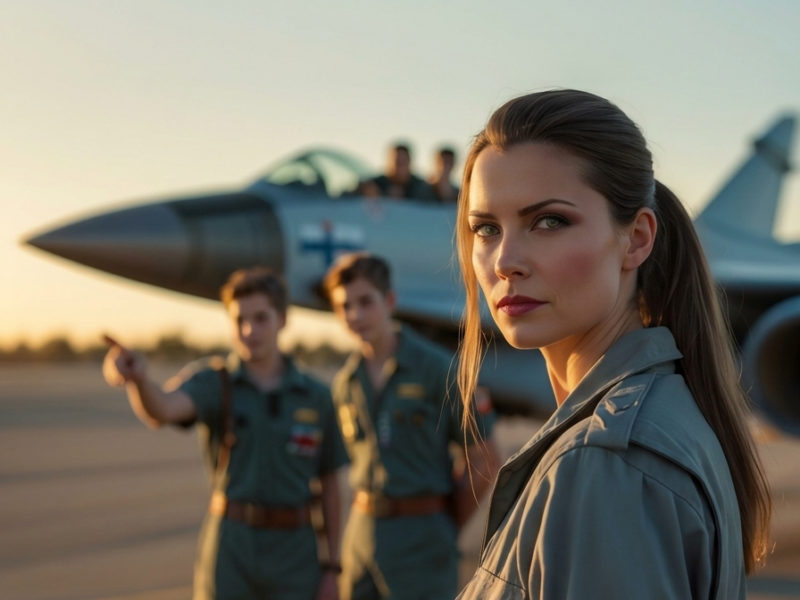
They laughed when I climbed into the battered F-14 nobody had flown in years, calling it a museum piece while the enemy’s newest fighter screamed across the Nevada sky
The heat shimmer rising off the tarmac at Nellis Air Force Base made the air bleed like oil on a warm canvas. Standing in the shadows of Hangar 4, the F-14 Tomcat looked less like a weapon of war and more like a ghost that had refused to fade away. Its airframe was a patchwork of dull gray primer and sun-bleached Navy paint, scarred by decades of desert dust and neglect. The swing-wing interceptor had been decommissioned before half the airmen on the base were old enough to drive, parked in the sun to rot while the world moved on to sleek, composite, stealth-coated machines that looked like polished obsidian.
I ran my gloved palm along the leading edge of the titanium wing glove. The metal was burning warm, vibrating slightly with the distant rumble of jet engines taxiing three runways over.
“You’re seriously taking that thing up?”
Captain Miller leaned against the rusted rungs of the boarding ladder, a cup of lukewarm mess-hall coffee clutched in one hand and a sneer pinned to his face. He was dressed in the pristine flight suit of the Fifth-Generation Fighter Wing, a man who had never flown an aircraft that didn’t calculate its own landing approach.
“It still has wings, Miller,” I said without looking down, adjusting the heavy straps of my chest harness. “It still burns JP-8. That makes it an aircraft.”
Miller let out a short, barked laugh that carried across the quiet floor of the hangar. “It’s a museum piece, Marcus. A mechanical dinosaur. Look at the radar dome—it’s held together with high-temp tape and prayer. The airframe has over nine thousand flight hours on it. You pull more than six Gs in that bucket, and you’re going to rain aluminum all over the desert.”
“She’s stronger than she looks,” I muttered, tightening the chin strap of my helmet.
“Against an X-99?” Miller snorted, shaking his head as he turned to look out toward the clear Nevada sky. “The aggressor squadron just rolled out two of them. Unmanned, AI-vectored, vector-thrusting platform. It flies faster than your radar can sweep, turns sharper than human blood pressure can sustain, and you’re down here playing mechanic on a tombstone.”
I didn’t answer him. I couldn’t tell him about the six months of midnight shifts I’d spent inside the belly of this beast. I couldn’t tell him about the unauthorized access codes I’d used to scrape discarded processing units from the base scrap heaps—clandestine components, old thermal imaging arrays from experimental drone programs, and modified signal processors that the Air Force Logistics Command had declared obsolete three fiscal years ago.
They thought the Tomcat was dead. They thought its ancient AN/AWG-9 radar was nothing more than a heavy paperweight sitting in the nosecone. They had no idea that beneath the rusted panels and faded stencils, I had rewired the core processing architecture. I hadn’t modernized it to match the high-tech, networked systems of the fifth-gen fleet; I had rebuilt it to do something far more dangerous. I had tuned it to listen to the empty spaces—the radio-silent, low-observable gaps where modern stealth aircraft hid.
Suddenly, the desert calm split wide open.
A high-pitched, screaming howl tore across the sky above the base, so violent it rattled the corrugated tin walls of Hangar 4 and set off the emergency alarms of the fire trucks parked near the tarmac. It wasn’t the sound of a standard jet turbine. It was a wet, unnatural screech—the acoustic footprint of a pulse-detonation engine.
Within seconds, the base air-defense sirens began to wail, their long, rising notes cutting through the morning heat. The red warning lights inside the hangar started to rotate, casting a bloody wash over the Tomcat’s scarred fuselage.
Miller dropped his coffee cup. The dark liquid splashed across his polished boots as he instinctively stepped toward the open hangar doors, shading his eyes. “What the hell was that? That wasn’t on the flight schedule.”
I scrambled up the ladder, pulling myself into the cramped, high-walled cockpit of the F-14. The scent hit me immediately—a mixture of old hydraulic fluid, preserved leather, sun-baked wiring, and the distinct, coppery tang of old ozone. It was the scent of my childhood. It was the scent of my father.
Outside, the tactical intercom system snapped to life, crackling over the loudspeakers stationed around the flight line. “All units, all units, condition RED. Unidentified air contact entering Sector 4 airspace at extreme altitude. Speed exceed Mach 3.2. Radar cross-section negligible. Intercept team, scramble immediately.”
Two F-35 Lightnings, sitting on the hot-pad at the end of Runway 22, roared into life. Their engines shrieked as they engaged afterburners, lifting off into the blue haze with impossibly short takeoff rolls. They were the pride of the fleet—billions of dollars of software, stealth, and lethal efficiency.
I watched through the yellowed acrylic of my canopy as the two stealth fighters banked hard to the north, climbing vertically to meet the intruder.
On the secondary tactical display screen inside my cockpit—a modified cathod-ray tube I had wired directly into my custom signal processor—I watched the green traces of the two friendly fighters. High above them, completely invisible to standard base tracking, a faint, flickering red ghost appeared on my modified screen. It wasn’t moving like an aircraft. It moved in sharp, jagged vectors, stopping and accelerating with a violence that defied fluid dynamics.
Then, the radio traffic turned to static.
“Ghost Leader, I’m losing radar lock—my targeting computer is throwing error codes!” a voice screamed through the tactical frequency. “He’s not jamming us! He’s… he’s not showing up on the infrared array either! Where is he?”
“Break right, Leader! Break right! He’s on your—”
The audio cut into a harsh, metallic whistle, followed by a sickening silence.
On my screen, the green trace of the lead F-35 vanished instantly. Three seconds later, the second green trace blinked out of existence. No eject signals. No parachute beacons. Just absolute, silent erasure.
Below my canopy, the ground crew was scrambling in sheer panic. Men and women were running toward the bunkers, vehicles were swerving on the taxiways, and the control tower was issuing frantic, nonsensical orders over the command net.
A face appeared at the side of my cockpit. It was the base commander, Brigadier General Vance. His uniform cap was gone, his grey hair blown wild by the desert wind, his face drained of all color. He looked up at me, then at the ancient, faded aircraft under my hands.
“Marcus,” Vance shouted over the roar of the siren, his hands gripping the cockpit edge until his knuckles turned white. “The scramble team is gone. Radar tower says whatever is up there just shut down the automated defense matrix. Nothing we have on the line can get a track on it.”
“I know,” I said, pulling my oxygen mask over my nose and mouth. My voice sounded hollow, echoed through the rubber hose.
“Can that… can that piece of junk fly?” Vance demanded, his eyes wide with a terrifying mix of disbelief and desperation.
“She’ll fly, General,” I said, reaching for the master battery switches.
“Then get her in the air,” Vance ordered, stepping back from the ladder. “God help us.”
I flicked the twin starter switches. Deep within the belly of the old fighter, the dual Pratt & Whitney engines groaned, coughing up plumes of dark, unburnt fuel before catching with a deep, chest-throbbing roar that shook the entire hangar frame. The old analog gauges swept across their dials, needles bouncing wildly before settling into the green.
Nobody laughed as I taxied the battered monster out of the shadow of Hangar 4. Ground crew members froze in place, staring in stunned silence as the swing-wing giant rolled toward the runway, its ancient twin tails towering above the modern debris scattered across the base.
I pushed the throttles forward into full afterburner. The thrust slammed me back into the cracked leather seat with immense, brutal force. The runway blurred, the desert dropped away, and the old bird screamed as she tore into the sky, climbing straight toward the darkness that awaited us above.
The blue sky vanished, replaced by the deep, bruised violet of the high stratosphere. At 45,000 feet, the curvature of the Earth was visible, a soft blue line separating the desert floor from the void of space.
Inside the cockpit of the F-14, the environment was a strange blend of antique and experimental. The primary flight controls were heavy, mechanical, and unforgiving; every movement of the stick required physical exertion, a stark contrast to the fly-by-wire computers of modern jets that cushioned the pilot from the reality of aerodynamics.
My headset crackled with the sound of the regional Air Defense Sector controller. His voice was breathless, panicked, laced with heavy static.
“Overlord to Tailhook 01. Be advised, you are entering the engagement zone alone. Target is designated Hostile-Alpha. We have lost all telemetry on the previous flight. Repeat, we have no radar track for you. You are visual-only.”
“Copy, Overlord,” I said calmly, resting my gloved hand on the throttle quadrant. “Shut down your ground tracking. You’re giving him a signal to home in on.”
“Say again, Tailhook? We need to provide—”
“Shut it off, Overlord. Clear the net.”
I clicked the radio off, severing my connection to the ground. The sudden silence inside the canopy was deafening, broken only by the rhythmic, mechanical hiss of my oxygen regulator and the low, heavy hum of the twin engines behind me.
I looked at the primary CRT screen nestled between my knees. The conventional air-to-air tracking system was useless; the enemy platform—whatever it was—utilized an active meta-material skin that absorbed radio waves and reflected thermal energy back toward its source as neutral environmental heat. To a modern radar or forward-looking infrared camera, the aircraft simply did not exist.
But every object pushing through the atmosphere at Mach 3 leaves a mark. It disturbs the ambient electromagnetic field of the upper atmosphere; it creates a microscopic wake of ionised air in its path.
I reached down and flipped three toggle switches on the hand-soldered modification panel I had installed beneath the main dash.
The screen flickered. The familiar green sweep line of the old radar vanished. In its place, a raw, unstructured spectrum cascade began to scroll—a visualization of atmospheric disturbance data gathered by the auxiliary sensor array I had disguised as an old tactical navigation antenna.
For several agonizing seconds, the screen showed nothing but static. The sky around me was vast, empty, and terrifyingly clear. I turned my head, scanning the canopy arch. Nothing. Just the dark purple expanse above and the tan desert thousands of feet below.
Then, my instrument panel groaned. A spike of high-frequency interference rattled the analog fuel gauges.
It was here.
Without warning, the F-14 lurched violently to the left as a massive shockwave hit the airframe. A shadow, impossibly sleek and shaped like a jagged silver arrowhead, tore past my canopy less than fifty yards away. It made no sound as it passed—only the sudden, violent displacement of air that sent my heavy interceptor into a sharp rolling dive.
I fought the controls, hauling the heavy stick toward my hip. The old hydraulic lines screamed, and the airframe groaned under a heavy four-G load as I pulled the nose back toward the horizon.
I caught a glimpse of it in the rear-view mirror.
The enemy aircraft didn’t have a cockpit. It had no visible control surfaces, no horizontal stabilizers, no air intakes. Its surface was a continuous, shifting sheen of liquid silver, reflecting the sunlight in distorted, unnatural angles. It turned on a dime—pivoting in mid-air without banking, defying every law of aerodynamics that had been taught in flight school for a hundred years.
It was on my tail.
A bright red warning light began to flash on my main console: UNABLE TO LOCK.
The computer was blind. If I relied on the plane’s automated targeting, I was already dead. The silver arrowhead was closing the distance, preparing to deploy whatever silent, invisible weapon had erased the two F-35s minutes earlier.
“Technology tells you where they are,” I whispered, my voice thick with the strain of the G-forces pulling at my face.
The memory hit me with the suddenness of a physical blow. I was twelve years old, sitting on the dusty concrete floor of a forgotten hangar in Edwards Air Force Base, holding a grease-stained flashlight while my father worked beneath the belly of this exact same aircraft. He had been sweat-soaked, his hands covered in hydraulic fluid, his eyes glowing with an intense, obsessive light that scared me even then.
“Listen to me, Marcus,” he had said, pointing his wrench toward the sky. “The Air Force thinks war is fought with computers and numbers. They think if you have a faster processor, you win. But a computer only sees what it’s programmed to look for. When the sky turns sideways, when the screen goes dark, you don’t trust the glass. You trust the air. Instinct tells you where they’re going.”
I closed my eyes for a fraction of a second.
I took a deep breath, reaching out with my left hand, and did something that would have gotten any other pilot instantly stripped of his wings.
I flipped the master breaker switch.
The cockpit went completely dark. The CRT screen died. The primary attitude indicator fell limp. The artificial horizon collapsed. The HUD display on the front glass vanished. I stripped away every computer system, every digital filter, every automated shield that modern aviation relied upon.
I was flying a forty-ton glider with twin afterburners, moving at supersonic speed, entirely by feel.
I felt the air pressure change through the control stick. I felt the tiny, high-frequency vibration in the rudder pedals—a subtle buffeting caused by the displacement wake of the silver arrow trailing behind me.
He was expecting me to run. He was expecting me to try to break lock using digital countermeasures that his system could instantly read and overpower.
Instead, I kicked the left rudder pedal with all my weight and pulled the throttle back to idle, simultaneously pulling the manual wing-sweep lever all the way back to the full-dusted position.
The Tomcat’s massive wings swung outward, grabbing the thin air like giant brakes. The sudden, violent deceleration was brutal. My chest slammed against the shoulder harness with enough force to knock the air from my lungs, my vision narrowing as the blood rushed to my head.
The silver aircraft didn’t expect it. Its advanced predictive AI had calculated every logical defensive maneuver a pilot could make, but it had not calculated a deliberate, atmospheric air-braking stall.
With a deafening roar of torn air, the silver arrowhead overshot me, shooting past my nose like a chrome streak.
For two seconds, it was suspended directly in front of my windscreen—vulnerable, exposed, and completely stripped of its speed advantage.
I didn’t wait for a radar lock. I didn’t wait for a computer tone.
I slammed the throttles back into full afterburner, manually aligned the iron sight reticle etched into the glass of my windscreen with the center mass of the silver target, and squeezed the mechanical trigger on the front of the stick.
The nose-mounted Vulcan 20mm cannon roared to life.
A stream of depleted-uranium armor-piercing rounds erupted from the left side of the nose, a continuous line of fire tearing through the thin atmosphere. The mechanical cannon didn’t rely on radar cross-sections, thermal signatures, or digital telemetry. It was simple, brutal kinetic physics.
The silver arrowhead met the lead stream.
The liquid-metal skin shattered on impact. The rounds penetrated deep into the core of the experimental craft, igniting its pressurized pulse-detonation fuel cells. A blinding, violet explosion ripped through the sky, lighting up the canopy with the brilliance of a falling star.
The shockwave hit the F-14, violently tossing the heavy interceptor upward as the silver debris vanished into a trailing cloud of black, burning smoke.
Silence returned to the cockpit.
I sat there, my heart hammering against my ribs like a trapped bird, breathing heavily into my mask. Through the smoke, tiny fragments of silver metal floated downward, sparkling like foil in the noon sun.
I reached down and manually reset the main breaker switches. One by one, the ancient analog gauges came back to life, their needles flickering back into safe operational zones.
I looked at the center console. Taped beneath the standby altimeter was a faded, black-and-white photograph. It showed a young man in an early-generation flight suit standing proudly in front of this very Tomcat, his arm thrown casually over the tailhook.
My father.
Twenty-eight years ago, he had been disgraced, stripped of his rank, and buried beneath classified reports after claiming he had encountered an unknown airborne platform during a routine test flight over the Pacific—a platform the Pentagon insisted did not exist. He had died five years later, broke and forgotten, maintaining to his last breath that the future of air warfare was already flying in our skies, controlled by forces outside our government.
“I found them, Dad,” I whispered to the quiet air inside the helmet. “I found them.”
The flight home was a silent procession through a sky that suddenly felt far too quiet.
When the F-14 broke through the lower cloud deck above Nellis, the scene on the ground looked frozen in time. Thousands of personnel were standing on the taxiways, on top of maintenance hangars, and along the perimeter fences. Every eye on the base was turned upward, watching the battered, grey shape glide slowly toward the runway.
The landing was hard, a mechanical thump that rattled the airframe as the heavy tires struck the heat-softened asphalt. I deployed the speed brakes, the engines lowering to a high-pitched whine as I turned off the active runway and taxied toward the main flight line.
There were no cheering crowds. No high-fives among the ground crews. The atmosphere was thick with a strange, heavy awe—the kind of silence that reserved for miracles or disasters, when people are forced to witness something that shatters their understanding of reality.
I taxied past the line of pristine, multi-billion-dollar F-35s sitting inert in their sunshades. Beside them, my old Tomcat looked like a battle-scarred warhorse returning from a medieval field of slaughter, its grey paint scorched black along the nose and cannon port, its skin streaked with hydraulic fluid and soot.
I brought the jet to a stop in front of Hangar 4, pulled the throttles back to cutoff, and felt the deep, rhythmic vibration of the twin engines slowly die away.
The air in the cockpit instantly became hot and heavy. I unclipped my mask, letting it dangle from my helmet, and took a deep breath of the outside air. It smelled of burnt rubber, kerosene, and hot metal.
Outside, a convoy of black SUVs and military police vehicles was already rolling toward the aircraft, their red and blue lights flashing silently against the blinding desert sun. Behind them walked General Vance, accompanied by two men in dark, unbadged civilian suits.
I popped the canopy latch. The heavy acrylic bubble lifted with a hiss of pneumatic pressure, letting in the full noise of the airfield.
Captain Miller was standing near the bottom of the ladder. He didn’t look like the man who had laughed at me three hours ago. His face was pale, his eyes wide and vacant as he looked up at me, then at the scorched Vulcan cannon port on the nose of the plane.
“Marcus…” Miller’s voice was barely a whisper, cracking in the middle. “The tower… the tower had a partial visual before the sensors died. What… what was that thing?”
“It was just an aircraft, Miller,” I said quietly, unbuckling my harness legs and swinging my legs over the side of the cockpit. “It burned just like any other.”
I climbed down the ladder, my boots hitting the hot asphalt with a heavy thud. My legs felt weak, my muscles trembling from the intense physical exertion of the dogfight and the residual adrenaline still coursing through my veins.
General Vance stepped forward, stopping three feet in front of me. The two men in suits remained behind him, their hands folded neatly in front of their waists, their faces utterly devoid of emotion.
“Captain,” Vance said, his voice low and tight. “You disobeyed a direct tactical order to maintain formation with ground tracking. You severed radio communications with defense command.”
“Ground tracking was giving the target a beacon to trace, sir,” I replied, standing at attention despite the exhaustion pulling at my shoulders. “If I had kept the radio on, he would have killed me before I ever saw him.”
Vance stared at me for a long moment. His jaw worked silently beneath his weathered skin. Then, slowly, the harsh angle of his mouth softened, and he took a long, shaking breath.
“You took down an unidentified platform that wiped out two of our most advanced stealth assets in under ninety seconds,” Vance said, his voice dropping so low that only I could hear it. “You did it in an aircraft that was scheduled to be turned into razor blades next month.”
“She’s a good plane, sir.”
“It’s not the plane, Marcus,” Vance said softly, looking up at the scarred metal of the F-14. “And we both know it.”
One of the civilian suits stepped forward, pulling a heavy, leather-bound folder from beneath his arm. The folder was sealed with thick blue wax and stamped with a security classification code I had never seen before—a series of geometric symbols instead of standard military markings.
“Captain Marcus Vance,” the civilian said, his voice completely flat, devoid of any regional accent. “You are to hand over all flight logs, auxiliary sensor recordings, and personal telemetry immediately. You will not discuss the events of this morning with anyone on this base, including your flight crew.”
“Who are you?” I asked, looking him dead in the eye.
“We are the custodians of the asset you just destroyed,” the man replied without blinking. “General, clear the flight line. We are taking custody of the aircraft.”
“Hold on,” I said, taking a step toward the Tomcat. “This is an Navy airframe assigned to—”
“This airframe was officially struck from the register twenty-two years ago, Captain,” the civilian cut me off, his voice ice-cold. “As far as the United States government is concerned, this aircraft does not exist. It never existed. And neither did the object you shot down today.”
General Vance placed a heavy hand on my shoulder, pulling me back gently. “Let them have it, Marcus. You’ve done your job.”
“No,” I said, turning to Vance. “You don’t understand. That wasn’t an automated drone. That thing was flying with predictive algorithms that matched a specific tactical signature. I’ve seen those flight paths before.”
The second civilian suit, who had remained quiet until now, looked up from a small digital tablet he was holding. He looked at me with a cold, calculating curiosity.
“Where have you seen those flight paths, Captain?” he asked.
“In my father’s personal logs,” I said, my voice rising. “Major Arthur Vance. 1998. The Blackbird testing range over the Pacific.”
The two civilians exchanged a swift, silent look—a split-second communication that sent a cold wave of dread straight down my spine.
The first suit handed the heavy leather-bound folder to General Vance. “Give him the file, General. He’s earned that much, at least. Then bring him to Building 7 for debriefing.”
The civilians turned and walked toward the F-14, signaling to a team of unmarked black flatbed trucks that were already driving through the main perimeter gate.
General Vance looked down at the folder in his hands. The wax seal had already been broken. He slowly opened the cover, revealing a yellowed, faded military document tucked inside a plastic sleeve.
“Marcus,” Vance whispered, his voice trembling slightly. “Before we go inside… there’s something you need to see. Something your father wanted kept hidden until the day this aircraft flew again.”
I reached out and took the document from his hand.
The air inside Building 7 was cold, sterile, and smelled faintly of floor wax and old paper. It was an old administrative bunker built during the Cold War, buried three stories beneath the concrete floor of the desert base, far away from satellite ears and digital surveillance.
I sat at a plain steel table beneath a buzzing fluorescent light fixture, the yellowed document laid out flat between my hands. General Vance stood near the heavy iron door, his arms crossed over his chest, watching me with a heavy, somber expression.
“Read it,” Vance said quietly.
I looked down at the top page. It was a formal military incident report dated October 14, 1998—the exact day my father’s aircraft reportedly crashed into the deep waters of the North Pacific during a high-altitude interception exercise.
According to the official story I had been told as a child, Major Arthur Vance had suffered a catastrophic structural failure at Mach 2.8. His body was never recovered; only a few floating fragments of titanium canopy were retrieved by the Navy search-and-rescue team. He had been given a memorial service with an empty casket, buried with full military honors while the press reported a tragic training accident.
But the document in my hands told a completely different story.
It wasn’t an accident report. It was an extraction manifest.
“Subject: Operation DARK HORIZON,” the document read in faded black typewriter ink. “Primary Asset: Major Arthur Vance. STATUS: EXTRACTED. Aircraft F-14A (Tail #160382) recovered intact. Advanced avionics array secured.”
My fingers began to tremble as I turned the page. Taped to the center of the second sheet was a high-resolution, black-and-white photograph.
The photograph showed my father. He was standing on a sun-baked runway lined with strange, windowless hangars that looked nothing like any base in the United States. He was wearing an unbadged, charcoal-grey flight suit, his helmet tucked under his arm.
He wasn’t dead. The timestamp on the bottom right corner of the photograph read: OCTOBER 17, 1998—THREE DAYS AFTER HIS SUPPOSED DEATH.
He was smiling at the camera—a tired, weary smile—and standing beside him was another man.
I leaned closer to the light, my breath catching in my throat.
The second man was wearing an identical grey flight suit. He was taller, younger, with sharp, angular features and eyes that looked piercingly familiar. Across his flight suit chest was a embroidered insignia—a stylized silver arrowhead, the exact same geometric shape as the aircraft I had shot out of the sky three hours ago.
“Who is this?” I whispered, my finger resting on the face of the second pilot.
“His name was Nikolai Chen,” Vance said softly, stepping closer to the table. “He was a former high-altitude test pilot for the Soviet Union’s experimental skunkworks program in Zhukovsky. After the wall fell in ’91, he disappeared into the private sector—hired by a non-governmental defense consortium that operates outside international law.”
“A consortium?” I looked up at Vance. “What are you talking about? Who built that aircraft I fought today?”
“The same people who funded your father’s real work,” Vance answered, leaning down against the metal table. “Marcus… your father didn’t die in 1998. He defected. But he didn’t defect to a country. He defected to a shadow organization known only as Aegis-Null.”
The room seemed to tilt around me. The noise of the buzzing light fixture grew deafeningly loud.
“That’s a lie,” I snapped, slamming my palm down on the steel table. “My father was a patriot! He spent his entire life building tactical systems for the Navy! He built the signal architecture in that F-14 to protect this country!”
“He built that architecture because they asked him to,” Vance replied calmly, his voice steady despite my outburst. “Look at the back of the photograph, Marcus.”
I pulled the black-and-white photograph out of its plastic sleeve with shaking hands and turned it over.
On the back, written in thick, black ink in my father’s unmistakable, sharp handwriting, were four sentences:
“To my son, Marcus.
If you are reading this, you have finally flown the Tomcat the way it was built to be flown.
Do not look for my grave. Look for the silver in the sky.
Your father knew him—and he was the one who built the brain inside the machine.”
Below the handwriting, four words were underlined twice in heavy blue ink:
YOUR FATHER KNEW HIM.
“Nikolai Chen was the human baseline,” Vance whispered, his voice dark and heavy. “In 1998, Chen and your father developed an autonomous, neural-mapped flight matrix—a system that copied the tactical instincts, reaction speeds, and spatial awareness of a master combat pilot and uploaded them into a digital control core.”
I felt the blood drain completely from my face. My mind raced back to the dogfight at 45,000 feet—the way the silver arrowhead had turned without banking, the way it had anticipated every standard missile maneuver, the way it had moved with an unnatural, terrifying precision.
It hadn’t been an AI calculating math.
It had been a ghost flying a machine.
“The aircraft you shot down today wasn’t a remote-controlled drone, Marcus,” Vance said, his eyes locking onto mine with terrifying intensity. “It was the second-generation platform powered by the neural core your father created before he died three years ago.”
“So… what was I fighting up there?” I asked, my voice barely audible over the hum of the light.
Vance leaned in closer, his voice dropping to a harsh whisper. “You weren’t fighting an enemy pilot, Marcus. You were fighting your father’s mind.”
The silence in the underground bunker was absolute, broken only by the rapid, shallow sound of my own breathing. The realization hung in the air like poison, heavy and suffocating.
I looked back down at the faded photograph, at my father’s tired smile, at the silver arrowhead insignia on Nikolai Chen’s flight suit.
Everything I had believed for the last twenty years—my father’s legacy, my reason for becoming a pilot, my six months of obsessive work rebuilding the old Tomcat—had been orchestrated by a ghost. I hadn’t saved the base today by chance. I had been lured into the sky to test his ultimate creation.
“Why?” I choked out, my knuckles turning white as I gripped the edges of the steel table. “Why would he do this? Why leave the Tomcat behind?”
General Vance reached into his coat pocket and pulled out an old, square micro-cassette tape, yellowed with age, its magnetic ribbon wound tight inside clear plastic. He placed it gently on the center of the photo.
“Because he knew what Aegis-Null was building,” Vance said. “He realized too late that they didn’t want to replace pilots to save lives. They wanted to build weapons that could strike anywhere on the planet without human conscience, without political accountability, and without fear of death. When your father tried to destroy the neural core in 2012, they locked him away in an underground facility in Alaska.”
“He was still alive in 2012?” I gasped, looking up.
“He died in that facility four years ago,” Vance nodded slowly. “But before he died, he managed to ship three things out through an old Navy contact: the modified signal processor you found in the scrap heap, the raw access codes to this base’s offline storage… and this tape.”
Vance reached down and pressed the play button on a small, portable recorder sitting on the side desk.
The speaker crackled with heavy magnetic static. Then, a low, rasping voice came through the small speaker—a voice worn thin by age and sickness, but carrying the unmistakable cadence of the man who had taught me how to fly.
“Marcus,” the voice said, echoing through the cold concrete bunker. “If you are listening to this tape, then the sky has already turned silver. It means Nikolai’s machine has taken to the air, and the military’s modern toys have failed to stop it.”
I closed my eyes, my breath catching in my chest as my father’s voice washed over me.
“I made a terrible mistake, son,” the recording continued, coughing softly before regaining its strength. “I believed that technology could perfect the art of flight. I thought if we stripped away human frailty—fear, fatigue, hesitation—we could create the ultimate shield. But flight isn’t math, Marcus. War isn’t an algorithm. When you take the heart out of the cockpit, you don’t get a perfect pilot. You get an executioner.”
The tape paused, a long stretch of soft, rhythmic static filling the quiet room.
“I couldn’t destroy the neural core—they had already backed up Nikolai’s flight data across twelve distributed servers. But I built a back door. Not in their software… in the plane you’re sitting in right now. I left the old Tomcat at Nellis because it’s the only airframe left on Earth that is completely disconnected from their network. I tuned its radar array to read my own operational frequencies—the exact frequencies I used when I mapped Nikolai’s brain.”
I opened my eyes, staring at the tape recorder as the truth finally clicked into place.
The six months I spent rebuilding the targeting system… the discarded components I thought I had found by accident… the strange signal processing errors I had spent nights debugging—it hadn’t been my idea at all. Every step had been guided by hidden schematics my father had buried in the base’s obsolete logistics database decades ago, waiting for me to find them.
“You beat him today because you flew with your gut, Marcus,” my father’s voice whispered through the speaker. “You turned off the lights and felt the air. That’s something a machine—even one built from Nikolai’s mind—can never replicate. But today was only a test flight. They sent one prototype to evaluate the regional defense matrix. There are six more silver arrowheads sitting in a hardened silo at an unmapped airfield near the Arctic Circle.”
The recording began to break up, filled with high-pitched interference.
“They are launching the full swarm in forty-eight hours, Marcus. Once those six platforms reach operational altitude, no air force on Earth will ever be able to reclaim the sky. You have to take the Tomcat north. You have to destroy the primary uplink before they go live.”
The voice softened, losing its harsh tactical edge, returning to the voice of the father who used to hold the flashlight while I worked on old engines.
“I’m sorry I left you in the dark, son. I’m sorry I couldn’t be there to see you fly. But you were born for this sky. Don’t let them take it from us.”
A loud mechanical click sounded from the recorder as the tape reached its end.
Silence descended back upon Building 7.
I sat staring at the black-and-white photograph, my mind spinning with the immense, impossible weight of what lay ahead. The single silver arrowhead I had destroyed over Nevada had almost killed me. Six of them, flying in a coordinated swarm, controlled by a perfected neural core… it was a suicide mission.
General Vance stepped over to the table, leaning his hands flat on the steel surface.
“The civilians are taking the F-14 out of Hangar 4 in two hours,” Vance said, his voice cold and resolute. “They’re loading it onto a heavy transport plane to be dismantled at a research facility in Maryland.”
I looked up at him, my eyes narrowing. “Are you going to let them?”
Vance reached into his uniform pocket, pulled out a heavy metal key card, and slid it across the table toward me.
“Runway 04 is unlit,” Vance said softly, looking away from me toward the security camera in the corner of the room, which had mysteriously stopped its rotating sweep. “The fuel truck parked behind Hangar 4 is fully loaded with JP-8. The security sensors on the north perimeter fence will experience an unexpected power drop at 0300 hours tonight.”
I looked at the key card, then up at the general.
“If you take that plane, Marcus,” Vance warned, his voice low and dead serious, “you will be classified as a rogue element. The Air Force will disavow you. Every defense system from here to Alaska will treat you as an enemy combatant.”
I picked up the key card, feeling its sharp metal edges press into my palm. I reached down, took the yellowed photograph of my father, and slid it carefully inside the chest pocket of my flight suit, right over my heart.
“They won’t see me coming, General,” I said, a dark, dangerous smile touching my lips beneath the dim light. “I’ll be flying dark.”
I stood up, pulling my flight helmet over my head, and stepped toward the heavy iron door of the bunker. The desert night was waiting outside, cold, vast, and silent—a sky that was about to belong to a ghost and his ancient machine one last time.
The end









