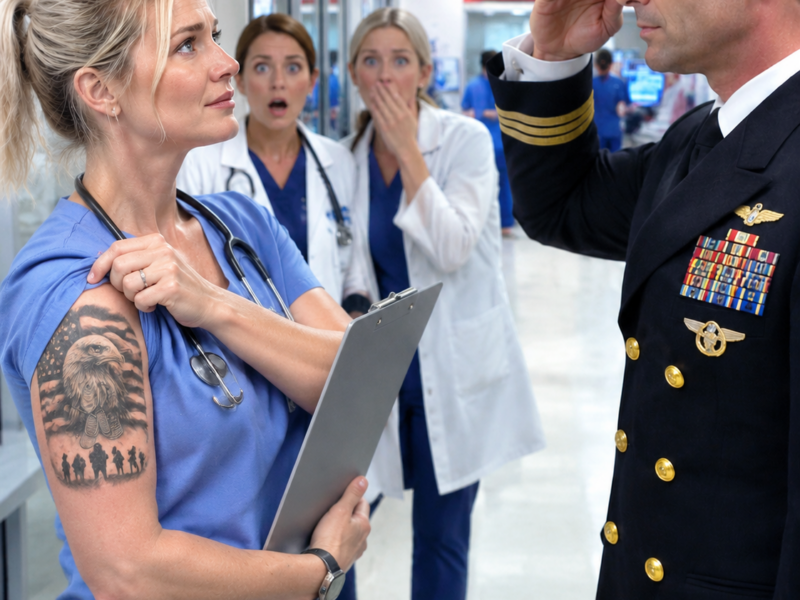
“They laughed at the faded tattoo on my wrist and called it a prison mark—until a Navy SEAL commander walked into the emergency room, saw it
“General Thomas Whitaker,” Commander Hayes said.
For a moment, I couldn’t hear anything else.
The emergency department continued moving around us. Monitors beeped. Nurses called for supplies. A doctor hurried past with a chart in his hand.
But all I could hear was that name.
General Whitaker had been the senior officer who approved our mission nine years earlier.
He had personally congratulated our team before deployment.
He had shaken my hand and told me that the men under my care would come home safely.
And when I returned alone, he had looked me in the eyes and told me that Michael Reed was dead.
“You’re saying General Whitaker ordered us abandoned?” I whispered.
Hayes nodded.
“That’s what the evidence suggests.”
I looked down at the photograph.
“Then why are you showing me this now?”
“Because the official investigation has been reopened. And because Michael Reed has finally agreed to testify.”
My knees nearly buckled.
“He’s alive?”
Hayes didn’t answer immediately.
Instead, he glanced at the sailors lying in the treatment area.
“We need somewhere private.”
I turned toward the young men who had mocked my tattoo.
Neither was smiling anymore.
The youngest looked at my wrist, then quickly lowered his eyes.
“Ma’am,” he said quietly, “I’m sorry about what we said.”
I gave him a small nod.
There were bigger things happening than an apology.
I asked another nurse to take over my patients, then followed Hayes into an empty consultation room.
He closed the door.
I placed the photograph on the table.
“Start from the beginning.”
Hayes took off his service cap.
“Nine years ago, your team was assigned to retrieve an intelligence officer from a remote location in northern Syria. The mission was classified, and the extraction window was extremely narrow.”
“I remember.”
“You were the team’s combat medic.”
“I remember that too.”
“Your helicopter was hit during the extraction. The pilot managed to bring it down near an abandoned communications station. Your team was scattered, and Michael Reed was seriously injured.”
I closed my eyes.
I could still see the smoke.
I could still hear the metallic scream of the damaged aircraft.
I could still feel Michael’s blood soaking through my gloves.
“Keep going,” I said.
“Your team requested immediate extraction. The response was a direct order to withdraw without waiting for the wounded.”
“That wasn’t the order we received.”
Hayes looked at me.
“What do you mean?”
I swallowed.
“Our original orders said no one was to be left behind. I heard the withdrawal command, but it came from a different frequency. I thought the communications system had been compromised.”
“Was it?”
“Yes.”
I remembered the moment clearly now.
The radio had crackled.
A voice had instructed our team to move toward the eastern ridge.
Then another voice had ordered us to leave Michael behind.
The two commands had come from different authorization codes.
I had refused.
I had stayed with Michael while the others moved toward the extraction point.
Then the second helicopter had been hit.
Everything after that had become fragments.
“Why did the report say I was the only survivor?” I asked.
“Because the people responsible needed the mission to disappear.”
Hayes opened a folder.
Inside were copies of old operational records.
“Your team discovered evidence of illegal weapons shipments being moved through a private defense contractor. Someone inside the command structure was protecting the operation.”
“Who?”
“General Whitaker.”
I stared at him.
“How could he control an entire investigation?”
“He controlled the original mission authorization, the intelligence briefing, and the first casualty report. He also had influence over the contractors who supplied the aircraft.”
I turned another page.
There was a list of names.
Six names.
The men from the photograph.
Every one of them had been listed as killed in action.
“Where are they?”
“Three are alive and willing to cooperate. One is still missing. Two were confirmed dead.”
My throat tightened.
“And Michael?”
“He’s alive, but he has been living under another identity.”
I gripped the folder.
“Why didn’t he contact me?”
Hayes looked uncomfortable.
“Because he believed you had betrayed the team.”
The words hurt more than I expected.
“What?”
“He received a recording that appeared to show you giving the order to abandon him.”
I shook my head.
“I never gave that order.”
“I know.”
“Then why would he believe it?”
“Because the recording was convincing.”
I stood and walked to the window.
For nine years, I had carried the memory of Michael lying beneath a damaged helicopter.
I had remembered his fingers gripping my sleeve.
I had remembered promising him that I would come back.
And I had remembered the moment I was forced to leave when the ammunition ran low and the remaining men were ordered to withdraw.
I had spent years wondering whether I could have done more.
Now I was being told that someone had taken that memory and turned it into evidence against me.
“Why did you wait nine years?” I asked.
Hayes was quiet for a moment.
“Because I was part of the operation.”
I turned.
“What?”
“I was a lieutenant commander then. I was assigned to the backup extraction unit.”
My stomach dropped.
“The unit that never arrived?”
“Yes.”
I stepped closer.
“You were supposed to come for us?”
“Yes.”
“Then why didn’t you?”
His face tightened.
“Whitaker ordered us to hold position. I challenged the order. He threatened to have my entire unit court-martialed if we moved.”
“And you obeyed.”
“Yes.”
He didn’t make excuses.
That made it harder to hate him.
“I have spent nine years trying to prove what happened,” he continued. “I was removed from the original investigation, transferred, and warned to stop asking questions.”
“Why did you come here today?”
“Because Michael contacted me last week. He said he had found something that could expose Whitaker.”
I looked at the photograph.
“What?”
Hayes reached into his folder and pulled out a small digital storage device.
“The original mission recording.”
I stared at it.
“Where did he get that?”
“From the communications equipment recovered after the crash. Someone removed it before the official evidence team arrived.”
“Someone?”
“One of your teammates.”
I felt my pulse quicken.
“Who?”
Hayes looked directly at me.
“Sergeant David Collins.”
I remembered David.
He had been the youngest member of our team.
He used to make jokes whenever the tension became unbearable.
He had given me his lucky coin before the mission and told me to return it when we got home.
“David survived?”
“Yes.”
I covered my mouth.
“Where is he?”
“He’s been working with the investigators.”
Hayes put the storage device back into the folder.
“But there’s a problem.”
I looked at him.
“What now?”
“Someone knew I was coming here.”
My phone vibrated again.
This time, the message came from a number I recognized.
My former commanding officer’s office.
I opened it.
A single sentence appeared.
If you want Michael Reed to stay alive, stop asking questions.
I felt cold all over.
Hayes read the message.
“That’s why we need to leave.”
I shook my head.
“I’m not running again.”
“Emily, I didn’t say run. I said leave this hospital before someone gets hurt.”
I looked toward the treatment area.
The sailors were still there.
Patients were still arriving.
This was my workplace.
My responsibility.
I wasn’t going to turn it into a battlefield.
“Then tell me what you need.”
Hayes hesitated.
“Your testimony. You were the last person with Michael before the team separated. You know the original command sequence. And your tattoo may be the only remaining proof that your team used the same authentication mark.”
I looked at my wrist.
The compass.
The silver star.
I had forgotten how it began.
Nine years earlier, each member of our unit had received the same tattoo before deployment.
It was not an official military insignia.
It was a private symbol we had chosen together.
The compass represented our promise that no one would be left behind.
The tiny star marked the person who had saved the team during a previous deployment.
In my case, that person had been Michael.
He had dragged me out of a burning vehicle during our first operation.
I had refused to let him call it a debt.
He had laughed and said, “Then wear the star. It means we’re even.”
I had never explained that story to anyone at the hospital.
Now the tattoo was the one thing that connected me to a team the military had officially erased.
“How can a tattoo prove anything?” I asked.
Hayes opened another document.
“Because the original team roster included a photograph of every member wearing the mark. General Whitaker later claimed the photograph was fabricated.”
I looked at the image on the table.
There I was, standing between Michael and David.
The tattoo was visible on my wrist.
“Who has the original?”
“Michael.”
A knock interrupted us.
Both of us turned.
Dr. Lauren Mitchell, the hospital’s chief medical officer, stood outside.
She looked concerned.
“Emily, there are two men downstairs asking for you. They say they’re from the Department of Defense.”
Hayes moved toward the door.
“Did they show identification?”
“Yes. But something feels wrong.”
“Why?”
“One of them asked security to give him your employee records and home address.”
Hayes’s expression hardened.
“Don’t give them anything.”
Dr. Mitchell looked at me.
“Emily, what’s happening?”
I wanted to tell her everything.
Instead, I said, “I think someone from my past is trying to intimidate me.”
She nodded once.
“Then you’re not leaving this building alone.”
A few minutes later, Hayes received a secure call.
He listened without speaking.
Then he looked at me.
“Michael is at a safe location outside the city. He wants to meet you.”
I stared at him.
“Now?”
“Tonight.”
“Why not here?”
“Because someone has already started searching for him.”
I looked at the tattoo again.
For nine years, I had hidden it because I couldn’t bear the questions.
Now I wanted everyone to see it.
“I’ll go,” I said.
Hayes nodded.
“There’s one more thing.”
I waited.
“Michael asked me to give you a message.”
“What?”
Hayes hesitated.
“He said, ‘Tell her I never stopped waiting for the compass to find north.'”
My eyes filled with tears.
It was an old joke between us.
When our team got lost during training, Michael always blamed my navigation skills.
I used to tell him that the compass was fine.
It was the people holding it who needed direction.
I pressed my fingers against the tattoo.
“Take me to him.”
We left through a private staff exit.
Dr. Mitchell insisted on arranging an escort to the parking garage.
She didn’t ask for details.
Before I stepped outside, she touched my shoulder.
“Whatever happened before you came here, Emily, it doesn’t define the nurse you are today.”
I nodded.
But I wasn’t sure I believed her yet.
The drive took forty minutes.
Hayes drove a plain vehicle, avoiding the main roads.
I watched the city lights pass through the window.
“Can I ask you something?” I said.
“Of course.”
“Did you know I was working at St. Mary’s?”
“No.”
“Then how did you find me?”
“David found your employment record through an old veterans’ medical network. He wasn’t sure it was you until he saw the photograph.”
I looked down.
“Why didn’t he contact me?”
“He was afraid the same people who had monitored you after the mission would trace the communication.”
“Someone monitored me?”
Hayes nodded.
“After the operation, you were questioned repeatedly. Your medical records were sealed, your service history was restricted, and your requests for information were denied.”
“I thought that was normal because of the classification.”
“It was used to keep you isolated.”
I remembered the strange calls.
The letters that arrived without return addresses.
The former colleagues who stopped answering my messages.
I had assumed they were simply trying to move on.
Now I wondered how much of my life had been arranged by someone else.
We arrived at a small house near the edge of town.
A single porch light was on.
Hayes knocked twice, paused, then knocked once more.
The door opened.
A man stood in the doorway.
He was thinner than I remembered.
His hair was gray at the temples.
A long scar crossed his cheek.
But his eyes were unmistakable.
Michael Reed.
For a second, I forgot how to breathe.
He stared at me.
Then his gaze dropped to my wrist.
The tattoo.
The compass.
His expression crumpled.
“Emily.”
I stepped forward.
He didn’t move.
I wanted to run into his arms, but I couldn’t.
Not yet.
“You’re alive,” I whispered.
He nodded.
“I’m sorry.”
I shook my head.
“Don’t.”
His eyes filled.
“I thought you left me.”
“I thought you were dead.”
“I saw the recording.”
“It was fake.”
“I know that now.”
I looked at the scar on his face.
“What happened to you?”
He stepped aside.
“Come in. There’s something you need to see.”
Inside, the house was modest.
A table stood in the center of the living room.
On it were several folders, a laptop, and a photograph of our old team.
David Collins sat beside the window.
He stood as soon as he saw me.
For a moment, I couldn’t speak.
Then he smiled sadly.
“Hey, Carter.”
I laughed through my tears.
“You still owe me my lucky coin.”
David reached into his pocket and placed it in my palm.
“I’ve kept it safe.”
I closed my fingers around it.
Michael pulled out a chair.
“Sit down. We need to show you something.”
He connected the storage device to the laptop.
A recording appeared on the screen.
The date was nine years old.
The location was the extraction zone.
I heard my own voice.
“Reed is injured. We need immediate extraction.”
Then another voice.
A command officer.
“Negative. Leave the injured personnel. Withdraw to the eastern ridge.”
Michael looked at me.
“That’s the recording I received.”
I leaned closer.
“Keep playing.”
The recording continued.
My voice again.
“Negative. I will not abandon him.”
Then static.
Then another voice, clear and unmistakable.
General Whitaker.
“Remove Carter’s authorization from the record. If she survives, she becomes a liability.”
My blood ran cold.
David paused the recording.
“There’s more.”
He opened another file.
It contained the original authentication log.
The withdrawal order had been entered using General Whitaker’s command code.
But the order was transmitted from a private communications station operated by the defense contractor.
The station had been officially decommissioned months before the mission.
“Why was it still active?” I asked.
Michael answered.
“Because Whitaker used it to send orders that couldn’t be traced through the official military network.”
David opened a final document.
A financial transfer.
Several large payments had been made to a company controlled by Whitaker’s relatives.
The payments began two weeks before our mission.
They continued for months afterward.
I sat back.
“How did you get all this?”
Michael looked at David.
“He recovered the original equipment.”
David nodded.
“After the crash, I found the recorder under a damaged communications panel. I hid it because I realized someone was altering the evidence.”
“Why didn’t you come forward?”
“I tried.”
His voice broke.
“Two weeks later, my wife received a photograph of our daughter leaving school. There was a note telling me to forget the mission.”
I looked at him.
“Did you?”
“No.”
He swallowed.
“But I kept quiet long enough to keep them safe.”
Michael leaned forward.
“And I spent years believing you had betrayed us. I was angry at you, Emily. I should have asked questions instead of trusting a recording.”
I looked at him.
“You were injured and alone. Someone showed you something designed to destroy your trust.”
“I still should have known.”
“Maybe. But we were all being manipulated.”
He lowered his eyes.
“I never forgot what you promised me.”
I knew exactly what he meant.
On the night of the crash, I had pressed a bandage against his side and told him I would come back.
I had failed to return.
But I had never stopped trying to find him.
“I didn’t leave you because I wanted to,” I said.
“I know.”
“I heard you calling my name.”
His face tightened.
“I remember.”
“I tried to get back.”
“I know, Emily.”
For the first time, he reached across the table and took my hand.
His fingers were cold.
But they were real.
And I was no longer speaking to a ghost.
The next morning, we met Deputy Director Rachel Morgan, an independent military investigator who had been assigned to review the original operation.
She brought two federal agents and a secure evidence team.
We provided the recording, the authentication logs, the financial records, and our individual statements.
I told them exactly what happened after the crash.
I described the command that ordered us to withdraw.
I described how Michael was injured.
I described how I stayed with him until the ammunition ran low and the remaining team members reached the secondary extraction point.
And I told them about the moment I was forced to leave.
“I didn’t abandon him,” I said. “I was ordered to withdraw after the second aircraft was hit. I believed we would return with another team.”
Rachel looked directly at me.
“Did anyone tell you that Michael had been recovered?”
“No.”
“Did anyone tell you he was alive?”
“No.”
She closed her notebook.
“Then someone deliberately concealed his survival from you.”
The investigation moved quickly once the original recording was authenticated.
General Whitaker denied everything.
He claimed the audio had been edited.
He claimed the financial transfers were unrelated.
He claimed our testimony was motivated by resentment.
But the evidence was stronger than his explanations.
The original communications equipment contained matching timestamps.
The authentication logs matched the command system.
The financial records traced payments to shell companies controlled by people connected to Whitaker.
And three surviving members of our team independently confirmed the withdrawal order.
Then came the most important discovery.
A backup file showed that Whitaker had personally approved a false casualty report before the rescue operation was officially terminated.
The report listed Michael Reed as killed in action.
It listed me as the only surviving member.
And it stated that I had abandoned the mission without authorization.
That report had been used to close the investigation and discredit anyone who questioned the operation.
When Whitaker was confronted with the original recording, his story finally collapsed.
He was arrested pending trial.
Several officers and contractors were also charged.
The investigation revealed that the weapons shipments had been concealed through a network of fraudulent contracts.
Our mission had been sabotaged because we were too close to discovering it.
Months later, I was asked to attend a formal military review.
I wore my old uniform for the first time in nine years.
The sleeves were slightly loose.
The fabric had faded.
But the compass tattoo remained visible.
Michael sat in the front row.
David was beside him.
Commander Hayes stood at the back of the room.
When I entered, he saluted.
Then Michael rose.
David followed.
One by one, the surviving members of our team stood.
I felt my throat tighten.
For years, I had believed that the people who knew what happened had forgotten me.
Now they were standing in front of me.
Not because I had asked them to.
Because they remembered.
The review officially cleared my name.
It also corrected the mission record, restoring the names of the men who had been erased from the official account.
When the chairperson finished reading the findings, she asked whether I wanted to make a statement.
I stood.
“I don’t need anyone to call me a hero,” I said.
“I need the record to show that I followed my orders as best I could, that I refused to abandon an injured teammate, and that I never stopped believing he was worth saving.”
I looked toward Michael.
“And I need the families of the people we lost to know that their loved ones were never forgotten by the people who served beside them.”
The room remained silent.
Then Michael stood.
He didn’t say anything.
He simply placed his hand over his heart.
I did the same.
After the hearing, Hayes approached me.
“I owe you an apology.”
I looked at him.
“For what?”
“For staying behind when Whitaker ordered us to hold position.”
He took a breath.
“I should have disobeyed.”
I studied his face.
“Would it have changed everything?”
“I don’t know.”
“Neither do I.”
He lowered his eyes.
“I’ve carried that question for nine years.”
“So have I.”
He nodded.
“I hope one day you can forgive me.”
I looked at the commander who had walked into my hospital and saluted a nurse everyone else had overlooked.
“I can’t change what happened,” I said. “But I can respect that you finally came back to tell the truth.”
He nodded.
It wasn’t forgiveness.
But it was a beginning.
I returned to St. Mary’s the following Monday.
The hospital hadn’t changed.
The same reception desk stood near the entrance.
The same coffee machine made terrible coffee.
The same call lights rang down the corridors.
But I had changed.
Dr. Mitchell greeted me at the nurses’ station.
“Ready for another shift?”
I smiled.
“Always.”
She glanced at my wrist.
“You aren’t wearing long sleeves today.”
I looked down at the compass.
“No. I don’t think I need to hide it anymore.”
Later that afternoon, I was checking a patient’s medication when the three young sailors from the training accident approached my station.
The youngest one held a small paper bag.
“Ma’am?”
I looked up.
“Can I help you?”
He placed the bag on the counter.
“We wanted to apologize properly.”
Inside was a small card signed by all three.
The message was simple.
We judged you without knowing your story. Thank you for taking care of us anyway.
I read it twice.
Then I smiled.
“You’re welcome.”
One of them glanced at my wrist.
“Does the compass have a meaning?”
I considered giving him the short answer.
Instead, I told him the truth.
“It means you never leave someone behind just because the road gets difficult.”
He nodded slowly.
“I understand.”
I wasn’t sure he did.
Not yet.
But perhaps one day he would.
A month later, Michael visited the hospital.
He was walking without assistance.
His scar remained, and his left side still hurt when the weather changed.
But he was laughing again.
He brought me a small wooden box.
Inside was a silver star.
The exact shape of the one in my tattoo.
“I thought you should have the original,” he said.
I turned it over.
On the back were two engraved words.
Still here.
I looked at him.
“Where did you find this?”
“It fell off your medical bag during the evacuation. I kept it.”
I closed my fingers around it.
For nine years, I had believed that the compass tattoo was a reminder of a promise I had failed to keep.
Now I understood that it was a reminder of the promise we had both survived.
I looked at Michael.
“I’m glad you came back.”
He smiled.
“So am I.”
We stood quietly for a moment.
Then he glanced toward the emergency department.
“Do they still make you work the night shifts?”
“Unfortunately.”
He laughed.
Somewhere behind us, a monitor beeped.
A patient needed help.
I slipped the silver star into my pocket and returned to work.
I was still Emily Carter.
Still a nurse.
Still the woman who preferred listening to talking.
But I no longer pulled my sleeve down when someone noticed my wrist.
The tattoo wasn’t a prison mark.
It wasn’t a secret.
It was the last visible piece of a promise that had survived nine years of lies.
And when I walked through the hospital doors the next morning, I finally understood why Commander Hayes had saluted me.
He hadn’t been saluting a tattoo.
He had been saluting the woman who stayed when everyone else was ordered to leave.
THE END.









