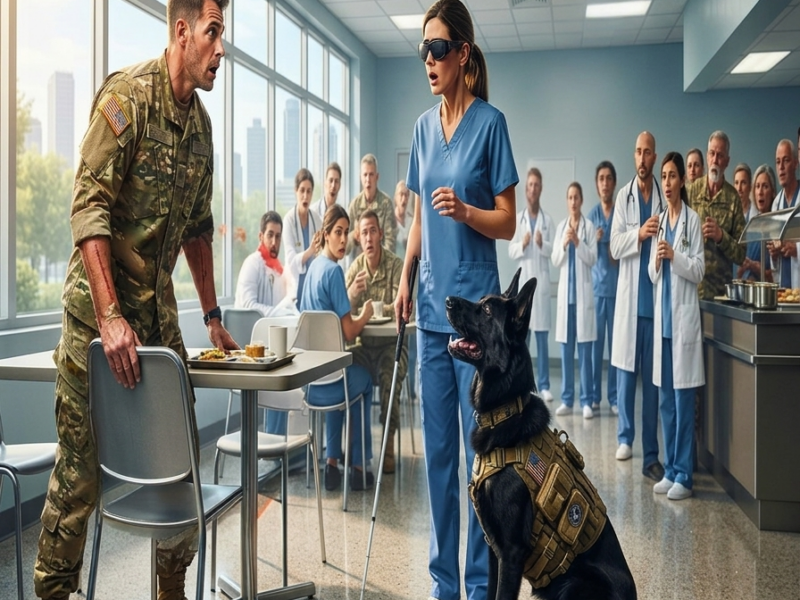
They Laughed at the Blind Nurse — Then the Veteran’s K9 Obeyed Only Her
The laughter had started before Dr. Bennett even finished his sentence.
“She’s a liability, plain and simple,” Bennett’s voice had boomed through the open doors of Trauma Bay 3, sharp and dismissive, carrying effortlessly across the polished linoleum of St. Matthew’s Emergency Department. “I don’t care how many years she’s spent wandering these halls. A blind trauma nurse is an oxymoron, and frankly, a lawsuit waiting to happen. The board only keeps her around for the diversity pamphlet.”
A few of the younger residents had chuckled—that high-pitched, nervous laughter that junior doctors use when they want their attending to know they’re loyal. Nurse Jenkins had cleared her throat awkwardly, while two paramedics near the triage desk suddenly found their paperwork fascinating.
I didn’t flinch. I stood by the supply cart, my hands moving with practiced precision, counting vials of epinephrine by touch, feeling the tiny raised glass ridges, registering the exact coldness of the glass. I had worked at St. Matthew’s Medical Center in Virginia for six years. I knew every tile, every doorway, every subtle dip in the floor. I knew that the floor in the main hallway squeaked slightly outside Room 104, that the air conditioning vent in the breakroom whistled in a high B-flat, and that Dr. Bennett’s left shoe dragged by three millimeters whenever his back was acting up.
I didn’t need eyes to know who people were. I knew them by the cadence of their breath, the heavy scent of cheap coffee, or the nervous rhythm of their pulse when they were about to deliver bad news.
Then, the heavy glass double doors of the ER outer foyer burst open with a brutal force that set the metal frames vibrating.
“Clear the bay! We need a doctor out here!” a voice roared. It was rough, gravelly, shredded by dust and smoke, carrying the sharp, unyielding authority of someone who was used to commanding men through gunfire.
Before anyone could move, a secondary sound tore through the room—a low, thunderous, guttural growl that rattled the glass cabinets. It wasn’t the sound of an unruly pet. It was the lethal, chest-heaving vibration of an apex predator.
“Get security!” Bennett barked instantly, his bravado evaporating into a high, reedy panic. “Get them out! We don’t allow animals in the trauma center!”
I turned toward the sound, my ears mapping the room in real time.
Footsteps: heavy, asymmetric, favoring the right leg. The sound of leather boots with reinforced soles, dragging slightly—a combat injury, old, well-heeled, but painful. Beside him, four padded paws struck the tile with rhythmic, lethal speed. The scent hit me next—not the clinical tang of bleach and isopropyl alcohol, but the rich, dark smells of pine needle, burnt copper, gunpowder, dried mud, and stale sweat.
“Nobody touches him!” the man yelled, his voice cracking with exhaustion. “I need a trauma kit and a clean field, but nobody fucking touches my dog!”
“Sir, you are bleeding onto the floor!” Bennett yelled from behind the safety of the nurses’ station counter. “Security! Code Blue in triage—we have an aggressive subject!”
“He’s not aggressive, he’s tactical!” the veteran snarled.
I heard the heavy click of duty belts—the three security guards who patrolled the night shift were moving in, their heavy shoes scuffing the floor as they unholstered their tasers.
“Don’t do that,” the veteran warned, his voice dropping into a deadly whisper. “If you point that at him, he will take your throat out before you pull the trigger.”
The room went dead silent, except for the dog’s ragged, wet breathing.
“Shadow, hold!” the man commanded.
Instead, a sudden metal snap rang out—the sound of a heavy-duty carabiner breaking free from a tactical vest.
Panicked screams erupted from the waiting room. Chairs scraped back wildly against tile. “He’s loose!” someone shrieked. “Get back!”
“Shadow, heel! Shadow, halt!” the veteran barked, but the dog didn’t obey.
Claws clicked furiously against the floor, heading straight down the central corridor. Bennett scrambled backward, knocking over a tray of stainless steel surgical bowls that clattered across the floor like falling armor.
“Shoot it!” Bennett screamed. “Shoot the dog!”
I didn’t move. I stood in the middle of the corridor, my cane resting lightly against my shoe. I listened past the panic, past Bennett’s screaming, past the heavy boots of the guards rushing forward.
I listened to the dog.
The growl was deep, but it was irregular. It hitched in the back of his throat. His breath came in fast, shallow gasps, his heart beating at a terrifying rate—I could hear the frantic thump-thump-thump of his chest from ten feet away.
It wasn’t aggression. It was terror. It was the desperate, frantic search of a creature that had been lost in the dark for far too long.
“Shadow?” I whispered softly.
The frantic clicking of claws stopped instantly.
The silence that fell over the room was absolute. Even Bennett stopped breathing.
“Shadow?” I repeated, lowering myself slightly, kneeling on the hard floor, holding out one open, empty palm. “Easy, sweetheart. Easy…”
A warm, heavy mass surged into my chest. The impact almost knocked me backward, but instead of teeth or claws, I felt a wet nose press furiously against the crook of my neck. Two large, powerful front paws landed heavily on my thighs. The dog let out a sound that wasn’t a growl or a bark—it was a long, shuddering, human-like sob.
He was trembling so violently that the heavy tactical harness he wore rattled against his ribs.
Gasps echoed around the room.
“What… what is he doing?” Bennett stammered from behind the counter. “Get away from her!”
“Don’t move,” the veteran called out, his voice suddenly thick with an emotion he couldn’t hide. He limped slowly toward us, his heavy boots coming to a stop three feet away. “Don’t anybody move.”
I ran my hands along the dog’s coat. His fur was coarse, dense, matted with dirt and dried sap. Beneath the thick fur of his neck, I felt the deep, raised ridges of massive surgical scars—he had survived shrapnel, maybe explosions.
As my fingers drifted toward the underside of his thick leather working collar, my tips brushed against something hard, thin, and metallic. It wasn’t his rabies tag. It was a metal cylinder, taped securely beneath the heavy buckle. Attached to it was a pair of notched metal dog tags.
The moment my fingers touched the notched edge of the metal, Shadow went completely still. He pressed his heavy forehead firmly into my neck, letting out a soft, low whine.
“Where…” The veteran’s voice sounded like it was being dragged through glass. “Where did you learn that command?”
I froze, my hand still resting on the metal tag beneath the dog’s chin.
“What command?” I asked, my voice barely a whisper.
“The words you just said,” the veteran whispered. He took a heavy, painful step closer. I could smell the blood on him now—fresh, metallic, dripping from a deep laceration above his left eyebrow down onto his collar. “‘Easy, sweetheart.’ You said it with a specific pitch. Two low notes, one high.”
My heart gave a sickening, violent thud against my ribs. The room around me seemed to recede, the background noise of the monitors and the hum of the fluorescent lights fading into a cold, hollow ring.
“My brother,” I breathed, my throat suddenly so dry I could barely form the words. “My brother taught me. He… he was a handler in the 75th Ranger Regiment.”
The veteran stopped breathing. I could hear his chest expand and lock.
“What was his name?” he asked.
“Daniel. Daniel Brooks.”
For five long seconds, nobody in the emergency room made a sound. I could hear the slow, rhythmic drip of blood falling from the veteran’s forehead onto his leather boot.
“Daniel…” the veteran murmured, his voice cracking open. “Daniel saved my life in the Shah-i-Kot Valley. He was my squad leader.”
A cold wind seemed to sweep through my chest, pulling the air straight out of my lungs.
“Daniel died four years ago,” I said, repeating the hollow, sterile words that two military officers in dress uniforms had delivered to my living room four years, three months, and twelve days ago. “They told us his patrol was ambushed near the border. They said his body was lost in the river. They gave us an empty coffin with an American flag folded over it.”
“They lied to you,” the veteran said.
A collective gasp went up from the medical staff gathered near the doors.
“Sir!” Bennett yelled, stepping forward with newfound bravery as two armed hospital security officers lined up behind him. “That is enough! You are trespassing, you are causing a public disturbance, and you are slinging treasonous conspiracy theories in the middle of my emergency department! Security, escort this man out immediately! Call the local police!”
“He didn’t die in that ambush!” Michael shouted over Bennett, his voice cut through with fierce, desperate intensity. “Daniel didn’t die because of the Taliban! He vanished because he found out someone inside his own command structure was selling intelligence! He discovered the coordinates for our forward operating bases were being auctioned off to the highest bidder!”
“Get him out of here!” Bennett screamed, his face red, pointing a trembling finger at the door. “Now!”
The two guards moved forward, drawing their batons.
Shadow immediately spun around, placing his massive body in front of me and Michael, his lip curling back to reveal rows of gleaming, lethal white teeth. A sound terrifyingly low echoed from his chest. The guards halted, their feet slipping slightly on the slick tile.
Michael reached out and grabbed my wrist. His skin was burning hot, his grip rough and calloused, trembling with adrenaline.
“Listen to me, nurse,” he hissed, leaning down so close I could smell the copper of his blood and the smoke on his jacket. “Daniel didn’t send me here by accident. Shadow didn’t track your scent by luck. Daniel trained this dog to recognize the frequency of your voice from recordings he kept on his phone.”
My mind was spinning, a chaotic kaleidoscope of memories—Daniel’s laugh, the smell of his old denim jacket, the way he used to grab my hand when we crossed the street when we were kids, long before I lost my sight to a retinal degenerative disease at sixteen.
“He’s… he’s alive?” I whispered, tears finally bursting past my eyelids, hot and burning against my cheeks.
Shadow turned back to me. With a gentle, deliberate nudge of his broad snout, he pushed his head against my right hand. I felt something small, smooth, and rectangular drop from the inner lining of his collar directly into my open palm.
It was a piece of heavy, waterproof paper, tightly folded into a dense square.
My fingers, trembling so hard I could barely control them, unfolded the stiff plastic-coated paper. I ran my fingertips over the surface. I couldn’t see the ink, but I didn’t need to. The writer had pressed so hard with a ballpoint pen that the letters were deeply embossed into the thick paper, creating a stark, raised Braille of human desperation.
I traced the grooves with the sensitive pads of my index finger.
L-i-t-t-l-e s-i-s-t-e-r…
My breath hitched. Nobody in the world called me that. Only Daniel.
…if Shadow has found you, it means they know I’m alive.
Below it were a set of geographical coordinates, followed by a crude, heavily indented timestamp:
Tomorrow. Midnight. Old Mill Dock, Shed 4.
“He’s alive,” I sobbed, clutching the paper against my scrub top, right over my hammering heart. “Oh God, he’s alive.”
“He won’t be for long,” Michael said, his voice dropping into a terrifyingly flat, urgent tone. He tightened his grip on my arm, leaning in so close his words were meant for my ears alone. “If Daniel contacted you now, it means his cover is blown. We have less than twenty-four hours to pull him out.”
“Why?” I asked, terror seizing my throat. “Why now? After four years?”
Michael’s eyes shifted past me, looking toward the far end of the hallway where the glass elevators sat.
“Because the man who ordered Daniel’s unit to be wiped out four years ago just retired from the Department of Defense,” Michael whispered. “And three days ago, he was appointed as the head of global security for this entire hospital network.”
Before the words could fully register, the mechanical chime of the executive elevator sounded at the end of the hall.
Ding.
The doors slid open with a soft, pneumatic hiss. Heavy, polished dress shoes stepped onto the linoleum—a crisp, rhythmic, terrifyingly deliberate footfall that carried the weight of a man who commanded legions.
Dr. Bennett instantly dropped his defensive stance, his voice shifting into a pathetic, groveling pitch. “Ah, Director Vance! Thank God you’re here. We have a severe security breach in Triage—a rogue veteran and a dangerous animal—”
The heavy footsteps stopped.
A voice, deep, smooth, impeccably calm, and cold as a winter grave, echoed down the corridor, cutting Bennett off mid-sentence.
“Where is the blind nurse?”
Shadow immediately dropped into a low, lethal crouch, his head level with my knees, a silent, vibrating growl shuddering through his ribcage into my hand.
And in that freezing moment, as the heavy footsteps began to walk slowly toward us, I knew that the nightmare of my brother’s death hadn’t ended four years ago. It was only just beginning.
The silence in the hallway was thick enough to choke on.
I stood paralyzed, the piece of waterproof paper burning like hot iron against my palm. Beside me, Shadow was a tight spring of muscle and bone, every fiber of his body vibrating with lethal intent.
“Director Vance,” Dr. Bennett stammered, stepping forward with his hands raised nervously. “This is Nurse Maya Brooks. She… she seems to have some prior connection to this trespasser’s animal. We were just about to have security remove them both from the premises.”
The polished dress shoes stopped three feet in front of me. I could smell him now—expensive sandalwood cologne, crisp starch, and beneath it, the unmistakable, dry scent of gun oil and brass. It was the smell of a man who spent his life in air-conditioned command centers while other men died in the dirt.
“Nurse Brooks,” Vance said. His voice was smooth, cultured, totally devoid of warm human cadence. “I’ve read your file. Impressive work. The hospital board speaks very highly of your spatial memory. They say you can navigate this facility faster than staff with full vision.”
“I know where every door leads, Director,” I said, forcing my voice to remain steady, though my knees felt like water. I shoved the folded paper deep into the pocket of my scrub pants, my fingers curling tightly around it.
“Is that so?” Vance took half a step closer.
Shadow let out a short, sharp bark that echoed off the tile walls like a gunshot. Vance didn’t flinch. He didn’t even shift his weight.
“Fascinating creature,” Vance observed coldly. “Belgian Malinois cross. Military Working Dog, class K9. Trained for human tracking and high-value target containment. I haven’t seen one of these harnesses since my time with the Defense Intelligence Agency in Kabul.”
“He’s a service animal,” Michael spat out, his voice thick with blood and malice. He stepped slightly in front of me, despite his limp. “And I am a decorated veteran receiving care. You touch him, or you touch her, and every local news station in Virginia will be parked outside your emergency room before the sun comes up.”
Vance let out a soft, dry chuckle. “Mr. Hayes, isn’t it? Former Staff Sergeant, 75th Ranger Regiment. Discharged three years ago due to severe post-traumatic stress and physical trauma sustained in Operation Red Dagger. A sad story. A very sad story.”
Vance stepped closer to Michael, his tone lowering into something intimate and vicious. “You think you’re protecting a ghost, Sergeant. But ghosts have a habit of getting the people who remember them killed.”
“Is that a threat, Director?” Michael barked.
“It is an observation of medical reality,” Vance replied smoothly. He turned his head toward Bennett. “Dr. Bennett, this man is clearly suffering from a acute psychotic episode brought on by his documented combat trauma. He is delusional, bleeding, and posing a physical threat to our staff with an unrestrained animal.”
“Exactly, Director!” Bennett agreed hastily. “I’ll have him committed for a 72-hour psychiatric hold immediately.”
“No,” Vance said softly. “Not here. St. Matthew’s isn’t equipped for high-risk military psychiatric admissions. Call our private security transport team. We will have him moved to the Westridge Secure Facility in Maryland for his own safety.”
My heart dropped into my stomach. Westridge wasn’t a hospital. It was a private, black-budget psychiatric compound funded by defense contractors—a place where people went when someone wanted them forgotten forever.
“You can’t do that!” I stepped forward, putting myself between Vance and Michael. “He came here for trauma care! He has a head injury!”
Vance’s gaze landed on me. I couldn’t see his eyes, but I felt the cold, calculating weight of his attention sweeping over my face, measuring my heart rate, watching the pulse hammering in my throat.
“Nurse Brooks,” Vance said, his voice dropping into a deceptively gentle whisper. “You are an exceptional nurse. It would be a profound tragedy if your… disability… were to lead to a tragic misunderstanding. Or if your employment here were terminated under circumstances that compromised your professional standing.”
He leaned in closer. The scent of sandalwood flooded my nose.
“I understand you lost a brother in the service,” Vance murmured. “Grief can do terrible things to the mind, Maya. It makes us see patterns where none exist. It makes us trust dogs and broken men. I would hate to see you ruin your life chasing phantom letters written by dead soldiers.”
He knew.
He knew about the note in my pocket. He knew about Daniel. He knew everything.
“Guards,” Vance commanded, stepping back. “Sedate the veteran. Contain the animal.”
“Shadow, ATTACK!” Michael roared.
The dog launched himself forward with terrifying speed, his jaws snapping shut inches from Vance’s chest. Vance took a swift step back as his two personal bodyguards—men dressed in dark suits, built like brick walls—drew hidden stun batons.
“Maya, RUN!” Michael screamed, grabbing a heavy metal IV pole with his bare hand and swinging it with ferocious, desperate strength into the first guard’s chest.
The ER exploded into absolute chaos.
Patients shrieked, nurses scrambled for the exit, metal trays overturned, and the loud, rhythmic buzz of stun batons filled the air. Shadow tore into the arm of the second guard, pulling him to the ground with a sickening crunch of fabric and bone.
“Go, Maya! Get to the docks!” Michael yelled, his voice cut off by a heavy, dull blow as the second guard struck him from behind with a weighted boot.
I didn’t hesitate. Survival instinct, drilled into me by years of living in the dark, took over. I grabbed my cane, tucked Shadow’s leash handle firmly into my left hand, and turned toward the service corridor behind Trauma Bay 3.
“Stop her!” Vance’s cold voice shouted over the alarms. “Do not let that nurse leave this building!”
“Shadow, with me!” I yelled.
The dog disengaged instantly, his heavy paws slamming against the tile as he sprinted by my side. I didn’t need to see where I was going. I knew every turn, every angle, every swinging door of St. Matthew’s.
Left at the linen supply. Twelve paces.
Right through the double-doors into the basement laundry route.
Eighteen paces to the boiler room corridor.
Behind us, heavy boots pounded against the floor. “She’s heading for the basement!” a voice shouted. “Block the stairs!”
“Shadow, soft!” I whispered, pulling the dog close to my side as we burst through the heavy plastic doors of the central laundry facility. The air here was hot, thick with the smell of detergent, steam, and damp cotton. Massive industrial dryers roared like jet engines, masking the sound of our footsteps.
I ducked behind a row of giant metal laundry carts filled with dirty linens. Shadow pressed himself flat against the floor beside me, his chest heaving, his mouth open in a silent, panting gasp. I reached down, pulling his head against my chest, smothering any potential sound he might make.
Footsteps echoed down the concrete stairs. Two men. Heavy boots—not hospital security. Vance’s private mercenaries.
“Where is she?” one of them growled, his voice muffled by the hum of the machinery.
“She’s blind, man. How far could she get?” the second replied. “Check the storage lockers. The director wants that paper she was holding. He said if she resists, make it look like an accidental fall down the elevator shaft.”
A cold shudder ran through my spine. They weren’t just trying to cover up a military scandal—they were going to murder me right here in the basement of the hospital where I had spent six years saving lives.
I reached into my scrub pocket and pulled out the folded note. My fingers retraced the embossed letters, memorizing every single stroke, every curve of Daniel’s handwriting.
Tomorrow. Midnight. Old Mill Dock, Shed 4.
If Vance controlled the hospital, he controlled the security cameras, the police response, and the local authorities. I couldn’t trust anyone inside this building. I couldn’t go back to my desk. I couldn’t go back to my apartment.
I had to get out.
“Sweep the east wall,” the first voice ordered, the sound of his heavy boots drawing closer to my laundry cart. “She’s hiding behind the dryers.”
I looked down at Shadow in the dark. I couldn’t see his eyes, but I felt his nose press gently against my wrist, giving me a soft, reassuring nudge.
“Okay, boy,” I whispered into his ear. “We do this together.”
I reached into my scrub pocket and pulled out a heavy metal heavy-duty trauma shears—the thick, serrated scissors used to cut through leather boots and thick clothing in emergency situations.
I waited until the mercenary’s footsteps were right on the other side of the metal linen cart—three feet away.
I reached out with my left foot and violently kicked the lock lever on the cart’s heavy caster wheels.
CLACK!
The heavy, steel-framed cart, loaded with two hundred pounds of damp linen, slammed straight into the mercenary’s shins.
“Argh! Shit!” he roared, falling backward onto the hard concrete floor.
“Shadow, GO!” I barked.
Shadow exploded from behind the cart like a launched missile. He hit the second mercenary before the man could draw his weapon, knocking him flat onto his back with a heavy, concussive crash.
I sprinted down the narrow aisle between the industrial washers, my cane sweeping rhythmically, guiding me toward the emergency fire exit at the end of the north corridor. I knew this door—it had a heavy push-bar exit latch that triggered an alarm when opened.
“Stop her!” the first guard yelled, scrambling to his feet behind us.
I reached the door, slammed my body against the heavy panic bar, and pushed.
The alarm shrieked—a high, piercing, 100-decibel siren that blasted through the tight concrete stairwell. The heavy door swung open, and the freezing, damp night air of Virginia rushed over my face, carrying the scent of rain, river water, and diesel exhaust.
Shadow leaped through the opening beside me. We burst out into the dark loading dock alley behind the hospital.
Rain was falling hard now, cold droplets stinging my skin. Down the street, sirens were already wailing in the distance—police cars responding to Bennett’s call.
I didn’t stop. I grabbed Shadow’s tactical harness, pulled my cane close to my chest, and ran into the dark, rainy streets of the city, leaving everything I had ever known behind.
The rain was relentless. It flattened my hair against my skull and soaked through my thin medical scrubs, turning the fabric into a cold, heavy layer against my skin.
We were huddled inside an abandoned train shed three miles south of the medical center. The air inside smelled of rusted iron, damp timber, and creosote. Above us, rain rattled against the corrugated tin roof like a thousand tiny hammers.
I sat on a wooden crate, my legs shaking so violently I had to press my hands against my knees to stop them from knocking together. Shadow sat directly between my feet, his broad chest pressed firmly against my shins, providing a steady, solid anchor of heat in the freezing dark.
“Good boy,” I whispered, my voice trembling as I ran my fingers through his wet fur. “Good boy, Shadow.”
He let out a low, contented sigh, leaning his massive head into my lap.
I pulled the waterproof note from my pocket again. Even in the dampness, the plastic-coated paper had protected Daniel’s message. I ran my fingertips over the raised letters once more, feeling the sharp, violent indents of the pen.
Little sister, if Shadow has found you, it means they know I’m alive.
Old Mill Dock, Shed 4. Midnight.
Midnight was still four hours away.
My mind raced back four years. I remembered the day the two officers in dark green dress uniforms had walked up the front steps of my parents’ house. I remembered the cold, clinical language they used: Unforeseen enemy action… tragic loss of life… body non-recoverable due to terrain.
I had spent four years mourning a ghost. Four years believing my brother was lying in a cold ravine in the Hindu Kush. And all the while, he was hiding in the shadows, hunted by the very government he had sworn to serve.
Why Vance? What had Daniel found that was so dangerous a high-ranking defense official would hunt him for four years?
A quiet rustle outside the train shed made Shadow’s ears instantly snap upright.
He didn’t growl, but his entire body went rigid as steel. I gripped my heavy trauma shears in my right hand, my knuckles turning white.
Footsteps approached. Slow, heavy, uneven.
Drag, step. Drag, step.
The scent hit me a second later—stale sweat, blood, wet leather, and cheap cigarettes.
“Maya?” a ragged voice called out from the dark doorway. “Maya, it’s me… don’t shoot.”
“Michael?” I gasped, dropping the shears back into my pocket.
Michael Hayes stumbled into the shed, collapsing against a wooden support beam. He was breathing in heavy, ragged wheezes. I jumped up and navigated my way toward him by the sound of his breathing, my hands reaching out until they met his jacket.
His face was sticky with blood. The cut above his eyebrow was deep, and he was clutching his left side where Vance’s guards had hit him with the baton.
“How… how did you find us?” I asked, guiding him down to sit on a low wooden crate.
“Shadow,” Michael grunted, wincing as he leaned back. “I knew… I knew he’d take you somewhere quiet along the old rail line. Daniel used to talk about how you two played near the old tracks when you were kids. He programmed this whole sector as a primary rally point in Shadow’s navigation memory.”
I pulled a roll of sterile gauze from my scrub pocket—habits of a trauma nurse—and began gently dabbing at the gash on his forehead. “You escaped Vance’s men?”
“Barely,” Michael coughed, a bitter chuckle shaking his chest. “They tried to throw me into an unmarked van in the ambulance bay. I took out the driver’s knee and slipped into the storm drains. But Vance has the whole city on lockdown. The local police think you’re a kidnapped nurse and I’m an armed, dangerous felon who broke out of a psych facility.”
“He controls the narrative,” I said, feeling a sudden wave of nausea. “He controls everything.”
“Not everything,” Michael said, his tone turning deadly serious. He reached inside his leather jacket and pulled out a heavy, metallic object, placing it in my hands.
It was a small, ruggedized military hard drive—heavy, wrapped in shockproof rubber, with several USB and tactical interface ports along its edge.
“What is this?” I asked, tracing the smooth metal surface.
“That’s what Daniel died for,” Michael said quietly. “Or almost died for. It’s an encrypted ledger from the DIA command post in Bagram. It contains four years of illegal weapons transactions, troop movement leaks, and private contractor kickbacks—all signed off by General Richard Vance before he retired to take that cushy hospital job.”
I stared at the drive in my hands. “If Daniel had this… why didn’t he go to the authorities? Why didn’t he go to the press?”
“Because Vance was the authority,” Michael replied grimly. “The moment Daniel tried to upload these files to internal affairs four years ago, his whole squad was ordered into an ambush. Vance sent us into a kill zone to erase the evidence. Daniel realized it at the last second. He shoved me off the cliff into the river, gave Shadow the drive, and drew the enemy fire away from us.”
Tears pricked my eyes again. “He sacrificed himself… for you? For the dog?”
“For the truth,” Michael corrected. “Daniel survived the fall, but he was badly wounded. He’s been living off the grid, moving from safe house to safe house, waiting for Vance to make a mistake. And Vance just made one.”
“What mistake?”
“He took the job at St. Matthew’s,” Michael said. “Vance thought he was safe. He thought the military record was sealed forever. But he didn’t know Daniel had hidden the master decryption key inside the hospital’s internal server six years ago—before he ever deployed.”
I froze. “The hospital server?”
“Daniel used to work in St. Matthew’s IT department while you were in nursing school,” Michael reminded me. “He built the secondary data relay for the hospital’s trauma network. The decryption key to lock Vance away forever is hidden inside the very hospital you work in, Maya. And Daniel needs you to get it.”
The pieces suddenly fell into place with terrifying clarity. Daniel hadn’t just chosen St. Matthew’s because I worked there. He had chosen it because the trap was built there long ago.
“The paper,” I said quickly, pulling out the note. “The coordinates… Old Mill Dock, Shed 4. Is that where Daniel is?”
Michael took the paper from my hand, running his thumb over the embossed writing. He was silent for a long moment. Too long.
“Michael?” I asked, my blood running cold. “What’s wrong?”
“These coordinates,” Michael said slowly, his voice dropping into a register of sheer dread. “They aren’t for Old Mill Dock.”
“What do you mean? I read the raised letters! It says Old Mill Dock!”
“The text says Old Mill Dock,” Michael whispered, his hand shaking as he held the paper up to the dim light filtering through the roof. “But the numerical coordinates below it… the ones carved deep into the margin… they don’t point to the river.”
He looked up at me in the dark, his eyes wide with horror.
“They point to the Sub-Basement 3 of St. Matthew’s Medical Center. Right beneath Vance’s new office.”
I gasped. “It’s a trap.”
“No,” Michael said, a terrible realization dawning in his voice. “It’s not a trap for us. It’s a bait for Vance. Daniel isn’t waiting at the docks. He’s already inside the hospital.”
Suddenly, Shadow jumped to his feet, letting out a sharp, aggressive bark toward the dark night outside.
A loud, metallic voice echoed from a loudspeaker parked two hundred yards away on the street, cutting through the heavy sound of the falling rain.
“Maya Brooks! Michael Hayes! This is the Virginia State Police! You are surrounded! Step out with your hands up immediately!”
Red and blue police lights began to flash through the gaps in the train shed walls, casting long, frantic shadows across the concrete floor.
Vance had tracked us. And time had just run out.
“They found us faster than I expected,” Michael hissed, drawing a suppressed 9mm pistol from beneath his jacket.
“The police won’t shoot if they see me,” I said quickly, stepping toward the doorway.
“The police aren’t the ones who will pull the trigger,” Michael warned, grabbing my shoulder and pulling me back into the shadows. “Look at the light patterns on the wall.”
I listened carefully. Above the low hum of the police cruisers’ idling engines, I heard a different sound—a faint, high-pitched turbine whine hovering high in the clouds above the shed. A surveillance drone. Military grade.
“Vance’s private contractors are feeding the police our location,” Michael whispered. “If we walk out there, a sniper will take us both out before we reach the cruiser, and Vance will claim it was a tragic misunderstanding during a high-risk felony arrest.”
“Then we don’t walk out the front,” I said.
I turned my head toward the floor, tapping my cane twice against the damp timber planks beneath our feet.
“This old shed was built over the 1920s coal transport tunnels,” I said, memory pulling up the historical blueprints I had studied when St. Matthew’s expanded its basement facility three years ago. “The tracks lead straight into the lower utility vaults beneath the city hospital. It’s how they used to move coal to the hospital boilers.”
Michael looked down at the rot-weakened floorboards. “Can we break through?”
“We don’t need to break through,” I said. I walked four paces to the left, feeling for the heavy iron ring bolt set into the floorboards—a detail I had stumbled across months ago during a walk along the perimeter.
I hooked my cane beneath the iron ring and pulled. With a loud, groaning screech of rusted hinges, a square trapdoor swung upward, releasing a blast of cold, damp, earth-scented air.
“Shadow, down!” I commanded.
The dog leaped into the darkness without hesitation, landing with a soft splash on the wet brick floor six feet below.
“Go!” I pushed Michael toward the opening. “I’ll close the door behind us!”
We dropped into the pitch-black tunnel just as the heavy timber doors of the train shed above were kicked off their hinges with a deafening crash. Tactical boots pounded overhead, followed by shouts and the sharp beams of high-powered flashlights sweeping across the empty wooden crates.
“Down here!” a voice barked from above, but I had already pulled the trapdoor shut and jammed my heavy aluminum cane through the iron latch mechanism, locking it from below.
We were in total darkness.
For Michael, it was a terrifying blind obstacle course. For me, it was home.
“Hold onto my shoulder,” I told Michael, taking the lead. “Shadow, heel.”
We walked quickly through the narrow brick archways. The air was thick with the smell of old groundwater, moss, and wet clay. I moved with absolute confidence, my fingers lightly brushing the curved brick walls, counting the arches, registering every rise and fall of the concrete walkway beneath our feet.
One hundred paces south. A thirty-degree right turn.
Fifty paces straight. The air pressure is dropping—we’re approaching the main hospital intake shaft.
“You’re amazing, you know that?” Michael muttered behind me, his hand resting heavily on my shoulder as he limped along.
“I’ve lived in the dark for ten years, Michael,” I said quietly, my eyes staring into the blackness that looked no different to me than bright sunshine. “You learn that sight is just one way of seeing. The dark isn’t an enemy if you know how to talk to it.”
Twenty minutes later, the narrow tunnel ended at a heavy metal ladder leading straight up into a brightly lit concrete shaft.
Above us, I could hear the deep, rhythmic hum of St. Matthew’s central HVAC system—the familiar B-flat whistle of the air conditioning vents I had listened to for six years.
We had made it back inside. Sub-Basement 3.
I climbed the ladder slowly, pushing open the rusted service hatch at the top. We emerged into a long, brightly lit corridor painted in industrial gray. Exposed pipes ran along the ceiling, sweating condensation onto the concrete floor.
“This area is off-limits to regular staff,” I whispered, stepping off the ladder and helping Michael up. “This is where the server mainframes and old archives are kept. Vance set up his private security hub right at the end of this hall.”
Shadow suddenly stopped, his nose twitching frantically in the air. He let out a tiny, nearly silent whine, his tail giving a single, tentative wag.
“He smells him,” Michael whispered, his eyes widening. “Daniel is close.”
We moved silently down the hallway, sticking close to the shadows cast by the large overhead air ducts. Up ahead, double steel doors marked SERVER ROOM 3 – RESTRICTED ACCESS stood slightly ajar. A thin strip of white light spilled out onto the floor.
I raised my hand, signaling Michael to halt.
From inside the server room, two voices were speaking. One was Vance—calm, icy, arrogant.
The other voice made my heart stop beating entirely.
It was raspy, deep, weathered by time and pain, but unmistakable. It was the voice that used to sing me to sleep when I was a little girl after I lost my sight. It was the voice that had promised me everything would be okay.
“You’re too late, Vance,” Daniel said.
“Am I?” Vance replied smoothly. I heard the distinct click-clack of a handgun slide being pulled back. “You’ve spent four years living like a rat in the sewer, Brooks. All to deliver a hard drive that will never see the light of day.”
“The hard drive is just a shell, Vance,” Daniel’s voice rang out, steady and cold as steel. “The real transmission started three minutes ago. The moment I plugged into the hospital’s master relay, every encrypted file—every illegal payoff, every troop coordinate you sold, every murder you ordered—was broadcast directly to the Department of Justice and the Inspector General.”
Silence stretched in the corridor. A long, agonizing silence.
Then Vance laughed—a cold, cruel sound.
“You really are an idealist, Daniel,” Vance said softly. “Do you honestly think the Department of Justice cares about a few dead soldiers in Afghanistan? I am the system, Brooks. By tomorrow morning, that upload will be scrubbed from the federal servers, and you will be listed as a rogue terrorist who was shot while attempting to bomb a public medical facility.”
“Not if I press this,” Daniel said.
I heard the distinct, metallic chime of a manual override trigger—a high-frequency kill-switch used in military demolitions.
“If my heart rate drops below sixty, or if I release this switch, the primary power relay for this entire facility overloads,” Daniel said calmly. “It won’t hurt the patients—the emergency generators will kick in instantly. But it will permanently burn every digital drive within fifty yards. Including your personal server, Vance. The one holding your untraceable offshore accounts.”
“You’re bluffing,” Vance spat out, his voice finally losing its icy composure.
“Try me,” Daniel said.
I couldn’t wait any longer. Tears streaming down my face, I stepped out from behind the doorframe, entering the bright, harsh lights of the server room.
“Daniel!” I cried out.
Daniel turned his head sharply. He was standing near the central server rack, his body thin, scarred, wrapped in a worn jacket, his arm covered in medical bandages. His face was weathered and lined with pain, but his eyes—those familiar, warm brown eyes I remembered from my childhood—widened in absolute shock.
“Maya?” he breathed, his voice cracking. “No… no, Maya, get out of here!”
Vance spun around, his gun instantly swinging away from Daniel and pointing straight at my chest.
“Well, well,” Vance purred, a dark, venomous smile spreading across his face. “The family reunion is complete.”
Shadow didn’t wait for a command. With a deafening roar, the Belgian Malinois leaped through the doorway, his massive body sailing through the air straight toward Vance’s throat.
The shot echoed like a cannon blast inside the enclosed concrete server room.
BANG!
The muzzle flash blinded Michael for a fraction of a second, but I didn’t see the flash—I heard the brutal, metallic slap of the bullet hitting flesh and concrete.
Shadow screamed—a high, pained yelp—as the bullet grazed his shoulder, but his momentum was unstoppable. He slammed into Vance’s chest with full force, knocking the heavy gun from the director’s grip. The weapon clattered across the floor, spinning violently toward my feet.
“Maya! The gun!” Michael yelled, lunging forward to tackle Vance’s arriving bodyguard, who had just rushed into the room with his baton raised.
Vance cursed violently, kicking Shadow off his chest with his heavy dress shoe and scrambling across the polished floor toward the fallen weapon.
I didn’t think. I didn’t hesitate.
I dropped my cane, dropped to my knees, and swept my right hand across the floorboards. My fingers brushed the cold, heavy steel of the automatic pistol just as Vance’s hand reached out for it.
I snatched the gun away, rolling backward, and raised it with both hands.
“Don’t move!” I screamed into the dark.
Vance froze on his knees, breathing heavily, five feet away from me. He looked up at me, a cold sweat breaking out on his forehead, his eyes staring at the dark barrel of the gun pointed directly at his chest.
Then, a sickening smirk spread across his lips.
“Nurse Brooks,” Vance whispered mockingly, slowly rising to his feet, stepping toward me with quiet, deliberate confidence. “You’re holding a semi-automatic pistol. You’ve never fired a gun in your life. And more importantly… you’re completely blind. You don’t even know where my heart is.”
He took another step closer. The leather of his shoes squeaked against the floor.
“You won’t shoot,” Vance purred softly, taking another small step. “Because you’re afraid you’ll hit your brother. You’re afraid you’ll hit your dog. You are helpless, Maya. Just like you were the day your eyes failed you.”
I stood my ground. The heavy steel weapon was solid in my hands. I felt the weight of the magazine, the cool metal of the trigger guard resting against my index finger.
I closed my eyes. Not that it changed anything, but it allowed me to shut out the blinding overhead fluorescent lights, to let the visual world disappear completely, leaving only the pure, unbroken realm of sound.
I listened.
I heard Michael wrestling with the bodyguard near the door—two heavy bodies breathing heavily, the thud of fists against cloth.
I heard Daniel near the server rack, his pulse fast, his breath shallow as he held the dead-man switch steady in his trembling hand.
I heard Shadow lying on his side, panting softly, his blood dripping slowly onto the floor—alive, but hurt.
And right in front of me, three feet away, I heard Vance.
I heard the smooth, expensive starch of his shirt rustling as his right arm moved stealthily toward his inner coat pocket. I heard his right heel shift backward, transferring his weight to his left leg, preparing to lunge at me. I heard the sharp, frantic intake of air through his nose as he opened his mouth to speak.
I didn’t need eyes. I had his sound. I had his heart.
Click.
I pulled back the thumb safety on the side of the pistol with a crisp, clear snap.
Vance froze mid-step, his foot hovering an inch above the floor. All the arrogance, all the cold malice evaporated from his posture in a single, terrifying instant.
“I don’t need my eyes to find you, Director Vance,” I said, my voice as calm, flat, and absolute as judgment itself. “I’ve known every footstep in this building for six years. And right now, your heart is beating at 112 beats per minute, three inches to the left of your silver tie clip.”
Vance’s breath hitched in his throat. He swallowed hard, his hands slowly rising into the air above his head.
“Don’t…” Vance whispered, his voice trembling for the very first time. “Please…”
Before anyone could say another word, the reinforced steel doors of Sub-Basement 3 were thrown open with a violent crash.
Dozens of heavy tactical boots flooded the hallway. High-powered flashlights cut through the gloom, their bright beams reflecting off the concrete walls.
“Federal agents! Don’t move!” a powerful voice boomed down the corridor. “FBI! Hands in the air! Drop your weapons!”
An army of federal officers in black tactical vests with FBI emblazoned in bright yellow across their chests poured into the server room, their rifles raised, covering every corner of the space. Behind them stood two senior military officers in dress uniforms, accompanied by the hospital’s chief of medicine.
“Director Richard Vance!” the lead FBI agent barked, stepping forward with hand-cuffs drawn. “By order of the United States District Court, you are under arrest for high treason, conspiracy to commit murder, and unauthorized sale of classified military intelligence.”
Vance’s face turned gray as ash. He offered no resistance as two federal agents forced his arms behind his back and snapped the heavy steel cuffs around his wrists.
“Miss Brooks,” the lead agent said gently, stepping toward me with his hands open. “You can put the gun down now. It’s over.”
I slowly lowered the weapon, letting the heavy metal slide from my numb fingers. Michael caught it before it hit the floor.
I turned around, my knees finally giving out completely. I sank to the floor, my hands reaching out into the dark.
“Daniel?” I cried out.
Two strong, scarred arms wrapped around my shoulders, pulling me into a fierce, tight embrace. The scent of pine needles, rain, and old wool flooded my senses—the smell of home, the smell of my childhood, the smell of my brother.
“I’m here, little sister,” Daniel sobbed into my hair, holding me so tightly I could barely breathe. “I’m here. I’m so sorry… I’m so sorry it took me so long.”
I buried my face in his chest, weeping uncontrollably, four years of buried grief, hidden pain, and hopeless longing pouring out of me in a torrent of hot tears.
A heavy, wet nose nudged its way between us. Shadow pressed his broad head into our laps, letting out a low, happy whine despite his blood-soaked shoulder bandage. Michael knelt beside us, laying a hand on Daniel’s back, a tired, triumphant smile breaking through the dirt and blood on his face.
Six months later.
The summer sun was warm against my face as I sat on the wide wooden porch of our new house in the Virginia countryside. The air smelled of fresh-cut grass, clover, and sweet honeysuckle.
In the driveway below, I could hear the sound of a wrench clanking against metal—Michael and Daniel were fixing up an old 1970 Land Cruiser, their laughter carrying softly across the yard over the radio music playing in the background.
Vance’s trial had dominated national headlines for weeks. The evidence extracted from the server room had exposed an entire network of corrupt officials, resulting in dozens of arrests across the Department of Defense. Daniel and Michael had been fully exonerated, their military honors reinstated in a private ceremony at the Pentagon.
I had resigned from St. Matthew’s Medical Center three months ago. The board had offered me a promotion, a raise, and a public apology from the hospital directorate, but I didn’t need their validation anymore.
Instead, Daniel, Michael, and I had opened the Brooks Foundation for K9 Rehabilitation—a sanctuary dedicated to training and rehoming retired military working dogs and helping wounded veterans recover from the invisible scars of war.
A heavy, familiar weight pressed against my knees.
I smiled, reaching down to stroke the dense, soft fur of Shadow’s neck. The scars on his shoulder were healed now, covered by a smooth coat of dark fur. He let out a long, contented sigh, resting his chin on my lap as the warm breeze blew through the trees.
I closed my eyes, listening to the world around me—the birds singing in the oak trees, the sound of my brother’s voice, the steady, peaceful beat of Shadow’s heart beneath my hand.
I had spent years living in the dark, believing that sight was the only way to find your way through the world. But standing here now, surrounded by the people I loved, I knew the truth.
Light isn’t something you see with your eyes.
It’s something you carry inside you, waiting for the right moment to burn through the dark.
The end.









