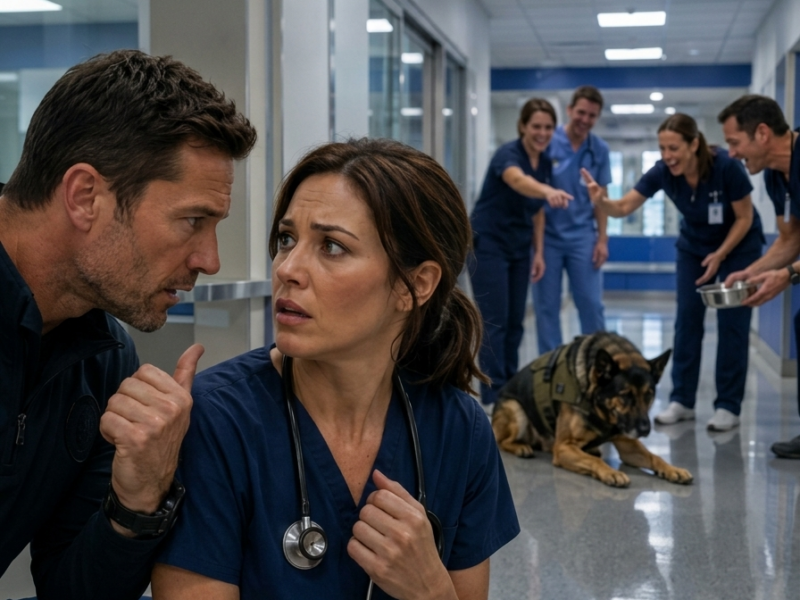
“They hurt your K9 when you leave,” the Navy SEAL whispered as I entered his hospital room, and when his dog suddenly pressed against my leg
The night shift at San Diego Naval Medical Center had a specific rhythm: the low hum of HVAC units circulating sterile air, the muted chirping of telemetry monitors, and the endless expanse of polished linoleum stretching down dimly lit corridors. I had taken a position on the fourth-floor surgical recovery unit three weeks ago, seeking a quiet routine after years in civilian trauma centers. But quiet was a luxury that vanished the moment they transferred Commander Jake Miller into Room 412.
Miller was a Navy SEAL whose team had encountered a “training anomaly” off the coast of Coronado—a classified phrase that usually translated to a violent, high-velocity catastrophe. He arrived with three fractured ribs, a severe concussion, and a ruptured spleen.
He also arrived with Shadow.
Shadow was a seventy-pound Belgian Malinois with a grey-muzzled snout, a notched left ear, and eyes that held the hard, unblinking intensity of a veteran who had seen too many dark rooms. Officially, active-duty working dogs were not permitted to lodge in inpatient civilian-staffed wards. Unofficially, nobody on the medical staff possessed the courage to tell a decorated SEAL operator that his combat assault dog had to wait in the base kennels.
“He won’t bite unless I tell him to,” Jake had rasped on his second night, his voice thick with pain medication. “Or unless you make a move that looks like a threat.”
Most of the nursing staff gave Room 412 a wide berth. They dropped off medication trays on the rolling table outside the door and slid vital-sign logs through the threshold slot. But I had grown up on a farm in Oregon with working herding dogs; I understood the language of rigid spines and focused gazes. When I first stepped into the room, I didn’t reach for the dog or make sudden eye contact. I simply set my clipboard down, let Shadow sniff the hem of my scrubs, and went to work checking Jake’s IV lines.
By the second week, an unspoken understanding had formed between the three of us. Every night at 0200, when I entered to chart Jake’s vitals, Shadow would rise from his pad in the corner, press his heavy flank briefly against my knee as a quiet greeting, and then position himself near the door, watching my hands with hyper-vigilant intensity. When I finished my rounds and prepared to leave, he would step silently alongside me to the threshold, standing guard until the heavy door clicked shut behind me.
On the night the quiet shattered, the weather outside was miserable. Rain lashed against the fourth-floor windows, driven by a cold Pacific gale.
I had just finished swapping Jake’s saline bag when he reached out and caught my wrist. His grip was surprisingly weak from the sedatives, but his fingers were rigid.
“Don’t go yet,” he murmured, his breath catching against his broken ribs.
I offered a professional smile, trying to gently ease my arm back. “I have three other post-op patients down the hall, Commander. I’ll be back in two hours for your next dose of antibiotics.”
Jake’s dark eyes were wide, bloodshot, and strangely focused. The foggy haze of morphine seemed to clear in an instant, replaced by a cold, visceral terror that looked entirely out of place on a man trained for war.
“They hurt your K9 when you leave,” he whispered.
I paused, my thumb resting on the roller clamp of the IV tubing. “My what?”
Jake rolled his head slightly toward the corner where the Malinois sat. “Someone has been hurting him whenever I leave. Whenever you leave the room.”
I stared at him, bewildered. “Jake, Shadow is right here. He hasn’t left this room since you were admitted.”
“Not when I’m awake,” Jake insisted, his chest heaving under the hospital gown. “When they push the IV sedatives at night. I can’t move my head, but I hear it. I hear him whining. Look at his neck, Sarah.”
I frowned, shifting my gaze down to the dog. Shadow had stepped closer, his body taut, his ears pinned back against his skull. He let out a low, almost imperceptible breath. I knelt on the cold floor, reaching out slowly toward his leather working collar. The dog didn’t flinch, but he leaned his weight heavily against my shoulder, as if seeking protection.
I lifted the thick leather strap. Hidden beneath the dense brown fur near his jawline was a raw, fresh laceration—a thin, deliberate slice about two inches long, oozing a faint bead of dark blood. It wasn’t a bite mark, nor was it a tear from a fence. It was a clean, linear incision made by a sharp blade.
My stomach dropped. “Jake… how long has this been there?”
“Three days,” Jake rasped, his knuckles turning white as he gripped the bedrail. “Who’s doing it, Sarah? Who’s coming in here?”
“I don’t know,” I whispered, my heart beginning to hammer against my ribs. “I’ll call hospital security right now. We’ll get the night supervisor up here.”
The next morning at 0600, as the shift change approached, I tried to leave Room 412 to deliver my final reports to the nurse’s station. But as I reached for the door handle, Shadow moved.
He didn’t growl. He simply stepped in front of the door, his broad chest blocking the frame, his dark eyes fixed on mine. When I tried to step to the left, he matched my movement.
“Shadow, back,” I commanded gently. “Break.”
The dog didn’t budge. He dropped his head low, let out a short, soft huff, and turned his snout toward the small private bathroom and supply closet attached to the suite. He walked three steps toward the closet, stopped, and looked back over his shoulder to ensure I was following.
“What is it, boy?” I asked, stepping carefully across the tile.
Shadow stepped into the narrow supply closet, where extra linens, sterile dressing kits, and suction tubes were stacked on stainless-steel shelving. He nudged a large, unopened cardboard box of saline flushes with his snout, then began scratching frantically at the laminate wall behind it.
I reached past him, shifting the heavy box aside.
Hidden in the shadowy recess between the back of the shelf and the wall panel was a tiny, cylindrical object no larger than a button. A faint, pin-sized red optic glinted in the dim light. It was a high-definition pinhole camera, wired directly into the hospital’s internal conduit pipes.
A cold surge of adrenaline shot through my veins. Someone hadn’t just been entering the room; someone was watching every interaction, every dressing change, every moment Jake was incapacitated.
I pulled a pair of nitrile gloves from my pocket, carefully prised the tiny lens assembly from the drywall, and placed it inside a sterile specimen cup.
“I’m taking this directly to the Chief of Security,” I told Jake, holding the cup up to the light. “Don’t let anyone touch your IV lines until I get back with the military police.”
I hurried down the central stairwell to the basement administration wing. The hospital security office was staffed by a civilian chief named Master-at-Arms Halloway, a retired Petty Officer with a sharp posture and a tired face. I explained the situation in rapid sentences, placing the plastic cup containing the micro-camera on his desk.
Halloway looked at the device, his brow furrowing. “A camera in 412? Are you sure this wasn’t part of the room’s telemetry installation?”
“It was hidden behind a supply box, Chief,” I snapped, frustration sharpening my voice. “And Commander Miller’s dog has a knife wound on his neck. Someone is tampering with that room.”
Halloway picked up the cup, locking it in his desk drawer. “Leave it with me, Nurse Vance. I’ll pull the corridor security logs for the past forty-eight hours and have my staff run a sweep of the fifth and fourth floors. Go back up, finish your shift, and don’t mention this to the other nurses. We don’t want a panic.”
I left his office feeling a strange, hollow sensation in the pit of my stomach.
Ten hours later, at 2000, I returned for my next night shift. The first thing I did was walk straight down to the security office to ask for an update.
Chief Halloway was sitting at his desk, drinking dark coffee. When I asked about the camera and the corridor footage, he looked at me with a blank, unblinking expression.
“What camera, Nurse Vance?” he asked calmly.
I froze. “The camera I gave you ten hours ago. The one from Room 412.”
Halloway opened his desk drawer. It was empty save for a notepad and a ring of keys. “I think you’re tired, Sarah. You’ve been working six consecutive night shifts. We ran a standard sweep of 412 this afternoon. We found nothing. There is no evidence of any surveillance equipment in this facility.”
I stepped back, the skin on my arms prickling with ice. “You’re lying. I handed it to you directly.”
“I suggest you get back to your floor,” Halloway said, his voice dropping into a flat, warning tone. “Commander Miller is a high-profile patient with significant post-traumatic stress. Don’t let his paranoia infect your professional judgment.”
I turned on my heel and practically ran back up the stairwell to the fourth floor.
When I entered Room 412, the room was shrouded in deep shadows. The overhead lights were off; only the green glow of the heart monitor illuminated Jake’s pale face.
Shadow was standing at the edge of the bed, his body rigid, his head low.
Jake turned his head slowly as I closed the door. “I told you,” he whispered, his voice barely audible over the hum of the oxygen pump.
“How did you know?” I asked, my knees shaking as I approached the bedside. “How did you know they would cover it up?”
Jake stared up at the acoustic ceiling tiles. “Because the exact same thing happened to my last nurse.”
The air left my lungs in a sharp gasp. “What last nurse? You were transferred here from the recovery ship three days ago.”
“Before I came here, I was at the forward surgical facility in San Clemente,” Jake murmured, his dark eyes brimming with a silent, heavy dread. “Nurse Lieutenant Ramirez. She found a transmitter in my room. She took it to the officer in charge.”
I leaned over the bedrail, my hands trembling. “What happened to her, Jake?”
“She stepped out to the parking garage at midnight to take a phone call,” Jake whispered. “Her car was still there the next morning. Her phone was in the trash compactor. Nobody has seen her in two weeks. They logged her as a deserter.”
Before I could process his words, Shadow let out a low, terrifying rumble from the back of his throat.
The dog didn’t look at us. He shifted his weight to his hind legs, his snout pointed directly at the heavy wooden door leading out to the main hallway.
Through the narrow glass observation panel in the door, I saw a tall silhouette stop in the ambient corridor light. A man’s shadow stretched long and dark across the floorboards beneath the door frame.
A heavy hand knocked once on the wood.
Then a man’s voice, smooth, authoritative, and utterly devoid of warmth, called out through the panel:
“Nurse Vance. You need to come with me to Administration immediately.”
I looked at Jake. He shook his head slowly, his hand reaching out to grab the edge of my scrub top.
Shadow moved, his paws sliding silently across the tile, positioning his massive body directly between me and the door. Every hair along his spine stood straight up.
Suddenly, with a sharp clack, the overhead fluorescent lights in the corridor outside flickered once, twice, and went completely dark. The emergency red floor strips kicked on, casting a dim, bloody glow through the bottom of the door.
A second later, a distinct, heavy iron click echoed through the frame.
Someone had pulled the manual fire door release from the outside, locking the magnetic deadbolts of Room 412 from the hallway.
We were trapped.
Jake tightened his grip on my shirt, his knuckles grey. “Now you understand why I warned you.”
Shadow let out an explosive, echoing bark, slamming his seventy-pound body hard against the reinforced wooden door. The frame groaned under the impact, but the heavy deadbolt held firm.
And then, from the small speaker of the room’s internal inter-com system mounted on the wall, a soft, dry whisper filtered through the static—a whisper that made every drop of blood in my body turn to liquid ice.
“Open the door, sweetheart.”
It was my voice. My cadence, my pitch, my exact tone—played back through the speaker with chilling, mechanical precision.
The sound of my own voice coming through the intercom speaker sent a wave of nausea crashing through me. It wasn’t just a recording of a sentence I had spoken before; it was a pieced-together synthesis, the syllables clipped and stitched together with cold, digital perfection.
“Open… the… door… sweetheart.”
Shadow threw himself against the wood a second time, a furious volley of deep, chest-rattling barks erupting from his throat. The door didn’t yield, but the heavy iron frame shuddered.
“Sarah,” Jake barked, his voice suddenly dropping its narcotic haze. “Get away from the door. Now!”
I backed away until my shoulder slammed into the wall beside the headboard. “Jake, that was my voice. How do they have my voice?”
“The camera in the closet,” Jake snapped, struggling to push himself into an upright position despite the agony in his torso. “It wasn’t just a video feed. It was a directional audio harvester. They’ve been recording you since your first shift in this room.”
Outside in the corridor, heavy footsteps began to move away from the door, retreating rapidly toward the central nurse’s station.
“They locked the magnetic fire doors,” I said, my hands flying to the wall-mounted emergency telephone. I pulled the receiver from the cradle and pressed ‘0’ for the hospital operator.
Nothing. No dial tone. Just a high-pitched, rhythmic hum—a frequency jammer operating somewhere within fifty feet of our room.
“The lines are dead,” I gasped.
“Listen to me,” Jake said, grabbing a pair of medical trauma shears from the stainless-steel tray beside his bed. He thrust the blunt-tipped steel scissors into my hand. “This isn’t a hospital security team. Hospital security doesn’t use audio spoofing or tactical signal jammers.”
“Then who are they?”
“Contractors,” Jake said grimly. “Or an internal black-budget intelligence unit. Three months ago, my SEAL team recovered a hard drive during an interdiction operation in the South China Sea. Before I was injured, I realized the data on that drive contained tracking logistics for unauthorized medical research being conducted right here on military bases in California. I was going to hand it to the Naval Criminal Investigative Service.”
He looked toward the window. “Then my helicopter suffered a ‘mechanical failure’ during a routine jump over Coronado.”
My mind raced through the implications. “They didn’t just want to kill you in the crash… they wanted to see who you spoke to before you died.”
“And now they know I spoke to you,” Jake said. “And they know you found their wire.”
Suddenly, Shadow ceased his barking. He dropped his head to the floor, his nostrils flaring as he sniffed the narrow gap beneath the door. A soft, subtle whistling sound began to fill the room—a faint, hissing hiss like gas escaping a pressurized canister.
A thin, grey vapor began to roll across the linoleum floor from the HVAC air supply vent near the ceiling.
“Halothane,” I gasped, instantly recognizing the sweet, sickly chemical odor of industrial aerosolized anesthetic. “They’re pumping surgical gas through the ventilation duct!”
“Cover your mouth!” Jake ordered, ripping the heavy cotton blanket off his bed and throwing it to me. “Soak it in the sink!”
I scrambled into the small bathroom, threw the blanket into the basin, and cranked the cold water faucet to maximum. As the heavy fabric absorbed the water, I caught a glimpse of myself in the mirror above the sink. My face was dead white, my eyes wide with terror. But beneath the fear, an old, buried instinct took over—the survival drive that every trauma nurse develops when a room turns into a war zone.
I ran back into the main room, wrapping the wet blanket tightly around Jake’s nose and mouth, then wrapped a wet towel around my own face.
Shadow was already coughing, his back legs wobbling as the dense chemical gas settled low near the floor.
“Shadow! Up!” I yelled, pulling the dog up onto the raised hospital bed beside Jake. “Stay up high!”
The gas was filling the room rapidly, obscuring the floor in a thick, swirling cloud of grey mist. The emergency red lights flickered through the haze, giving the room the nightmare appearance of a sunken submarine.
“We have two minutes before the concentration in here reaches a lethal dose,” I said through the damp towel, my eyes burning from the chemical fumes. “We can’t break the door, and the windows are reinforced safety glass designed to withstand hurricane winds.”
Jake pointed with a trembling hand toward the ceiling directly above his bed.
“The maintenance access hatch,” he whispered. “Every corner room in this wing has a square service hatch leading to the utility crawlspace between the fourth and fifth floors.”
I looked up. In the center of the acoustic tile ceiling was a square aluminum frame held in place by four plastic turn-latches.
“Can you climb?” I asked Jake.
“No,” Jake rasped, his face pale as he clutched his ruptured spleen. “My ribs are splintered. If I try to pull my own weight, I’ll drive a bone fragment into my lung. You have to go.”
“I’m not leaving you here to suffocate!”
“You aren’t leaving me,” Jake said, his eyes burning with absolute command. “You’re taking Shadow. He can climb if you hoist him. Get to the floor above us, pull the main manual fire alarm on the fifth-floor corridor. It hardwires directly to the San Diego City Fire Department outside the base network. Once the civilian fire department responds, they can’t cover this up.”
I looked from Jake to the dog. Shadow was resting his heavy head against Jake’s arm, his breath coming in shallow, ragged hitches as the gas took effect.
“Do it, Sarah!” Jake barked, his voice cutting through the hiss of the gas. “That’s an order!”
I didn’t argue. I dragged the heavy over-bed rolling table beneath the ceiling hatch, unlocked the wheels, and stepped up onto the artificial wood surface.
Reaching up, I used the tips of the trauma shears to twist the four plastic latches. The metal access panel dropped open with a heavy thud, revealing a dark, dusty square conduit filled with insulated pipes, electrical conduits, and the cool, damp smell of structural concrete.
“Shadow, up!” I commanded, leaning down over the edge of the table.
The Malinois gathered his remaining strength, sprang off the mattress onto the rolling table, and placed his front paws onto my shoulders. He was heavy—seventy pounds of dense muscle and fur—but adrenaline gave me a burst of strength I didn’t know I possessed.
I grabbed the heavy leather harness around his chest, braced my feet against the table, and heaved him upward into the dark crawlspace. The dog scrambled onto the steel support beams, his claws scraping against the metal, until he secured his footing on the concrete deck above.
“Now you!” Jake shouted from below, his voice growing raspy as the gas thickened.
I gripped the edge of the aluminum hatch frame, hauled my upper body into the dark conduit, and kicked off the table.
As I pulled my legs up into the crawlspace, I looked down one last time through the square opening.
Below me, the grey gas had completely filled the room. Through the mist, I saw the heavy wooden door of Room 412 splinter inward as a metal prybar forced the deadbolt back.
Three figures in black tactical coveralls and full-face respirators stepped into the room, their weapons raised.
The lead figure looked up at the open ceiling hatch, raised a silenced pistol, and aimed it directly at my face.
I threw my weight to the left just as the quiet, sharp puff of a suppressed firearm echoed through the narrow crawlspace.
A heavy 9mm round slammed into the concrete deck an inch from my knee, spraying sharp flecks of grit against my scrub pants.
“Move!” I screamed to Shadow.
The dog didn’t need to be told twice. Despite the lingering effects of the halothane gas, his combat training kicked in. He stayed low to the concrete, his belly practically scraping the dust, navigating the dark maze of galvanized air ducts and thick bundles of black fiber-optic cables with practiced agility.
I crawled on my hands and knees behind him, the sharp edges of metal support brackets tearing through my uniform, blood trickling down my shins.
Above us, the crawlspace was pitch black, lit only by the sporadic green flickers of emergency circuit boards mounted along the walls. The air was dry, heavy with fiberglass insulation dust that burned my throat with every desperate gasp.
Behind us, a metallic clatter echoed through the hatch.
“They’re coming up!” I whispered, my voice trembling.
One of the pursuers was hauling himself up through the square ceiling opening of Room 412. I could hear the rhythmic scraping of tactical boots against the aluminum frame.
“Shadow, find an exit!” I urged.
The dog surged forward, turning sharp right down a long structural trench where the high-voltage electrical lines fed into the fifth-floor power junction.
We crawled forty feet through the darkness until Shadow abruptly stopped. His tail brushed against my head as he lowered his front legs, pressing his snout against a heavy, rectangular steel grate mounted in the floor of the crawlspace.
I crawled up beside him.
Looking down through the metal slats of the grate, I saw the brightly lit hallway of the fifth floor—the pediatric oncology ward. The corridor was empty, bathed in the soft blue night-lights of the nurse’s station fifty feet away.
“The fire alarm,” I whispered, scanning the wall below the grate.
Mounted on a drywall pillar right next to the central water fountain was a bright red manual fire alarm box with a pull-down handle.
If I could reach that handle, the building’s automated suppression system would drop heavy iron fire doors across every floor, sound high-decibel horns, and immediately notify the San Diego Metropolitan Dispatch Center via a hardwired landline that couldn’t be intercepted by local jammers.
“We have to break the grate,” I whispered to Shadow.
The grate was held in place by four structural steel screws anchored into the concrete ceiling joists. I pulled the heavy medical trauma shears from my pocket, wedged the thick steel blade into the seam between the grate and the wall, and applied every ounce of my weight.
The metal groaned, but it didn’t yield.
Behind us, down the dark crawlspace tunnel, the beam of a high-intensity tactical flashlight sliced through the darkness. The harsh white beam swept across the insulated pipes, drawing closer with every passing second.
“Target acquired,” a cold voice radioed from forty feet away in the darkness. “Two subjects in the junction crawlspace. Authorization to neutralize.”
My heart stopped.
I turned back to the grate, panic exploding in my chest. I jammed the shears into the top screw hole and struck the plastic handle with the palm of my hand like a hammer.
CRACK.
The old drywall around the upper right anchor crumbled, sending a shower of white dust down into the fifth-floor corridor below.
“Shadow, help me!” I cried.
The Malinois didn’t hesitate. He jammed his broad snout into the widened gap, planted his back paws against the concrete ceiling above us, and shoved his entire body weight forward with violent, explosive force.
The remaining three screws tore free from the aging plaster with a loud metal screech. The heavy iron grate crashed down onto the fifth-floor linoleum floor below with a deafening bang that echoed down the empty hospital hallway.
“Go!” I yelled.
Shadow didn’t wait. He dropped through the open six-foot gap, landing lightly on his paws on the polished floor below, immediately turning to face the opening.
I threw my legs through the hole, hung by my fingers from the concrete lip for a fraction of a second, and dropped to the floor beside him.
The impact jarred my ankles, sending a sharp shoot of pain up my calves, but I scrambled to my feet instantly.
I lunged for the red fire box on the pillar.
I grabbed the heavy plastic T-handle and pulled down with all my strength.
Nothing happened.
No horns blared. No strobe lights flashed. The small glass rod inside the box didn’t break; the handle simply pulled down loosely, hanging limp against the red casing.
The wiring behind the box had been cleanly severed from inside the wall cavity.
“No… no, no, no!” I sobbed, hammering my fist against the useless plastic box. “They cut the alarms!”
“They cut everything on four and five, Sarah,” a calm, familiar voice said from down the corridor.
I spun around.
Standing near the fifth-floor elevator bank was Chief of Security Halloway.
He was no longer wearing his navy blue security shirt. He wore a dark, unmarked tactical jacket, and in his right hand, he held a sleek, silver-suppressed automatic pistol equipped with a laser sight.
Behind him stood two of the black-clad contractors who had breached Room 412.
“You should have stayed in your lane, Nurse Vance,” Halloway said gently, stepping forward. His rubber-soled boots made almost no sound on the floor. “You were doing so well. Three weeks of clean reviews, good patient feedback. Why did you have to look behind the boxes?”
“You’re a veteran,” I spat, stepping back until my shoulder touched the drywall. “You took an oath to protect military personnel!”
Halloway let out a dry, hollow laugh. “An oath doesn’t pay for a house in La Jolla when you retire on a Petty Officer’s pension, Sarah. The people I work for pay five million dollars for the proprietary medical data Commander Miller’s team seized in the Pacific. That data belongs to a private defense syndicate, not the NCIS.”
He raised his weapon, the red laser dot appearing directly on the center of my chest.
“Where is the secondary drive?” Halloway asked calmly. “Miller didn’t have it on his person when he was admitted. He gave it to you, didn’t he?”
“I don’t have any drive!” I yelled, my voice echoing down the silent corridor. “I don’t know what you’re talking about!”
“Search her,” Halloway ordered the two men behind him.
Shadow let out a guttural, terrifying roar, stepping directly in front of me, his lips pulled back to reveal sharp white teeth, his ears flat, his tail rigid.
Halloway shifted his aim down to the dog’s head. “Pity about the dog. Fine animal. But military property is easily replaced.”
His finger tightened on the trigger.
Before he could squeeze it, the heavy metal doors of the fifth-floor service elevator behind him suddenly shuddered with a massive, violent impact.
The reinforced steel doors of the service elevator groaned as if hit by a battering ram.
Halloway turned his head sharply, his weapon momentarily shifting away from me toward the elevator bank.
BOOM.
A second impact struck the doors, and the heavy metal panels buckled inward, popping off their overhead rollers. A steel crowbar wedged itself into the central seam, flexing with immense hydraulic pressure until the doors were ripped apart with a deafening screech of tearing metal.
Standing inside the elevator shaft, holding a heavy iron oxygen tank lever like a club, was Commander Jake Miller.
He was pale, his hospital gown soaked in blood where his surgical drain had torn loose, his chest bare beneath an unbuttoned tactical vest he had stripped from one of the downed contractors in Room 412. His dark eyes were burning with pure, unadulterated combat rage.
Behind him in the elevator cage stood three armed men wearing the blue uniforms and windbreakers of the Naval Criminal Investigative Service (NCIS), their assault rifles raised and locked onto Halloway’s team.
“Drop your weapons!” the lead NCIS agent roared, his voice booming down the corridor. “Federal agents! Drop them now!”
Halloway didn’t hesitate. He spun around, raised his pistol, and fired two rapid shots into the elevator frame.
The corridor exploded into absolute violence.
“Shadow, ATTACK!” Jake screamed, his voice cutting through the gunfire like a thunderclap.
The command word wasn’t English; it was a short, sharp guttural syllable in Dutch that the dog had been conditioned to respond to since he was a pup.
Shadow surged forward like a missile launched from a tube.
He covered the thirty feet between us and Halloway in less than two seconds, jumping off the linoleum floor and launching his entire body through the air.
Halloway tried to swing his weapon toward the dog, but Shadow’s jaws clamped onto his right forearm with bone-crushing force.
Halloway let out a bloody scream as the Malinois tore him to the floor, the suppressed pistol skidding across the slick tiles into the shadows.
The two contractors behind Halloway opened fire toward the elevator, but the NCIS agents returned a lethal volley of suppressed rifle fire. Both contractors collapsed onto the floor within seconds, their weapons clattering uselessly against the baseboards.
“Cease fire! Cease fire!” the lead NCIS agent yelled, stepping out of the elevator frame with his rifle aimed at Halloway, who was thrashing helplessly on the ground under the weight of the dog.
“Shadow, OUT!” Jake shouted, limping out of the elevator shaft, using an IV pole as a cane to support his weight.
The dog instantly released his grip on Halloway’s arm, stepping back three paces, his teeth still bared, standing guard over the bleeding security chief.
I collapsed against the wall, my knees finally giving out completely, tears of shock and pure exhaustion breaking through my eyes.
Jake limped over to me, dropping to one knee despite the agonizing pain in his ribs. He reached out with a bloody hand and grabbed my shoulder, pulling me into a firm embrace.
“You pulled the fire alarm handle,” Jake said, his voice rough and shaking.
“It didn’t work,” I sobbed into his shoulder. “They cut the wires.”
“It didn’t need to work,” Jake murmured, a faint, bloody smile touching his lips. “The handle had a secondary hardwired micro-switch inside the wall casing. When you pulled it, it bypassed their local jammer and sent an automated distress ping directly to the NCIS field office at Naval Base San Diego.”
He looked up at the ceiling hatch where I had dropped through moments before. “You held them off long enough for the tactical team to clear the basement garage and get up the service lift.”
NCIS agents swarmed the corridor, throwing heavy plastic zipties around Halloway’s wrists and securing the scene. The lead agent walked over to Jake, holding up a small, black encrypted flash drive wrapped in a clear plastic evidence bag.
“We found the secondary drive hidden in the dog’s leather collar lining, Commander,” the agent said. “Exactly where you told us it would be.”
Jake looked down at Shadow, who had walked over to sit beside my knee, pressing his heavy, blood-stained head into my lap.
“They weren’t trying to hurt him out of cruelty,” Jake whispered, his thumb gently tracing the cut on Shadow’s neck where the contractors had attempted to slice open his collar during his sedated nights. “They knew I hid the data in his tactical gear before I was admitted. They were trying to cut it out without waking me up.”
I reached down, wrapping my arms around the dog’s neck, burying my face in his thick brown fur as the heavy adrenaline crash finally overwhelmed my body. Shadow let out a long, quiet sigh, his tail giving two soft thumps against the floorboards.
Two weeks later, the morning sun was rising over the blue expanse of the San Diego Bay, casting long beams of golden light across the wooden deck of the Coronado Pier.
The storm had passed, leaving the air crisp, clear, and smelling faintly of salt water and eucalyptus.
I sat on a wooden bench at the end of the pier, holding a hot paper cup of coffee. My hands no longer trembled, though the faint red scars on my shins remained as a permanent reminder of the crawlspace above Room 412.
The news had been swept quietly under the rug of military justice, as such things usually were.
Master-at-Arms Halloway and four senior executives of a private defense technology firm were currently sitting in federal maximum-security detention facing charges of treason, attempted murder, and corporate espionage. The classified medical data had been safely secured by NCIS, exposing an illegal research syndicate that reached across three naval installations.
A quiet step echoed on the wooden planks behind me.
I turned around.
Commander Jake Miller was walking toward me. He was wearing his dark blue Navy service uniform, his chest decorated with rows of colorful ribbons, including the Navy Cross. He was walking slowly, using a polished wooden cane, but his posture was straight, his chin high.
Beside him walked Shadow.
The dog wore a fresh leather working harness, his fur brushed clean, the wound on his neck almost completely healed beneath a neat line of surgical ointment.
When Shadow saw me, he broke away from Jake’s side, trotting across the pier and pressing his broad snout directly into my palm.
“He doesn’t usually greet civilians like that,” Jake said, stopping beside the bench and looking out over the water.
“I’m not sure I count as a civilian anymore,” I offered with a soft smile, reaching down to scratch Shadow behind his notched left ear. “After spending forty minutes in a ceiling conduit with him, I think we’re officially battle buddies.”
Jake let out a low laugh, sitting down on the wooden bench beside me. He stretched his injured leg out, looking at the distant silhouette of the aircraft carriers docked across the bay.
“I received my official discharge papers this morning,” Jake said quietly. “Medical retirement. My ribs will heal, but the spleen and the lung trauma mean my time with the teams is done.”
I looked at him gently. “What are you going to do?”
“I bought a small ranch up in the foothills near Julian,” Jake said, turning his head to look at me. “Fifty acres of oak trees, quiet land, no cameras, no surveillance, no hospital walls.”
He paused, adjusting the grip on his cane.
“Shadow is retiring with me,” Jake added, his dark eyes fixing on mine with a gentle, unhurried intensity. “He’s going to need a good veterinarian nearby. And… I’m going to need someone who knows how to handle a dog who doesn’t like to sleep alone.”
I looked down at Shadow, who had laid his heavy head across my boots, his dark eyes fixed on mine with the quiet, unyielding loyalty that had saved my life two weeks ago.
“Is that an official offer, Commander?” I asked softly.
Jake reached into his pocket and pulled out a small, silver working-dog tag, handing it to me. On the back, engraved beneath Shadow’s name and service number, were three simple words:
Guardian of the Ward.
“It’s an invitation, Sarah,” Jake murmured, his hand resting gently over mine. “To anywhere the road takes us next.”
I looked out over the Pacific Ocean as the golden sun broke fully over the horizon, illuminating the white caps of the waves below.
I took a sip of my warm coffee, leaned my shoulder against Jake’s arm, and let out the first deep, quiet breath I had taken in three weeks.
“I think,” I whispered, reaching down to stroke the dog’s soft head, “that sounds like the first good shift I’ve had in a long time.”
The end









