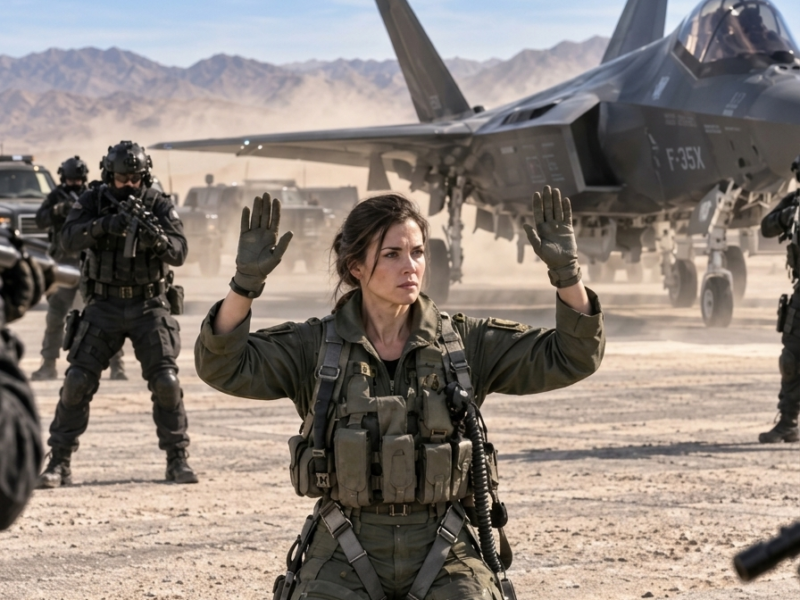
They handcuffed me on the runway at Edwards Air Force Base while dozens of airmen watched, and the general called me a traitor with ice in his voice
The concrete room beneath Edwards Air Force Base smelled like damp chalk and hydraulic oil, a familiar combination that usually offered me peace. Today, it carried the metallic scent of copper and fresh terror.
The screen of my phone lay facedown on the steel table between General Marcus Hale and me, its glass illuminated intermittently by the buzzing pulse of incoming signals. The single red emergency beacon in the corner rotated with mechanical indifference, casting long, bloody ribs of light across the walls.
“Don’t touch it,” Hale said softly. His hand rested firmly against the black composite grip of his sidearm. The gray in his crew cut looked stark under the scarlet flicker. “Emily, leave it alone.”
I did not listen. I couldn’t.
My fingers were bruised around the cuticles, stained with grease from the pre-flight checks of the Phantom-9—the experimental delta-wing jet that still ticked as its titanium chassis cooled out on the windswept tarmac. My hand reached forward and flipped the phone.
The display flared against my eyes.
The picture was grainy, taken from a low angle under harsh halogen tubes. It depicted a man sitting on an aluminum bench against a corrugated steel wall. He wore an unzipped flight suit, the silver Nomex thread at the collar worn down to the backing fabric. His dark hair was longer than regulation, his cheekbones sharper, scarred along the left jawline where an oxygen mask had melted during some unrecorded catastrophe.
It was Daniel.
He was staring directly into the lens. In his right hand, he held a slip of paper dated with today’s mission timestamp: 03:22 UTC.
“That’s impossible,” I whispered, the sound scraping against my dry teeth. “I stood by his casket at Fort Rosecrans. I felt the weight of the bronze urn. We scattered half of him over the Pacific.”
“You scattered what the Department of Defense authorized you to scatter,” Hale murmured, his voice tightening. He leaned over the table, his knuckles pressing into the laminate surface until the skin turned bone-white. “Look at the background, Emily. Do you recognize those rivets on the bulkhead?”
I narrowed my eyes. Every rivet in modern aerospace engineering is a signature. The aircraft I worked on used counter-sunk titanium fasteners with a specific hexagonal drive head to eliminate radar signatures. The pattern behind Daniel’s shoulder wasn’t from a conventional hangar.
“Hangar 18-B,” I said, my throat constricting. “The decommissioned cold-altitude chamber on the north perimeter.”
“Which has been off the electrical grid since nineteen ninety-eight,” Hale said. “Officially.”
Before I could breathe, the heavy pneumatic seal of the interrogation room hissed. The latch mechanism did not click with the familiar clearance chime of an authorized keycard. Instead, the solenoid clicked twice, rapidly, followed by the electronic squeal of an override chip burning out the circuitry.
“Get behind the desk,” Hale commanded. His weapon cleared its holster without a sound, his body moving with the instinct of a man who had fought in three desert campaigns before I was born.
The door swung inward by two inches. Cold desert air, carrying the fine, powdery dust of the dry lake bed, poured into the heated bunker. Along with it came the heavy scent of burning insulation.
“General?” a voice called from the darkness of the corridor. It sounded young, strained, breathless. “General Hale, sir? Security Section Four is down. The cameras on the main apron just looped.”
Hale didn’t lower his pistol. “Identify yourself, Airman.”
“Lance, sir! Staff Sergeant Lance, auxiliary maintenance.” A young man stepped into the red wash of the emergency light, his hands held high, palms out. His uniform was rumpled, his eyes wide and dilated. “Sir, someone cut the primary transformers at the sub-station. But that’s not all. The auxiliary generators didn’t kick on because their fuel lines were bypassed with water. It was planned.”
“Where is the perimeter guard?” Hale demanded.
“Dead, sir. Or unconscious. They’re scattered across Sector Two. The team that brought Mrs. Vance in—they never made it back to the command center. Their transport was rammed at Checkpoint Delta.”
The name struck me like a physical blow. Mrs. Vance. For six months, I had been the widow Vance. The grieving technician who stayed late in the wind tunnels because going home to an empty craftsman house in Lancaster meant facing Daniel’s flight boots still sitting by the front door.
“He’s not dead, Marcus,” I said, grabbing the general’s sleeve. “Look at the photograph. He’s here. On this base.”
Hale didn’t look back at me. “If Daniel is alive, Emily, then the men who tried to drop him into the sea from eighty thousand feet know he survived. And if they know he survived, they didn’t cut the power to rescue him. They cut it to clean the hangar.”
A loud, thumping detonation shook the concrete floor beneath our boots. Dust sifted down from the acoustic ceiling tiles, settling in my hair. It came from the north.
Hangar 18-B.
“They’re burning the chamber,” I said, pure adrenaline replacing the shock that had kept me paralyzed since the MPs had dragged me out of the cockpit. “The flight recorders from the Phantom-9 are encrypted with his biometric keys. If he dies, the decryption sequence locks forever.”
“How do you know that?” Hale asked, turning his head sharply.
“Because I wrote the compiler,” I said. “Three weeks before Daniel took his final flight, he asked me to design a partition in the flight management software that couldn’t be purged by ground control. He told me it was an operational failsafe for deep-space telemetry. I believed him.”
Hale closed his eyes for a fraction of a second, an expression of profound weariness passing over his lined features. “He wasn’t protecting telemetry, Emily. He was recording the tail numbers of the aircraft carrying undocumented payloads out of this facility under the cover of the Black Sky trials.”
“We have to get to him,” I said, moving toward the open doorway.
“Wait!” Sergeant Lance shouted, stepping backward into the corridor. “You can’t go through the north tunnel. There are four men in sterile black tacticals moving toward the flight line. They have suppressed carbines and thermal optics. They aren’t base security.”
Hale stepped past the young sergeant, peering down the dimly lit hallway. The emergency lights down the line were dying one by one, their battery packs failing as an electromagnetic pulse or targeted bypass drained the circuits.
“Emily,” Hale said without looking back. “The jet you landed on the auxiliary runway. How much fuel did you have when the turbine spooled down?”
“Twenty-two hundred pounds,” I replied immediately. “Enough for seven minutes of high-altitude burn or twenty minutes of subsonic ferry.”
“And the canopy?”
“Still warm. The ground crew hadn’t connected the egress pins when your security detail yanked me out.”
“Then we have one chance,” Hale said, checking the magazine of his sidearm and sliding it back into place with a sharp metallic snap. “Those men aren’t here for Daniel. They already have him cornered. They’re here to sanitize the Phantom-9 before its internal drives finish transmitting to the off-site server.”
“Transmit to where?” I asked.
Hale looked at me with cold, clear eyes. “To the Pentagon’s Inspector General. The real one.”
A burst of automatic gunfire chattered from the end of the north corridor, muffled by layers of reinforced concrete but unmistakable in its cadence. Three distinct, short bursts. Execution shots.
Lance flinched, slamming his back against the wall. “They’re inside the inner perimeter.”
“Emily, take my jacket,” Hale said, peeling off his heavy olive-drab field coat and throwing it over my shoulders. It smelled of cigar smoke and damp wool. “Cover your hands. If they see your rings or your watch, the reflection will give you away. Lance, you take the rear.”
We stepped out into the corridor. The darkness was absolute except for the occasional twitch of a dying fluorescent tube overhead. The air had grown colder, smelling of ozone, dust, and something else—the sharp, unmistakable chemical tang of white phosphorus.
They were not just clearing the hangar; they were incinerating every trace of the project.
We moved in silence toward the north exit stairs, our boots stepping over discarded communication cables and tools abandoned by the night-shift maintenance crew. My heart hammer-beat against my ribs like an engine starved of oil.
With every step, Daniel’s face from the photograph remained burned into my retinas. His sunken eyes, the grim set of his mouth, the way his fingers had gripped that dated paper. He had known I would steal the jet. He had counted on it.
We reached the foot of the steel staircase that led up to ground level. Above us, the metal hatch had been forced open, admitting a sliver of violet dawn from the Mojave sky.
Hale held up a fist, signaling for us to stop. He raised his weapon, his boots silent on the corrugated treads as he climbed three steps.
Then, from the darkness of the stairwell landing above, a low, modulated voice cut through the stillness:
“Marcus. You’re five minutes late.”
Hale froze. The silhouette against the gray sky was tall, broad-shouldered, holding an assault rifle at low ready. The man stepped down into the gloom just enough for the faint dawn light to catch his collar.
He wore the insignia of a Lieutenant Colonel.
“Vance?” Hale breathed.
The man stepped into the light. It wasn’t Daniel.
It was Colonel Robert Vance—Daniel’s older brother, the man who had delivered the eulogy at Daniel’s funeral, the man who had handed me the folded American flag with tears streaming down his face.
Robert looked down at us, his rifle never wavering from Hale’s chest.
“You should have stayed in the bunker, Marcus,” Robert said quietly. “And you, Emily… you shouldn’t have flown that plane.”
The silence on the stairwell was heavier than the three feet of reinforced concrete surrounding us. I could hear the wind scouring the gravel on the runway apron above, a dry, whispering sound that seemed indifferent to the betrayal taking shape on the metal stairs.
“Robert?” My voice didn’t sound like my own; it sounded thin, stripped of substance by the sheer absurdity of the moment. “You… you were in Washington. You were at the Defense Logistics Agency.”
Robert Vance did not lower the rifle. His uniform was clean, pressed with the fanatical precision typical of staff officers, but his eyes were completely bloodshot, surrounded by dark rings of exhaustion. He had the same jaw as Daniel, the same straight bridge of the nose, but the humor and quiet kindness that had defined my husband were completely absent from Robert’s face. There was only a dull, mechanical resolve.
“I took an executive transport out of Andrews at twenty-two hundred last night, Emily,” Robert said, his tone conversational, as if we were discussing the flight schedule over coffee in my kitchen. “I needed to be here when the automated transponder on the Phantom-9 triggered the perimeter breach.”
“You killed him,” Hale said, his voice dropping into a register of deadly calm. “At Fort Rosecrans. You handed this girl a box of scrap metal and ashes.”
“I did what Daniel asked me to do,” Robert snapped, the first crack appearing in his composed facade. “Daniel was an idealist. He thought he could pull the emergency brake on a machine that has been rolling since the end of the Cold War. He thought if he gathered the telemetry from the illegal black-payload drops over the Pacific, he could walk into a congressional committee and be the hero of the republic.”
Robert stepped down one more tread. The muzzle of his weapon remained centered on Hale’s heart.
“He didn’t realize,” Robert continued, “that the committee members are the ones who authorized the black-budget line items in the first place. If I hadn’t faked the telemetry failure on his flight, Marcus, they wouldn’t have just retired him. They would have scrubbed his name from every database in the military, seized every asset Emily owned, and left them both in an unmarked trench in the Nevada salt flats.”
“So you staged his death,” I said, stepping past Hale despite the general’s arm trying to bar my path. “You let me grieve for six months. You watched me pack his clothes into cardboard boxes. You watched me sit on the floor of our closet with his flight jacket until I couldn’t breathe!”
“I kept him alive!” Robert hissed, his knuckles whitening on the polymer stock of his rifle. “He was safe in the northern sector. We had him isolated, off-grid, waiting for the political transition next month. But then you had to interfere, Emily. You couldn’t leave the damn flight logs alone. You noticed the discrepancy in the turbine consumption records for the Phantom-9.”
“Because the numbers were wrong,” I said, my voice rising. “A fifty-thousand-pound aircraft doesn’t burn four hundred pounds of kerosene per minute while sitting idle on an apron! You were siphoning fuel into an auxiliary reserve to power the ground-based refrigeration arrays in Hangar 18-B!”
“She’s an engineer, Robert,” Hale said coldly. “You always underestimated her. You thought because she loved your brother, she wouldn’t look at the math.”
“The math doesn’t matter anymore,” Robert said. He reached into his tactical vest with his left hand, never dropping the sight line of his rifle, and pulled out a heavy plastic master-key card. “The perimeter is sealed. The contractor team I brought in has already severed the communication trunks to the outside world. To the base command, this looks like a terrorist infiltration led by a rogue pilot—Emily—assisted by a compromised base commander—you, Marcus.”
“And what happens to Daniel?” I asked, my heart pounding so hard I felt it behind my eyes. “What did you do to him in 18-B?”
Robert’s eyes flickered, just for an instant, toward the northeast corner of the facility.
“Daniel made his choice twenty minutes ago,” Robert said softly. “When the alarms sounded, he realized you were the one who took the jet. He broke the containment seal on the inner chamber. He tried to override the tarmac safety floodlights to give you a landing path.”
“Where is he?” I demanded.
“He’s in the chamber,” Robert said. “And the chamber is set to self-purge in twelve minutes. White phosphorus doesn’t leave teeth, Emily. It doesn’t leave dog tags. It leaves three inches of gray slag.”
Behind us, Staff Sergeant Lance shifted his weight. The sound of his rubber sole scuffing the steel riser was slight, but Robert’s eyes flicked to him instantly.
“Lance,” Robert said, his voice dropping into a commanding bark. “Take the general’s sidearm.”
I turned, stunned.
Sergeant Lance was not shaking anymore. The nervous, terrified airman from the bunker had vanished. His face was blank, his posture upright and rigid. From behind his waistband, he drew a suppressed nine-millimeter pistol and pressed the cold muzzle against the base of General Hale’s skull.
“I apologize, General,” Lance said flatly. “The Colonel’s team pays on a private contractor scale. The pension from the Department of the Air Force wasn’t going to cover my daughter’s treatments.”
“You pathetic little turncoat,” Hale growled, not moving an inch. “I signed your promotion warrant myself.”
“And I appreciated it, sir,” Lance said. “Now drop the weapon.”
Hale hesitated for a second, then opened his fingers. His service pistol clattered onto the concrete floor of the corridor below.
Robert smiled, a cold, empty stretch of the lips. “Good. Now, we go back down to the secure bay. Emily, you are going to sit at the maintenance terminal. You are going to log into the Phantom-9’s flight computer through the remote data link, and you are going to execute the purge script Daniel blocked.”
“No,” I said.
“If you do,” Robert said, “I will open the hatch to 18-B. I will give you Daniel. You can take him, you can take his car from the long-term parking lot, and you can disappear to South America. We will report you both dead in the explosion. You get your husband back. I get the records destroyed. Nobody else has to die.”
“You’re lying,” I said. “If you purge the records, you kill the only witnesses who know you were skimming fuel and running black ops out of a military test center.”
“I am his brother!” Robert yelled, his voice cracking with sudden, uncontrolled rage that echoed down the stairwell. “Do you think I wanted this? Do you think I wanted to spend eighteen years serving this country only to find out that every general above me was selling intelligence to private aerospace conglomerates? I didn’t create this system, Emily! I’m just trying to make sure Daniel and I survive it!”
A low, mechanical rumble began to vibrate through the concrete walls. It was the sound of an auxiliary turbine spooling up somewhere on the surface.
“That’s not base power,” Hale said, his voice tight despite the gun at his neck. “That’s the taxi engine on the Phantom-9.”
Robert’s eyes widened slightly. He reached for the radio pinned to his shoulder. “Strike Team One, report. Who is on the apron?”
Static was the only reply.
“Strike Team One, acknowledge!” Robert snapped.
Then, through the speaker of Robert’s tactical radio, a voice spoke. It was hoarse, ragged, scarred by smoke inhalation and cracked vocal cords, but I would have recognized it across a lifetime of noise.
“The jet is locked to my flight profile, Robert,” the voice said.
“Daniel,” I gasped, tears finally spilling over my eyelids.
“Emily?” Daniel’s voice broke through the radio, filled with a sudden, desperate warmth that shattered the cold morning. “Emily, don’t listen to him. The flight computer isn’t transmitting to the Pentagon. It’s broadcasting unencrypted on the civilian emergency guard frequencies. Every air traffic control tower from Los Angeles to Salt Lake City is downloading the telemetry right now.”
“You idiot!” Robert screamed into the radio. “They’ll ground every flight in the western hemisphere! They’ll scramble interceptors from Nellis!”
“Let them scramble,” Daniel said. “The files are already out. And Robert… the maintenance crew left the ground-attack radar in test mode. I’m looking right through the walls of the north stairwell.”
Before Robert could react, the heavy blast hatch at the top of the stairs—the one leading directly onto the north apron—shuddered under an immense, concussive pressure wave. The high-pitched whine of an aircraft engine screamed just outside, so loud that the concrete beneath our feet began to hum like a tuning fork.
Lance panicked. He turned his head toward the hatch for a fraction of a second.
It was all the opening Marcus Hale needed.
The old general drove his left elbow backward into Lance’s throat with the force of a battering ram. Lance gagged, stumbling down two stairs as his weapon fired blindly, the bullet sparking harmlessly off the reinforced concrete ceiling.
Hale lunged forward, sweeping Lance’s legs out from under him and driving the airman down the flight of stairs into the lower gloom.
Robert raised his assault rifle, aiming directly at Hale’s back.
“Emily, down!” Hale roared.
I didn’t drop. Instead, I grabbed the heavy olive-drab coat Hale had given me, bunched the thick wool in my fists, and threw it over Robert’s rifle barrel, throwing my entire body weight into the weapon.
The gun fired two suppressed rounds into the fabric with dull, muffled thuds. The impact ripped the wool, the muzzle flash scorching my forearms, but the force drove Robert off balance. He struck the concrete railing, his helmet clattering against the wall.
“Move!” Hale shouted, scrambling back up the stairs. He grabbed my wrist with a grip like an iron clamp, hauling me toward the daylight above.
We breached the top hatch and tumbled out onto the tarmac.
The morning sun had just cleared the jagged peaks of the San Gabriel Mountains, washing the base in blinding amber light. But right in front of us, less than fifty yards away, sat the Phantom-9.
Its matte-black surface absorbed the sunlight like an open grave. Its twin engines were idling at low thrust, the heat haze shimmering behind its exhaust nozzles and distorting the hangars behind it.
In the cockpit, beneath the tinted canopy, sat a pilot.
His helmet was off, resting on the glare shield. His face was turned toward us, white as ash, streaks of grease across his forehead. He raised one trembling, gloved hand and pressed it flat against the thick glass of the canopy.
“Daniel,” I whispered, the wind from the desert whipping my hair across my face.
Behind us, from the darkness of the stairwell hatch, Robert Vance emerged. His face was covered in blood from a split brow, his rifle gone, but his service pistol was raised, level with Daniel’s chest through the thin Plexiglas of the cockpit.
“Nobody leaves this base,” Robert said, his hand dead steady.
The tarmac felt vast and exposed, an ocean of light-gray concrete scored with expansion joints filled with black tar. The roar of the Phantom-9’s twin engines was a living thing, vibrating through the soles of my shoes, through my marrow, rattling my ribs until my breath hitched in my throat.
Robert Vance didn’t look like an officer anymore. The pristine uniform was torn at the shoulder, his face smeared with soot and his own dark blood. The service pistol in his hand was an extension of his absolute desperation.
“Shut the engines down, Daniel!” Robert screamed over the turbine whine. “Cut the fuel cutoff levers, or I swear to God I’ll put a round through this canopy and end it right here!”
Inside the cockpit, Daniel didn’t reach for the throttles. His gaze was locked entirely on me. Six months of absence, six months of weeping over cold photographs and empty rooms, collapsed into the few yards of concrete between us. He had lost weight; his flight harness hung loose over his chest, and his eyes were hollowed out by fear and isolation. But the way he looked at me—with that quiet, stubborn certainty that had always infuriated and comforted me—was entirely unchanged.
He shook his head once. Then, his left hand dropped to the left-hand console.
“He’s cycling the canopy pressurization,” I said to Hale, my voice barely audible beneath the engine sound, but the general heard me.
“Robert!” Hale shouted, stepping forward, his hands open at waist height, trying to command the space through sheer presence. “Look at the perimeter towers! Look at the horizon!”
Robert didn’t turn his head. “Don’t play games with me, Marcus.”
“Look, you blind son of a bitch!” Hale roared.
Far to the west, rising above the low scrub of the Mojave, two slender black needles were climbing into the morning sky, followed by long, violent plumes of white vapor. The sonic booms arrived three seconds later—two heavy, overlapping cracks that rattled the metal siding of the nearby hangars like sheet iron in a gale.
F-22 Raptors from Nellis Air Force Base. Combat air patrol, scrambled and vectored toward Edwards.
“They aren’t here for the jet, Robert,” Hale said, his voice dropping into that terrifying, steady command tone. “They’re on an intercept vector for this runway. The unencrypted broadcast Daniel sent went straight to the Northern Command tactical net. They think Edwards is under hostile ground attack. If you fire that weapon, you are an enemy combatant on an active runway during an air-defense scramble.”
Robert’s eyes flickered toward the sky. For a second, the illusion of control shattered across his face.
In that single second, Daniel slammed the emergency canopy seal.
A sharp, explosive pop of pneumatic gas hissed along the frame as the canopy broke its seal, lifting four inches on its mechanical struts. Daniel didn’t wait for it to cycle fully. He grabbed the release latch, kicked the heavy acrylic upward with his boot, and reached down into the cockpit floorboard.
He wasn’t grabbing a weapon. He pulled the red lanyard of the emergency fire suppression system.
A dense cloud of Halon gas and potassium carbonate powder exploded from the underside of the nose cone, blinding the apron in an impenetrable, suffocating wall of white chemical mist.
“Run!” Hale screamed, grabbing my arm and pulling me violently toward the right landing gear of the Phantom-9.
Gunfire ripped through the white cloud—four rapid, high-pressure cracks from Robert’s pistol. The rounds pinged violently off the titanium intake cowlings, throwing orange sparks into the fog.
I choked on the bitter, acidic taste of the Halon, my eyes streaming tears as I crawled under the leading edge of the delta wing. The heat radiating from the engines was intense, smelling of burning synthetic oil and baked carbon fiber.
“Emily!”
A hand reached through the fog, catching my wrist. The grip was rough, the flight glove slick with hydraulic fluid.
I looked up. Daniel had dropped from the cockpit ladder, landing hard on the concrete beside me. He was limping heavily, his left knee wrapped in duct tape and field dressings, but his face was real. His flesh was warm.
“Daniel,” I sobbed, throwing my arms around his neck, my face burying into the rough Nomex of his collar. He held me so tightly that the metal buckles of his harness bruised my chest, his breath shaking against my ear.
“I’m sorry,” he whispered, his voice broken and raw. “Emily, I’m so sorry. I couldn’t tell you. I couldn’t bring them to our door.”
“You let me bury an empty box,” I said, hitting his chest once before clinging to him again. “You let me think you were gone.”
“They had snipers on the house from the day my plane went down,” he said quickly, pulling back to look at my eyes. His hands framed my face, leaving smudges of black graphite on my cheeks. “If I had made contact, they would have staged a gas leak. They would have killed you to clean up the chain of custody. The only way you were safe was if you were completely innocent.”
“We don’t have time for a reunion!” Hale barked, appearing out of the Halon fog, holding an iron fire-axe he had ripped from the runway emergency station. “The fog is clearing, and the Nellis interceptors will be over the field in three minutes. What is the status of the Phantom’s avionics?”
Daniel turned to the general, his expression hardening instantly back into that of an operational test pilot.
“The flight records are fully archived on the internal flight data recorder,” Daniel said. “The telemetry broadcast went through, but the raw data—the names of the private logistics companies, the manifests of the surveillance payloads, the accounts linked to the Defense Logistics Agency—that’s all stored in the hard-cased black box behind the avionics bay.”
“Can we pull it?” Hale asked.
“Not without an engineering cradle and twenty minutes with an impact wrench,” I said, my professional training cutting through the emotional fog. “The recorder is integrated into the primary structural spar. It’s designed to survive an eighty-G impact.”
“Then we don’t pull it,” Daniel said, turning to look at the open cockpit. “We take the aircraft.”
“Are you insane?” Hale said. “Daniel, you have a shattered kneecap, you’ve been locked in a lightless chamber for six months, and there are two Raptors ten miles out with orders to shoot down anything that lifts off without clearance.”
“The Raptors won’t shoot down an experimental bird if we’re on the federal emergency channel,” Daniel said, his breathing shallow from pain as he leaned against the fuselage. “They have visual-confirmation rules of engagement over domestic airspace. But we can’t take off together. The Phantom-9 is a single-seat testbed.”
My heart stopped.
I looked at the aircraft. The sleek, predatory lines of the cockpit canopy were designed for one human occupant, surrounded by multi-function displays and life-support lines. There was no jump seat. There was no rear cockpit.
“No,” I said, stepping between Daniel and the ladder. “No. I am not watching you fly away again. I won’t do it.”
“Emily, listen to me,” Daniel said, his eyes pleading. “The contractor team Robert brought in will sweep this runway clean the second the Raptors pass. They have authorization from the regional safety director to sanitize the field under a biohazard protocol. If this plane stays on the ground, the black box will vanish into an incinerator before lunch.”
“Then let it burn!” I screamed at him, my voice cracking over the steady roar of the jet. “Let the whole damn base burn! I don’t care about the Pentagon! I don’t care about the contracts! I care about you!”
Daniel took my hands, his fingers trembling with exhaustion.
“It’s not just the contracts, Em,” he said quietly. “The payload they were testing on the Phantom-9 wasn’t just cameras. It’s a continuous atmospheric monitoring system equipped with a biological tagging vector. They’ve been spraying it over civilian flight corridors to test population dispersal tracking. They’ve been doing it for eighteen months.”
I stared at him, the horror settling into my stomach like lead.
“They used our design,” I whispered. “The aerosol injection system I built for high-altitude weather seeding.”
“Yes,” Daniel said. “They weaponized your research, Emily. They used your patents. If that black box disappears, the official story will be that you and I designed an illegal bio-monitoring system and sold it to foreign buyers. Robert has the paperwork already signed. Our names are on the manifest.”
The Halon fog drifted away in the rising morning breeze, revealing the far edge of the apron.
Robert Vance was standing fifty yards away, near the corner of Hangar 4. He wasn’t alone anymore. Four men in unmarked dark gray tactical gear had fanned out beside him, their rifles raised, scanning the aircraft with laser sighting systems. The red dots danced across the black skin of the jet like crimson insects.
“Get down!” Hale yelled, shoving us behind the heavy steel of the main landing gear as the first rounds cracked across the tarmac.
The sharp ping-ping-ping of high-velocity rounds slamming into the titanium undercarriage sounded like hail on a tin roof, but each strike tore away another layer of our safety. The carbon-composite skin of the Phantom-9 was tough enough to withstand Mach 3 friction, but it was not designed to repel armor-piercing ammunition at point-blank range.
“They’re shooting for the fuel bladders in the wing roots!” I shouted, crouching low as fragments of concrete sprayed my face from a ricochet. “If they breach the JP-7 fuel cells, the whole apron goes up!”
“We can’t get to the cockpit!” Daniel said, his teeth gritted as he held his injured leg. He had drawn a compact survival knife from his flight suit, the only weapon he had managed to smuggle out of the storage room in Hangar 18-B. It was completely useless against four rifles fifty yards away.
Hale peeked around the massive rubber tire of the landing gear. “They’re moving in a bounding overwatch formation. Professional. Cold. Two advance while two suppress. We have about forty seconds before they flank the wingtips and have a clear line of fire into this wheel well.”
“Marcus,” Daniel said, grabbing the general’s shoulder. “The emergency tow vehicle. Is the key still in the ignition?”
Twenty feet behind the tail of the Phantom-9 sat a low-profile, diesel-powered aircraft tug—a heavy, squat block of steel used to haul multi-million-dollar prototypes around the tarmac. It had four-wheel drive, three-inch steel bumper plating, and weighed nearly twelve thousand pounds.
Hale looked at the tug, then back at Daniel. “The engine is idling. Those maintenance kids never shut them down during pre-flight.”
“You won’t make it across the open concrete,” I said, grabbing Hale’s coat. “They’ll cut you down before you take five steps.”
“Not if they’re looking somewhere else,” Daniel said.
Before I could realize what he was doing, Daniel lunged out from behind the tire, dragging his useless leg, and rolled toward the external power cart sitting near the aircraft’s nose.
“Daniel, no!” I screamed.
The red laser dots converged on his chest instantly.
“Hold your fire!” Robert’s voice boomed through a megaphone from across the apron. “Take him alive! The encryption key is tied to his pulse!”
The hesitation was brief, but it was the only margin Marcus Hale needed.
The general sprinted toward the tug with an explosive burst of speed that belied his sixty years. He threw himself into the open steel cab, hit the starter toggle with the palm of his hand, and slammed the heavy forward lever into gear.
The diesel engine roared with a thick, black belch of exhaust. Hale didn’t turn toward the perimeter gate. He wheeled the twelve-thousand-pound steel ram directly toward the four tactical contractors.
The contractors scattered, their discipline breaking as the massive steel wedge tore across the concrete at thirty miles per hour. Gunfire shifted entirely to the tug, the windshield spider-webbing instantly into a frost of shattered safety glass. Hale ducked low beneath the steel cowl, steering blindly toward their line.
The tug plowed into a stack of pressurized nitrogen cylinders parked near Hangar 4.
The resulting explosion was a brilliant flash of blue-white light and expanding gas that threw two of the contractors off their feet and filled the apron with an ear-splitting concussion wave. The sound echoed violently against the mountains, followed immediately by the scream of jet engines descending from the sky.
The two F-22 Raptors had arrived.
They came in low, barely three hundred feet above the runway, their twin Pratt & Whitney engines producing a roar so deafening that every living thing on the tarmac was forced to freeze or drop. The pressure wave rattled the teeth in my skull, blowing away the remaining smoke and Halon gas in a single violent gust.
The jets banked hard, their silver-gray bellies gleaming in the morning sun, circling the apron like birds of prey waiting for the ground below to declare its allegiance.
“Emily! The cockpit!” Daniel was on his knees near the nose gear, shouting over the vanishing roar of the flyby.
“You can’t fly!” I yelled, scrambling toward him through the scattered debris. “Daniel, look at your hands! You’re in shock! You’ll pass out before you hit the transition altitude!”
His hands were shaking violently, the skin around his fingernails gray and bloodless. The strain of the past six months, combined with the Halon exposure and the sprint across the runway, had drained the last reserves of his physical strength. He could barely hold his head upright.
“Then who flies it, Em?” he whispered, his eyes wide and glassy. “Who takes the recorder?”
I looked up at the ladder.
I had never flown the Phantom-9 in the air.
I had logged three hundred hours in the simulator during the development phase. I had written the autopilot control laws. I knew every hydraulic line, every electrical bus, every line of machine code that translated a pilot’s hand on the flight stick into the movement of the elevons. I knew the plane better than the men who built it, and better than the men who flew it.
“I will,” I said.
Daniel stared at me, the horror and awe battling on his exhausted face. “Emily… the envelope is unstable above Mach 2. The flight control computer requires manual trim inputs if the sensor package is damaged.”
“I wrote the trim algorithms, Daniel,” I said, my voice suddenly clear and quiet despite the chaos around us. “I know how to keep it in the air.”
“Emily, listen to me,” he said, reaching into his pocket and pressing a small, cold piece of brass into my hand. It was his personal key to the telemetry vault—the old, physical key he had carried since his first solo flight at Columbus. “You take this bird straight to Edwards North Base. You don’t land. You eject over the Dryden Flight Research Center. NASA has jurisdiction there. The military contractors can’t touch the wreckage on NASA soil without a federal warrant.”
“I am not leaving you here with them,” I said, tears burning my eyes again.
“You aren’t leaving me,” Daniel said, pointing toward the burning wreckage of the tug.
General Hale was climbing out of the crushed cab, bleeding from a cut across his temple, but holding an automatic rifle he had stripped from one of the downed contractors. He fired two short bursts toward the remaining guards, keeping them pinned behind a concrete blast deflector.
“Hale has the apron,” Daniel said. “And the Raptors are overhead. They can’t shoot me on an open runway with two fighters filming the scene from three hundred feet. But if that jet stays here, Robert will find a way to wipe the drives. You have to go.”
A single shot rang out from the far hangar.
Daniel flinched, a sharp gasp escaping his lips as a dark stain bloomed across the right shoulder of his flight suit.
Robert Vance was standing fifty yards away, his pistol resting on the hood of an abandoned maintenance truck, his face set in a mask of murderous concentration.
“Get in the plane, Emily!” Daniel roared, using his good arm to shove me toward the ladder with all the strength he had left. “GET IN THE DAMN PLANE!”
I didn’t think anymore. The human part of my brain—the part that felt fear, grief, and love—shut down entirely, replaced by the cool, relentless logic of an aerospace engineer facing a catastrophic system failure.
I hit the ladder with both feet, climbing three rungs at a time.
I dropped into the cockpit, my boots sliding into the rudder pedals. The cockpit smelled of old sweat, adrenaline, and hot silicone. The heads-up display was flickering with amber warning codes, but the primary flight display was green.
Behind me, the pneumatic canopy began to descend as I hit the master closure switch.
Through the lowering glass, I saw Daniel collapse against the wheel-chock of the nose gear, looking up at me. He raised his bloodied hand, two fingers pressed to his forehead in the casual, cocky salute he had given me every single time he taxied out to the runway.
Below the wing, Robert was running toward the aircraft, his pistol firing continuously, the rounds ricocheting off the armored canopy frame with terrifying cracks.
I reached for the throttle quadrant.
My left hand closed around the dual black levers. My thumb found the master fuel feed.
“Come on,” I whispered to the machine. “You know my voice.”
I slammed the throttles forward into military power.
The two high-bypass turbofans roared behind me, and the twenty-ton black aircraft lurched forward, throwing me back into the seat as the runway began to blur beneath the nose.
The acceleration was not a push; it was a violent, crushing weight that flattened my chest and drove the breath from my lungs.
The Phantom-9 had no conventional mechanical linkage. Every millimeter of movement in the flight stick was interpreted by a quadruple-redundant digital flight control computer—a system I had spent four years programming in a windowless laboratory in El Segundo. Now, that code was the only thing standing between me and the concrete.
The runway markers flashed past in a continuous white smear.
One hundred knots.
The aircraft wanted to veer left; the nose gear had taken a bullet during the firefight, and the steering actuator was binding against the hydraulic collar. I had to kick the right rudder pedal with all my weight, my calf muscle seizing with the effort, fighting the machine for every inch of straight line.
One hundred forty knots.
Through the heads-up display, the far perimeter fence of Edwards Air Force Base was rushing toward me at two hundred feet per second. Beyond the chain-link stood the open expanse of Rogers Dry Lake—an endless, sun-baked flat of cracked clay that had claimed the lives of twenty test pilots since the dawn of the jet age.
Rotate.
I pulled back on the stick.
For half a second, nothing happened. The nose felt impossibly heavy, the control surfaces sluggish in the dense morning air. Then, the airflow caught the canards. The nose pitched up sharply, the main gear lifted off the concrete with a hollow thunk, and the desert dropped away beneath me.
“Gear up,” I said aloud, my hand finding the heavy, wheel-shaped handle on the left bulkhead.
The three green lights blinked out, replaced by the red warning: UNSAFE.
The damaged nose gear was jammed halfway into the well, sticking into the airstream like a broken limb. The aerodynamic drag began to pull the nose downward, the stall-warning horn sounding in my headset—a dry, rhythmic, robotic chirp that demanded immediate correction.
BEEP. BEEP. STALL. BEEP. BEEP. STALL.
“Override,” I said, reaching for the flight management terminal on the center console. My fingers flew across the mechanical keyboard, entering the maintenance bypass code that only four people in the world possessed: ZERO-NINER-ECHO-VICTOR.
The warning horn died. The flight computer recalibrated the elevon trim to compensate for the drag, and the aircraft surged upward into the clear blue desert sky, climbing through five thousand feet like a launched spear.
In the rearview mirrors mounted on the canopy arch, Edwards Air Force Base was shrinking into a complex grid of gray lines and white roofs. Near Hangar 4, tiny black shapes were clustered around the remains of the fuel fire.
Two dark shadows cut across my field of view.
The F-22 Raptors had completed their turn. They were now sitting off my left wingtip, less than a hundred yards away, their gray stealth panels shimmering in the sunlight. Through the Plexiglas of the lead Raptor’s canopy, I could clearly see the pilot’s helmet—a matte-black shell with a dark gold visor.
He raised his left hand, holding up two fingers, then made a sweeping downward gesture.
Land immediately.
I reached for the radio panel, switching the communication suite from base-tactical to the universal emergency guard frequency: 121.5 MHz.
“Edwards tower, Edwards tower, this is Experimental Nine-Victor on Guard,” I said, my voice shaking so hard the microphone clipped. “I am an unauthorized civilian operator. Do not engage. I repeat, do not engage. I have an uncontained biometric payload manifest and raw telemetry recording on board.”
A new voice cut through the static—not the young, crisp controllers from the Edwards tower, but an older, gravelly voice speaking through a high-frequency satellite link.
“Nine-Victor, this is General Marcus Hale from Edwards Ground Command.”
Tears sprang into my eyes, cold against my cheeks under the oxygen mask I had managed to pull over my chin. “Marcus! You’re alive!”
“Barely, Emily,” Hale’s voice crackled. “Robert is in custody. Security Forces from Sector Seven arrived thirty seconds after you lifted off. They have the apron locked down.”
“And Daniel?” I asked, my heart stopping in my chest as I banked the aircraft slightly to keep the Raptors in sight. “Marcus, where is Daniel?”
There was a long, terrifying pause on the radio. The only sound was the hum of the avionics and the rushing scream of the Mach-1 shockwave forming along the leading edges of my wings.
“He’s in the ambulance, Emily,” Hale said, his tone dropping into something profoundly soft. “He took a round to the right shoulder, and he’s suffering from acute respiratory failure from the Halon exposure. But he’s breathing. He’s looking at the runway monitors right now. He can see your transponder.”
The relief that washed over me was so intense that my hands nearly slipped from the controls. I let out a long, ragged sob that fogged the inside of my mask.
“Now, listen to me very carefully,” Hale continued, his voice returning to business. “The lead Raptor is flown by Major Jack Miller. He is under direct orders from the Air Combat Command to escort you to Palmdale Plant 42. Do not go to Palmdale.”
“Why?” I asked, looking over at the gray fighter off my wing. The second Raptor had dropped back into my six o’clock position—a classic missile-engagement profile.
“Because the regional director who authorized Robert’s operation is currently at Palmdale,” Hale said. “If that wheels-up landing happens on their runway, the jet will be inside an enclosed hangar before the local police can even reach the perimeter gate. They will seize the recorder under the National Security Act, and Daniel will never leave that base hospital alive.”
“Where do I put it down?” I asked, looking at the fuel gauge.
The indicators were dropping rapidly. The jammed nose gear had increased the aerodynamic drag by thirty percent, and the engines were guzzling fuel at an alarming rate. I had less than nine hundred pounds of JP-7 remaining. Ten minutes of flight time.
“Look north, Emily,” Daniel’s voice suddenly crackled over the radio. It was faint, accompanied by the steady, rhythmic beep of a portable heart monitor in the back of an ambulance. “Look at the salt.”
Rogers Dry Lake.
Forty-four square miles of flat, sun-baked, hardened mud. It had been the landing site for the X-15, the early lifting bodies, and the first space shuttle missions. It had no gates. It had no private security guards. It was completely open to the public along the eastern edge of the reservation boundary, where State Route 58 ran parallel to the dry lake bed.
“The lake bed is soft on the southern end from the rains last week,” I said, my engineering knowledge kicking in automatically. “If I put twenty tons of titanium down on wet clay with a jammed nose gear, the nose will dig in. The airframe will cartwheel.”
“Not on the east runway, Em,” Daniel whispered, his breath shallow. “The old compass rose. The soil is hard as asphalt there. Chuck Yeager put an F-104 down on that track with dead engines in nineteen sixty-three. You can make it.”
“Nine-Victor, break right!” the lead Raptor pilot suddenly barked over the Guard frequency. “Nine-Victor, you are drifting off your assigned vector! Turn left to heading one-eight-zero immediately, or you will be declared hostile!”
“They’re painting me with radar,” I said, the warning tone on the threat display screaming as the second Raptor locked its fire-control system onto my tail.
“They won’t fire, Emily,” Hale said over the link. “They don’t have weapons release authority over the continental United States without a direct signature from the Secretary of Defense, and the Secretary is currently on a plane to Tokyo. Miller is bluffing. Dive for the lake bed!”
I didn’t answer.
I pulled the dual throttles all the way back to flight idle.
The Phantom-9 dropped out of the sky like an anvil.
The sudden loss of thrust took the two Raptors completely by surprise. Their modern computer-controlled engines took three seconds to spool down, and their streamlined stealth frames had far less parasitic drag than my damaged jet with its half-extended nose wheel.
They shot past me at six hundred knots, their gray shapes flashing overhead like silver ghosts before banking violently to avoid a mid-air collision.
The desert floor rushed upward with terrifying speed.
Ten thousand feet.
Seven thousand feet.
The cracked clay of Rogers Dry Lake expanded until it filled the entire world through the windscreen. I could see the giant white compass rose—hundreds of feet wide, painted onto the desert floor decades ago to calibrate aircraft navigation systems—spinning slowly as I aligned the nose with the prevailing wind.
“Three thousand feet,” I called out, fighting the massive buffet of the turbulent air coming off the dry lake. “Airspeed two-forty. Marcus, tell the highway patrol to close Route Fifty-Eight. If I skid, I’m going all the way to the asphalt.”
“The patrol is already there, Emily,” Hale replied. “There are fifty civilian cars pulled over on the shoulder watching you right now. You have an audience.”
Good. Witnesses were the only armor we had left.
“One thousand feet.”
The ground was a blur of yellow-gray silt. The shadow of the Phantom-9 raced across the cracked mud beneath me, growing larger, darker, more menacing with every fraction of a second.
“Five hundred.”
I pulled the stick back into my stomach.
The elevons bit into the air. The dive flattened out just fifty feet above the ground. The airspeed dropped: two hundred knots… one-eighty… one-sixty.
“Hold it off,” Daniel’s voice came through the headset, calm and quiet, as if he were sitting right beside me in the cockpit, his hand guiding mine on the stick. “Don’t let the nose drop, Em. Keep the wings level. Let the main gear take the earth first.”
The rear tires touched the dry lake bed.
A massive cloud of white dust exploded behind the aircraft, rising two hundred feet into the air like the tail of a comet. The sound of the rubber biting into the baked clay was a deafening shriek that shook the entire frame.
The plane skipped once, airborne for half a second, then slammed back down with a violence that snapped my head forward against the harness.
“Now the nose,” I whispered. “Gently.”
I eased the stick forward.
The half-extended nose gear caught the clay.
The metal struts snapped instantly under the immense torque. The nose of the twenty-million-dollar experimental jet dug into the hard desert floor like a plow.
A wall of yellow earth and pulverized rock smashed against the canopy glass, obliterating my view. The aircraft veered violently to the left, spinning three hundred and sixty degrees across the lake bed as the left wingtip dragged through the soil, tearing away in a shower of carbon shards and sparking aluminum.
The world became a washing machine of dust, screaming metal, and crushing centrifugal force that threw my body against the side of the cockpit until my shoulder cracked against the canopy rail.
Then, with a final, shuddering groan of tortured titanium, the movement stopped.
The silence that followed was absolute.
The engine noise was gone. The stall horns were dead. The only sound was the high-pitched ringing in my ears and the slow, rhythmic tick-tick-tick of cooling metal settling into the desert dust.
I hung forward in the harness, my breath coming in short, painful gasps. The air inside the cockpit was thick with fine alkaline silt that had penetrated the seals, tasting like salt and lime.
Slowly, painfully, my right hand reached up to the manual canopy release.
I hit the lever with the heel of my palm.
The canopy didn’t lift on its pneumatic struts—they were bent and dead. But the latch was free. I braced my back against the ejection seat and kicked the frame with both boots until the heavy glass popped outward and tumbled into the dust beside the cockpit.
The cool, clean desert air poured over my face.
I pulled off my helmet and let it fall onto the glare shield. My hair, soaked with sweat and white with dust, fell across my eyes.
A hundred yards away, across the low earthen berm that separated the lake bed from the highway, dozens of civilian cars had stopped. People were standing on their hoods, holding up mobile phones, pointing toward the wreckage of the black jet.
Far down the highway, the flashing red and blue lights of half a dozen California Highway Patrol cruisers were speeding toward the crash site, their sirens carrying faintly across the empty salt flats.
And behind them, approaching from the south along the perimeter road, came a lone white military ambulance, escorted by a single dark command sedan with four-star plates.
I reached down into the center console, my bruised fingers gripping the heavy, steel-cased flight data recorder. The green indicator light on its chassis was still glowing, solid and unblinking, showing that every byte of data, every name, every flight path, and every stolen mission was intact.
I unbuckled the harness, pulled myself up out of the destroyed cockpit, and sat on the jagged edge of the broken fuselage.
The Mojave sun was fully above the mountains now, warm and golden, burning away the last of the morning shadows.
For the first time in six months, I stopped running. I took a deep, clear breath of the desert wind, clutched Daniel’s key tightly in my palm, and waited for my husband to come home.
The end









