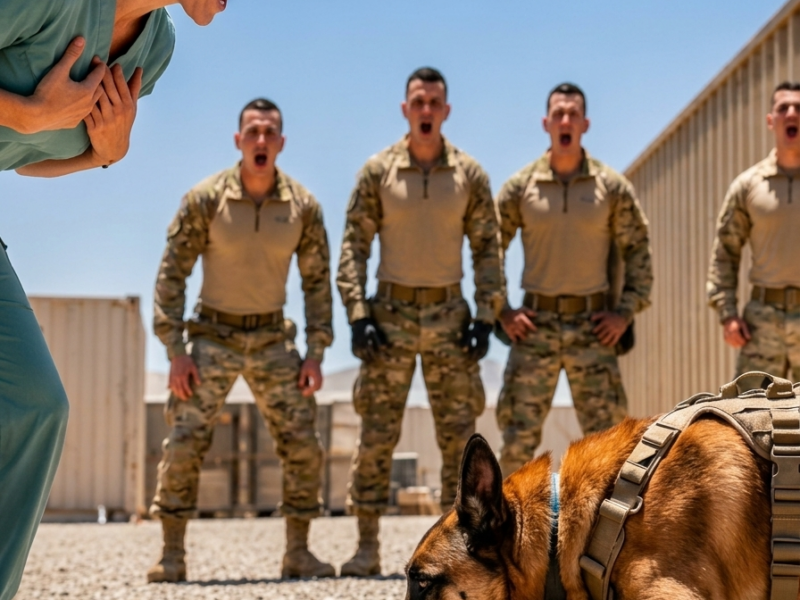
They had six armed handlers struggling to restrain a SEAL dog inside the hospital hallway when he suddenly stopped
The air in the long, sterile corridor of Harbor Point Naval Hospital was thick with tension, smelling sharply of antiseptic, cold sweat, and raw, panic-fueled aggression.
Six hulking military handlers, clad in reinforced tactical vests and heavy leather sleeves, were clinging desperately to three thick nylon leads attached to a single massive Belgian Malinois. The dog was a terrifying blur of dark fur, muscle, and bare teeth. He lunged wildly against the restraints, his claws screeching against the polished linoleum floor as he dragged three full-grown men two feet forward with every violent surge.
“Hold the line! Don’t let him near the main doors!” Commander Vance bellowed, his voice echoing off the tile walls. He stood ten feet back, his hand hovering nervously near his holstered sidearm.
I stepped out from the third-floor triage station, carrying a tray of fresh IV bags. I was wearing standard light-blue civilian nursing scrubs, my hair pinned back in a loose bun. To the doctors and senior staff who had worked alongside me for the past four months, I was just Clara—a quiet, soft-spoken rookie nurse who kept her head down, worked the double graveyard shifts, and never complained.
“Keep her away from him!” Commander Vance barked the moment his eyes caught mine. His face was flushed red with frustration.
I stopped in my tracks, balancing the plastic tray in my hands. “Why?”
“Because he’s a rogue K9 asset from a classified maritime strike team,” Vance snapped, keeping his eyes glued to the thrashing animal. “He attacked two handlers at the gate, knocked down a base security officer, and he’s been trying to tear through this wing since he was brought in twenty minutes ago. He’ll take your arm off before you can scream.”
I didn’t step back. Instead, I looked past the frantically struggling handlers and focused my eyes directly on the dog.
He was large for a Malinois, his coat a blend of charcoal black and pale silver-gray across his muzzle. Across his left shoulder, buried under his thick fur, was a jagged, hairless white scar that ran all the way down to his chest. On his tactical harness, a dull, scratched brass plate bore a single word engraved in bold military block letters: GHOST.
Ghost slammed his weight against the heavy steel safety barrier dividing the corridor. The metal groaned under the impact. The handlers braced their boots, swearing under their breath as they fought to keep their grip on the leads.
I expected him to bark. I expected him to let out the fierce, guttural roar that had terrified half the hospital staff into locking themselves in the breakrooms.
Instead, the moment my eyes locked onto his, Ghost went completely, terrifyingly still.
The thrashing stopped instantly. His ears, which had been pinned flat against his skull in a posture of violent rage, twitched forward. His chest heaved as he drew in deep, frantic gulps of air, smelling the space between us.
The three handlers stumbled backward, nearly losing their balance from the sudden, total release of tension on the lines.
I slowly lowered my tray onto a nearby supply cart. I didn’t make any sudden movements, nor did I lower my posture into a defensive stance. I took two slow steps forward, stepping directly into the open corridor space.
“Nurse, what are you doing? Get back!” Vance shouted, raising a hand to grab my shoulder.
“Don’t touch me, Commander,” I said softly, my voice cool, level, and entirely stripped of the gentle tone I used with my bedridden patients.
I raised my right hand slowly, extending my palm outward, thumb tucked inward, exposing the underside of my wrist.
“Ghost,” I said.
The dog began to tremble violently. A soft, high-pitched whine—a sound so full of agony, confusion, and overwhelming recognition that it sounded almost human—erupted from his throat.
Slowly, deliberately, Ghost lowered his massive head. He ignored the handlers, ignored the commander, and took three quiet steps forward, dragging the slack leashes behind him. He pressed his wet black nose directly into the cold wire mesh of the steel gate, right where my hand was resting.
The entire corridor went dead silent. The handlers stared at the scene with open mouths. Commander Vance froze, his hand suspended in mid-air.
Four months ago, I had applied for a civilian nursing license under my middle name, hiding behind a thick stack of standard medical certifications. Nobody at Harbor Point knew my history. To them, I was a twenty-six-year-old rookie.
Nobody knew that before nursing school, I had served six years as a Special Operations Combat Medic assigned to a Joint Special Operations Command task force. Nobody knew that Ghost wasn’t just a military working dog—he was my working dog.
And nobody knew that seven months ago, inside a crumbling, burning compound in the mountains of Helmand Province, I had strapped a tourniquet onto my own bleeding leg, loaded a two-hundred-pound wounded handler onto a stretcher, and physically carried a blast-shocked Ghost out through the flames while enemy fire rained down from the surrounding ridges.
The military medical board had deemed my shrapnel-damaged knee unfit for active deployment, handing me a quiet medical discharge. Ghost had been re-assigned to a new unit, separated from me before I even woke up in the recovery ward at Landstuhl. We were never supposed to see each other again.
I reached through the steel mesh and gently stroked the top of his skull, right between his ears. Ghost leaned his full body weight against the barrier, sighing deeply, his eyes closing under my touch.
“Stay,” I whispered, using the low, gutteral vocal cadence of our old tactical language.
He sat immediately, his posture dropping into a perfect, razor-sharp military parade rest.
One of the senior handlers, his face slick with sweat, stepped forward, his eyes darting between me and the docile animal. “How… how do you know that command? That’s a Tier-1 vocal trigger. He hasn’t listened to a single handler since his operator was brought in.”
I didn’t answer him. My eyes were fixed on Ghost.
Suddenly, Ghost’s head snapped to the left. His ears pinned back, and he let out a low, vibrating growl directed toward the double doors of the Intensive Care Unit at the far end of the hall.
Commander Vance frowned, stepping closer. “What is wrong with him now? What’s he smelling?”
I knew that posture. Ghost had been trained in advanced chemical scent detection and explosive hazard identification, but he had also been cross-trained in specialized bio-detection during our covert hostage-recovery operations. Ghost never reacted without a reason.
“Unlock the gate,” I commanded Vance.
“Nurse, you don’t have the authority—”
“Unlock the gate, Vance!” I snapped, turning my head to glare at him with an intensity that made the veteran officer step back half a pace. “Or watch him tear it down himself.”
Vance swallowed hard, pulled a keycard from his belt, and swiped the electronic lock. The heavy steel door clicked open.
Ghost didn’t bolt. He stepped through the frame, immediately taking up a heel position at my left hip, his shoulder pressed against my leg as if we were back on patrol in the dark alleys of Kabul.
He led me straight down the quiet hall of the ICU, stopping outside Room 304. He dropped low, scratching frantically at the bottom of the solid wooden door with his front paws, letting out urgent, stressed whines.
Through the observation glass, I saw a patient hooked up to a complex array of heart monitors, ventilators, and automated IV pumps. The chart on the door identified him as Lieutenant James Miller—a Navy SEAL who had supposedly suffered severe blast trauma during a routine training exercise off the coast three days ago.
I pushed the door open. Ghost slipped inside first, placing his front paws on the edge of the bed frame, his nose hovering inches above the unconscious soldier’s face.
I walked over to the bed, my medical training taking over. I looked down at the lieutenant’s pale, clammy skin. Then I caught sight of his right arm, resting outside the blanket.
Along the inside of his wrist was a faint, raised red mark—a distinct, localized chemical burn shaped like a thin ring.
My blood ran cold. It wasn’t a blast injury. It was the mark left by a high-pressure pneumatic transdermal injector—a weapon used in silent, covert assassinations to deliver fast-acting, untraceable neurotoxins that mimicked cardiac arrest. Ghost had been trained to detect the faint trace odor of those exact synthetic compounds.
“Who brought this man in?” I demanded, turning to Vance, who had followed me into the room with two handlers.
Before Vance could answer, the bedside heart monitor began to beep frantically. The green line on the screen spiked wildly before collapsing into a flat, continuous, high-pitched tone.
“Code Blue! He’s going into ventricular fibrillation!” Vance yelled, reaching for the wall alarm.
The door snapped open, and a female ICU nurse rushed into the room carrying a pre-filled syringe. Her face was hidden behind a surgical mask, her blue eyes darting nervously toward Ghost, who was growling furiously from the side of the bed.
“Out of the way! Emergency push!” she shouted, shoving a needle toward the patient’s primary IV line.
I caught her wrist mid-air.
“Stop!” I commanded, squeezing her arm with every ounce of strength I had.
“What are you doing? He’s dying!” she screamed, trying to pull away.
“That’s not atropine or epinephrine,” I said, eyeing the clear fluid inside the syringe, which had a faint, almost invisible yellow tint near the plunger. “That syringe isn’t marked with an pharmacy batch code. Who ordered this injection?”
The nurse’s eyes widened in sheer terror. She dropped the syringe onto the floor, turned on her heel, and bolted out of the room.
“Security! Stop her!” Vance roared into his radio, sprinting into the hallway after her as alarms began blaring down the corridor.
I turned back to the bed, grabbing a bag of sterile saline to flush the line, my mind racing as I tried to process the sheer scale of what was unfolding inside a military hospital.
Ghost had saved my life in Afghanistan. Now, he had recognized me because he needed me to stop an execution.
I reached down to check the patient’s carotid pulse. But before my fingers could touch his neck, Ghost suddenly turned on me.
He let out a fierce, terrifying growl, his teeth snapping shut inches from my hand, physically blocking me from touching the bed.
His dark amber eyes weren’t looking at the patient. They were fixed entirely on the doorway behind me.
I slowly turned around.
Standing in the shadow of the doorway, holding a silenced pistol aimed directly at my chest, was a man wearing the dark dress uniform of a Navy Captain.
A man I knew all too well. The former commander of my old JSOC task force—the man who had signed my medical discharge seven months ago.
“Hello, Clara,” Captain Sterling said quietly, his thumb pulling back the hammer of the gun. “You always had a habit of being in the wrong place at the wrong time.”
The quiet hum of the ICU equipment was swallowed by the sudden, suffocating silence inside Room 304.
Captain Sterling stood motionless in the doorway, his silhouette framed by the flickering fluorescent lights of the hallway. The suppressor attached to the barrel of his SIG Sauer P226 was black, cold, and pointed directly at the center of my chest. His medals gleamed against his navy-blue dress uniform, polished to a mirror shine—a terrifying contrast to the cold, calculating murderous intent in his eyes.
Beside my leg, Ghost’s body was strung tight as a piano wire. His chest rumbled with a growl so deep it vibrated through the floorboards into my boots. He didn’t lunge. He knew the threat of a firearm; he had been trained in close-quarters battle scenarios for four years. He stayed positioned precisely between the barrel of Sterling’s gun and my vital organs.
“Captain Sterling,” I said, keeping my voice utterly flat, forcing my heart rate down through sheer muscle memory. “I was told you were posted at the Pentagon.”
“I was, Clara,” Sterling said softly, taking one slow step into the room, his boots making no sound on the rubberized flooring. He reached back with his left hand and clicked the heavy door shut behind him, locking the electronic latch with a subtle press of his thumb. “Until Lieutenant Miller here decided to wake up from his coma and start asking questions about the missing munitions shipment in Kandahar.”
Everything connected in a single, sickening second.
The explosion seven months ago—the one that had trapped Miller under the rubble and ripped my leg open—hadn’t been an enemy mortar. It had been a controlled demolition designed to tie up loose ends. Sterling had been skimming black-budget military hardware, selling it off to private contractors, and wiping out anyone who caught wind of the paper trail.
Miller hadn’t survived a training accident. He had survived a hit job in Afghanistan, made it back to the States under military transport, and Sterling had come to Harbor Point to ensure he never spoke to the Inspector General.
“You used a transdermal neurotoxin,” I said, glancing down at the syringe shattering on the floor. “And when the nurse failed to finish him off, you came down here to clean up the mess yourself.”
Sterling smiled—a small, tired, hollow gesture. “I didn’t want to kill you, Clara. I really didn’t. I gave you an honorable medical discharge. I gave you a pension. I gave you a quiet life as a nurse where you could spend the rest of your days handing out bandages. You were supposed to stay in your lane.”
“And Ghost?” I asked, shifting my weight slightly to the left, angling my body so I could shield Ghost’s flank. “Where was he supposed to go?”
“Ghost was a asset that refused to adapt,” Sterling sneered, his eyes flicking briefly to the Malinois. “He attacked three handlers because he smelled the compound on Miller’s skin. He knew what happened in the compound that night. He was scheduled to be put down at Joint Base Andrews tomorrow morning. Commander Vance was just holding him here until the transport arrived.”
Ghost let out a sharp, ear-splitting bark, his front paws digging into the linoleum. He felt my tension; he smelled the adrenaline flooding my bloodstream.
“Drop the gun, Captain,” I said calmly. “Vance is already chasing your fake nurse down the hall. Security is on high alert. You shoot me, and this entire hospital locks down in thirty seconds.”
“Security is currently chasing a decoy through the basement level, Clara,” Sterling replied, his finger tightening slightly on the trigger. “And as for the alarms? The ICU wing is soundproofed for patient recovery. By the time anyone realizes what happened in this room, I’ll be back on a transport chopper to D.C., and you’ll just be another unfortunate victim of a rogue, unstable military dog.”
He raised his sight line, aiming directly between my eyes.
“Ghost, DOWN!” I suddenly screamed at the top of my lungs.
Ghost didn’t hesitate. The moment the vocal trigger left my mouth, the dog dropped his entire body flat against the floorboards, disappearing below the sight line of the bed frame.
In that exact fraction of a second, I lunged to the right, grabbing the heavy metal tray of stainless steel surgical instruments from the bedside cart and hurling it with all my strength directly at Sterling’s face.
CLANG!
The heavy tray struck Sterling across his jaw, shattering his nose and sending a spray of blood across his crisp white collar. His gun discharged with a muffled POOF sound, the bullet ripping through the drywall six inches above my head.
“ARES! ATTACK!” I roared, using Ghost’s original classified JSOC attack command—the name he had carried before the military tried to erase his record.
Ghost launched himself off the floor like a dark missile.
He cleared the distance between the bed and the door in a single, explosive leap. His eighty-pound frame slammed directly into Sterling’s chest, driving the officer backward against the heavy wooden door frame. Ghost’s jaws snapped shut around Sterling’s right forearm, locking down on the bone with crushing force.
Sterling screamed, a high-pitched, agonized sound, dropping the silenced pistol as he was slammed into the wall. He tried to reach for his tactical knife with his free hand, but Ghost twisted his weight violently, throwing the grown man onto the concrete floor like a ragdoll.
“RELEASE! GHOST, HOLD!” I yelled, stepping forward and kicking the dropped pistol far beneath the ICU bed frame.
Ghost instantly released his grip on Sterling’s arm, stepping back two paces, his teeth bared, his body coiled, standing directly over the bleeding captain with absolute, disciplined restraint.
Sterling lay on his back, gasping for air, clutching his mangled, bleeding forearm, his face pale with sheer horror as he stared up at the dog he had ordered to be executed.
I knelt beside Sterling, reaching into his dress jacket and pulling out his encrypted military smartphone and his security clearance pass.
“You’re right about one thing, Captain,” I said softly, staring down into his panicked eyes. “I was supposed to stay in my lane.”
I leaned closer, my voice dropping into a cold whisper. “But you forgot who trained this dog.”
Suddenly, the bedside heart monitor began chiming again. Miller’s chest heaved violently as he gasped for air, his eyes fluttering open for the first time in three days.
I didn’t waste another second. I grabbed the encrypted phone, turned to Ghost, and whistled a single sharp note.
“Heel, Ghost,” I commanded. “We’re leaving.”
We slipped out through the ICU’s rear service exit before the base security team could clear the basement decoy.
The rain was falling heavily across the harbor, a thick grey fog rolling off the dark Atlantic waters and blanketing the naval base in cold mist. The scent of salt water, wet asphalt, and jet fuel hung heavy in the air as Ghost and I moved through the shadows of the maintenance docks behind the hospital.
Ghost moved beside me like a phantom, his silver-black coat blending seamlessly with the dark rain. He stayed flush against my left knee, his eyes constantly scanning the shadows, his ears rotating toward every distant siren echoing across the base.
I pulled off my blood-stained nurse’s smock, throwing it into a recycling dumpster, revealing the black thermal long-sleeve shirt I wore underneath. I pulled my hair down from its bun, letting it fall loosely around my face to break up my silhouette.
We reached an abandoned wooden boathouse at the far edge of Pier 4—a location I had scouted three months ago when I first realized my military pension was being routed through a suspicious private holding firm in D.C.
I jimmied the lock with a thin surgical tool from my pocket, sliding inside the dark, dry shelter. Ghost trotted in behind me, immediately executing a thirty-six-degree perimeter sweep of the empty room before settling into a crouch near the door, his dark eyes fixed on the entrance.
“Good boy,” I whispered, kneeling beside him in the dark.
I pulled out Sterling’s encrypted military smartphone. The screen was locked with a bio-metric thumbprint requirement and a twelve-digit tactical passcode.
I didn’t need the passcode. I pulled off Sterling’s security pass, which contained a hidden high-frequency RFID microchip embedded along the plastic edge. I tapped the chip against the back of the phone three times in rapid succession—a emergency override sequence used by JSOC field commanders.
The screen flashed bright green: OVERRIDE ACCEPTED. WELCOME, CAPTAIN STERLING.
My fingers flew across the glass screen, accessing the phone’s encrypted local storage directory.
What I found made my blood run cold.
It wasn’t just a few missing crates of small arms. It was a massive, multi-billion-dollar international logistics network operating out of Naval Station Norfolk and Harbor Point. Sterling had been using military transport planes to move advanced shoulder-fired anti-air missiles, night-vision optics, and classified drone guidance systems out of active war zones, selling them directly to a high-end private security contractor called Aegis Defense.
And there, buried deep inside a folder labeled PROJECT ECLIPSE, was the personnel file for my old unit.
My breath caught in my throat.
The document listed the Kandahar compound explosion from seven months ago. Across the top of the page was a bold red stamp: TERMINATION SANCTION APPROVED.
It hadn’t been an accident. Sterling had personally ordered the strike on our compound after Lieutenant Miller discovered a discrepancy in the inventory manifests. And when I had dragged Miller and Ghost out of the burning rubble, surviving the blast, Sterling had placed my name on a secondary watch list, waiting to see if I knew what Miller had found.
My medical discharge hadn’t been a mercy. It had been a holding pattern.
“He was waiting for Miller to die,” I murmured to the dark room. “He kept me in the hospital system so he could watch me.”
Ghost let out a soft whine, stepping closer and resting his heavy chin on my knee. His warm breath brushed against my hand, comforting, steady, solid.
Suddenly, the smartphone vibrated violently in my grip. An incoming call illuminated the screen.
The caller ID displayed a name that sent a fresh wave of adrenaline surging through my veins: ADMIRAL H. VANCE – JOINT CHIEFS OF STAFF.
I hesitated for two seconds, my thumb hovering over the screen. Then I swiped the bar and put the phone to my ear, keeping my voice completely silent.
“Sterling, talk to me,” a deep, authoritative voice demanded through the speaker. “Base security reports a breach at Harbor Point Hospital. They’re saying a civilian nurse knocked out a security team and fled with a rogue K9 asset. What the hell is going on down there?”
I took a quiet breath, my voice echoing low and clear through the empty boathouse.
“Admiral Vance,” I said. “This isn’t Captain Sterling.”
A long, heavy silence stretched across the line.
“Who is this?” the Admiral asked, his voice dropping into a dangerous, icy register. “How do you have this phone?”
“My name is Clara Mercer,” I replied, staring out the cracked boathouse window at the flashing blue lights sweeping the main hospital complex half a mile away. “Former Staff Sergeant, JSOC Combat Medic, Service Number 884-01-Niner. Seven months ago, my team was blown up in Helmand Province on Captain Sterling’s orders.”
“Mercer…” Vance murmured, papers rustling on his end of the line. “You were medically discharged. The reports say you were suffering from severe combat trauma and memory loss.”
“The reports were written by a traitor, Admiral,” I said, my voice hardening like steel. “I am currently standing in Pier 4 with the encrypted drive from Sterling’s phone. It contains the complete ledger of the Aegis Defense weapons smuggling ring, the authorization orders for the Kandahar strike, and the forensic evidence of tonight’s attempt on Lieutenant Miller’s life.”
“Where is Sterling now?” Vance demanded.
“He’s currently lying on the floor of ICU Room 304 with a crushed arm,” I said flatly. “Courtesy of the K9 asset he tried to have executed.”
Vance let out a heavy sigh through the receiver. “Clara, listen to me very carefully. If what you’re saying is true, you are in extreme danger. Sterling’s partners in Aegis Defense aren’t just military officers. They have tactical teams deployed in Norfolk right now. They monitor the base communications grid. The moment Sterling’s phone logged onto that tower, they pinpointed your location.”
Before Vance could finish his sentence, Ghost’s ears snapped back. He stood up in a single fluid motion, his neck fur bristling straight up, a guttural growl rumbling from the depths of his chest.
Through the rain-slicked window of the boathouse, I saw four dark, unlit tactical SUVs pull onto the wooden planks of Pier 4, blocking the only road leading back to the base gates.
Heavy doors opened simultaneously. Eight men dressed in dark, unmarked tactical gear stepped out into the pouring rain, carrying short-barreled automatic rifles equipped with silencers and thermal optics.
“Admiral,” I whispered into the phone, snapping the device shut. “They’re already here.”
The dark tactical teams moved across the wet wooden planks of Pier 4 with practiced, lethal precision.
Their thermal optics cast faint red glows against their night-vision goggles as they fanned out into a wide assault wedge, cutting off every landward exit from the boathouse. They didn’t shout commands; they didn’t flash spotlights. These were professional mercenaries sent to eliminate a target and retrieve an encrypted device without leaving a single trace.
Inside the dark boathouse, I crouched low behind a stack of rotting cedar storage crates. Ghost was pressed flush against my right side, his body completely motionlessness, his breathing silent, his amber eyes tracking the shadows moving outside the cracked wooden walls.
“Eight targets,” I whispered in his ear, my voice barely a breath. “Heavy armor. Thermal gear.”
Ghost didn’t make a sound. He understood the tactical reality of the situation. Against eight heavily armed operatives with thermal vision, a direct firefight inside a wooden building was a death sentence. We needed to eliminate their tactical advantage—we needed to turn the darkness and the water into our weapons.
I reached down to my belt, pulling out a heavy, brass flare gun I had salvaged from the boathouse emergency locker. I loaded a high-intensity marine magnesium flare into the chamber.
“Ghost,” I murmured, holding my finger up before his nose. “Distraction tactic. Left flank. On my mark.”
He gave a single, firm nod of his head, his tail giving one sharp thump against the floorboards.
Outside, the lead contractor raised three fingers, signaling his team to breach the wooden front doors. Two operatives stepped forward, raising heavy breaching shotguns aimed at the hinges.
“NOW!” I screamed.
I aimed the flare gun at the dry wooden rafters directly above the doorway and pulled the trigger.
THUMP!
A blinding, four-thousand-degree white magnesium flare erupted inside the small room, instantly igniting the dry timber ceiling and flooding the boathouse with an overwhelming wall of brilliant white light and immense heat.
To men wearing night-vision goggles and thermal optics, the sudden explosion of intense heat and light was agonizingly whiteout blinding.
Outside, two operatives screamed in pain, tearing their night-vision units off their helmets as their vision was completely burned out by the white light glare.
“GO! GHOST, SWEEP!” I commanded.
Ghost burst through the side window frame like a shadow made manifest, shattering the glass and wood in a single leap.
He hit the first blinded contractor mid-stride, eighty pounds of force slamming into the man’s chest and sending him flying off the wooden pier into the churning, icy black waters of the harbor below. Without stopping, Ghost pivoted on his rear legs, lunging at the second operative, his jaws locking onto the man’s weapon arm and dragging him to his knees on the wet planks.
I kicked open the side access door, holding a heavy iron boat hook in my hands. I stepped into the blinding light and smoke, swinging the iron bar with all my weight, striking the third contractor across his tactical helmet, dropping him cold onto the decking.
“Fire! Open fire on the dock!” the mercenary team leader shouted, his voice hoarse as he pulled his sidearm and aimed through the smoke at my silhouette.
BANG! BANG!
A bullet grazed my shoulder, tearing through my thermal shirt and burning a hot line of pain across my skin. The impact threw me off balance, my boot slipping on the wet, rain-slicked wood of the pier.
I hit the deck hard, dropping the iron hook, the encrypted phone sliding across the planks toward the edge of the pier.
The lead contractor stepped over his groaning operative, his boots heavy against the wood. He raised his tactical rifle, pointing the barrel directly at my head as I struggled to sit up in the pouring rain.
“End of the line, Nurse,” he sneered, his finger tightening on the trigger.
A silver-and-black shadow flew through the blinding white smoke of the burning boathouse.
Ghost didn’t attack the gun arm. He leaped from a raised cargo crate ten feet away, launching himself directly into the lead contractor’s face.
The weight of the strike knocked the man backward over the wooden safety railing. The contractor shrieked as he tumbled through the air, plunging twenty feet down into the dark, freezing ocean below, taking his rifle with him.
Ghost landed cleanly on the edge of the wooden pier, his wet fur slick with rain, his heavy chest heaving as he turned back to look at me.
I pulled myself up from the deck, clutching my bleeding shoulder, gasping for breath.
“Good boy,” I choked out, reaching down to grab the encrypted phone from the edge of the wood. “Good boy, Ghost…”
Suddenly, the roar of heavy military helicopter blades cut through the storm overhead.
Two massive MH-60 Black Hawk helicopters burst through the grey clouds above Pier 4, their powerful searchlights cutting through the rain and illuminating the entire dock in blinding white light.
Fast-ropes dropped from the open side doors of the choppers, and within seconds, a dozen heavily armed Navy SEALs in full tactical gear slid down to the wooden planks, their weapons instantly covering the surviving, disarmed mercenaries.
A senior officer stepped off the lead helicopter, rushing across the wet pier toward me, surrounded by an armed escort.
It was Admiral Vance.
He took in the scene in a single glance: the burning boathouse, the defeated mercenaries, the bleeding nurse sitting on the wet wood, and the massive Malinois standing fiercely beside her, guarding her body from any potential threat.
Admiral Vance knelt down in the rain, looking at me with a mixture of profound respect and solemn apology.
“Staff Sergeant Mercer,” the Admiral said, his voice carrying over the roar of the helicopter engines. “I believe we owe you—and your dog—an apology.”
I looked up at him, my arm wrapped tightly around Ghost’s thick, warm neck, my face pressed into his wet fur.
“He’s not just a dog, Admiral,” I whispered, feeling Ghost’s warm tongue touch my bruised cheek. “He’s my squad.”
The warm autumn sun streamed through the high arched windows of the Pentagon’s main briefing auditorium, casting long, golden geometric shadows across the polished oak floorboards.
The room was packed to absolute capacity. Hundreds of uniformed military personnel—ranging from young Navy lieutenants to four-star generals—sat in silent, respectful attendance. Along the front row sat Lieutenant James Miller, fully recovered from his ordeal, looking strong and healthy in his crisp Navy dress whites.
Beside him sat Captain Sterling and three senior executives from Aegis Defense—all four of them wearing dark suit jacket prison jumpsuits, handcuffed at their wrists, flanked by armed federal marshals. The trial had lasted less than three weeks; the irrefutable evidence recovered from Sterling’s phone had exposed the entire international trafficking ring, resulting in forty-two arrests across three military branches.
I stood at the center of the raised mahogany stage, wearing a brand-new, tailored dress uniform bearing the raised golden stripes of a Chief Master Sergeant, alongside the Distinguished Service Cross medal pinned over my left breast pocket.
Beside me, sitting at absolute, flawless military parade rest, was Ghost.
His dark silver-black coat shone like silk under the auditorium lights. Around his thick neck hung a solid bronze medal suspended from a blue-and-gold ribbon—the Military Working Dog Medal of Bravery, the highest honor awarded to a canine asset in the United States Armed Forces.
Admiral Vance stepped up to the podium, adjusting his microphone as he turned to face the audience.
“Seven months ago,” Vance began, his voice echoing clearly through the massive hall, “a classified unit was betrayed in the line of duty. They were written off as casualties of war. Their records were altered, their honor questioned, and their legacy buried under a mountain of military bureaucracy and corruption.”
Vance turned his head, looking directly at me, his eyes full of deep, genuine pride.
“But those who sought to destroy them forgot a fundamental truth about our armed forces,” Vance continued. “They forgot that true loyalty cannot be erased by a paper trail. They forgot that a real soldier never leaves a comrade behind. And they forgot that the bond between a combat handler and her working dog is stronger than any army.”
The Admiral gestured toward the side of the stage.
“By order of the Secretary of the Navy and the Joint Chiefs of Staff, Chief Master Sergeant Clara Mercer is hereby fully reinstated to active duty with full back pay, rank restoration, and command authority over the newly formed Special Operations Canine Rescue Division.”
The auditorium erupted into a thunderous wave of applause. Hundreds of officers stood up from their seats, giving a standing ovation that shook the wooden rafters of the hall.
Vance turned back to the podium, smiling slightly as he looked down at the dog.
“And by special presidential decree,” Vance added, his voice rising over the applause, “Military Working Dog Asset ‘Ghost’ is hereby officially retired from active combat service, granted full medical benefits for life, and transferred into the permanent, legal custody of Chief Master Sergeant Mercer.”
Ghost’s ears twitched at the sound of my name. He didn’t bark, nor did he break his flawless posture, but his thick tail gave three distinct, happy thumps against the polished stage floor.
I looked down at him, my eyes burning with hot, happy tears that I no longer cared to fight. I reached down, my fingers sinking into his soft fur right behind his ears, where his brand-new bronze medal rested against his chest.
“You heard the Admiral, Ghost,” I whispered softly, using our private, quiet tone. “We’re going home.”
Ghost looked up at me, his deep amber eyes shining with absolute, unconditional love, trust, and peace.
He gave a soft, quiet huff of air, rested his heavy snout gently against the side of my polished dress boots, and sat beside me—no longer a condemned asset, no longer a rogue weapon in a cold hospital hallway, but a hero who had finally brought his handler all the way back from the dark.
The end









