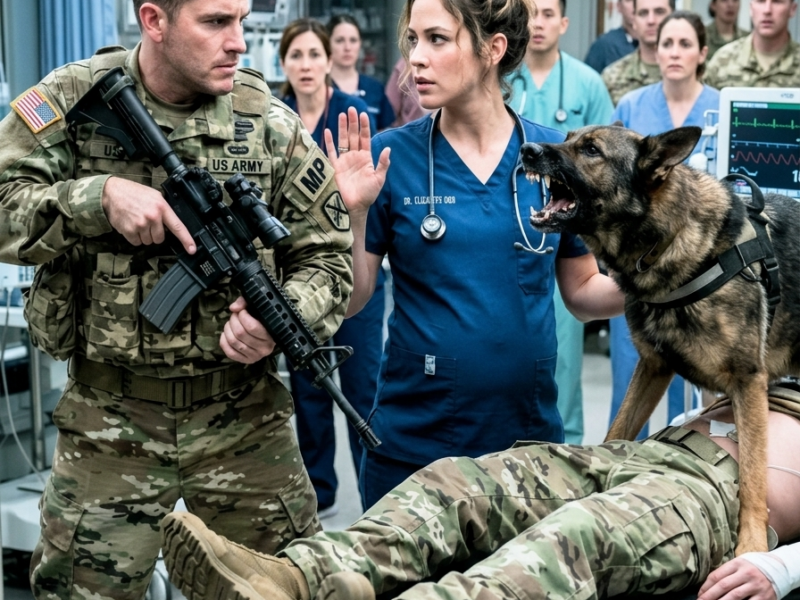
They had already strapped the K9 to a steel table at the county shelter when his handler called him a danger and ordered the needle prepared
The heavy deadbolt clicked into place with a sound that vibrated straight through the soles of my shoes. In the small, sterile room of the county shelter clinic, the silence that followed was suffocating. The air smelled sharply of cold stainless steel, bleach, and fear.
Officer Miller stood with his back against the heavy metal exit door, his hand resting heavy and deliberately on his utility belt. The polished leather of his holster creaked under the weight of his posture. His face, which had been pale just moments ago, was now hard, rigid, and drained of any human warmth.
On the table beside me, Rex stood up. The massive German Shepherd’s body was no longer trembling. The terrified, submissive posture that had made him look like a broken stray disappeared, replaced by a deep, resonant growl that vibrated in his chest. His amber eyes were locked onto Miller, unblinking, full of a fierce, protective recognition.
My heart pounded against my ribs like a trapped bird. On the other end of the phone, the child’s mother was still breathing, her voice a ragged whisper coming through the tiny speaker.
“Listen to me,” she sobbed, unaware of the door locking. “The fire wasn’t an accident. My son told me what happened before they took him to the ICU. He said the officer—the one who called it in—he was the one who set the fire in the garage. Rex was trying to pull my boy away, but Miller tried to stop him. Rex bit him to save my son’s life!”
The pieces of the nightmare slammed together with horrifying clarity. The altered intake report, the missing body-camera footage, the erased history, and the desperate, rushed order for execution. Rex wasn’t a rogue K9 who had turned on an innocent child. He was the only living witness to a crime committed by a man carrying a badge.
I slowly lowered the phone, my fingers trembling so violently I almost dropped it onto the concrete floor. “Miller,” I said, trying to keep my voice from cracking. “What did you do?”
Miller didn’t answer right away. He took a single step forward, his heavy tactical boots squeaking on the freshly mopped tile. “You shouldn’t have dug into those old archives, Sarah,” he said, his voice flat, devoid of emotion. “You’re just a shelter nurse. You were supposed to prep the tray, hand the vet the syringe, and go home.”
“He saved that boy,” I said, stepping between Miller and the steel examination table, though every instinct in my body screamed at me to run. “You set that fire. You brought him here to be put down because you knew if he lived, someone would check his teeth, someone would match the bite marks on your arm, someone would ask why a retired police dog was at a arson scene!”
Miller let out a short, humorless laugh. “A dog’s testimony doesn’t hold up in court, Sarah. But a dead dog doesn’t bark at all. And an overly nosey shelter worker who suffered a tragic accident during a violent canine attack? Well, people would believe that in a heartbeat.”
He reached for his belt. Not for his gun, but for the heavy metal flashlight attached to his hip. He unhooked it, his grip tightening around the solid aluminum casing.
Rex let out a furious bark, a sound so loud it bounced off the tile walls like a gunshot. He lunged forward, jumping off the stainless steel table and landing heavily between me and Miller. His fur was bristled straight up, his lips curled back over gleaming white teeth.
“Back off, Rex!” Miller growled, raising the flashlight.
“Rex, hold!” I shouted, using the command I had seen in old training manuals, hoping against hope he would remember his original training.
Rex didn’t retreat, but he didn’t attack blindly either. He placed himself firmly in front of me, his body acting as a living shield. Miller took another step, his eyes darting toward the counter where the prepped euthanasia needles lay in a tray, filled with lethal doses of pentobarbital.
“You’re not leaving this room with that dog,” Miller said quietly. “Nobody is going to check those files. Nobody is going to care about a stray K9.”
“He’s not a stray,” I blurted out, my mind racing as I tried to buy time. My hand secretly slid into my pocket, desperately feeling for the panic button on my shelter radio. “I saw his tag. I know who he belongs to.”
Miller paused, his eyes narrowing slightly. “That tag is ten years old. It doesn’t mean anything.”
“It means everything,” I lied, pretending I knew more than I did, while my thumb finally found the emergency button on the side of the radio and pressed down hard. “It has six numbers and the word MERCY. I already ran the sequence through the federal registry before you walked back in.”
It was a complete gamble, a desperate bluff born out of sheer terror. But the moment the word MERCY left my mouth, Miller’s composure shattered completely. The color drained from his face once more, replaced by a look of sheer panic.
“You’re lying,” he whispered, his knuckles turning white around the flashlight.
“Try me,” I said, holding my ground, feeling the vibration of Rex’s low growl against my shins.
Suddenly, the red emergency light above the clinic door began to flash, accompanied by a high-pitched siren echoing down the hallway. The panic button had worked.
Miller swore loudly, looking toward the hallway window. He knew he had only seconds before the night staff and security guards arrived. His eyes snapped back to me, filled with malice. He raised the heavy flashlight and stepped forward to swing.
Rex didn’t wait for a command. With explosive power, the massive German Shepherd launched himself off the floor, his jaws snapping shut on Miller’s forearm just as the metal door was slammed open from the outside.
The clinic exploded into chaos.
Shouts echoed through the hallway as two night-shift shelter workers and a private security guard burst through the door, their eyes wide with shock. Miller was screaming, trying frantically to beat Rex off him with his free arm, but the dog held his grip with absolute precision, pinning the officer against the wall without tearing wild flesh—a textbook K9 apprehension maneuver.
“Get him off me! Shoot him! He’s crazy!” Miller shrieked, his voice cracking with pain and rage.
“Rex, OUT!” I screamed at the top of my lungs, using the standard release command.
Instantly, Rex released his hold, stepping back and dropping into a guarded stance right beside my boots. He was breathing heavily, his chest heaving, but his discipline was flawless. He didn’t chase, he didn’t maul. He stood as a guardian.
The security guard looked from Miller, who was clutching his bleeding arm, to me, standing pale and trembling in my blue scrubs.
“What the hell is going on here?” the guard demanded, drawing his taser.
“He tried to kill the dog to cover up a crime,” I gasped, pointing at Miller. “He tampered with shelter records! Call the state police. Do not let him leave!”
“She’s out of her mind!” Miller spat, holding his forearm where blood was soaking through his uniform sleeve. “The dog attacked me! Look at me! He’s dangerous, he needs to be destroyed immediately!”
“Check his arm!” I shouted back, stepping forward. “That’s an old bite mark next to the new one! He was bitten at the scene of the garage fire this morning! He altered the intake report to make it look like Rex attacked a kid, but Rex was saving him!”
The shelter workers looked between us, confused and horrified. One of them, a veteran technician named Marcus, looked down at Rex. Rex was completely motionless now, looking up at me with calm, intelligent eyes, waiting for his next command. A dangerous, unhinged animal didn’t calm down instantly upon command. Marcus knew dogs. He looked up at Miller with growing suspicion.
“Miller,” Marcus said slowly, his voice dropping an octave. “Where is the original intake sheet? I logged that dog in myself at 4:00 PM, and I noted he had structural debris and ash on his coat. When I came back from lunch, the sheet was swapped for an aggression report.”
Miller’s eyes darted toward the exit. He knew the room was turning against him. “You’re all insane,” he muttered, backing toward the hallway. “I’m going to my cruiser to get my medical kit.”
“Don’t let him leave!” I cried.
Miller turned and ran down the corridor. The security guard hesitated for a second before chasing after him, shouting into his radio.
I didn’t wait to see if they caught him. I knew how deep corruption could run, and if Miller had partners on the force, Rex and I were in immediate danger. I reached down, grabbing Rex’s heavy tactical collar.
“Marcus, give me the keys to the transport van,” I demanded, my voice leaving no room for argument.
“Sarah, you can’t just take a shelter animal—”
“He’s going to kill him, Marcus!” I yelled, tears finally breaking through my composure. “He’s going to bring back officers who will shoot this dog in his cage and call it self-defense! Please!”
Marcus looked at me, then down at Rex, who gently licked my trembling hand. Marcus reached into his pocket, pulled out a ring of heavy brass keys, and pressed them into my palm. “Take the side exit through the loading dock. The van is parked near the dumpster. Go.”
“Thank you,” I sobbed.
I didn’t waste another second. “Rex, heel!” I commanded.
The dog fell into step beside me instantly, his shoulder pressed against my leg as we sprinted down the dimly lit back corridor of the shelter. We burst through the heavy crash doors of the loading dock into the crisp night air. The smell of exhaust, damp earth, and rain filled my lungs.
I unlocked the shelter’s white utility van, slid the side door open, and Rex leaped inside without hesitation, making himself small on the floorboards. I jumped into the driver’s seat, jammed the key into the ignition, and slammed my foot on the gas just as blue and red police lights began flashing at the front gate of the shelter compound.
I drove out through the rear service exit, turning off the van’s headlights until we were two blocks away, disappearing into the dark, rain-slicked streets of the county.
My hands were shaking so hard on the steering wheel that the van drifted slightly in the lane. In the rearview mirror, I could see Rex lying down in the back, his head resting on his paws, his bright eyes staring back at me through the mirror.
I pulled over under the dim yellow light of an abandoned gas station two miles away. The rain was starting to beat heavily against the windshield. I put the van in park, turned around in my seat, and looked at the dog.
“Who are you, Rex?” I whispered.
I reached out and gently reached under his thick fur, pulling out the battered steel tag attached to his collar. Under the dim overhead cabin light, I looked closer at the six numbers stamped above the word MERCY.
0 9 1 4 2 1
It wasn’t a registration number. It wasn’t a phone number or a badge code.
It was a date. September 14, 2021.
I pulled out my smartphone, my heart hammering a chaotic rhythm against my chest. I opened a browser and typed the date alongside the word that had rattled Miller to his core: September 14, 2021 Mercy.
The search engine loaded agonizingly slowly under the weak cellular connection. Finally, a series of news articles popped up on the screen, accompanied by archived photographs.
My breath caught in my throat.
The headline read: “MYSTERY SURROUNDS FATAL SHOOTING OF FEDERAL AGENT IN MERCY COUNTY; K9 UNIT MISSING.”
I scrolled rapidly down the article. Five years ago, an undercover DEA agent named Marcus Vance had been murdered in an abandoned warehouse on the outskirts of Mercy County. He had been investigating a massive drug ring that was suspected of involving high-ranking local law enforcement officers. Agent Vance’s body had been found, but his assigned K9 partner—a highly trained tactical Belgian Malinois-German Shepherd cross named ‘Ares’—had vanished from the scene, along with Vance’s encrypted laptop containing the names of the corrupt officers.
The article included a photo of Agent Vance. He was a tall man with kind eyes, standing beside a younger, fiercely alert Rex, who was wearing a full tactical vest.
Rex wasn’t a local police dog. He was a federal asset. And his real name wasn’t Rex. It was Ares.
Suddenly, a soft whine came from the back of the van. I turned around. Ares had stood up and was leaning his heavy head over the front seat, staring intently at the screen of my illuminated phone. His ears were perked forward, his nostrils flaring as if he could somehow smell the image of his long-lost handler.
“You were there,” I whispered, reaching up to touch his soft muzzle. “You saw who killed him.”
Ares let out a low, mournful sigh and rested his forehead against my shoulder. The weight of his grief was palpable. For five years, this dog had been living in the shadows, surviving on the streets or being passed through rural shelters, carrying the memory of a tragedy that no one else understood.
And then Miller had crossed his path again.
Miller hadn’t just been the officer at the garage fire today. Miller was part of the ring that killed Agent Vance five years ago. When Miller saw Ares at the garage fire, he must have recognized the dog—or recognized the threat the dog posed if anyone connected him back to the Vance homicide.
Suddenly, my phone buzzed violently in my hand, making me jump. It was an incoming call from an unknown number.
I hesitated, my thumb hovering over the decline button. But something told me I needed to answer. I swiped the screen and put it to my ear, keeping my voice quiet.
“Hello?”
“Sarah, don’t hang up,” a frantic female voice came through the line. It was the child’s mother from the shelter. “You need to get out of the county right now.”
“Where are you?” I asked, gripping the phone tightly. “Are you and your son safe?”
“We’re at the regional hospital, but there are deputies outside our door,” she said, her voice shaking violently. “Miller isn’t acting alone. He called his captain. They’re putting out an emergency broadcast for the van. They’re claiming you stole a dangerous, rabid animal and that you’re mentally unstable. If they find you, Sarah, they won’t try to arrest you. They’re going to shoot to kill.”
A chill ran down my spine. “How did you get this number?”
“I called the shelter front desk before the blackout happened. Marcus gave it to me,” she whispered. “Listen to me, Sarah. My son told me something else before they medicated him for the pain. He said when the dog dragged him out of the burning garage, the dog wasn’t just pulling him out… he was digging something up from under the floorboards of the old shed out back. My son saw the dog hide something in the woods behind our property before Miller arrived.”
My eyes snapped to Ares. The dog was watching me intently, his dark eyes filled with startling comprehension.
“What did he hide?” I asked, my voice barely a whisper.
“A heavy metal box,” she said. “My son said it had a yellow federal seal on it. Agent Vance’s laptop.”
The final piece of the puzzle fell into place. Ares hadn’t been living aimlessly for five years. He had been guarding the evidence. He had stashed his handler’s laptop in that old garage years ago, and when the corrupt officers discovered the stash site and set the fire to destroy it, Ares had returned to protect the evidence and save the innocent boy caught in the crossfire.
“Thank you,” I said to the mother. “Stay safe. I’m going to finish this.”
“Sarah, wait—!”
I hung up the phone. I looked into the rearview mirror. In the distance, down the dark highway behind us, I saw the distinct red and blue flashes of multiple police cruisers sweeping the area. They were closing in.
I looked back at Ares. “Alright, Ares,” I said, putting my hand on his head. “Show me where you hid it.”
The rain was falling in relentless torrents by the time we reached the perimeter of the farm property where the garage fire had occurred earlier that day. The scent of charred wood and wet ash hung heavy in the night air, mixing with the muddy smell of the woods.
I parked the shelter van deep inside a thicket of pine trees half a mile away, killing the engine and lights. The forest was pitch black, illuminated only by the occasional flash of lightning across the storm-ravaged sky.
“Stay close,” I whispered, sliding open the van door.
Ares slipped out silently, his padded feet making almost no sound in the wet mud. Unlike his timid demeanor at the shelter, he was now moving with absolute tactical precision. His body was low, his tail straight, his ears sweeping back and forth to catch any sound over the roar of the rain.
We crept through the dense woods toward the back of the burnt-out property. Through the trees, I could see yellow police tape fluttering wildly in the wind around the blackened skeleton of the destroyed garage. A single sheriff’s cruiser was parked near the driveway, its floodlights illuminating the ruins. A deputy sat inside the idling car, staring at his phone, completely oblivious to our presence in the treeline.
Ares nudged my hand with his nose, then began moving purposefully toward a massive, lightning-struck oak tree about fifty yards behind the burned structure.
I followed him on my hands and knees, sliding through the cold mud, my scrubs soaking wet and ruined. The cold rain stung my face, but adrenaline kept the numbness away.
When we reached the base of the oak tree, Ares stopped. He began scratching urgently at a deep hollow nestled between two massive, moss-covered roots. He dug with methodical speed, flinging damp earth and wet leaves behind him.
After less than a minute, his teeth caught on something metallic. He pulled back, letting out a soft huff of air.
I reached into the muddy hole and felt the hard, cold edge of a heavy waterproof case. I hauled it out into the open. It was a pelican case, covered in grime and dirt, sealed with heavy plastic latches. On the top lid was a faded stencil: PROPERTY OF U.S. DEPARTMENT OF JUSTICE.
My heart leaped into my throat. We had it. The evidence that could clear Ares, expose the arson, and bring justice for Agent Vance.
“Good boy, Ares,” I breathed, wrapping my arms around his neck and pressing my face into his wet fur. “Good boy.”
Suddenly, the blinding beam of a high-powered tactical flashlight slammed onto us, cutting through the darkness like a blade.
“Don’t move! Freeze!” a harsh voice screamed over the sound of the rain.
I gasped, blocking my eyes against the blinding light. Heavy footsteps splashed rapidly through the mud toward us.
It was Miller. He had stepped out from behind the trunk of a neighboring tree, his face slick with rainwater, his left arm wrapped tightly in heavy white gauze. In his right hand, he held his service pistol, aimed directly at my chest.
Behind him, two other uniformed officers emerged from the shadows, their weapons raised as well.
“I knew you’d come here,” Miller sneered, his voice laced with venomous triumph. “I knew that damn dog would lead you right to it if you got scared enough. Thanks for digging it up for us, Sarah. Saved us hours of searching through this filthy swamp.”
I stood up slowly, keeping my hands raised, standing right in front of the metal case. Ares dropped into a low, terrifying crouch beside my legs, his lips peeling back, a guttural growl roaring from his chest that sounded like thunder itself.
“It’s over, Miller,” I said, my voice surprisingly steady despite the gun pointed at my heart. “The child’s mother already spoke to the state authorities. They know about the fire. They know about Vance.”
Miller laughed, a cold, unhinged sound that sent shivers down my spine. “The state police? They don’t know anything yet. And by the time they sort through the wreckage here tomorrow morning, they’ll just find a dead fugitive shelter worker and her killer dog, killed in a tragic shootout with local law enforcement.”
He raised his pistol, aligning the sights with the center of my forehead. “Drop to your knees, Sarah.”
I looked down at Ares. His muscles were coiled like steel springs, ready to sacrifice his life for mine just as he had done for his handler five years ago. I couldn’t let him die. Not like this. Not for me.
“Ares, run,” I whispered quietly.
The dog didn’t move an inch. He shifted his weight, preparing to spring directly into the line of fire.
“I said drop to your knees!” Miller roared, stepping closer, his finger tightening on the trigger.
A blinding flash of lightning split the night sky, followed instantly by a deafening crack of thunder that shook the ground beneath our feet.
In that split second of total illumination, Ares launched himself forward.
He didn’t leap at Miller’s gun arm this time. He leaped with the full force of his eighty-pound body directly into Miller’s chest, knocking the officer backward into the thick, slippery mud. The gun fired wildly into the air, the loud BANG lost in the roar of the thunder.
“Shoot it! Shoot the dog!” Miller screamed as he hit the ground, struggling against the furious mass of fur and fangs pinning him down.
The second officer raised his weapon to shoot Ares, but I didn’t think. I threw myself forward with all my weight, slamming into the officer’s knees. We both went crashing into the mud. The gun flew from his hand, sliding away into the dark underbrush.
The third deputy, panicked by the sudden chaos and the darkness, fumbled with his sidearm, screaming commands that no one could hear over the storm.
Ares wasn’t killing Miller. With surgical, tactical precision, he had pinned Miller’s good arm under his heavy paws while his jaws clamped firmly down on the officer’s tactical vest, holding him completely immobile against the earth.
“Get him off me! Get him off!” Miller shrieked, his tough facade completely shattered into pathetic terror.
Suddenly, the dark woods were illuminated by dozens of blinding white spotlights. The thudding roar of heavy helicopter blades cut through the storm overhead, beating the treetops into a frenzy and sending rain swirling in wild spirals.
Sirens—dozens of them, distinct, high-pitched federal sirens—erupted from the road, blocking off every exit from the property.
Over a megaphoned loudspeaker, a booming voice echoed across the woods:
“THIS IS THE FEDERAL BUREAU OF INVESTIGATION AND THE STATE POLICE! ALL OFFICERS DROP YOUR WEAPONS IMMEDIATELY! STAND DOWN! I REPEAT, STAND DOWN!”
Tactical officers in dark green vests bearing FBI in bold white letters poured out of the treeline, their assault rifles trained on Miller’s accomplices. Within seconds, the two corrupt deputies were slammed onto the hoods of their cruisers and handcuffed.
A senior agent with graying hair and a sharp, intense gaze rushed toward us, surrounded by an armed escort. He took in the scene in an instant: me, lying in the mud, covered in dirt and rain; Miller, crying on the ground; and the massive German Shepherd standing proudly over him.
The agent’s eyes drifted down to the heavy pelican case sitting beside the oak tree. Then his gaze shifted to the dog.
His breath caught in his throat. His sharp demeanor melted into sheer disbelief.
“Ares?” the agent whispered, his voice cracking with emotion.
At the sound of that name spoken in that specific voice, the dog’s ears perked up. Ares slowly stepped off Miller’s chest, leaving the officer sobbing in the mud as federal agents rushed in to zip-tie his wrists.
Ares stepped toward the senior agent. The dog raised his head, let out a soft, high-pitched whine, and thumped his tail against the wet leaves.
The senior agent dropped to his knees right there in the mud, completely unbothered by the dirt soaking his suit. He wrapped his arms around the dog’s neck, pressing his face into Ares’s wet fur.
“You’re alive,” the agent sobbed quietly. “You beautiful, brilliant boy… you’re alive. We thought we lost you both.”
I sat up slowly in the mud, wrapping my arms around my chest, shivering uncontrollably from the cold and the sudden release of overwhelming adrenaline.
The agent looked up at me. Tears were mixing with the rain on his cheeks. “I’m Special Agent Richardson,” he said, his voice full of profound gratitude. “Marcus Vance was my junior partner. We’ve been looking for this evidence—and this dog—for five long years. Who are you?”
“I’m Sarah,” I whispered, wiping mud from my eyes. “I’m… I’m just a nurse at the animal shelter.”
Richardson looked from me to the pelican case, and then to Ares, who walked over and gently rested his wet snout against my knee, exactly as he had done in the shelter clinic hours ago.
“You’re not just a nurse, Sarah,” Richardson said softly, standing up and reaching out a hand to help me up from the cold ground. “You’re the person who saved Marcus’s legacy. And you saved his best friend.”
Three months later, the sun was shining brightly over the rolling green hills of a private canine training sanctuary on the outskirts of the state capital.
The headlines had dominated the news for weeks. The encrypted laptop in the pelican case had exposed a massive, multi-county corruption ring. Miller and seven other high-ranking officials were now sitting in federal prison awaiting trial for arson, conspiracy, and the murder of Agent Marcus Vance. The shelter records had been corrected, and the county shelter had received a massive federal grant in honor of their service.
I sat on a wooden bench overlooking the open training field, sipping a warm cup of coffee. The breeze was soft and carried the sweet scent of clover.
A whistle blew across the field.
Ares came charging across the grass like a lightning bolt, his coat shining, healthy, and pristine under the warm sun. He didn’t look like a terrified stray or a condemned shelter animal anymore. He was majestic, proud, and free.
He skidded to a halt in front of my bench, dropping a bright red rubber ball directly onto my lap, his tail wagging like a metronome.
I laughed, picking up the ball and scratching him right behind his ears, where his old, scratched metal tag hung neatly alongside a brand-new, polished gold federal medal of valor.
“Ready for another round, buddy?” I asked him.
Ares let out a happy, sharp bark, his bright amber eyes shining with absolute trust and joy.
I leaned back and threw the ball far into the clear blue sky, watching him run—no longer running away from his past, but running straight toward his future.
The end









