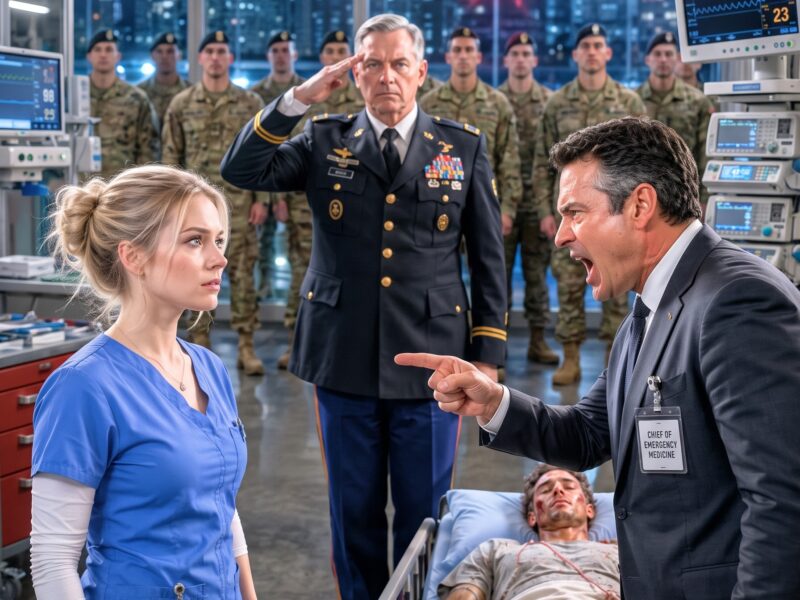
They fired me in front of thirty patients after I refused to follow a doctor’s deadly order, and while the hospital director called me an incompetent nurse
The clock above the nurses’ station read 6:18 a.m., its mechanical ticking a hollow rhythm against the low hum of the fluorescent lights. The night shift had been brutal, but the real nightmare was just beginning. Dr. Robert Harrison threw the crisp white piece of paper onto the laminate counter with enough force to make the plastic clipboard beside it rattle.
“You’re finished here, Maya,” he said. His voice wasn’t raised, but it carried an icy, absolute authority that cut through the sterile atmosphere of the emergency department.
Every nurse nearby went completely silent. The clatter of IV stands, the rustle of chart papers, the soft beep of heart monitors—all of it seemed to freeze. Nurse Sarah, who had worked alongside me for six years, dropped her eyes to her shoes. Nurse Jackson slowly turned his back, suddenly fascinated by an empty telemetry screen.
I had worked at Mercy General Hospital for eleven years. Eleven years of double shifts, missed holiday dinners, blood-stained scrubs, and CPR performed until my palms bruised. I had held the hands of dying grandmothers and delivered frantic chest compressions to trauma victims in the back of moving elevators. I had built my entire identity around these hall walls. And now, I was being dismantled in front of thirty staring patients and my own tight-lipped colleagues.
“Doctor Harrison,” I said, my voice surprisingly steady despite the violent shaking in my knees. “The patient in Room 412 arrived with acute chest pain and dangerously low blood pressure. His chart clearly lists a severe, anaphylactic reaction to the exact beta-blocker variant you just prescribed. It isn’t just a mild allergy—his airway closed up three years ago at St. Jude’s. It’s documented in the system.”
Harrison didn’t even look up from his digital tablet. He was immaculate, as always, his hair combed back with expensive pomade, his white coat pristine and free of the bodily fluids that covered mine. “The system was updated this morning, Nurse Walker. I am the attending physician. I evaluated the patient’s current hemodynamic status, and I ordered forty milligrams of intravenous Sotalol. Give him the medication.”
“I can’t administer something I know will put him into cardiac arrest,” I replied, leaning over the desk so only he could hear my next words. “You are asking me to kill that man.”
His face hardened into a mask of pure contempt. He set the tablet down with a deliberate click. “Then you can find another hospital.”
Beside him, the hospital director, Arthur Vance, stepped forward from the shadows of the administration hallway. Vance was a tall, thin man who smelled perpetually of mints and expensive cologne. He folded his arms over his tailored charcoal suit, his expression cold and unreadable.
“Nurse Walker,” Vance said, his voice dripping with false concern. “Insubordination in a critical care environment is a direct threat to patient safety. If you refuse to carry out a lawful, written order from the Chief of Medicine, you are in breach of your contract. Effective immediately, your clinical privileges are suspended, and your employment is terminated for gross professional negligence.”
“Negligence?” I gasped, looking from Vance to Harrison. “I am protecting a human life!”
“You are creating a disruption,” Vance countered smoothly. “Sign the termination acknowledgement, or security will remove you.”
I looked around the room one last time. I looked at Sarah. I looked at Jackson. I looked at the young resident doctor sitting in the corner, staring at his keyboard with white knuckles. Nobody defended me. Not a single person met my eyes. They knew Harrison’s power in this hospital; they knew Vance controlled their schedules, their references, and their livelihoods. Fear had turned my family of eleven years into deaf and mute statues.
“I won’t sign a lie,” I said.
An hour later, two armed security guards escorted me down the main corridor. The morning sun was just cutting through the high glass windows of the central lobby, casting long, dramatic shadows across the polished marble floor. Early morning visitors and outpatient guests stared as I walked between the guards, my personal belongings packed haphazardly into a single cardboard box. A woman holding a toddler pulled her child closer as I passed. A man sitting in a wheelchair whispered to his wife, “She must have done something terrible.”
I kept my chin up, swallowing the burning ache in my throat, but inside, I was collapsing. I had spent my entire adult life building a career based on integrity, and in less than sixty minutes, one orchestrated accusation had turned me into a pariah.
I pushed through the glass double doors, step into the crisp morning air, ready to crumble on the sidewalk. But before I could reach my car, a long, black government sedan with darkened windows pulled up directly to the ambulance bay kerb, cutting off the pedestrian path.
The rear door swung open. A tall, broad-shouldered man in a dark green military dress uniform stepped out. Gold stars glinted on his shoulders, catching the low morning light. A four-star general. Behind him, two armed Military Police officers in full tactical gear stepped out of a secondary vehicle, their expressions stoic and alert.
The hospital lobby behind me fell into an absolute, breathless hush. Visitors pressed against the glass. Security guards halted in their tracks.
Dr. Harrison and Director Vance, who had followed me out to ensure I left the premises, hurried down the steps. Vance adjusted his tie, putting on his practiced executive smile. “General… we were not informed of an inspection. I assure you, if this is regarding the veteran outreach program, my office is open to you. However, right now this is a private medical matter—”
General Thomas Reed completely ignored Vance. He walked right past the director, his heavy military boots echoing on the concrete, and stopped three feet in front of me. His face was weathered, carved with deep lines of discipline and quiet stress.
His eyes scanned my face, noting the tear stains I had tried so hard to wipe away, and then dropped to the cardboard box in my arms.
“Chief Nurse Maya Walker?” he asked.
“Yes, sir,” I managed to say, my breath catching in my chest.
He took off his officer’s cap, holding it respectfully against his side. “My name is General Thomas Reed. United States Army. May I speak with you in private?”
Vance cut in, his voice rising sharply. “General Reed, Nurse Walker has just been terminated for gross medical misconduct. She no longer has authorization to access this facility or discuss internal clinical matters—”
General Reed turned his head just enough to look Vance in the eye. The temperature on the sidewalk seemed to drop ten degrees. “Director Vance, if you utter another word, my officers will detain you for obstructing a federal investigation. Am I clear?”
Vance snapped his mouth shut. Harrison stepped back, his face draining of color.
The General gestured toward the hospital’s administrative wing. “We will use the executive conference room.”
Inside the glass-walled conference room, the morning light streamed across a polished mahogany table. General Reed motioned for me to sit. He placed a heavy, leather-bound military intelligence folder onto the surface between us. The classification stamp across the front read RESTRICTED – FEDERAL HEALTHCARE AUDIT.
My hands were trembling so badly I had to set my box on the floor. “What is this? Who are you?”
“I am the director of the Defense Health Agency’s special oversight committee,” Reed said, pulling out a chair and sitting across from me. “And this folder contains the truth about what just happened to you.”
He opened the binder. Inside were dozens of pages: high-resolution color printouts of medical records, network access timestamps, internal hospital pharmacy logs, and crystal-clear security camera stills.
“Three hours ago,” Reed explained, pointing to a computer printout, “Dr. Harrison logged into the hospital’s core server from a private terminal in the basement lab. He manually edited the medical history of the patient in Room 412. He deleted the allergy flag for Sotalol.”
I stared at the paper. “He… he erased it? But why? That’s murder!”
“He knew you were the charge nurse on duty,” Reed said coldly. “He knew your reputation for meticulous chart reviews. He knew you would spot the conflict, refuse the order, and trigger the hospital’s mandatory insubordination clause.”
“He set me up,” I whispered, the realization hitting me like a physical blow to the chest. “It wasn’t about the patient’s care at all. It was a trap to get me fired.”
“It was a trap to remove you from the floor,” Reed corrected. “Because as long as you were Chief Nurse, you kept auditing the nighttime pharmacy dispatches.”
The General turned another page in the thick file. A list of names and dates appeared, highlighted in red. “Your patient in Room 412 wasn’t the first, Maya.”
My stomach tightened into a hard knot. “What do you mean? How many?”
General Reed looked away for a brief moment, staring out the window toward the emergency bay before meeting my eyes again. “Seven. Over the last eight months, seven patients in this facility suffered unexpected, fatal cardiac events following routine medication adjustments made during the late-night shift change. All seven were high-profile retired military personnel or individuals involved in federal defense contracting.”
Seven patients. Seven families who had sat in those waiting rooms, trusting the people in white coats. Seven people I might have helped if I had looked deeper into the pattern sooner.
I gripped the edge of the table, struggling to draw air into my lungs. “If you knew this… if the military was tracking this… why didn’t you step in earlier? Why did you let them march me out of there like a criminal?”
The General’s voice softened slightly, a rare flicker of empathy breaking through his iron military composure. “Because we needed proof that the system wasn’t just broken—we needed proof of who was standing against it. We needed a nurse with an unblemished record who would refuse a lethal command on the record, forcing Harrison and Vance to expose their administrative collusion.”
He reached into the back pocket of the binder and pulled out one final photograph. He pushed it across the dark wood table until it rested directly under my eyes.
The photo was taken with a high-powered night-vision lens. It showed Dr. Harrison and Director Vance standing near an unmarked black SUV in the hospital’s underground parking garage. They were handing a metallic briefcase to a third man whose face was partially turned away from the camera.
But I didn’t need to see his full face. I recognized the silver watch on his left wrist—the anniversary gift I had saved up three months of overtime to buy him. I recognized the slight slouch of his shoulders, the jacket he had worn when he left our house at 9:00 p.m. last night claiming he had an emergency client meeting.
It was my husband, Mark.
“Your dismissal wasn’t just an administrative decision, Maya,” General Reed said, his voice sounding as if it were coming from the end of a long tunnel. “It was planned three weeks ago in that garage. Your husband helped them draft the non-disclosure agreements and the legal paperwork to strip your nursing license.”
I stared at the photograph. The world seemed to spin on its axis, dissolving into a sickening blur. The man I had shared a bed with for eight years, the man who had kissed my forehead that very morning and said, ‘Hang in there, sweetheart, it’s almost over’—he was part of the machine that just destroyed my life.
Before I could form a sentence, the screen of my phone lit up on the table.
A single text message popped up on the lock screen.
From: Mark
Please don’t trust the general. Get out of the building now.
The text message blinked on the glass screen, a tiny beacon of light that felt like a physical strike. I stared at the words—Please don’t trust the general. Get out of the building now—while the blood pounded a deafening rhythm in my ears.
General Reed observed my sudden paralysis. His eyes narrowed slightly as he leaned over the mahogany table. “What is it, Maya?”
I slowly pulled the phone toward me, my fingers slick with cold sweat. I didn’t show him the screen. “Nothing. Just a automated alert.”
“Maya,” Reed’s voice took on a sharper edge. “In my line of work, there are no coincidences. If someone is reaching out to you right now, you need to tell me.”
I looked from the photo of my husband handing over that metallic briefcase to the four-star general sitting across from me. Who was the predator, and who was the protector? Eleven years at Mercy General had taught me that titles meant nothing behind closed doors. Doctors broke oaths; directors sold out safety for profit; husbands lied.
“I need a moment,” I said, rising unsteadily from the chair. “I need to use the restroom.”
Reed looked at me for three long seconds, evaluating my body language. Finally, he gave a curt nod to one of the Military Police officers standing by the door. “Officer Harris, escort her to the corridor. Keep it clear.”
I walked out of the conference room, my head spinning. The officer stood outside the restroom door as I ducked inside, locking the deadbolt behind me. I turned on the brass faucet, splashing ice-cold water over my face, staring at my reflection in the mirror. My scrub top was faded, my eyes bloodshot, my hair pulled back in a messy bun. I looked like a woman who had lost everything—because I had.
I pulled out my phone, my thumb trembling over the keypad, and dialed Mark’s number.
He answered on the first ring. “Maya? Maya, are you okay? Are you still in the hospital?”
“Where are you, Mark?” I whispered, my voice trembling with a mixture of rage and heartbreaking grief. “I saw the photograph.”
Silence filled the line. For five agonizing seconds, the only sound was the faint static of the cell tower.
“Maya… listen to me very carefully,” Mark’s voice was strained, lower than I had ever heard it. “Whatever General Reed told you, whatever he showed you… it’s not what you think. You are in extreme danger. Reed isn’t DHA.”
“What are you talking about?” I demanded, gripping the edge of the marble sink. “He has full military clearance! He had security footage of Harrison changing the charts! He had logs of seven dead patients!”
“Because he controls the servers that recorded them!” Mark hissed. “Maya, I’m a senior compliance attorney for the regional health network. Do you really think I was selling them out in that garage? I was auditing them! Harrison and Vance aren’t working alone—they’re executing a trial for an unauthorized biological stabilization compound funded by a rogue black-budget military division. Reed isn’t investigating the deaths. He’s covering them up by blaming the hospital staff!”
My breath caught in my throat. “Mark… he showed me a picture of you taking a briefcase from them.”
“That briefcase contained the encrypted hard drives with the raw data of the seven deceased patients!” Mark pleaded. “I took it to extract the telemetry logs before Vance could erase the server backups! They used you today to pull me out into the open. They knew if they publicly destroyed your life, I would step out of the shadows to protect you. Reed walked in there today not to save you, Maya, but to secure the last person who held the clinical knowledge to prove those deaths weren’t medical errors.”
I leaned my forehead against the cool mirror, my mind fragmenting into a thousand pieces. Two men, two stories, both completely persuasive, both pointing guns at each other through me.
Suddenly, the lights in the bathroom flickered twice and died, plunging the room into darkness.
A split second later, the heavy emergency fire doors at the end of the outer hallway slammed shut with a metallic boom that echoed through the plumbing. The hum of the hospital’s ventilation system cut out completely.
“Maya?” Mark’s voice panicked over the speaker. “Maya, did the power just drop?”
“Yes,” I said, my heart slamming against my ribs.
“Reed is isolating the floor,” Mark yelled. “They’re cutting the primary grid to override the digital security locks! You have to get out through the old service tunnels behind the morgue!”
Before I could answer, the door handle of the bathroom rattled violently.
“Nurse Walker?” Officer Harris’s voice echoed through the wood, missing its previous polite cadence. It was flat, hard, and commanding. “General Reed requires you back in the conference room immediately. Open the door.”
“Just a minute!” I called back, stepping away from the door and looking around the dark room.
“Open the door, Nurse Walker. Now.”
The sound of a heavy boot kicked against the frame, making the wood splinter around the deadbolt. They weren’t waiting.
I sprinted toward the back of the large restroom facility, where a small maintenance access panel was built into the tile wall to service the main pipe chaser. I jammed my fingertips under the metal latch, pulling with all my strength. The panel popped open with a loud metallic scrape, revealing a narrow, dark shaft filled with exposed pipes, electrical conduits, and the dusty smell of damp concrete.
Behind me, the bathroom door burst open with a loud crack of splintering wood.
“She’s in the maintenance chute!” Officer Harris shouted.
Without thinking, I threw my phone into my pocket, squeezed my shoulders into the tight space, and pulled the access door shut behind me just as heavy footsteps rushed into the room.
It was pitch black inside the utility corridor. The air was warm and heavy, smelling of rust and old insulation. I dropped to my hands and knees, crawling along the metal gangway that ran alongside the main steam pipes. Years of working night shifts in the sprawling, century-old hospital meant I knew the building’s infrastructure better than most doctors knew their patients. Mercy General had been built in three distinct phases since 1940; the modern wings were stacked right on top of an old subterranean brick foundation.
Above me, I could hear the muted thuds of heavy boots and the harsh, crackling sound of tactical radios.
“Lock down the basement exits,” General Reed’s voice echoed through a ventilation grate somewhere above my head. “Find her before she reaches the street. And secure Director Vance—he’s no longer useful.”
A cold shudder ran down my spine. Mark was right. Reed wasn’t an investigator; he was an executioner cleaning up a crime scene.
I crawled faster, the rough metal grating biting into my knees through my scrubs. I followed the slope of the steam pipes downward, descending deep into the bowels of the hospital. After five agonizing minutes of crawling through dust and cobwebs, I reached a vertical ladder that dropped into the sub-basement corridor—the passage leading toward the morgue and the disused utility tunnels that connected to the city sewer system.
I slid down the ladder, my shoes hitting the damp concrete floor with a soft slap.
The sub-basement was bathed in the eerie red glow of emergency backup lights. The air here was freezing, kept chilled by the cooling systems of the pathology labs above. Silence hung heavy in the air, broken only by the steady drip-drip-drip of a leaking pipe somewhere in the darkness.
I crept along the wall, heading toward the heavy steel double doors marked MORGUE – AUTHORIZED PERSONNEL ONLY. If I could get through the morgue, the old coal chute at the far end led directly out to an alleyway behind the laundry docks.
As I reached the doors, a shadow stepped out from the doorway of Pathology Lab B.
I gasped, jumping back and raising my fists in defense.
“Maya! Quiet!” a voice hissed from the dark.
The shadow moved into the red emergency light. It wasn’t an officer. It was Nurse Sarah. She was shaking, holding a master keycard in one hand and a small plastic cooler in the other.
“Sarah?” I whispered, my heart in my throat. “What are you doing down here?”
Tears welled up in Sarah’s eyes, glistening in the emergency light. “I… I saw them put you in that room with those military men. Then Dr. Harrison came down to the pharmacy and tried to delete the physical logbooks. I realized… I realized you were telling the truth about Room 412.”
She shoved the small cooler into my hands. “I ran to the blood bank freezer. The blood samples from the last three patients who died… Harrison ordered them destroyed, but I hid them in the overflow unit last week because something felt wrong. I have their lab draws, Maya. The toxic toxicological screens are in here.”
I held the heavy cooler against my chest, overwhelmed by a sudden wave of emotion. “Sarah… you could get killed for this.”
“They humiliated you,” Sarah whispered, her voice cracking. “You were the only one who ever stood up for us, for the patients. I was a coward upstairs, Maya. I didn’t say anything when Vance fired you. I can’t be a coward down here.”
Before I could thank her, the heavy metallic doors at the top of the stairwell slammed open. The sound of rapid, rhythmic military boots echoed down the concrete hallway.
“They’re coming,” Sarah gasped, pushing me toward the morgue doors. “Go! Use my keycard on the coal chute lock!”
“Come with me!” I urged, grabbing her arm.
“No,” Sarah shook her head, tears spilling down her cheeks. “If we both run, they’ll hunt us together. I’ll distract them at the main elevator. Go, Maya! Save yourself and expose these monsters!”
She swiped her keycard, pushed me through the morgue doors, and hit the green exit lock, sealing the heavy steel door between us. Through the reinforced glass window, I saw her turn and run toward the central elevator shaft, shouting to draw the guards’ attention away.
I turned around into the icy, silent darkness of the morgue, holding the evidence that could tear down an empire.
The morgue smelled of formaldehyde, stainless steel, and the heavy, stagnant chill of death. Long rows of silver freezer doors lined the far wall, reflecting the low, pulsating hum of the emergency backup lighting.
I clutched the cooler tightly against my ribs, my knuckles white. Inside this insulated box were the blood samples of three human beings who had walked into Mercy General seeking healing and left in body bags. They were no longer just names on an electronic chart; they were evidence of a conspiracy that stretched from the executive suites of my hospital to the highest corridors of military power.
I hurried past the stainless steel dissection tables, my rubber-soled nursing shoes making soft squeaking sounds against the epoxy floor. At the far end of the room stood the heavy cast-iron door of the old coal chute—a relic from the hospital’s original 1940 construction, now used as an emergency secondary utility exit.
I pulled Sarah’s keycard from my pocket and swiped it through the magnetic reader mounted beside the frame.
Beep. Red light.
“Access Denied,” a mechanical voice chirped from the reader.
My heart plummeted. “No, no, no… come on, Sarah,” I muttered frantically, swiping it again.
Beep. Red light.
The master lockout had already been activated across the entire building. General Reed’s team had taken full control of the hospital’s security infrastructure. I was trapped in a cold room beneath the earth with no way out.
Behind me, the heavy double doors of the morgue shuddered. A loud CLANG echoed through the room as someone attempted to force the electronic latch from the outside.
I backed away from the entrance, looking around frantically for a place to hide. The room offered almost no cover: two stainless steel prep tables, a sink, a supply cabinet filled with specimen jars, and the massive bank of body freezers.
The metal doors clanged again—harder this time. The sound of a heavy hydraulic ram striking the frame shook dust from the ceiling tiles.
I had seconds.
I ran to the main freezer unit. The bank consisted of twenty stainless steel drawers arranged in four tiers. I pulled the handle of Drawer 14—it was cold, heavy, and empty. Without allowing myself a moment to think about the horror of what I was doing, I slipped my feet into the narrow metallic bay, holding the cooler tightly against my stomach, and pulled the drawer handle from the inside until it clicked shut with a sharp, airtight seal.
Total darkness consumed me.
The air inside the freezer bay was bitterly cold, instantly freezing the moisture on my eyelashes and making my lungs ache with every breath. I pressed my back against the flat steel bed, holding my breath, listening through the thick insulation of the metal walls.
A heavy EXPLOSION of metal echoed through the room as the outer doors were breached.
Feet stomped across the concrete. Heavy, tactical boots.
“Clear the perimeter!” a military voice barked inside the morgue. “Check the prep counters!”
“Sir, the coal chute exit is locked from the inside,” another voice reported. “She hasn’t left the room.”
I held my breath, my chest burning, my heart pounding so loudly against my ribs I was terrified they would hear it through the steel drawer. The temperature inside the unit was rapidly dropping. My fingers began to lose feeling around the plastic handle of the cooler.
“Search the units,” a deep, familiar voice commanded. General Reed.
My blood turned colder than the freezer frame.
I heard the distinct sound of stainless steel drawers being yanked open one by one.
Slam. Slam. Slam.
They were moving down the line. Top row, middle row, bottom row. They were checking every single bay.
Slam. Slam.
They were three drawers away from mine. I closed my eyes, squeezing the cooler, praying silently for a miracle. If they opened Drawer 14, I was dead. There was nowhere to run, no weapon to fight with, no escape.
Slam. Two drawers away.
Slam. The drawer directly above me was pulled out with a harsh metallic scrape.
I prepared myself for the cold burst of light, tightening my grip on the cooler.
“General!” a voice suddenly shouted from the hallway outside. “We’ve got a situation in the main lobby! Local law enforcement just arrived—three state police cruisers and a federal prosecutor. They’ve got a search warrant issued by the District Court!”
The footsteps near my drawer stopped instantly.
“Who called the state police?” Reed demanded, his voice hard as iron.
“It was Mark Walker, sir,” the officer replied. “He bypassed our communications block by patching through the municipal emergency network. He’s standing in the lobby right now with the media!”
A tense silence filled the morgue. I could feel the invisible war of calculations happening in Reed’s mind through the metal door.
“Leave a squad to secure the lower level,” Reed ordered sharply. “The rest of you, move upstairs now. We need to control the narrative before the news crews set up live feeds.”
“What about the nurse, General?”
“She’s trapped down here anyway,” Reed snapped. “Without a card, she can’t bypass the environmental seals. Lock the main morgue doors from the outside and cut the auxiliary power to this sector. Let the cold do the work for us.”
Heavy footsteps retreated rapidly across the concrete floor. The outer doors slammed shut, followed by the heavy, mechanical thud of external deadbolts sliding into place. A moment later, the subtle vibration of the freezer’s compressor died completely as the auxiliary power was severed.
Silence returned to the morgue.
I waited two agonizing minutes, counting every second in my head, before I placed my hands against the inside roof of the freezer drawer and pushed with all my strength. The safety release latch caught, and the drawer slid open into the dim, shadowy room.
I fell out of the bay onto the cold floor, gasping for air, my limbs shivering uncontrollably from the freezing temperatures. I lay there on the epoxy surface for a moment, clutching the cooler, my breath forming thick white clouds in the rapidly cooling room.
I had survived the search, but Reed’s trap was still active. They had locked the morgue from the outside and cut the power. The air in the room would slowly grow stagnant, and I was completely trapped.
I stood up on shaky legs, using a stainless steel table for support. I looked at the cast-iron coal chute door again. If the electronic reader was dead, the magnetic lock was likely engaged in a “fail-secure” mode—meaning without power or a manual override, it would remain bolted shut forever.
I walked over to the prep table and grabbed a heavy steel surgical mallet and a wide orthopedic chisel left in a tray. I ran to the chute door, inserting the chisel into the tiny gap between the iron frame and the wall where the manual locking pin resided.
I swung the mallet with all the strength left in my shivering body.
CLANG!
Sparks flew into the darkness. My arms vibrated with a sickening numbness, but the steel pin didn’t budge.
CLANG!
“Come on!” I screamed through gritted teeth, swinging again. “Come on!”
CLANG!
On the third strike, the brittle, decades-old cast-iron housing around the latch cracked. I jammed the chisel deeper, using it as a lever, throwing my entire body weight against the tool. With a loud, metallic SNAP, the internal bolt sheared off, and the heavy iron door swung open, revealing a steep, narrow, soot-stained incline rising toward a faint circle of grey daylight forty feet above.
It was the old coal chute leading to the exterior loading alley.
I shoved the mallet into my pocket, strapped the cooler securely to my waist using a piece of medical tubing from the prep counter, and scrambled into the dark, filthy shaft.
The incline was steep and covered in slick, wet coal dust and rust. My hands slipped repeatedly as I dragged myself upward, my nails tearing, my scrub pants becoming soaked in black residue. Every foot gained was a battle against gravity and exhaustion. Halfway up, my foot slipped, and I slid back three feet, my knee smashing painfully against the metal wall. I gasped in pain, but I forced myself to reach forward, grabbing an old iron support rung embedded in the masonry.
I pulled, step by step, inch by inch, until my fingers finally reached the top lip of the chute.
I pushed open the rusted exterior iron grate and dragged myself out into the blinding daylight of the hospital’s back service alleyway.
The cold autumn wind hit my face, shocking my lungs with fresh, clean air. I lay on the damp asphalt of the alley, covered in soot, bleeding from my fingers, clutching the cooler like a lifeline.
Across the street, the sound of blaring police sirens echoed through the city buildings.
I pulled myself up against the brick wall and looked around the corner toward the main hospital entrance. The front plaza was a scene of absolute chaos. Four state police vehicles were parked at angles with their lights flashing. Local news vans were setting up satellite dishes. A crowd of onlookers and hospital staff had gathered on the lawn.
Standing on the top step of the entrance plaza, surrounded by reporters holding microphones, was my husband, Mark. Beside him stood the local District Attorney.
And stepping out of the front doors, flanked by his military officers, was General Reed—his face calm, his posture commanding, preparing to address the cameras.
I held the cooler tightly, wiped the coal dust from my eyes, and began walking toward the light.
The morning sun hit the glass facade of Mercy General Hospital, reflecting a blinding glare off the emergency vehicles parked across the plaza. The air was loud with the sound of idling news vans, crackling police radios, and the murmurs of an growing crowd.
General Reed stood at the top of the concrete steps, a microphone-laden podium quickly erected before him by hospital staff. He looked immaculate, steady, and utterly in control—the picture of military decorum addressing a public crisis. Beside him stood Director Vance, who was sweating profusely under his tailored suit, dabbing his forehead with a silk handkerchief, and Dr. Harrison, who was trying desperately to maintain an expression of solemn concern.
“Ladies and gentlemen of the press,” General Reed began, his deep, resonant voice amplified by the portable public address system. “I am General Thomas Reed of the Defense Health Agency. We are currently managing a tragic internal breach of clinical protocol at Mercy General. A rogue senior staff member, Chief Nurse Maya Walker, has been implicated in a series of fatal medication errors affecting multiple patients.”
A wave of gasps ran through the crowd of reporters and gathered hospital employees.
“Nurse Walker,” Reed continued smoothly, “demonstrated signs of severe psychological distress and administrative insubordination this morning. When confronted with her actions, she fled the facility, stealing classified medical records and biological materials in an attempt to obscure her guilt. We are working closely with local authorities to apprehend her safely.”
From the edge of the plaza, near the state police cruisers, Mark stepped forward toward the podium, shouting over the reporters. “That’s a lie! General Reed, you are lying to these people!”
Two military officers immediately moved to block Mark’s path, placing their hands on their holstered sidearms.
“Stand back, sir,” one of the officers warned.
“She didn’t steal anything!” Mark yelled, his voice desperate, turning toward the news cameras. “My wife was framed because she refused to participate in an illegal clinical trial! Mercy General is being used as a testing ground for unauthorized pharmaceuticals!”
Director Vance stepped up to the microphone, taking a quick breath. “Please, calm down, Mr. Walker. We understand you are distressed by your wife’s tragic mental breakdown. The hospital is offering full support to affected families, but we must let law enforcement do their job.”
“She didn’t have a breakdown,” a voice echoed from the back of the crowd.
The voice was quiet, but it carried across the concrete plaza with terrifying clarity.
The reporters turned around. The cameramen swung their heavy shoulder-mounted rigs toward the lower steps of the plaza. The crowd parted, creating a wide path through the center of the lawn.
I walked through the gap.
I was a terrifying sight. My scrubs were torn and covered in black coal dust. Blood was dried on my fingernails and streaked across my cheek from a cut on my forehead. My hair was wild, hanging in dark, tangled strands around my face. But my stride was steady, my head was held high, and in my arms, I held the white plastic cooler wrapped tightly in medical tubing.
“Maya!” Mark gasped, trying to push past the officers.
The crowd went completely silent. Cameras flashed frantically, the shutters clicking like a swarm of mechanical insects.
General Reed’s eyes narrowed, his calm composure fracturing for a fraction of a second into pure, unadulterated shock. He hadn’t expected me to survive the sub-basement, let alone walk onto the front lawn in front of every major news network in the state.
“Maya Walker,” Reed said, recovering instantly and speaking into the microphone. “Stand down. You are entering a secure perimeter while under federal investigation. Officers, detain her.”
The two Military Police officers stepped away from Mark and began advancing down the concrete steps toward me.
“Stop right there!” a loud voice boomed over a loudspeaker.
A State Police Captain stepped out from behind his cruiser, drawing his sidearm and pointing it at the military officers. “Stand down, military personnel! You are on state jurisdiction! Nurse Walker is under the protection of the State Attorney General’s Office!”
Three state troopers immediately drew their weapons, stepping into the space between me and the military officers. The standoff was instantaneous and terrifying. Guns were drawn in broad daylight on the front steps of a public hospital. Reporters scrambled behind bushes; camera crews dropped low but kept their lenses pointed directly at the confrontation.
“Captain,” Reed’s voice dropped an octave, turning deadly quiet. “You are interfering with a national security operation.”
“I am enforcing a judicial warrant signed twenty minutes ago by the Chief Justice of the State Supreme Court,” the Trooper Captain replied, not lowering his weapon an inch. “Nurse Walker, walk over here.”
I kept my eyes fixed on General Reed, Dr. Harrison, and Director Vance as I walked past the line of drawn weapons and stood beside the Trooper Captain and Mark.
Mark reached out, grabbing my shoulder, his eyes filled with tears. “Maya… thank God. Are you okay?”
I didn’t answer him yet. The betrayal of seeing him in that photo still burned like acid in my soul, but right now, there was a larger battle to win.
I walked directly up to the microphone stand set up by the news crews at the base of the plaza steps. I set the white cooler on the small wooden table beside the microphones.
“My name is Maya Walker,” I said into the barrage of microphones, my voice echoing across the plaza and broadcasting live to thousands of homes across the state. “For eleven years, I have served as a critical care nurse in this hospital. This morning, at 6:18 a.m., Dr. Robert Harrison ordered me to administer a fatal dose of Sotalol to a patient in Room 412. When I pointed out the fatal allergy in his history, Dr. Harrison and Director Vance terminated me on the spot.”
I pointed directly at Dr. Harrison. The doctor took a step back, his face turning gray under the sunlight.
“They claimed I was negligent,” I continued, my voice growing stronger with every word. “They claimed I was unstable. But the truth is inside this box.”
I unwrapped the medical tubing from the cooler and lifted the lid. I pulled out three sealed glass vials filled with dark red blood, holding them up into the sunlight so every camera lens could capture them.
“These are blood samples from three of the seven patients who died unexpectedly in Mercy General’s ICU over the last eight months,” I declared. “They were ordered to be destroyed this morning by Dr. Harrison. But brave staff members saved them. Inside these vials is the chemical footprint of an unregistered, experimental cardio-toxin designed to mimic sudden cardiac arrest.”
“That’s unproven speculation!” Director Vance yelled, grabbing a microphone from the podium above. “She has no lab results! She’s holding stolen clinical waste!”
“The lab results are right here,” Mark shouted, stepping up beside me and pulling a thick stack of printed documents from his briefcase. He handed them directly to the State Trooper Captain and the lead reporter from the state’s primary news station.
“These are the decrypted server logs from the hospital’s core database,” Mark announced loudly. “Extracted three hours ago from the administrative server. They show Dr. Harrison manually accessing patient files minutes before their deaths to alter their dosage histories. And they show wire transfers totaling four million dollars paid from a blind offshore account directly to Vance, Harrison, and a shell corporation owned by General Thomas Reed.”
The crowd erupted into chaotic noise. Reporters began shouting questions all at once, thrusting their microphones over the barricades.
“General Reed! Is this true?”
“Doctor Harrison, did you kill those patients?”
“Director Vance, who authorized the trial?”
General Reed didn’t answer. He looked at the news cameras, then at the state troopers standing with their weapons ready, and finally at me. The mask of the heroic four-star general fell away completely, revealing the cold, calculating criminal beneath.
He slowly raised his hand, gesturing to his military officers. “We are leaving.”
“You’re not going anywhere, General,” the State Police Captain said, stepping forward with handcuffs in his hand. “Federal prosecutors have already frozen your accounts. Drop your weapons and step down from the podium.”
Reed looked around the plaza. He saw the state police cruisers blocking the street, the news helicopters hovering overhead, and the dozens of hospital staff members staring at him with pure hatred. He knew the war was lost.
He slowly unbuckled his sidearm belt, dropping it onto the concrete with a heavy thud. Dr. Harrison sank onto the steps, burying his face in his hands, while Director Vance began babbling incoherently to his lawyer on his cell phone.
Mark turned to me, his eyes searching my face, reaching out to take my hand. “Maya… we did it. It’s over.”
I looked down at his hand, then up at his face. “Is it, Mark? You still have to answer for why you were in that garage.”
Three days later, the rain was falling steadily over the city, washing away the chalk marks and tire tracks that had covered the hospital plaza during the chaotic arrest.
Mercy General was under federal receivership. A team of independent auditors, state investigators, and federal agents in dark suits now walked the corridors where Director Vance and Dr. Harrison once ruled. Harrison and Vance were currently being held without bail at the county correctional facility, facing multiple counts of second-degree murder, federal healthcare fraud, and conspiracy. General Reed was in federal custody, undergoing court-martial proceedings that were threatening to pull down half a dozen high-ranking officials in the Defense Logistics Agency.
I sat in the quiet office of the State Attorney General, looking out the large floor-to-ceiling window at the gray skyline. The coal dust had been scrubbed from my skin, the cut on my forehead was covered with a neat butterfly bandage, and I was wearing clean, simple clothes. But the exhaustion inside me went deeper than muscle and bone.
The door opened, and Mark walked in, accompanied by his defense attorney. He looked exhausted, the dark circles under his eyes evidence of three sleepless nights spent in interrogation rooms.
He sat down in the leather chair across from me. He didn’t try to touch me this time. He knew I needed the truth before anything else could exist between us.
“The Attorney General’s office just cleared me, Maya,” Mark said softly, setting a manila folder on the glass coffee table between us. “They reviewed the full timeline of my communications with the federal whistle-blower task force. I wasn’t part of their conspiracy. I was the one who alerted the Department of Justice two months ago.”
I looked at the folder, but I didn’t open it. “Then why didn’t you tell me, Mark? We slept in the same bed every night. You watched me come home crying because patients were dying on my shift, and you said nothing.”
Mark swallowed hard, his eyes shining with unshed tears. “Because the moment I started digging into Vance’s legal filings, I realized how dangerous these people were. General Reed had private security units monitoring my office, my phone, and our home. If I had told you, you would have acted differently on the floor. You would have looked scared. You would have given them a reason to target you directly.”
“They targeted me anyway!” I said, my voice rising with a sharp edge of pain. “They humiliated me in front of my entire staff! They dragged me out like a criminal!”
“Because Harrison realized you were getting too close!” Mark pleaded, leaning forward. “That morning in the garage… Vance brought me there under the pretense of discussing a legal settlement for the hospital network. When they handed me that briefcase, they told me it was my retainer fee to keep quiet about the ICU audits. I took it because I knew the hard drives inside contained the raw telemetry data. I needed that physical proof to go to the State Prosecutor.”
He reached out, his hand trembling, and gently touched the cover of the folder. “I never betrayed you, Maya. Every step I took was to make sure that when the house burned down, you were standing on the outside holding the match.”
I looked at him for a long, silent moment. I saw the fear in his eyes, the deep love, and the profound guilt of a man who had tried to play a dangerous game alone to protect the person he loved. I didn’t completely forgive him—the trust we had shared would take months, maybe years, to rebuild—but the icy wall around my heart began to crack.
“What happens to the hospital now?” I asked quietly, shifting the conversation.
“The board of trustees was dissolved yesterday,” Mark answered, taking a deep breath. “The state has appointed an emergency interim director. And… they sent this for you.”
He reached into his jacket pocket and pulled out a formal, thick envelope bearing the official seal of the Mercy General Board of Directors. He set it on the table.
I opened the envelope. Inside was a letter printed on heavy cream paper.
Dear Nurse Walker,
By unanimous vote of the interim oversight board, all administrative actions taken against your professional license on October 14th have been expunged with prejudice. We formally request your return to Mercy General Hospital to assume the position of Director of Nursing and Chief Clinical Auditor.
The hospital needs your integrity, your courage, and your leadership to heal.
I stared at the black ink on the page. Director of Nursing. The position Vance had used to threaten every staff member who dared to speak up. The position that now offered the power to ensure no patient would ever be sacrificed for profit or power in those halls again.
An hour later, I stepped out of a taxi in front of Mercy General.
The rain had stopped, leaving the wet asphalt glistening under the afternoon light. I walked up the broad concrete steps where three days ago I had stood covered in soot, holding three vials of blood against an empire.
I pushed through the automatic glass doors into the main lobby.
The moment I stepped inside, the noise of the busy lobby faded. Nurses, residents, orderly staff, and administrative workers stopped what they were doing.
Nurse Jackson looked up from the reception counter, his cheeks turning red with shame. Young residents stood up from their desks.
Then, near the central elevator bank, Nurse Sarah stepped out. She looked at me, a brilliant, tearful smile breaking across her face, and began to clap.
Slowly, one by one, the entire lobby joined in. The nurses who had been too afraid to speak, the orderlies who had watched me be escorted out by security, the young doctors who had felt helpless under Harrison’s reign—they all stood and applauded. It was not a grand, theatrical spectacle; it was a quiet, profound act of collective apology and respect from people who had finally found their voice.
I walked past them, nodding softly, acknowledging each of them in turn. I didn’t harbor anger toward them anymore. I knew the weight of fear that had kept them silent, and I knew my job now was to make sure they never had to feel that fear again.
I took the elevator up to the fourth floor—the Intensive Care Unit.
I walked down the quiet corridor to Room 412. The door was slightly open.
Inside, the elderly patient who had arrived three days ago with chest pain was sitting up in bed, looking out the window at the clearing sky. His heart monitor was ticking with a steady, healthy, rhythmic rhythm.
I stepped into the room, picking up his chart from the holder at the foot of the bed. I checked the vitals, verified the current medication orders, and signed my name at the bottom of the log in clear, bold black ink.
“How are you feeling today, sir?” I asked gently.
The old man turned his head, smiling warmly at me. “Much better, nurse. Much better. Someone came in earlier and changed my medicine. Said the previous orders were all wrong.”
I set the chart down, adjusted his blanket, and patted his shoulder.
“Yes,” I said softly, looking out the window as the sun finally broke through the clouds, illuminating the city below. “The orders have been changed.”
The end.









