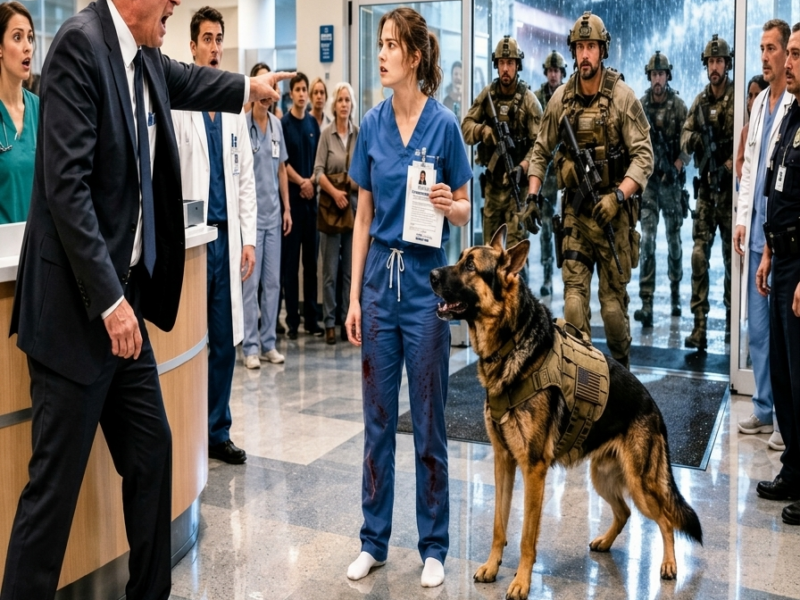
They fired me in front of the entire trauma ward for saving a dying military K9, and while my supervisor coldly told me to hand over my badge
The fluorescent lights of San Diego Military Medical Center buzzed with a sharp, sterile hum that seemed to rattle the back of my skull. It was 4:12 AM when the red emergency bay doors slammed open, carrying in the scent of jet fuel, burning rubber, and wet iron.
“We got two inbound! Critical!” the triage nurse screamed into her headset.
The first gurney hit the floor running. On it lay a young man in torn, mud-splattered flight fatigues, his chest rising in shallow, violent hitches. His face was obscured by an oxygen mask fogging rapidly with every ragged breath. But it wasn’t the soldier that caused the entire ER floor to freeze in place.
It was what was strapped to the lower shelf of the second gurney.
He was a Belgian Malinois—a massive, solid-built military working dog with a scarred muzzle and black-tipped ears. His dark tactical harness was shredded, soaked in crimson that dripped steadily onto the linoleum floor. He wasn’t barking. He wasn’t whining. He was staring straight up at the ceiling lights, his chest broad and heavy, shivering violently from traumatic shock.
“The dog was in the vehicle roll-over during a classified training exercise at Pendleton,” the transport medic shouted over the commotion, shoving a stack of blood-slicked intake papers into my chest. “Handler took the brunt of the kinetic impact. The dog—his name is Atlas—got caught in the frame collapse. Shrapnel to the femoral region. He’s bleeding out!”
I didn’t hesitate. I dropped my clipboard, snapped on a pair of nitrile gloves, and dropped to my knees beside the gurney shelf. “Get me a trauma tray! Two units of canine-compatible plasma or saline, 14-gauge angiocaths, and tourniquets now!”
“Stop right there, Dr. Vance!”
A heavy, cold hand clamped down onto my shoulder, pulling me backward with enough force to snap my collarbone against my scrubs.
I turned. Standing over me was Dr. Harold Vance—no relation, though he took every opportunity to remind the staff of his supreme authority as Chief of Emergency Medicine. His face was pale, his thin lips pulled back into a tight, bureaucratic line. Behind his gold-rimmed glasses, his eyes were darting nervously toward the double doors where two suits in unmarked navy coats were standing guard.
“Treat the soldier first,” Dr. Vance ordered, his voice echoing off the tiled walls.
“The soldier has three medics around him right now!” I snapped, trying to shake his hand off my shoulder. “His airway is clear, his vitals are stabilizing! This dog has three minutes before his arterial bleed empties his chest cavity!”
“I said leave the animal, Julian,” Dr. Vance said, stepping directly between me and the bleeding Malinois. His voice dropped to an icy whisper. “This facility receives federal funding for human casualties, not military hardware. That dog is property. The soldier is a primary asset. You touch that leash, and you are stepping outside your medical mandate.”
“He’s not hardware!” I yelled.
I shoved past Vance. I didn’t care about the protocol, the funding, or the unspoken hierarchy that made military hospitals so unbearable. I cut away Atlas’s shredded tactical harness with trauma shears, exposes the deep, jagged tear near his inner thigh. Blood spurted in rhythmic, sickening surges.
I drove my gloved fingers directly into the wound, applying manual pressure against the pulsing artery.
Atlas flinched. A low, gut-wrenching groan escaped his throat, but he didn’t snap. He didn’t bite. He turned his heavy, majestic head slowly on the steel tray. His dark amber eyes—deep, terrifyingly intelligent, and filled with a profound, quiet pain—locked directly onto mine.
Slowly, with what little strength remained in his trembling body, Atlas lifted his heavy right paw and pressed it firmly against my wrist, right over my pulse point.
“I’ve got you, buddy,” I whispered, my tears mixing with the sweat dripping off my chin. “Hold on. Just hold on.”
For twenty-five agonizing minutes, the world outside that small circle of blood dissolved. I packed the wound with quikclot gauze, drove two large-bore IV lines into his forelegs, and pushed high-dose fluid resuscitations while the trauma monitors screamed around us.
By 5:30 AM, the monitor’s erratic, frantic beep smoothed into a steady, rhythmic cadence. Atlas’s breathing deep-set and stabilized. The bleeding had stopped.
Over in Trauma Bay 1, the handler’s vitals had stabilized as well. Both had survived the night.
I collapsed onto a metal stool in the hallway, my hands covered in dark, dried blood, my lungs burning with exhaustion. I closed my eyes for three seconds.
“Stand up, Mr. Vance.”
I opened my eyes. Dr. Vance was standing in front of me, flanked by two armed hospital security officers and the hospital’s head of Human Resources. The morning shift nurses were pulling back, ducking into breakrooms, hiding behind monitors, refusing to meet my eyes.
“Hand over your badge,” Vance said softly. His voice was entirely devoid of warmth, smooth like oiled glass.
I stared at him. “The handler lived. The dog lived. What are you talking about?”
“You disobeyed a direct, lawful order from the Chief of Medicine during an active trauma intake,” Vance declared, making sure his voice carried down the long, empty hallway for every staff member to hear. “You misused federal medical supplies on non-classified canine assets. You compromised the bio-hygiene of Trauma Room 3.”
“He was dying, Harold!” I stood up, my fists clenching at my sides. “If I had waited five minutes, that dog would have been dead on the floor!”
“Then he would have been written off as equipment loss,” Vance replied coldly. He reached out his hand. “Your badge. Now. Security will escort you off the premises. If you set foot on hospital grounds again, you will be arrested for criminal trespass and federal destruction of property.”
I looked at the security guards. I looked at the HR officer, who held out a manila envelope containing my termination notice. They had prepared this before the sun even came up.
Slowly, I unhooked my plastic ID badge from my scrub pocket. I dropped it into Vance’s open palm.
“You’re a disgrace to this institution, Julian,” Vance whispered as he tucked my badge into his coat pocket.
I turned and began the long, humiliating walk toward the double glass doors of the ER exit. The silence in the hallway was suffocating.
As I reached the glass doors, a sound echoed from behind the sealed partition of the Recovery Unit.
It was a bark.
Not a wild, frantic yelp. Not a threat.
It was three sharp, echoing barks.
BARK. BARK. BARK.
Then… total silence.
I turned back one last time. Atlas was standing inside his glass recovery enclosure, his legs bandaged, his chest wrapped tight, staring through the glass directly at me. He didn’t move a muscle. He just watched me leave.
Twenty-four hours later, the rain was coming down in heavy, gray sheets over San Diego.
I sat in my tiny, second-story apartment three blocks from the base, staring at a cold cup of black coffee. My phone sat on the kitchen counter, dead quiet. No calls from the board. No calls from my colleagues. Word travels fast in the military medical network: Julian Vance, the rogue doctor who got fired for prioritizing a dog over a soldier. My career, built over twelve years of relentless study and ninety-hour work weeks, was gone.
At 8:15 AM, my doorbell rang.
It wasn’t a soft, polite ring. It was three heavy, metallic knocks that shook the thin wooden frame of my front door.
I walked over and pulled the door open.
Standing on my narrow porch were six men. They weren’t wearing police uniforms, and they weren’t hospital security. They wore dark gray tactical windbreakers over civilian clothes, but their posture, their short-cropped hair, and the quiet, lethal presence they projected screamed elite military.
Navy SEALs. Special Warfare Operator Group 1.
The man standing at the front was tall, with a thick beard peppered with gray and eyes like chipped flint. He didn’t look angry; he looked terrifyingly focused.
“Julian Vance?” he asked. His voice was low, carrying the weight of command.
“Yes,” I rasped, leaning against the doorframe. “If you’re here about the hospital bill for the dog, I don’t work there anymore. Dr. Vance had me terminated yesterday morning.”
“We know,” the bearded commander said. “I’m Master Chief Marcus Thorne. The man you saved in Trauma Bay 1 was my lead operator. The dog you saved was my team’s point asset.”
He gestured down the stairs. “Get your coat, Doctor. You’re coming back to the hospital with us.”
“I can’t,” I said, pointing to my chest. “I’ve been barred. I step on that property, I get arrested.”
“Nobody is arresting you today, Doctor,” Thorne said flatly. “Not while my team is walking with you.”
Ten minutes later, I was sitting in the back of an unmarked black suburban speeding through the rain toward San Diego Military Medical Center. The six SEALs in the vehicle didn’t speak. The silence inside the SUV was absolute, broken only by the rhythmic swish of the windshield wipers.
When we pulled into the hospital’s main entrance, the rain was pouring harder. The six SEALs stepped out in unison, forming a tight perimeter around me as we walked through the automatic sliding glass doors.
The morning rush in the main lobby came to a complete halt.
Nurses stopped writing on their clipboards. Visitors froze in their chairs. The two hospital security guards who had escorted me out yesterday took one look at Master Chief Thorne’s face, stepped back, and slowly unclasped their hands from their belts.
We didn’t stop at the reception desk. We marched straight through the double doors, down the main administrative corridor, and halted directly outside the corner office with the brass plate that read: DR. HAROLD VANCE – CHIEF OF EMERGENCY MEDICINE.
Thorne didn’t knock. He turned the handle and shoved the heavy oak door open.
Dr. Vance was sitting at his large polished mahogany desk, a glass of water in one hand and a stack of files in the other. He looked up, his face instantly souring.
“What is the meaning of this?!” Vance demanded, slamming his files onto the desk and standing up. “Julian? I warned you about trespassing! Security—!”
“Sit down, Harold,” Master Chief Thorne said. He didn’t raise his voice, but the sheer weight of the command caused Vance’s knees to buckle slightly. He sank back into his leather executive chair, his face losing every drop of color.
Thorne stepped up to the desk. He didn’t offer a handshake. He pulled a heavy, sealed plastic evidence bag from inside his tactical windbreaker and dropped it onto the glass top of Vance’s desk.
Thud.
Inside the clear plastic bag lay Atlas’s damaged tactical harness—the same bloodstained, torn nylon I had cut off the dog twenty-four hours ago.
“What… what is this?” Vance stuttered, his eyes darting from the bag to the six imposing men crowding his office. “Why are you bringing me dog equipment? I told your division yesterday, this hospital does not handle—”
“We recovered this from the accident site at Camp Pendleton three hours ago,” Thorne interrupted smoothly. “Or rather, we recovered where it should have been.”
I stepped closer to the desk, looking at the harness inside the bag. “What does that have to do with me?” I asked.
Thorne turned his cold flint eyes toward me. “Everything, Doctor.”
He turned back to Vance. “When our team operates in high-risk training scenarios, every K9 unit carries a primary GPS locator, a vital-sign monitor, and an encrypted micro-camera built directly into the chest plate of the harness. It’s standard federal issue.”
Thorne leaned forward, placing both palms flat on Vance’s desk.
“When Atlas was brought into your trauma bay yesterday morning, the official telemetry feed from his harness went completely dark five minutes before the vehicle rolled over,” Thorne said. “And when my boys recovered the harness from your hospital incinerator bin this morning… someone had cut out the internal recording module.”
Vance’s jaw twitched. His hands began to tremble as he reached for his glass of water, missing it by an inch. “That’s… that’s ridiculous. The harness was discarded as biohazardous waste! Hospital protocol dictates—”
“Hospital protocol doesn’t override federal evidence retention for an active military investigation,” Thorne growled.
Before Vance could respond, the heavy wooden door to the office clicked open behind us.
The room went dead silent.
Limping slowly through the doorway, his broad chest wrapped tight in white surgical bandages, was Atlas.
He wasn’t on a leash. Walking right beside him, holding his broad collar with one heavily bandaged hand, was his handler—the young soldier from Trauma Bay 1. He was wearing an olive-drab hospital gown, his face pale and bruised, an IV pole rolling along beside him.
Atlas didn’t bark. He walked straight past the SEALs, walked straight past Vance’s desk, and stopped right beside me. He leaned his heavy, warm body against my leg, letting out a soft, deep sigh, and dropped his massive head directly into my open hand.
Vance stared at the handler, his chest heaving with shallow, panicked breaths. “Sergeant Miller… you should be in intensive care. You’re not cleared to walk—”
“Shut your mouth, Harold,” Sergeant Miller said. His voice was raspy from the oxygen tubes, but his eyes were burning with a terrifying, absolute clarity.
Thorne reached back into the evidence bag on the desk. He reached into a small, slashed seam near the inner lining of the harness—a hidden compartment that hadn’t been destroyed by the shears.
He pulled out a tiny, silver micro-SD memory card, no larger than a fingernail.
Harold Vance’s face went completely gray. He whispered two words: “That’s impossible.”
Master Chief Thorne looked down at the tiny card in his hand, then turned his gaze to Vance.
“We know,” Thorne said softly. “Because Atlas wasn’t the only one recording what happened out on that range.”
My blood went cold. I looked from Thorne to the handler standing beside me. “Who else was recording?” I asked.
Thorne pointed toward the young soldier. “Sergeant Miller’s tactical helmet had a secondary offline buffer. It recorded the entire radio frequency traffic thirty seconds before the crash.”
The entire room fell into an absolute, suffocating silence.
Sergeant Miller slowly raised his uninjured left hand. He didn’t point at the evidence bag. He didn’t point at me.
He pointed his trembling index finger directly at Dr. Harold Vance’s face.
Atlas let out a low, menacing growl that vibrated straight through the floorboards under my boots.
And in that freezing moment, as I felt the dog’s warm weight against my leg, the horror of the situation finally hit me. Saving Atlas hadn’t just been an act of mercy. It had derailed a high-level cover-up—and I had been fired not for breaking hospital rules, but because I had kept alive the only two witnesses to a crime.
Master Chief Thorne didn’t wait for Vance to offer an excuse. He reached into his pocket, pulled out a hardened military-grade tablet, and slid the tiny silver micro-card into the side slot.
“You see, Doctor Vance,” Thorne said, his voice dropping into a register that made the ambient noise of the hospital vanish entirely, “when an elite unit suffers a catastrophic hardware failure during a live-fire exercise, we don’t just clear the wreckage and write a report. We audit every single byte of data.”
Thorne pressed the screen.
A sharp burst of static filled the quiet office, followed by the heavy, mechanical heavy-breathing of a driver operating an armored personnel carrier.
“Vanguard Actual, this is Team Delta,” Sergeant Miller’s recorded voice echoed from the tablet’s speakers. “We are inbound to Sector 4 for the primary breach demonstration. Vehicle telemetry is stable. K9 Atlas is secured in the rear bay.”
Then, a second voice came through the speaker. It wasn’t over the open tactical channel. It was a secondary, patch-through signal originating from an external line inside the hospital network.
“Delta Lead, this is Medical Liaison,” the voice crackled. It was metallic, filtered through an encryption scrambler, but the distinct, clipped cadence was unmistakable. “You are cleared for Sector 4. Proceed through the lower canyon road.”
“Say again, Medical Liaison?” Miller’s recorded voice responded, sounding confused. “Canyon road is marked red on the grid! Range control reported unexploded ordnance testing in that sector ten minutes ago!”
“Override confirmed from Chief Authority,” the scrambled voice replied coldly. “Proceed immediately.”
In the office, Harold Vance shrank back into his leather chair, his hands locking onto the armrests so tightly his knuckles turned white. “That… that could be anyone,” Vance stammered, his forehead glistening with a heavy sheen of sweat. “You can’t prove that transmission came from my terminal!”
“We didn’t have to,” Sergeant Miller rasped, taking a heavy step toward the desk. The IV pole clinked against the hard floor. “Because five seconds after that fake order came through, the steering column on our vehicle electronically locked up. The brakes went completely dead. We were steered remotely off the cliff face.”
Miller leaned across the desk, glaring into Vance’s sweating face.
“The remote override signal didn’t come from Pendleton,” Miller whispered. “It was bounced through the server array located right here… on the fourth floor of this hospital. In your private research lab.”
I stared at Vance in utter disbelief. “You tried to kill them?” I gasped. “An active Navy SEAL team and a military K9? Why?!”
“He didn’t do it alone,” Thorne said, swiping his thumb across the tablet screen to display a secondary set of encrypted financial logs. “Dr. Vance here isn’t just the Chief of Emergency Medicine. He is the principal shareholder in Vanguard Logistics—a private medical defense contractor bidding for a eighty-million-dollar contract with the Department of Defense.”
Thorne looked at me. “Three weeks ago, K9 Atlas was deployed on a perimeter sweep near Vanguard’s storage facility in San Diego. During the sweep, Atlas picked up the scent of illegally diverted military-grade pharmaceuticals—blood-clotting agents and surgical narcotics—being funneled out of this hospital and sold on the black market.”
The pieces of the puzzle began slamming together in my mind with terrifying speed.
“Atlas found the stash,” I breathed, looking down at the scarred Malinois standing beside me. “And Miller filed a suspicious activity report.”
“Miller filed the report directly to Vance,” Thorne confirmed, his voice cold as ice. “Thinking Vance was an honest hospital administrator. Vance realized that if Miller and Atlas made it back to base to testify to the Inspector General, his eighty-million-dollar contract would turn into a federal indictment for treason and grand larceny.”
“So you staged the accident,” I said, stepping up to the desk, my hands trembling with white-hot rage. “You used the canyon road training exercise to kill Miller and Atlas. And when they survived the crash and were brought into your ER…”
“He couldn’t let the dog survive,” Miller finished, his voice trembling with emotion. “If Atlas survived, his internal tracking harness would be scanned by our division’s veterinary team. The remote electronic interference data would have been discovered immediately. That’s why Vance ordered you to let him bleed out on the floor, Julian.”
I looked at Vance, the man who had sat in performance reviews with me, the man who had lectured me on ethics, the man who had stripped my badge off my chest with a smile.
“You wanted him to die right there in front of me,” I said softly. “And when I saved him… I ruined your window to dispose of the evidence.”
Vance’s mouth opened and closed like a dying fish. He looked around his office, but there was nowhere to go. Six elite SEALs blocked every corner of the room. The window behind him was three stories up.
“You… you have no jurisdiction here,” Vance squeaked, attempting to pull a thin, professional composure back over his terrified face. “This is a civil medical facility! You can’t hold me here! I demand my attorney!”
He reached out his hand toward the desk phone to dial an internal line.
CLACK!
Before his fingers could touch the receiver, Thorne’s heavy tactical boot slammed down onto the phone, crushing the plastic casing into a dozen flying splinters.
“You’re right about one thing, Harold,” Thorne said, pulling a set of heavy steel federal detainment cuffs from his belt. “This is a medical facility. But that training exercise was a joint-spec special operations mission. Which means trying to murder my operators isn’t a civil matter.”
Thorne grabbed Vance by the back of his expensive Italian wool suit collar and yanked him out of his chair, slamming his face down onto the glass desk top.
“It’s treason,” Thorne growled, snapping the cuffs tightly around Vance’s wrists. “And you are officially in federal custody.”
The arrest of Dr. Harold Vance sent shockwaves through the entire hospital, but the nightmare was far from over.
Within thirty minutes, the hallway outside Vance’s office was crawling with Naval Criminal Investigative Service (NCIS) agents and federal marshals. The hospital’s main server room was placed under immediate lockdown, red police tape stretched across the doors.
I sat in an empty consultation room down the hall, a fresh cup of coffee in my hand. Atlas lay on the floor right beside my chair, his heavy head resting across my boots, his tail giving a soft, rhythmic thud against the floor whenever I reached down to scratch behind his ears.
The door opened, and Master Chief Thorne walked in, accompanied by a woman in a dark tailored suit holding a secure briefing folder.
“Doctor Vance,” Thorne said, sitting down across from me. “This is Special Agent Ramirez, NCIS Lead.”
“Doctor,” Ramirez said, placing the folder on the table between us. “First, I want to formally apologize on behalf of the Department of the Navy for how you were treated yesterday. Your actions in Trauma Bay 1 didn’t just save a valuable service animal—they saved the key witness in an ongoing national security operation.”
“Is Vance talking?” I asked, taking a sip of the bitter coffee.
“Vance is singing like a canary,” Ramirez replied, opening the folder to reveal a series of wire transfer documents and mugshots. “The moment he realized he was facing military treason charges, he started giving up names to save himself from a life sentence in Leavenworth.”
She slid three photographs across the table toward me.
“Harold Vance was just the middleman,” Ramirez explained. “The operation stealing high-grade medical supplies from military hospitals goes far beyond San Diego. It’s an organized ring operating across four major naval bases on the West Coast.”
I looked at the photos. One was a regional distribution director for a major medical supply corporation. The second was an active-duty Navy Captain stationed at Pentagon procurement.
The third photo made my breath catch in my throat.
It was Dr. Eleanor Ross—the Chief of Surgery at San Diego Military Medical Center, and the woman currently operating on high-level military personnel three floors above us.
“Ross?” I gasped, looking up at Ramirez. “Dr. Ross is part of this?”
“Ross is the boss,” Thorne said, his jaw tightening. “Vance handled the hospital logistics, but Ross was the one approving the shipping manifests and authorizing the remote overrides for the field equipment. She’s the one who authorized the hit on Miller and Atlas.”
“Where is she right now?” I asked, standing up so fast my chair scraped loudly against the floor.
“She’s currently in Operating Room 4,” Ramirez said, her eyes darkening. “She started a routine orthopedic procedure on a senior Pentagon official forty-five minutes ago. We have federal agents securing the surgical floor right now to arrest her the moment she steps out of the scrub room.”
BEEP-BEEP-BEEP!
Ramirez’s tactical radio suddenly chimed at her hip. She snapped it off her belt and pressed the receiver to her ear.
“Ramirez, go.”
A panicked voice crackled over the speaker, competing with the blare of an emergency alarm echoing through the radio feed.
“Agent Ramirez! We have a situation on the third floor! Dr. Ross just abandoned OR 4 mid-procedure! She took a secure data drive from the surgical bay terminal and pushed through the service elevators into the subterranean parking garage!”
“Block all garage exits!” Ramirez yelled into the mic, pulling her sidearm from her holster. “Do not let any vehicle leave the perimeter!”
“She’s not trying to drive out!” the agent yelled back over the radio. “She’s wearing a tactical scrub suit and she’s armed! She took a hospital security guard’s weapon in the elevator bank!”
Thorne was already on his feet, his hand instinctively resting on his sidearm. “She’s going for the old utility tunnels under the south wing,” he said, looking at Ramirez. “Those tunnels lead directly to the civil marina behind the bay. If she reaches a boat, she’s gone.”
I looked down at Atlas.
The moment the alarm sound had come through the radio, the Malinois had scrambled to his feet. Despite his heavy bandages, despite the deep surgical stitches across his thigh, his ears were pinned back, his body coiled with a terrifying, single-minded focus.
He didn’t look like a recovering patient anymore. He looked like an operator ready for breach.
“He knows her scent,” I said, looking Thorne straight in the eye. “Ross was in the trauma bay when Atlas was brought in. She touched his harness.”
Thorne looked at the dog, then looked at the stitches on Atlas’s leg. “He’s injured, Vance. If he ruptures those arterial sutures…”
“If she gets into those tunnels, your agents will be searching a three-mile maze in the dark,” I argued, grabbing a fresh roll of compression bandage from the medical cart and wrapping it tight over Atlas’s thigh support. “I’m coming with you to monitor his vitals. But he is the only one who can track her before she hits the water.”
Atlas let out a sharp, resonant bark—one single bark of absolute agreement.
Thorne looked at me for two long seconds, then pulled a small, tactical ear-piece from his pocket and tossed it to me.
“Put it on, Doctor,” Thorne growled, heading for the door. “Let’s go hunt a doctor.”
The air in the subterranean utility tunnels beneath San Diego Military Medical Center was thick, damp, and heavy with the smell of rust, sewage, and hot steam. High above us, thick iron pipes groaned as boiling water rattled through the hospital’s aging heating infrastructure.
The only light came from the emergency red exit lamps spaced fifty yards apart, casting long, blood-red shadows along the damp concrete walls.
“Stay sharp,” Thorne whispered, his voice coming through my earpiece with crisp clarity.
He moved at the front of our four-man team, his silenced sidearm raised, sweeping the dark junctions ahead. Behind him came two SEAL operators, followed by me and Atlas.
Atlas was on a tactical short lead held firmly in my gloved hand. The dog’s nose was slammed low against the damp floor, his chest heaving in short, methodical sniffs. Every few seconds, his tail would stiffen, guiding us through the labyrinth of rusted steam pipes and electrical junction boxes.
Sniff. Sniff. Sniff.
Atlas suddenly stopped at a three-way junction in the tunnel. He turned his head sharply to the left, his ears twitching forward toward a dark access corridor marked PUMP ROOM 3 – AUTHORIZED PERSONNEL ONLY.
“She went left,” I whispered into my mic.
Thorne signaled his operators. They stacked up against the cold concrete wall outside the steel door of Pump Room 3. The heavy steel door was slightly ajar, a sliver of yellow light cutting across the dark floor.
CLICK.
The subtle, metallic sound of a handgun slide racking echoed from inside the room.
“She’s set up inside,” Thorne whispered, holding up three fingers to signal a breach count. “On three. One… two…”
“Don’t come any closer!” a frantic, high-pitched voice screamed from inside the pump room.
Dr. Eleanor Ross stepped into the doorway, framed by the yellow light. She wasn’t wearing her surgical whites anymore. She was wearing a heavy dark jacket over blue scrubs, holding a heavy standard-issue 9mm pistol in both shaking hands. In her left hand, she clutched a heavy, military-grade hard drive containing the master financial ledgers of the entire shadow network.
“Step back, Thorne!” Ross shrieked, her eyes wide, wild with the terrifying desperation of a cornered animal. “I have six pounds of industrial solvent wired to the main steam line behind me! You shoot me, and I drop the detonator! This whole floor goes up!”
Thorne halted, his weapon trained squarely on her forehead. “It’s over, Eleanor. Vance gave up everything. Federal marshals have locked down every marina from here to Coronado. You’re not getting out.”
“I don’t need to get to Coronado!” Ross yelled, her finger tightening visibly on the trigger of her gun. “I just need to clear this tunnel!”
Her eyes darted frantically across our stack, finally landing on me—and then down to the bandaged Malinois standing at my knee.
“You…” she spat, her face twisting in pure hatred as she looked at me. “The brilliant little resident who couldn’t follow orders! If you had just let that damned dog die in the trauma bay like you were told, none of this would have happened! I would have been retired in South America by next month!”
“You betrayed your oath, Eleanor,” I said, stepping forward slightly, keeping my body between her gun and Atlas. “You’re a doctor. You took an oath to save lives.”
“I took an oath to survive!” she screamed, raising the barrel of her gun directly at my chest. “And you just ruined yours!”
She began to squeeze the trigger.
BARK!
Atlas didn’t wait for a command.
He didn’t leap forward into the line of fire. He knew his training. He knew the tactical layout of an armed target.
With a explosive, terrifying burst of speed, Atlas drove his broad body hard against the side of my knees, knocking me sideways onto the concrete floor just as the gun discharged.
BANG!
The 9mm round slammed into the concrete wall right where my head had been a fraction of a second prior, sending sharp chips of stone spraying through the air.
Before Ross could re-align her sights, Atlas launched himself off the damp floor.
Despite his torn muscles, despite the surgical stitches straining across his thigh, the massive Belgian Malinois flew through the air like a missile, his jaws locking around Ross’s right forearm with precise, bone-crushing force.
“AAAAAHHHH!” Ross shrieked in agony as the gun was ripped from her grip, clattering loudly across the wet floor.
She hit the concrete wall hard, Atlas pinning her against the steel frame of the doorway, his massive paws resting on her shoulders, his razor-sharp teeth locked tight around her wrist, growling with a deep, lethal vibration that shook the entire corridor.
“Hold, Atlas! HOLD!” Thorne shouted, rushing forward with his operators.
The two SEALs tackled Ross to the ground, slamming her wrists behind her back and snapping heavy steel restraints onto her hands while Thorne kicked the dropped pistol and the hard drive safely away from her reach.
“Atlas, release!” I called out, pulling myself up from the floor.
The Malinois instantly released his grip, stepping back from the downed doctor. He didn’t attack further. He turned around, walked slowly back over to me, and sat down at my side, his heavy chest rising and falling in deep, victorious breaths.
I dropped to my knees, throwing my arms around his broad neck, burying my face in his fur. “Good boy,” I choked out, tears of adrenaline and relief streaming down my face. “Good boy, Atlas.”
Atlas turned his head, giving my ear a single, rough lick, then leaned his full weight against my chest.
Three weeks later, the California sun was shining brightly over the parade grounds at Naval Amphibious Base Coronado.
The ocean breeze carried the clean, sharp smell of salt air across the blacktop. Standing on the raised wooden dais were the higher command of Special Warfare Group 1, flanked by dozens of uniformed personnel and media representatives.
Harold Vance and Eleanor Ross were currently sitting in a federal high-security detention facility, awaiting trial on charges of conspiracy to commit murder, theft of government property, and military treason. The entire shadow network had been dismantled from top to bottom.
I stood on the dais wearing a brand-new suit, a polished silver guest badge pinned to my lapel.
Master Chief Marcus Thorne stepped up to the podium, his dress uniform covered in rows of ribbons and medals. He adjusted the microphone, looking out over the crowd of assembled operators.
“Three weeks ago,” Thorne’s voice echoed over the loudspeakers, “an attempt was made to destroy one of our division’s most vital assets. A cover-up was initiated to erase evidence, silence witnesses, and dishonor the sacrifice of men and working animals who put their lives on the line for this country.”
Thorne turned, gesturing for me to step forward.
“Dr. Julian Vance defied unlawful orders, risked his career, and stood his ground in a trauma ward to save a life that others viewed as expendable,” Thorne continued. “Because of his bravery, a treasonous network was dismantled, and a decorated team was saved.”
Thorne reached into a velvet box held by an aide and pulled out a heavy, gleaming gold medal—the Department of the Navy Distinguished Public Service Award, the highest civilian honor granted by the Navy.
He pinned the medal to my lapel, then snapped a sharp, textbook salute.
“Thank you, Doctor,” Thorne said, shaking my hand firmly.
The crowd erupted into thunderous applause.
As the clapping echoed across the parade grounds, Master Chief Thorne turned to the side of the stage. “And now… for the final transfer of duty.”
Walking up the wooden steps of the dais was Sergeant Miller, fully recovered, wearing his crisp dress whites. Beside him walked Atlas.
The dog no longer wore surgical bandages. His coat was sleek, his posture proud, his amber eyes bright in the afternoon sun. But across his chest, he wore a brand-new tactical harness, emblazoned with a gold special warfare insignia.
Miller stopped in front of me. He didn’t offer a formal speech. He simply unclipped the heavy leather lead from Atlas’s collar and placed the loop directly into my hand.
“He’s been medically retired from active tactical duty,” Miller said, a warm, genuine smile breaking across his face. “The board unanimously agreed… there’s only one person qualified to be his permanent handler.”
I looked down at the heavy lead in my hand. Then I looked down at Atlas.
The massive Malinois looked up at me, his tail giving three distinct, rhythmic thuds against the wooden platform.
Thud. Thud. Thud.
I knelt down on one knee, taking his heavy head in my hands, pressing my forehead against his.
“Ready to go home, buddy?” I whispered.
Atlas let out a soft, joyful bark that echoed out over the blue waters of the Pacific Ocean. The long night was finally over, and for the first time in a very long time, both of us were finally home.
The end









