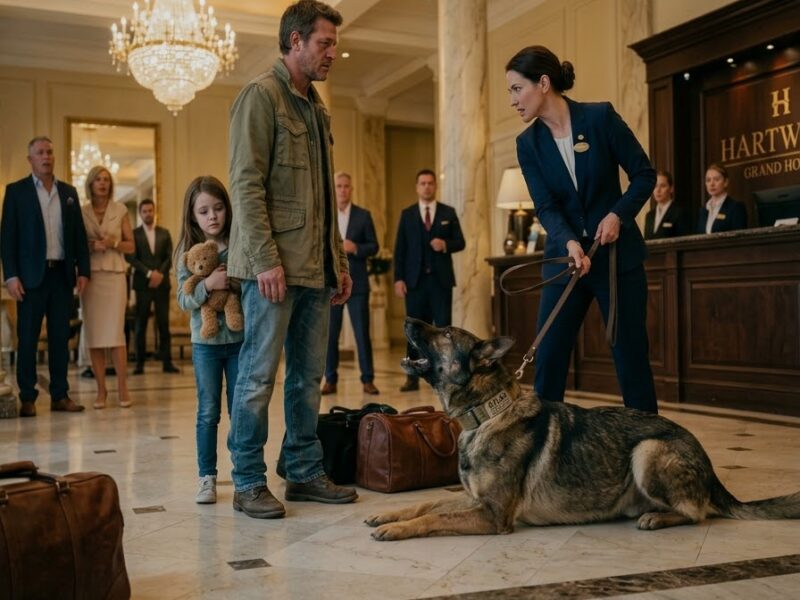
They dragged my injured K9 across the marble lobby of my own hotel while my eight-year-old daughter screamed for them to stop
The glass doors of the Grand Harbor Hotel slid open, releasing a wave of warm, lavender-scented air into the freezing rain of a late autumn evening. Outside, Lake Michigan tossed gray waves against the concrete piers of Chicago, but inside, the lobby was a sanctuary of gilded brass, polished mahogany, and forty-foot ceilings anchored by a cascading crystal chandelier.
I stepped onto the hand-carved Italian marble floor wearing a worn denim jacket, mud-stained boots, and carrying my eight-year-old daughter Lily’s pink plastic backpack over one shoulder. At my side walked Atlas, a seven-year-old Belgian Malinois whose ears were permanently scarred from a shrapnel tear outside Mosul. His black-and-tan coat was damp from the rain, but his heavy paws moved without a sound across the gleaming floor.
Lily pulled her yellow raincoat tighter around her chest, her hand buried deep in mine. She was tired, her eyes rimmed with red after an eight-hour drive from our cabin in upper Michigan.
“Dad,” she whispered, looking around at the soaring pillars and the tuxedoed bellhops gliding past. “Is this really Mom’s hotel?”
“It belonged to your mother,” I said softly, my voice raspy from cold air and months of silence. “And now it belongs to us.”
Six months ago, my wife Elena died when her car swerved off an icy road near our country home. The grief had knocked the breath out of my lungs, leaving me hollowed out and unable to face the concrete empire she had built. Elena had been the brilliant mind behind the Grand Harbor, a three-hundred-room luxury resort that catered to diplomats, CEOs, and international elite. I was just the quiet partner—an ex-Navy SEAL who preferred running tactical training contracts and living off the grid.
When she passed, the estate attorneys urged me to take the reins immediately. Instead, I stayed hidden. I let the executive staff believe I was a shattered recluse with no interest in corporate operations. I wanted to see how the machine ran when the master wasn’t watching.
Tonight was supposed to be my silent return—an unannounced visit to inspect the night staff, check the books in person, and take Lily to her mother’s old penthouse suite.
We approached the curved marble front desk. Behind the polished counter stood a young woman with a sleek gold name tag that read Jessica. She was scrolling through a tablet, her face tight with boredom, until she looked up and absorbed the sight of my patched jacket, Lily’s muddy boots, and Atlas’s broad, tactical chest.
Her eyebrows pulled together in instant disgust. “Can I help you?”
“Good evening,” I said, leaning against the counter. “I’d like the keys to the top-floor penthouse suite, please.”
Jessica let out a short, sharp laugh, not even attempting to hide her contempt. “The penthouse is reserved for executive VIPs, sir. The night rates start at four thousand dollars. There is a budget motel three blocks south near the highway.”
Lily looked up at me, confused. “Dad?”
I managed a small, tired smile. “I don’t need to rent it, Jessica. I own the hotel. My name is Ethan Carter.”
The clerk didn’t check the terminal. She didn’t look at the system. She simply folded her arms and smirked. “Sir, seriously. If you don’t leave the lobby right now, I’m calling security. We have a strict policy regarding loitering and unauthorized animals.”
“He’s not an animal,” Lily said, her small voice rising with protective anger as she patted Atlas’s broad head. “He’s Atlas! He was in the military!”
“Lily, it’s okay,” I murmured, keeping my temper locked behind years of professional discipline. “Jessica, check the corporate registry on your terminal. Look under the Carter Holding Trust.”
Before she could answer, heavy footsteps echoed off the marble floor behind us. A broad-shouldered man in a navy security blazer approached, his hand resting casually near his heavy leather belt. His tag read Vance – Security Supervisor.
“Problem here, Jessica?” Vance asked, his eyes sweeping over my worn clothes with dark satisfaction.
“This man is harassing me and refusing to leave,” she said smoothly. “He’s claiming he owns the building.”
Vance stepped into my personal space, his chest puffed out, bringing the foul smell of stale cigarettes and cheap aftershave with him. “You heard the lady. Take the mutt and get out before I physically remove you.”
Atlas felt the shift in tension instantly. He didn’t bark—combat-trained dogs don’t waste breath on noise. He lowered his center of gravity, his dark ears pinning back, a low structural rumble vibrating deep within his ribcage.
“Step back,” I told Vance, my voice dropping to a flat, dangerous register that used to make junior officers freeze in their tracks. “He’s a retired military working dog. He senses aggression.”
“I don’t care if he’s the Pope’s dog,” Vance snapped. He reached down aggressively, grabbing Atlas’s thick tactical harness to haul him toward the glass doors.
“Atlas, hold!” I commanded, but Vance pulled hard, twisting the harness.
Atlas planted his paws, refusing to budge, letting out a sharp warning growl. Vance panicked. He reached to his belt, pulled a heavy, weighted steel baton, and swung it downward with full force.
CRACK.
The sound of metal striking living bone echoed through the vast, quiet lobby like a gunshot.
The blow caught Atlas directly on his left shoulder. The dog let out a sharp, choked yelp—a sound I had never heard him make, even when an IED fragment tore his ear in Iraq—and collapsed onto his side on the slick marble floor.
“ATLAS!” Lily shrieked, her voice shattering the quiet dignity of the hotel. She burst into tears, dropping to her knees beside the dog. “Daddy, make him stop! Daddy!”
“Get that animal off the floor!” Vance barked, raising the baton again.
Something broke inside me. The six months of numb, suffocating grief vanished, replaced by an incandescent, white-hot rage that burned away every drop of civilized restraint.
Before Vance could bring the baton down a second time, I stepped inside his reach. My left hand shot out like a steel vise, clamping onto his throat, while my right palm slammed upward into the base of his nose. Bones crunched under the impact. Vance let out a gurgling cry, dropping the baton as he stumbled backward, crashing heavily into a brass luggage cart before hitting the floor.
Two junior security guards came running from the elevator bank, drawing their tasers.
“STAY BACK!” I roared, turning on them with such sheer, violent malice that both men froze, their weapons hovering in mid-air, their faces draining of color.
I dropped to my knees beside Atlas. Blood was pooling beneath his shoulder, staining the pristine white marble. He was breathing in fast, shallow gasps, his tongue hanging limply out of his mouth as his dark eyes locked onto mine, searching for safety.
“Stay with me, buddy,” I whispered, my hands trembling as I pressed my jacket against his wound to stem the bleeding. “Stay with me.”
“What in God’s name is happening here?!”
A tall man in an Italian wool suit marched out of the executive office corridor. His hair was slicked back, his gold cuff links flashing under the chandeliers, his posture radiating smooth, corporate arrogance. This was Julian Sterling—the general manager Elena had hired three years ago to oversee daily operations.
Sterling took in the scene: Vance groaning on the floor covered in blood, two guards terrified, a weeping child, and a bleeding dog surrounded by ruined marble.
He didn’t look at the dog. He didn’t look at Lily. He looked at me with cold disgust.
“Sir, you are trespassing, you have assaulted my staff, and you’re disturbing high-paying guests,” Sterling said, pulling a silk handkerchief from his pocket to touch his nose as if the air were foul. “Leave immediately before I have the police arrest you for felony assault.”
I slowly stood up. My hands were covered in Atlas’s blood. My daughter was sobbing, clutching my leg.
“You just permitted your staff to strike a decorated combat dog,” I said, my voice dead and cold. “You didn’t ask what happened. You didn’t check on a child. You just told me to leave.”
Sterling sneered. “Look at you. You look like a vagrant who wandered in from the lakefront. You don’t belong in a place like this. You don’t look like anyone who matters.”
I pulled my phone from my pocket with steady, surgical precision. I bypassed the main screen and hit a speed-dial number I hadn’t used since Elena’s funeral.
The line rang once.
“Ethan?” the voice answered—Arthur Pendelton, senior partner at Pendelton & Croft, the primary legal counsel for the hotel’s holding firm, and chairman of the executive board. “Where have you been? We’ve been trying to reach—”
“Arthur,” I interrupted, staring directly into Sterling’s eyes. “Bring the board down to the main lobby. Right now.”
Sterling’s sneer faltered slightly. “Who are you calling? You think some local lawyer is going to—”
Five minutes passed in heavy, suffocating silence. The lobby grew still as guests stopped to watch the bloody scene near the front desk.
Then, the private executive elevators chimed.
Arthur Pendelton rushed out, followed by three senior board members in formal attire. Arthur took one look at me, recognized the dead-eyed focus on my face, and turned pale.
He sprinted across the marble, ignoring Sterling entirely, and stopped two feet from me.
“Mr. Carter!” Arthur gasped, his voice trembling. “Good God… what happened here? Are you all right?”
The lobby went completely silent.
Jessica behind the counter dropped her tablet; it shattered against the floor. Vance, still nursing his broken nose on the ground, stopped groaning.
Julian Sterling stood entirely frozen, his mouth opening and closing like a fish pulled out of water. “Mr… Mr. Carter?” he stammered, the blood draining from his face until he looked like a corpse. “Arthur… who is this?”
“This is Ethan Carter,” Arthur barked, turning on Sterling with pure fury. “He is the sole owner of the Grand Harbor Hotel! He owns ninety percent of the holding stock!”
Sterling’s knees literally buckled. He reached out, gripping the edge of the front desk to keep from falling. “I… I didn’t know… he didn’t identify… there was no record of an arrival…”
I didn’t listen to his excuses. I looked down at Atlas, whose breathing was growing fainter by the second.
“Arthur,” I said, my voice cutting through the panic in the room like a razor. “Get the best emergency veterinarian in Chicago to the loading dock in ten minutes. If that dog dies, I will tear this board apart piece by piece.”
“Right away!” Arthur yelled, pulling his phone out instantly.
I stepped closer to Sterling until I could smell the cold sweat pouring off him.
“You’re fired,” I said softly. “Clear your desk. You have five minutes before security throws you onto the street.”
Sterling began to plead, his arrogance completely shattered. “Mr. Carter, please! It was a misunderstanding! We have policies about unregistered animals—we didn’t know who you were!”
“No,” I whispered, looking down at the blood staining my boots. “It wasn’t a misunderstanding. It was exactly what I needed to see.”
Within fifteen minutes, an emergency veterinary transport unit backed into the lower subterranean service bay. Dr. Sarah Lin, a trauma veterinarian who specialized in working dogs, stabilized Atlas with IV fluids and morphine before loading him onto a stretcher.
“The blunt force trauma fractured his scapula,” Dr. Lin told me as she secured the straps around Atlas’s chest. “There’s internal bleeding near the joint. He’s in shock, Mr. Carter, but he’s strong. We’re taking him straight to the surgical center on North Avenue.”
“Save him,” I said, rubbing Atlas’s soft muzzle one last time before they closed the ambulance doors. “Whatever it costs. Save him.”
I took Lily up to Elena’s old private apartment on the thirtieth floor—a secluded wing of the hotel that required a biometric keycard. The room was exactly as Elena had left it: her favorite painting of the Michigan shoreline hanging above the fireplace, her collection of fountain pens neatly aligned on the mahogany desk, the faint lingering scent of her jasmine perfume still trapped in the heavy velvet curtains.
I put Lily to bed in the master suite, wrapping her in a warm blanket while she held her favorite stuffed bear.
“Is Atlas going to come back, Daddy?” she asked, her eyelids heavy from exhaustion and tears.
“Atlas is a soldier, sweet pea,” I kissed her forehead, smoothing her hair back. “He’s tough. He’s going to beat this. I promise.”
Once she fell asleep, I engaged the suite’s secondary electronic deadbolts, posted two armed, off-duty police officers I trusted personally outside her door, and walked back down to the executive offices on the third floor.
The office wing was silent, illuminated only by emergency exit signs. Arthur Pendelton was waiting for me inside Julian Sterling’s former office, alongside a team of three forensic accountants who had been brought in under emergency order.
“Ethan,” Arthur said, handing me a glass of scotch I didn’t drink. “We’ve already initiated the termination paperwork for Sterling, Vance, and the front desk clerk. But… you need to see what we found in Sterling’s personal vault.”
Arthur gestured toward the desk, where dozens of red leather-bound ledgers and external hard drives were laid out under a bright lamp.
“What is it?” I asked, pulling up a leather chair.
“Julian Sterling wasn’t just managing the hotel poorly,” Arthur explained, his face grim. “He was running a massive, highly sophisticated embezzling scheme. For the past four months—coincidentally starting right after Elena’s death—he’s been falsifying structural maintenance reports, inflating vendor invoices by three hundred percent, and routing the excess funds through a shell company registered in the Cayman Islands.”
One of the forensic accountants looked up from her laptop. “So far, Mr. Carter, we’ve tracked four point two million dollars stolen from the hotel’s operational reserves. He was draining the building dry, preparing to declare bankruptcy on the property so it could be bought for pennies on the dollar at a foreclosed asset auction.”
I leaned over the desk, my eyes scanning the rows of fake numbers. “Who was going to buy it at auction?”
“That’s the strange part,” Arthur said, reaching into a manila folder and pulling out a single sheet of paper protected by a plastic sleeve. “The shell company bidding on the debt isn’t owned by Sterling. He was just the inside man. The primary backer is a private equity group called Apex Horizon.”
The name hit me like a cold spray of water. Apex Horizon was the same corporate entity that had tried to buy out Elena’s real estate holdings three years ago—an aggressive, shadowy syndicate with deep ties to foreign investment groups. Elena had flatly rejected their offers, calling their representatives “criminals in tailored suits.”
“They waited for Elena to die,” I muttered, my mind connecting the threads. “They knew I was out of the picture, crippled by grief up in the woods. They bought off Sterling to sabotage the hotel from the inside so they could force a distress sale.”
“It gets worse,” Arthur said quietly. He pushed another document across the blotter.
It was a physical folder pulled directly from the hidden wall safe behind Sterling’s desk. Inside was a single, printed surveillance report containing photographs of me.
There were photos of me buying groceries in our small Michigan town. Photos of Lily at her elementary school playground. Photos of Atlas sleeping on our cabin porch.
Every single aspect of our quiet, isolated life over the last six months had been cataloged, timestamped, and documented.
And clipped to the top of the file was a yellow sticky note with three handwritten sentences written in sharp, precise blue ink:
The target remains non-functional in Michigan.
Keep the owner away from the hotel at all costs.
If he returns, execute Protocol C.
My blood went dead cold. The ambient noise of the air conditioning, the low murmur of the accountants—everything faded into a sharp, lethal silence.
This wasn’t just a corporate takeover. This wasn’t just white-collar embezzlement.
They had been watching my home. They had been monitoring my daughter. And Sterling had explicit orders to make sure I never stepped foot back inside this building.
“What is Protocol C?” Arthur asked, his voice barely a whisper as he read the note over my shoulder.
“Protocol C isn’t corporate jargon, Arthur,” I said, my fingers pressing so hard into the oak desk that my knuckles turned white. “It’s tactical military terminology. It means liquidating an asset when compromise occurs.”
Before Arthur could reply, the phone in my jacket pocket began to vibrate.
I pulled it out. The screen displayed a blocked, untraceable number.
I pressed answer and placed the phone to my ear, keeping my voice completely neutral. “Carter.”
Static crackled over the line, followed by the quiet, rhythmic sound of heavy breathing. Then, a man’s voice spoke—low, muffled by a voice changer, but cold and entirely devoid of emotion.
“You should have stayed in the woods, Ethan,” the voice whispered. “You should have stayed away.”
“Who is this?” I demanded, my combat instincts flaring into high alert.
“Your dog took a blow meant for your ego,” the voice rasped softly. “Consider it a courtesy warning. The Grand Harbor doesn’t belong to your family anymore. If you stay in Chicago past sunrise, your daughter won’t make it back to Michigan.”
CLICK.
The line went dead.
I lowered the phone slowly. In the quiet office, Arthur was staring at me, his eyes wide with absolute terror.
“Ethan… who was that? Was that Sterling?”
“No,” I said, standing up and pulling my leather holstered sidearm from my duffel bag—a Glock 19 I had kept locked away since leaving the service. “Sterling was just the dog on the leash. The man on the phone just made the biggest mistake of his life.”
I checked the magazine, racked a round into the chamber, and engaged the safety with a sharp, metallic click.
“They touched my dog,” I whispered, looking out the floor-to-ceiling window at the black, rain-swept expanse of Lake Michigan. “They threatened my daughter. Now I’m going to burn their entire house down.”
By 0200 hours, the storm outside had intensified into a full-blown gale. Rain lashed against the high windows of the Grand Harbor, and the distant rumble of thunder rolled across the lake.
I left Arthur with strict instructions to lock down the hotel’s financial servers and secure all remaining physical files in a private bank vault under heavy guard. Then I took the private service elevator down to the lowest basement level—Level B3.
Level B3 wasn’t accessible to guests or standard hotel staff. It was a cavernous, concrete labyrinth housing the main boiler systems, electrical sub-stations, and the old historical vaults built back in the 1920s when the hotel was a speakeasy haven.
If Sterling was executing orders from an outside party, he had to have a local staging point—a place inside the building where he could store unmonitored communication gear and physical cash off the main network.
I moved down the damp concrete corridor, the Glock resting comfortably in my right hand, held low against my thigh. The smell of rust, wet coal, and ozone hung heavy in the cold air.
Near the back of the boiler room, tucked behind a disused steam pipe, sat a heavy steel door marked MAINTENANCE STORAGE – AUTHORIZED PERSONNEL ONLY.
The lock wasn’t standard hotel hardware. It was a high-grade commercial electronic keypad equipped with a biometric thumbprint scanner—far too sophisticated for a room meant to hold mops and paint cans.
I didn’t have the code, but I had something better.
I reached into my pocket and pulled out Julian Sterling’s personal keyring, which I had taken from his desk before security dragged him out. Attached to the ring was a small, high-frequency RFID master bypass fob that executive managers used for emergency access.
I pressed the fob against the sensor. The pad beeped twice, flickering from red to a solid, emerald green.
The heavy steel door unlatched with a wet, pneumatic hiss.
I pushed the door open, slipping inside with my weapon raised, sweeping the corners of the room in smooth, practiced arcs.
“Clear,” I muttered softly to myself.
The room was not a maintenance closet. It was a fully functional, high-tech tactical surveillance node.
Three large computer monitors mounted on the wall showed live, unauthorized feeds from forty different security cameras throughout the hotel—including the cameras covering the executive suites, the front desk, the main lobby, and the subterranean parking garage. A rack of encrypted radio equipment hummed in the corner, its blue lights blinking rhythmically in the gloom.
On the central worktable lay a map of Chicago, marked with red ink overlays, along with three untraceable burner phones, a set of suppressed submachine guns, and a stack of forged diplomatic passports.
This wasn’t just corporate espionage. This was a safehouse for a hit team.
I walked over to the central desk and woke up the main computer monitor. The system was locked behind an encryption screen, but a USB drive was still inserted into the side port.
I opened the drive’s directory. It contained a single folder labeled: OPERATION BLACKTHORN.
I clicked it open. Hundreds of files appeared, detailing a systematic plot that went far beyond the hotel.
Apex Horizon wasn’t just trying to steal the Grand Harbor. They were using the hotel’s subterranean private docks—which connected directly to the Chicago River and Lake Michigan—as an unmonitored entry point for smuggling unregistered weapons, illegal funds, and high-value targets into the heart of the Midwest.
Elena hadn’t just rejected their buyout offer three years ago. She had discovered their smuggling route.
She was going to the federal prosecutors. And that was why her car went off the road on an empty Michigan highway six months ago.
Her death wasn’t an accident. It was an assassination.
A cold, heavy stillness settled over my heart. The grief that had paralyzed me for half a year vanished, replaced by a crystal-clear, absolute certainty of purpose. They had taken Elena. They had tried to take her legacy. They had struck my dog, and they had threatened my daughter.
Suddenly, a quiet click echoed from the dark corridor outside the room.
My combat training kicked in instantly. I ducked behind the heavy steel server rack just as a burst of suppressed automatic fire shattered the glass monitors above the desk.
THWIP-THWIP-THWIP-THWIP!
Plastic, copper fragments, and sparks exploded across the room.
“Clear the room!” a harsh voice barked from the doorway in an accented tongue. “Find the drive!”
Two men in black tactical suits, wearing night-vision goggles and holding suppressed MP5 submachine guns, moved through the doorway in a tight, professional stack. They were fast, disciplined, and lethally precise—not common thugs, but professional mercenaries.
I didn’t wait for them to clear the corner.
I leaned out from behind the server rack and fired three rounds in rapid succession.
BANG! BANG! BANG!
The heavy 9mm hollow-point rounds slammed into the chest of the lead shooter. His body armor absorbed the force, but the sheer momentum knocked him backward into his partner.
Before the second man could bring his weapon to bear, I lunged forward, grabbing the hot barrel of his submachine gun and forcing it upward toward the concrete ceiling.
THWIP-THWIP-THWIP!
The bullets chewed harmlessly into the overhead pipes, releasing a blinding cloud of scalding white steam into the small room.
The guard screamed as the steam hit his face. I drove my left knee violently into his groin, pulled his head down, and cracked his skull against the edge of the steel worktable. He collapsed to the floor, instantly unconscious.
The first shooter was scrambling back to his feet, pulling a combat knife from his tactical vest.
I didn’t give him the chance. I stepped through the cloud of steam, side-stepped his desperate blade thrust, caught his wrist, and twisted it until the bone snapped with a wet pop. The knife dropped to the floor. I drove my elbow hard into his solar plexus, followed by a sweeping kick that brought him crashing down onto the concrete floor.
I planted my boot squarely on his neck, pressing down just hard enough to restrict his airway without crushing his windpipe.
“Who sent you?” I demanded, my voice low, dangerous, and dripping with lethal intent.
The mercenary choked, his eyes wide with terror under his tactical goggles as he stared up at the blood-stained denim jacket and the dead eyes of an ex-SEAL.
“Apex…” he gasped, struggling for air. “Apex… Security…”
“Where is your team lead?”
“The… the lower dock…” he choked out, pointing frantically toward the rear service corridor. “Boat… coming… at 0300…”
I reached down, pulled a pair of heavy zip-ties from his own vest, and bound his hands and feet tightly before knocking him out cold with a precise strike to the jaw.
I picked up one of the suppressed MP5s from the floor, checked the magazine, and slung it over my shoulder.
I looked at my watch. It was 0245 hours.
The boat was arriving in fifteen minutes. And the man who had ordered the hit on Elena was on board.
The subterranean dock beneath the Grand Harbor was an engineering marvel built during the city’s industrial boom. It was a massive concrete cavern situated twenty feet below street level, where a private water channel connected directly to the mouth of the Chicago River and out into Lake Michigan.
Heavy steel floodgates controlled the water level, allowing private yachts and supply barges to slip into the hotel’s lower hold entirely unseen by the public.
Tonight, the channel was a churning cauldron of black water, whipped into a frenzy by the storm raging outside. Rain poured through the open drainage grates overhead, splashing against the concrete walkways.
I took a position behind a stack of wooden cargo crates twenty feet above the main slip, my MP5 resting on a steel handrail, scanning the black water.
At precisely 0255 hours, the low, mechanical rumble of twin diesel engines echoed through the concrete tunnel.
A sleek, sixty-foot black tactical cruiser slid slowly through the outer floodgates, its running lights turned off, its hull cutting through the dark water like a shark.
The boat bumped softly against the rubber bumpers of the main dock.
Four armed men in dark rain gear stepped onto the dock, securing the heavy mooring lines to the iron cleats. Once the vessel was secured, the cabin door opened, and two men stepped out onto the deck under the yellow glare of a single overhead floodlight.
The first man was Julian Sterling. He looked broken, his expensive suit ruined, his hands trembling as he clutched a leather briefcase to his chest.
The second man was tall, broad-shouldered, wearing a long gray waterproof coat. He carried a silver-handled walking stick, his face framed by a short, perfectly groomed gray beard and sharp, predatory eyes that swept the dock with casual authority.
I recognized him instantly from intelligence briefings during my service days.
This was Victor Vance—former rogue defense contractor, founder of Apex Horizon, and the older brother of Vance, the security supervisor who had struck my dog in the lobby.
“Where is the secondary package, Julian?” Victor Vance asked, his voice booming softly off the wet concrete walls—the exact same voice that had threatened me over the phone an hour ago.
“I… I couldn’t get it, Victor,” Sterling stammered, shrinking under the big man’s gaze. “Carter returned. He took control of the building. His security team locked down the upper floors before my people could reach the suite.”
Victor Vance stopped, turning slowly to face Sterling. His expression didn’t show anger—it showed a cold, absolute indifference that was far more terrifying.
“You had one responsibility, Julian,” Vance said softly. “Keep a grieving, broken man away from his money for six months while we finalized the transfer documents. And you let him walk into the lobby, assault my brother, and take back the property in twenty minutes.”
“He had his dog!” Sterling cried desperately. “He called the board! I didn’t know he was coming back!”
“Failure is a choice, Julian,” Vance said smoothly. He reached into his gray coat, pulled a suppressed pistol, and casually shot Sterling once in the chest.
THWIP.
Sterling’s eyes went wide. He dropped the briefcase, stumbled backward off the edge of the dock, and splashed into the cold, churning black water of the channel, disappearing beneath the surface.
Vance didn’t even watch him sink. He wiped a drop of rain from his coat sleeve and turned to his lead guard. “Cast off the lines. We go to the secondary site in Indiana. Burn the hotel servers remotely.”
“You’re not going anywhere, Vance,” I called out from the darkness above.
The four guards on the dock reacted instantly, raising their rifles toward the overhead catwalk.
Before they could acquire their targets, I squeezed the trigger of my MP5.
THWIP-THWIP-THWIP-THWIP!
A burst of 9mm rounds swept across the dock, tearing through the fuel lines of the dockside emergency generator. The generator exploded in a violent, blinding shower of orange sparks and fire, plunging the entire lower cavern into near-total darkness, illuminated only by the flickering flames.
Panic broke out on the dock.
“Target overhead!” a guard screamed, firing blindly into the catwalks.
I didn’t stay on the high ground. I leaped over the handrail, dropping twenty feet down into a heavy wooden crate of foam insulation, absorbing the impact with a roll before coming up on my feet behind the main dock pillar.
The storm outside seemed to enter the cavern. Thunder shook the concrete walls, and the wind howled through the open floodgates, throwing freezing spray across the concrete floor.
I moved through the darkness like a ghost, using the shadows and the sound of the roaring fire to isolate the guards one by one.
THWIP-THWIP.
The first guard collapsed into the water as I caught him from behind near the stern of the boat.
THWIP-THWIP.
The second guard went down near the mooring lines, his weapon skittering across the slick concrete.
The remaining two guards panicked, spraying wild automatic fire toward the flames, backing toward the boat’s cabin.
“Vance!” I roared over the sound of the fire and the storm, my voice echoing off the concrete vault like a demon rising from the deep. “You killed my wife! You struck my dog! You threatened my daughter! Look at me!”
Vance stood on the deck of the cruiser, his suppressed pistol raised, his eyes wide as he searched the darkness. For the first time, the cool, arrogant composure on his face was completely shattered.
He realized he wasn’t fighting a grieving corporate heir. He was hunting a man who had spent his life surviving in the dark.
Out of the smoke and flames, I stepped onto the open dock, my MP5 held low, my blood-stained jacket soaked with rain, my eyes locked onto his.
“Carter…” Vance whispered, his voice trembling as he raised his pistol.
Before his finger could press the trigger, a loud, familiar bark echoed from the upper catwalks.
A dark shape burst through the upper service doors, vaulting over the guardrail without a second of hesitation.
It was Atlas.
His left shoulder was heavily bandaged, his fur matted with rain, a temporary surgical IV tap still taped to his front paw—but his eyes were burning with pure, unyielding combat drive. He had broken out of the veterinary transport, led by his legendary instincts, tracking my scent through the subterranean levels of the hotel to find his master.
Atlas hit the dock with a heavy thud, landed on his good legs, and launched himself twenty feet through the air directly at Victor Vance.
“NO!” Vance screamed.
Atlas hit Vance full in the chest, the ninety-pound Malinois driving the tall man backward off the deck of the cruiser. Both of them crashed violently onto the wet concrete of the dock.
Vance’s pistol flew from his hand, bouncing into the black water of the channel.
Vance hit the ground hard, gasping for air as Atlas stood over his chest, his powerful jaws locked onto the collar of Vance’s leather coat, a guttural, terrifying growl shaking the dog’s broad frame. One snap of Atlas’s jaw, and Vance’s throat would be torn open.
“Atlas! HOLD!” I commanded, my voice cutting through the roar of the storm.
Atlas froze instantly. He didn’t bite. He simply pressed his heavy front paws onto Vance’s shoulders, his bared teeth inches from the man’s face, holding him pinned to the freezing concrete like a stone weight.
I walked over slowly, standing over the man who had ordered the destruction of my family.
Vance lay there, trembling uncontrollably under the weight of the combat dog, his eyes wide with absolute, pathetic terror. The great corporate mastermind, the shadowy syndicate boss who had spent months manipulating events from afar, was now just a terrified old man lying in a puddle of dirty rainwater.
“Please…” Vance choked out, his voice a pathetic whimper. “Don’t… don’t let him…”
I reached down, pulled the wet leather briefcase from the dock where Sterling had dropped it, and clicked it open. Inside were the master digital hard drives containing the entire financial network of Apex Horizon, along with the encrypted evidence proving their involvement in Elena’s death.
“This is over, Vance,” I said, my voice cold, flat, and final. “Your accounts are frozen. Your mercenaries are dead or captured. And the federal prosecutor is going to receive every single file on this drive by sunrise.”
In the distance, the loud, wailing sirens of dozens of Chicago Police cars, SWAT transports, and Federal Marshal vehicles echoed down the concrete access tunnels leading to the lower docks.
Arthur Pendelton had done his job. The law had finally arrived.
SWAT officers in heavy tactical gear flooded the dock moments later, their weapon lights cutting through the lingering smoke.
“POLICE! DON’T MOVE!”
“He’s all yours,” I said calmly, stepping back and giving a small hand signal to Atlas. “Atlas, heel.”
The brave dog instantly released Vance’s coat, stepped around the fallen man, and walked to my side, resting his broad head against my hip.
The SWAT officers swarmed Vance, pinning his arms behind his back and slapping heavy steel handcuffs onto his wrists as they dragged him away, screaming about his corporate lawyers and diplomatic connections. Nobody listened to him.
Arthur Pendelton ran down the concrete ramp, surrounded by police commanders, his face pale with relief when he saw me standing uninjured beside Atlas.
“Ethan!” Arthur panted. “The police… they found the safehouse files! The Justice Department just issued an emergency arrest warrant for the entire executive board of Apex Horizon!”
“I know,” I said, reaching down to gently pat Atlas’s head, feeling the strong, steady beat of his heart under my hand. “It’s done.”
Three days later.
The morning sun broke through the gray autumn clouds, casting brilliant golden light across the sparkling blue waters of Lake Michigan. The storm had passed, leaving the air crisp, clean, and smelling of autumn leaves.
The front doors of the Grand Harbor Hotel slid open.
Inside, the grand lobby was immaculate. The blood had been scrubbed from the white Italian marble, the damaged fixtures replaced, and the air was filled once again with the sweet scent of fresh lavender and roses.
A new staff stood behind the front desk—vetted, professional men and women who greeted guests with genuine warmth and respect. Vance was in a federal holding cell awaiting trial, Jessica had been permanently blacklisted from hospitality management, and the board had unanimously voted to install Arthur Pendelton as temporary chief operating officer under my direct supervision.
I walked through the lobby wearing a clean gray wool coat, polished black boots, holding Lily’s small hand in mine.
Beside us walked Atlas. His shoulder was supported by a sleek, custom medical harness, but he walked proudly, his head held high, his dark eyes scanning the room with quiet, protective calm.
Every bellhop, clerk, and guest stopped and stood at attention as we passed, bowing their heads in deep, silent respect to the owner and the brave dog who had saved the hotel.
We took the private elevator up to the top floor—to Elena’s penthouse.
I stepped out onto the broad outdoor terrace overlooking the sweeping Chicago skyline and the vast, infinite horizon of the lake.
Lily ran to the railing, her face glowing in the warm morning sun as she laughed, pointing at the sailboats gliding across the blue water. “Look, Daddy! Look how pretty it is!”
Atlas walked over to the edge, sitting down beside her, leaning his heavy chest against her knee as she gently wrapped her arm around his neck.
I walked up behind them, resting my hands on the cool brass handrail, breathing in the fresh, clean air of a new day.
The weight of six months of dark, suffocating grief had finally lifted from my shoulders. The ghosts had been laid to rest. The truth had been brought to light.
I looked down at the scar on my hand, then at my daughter’s bright, smiling face, and finally at the faithful dog who had stood by my side through the dirt of war and the halls of luxury.
“We’re home, sweet pea,” I whispered softly into the gentle wind, feeling Elena’s presence in the warm sunlight around us. “We’re finally home.”
The end.









