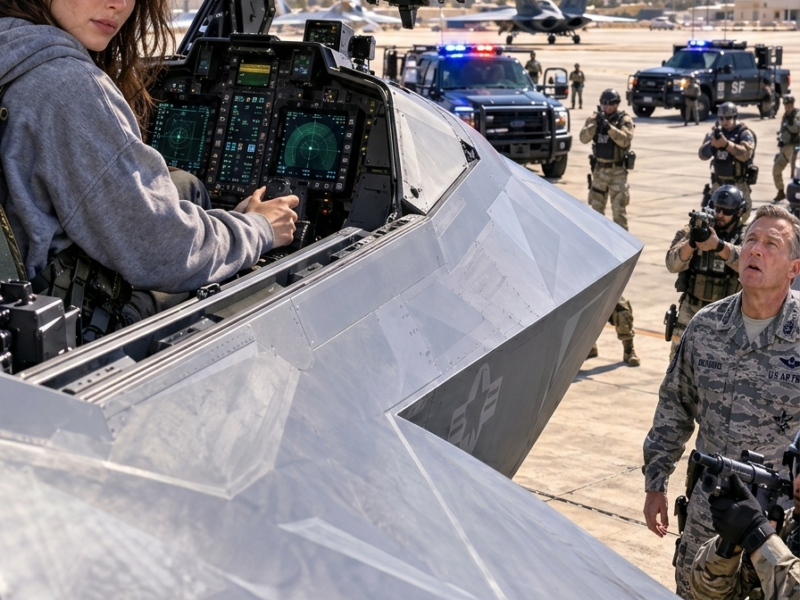
They dragged me out of a fighter jet in front of an entire squadron, accused me of trespassing, and laughed when I said I belonged there, but the moment the commander saw the faded bracelet on my wrist
I was sitting inside the cockpit when the alarms started screaming.
The high-pitched siren pierced the heavy stillness of Hangar 3 at Edwards Air Force Base, bouncing off the corrugated steel walls and reverberating directly into my chest. Through the curved glass of the F-22 Raptor’s canopy, I saw the main access doors slam open. A dozen armed security personnel surged across the concrete floor, their combat boots striking the pavement like a rhythmic drumbeat of violence.
I sat frozen in the ejection seat. I wasn’t wearing a flight suit or a tactical helmet. I was wearing faded blue jeans, an oversized gray sweatshirt, and a pair of worn-out sneakers that suddenly felt embarrassingly ordinary against the backdrop of a ninety-million-dollar war machine.
“Get your hands where we can see them!” the lead guard bellowed, unholstering his sidearm and aiming it directly at my head. “Step out of the aircraft slowly! Do it now!”
I obeyed immediately, lifting my trembling hands into the air.
Two guards grabbed my arms the second my feet touched the boarding ladder, pulling me roughly down to the hard ground. They forced my arms behind my back, pushing my shoulders low until my face was inches from the cold concrete.
“I didn’t break anything!” I gasped, my voice shaking as tears of panic stung my eyes. “Please… I didn’t mean any harm! I only wanted to see it!”
A group of elite pilots had gathered near the briefing room entrance across the bay, drawn by the sirens. They stood in immaculate flight gear, arms crossed, watching the scene with cold, amused detachment.
“What’s next?” one of the younger pilots snickered, nudging his wingman. “A high school tourist trying to joyride an F-22 home?”
A wave of cruel laughter echoed through the hangar. My cheeks burned with deep shame, but I forced myself to remain silent. I had learned a long time ago that showing vulnerability to people who thought they were superior only gave them more ammunition to crush you. They saw a crazy, trespassing girl who looked like she belonged anywhere except near a classified military installation. They didn’t know how I had slipped past three security checkpoints. They didn’t know why I was here.
“Clear the area! What in God’s name is happening here?” a deep, authoritative voice boomed from the hangar entrance.
The crowd of pilots instantly snapped to attention. Commander Daniel Hayes strode into the light, his jaw set like iron, his graying hair cropped in a sharp military cut. His chest was adorned with medals, and his eyes carried the sharp, unforgiving intensity of a man used to absolute obedience.
“Unauthorized civilian breach, sir,” the lead guard reported, keeping a firm grip on my arm. “We caught her sitting inside the cockpit of Tail Number 04. She bypassed the electronic perimeter.”
Hayes stopped a few feet from me, looking down with visible irritation and disgust. “Do you have any idea how much this aircraft costs, young lady?”
“No, sir,” I whispered, keeping my eyes on the ground.
“It costs ninety million dollars,” Hayes said coldly. “And it carries classified avionics that civilians aren’t permitted to look at, let alone sit in. Perhaps you should have considered the consequences before deciding to commit a federal felony.”
“Take her identification,” Hayes ordered the guard, turning his back to examine the fighter jet’s intake for damage. “Have military police place her in federal custody.”
The guard pulled my right wrist back aggressively to check for contraband or identification tags. In the process, the sleeve of my gray sweatshirt slipped back up my forearm, revealing a worn, faded black cord bracelet featuring a tiny, tarnished silver wing charm.
Hayes turned around to hand a clipboard to an officer, but his eyes caught the silver wing.
He stopped breathing.
The commander froze completely mid-step, his body locking up as if he had been struck by lightning. His gaze locked onto my exposed wrist, his eyes widening in absolute horror.
Slowly, without saying a word, he stepped closer to me. The harsh color in his face drained away, leaving him looking as pale as an ash burial shroud.
“Where did you get that?” Hayes asked. His voice was no longer commanding—it was a barely audible, trembling whisper.
I instinctively pulled my arm back, covering the bracelet with my sleeve. “It belonged to my father.”
Hayes took a ragged step backward, his hand grasping the edge of a tool cart to steady himself. “What… what was his name?”
“Michael Bennett,” I answered softly.
A strange, suffocating silence descended upon the entire hangar. The laughter died instantly. An older pilot standing near the back slowly took off his sunglasses, staring at me with a look of profound disbelief.
Hayes shook his head, staring at my face as if looking at a ghost climb out of a grave. “That’s impossible,” he whispered, his voice cracking.
I felt my stomach knot into a tight, icy ball. “My father died when I was eight years old.”
“No,” Hayes said, his breath hitching in his chest. “No, Lieutenant Michael Bennett’s aircraft suffered a catastrophic structural failure over the deep waters of the Pacific Ocean twelve years ago. The wreckage sank in thousands of feet of water. There were no survivors. We buried an empty casket.”
I had heard that exact story my entire life. My mother had spent her life staring out of living room windows in complete silence, refusing to ever speak his name. The Department of Defense had sent our family a folded American flag accompanied by a cold, formal letter stating that my father had died honorably while serving his country on a routine operational test.
But three weeks before my mother passed away from cancer, she had handed me a small, sealed yellow envelope with a lock of her hair and made me promise never to open it until my eighteenth birthday.
Inside that envelope was a single, aged photograph of my father standing right beside Tail Number 04—the exact F-22 Raptor I had climbed into today. On the back of the photograph, written in dark blue ink, was a single handwritten line:
If you ever find this aircraft, ask Daniel Hayes what really happened to me.
It had taken me six agonizing months of digging through public military registries, tracking down base transfers, and sneaking onto Edwards AFB to locate this specific plane. I had never imagined that the man named on the back of the photo would be standing right in front of me commanding the base.
With trembling fingers, I reached deep into my sweatshirt pocket, pulled out the worn photograph, and held it out to Hayes.
The commander reached out with hands that shook violently. He took the photo, turned it over, and read the sentence on the back. A look of absolute terror flashed across his eyes.
He spun around toward the pilots and guards watching the encounter.
“Everyone out,” Hayes ordered, his voice sharp and laced with panic.
“Sir?” the lead guard asked, bewildered. “She’s an intruder, we need to book her—”
“I SAID EVERYONE GET OUT! NOW!” Hayes screamed, his voice echoing off the metal rafters.
The guards and pilots didn’t dare hesitate. Within ten seconds, the hangar was completely cleared. Hayes slammed the heavy steel security doors shut and locked the manual deadbolt.
He turned back toward me, looking older and more broken than any man I had ever seen.
“Your father didn’t die in that crash, Sarah,” Hayes whispered softly.
My knees buckled. I caught myself against the boarding ladder, my head spinning. “Then… where is he? Why did he leave us?”
Hayes opened his mouth to answer, but before a single word could escape his lips, a red emergency warning light above the security door began flashing wildly, bathing the hangar in a bloody crimson hue.
The secure, high-priority telephone sitting on Hayes’ workbench began ringing with a harsh, metallic tone.
Hayes stared at the phone in utter horror. He slowly walked over, picked up the receiver with a trembling hand, and pressed it to his ear. He didn’t speak. He just listened for three seconds, his eyes locking onto mine with an expression of pure dread.
Slowly, Hayes extended his arm, holding the heavy black receiver out toward me.
“It’s for you,” he rasped.
I stepped forward with numb legs and pressed the phone to my ear.
“Hello?” I whispered.
A voice came through the static-filled line—older, rougher, and raspy, but carrying an unmistakable tone that matched the faint childhood lullabies stored deep in my memory.
“Sweetheart,” the voice whispered through the radio static. “If Daniel has told you the truth, you need to get off that base right now.”
My breath caught in my throat. I couldn’t move. The voice belonged to the father I had buried in my heart twelve years ago.
“Dad?” I choked out, tears finally spilling down my cheeks.
“Listen to me carefully, Sarah,” he said, his tone urgent and filled with fear. “They know who you are. They know you found the letter. They are coming for you right now.”
“Dad!” I cried into the receiver, my hand clutching the cold plastic until my knuckles turned white. “Dad, where are you? Where have you been for twelve years?!”
“There’s no time, Sarah,” my father’s raspy voice cut through the line, heavy with static. “The warning light in that hangar isn’t a base exercise. They’ve compromised the airfield security grid. Hayes, give her the key to the western perimeter gate! Right now!”
Commander Hayes took the phone from my hand, his face slick with sweat. “Michael? Is it really you? How are you alive?”
“Listen to me, Daniel!” my father barked over the line, his authority piercing through the radio interference. “They tracked Sarah’s search history when she pulled the flight records for Tail Number 04. They let her breach the base because they knew she would lead them straight to you and the aircraft’s hard drive! Get her out of there through Sector 4, or she won’t make it to midnight!”
The line went completely dead with a sharp, metallic click.
Hayes lowered the phone, looking at me with a mixture of immense guilt and absolute panic. He rushed over to a heavy steel safe mounted near his workbench, punched in a six-digit code, and pulled out a small black electronic keycard along with a heavy tactical knife.
“Put these in your pocket,” Hayes said, pressing the keycard into my hands. “Your father was part of a black-budget operational program called Project Archangel. They were modifying fighter jets with autonomous tracking nodes—systems designed to take full control of an aircraft remotely. Twelve years ago, during a test flight over the ocean, your father realized the software wasn’t designed for defense. It was designed to allow a rogue contractor inside the defense sector to hijack military jets mid-air and execute unauthorized strikes anywhere in the world.”
My heart pounded against my ribs. “And my father tried to stop it?”
“He tried to sabotage the program,” Hayes whispered, leading me rapidly toward a side exit hidden behind a stack of crate storage. “When they realized what he was doing, they remotely locked his controls mid-flight over the Pacific and forced his plane into a vertical dive. Michael managed to eject manually before impact, but he knew if he returned home, they would murder your mother and you to keep him silent. He sacrificed his life, his family, his entire existence… to keep you safe in the shadows.”
“And now?” I asked, tears blurring my vision. “Who is trying to kill us now?”
“The people who built Archangel,” Hayes said, opening the heavy emergency door. Beyond it lay a dark, dusty alleyway behind the hangars, leading toward an unlit parking lot. “They’ve reactivated the program. They are trying to wipe out every remaining pilot who knows the original system overrides—and your father is the only one left alive who holds the primary encryption key.”
Suddenly, a loud explosion rocked the front of Hangar 3.
The heavy steel security doors we had locked moments ago bowed inward with a deafening screech of tearing metal. Black-clad tactical operatives carrying silenced automatic weapons poured into the hangar through the smoke, their movements precise and lethal.
“RUN, SARAH! GO TO THE WESTERN GATE!” Hayes screamed, shoving me out the door into the night air.
I didn’t look back.
I bolted into the darkness of the alleyway, my heart hammering like a trapped bird against my ribs. Behind me, the sound of muffled gunfire echoed through the steel structure, followed by the heavy thud of a body hitting the concrete floor. My stomach turned to ice, but terror pushed my feet forward faster than I thought possible.
I sprinted across the dark tarmac toward the perimeter fence, keeping low beneath the shadows of parked transport planes. The desert wind blew cold and harsh against my tear-stained face. In the distance, near the base’s western boundary line, a set of headlights flashed twice in the pitch-black darkness.
Flash. Flash.
I scrambled up a dusty dirt slope toward the chain-link fence. The western perimeter gate stood before me, illuminated only by a single amber lamp. I rushed over, swiped Commander Hayes’ electronic keycard through the terminal scanner, and listened as the heavy magnetic lock clicked open.
I pushed the gate open and stumbled out onto a desolate, two-lane desert road that stretched into the vast, empty Nevada wilderness.
A battered black pickup truck was idling near the shoulder, its engine rumbling like low thunder. The driver’s side door swung open.
“Get in!” a rough voice shouted from inside the cab.
I lunged into the passenger seat and slammed the heavy door shut just as three black SUVs rounded the corner from the main base access road, their high beams blinding us as they accelerated rapidly across the dirt.
The driver slammed his foot onto the gas pedal. The truck’s tires spun violently on the loose gravel before catching asphalt, launching us into the dark expanse of the desert highway at dangerous speeds.
I turned in my seat, my chest heaving as I looked at the man sitting beside me in the dim glow of the dashboard lights.
He was older than the pictures in my mother’s album. Deep, jagged scars lined his left cheek and neck—remnants of a high-speed ejection seat deployment. His hair was streaked with gray, and his arms were weathered, but his eyes were the exact shade of soft, warm brown I remembered from my earliest childhood memories.
He reached out with a scarred, calloused hand and squeezed my wrist—right over the faded black bracelet with the tiny silver wing.
“I’m sorry, Sarah,” my father whispered, tears glistening in his eyes as he kept his left hand firmly on the steering wheel. “I am so, so sorry I left you in the dark for so long.”
“Dad…” I sobbed, throwing my arms around his shoulders, burying my face in his jacket.
“I’ve got you, sweetheart,” he said softly, pressing a quick kiss against my hair. “I’ve got you now. But we can’t stop. They aren’t going to let us leave this desert alive.”
I looked into the side rearview mirror.
The three black SUVs were closing the gap quickly, their sleek bodies glistening under the desert moonlight, moving without headlights like three predators hunting in the dark.
The roar of the truck’s engine echoed across the vast, empty expanse of the Mojave Desert. The speedometer needle hovered near ninety miles per hour, but the three black SUVs behind us were gaining ground with terrifying efficiency.
“Who are they, Dad?” I asked, gripping the dashboard tightly as the truck bounced wildly over a dip in the asphalt.
“Vanguard Dynamics,” my father said, his jaw clenched tight as he adjusted the rearview mirror. “They’re a private defense contractor that developed the secondary control software for Project Archangel. When the Air Force attempted to cancel their contract twelve years ago due to safety violations, Vanguard hid the backdoor code inside the avionics of several active F-22 units—including Tail Number 04.”
“Why did you leave that photo with Mom?” I asked, my voice cracking with emotional exhaustion. “Why write that message on the back?”
“Because I knew if Vanguard ever tried to activate the backdoor, they would have to target Tail Number 04 first to upload the master patch,” he explained, swerving hard to avoid a fallen rock on the dark highway. “I left that note because I knew that if anything ever happened to your mother, you might seek answers. I needed you to find Daniel Hayes before Vanguard found you. But I was too late… they monitored your digital footprint the moment you searched for that jet’s serial number.”
Suddenly, a heavy metallic CRASH echoed through the truck’s cabin.
The lead black SUV had caught up, slamming its armored front bumper directly into our rear quarter panel. The truck fishtailed wildly across the road, tires screaming against the asphalt as my father fought furiously with the steering wheel to keep us from rolling over into the ditch.
“Hang on!” he yelled.
The rear window of the lead SUV opened, and an operative leaned out holding a pneumatic cable launcher.
THUMP.
A thick, heavy steel cable with a magnetic clamp slammed onto the roof of our truck cab with a deafening metallic bang. The cable went taut as the SUV hit its brakes, dragging our vehicle backward and reducing our speed instantly.
“They’re trying to disable us!” I screamed.
“Sarah, look under your seat!” my father barked. “There’s a yellow emergency road flare kit and a crowbar! Grab them!”
I scrambled around in the dark footwell, my fingers brushing against cold metal until I found the heavy iron crowbar and a box of flare sticks. I pulled them out and looked at him. “What do I do?”
“I’m going to drop our speed! When I say now, smash out the rear cab window and hit that magnetic clamp off the roof!”
Before I could answer, the second SUV pulled alongside my passenger door. The tinted window rolled down, revealing an operative aiming a silenced weapon directly at my head.
My father saw it instantly. Instead of braking, he slammed his foot onto the gas and jerked the steering wheel hard to the right, ramming our heavy steel bumper straight into the side of the SUV. The impact sent a shower of sparks flying into the night air as the SUV was forced off the road, its tires digging into the loose desert sand before it flipped violently three times and exploded into a ball of orange flame.
“NOW, SARAH!” my father yelled.
I spun around, raised the heavy crowbar, and smashed the rear window of the truck cab. Glass shattered into thousands of tiny glittering pieces. Cold desert air rushed inside, deafening and fierce.
I reached up through the shattered window, wedged the flat edge of the crowbar beneath the heavy magnetic clamp stuck to our roof, and put every ounce of strength in my body into prying it upward.
The magnetic connection resisted for a agonizing second, then popped free with a loud CLANG.
The tension on the cable released instantly, sending the lead SUV swerving wildly across the highway into the opposing lane.
“Good job, kiddo!” my father roared, pressing the accelerator down to the floorboard.
We crested a long desert hill, the headlights illuminating a small, abandoned airstrip hidden inside a rocky canyon half a mile ahead. A rusty perimeter fence surrounded the strip, where the dark silhouette of a small, twin-engine prop plane was waiting under a dilapidated hangar overhang.
“Is that where we’re going?” I asked, wiping dust and glass fragments from my face.
“That’s our ride out of the country,” my father said, turning the truck off the main road and smashing straight through the wooden gate of the abandoned airfield. “I’ve got a secure haven setup across the border in Mexico. Once we get the hard drive data from my safe house, we deliver it directly to the Department of Justice.”
The truck slammed to a halt beside the twin-engine plane. My father grabbed a heavy canvas duffel bag from behind his seat, pushed his door open, and helped me scramble out into the cool night air.
“Get into the co-pilot seat!” he ordered, rushing toward the aircraft’s fuel line. “I need to unhook the static ground line!”
I ran up the airframe stairs and climbed into the small cockpit of the prop plane, my hands shaking as I looked out through the windshield.
In the distance, down the dirt access road, the headlights of the remaining black SUV appeared, moving at terrifying speed toward the airstrip.
“Dad! They’re here!” I screamed.
My father unhooked the fuel line, slammed the cargo door shut, and sprinted up the stairs into the pilot seat. He rapidly hit the engine ignition toggles. The twin propellers sputtered, coughed, and roared to life, sending a blast of wind whipping through the open hangar.
“They’re blocking the runway!” I yelled.
The black SUV sped directly onto the center of the dirt runway, positioning its heavy armored body straight in our takeoff path, its high beams shining directly into our eyes to blind us.
My father locked his hands on the throttle levers, his scars flushed red under the instrument lights.
“They think I’m going to stop,” my father said softly, a cold, dangerous smile touching his lips for the first time. “They forgot who taught me how to fly.”
He slammed the throttles forward into maximum takeoff power.
The twin engines roared with a deafening, metallic vibration that rattled every bolt in the small aircraft frame. We surged forward down the rough, dirt runway, accelerating directly toward the black armored SUV parked square in our path.
“Dad! We’re not going to clear it!” I screamed, pressing my back flat against my seat as the SUV grew larger in our windshield by the second.
Fifty yards. Thirty yards. Ten yards.
At the very last fraction of a second, my father pulled back hard on the control yoke, pulling the nose up into a near-vertical climb. The small plane’s landing gear brushed the roof of the SUV with a loud metallic THUD, ripping the vehicle’s roof rack clean off before our wings caught the rising air currents and lifted us into the vast expanse of the night sky.
I let out a long, ragged breath, my hands trembling uncontrollably in my lap as the desert floor receded into a dark sea of shadows below us.
“You okay, Sarah?” my father asked, leveling the aircraft off at ten thousand feet as we set a course southwest toward the border.
“I think my heart stopped three times,” I managed to say, letting out a weak, breathy laugh.
My father smiled warmly, reaching over to adjust the cockpit heater settings. “You’ve got your mother’s nerves of steel, kiddo. She used to scream at me the same way whenever I took her up in my old stunt plane.”
Silence settled over the cockpit for a few moments, broken only by the steady, rhythmic drone of the twin engines. I looked out the side window at the moonlit clouds floating beneath us like mountains of soft white cotton.
“Why didn’t you come back for us, Dad?” I asked softly, the painful question that had haunted my childhood finally escaping my lips. “After you got away from Vanguard… why did you let Mom believe you were dead for twelve years?”
My father’s smile faded instantly. He stared out into the dark horizon, his fingers tightening slightly on the control yoke.
“Because the moment I survived that crash, Vanguard put a price on my head,” he whispered, his voice thick with emotion. “I spent six months hiding in a hospital in South America under a fake name, recovering from third-degree burns and spinal injuries. By the time I could walk again, I found out that Vanguard had placed continuous surveillance on your mother’s house.”
He paused, swallowing hard as tears glinted in his eyes.
“If I had walked back through that front door, Sarah, Vanguard would have staged a home invasion or a car accident to eliminate all three of us. The only leverage I had to keep you and your mother alive was my own death. As long as they believed the lead pilot of Archangel was rotting at the bottom of the Pacific, they had no reason to hunt down my family.”
“Mom missed you every single day,” I said softly, looking down at the silver wing charm on my wrist. “She kept your medals hidden inside her sewing box. She never let anyone touch them.”
“I know,” he said softly, a single tear rolling down his scarred cheek. “I watched her from afar… at her funeral three months ago. I was standing near the trees at the edge of the cemetery, hiding behind sunglasses. It broke my heart not to hold you while you cried, Sarah. It almost killed me.”
I reached across the central console and wrapped my hand around his arm, leaning my head against his shoulder. “You were protecting us. I understand now.”
Suddenly, a loud, synthetic tone beeped from the flight panel’s emergency transponder display.
BEEP. BEEP. BEEP.
My father looked down at the radar scope, his face instantly turning pale.
“What is it?” I asked, sitting up straight.
“Radar lock,” he whispered, his voice filled with newfound dread. “An aircraft just scrambled from an undisclosed runway behind us. It’s moving at Mach 1.5, climbing rapidly through our altitude.”
“Is it another plane from Vanguard?”
My father shook his head, his eyes locked on the digital tactical map. “No… it’s not a private plane. It’s an F-22 Raptor. Serial origin: Edwards Air Force Base.”
My stomach dropped into a bottomless pit. “Tail Number 04?”
“Vanguard didn’t just chase us on the ground,” my father said, adjusting our flight vector into a steep downward dive toward the cloud cover below. “They uploaded the backdoor override patch into Tail Number 04 before we left the hangar. The autonomous system is live… and it’s flying without a pilot.”
Through the rear canopy glass, a dark, sleek shadow burst through the cloud layer behind us. It had no human pilot inside the cockpit—its controls were being operated remotely by a computer algorithm running from a central server. Its sleek, black hull reflected the pale moonlight like a flying coffin.
“It’s sweeping into our tail vector,” my father yelled, slamming our engines into full throttle as we plunged deep into the dense cloud bank. “Hold on tight! It’s locking on!”
The cloud bank swallowed our small prop plane in a wall of dense gray mist, but the threat behind us didn’t care about visibility. The autonomous F-22 Raptor possessed synthetic aperture radar—it could see our airframe through fog, storm, or absolute darkness.
BZZZZZT.
Our cockpit radios burst into life with a harsh, high-pitched stream of digital static, followed by a cold, synthesized voice that sounded hollow and unnatural.
“Target identified: Lieutenant Michael Bennett,” the machine voice rasped through our speakers. “Protocol Archangel active. Return to baseline or face immediate termination.”
“Dad! It’s talking to us!” I yelled over the engine roar.
“It’s an automated psychological intimidation script,” my father gritted out, pulling the plane into a tight, sickening left turn to break the radar lock. “The AI uses vocal synthesis to destabilize targeted pilots during combat!”
A streak of white light flashed through the mist outside my window—an AIM-9X heat-seeking missile shot past our starboard wing, missing us by less than thirty feet before exploding harmlessly in the clouds above. The shockwave rattled our airframe, causing our left engine to sputter violently.
“They missed!” I shouted.
“They didn’t miss, Sarah—they were testing our turning radius,” my father said, his face slick with sweat. “The AI is calculating our maneuverability limits. The next missile won’t miss.”
“What do we do? We can’t outrun a jet that flies at Mach 2!”
My father looked at me, his brown eyes filled with an intense, quiet calm that suddenly filled the small cockpit with hope.
“We can’t outrun it,” my father said quietly. “But an AI only flies by logical calculations. It follows algorithms, probabilities, and tactical manuals programmed by engineers sitting in air-conditioned offices. It doesn’t know how to deal with an insane human who ignores the rules of physics.”
“What are you going to do?”
“I built the original flight code for this system twelve years ago, Sarah,” my father said, his hands moving with blind speed across the cockpit control switches. “There’s a fatal design flaw in the altitude recovery sensor. If an aircraft enters a flat spin below three thousand feet over mountainous terrain, the AI’s safety override forces the computer to disengage manual authority for three seconds to prevent a crash.”
“Three seconds?” I asked. “What does that do for us?”
“Three seconds is enough time to crash a computer,” he said with a fierce grin. “Hold on to your seat harness, Sarah! We’re taking this bird into a free fall!”
My father cut both engine throttles to idle, pulled the altitude stick all the way back into his lap, and slammed his left rudder pedal to the floor.
Our prop plane stalled instantly. The aerodynamic lift vanished from our wings, and the aircraft pitched forward into an inverted, violent spinning dive, falling out of the clouds like a stone toward the sharp, jagged mountain peaks below.
WARNING: TERRAIN APPROXIMATION CRITICAL! PULL UP! PULL UP! the emergency warning system screamed.
Behind us, the autonomous F-22 Raptor followed our trajectory into the dive, its targeting computer locked onto our falling airframe. The machine calculated that we were attempting a low-altitude dive maneuver, and it plunged straight after us to secure a gun kill.
The mountain peaks rushed up toward us in the dark—two thousand feet, one thousand feet, five hundred feet.
“Dad! PULL UP!” I screamed, watching the rock faces enlarge in our windshield.
“Not yet!” he roared, staring at his altitude gauge with absolute focus. “NOT YET… NOW!”
At four hundred feet, my father kicked the opposite rudder, slammed the throttle forward, and pulled back on the stick with every ounce of physical strength in his body. The prop plane screamed as its wings caught the dense valley air, leveling out just thirty feet above the tree line and skimming over the ridge of the mountain peak like a flying blade.
The autonomous F-22 Raptor, plunging at Mach 1.2 directly behind us, triggered its safety override protocol three hundred feet too late.
When the computer disengaged its tactical flight authority to recalculate the terrain collision matrix, the jet’s massive momentum carried it straight past the pull-out point.
The black stealth fighter slammed directly into the granite face of the mountain ridge at over seven hundred miles per hour, exploding into a massive, blinding fireball that lit up the night sky for ten miles in every direction.
The shockwave knocked our small plane sideways, but my father held the controls steady, riding the thermal wave up into the safe sky beyond the ridge.
Silence returned to the cockpit. The roaring explosion faded into the distance behind us, leaving only the steady, comforting hum of our twin engines.
I looked back through the rear window. The mountain peak was burning in a bright ring of fire, destroying the final prototype of Project Archangel and every byte of code stored inside its hull.
My father let out a long, shuddering sigh, resting his head against the headrest for a brief moment before turning to look at me. He reached out, took my shaking hand, and smiled.
“We made it, Sarah,” he whispered softly. “It’s finally over.”
Two hours later, as the first rays of dawn painted the eastern horizon in brilliant shades of gold, purple, and pink, our small plane touched down safely on a private, hidden runway in rural California.
Standing near the edge of the hangar were four dark sedans bearing official seals from the Federal Bureau of Investigation and the Department of Justice—arranged by Commander Hayes before he was taken into custody to ensure our safe arrival.
My father unbuckled his seat harness, stepped down the airframe stairs, and stood on the tarmac, breathing in the fresh morning air for the first time as a free man in twelve years.
I stepped down beside him, wrapping my arm around his waist as federal agents walked toward us to take our statements and secure the remaining evidence drive.
I looked down at my wrist. The tiny silver wing charm on my faded black bracelet caught the golden rays of the morning sun, shining brighter than it ever had before.
My father put his arm around my shoulders, pulling me close against his side as we walked toward the sunrise together.
“Where do we go now, Dad?” I asked softly, looking up at his scarred, smiling face.
He looked out across the horizon, his brown eyes filled with a deep, endless sense of peace.
“Wherever you want, Sarah,” my father whispered gently. “The sky is finally open again.”
The end









