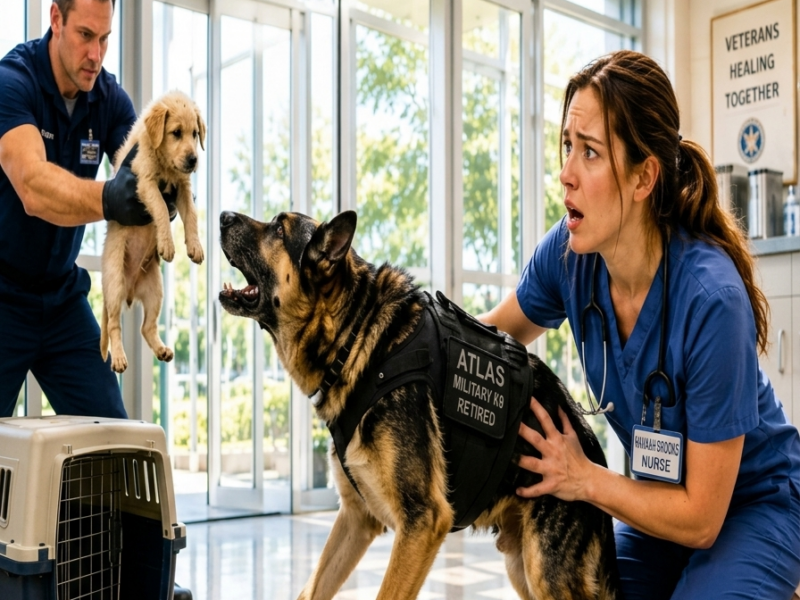
They dragged a trembling stray puppy away from the hospital entrance while everyone watched the quiet nurse kneel helplessly on the sidewalk
They dragged a trembling stray puppy away from the hospital entrance while everyone watched the quiet nurse kneel helplessly on the sidewalk, but when the nearby K9 suddenly broke formation and fought to reach the puppy, I realized the little dog wasn’t lost at all—it was carrying a secret that could save a man’s life.
I had worked the night shift as a trauma nurse at Mercy General for almost four years, and every morning before sunrise, as the cold mist rolled off the river and coated the asphalt, I saw the same stray puppy sleeping beneath the concrete incline of the ambulance ramp. He was a scruffy, nameless mix of golden fur and dark charcoal spots, barely bigger than a loaf of bread, with ribs that pushed sharply against his skin like a row of small arches.
I called him Milo.
He was tiny, dirty, and terrified of human voices, darting into the storm drains whenever the heavy steel doors of the emergency room burst open. Yet, through weeks of soft words and leftover turkey sandwiches saved from my meal breaks, he had somehow learned to trust me enough to take food directly from my trembling hand.
On a biting, rainy morning in late October, the routine broke.
I was standing near the outdoor triage bay, peeling off my latex gloves after a grueling fourteen-hour shift, when a white van with rusted wheel wells pulled onto the curb. Two officers from animal control stepped out, carrying heavy steel snare poles and heavy nylon nets.
“That dog can’t stay here,” the lead officer said, his heavy rubber boots splashing through a puddle of greasy water. “Hospital management submitted a formal hazard complaint. Vector control.”
I stepped outside into the freezing drizzle, crossing my arms over my damp scrubs. “He isn’t hurting anyone,” I pleaded, my voice cracking with exhaustion. “He doesn’t bite. He stays under the ramp, away from the sterile bays. I’m trying to secure a spot for him at a local shelter.”
“Orders are orders, lady,” the second officer muttered, lunging forward with a long aluminum catch-pole.
Milo let out a sharp, terrified yelp that cut straight to my heart. He scrambled backward against the wet concrete wall, his tiny paws slipping in the slick grease. The snare looped over his head, tightening around his scruffy neck, and he collapsed onto his side, his entire body trembling violently as they dragged him across the pavement toward the back of the pickup van. I instinctively dropped to my knees on the damp sidewalk, reaching out, but the officer shoved his shoulder between us.
Before I could say another word, a low, reverberating roar cut through the sound of rain hitting metal.
Across the clinical parking lot, near an unmarked black SUV belonging to the federal transit division, a massive, seventy-five-pound German Shepherd military K9 named Axel suddenly pulled against his handler’s thick leather leash. The handler, a tall, hard-faced man wearing a dark tactical jacket labeled Federal Protective Service, was caught off balance, his boot slipping on the wet painted lines of the pavement.
Axel wasn’t looking at the officers or at the hospital doors. The German Shepherd was staring directly at Milo.
Then, the working dog did something completely uncharacteristic of his breed and specialized training: he dropped his ears flat, lowered his chest to the wet asphalt, and began whining—a high-pitched, desperate sound filled with raw, human-like agony.
“Axel, heel!” the handler barked, digging his heels into the asphalt and jerking back on the leather strap. “Axel, sit! What’s wrong with him?”
Axel ignored the commands entirely. With a violent, explosive surge of power, the K9 yanked his harness free from the handler’s grip, the metal carabiner snapping with a sharp crack.
He sprinted across the pavement, his heavy paws kicking up sprays of gray water. The animal control officers froze, dropping their snare poles in sheer panic as the massive military animal charged directly toward them. But Axel didn’t bite. He didn’t attack.
He slid to a halt right beside the shivering puppy, lowered his massive, dark muzzle down into the dirt, and pressed his nose firmly against Milo’s scruffy neck.
Milo didn’t run. Instead of panicking, the tiny puppy immediately pressed his small, mud-soaked body against the giant German Shepherd’s forelegs, burying his wet snout beneath Axel’s heavy chin as if he had finally found a long-lost protector.
The K9 handler caught up, panting heavily, his hand resting warily on his holstered sidearm. “What in the hell is this?” he muttered, looking down at the two animals. “He’s a certified explosive and tracker asset. He doesn’t break formation for strays.”
“Look,” I whispered, kneeling closer to the mud-caked fur around Milo’s neck.
Twisted tightly into the dense, matted collar of twine and dirt beneath the puppy’s jaw was a cylinder. It wasn’t an ID tag. It was a heavy, military-grade waterproof capsule made of anodized black titanium, no larger than a thumb.
“Where did you find that?” the handler demanded, his eyes narrowing instantly as he recognized the matte black finish of the container.
“I didn’t,” I said, my voice barely audible over the hum of the hospital’s exterior ventilation fans. “The puppy had been carrying it the whole time.”
With trembling fingers, I unscrewed the threads of the titanium capsule. A tiny rubber O-ring popped, and out fell a micro-SD memory card, pristine and bone-dry.
The handler stared at the black plastic square in my palm, his posture stiffening instantly. “That’s classified hardware casing,” he said quietly. “We need to go inside. Now.”
We walked into the quiet night-shift breakroom behind the emergency reception desk. Outside, the rain continued to beat against the glass windows. The handler produced a rugged, hardened military laptop from his tactical bag, slid the micro-SD card into a side port, and initiated a bypass script.
A single video file appeared on the screen. The timestamp read 03:14 AM – Three Days Ago.
The video opened on a dark, unstable frame. The air in the recording was thick with floating dust particles, illuminated only by the faint blue glow of an emergency lantern. Sitting against a crumbling brick wall inside what appeared to be an abandoned industrial warehouse was a man wearing a torn, blood-stained army fatigue jacket. His skin was gray, his breathing shallow, and a heavy pressure bandage was wrapped tightly around his upper torso.
His voice was a weak, rattling whisper.
“If you’re watching this… they found me,” the soldier said, wincing as he shifted his weight. “My name is Sergeant Daniel Vance. Unit 404, Logistics Security. Three weeks ago, our medical transport was hijacked off Route 9. It wasn’t insurgents. It was an internal extraction.”
My stomach tightened into a hard knot. I leaned closer to the screen.
“They took three hundred units of experimental bio-pathogen precursors and surgical-grade narcotics,” Sergeant Vance continued, his eyes rolling back briefly in pain before he forced himself to focus on the camera lens. “They’re routing the distribution through a regional receiver. Through Mercy General Hospital. The person authorizing the manifest bypass… the person who ordered the hit on our escort… is Dr. Richard Sterling.”
I gasped. Dr. Richard Sterling was the Chief of Medical Operations at Mercy General—the most powerful administrator in the entire healthcare network, a man whose picture hung framed in gold leaf in the main lobby.
“I managed to crawl out with the primary ledger,” Vance whispered, reaching down off-camera. For a brief second, the camera tilted, showing the small, dirty golden puppy sitting beside his boots inside the dark warehouse. “I can’t walk. My legs are crushed. But this little guy knows the way to the city… If he makes it to someone who cares… check his collar.”
Before Vance could say another word, the audio cut into loud static. The video frame glitched, red lines tearing across the screen.
FILE DELETED – REMOTE WIPED.
The laptop screen went pitch-black.
“What happened?” I yelled, grabbing the edge of the desk. “Bring it back!”
“Someone just sent an unauthorized over-the-air signal override to this device,” the handler said, his face pale as he frantically typed commands into his terminal. “They monitored the card’s decryption handshake the second we plugged it into the hospital’s network. They know we saw it.”
Suddenly, Axel let out a deep, chest-vibrating growl toward the double glass doors that led to the central atrium.
I followed his gaze.
Standing thirty feet away at the end of the dimly lit hallway, partially obscured by the shadow of a marble pillar, was a man in a long, dark wool coat. His hands were buried in his pockets, and a dark brimmed hat was pulled low over his eyes.
Milo, sitting on the bench beside me, began shaking uncontrollably, burying his face into my waist.
The man in the coat didn’t move. He stared straight at the laptop, then at the K9, and finally at me. Seeing Axel step forward, his upper lip curling to reveal razor-sharp canine teeth, the stranger slowly stepped backward into the darkness of the service corridor and vanished.
That was when I understood why Axel had refused to leave Milo outside in the rain.
He hadn’t been acting like an untrained dog chasing a stray. He had recognized the scent of the military compound on the puppy’s fur, and he was protecting the only living witness to Sergeant Vance’s location.
I scooped Milo up into my arms, feeling his tiny heart racing like a hummingbird against my ribs.
Buzz.
My cell phone vibrated violently on the desk. An alert popped up from an unknown, encrypted number.
Keep the puppy alive, and you’ll learn where the soldier is. Bring him to Floor 4. Come alone.
I raised my head and looked through the glass doors toward the dark, cavernous hospital corridor. Floor 4 was the closed psychiatric and archival wing—a maze of abandoned wards and locked supply rooms currently undergoing renovation.
Somewhere inside that building, someone was waiting for us.
And in my arms, Milo suddenly lifted his small head, pointed his ears forward, and stared intently at the quiet indicator light above the locked express elevator at the end of the hall.
The quiet hum of the express elevator sounded like a grinding saw in the dead silence of the building.
The K9 handler, whose name tag read K. Miller, reached out and grabbed my forearm before I could take a step toward the steel doors. His grip was cold and firm.
“You aren’t going up there alone,” Miller said, his voice a tight whisper. He looked down at Axel, who was standing at absolute attention, his dark eyes locked onto the glowing digital floor counter above the elevator frame: B2… B1… G…
“The message said alone,” I replied, pulling Milo closer against my scrub top. The puppy’s wet fur was beginning to dry, leaving smudges of dirt across my chest. “If Dr. Sterling or his security team sees a federal handler, they won’t show themselves. They’ll kill Sergeant Vance wherever he’s hiding and burn the evidence.”
“If you walk onto that floor without protection, you’re just giving them another body to dispose of,” Miller countered. He unclipped a small, black tactical earpiece from his vest and pressed it into my hand. “Put this in. It’s an open-frequency transmitter. Axel and I will take the fire stairwell. We’ll be one floor below you. If I hear anything off over that mic, we breach.”
I looked at the tiny plastic earpiece, then down at Milo. The puppy let out a soft whine, licking the underside of my chin. “Okay,” I whispered, fitting the device into my left ear. “Just stay close.”
The elevator doors slid open with a soft ding.
I stepped inside the metallic box. The interior smelled of stale floor wax and ozone. As the heavy steel doors slid shut, cutting off my view of Miller and Axel, the sense of isolation hit me like a physical blow. The elevator rose smoothly, the floor numbers ticking up slowly: 1… 2… 3… 4.
The doors opened into pitch darkness.
Floor 4 was dead quiet. The air was thick with the smell of wet drywall, plastic sheeting, and old paper. Months ago, the hospital administration had shut down the entire floor for an extensive expansion project, but construction had stalled abruptly due to “budget shortfalls”—shortfalls that I now realized were likely shell accounts used to funnel money into Sterling’s illegal operation.
Temporary work lights hung from the exposed ceiling wires, casting long, swaying shadows down the central corridor. Rows of plastic sheeting hung like translucent curtains, blocking off former patient rooms.
“Hello?” I called out, my voice echoing hollowly down the hall.
No answer. Only the distant, rhythmic dripping of a leaky pipe somewhere in the darkness.
Milo shifted in my arms. Suddenly, he squirmed, lifting his nose into the air and sniffing frantically. He let out a tiny, imperative bark and reached his front paws toward the floor.
“Milo, no, stay here,” I murmured.
He squirmed harder, slipping through my hands, his small paws landing with a soft patter-patter on the dusty concrete floor. Instead of running away in fear, the puppy trotted forward with absolute purpose, his nose glued to the floorboards, navigating through the maze of hanging plastic sheets.
I followed him quickly, my rubber-soled nursing shoes making almost no sound on the floor. “Miller, are you reading me?” I whispered into the earpiece.
“I hear you,” Miller’s voice crackled softly in my ear, distorted by the concrete walls of the stairwell. “We’re on the landing between three and four. Keep moving, but watch your corners.”
Milo turned sharp left into what used to be the Medical Records Archive—a massive, windowless vault lined with rows of towering steel filing cabinets. Most of the drawers had been yanked open and emptied, leaving thousands of manila folders scattered across the floor like dead leaves.
The puppy stopped in front of a heavy, fireproof document safe sitting in the back corner of the room. Its heavy electronic lock was dark, the keypad smashed to pieces by a heavy hammer.
Milo dropped his nose into a pile of papers beside the safe and began digging frantically with his front paws.
“What is it, boy?” I whispered, kneeling beside him.
I reached into the pile and pulled out a water-logged leather-bound logbook. The gold lettering on the cover read: PHARMACEUTICAL CONTROL LEDGER – SPECIAL OPERATIONS DIVISION.
I flipped through the moldy, damp pages. Page after page listed high-potency chemical compounds, surgical trauma packs, and military blood plasma units—all marked as “DISPOSED / INCINERATED,” but every entry was signed by the same hand in dark blue ink: R. Sterling, MD.
“I found the paper trail,” I whispered into the mic. “It’s all here. Years of diverted supplies.”
“I’m glad you found it, Nurse Clara,” a voice remarked from behind me.
I whirled around, dropping the ledger onto the floor.
Standing in the doorway of the archive room, silhouetted against the dim light of the corridor, was Dr. Richard Sterling.
He was impeccably dressed in a tailored charcoal suit, his silver hair perfectly combed back, his wire-rimmed glasses catching the harsh glare of a hanging construction bulb. In his right hand, held casually at his side, was a compact, silenced 9mm pistol.
Beside him stood the man in the dark wool coat—the same man who had stalked us in the lobby down below.
“Dr. Sterling,” I breathed, backing away until my shoulders hit the cold steel of the broken safe. Milo instantly scrambled behind my heels, letting out a microscopic growl that was more pitiful than threatening.
“I must admit, Clara, you have been a persistent thorn in my side this morning,” Sterling said, his tone casual, as if he were discussing a minor scheduling error during shift change. “That worthless little animal was supposed to die in the warehouse along with Sergeant Vance. How he managed to navigate seven miles of city streets to wind up back at your ambulance ramp is frankly a miracle of canine biology.”
“Sergeant Vance is still alive,” I said, trying to keep my voice steady to buy time for Miller. “Where is he?”
Sterling let out a soft sigh, adjusting his glasses with his left hand. “He was alive when that video was recorded. Currently? His condition is… precarious. He took a heavy round to the femoral artery during our recovery operation. He won’t survive the afternoon without surgical intervention.”
He took two slow, deliberate steps into the room, the suppressor on his pistol pointed directly at my chest.
“Where is the micro-SD card, Clara?” Sterling asked. “My associate managed to wipe the local drive on the network, but I need the physical medium. Give it to me, along with that ledger, and I might consider letting you walk out of this building.”
“You’re lying,” I said. “You can’t let me walk. I know everything.”
“Yes,” Sterling agreed smoothly, raising the barrel of the gun. “You do.”
“NOW, CLARA! DROP!” Miller’s voice roared through my earpiece.
Before Sterling could pull the trigger, the reinforced drywall directly behind him exploded inward.
A cloud of white plaster dust and pulverized insulation erupted into the archive room.
Axel breached the wall like a missile, his powerful hind legs driving him through the hollow drywall paneling that separated the archive from the adjacent maintenance shaft. The seventy-five-pound military K9 didn’t hesitate for a fraction of a second; he hit the man in the dark wool coat mid-stride, his jaws clamping onto the man’s forearm with crushing force.
The man let out a choked scream, his pistol clattering to the concrete floor as he was violently thrown back into the hallway.
“Police! Drop your weapon!” Miller roared, stepping through the hole in the wall with his service weapon raised, his flashlight beam cutting through the thick dust cloud.
Sterling didn’t panic. With terrifying, sociopathic composure, he fired two quick shots toward the dust cloud. The silenced thwip-thwip of the gun was shockingly quiet, but the impact was devastating—one round struck Miller’s tactical vest, sending the handler stumbling back against the broken drywall with a gasp of pain.
Sterling turned the gun back toward me.
I didn’t think. I grabbed the heavy leather-bound ledger off the floor and hurled it with all my strength straight at his face.
The heavy book struck Sterling across the bridge of his nose, smashing his wire-rimmed glasses and throwing his aim off just as he pulled the trigger a third time. The bullet shattered the concrete wall inches above my left ear, spraying hot grit across my face.
Milo let out a sharp bark, darting out from behind my feet and biting down onto Sterling’s pant leg with all the strength his tiny jaws could muster.
“Get off me, you filthy stray!” Sterling snarled, kicking his leg violently.
The kick sent the little puppy tumbling across the dusty floor, slamming into a row of metal shelves. Milo let out a painful squeal, curling into a tight ball.
Seeing the puppy struck triggered something primal in me. Forgetting the gun, forgetting the danger, I grabbed a heavy steel filing drawer that had been pulled from the wall and slammed it with two hands directly into Sterling’s chest.
The metal edge struck him hard. Sterling lost his footing, stumbling backward through the ruined doorway.
Out in the hallway, Axel had already incapacitated the second man. Hearing the commotion, the German Shepherd spun around, his ears pinned back, his eyes flashing with red fury as he spotted Sterling standing over his handler.
Axel let out a terrifying, guttural roar and charged down the narrow corridor.
Sterling scrambled to his feet, bleeding from a cut across his nose where the book had hit him. Seeing the massive military dog hurtling toward him, he didn’t try to fight. He turned and sprinted down the hallway toward the emergency fire exit at the end of the wing.
“Axel, pursuit!” Miller gasped from the floor, clutching his bruised chest where the bullet had hit his ceramic armor plate. “Clara… go… don’t let him get to the basement!”
I ran over to Milo first. The puppy was shivering, but he pushed himself up onto his front paws, whining softly as I scooped him back up into my arms. “You’re okay, sweet boy,” I sobbed, checking his tiny ribs. “You’re okay.”
“Go!” Miller coughed, pulling his backup radio from his belt. “I’m calling city police for heavy backup! He’s heading for the sub-basement logistics docks!”
I didn’t wait. Holding Milo tight against my chest, I ran down the corridor, following the sound of Axel’s heavy paws and Sterling’s frantic, echoing footsteps descending the metal stairs of the fire exit.
The stairwell was cold and damp, winding down six full stories beneath the hospital structure. The air grew progressively thicker with the smell of diesel fuel, wet concrete, and sewage.
By the time I reached the bottom landing—Sub-Basement Level 3—the heavy steel fire door was propped open with a fire extinguisher.
Beyond lay the old boiler network and maintenance vaults—a vast, subterranean labyrinth of rusted iron pipes, hissings steam lines, and abandoned storage rooms that stretched beneath the entire hospital campus.
The sound of a dog barking echoed frantically from deep within the shadows.
One sharp bark.
Then a struggle.
Then the heavy splash of water.
I ran through the low-ceilinged vault, my eyes straining against the gloom. The temperature had dropped drastically down here; my breath formed white clouds in the damp air.
I rounded a corner lined with massive green water pumps and stopped dead in my tracks.
Standing in the center of a flooded concrete pit—where runoff water from the storm drains pooled knee-deep—was Sterling. He was holding a iron pipe he had ripped from a wall bracket, swinging it wildly at Axel.
Axel was circling the edge of the pit, his legs dripping with dirty water, his fur matted with grime, looking for an opening.
“Stay back!” Sterling screamed, his voice unravelling into pure mania. His expensive suit was ruined, covered in rust and oil. “Stay back or I’ll blow this entire sub-level to hell!”
In his left hand, Sterling was holding an emergency industrial flare controller wired to a high-pressure methane relief valve on the main boiler line. A faint, steady hiss of flammable gas was already filling the cold air of the vault.
“Dr. Sterling, stop!” I yelled, stepping out from behind the pump housing. “You can’t win this! Federal agents are already surrounding the building!”
Sterling laughed—a sharp, hysterical sound that echoed off the damp concrete walls. “You think I care about federal agents? If this ledger goes public, I spend the rest of my life in a supermax prison! I built this hospital! I built this entire network!”
He pointed the flare controller at the valve.
“If I go down,” Sterling spat, “I’m taking this entire facility, every patient in those beds, and every piece of evidence down with me!”
Suddenly, Milo, sitting in my arms, lifted his head toward the dark ceiling of the vault.
He didn’t look at Sterling. He didn’t look at the gas line.
He looked toward a heavy, rusted iron security door tucked behind the main boiler—a door secured with a heavy padlocked chain, stamped with the words: ABANDONED UTILITY TUNNEL – NO ACCESS.
Milo let out a long, clear bark—not a bark of fear, but a bark of recognition.
From behind the heavy iron door, deep within the dark tunnel, a weak, metallic tapping sound echoed back in response.
Tap… tap… tap.
Someone was inside that room.
My heart stopped.
The tapping sound was rhythmic, deliberate, and weak. It was military Morse code: S – O – S.
Sergeant Vance was alive, trapped behind that locked steel door, breathing the fumes of the leaking methane gas.
“He’s in there,” I whispered, horror washing over me. “You locked him in the abandoned utility vault to suffocate.”
Sterling smiled coldly, his hand tightening around the ignition trigger of the flare. “He was supposed to bleed out three days ago. The man is remarkably resilient. But it doesn’t matter now. The gas concentration in that small room is twice what it is out here. One spark, and he vaporizes.”
“You monster,” I gasped.
“Axel, NO!” I suddenly screamed, realizing what was about to happen.
Axel didn’t care about the gas. He didn’t care about the flare. The working dog smelled his target through the iron door, and his military instincts kicked into absolute overdrive.
The German Shepherd launched himself across the flooded pit, ignoring the iron pipe Sterling swung at his head. The pipe struck Axel across his shoulder with a sickening thud, but the dog didn’t stop. He slammed his full body weight into Sterling’s chest, knocking the administrator backward into the knee-deep water.
The flare controller flew out of Sterling’s hand, splashing into the pool.
“The valve!” I yelled, dropping to my knees as the hiss of raw methane gas grew louder, filling the chamber with a suffocating, rotten-egg smell.
Sterling scrambled through the dark water, frantically searching for the submerged flare device. His hand closed around the plastic handle, and he pulled it out of the water, wiping the mud from the activation button.
“We all burn together!” Sterling shrieked, raising his thumb to strike the mechanical flint.
Before he could push the lever, a small, golden flash blurred past my feet.
Milo.
The tiny puppy, driven by some incredible, miraculous surge of protective instinct, didn’t run away from the roaring gas or the massive men. He sprinted straight into the shallow water of the pit, jumped off a floating wooden pallet, and buried his tiny teeth directly into Sterling’s exposed thumb.
“Aaargh!” Sterling screamed, the sharp pain catching him completely off guard.
He instinctively jerked his hand, and the flare controller slipped from his grasp once again, falling deep into the dark suction drain at the bottom of the pit, where it vanished forever into the city sewer system.
“You miserable little rat!” Sterling roared, raising his heavy hand to strike the puppy.
“Get away from him!”
I charged into the pit, grabbing a heavy brass spanner wrench from a nearby tool rack, and swung it with everything I had. The heavy tool struck Sterling across the shoulder, sending him collapsing sideways into the water.
Before he could get back up, Axel was over him, pinning his shoulders against the wet concrete with two massive paws, his jaws hovering inches from Sterling’s throat, letting out a growl so deep it rattled the teeth in my skull.
“Don’t move,” I panted, pointing the heavy wrench at Sterling’s face. “Don’t even breathe.”
Sterling lay in the filthy water, shivering violently, his eyes wide with utter terror as he stared into the face of the military dog. “Okay… okay… call him off… please…”
“Keep him pinned, Axel,” I ordered.
I ran past the pit toward the rusted iron door at the back of the vault. The padlocked chain was thick, but the hinges were ancient and eaten away by decades of moisture and rust.
I jammed the brass spanner wrench into the gap between the frame and the latch, using all my body weight to leverage the iron. With a loud, screeching groan of tearing metal, the old latch snapped open.
The heavy steel door swung inward.
The air inside the tiny, windowless concrete cell was freezing and thick with the stench of infection and stale blood.
Lying on an old canvas cot in the corner, wrapped in a threadbare emergency blanket, was Sergeant Daniel Vance. His skin was paper-white, his eyes sunken, his chest barely moving as he took shallow, agonized breaths.
Sitting on the floor beside the cot was an empty water bowl and a single, torn piece of turkey sandwich wrapper—the same wrapper I had given Milo three mornings ago beneath the ambulance ramp.
The puppy had been carrying food back down into the utility tunnels to keep his human alive.
“Sergeant Vance!” I cried out, rushing to his side and dropping to my knees. I quickly pressed two fingers against his neck. His pulse was dangerously faint—a fluttering, thready beat that was fading by the second. “I’m a trauma nurse. You’re safe now. Help is here.”
Vance’s eyelids fluttered open slowly. He looked at me, his vision blurry, then his gaze shifted down to the small, dirty puppy that had just scrambled onto the cot beside his chest.
Milo pressed his wet nose against Vance’s pale cheek, letting out a tiny, soft whine.
A weak, painful smile touched the soldier’s cracked lips.
“You… you made it, little buddy…” Vance whispered, his voice barely a breath. “I told you… she’d help us…”
“Don’t talk,” I choked out, tears spilling over my eyelashes and running down my dirty face. “Save your strength. We’re getting you out of here.”
The heavy, rhythmic beat of helicopter blades filled the morning air above Mercy General Hospital.
Three hours later, the rain had finally cleared, leaving behind a brilliant, washed-clean blue sky. The hospital parking lot was a sea of flashing red and blue lights. Dozens of federal vehicles, city police cruisers, and mobile command units filled the bays.
Dr. Richard Sterling and three of his senior administrative co-conspirators were led out of the building in heavy steel handcuffs, surrounded by federal agents, their faces plastered across every major news network camera lined up outside the perimeter gates.
The illegal pharmaceutical ring had been completely dismantled, its network traced back through regional supply chains across four states.
Inside Trauma Bay 1, the brightest lights in the hospital were shining down on Sergeant Daniel Vance.
Thanks to an emergency blood transfusion and rapid surgical intervention by a team of honest, dedicated surgeons who had rushed to the scene, Vance’s internal bleeding had been controlled. He was resting comfortably in ICU recovery, stable, out of danger, and surrounded by military liaisons who had arrived to oversee his care and security.
I sat on a wooden bench just outside the emergency entrance, holding a warm cup of coffee in my hands. My scrubs were ruined, stained with dirt, plaster dust, and water from the sub-basement, but I had never felt a deeper sense of relief in my entire life.
Beside me sat Officer Miller. His chest was bruised where Sterling’s bullet had hit his armor plate, but he was smiling, holding a thick dog treat out to Axel.
Axel took the treat gently, crunching it down with a single bite, before dropping his head onto my knee.
“He likes you,” Miller said, leaning back against the brick wall. “And trust me, Axel doesn’t like many civilian nurses.”
“He saved all our lives today,” I said, gently scratching the German Shepherd behind his soft ears. “If he hadn’t broken leash to reach Milo…”
“He knew,” Miller said quietly. “Dogs have a way of seeing through the noise. He smelled the military compound grease on that puppy, and he knew something was deeply wrong. He wasn’t just following orders—he was protecting one of his own.”
A soft squeak of small paws echoed on the concrete.
I looked down.
Walking slowly out of the glass double doors of the emergency entrance was Milo.
He was no longer covered in mud or grease. The veterinary staff in the emergency triage unit had washed his fur, turning his scruffy coat into a soft, golden-and-charcoal fluff. Wrapped neatly around his neck was a brand-new, bright red nylon collar with a shiny silver tag shaped like a tiny shield.
He trotted straight over to my bench, stopped, and looked up at me with big, dark, intelligent eyes.
“Hey there, little hero,” I whispered, setting my coffee cup down and reaching down to pick him up.
Milo snuggled instantly into the crook of my neck, letting out a soft, contented sigh, his small tail wagging back and forth against my arm like a rhythmic pendulum.
“So,” Miller said, standing up and adjusting his tactical cap. “What happens to the little guy now? The federal evidence locker is done with the titanium capsule.”
I held Milo close against my chest, feeling his steady, strong heartbeat pulsing against mine. I looked out over the sunlit parking lot, toward the quiet ambulance ramp where he used to sleep alone in the freezing cold.
“He’s never sleeping under a ramp again,” I said softly, a smile spreading across my face. “He’s coming home with me.”
Just then, the glass doors opened once more. A medical assistant pushed a wheelchair out onto the ramp. Sitting in the chair, wrapped in a warm blanket, was Sergeant Vance. His skin had returned to a healthy color, and though he was weak, his eyes were bright.
When he saw us, Vance gestured for the assistant to stop.
Milo immediately squirmed in my arms, reaching his front paws toward the soldier. I walked over, carefully setting the puppy down on Vance’s lap.
Vance ran his hand over the puppy’s clean, soft fur, his eyes shining with silent emotion. He looked up at me, taking a deep breath.
“Thank you, Nurse Clara,” Vance said, his voice quiet but steady. “For trusting him when nobody else would.”
“He made it easy,” I smiled. “He’s a very persuasive little dog.”
“I owe you both my life,” Vance said. He looked down at Milo, then back up at me. “When I get through my rehabilitation… I was hoping I could visit him. If that’s okay with you.”
“You don’t have to visit, Sergeant,” I said gently. “You and Milo saved each other. Our doors are always open.”
Vance smiled—a real, bright smile that seemed to erase all the pain of the past three days.
Axel stepped up beside the wheelchair, letting out a low, happy huff, and rested his large head beside Milo on Vance’s blanket. The two dogs—one a massive, battle-hardened military asset, the other a tiny, brave stray—sat side-by-side in the warm morning sunlight.
I looked at them, feeling the cool autumn breeze against my face, knowing that the shadows were finally gone. Mercy General was safe, a good man was going to live, and the smallest hero in the city had finally found his home.
The end.









