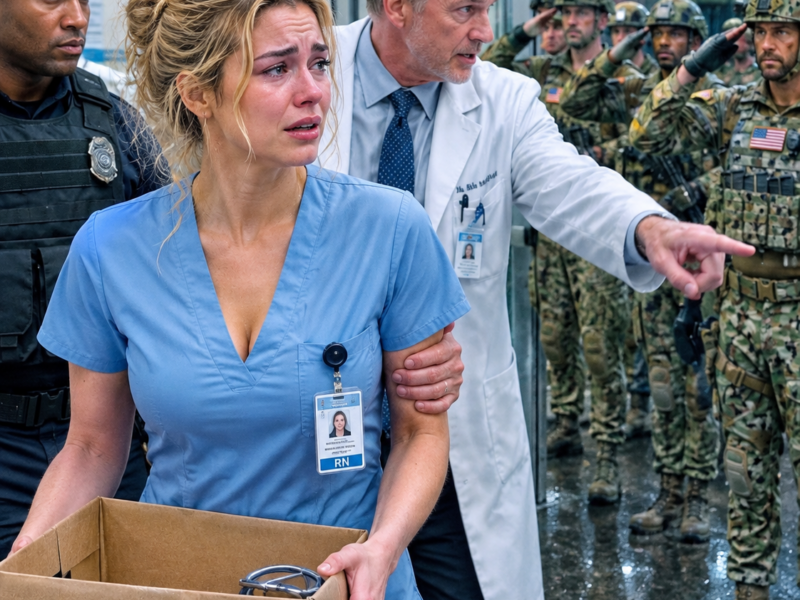
They called me a problem because I refused to follow an order that would have put a patient’s life at risk. They fired me before sunrise
The drive back to Pine Hollow took seventeen minutes.
It felt like seventeen years.
Rain hammered my windshield as I followed the emergency vehicles toward the hospital. Their lights flashed against the low clouds, and traffic had already begun backing up along the highway.
I kept hearing Hannah’s words.
Someone is asking for you by your old military callsign.
I hadn’t used that callsign since the day I left the service.
Not since the operation that ended my military career.
Not since I promised myself I would never again let the past decide who I was.
When I pulled into the hospital parking lot, the emergency entrance was crowded with ambulances. Paramedics were unloading stretchers. A police officer was directing vehicles around a fallen tree. Staff members hurried between the entrance and the treatment rooms.
I parked beside the ambulance bay and grabbed my old medical bag from behind the passenger seat.
I had kept it after leaving the military.
I told myself it was because the bag was useful.
The truth was that I had never been able to throw it away.
Hannah met me at the side entrance.
Her scrub top was stained with blood, and her hair had come loose from its bun.
“Claire.”
“Tell me what we have.”
“Twenty-six patients confirmed. More coming. We’ve got two critical cases, several fractures, and a child with a head injury. The county ambulance service can’t get through the north road.”
“What’s happening with communications?”
“Nothing reliable. The hospital radios work for a few seconds, then go dead.”
“Any satellite phone?”
“Locked in administration. Marjorie has the key.”
I looked toward the emergency department.
“Where’s Lawson?”
“Trauma two.”
“And the person asking for me?”
Hannah hesitated.
“He’s in the old consultation room. He told Marjorie his name was Captain Daniel Reeves.”
The name landed like a stone in my stomach.
Daniel Reeves had been my operations commander.
He had been the one who recommended me for the special operations medical team. He had taught me that medical skill meant nothing if you couldn’t keep your head when everything around you was falling apart.
He was also the last person who had spoken to me before the operation that ended my career.
“Is he injured?”
“I don’t think so.”
I nodded.
“Show me.”
We walked through the corridor. Nurses rushed past carrying supplies. A monitor alarm sounded from one of the treatment rooms. Someone called for another oxygen cylinder.
The hospital was already overwhelmed.
In the consultation room, a man in a dark rain jacket stood beside the window.
He had aged. His hair was almost completely gray, and there was a new scar along his jaw. But his posture was unmistakable.
He turned when I entered.
“Still carrying that bag?”
I stopped in the doorway.
“Captain.”
“Claire.”
For a moment, neither of us spoke.
Then he looked at Hannah.
“Could you give us a minute?”
She glanced at me.
I nodded.
When the door closed, Daniel lowered his voice.
“I’m sorry they fired you.”
“You didn’t drive here to discuss my employment.”
“No.”
He reached into his jacket and placed a small metal identification tag on the table.
I recognized it immediately.
It belonged to Staff Sergeant Marcus Bell.
Marcus had been part of our medical support team. Three years earlier, he had disappeared during a mission in a mountainous region overseas.
His official status had been listed as killed in action.
I had been the last medic to treat him.
I picked up the tag.
“Where did you get this?”
“From a man who walked out of the wreckage on Highway 12.”
I looked up.
“Marcus?”
Daniel nodded.
My chest tightened.
“That’s impossible.”
“That’s what I thought.”
“His remains were never recovered.”
“Because there were no remains to recover.”
I gripped the edge of the table.
“Why is he here?”
Daniel took a breath.
“Because the bus that crashed on Highway 12 was transporting people connected to that operation. Marcus was one of them.”
I looked toward the emergency department.
“Who else?”
“Two former contractors. A civilian communications specialist. And one man who knows what happened to the missing mission records.”
“Where is Marcus now?”
“Trauma two.”
I stared at him.
“Then why are we standing here?”
“Because before he lost consciousness, he gave the paramedics one instruction.”
Daniel’s expression hardened.
“He said not to let Colonel Voss reach him.”
I knew that name.
Colonel Andrew Voss had commanded the operation three years earlier. He had signed the report claiming Marcus had died during an extraction attempt and that I had disobeyed orders by abandoning my assigned position.
I had been investigated.
My testimony had been dismissed.
My career had ended.
And now Daniel was telling me that Marcus was alive.
“Where is Voss?”
Daniel looked toward the corridor.
“Inside the hospital.”
A cold feeling spread through me.
“Who brought him?”
“He arrived in a county vehicle. Says he’s here to coordinate the response.”
I almost laughed.
“Of course he does.”
Daniel stepped closer.
“Claire, listen. This isn’t just a mass-casualty incident. The bus was deliberately forced off the road.”
“By whom?”
“We don’t know yet.”
“Then we find out.”
He shook his head.
“You don’t understand. Voss knows Marcus survived. He knows the records exist. He may already have people inside this building.”
I looked at the identification tag in my hand.
“Then we keep Marcus alive and keep the evidence away from him.”
Daniel studied me.
“That’s why I called you.”
Before I could answer, the hospital intercom crackled.
“Attention. All emergency personnel. Additional incoming casualties from Highway 12. Estimated arrival, six minutes.”
Then another voice interrupted.
“Emergency department, this is county dispatch. We have a second collision near the north access road. Multiple vehicles. All units stand by.”
The radio hissed.
A third transmission broke through.
“Pine Hollow, this is field unit seven. We have a possible hazardous-materials situation. Do not send staff toward the north access road.”
Daniel and I exchanged a look.
The first incident had been a crash.
The second might be something else entirely.
I opened the consultation room door.
“Get me the charge nurse.”
Hannah appeared almost immediately.
“I’m here.”
“Who is coordinating triage?”
“Dr. Lawson.”
“Tell him I’m coming.”
She hesitated.
“Marjorie said you’re not authorized to provide care.”
I looked at her.
“Then tell Marjorie to come and explain that to the patients.”
I walked into the emergency department.
Dr. Lawson stood beside a stretcher, arguing with a paramedic about whether a patient needed immediate imaging.
He saw me.
“What are you doing here?”
“Helping.”
“You’ve been terminated.”
“I’m aware.”
“You cannot just walk into a clinical area and start giving orders.”
I pointed toward the patient.
“Then stop arguing and check his airway.”
Lawson’s face reddened.
“I have this under control.”
The patient suddenly began coughing. His oxygen saturation dropped.
The paramedic called for suction.
I stepped forward.
“Get the airway cart.”
Lawson froze for half a second before moving.
The room shifted into action.
Within moments, the patient was stabilized.
I turned toward the other stretchers.
“We need a separate triage area for patients who are stable enough to wait. Keep the critical patients in the main treatment rooms. Assign one person to track every incoming patient and every transfer. Nobody moves a patient without documenting where they’re going.”
A nurse looked at Lawson.
He glanced at the crowded room, then at the patient who had just been stabilized.
“Do it,” he said.
It wasn’t an apology.
It was a decision.
And for now, that was enough.
The next forty minutes became a blur of controlled chaos.
A woman with a broken pelvis.
A young man with a deep scalp wound.
Two children who had been sitting near the back of the bus.
A driver with chest injuries.
A paramedic who had injured his wrist while pulling someone out of the wreckage.
We had too few hands and too little space.
But we had people.
And people could be organized.
I assigned Hannah to the pediatric area and asked another nurse to track blood products. Lawson took charge of the critical patients. I worked between them, helping with assessments and keeping the flow moving.
No one asked whether I was officially employed.
No one cared.
Then a stretcher came through the entrance with a man whose face was covered in blood.
He was conscious.
His left arm was immobilized, and his breathing was labored.
The paramedic leaned over him.
“Male, approximately forty-five. Found outside the bus. Possible internal injuries. He keeps asking for someone named Claire.”
I stepped forward.
“I’m Claire.”
The man’s eyes opened.
“Bennett?”
I recognized him.
Marcus Bell.
Older, thinner, with a deep scar crossing his cheek.
But alive.
He looked at me as if he couldn’t believe what he was seeing.
“You came back.”
I leaned closer.
“Of course I did.”
His hand caught my sleeve.
“Don’t trust Voss.”
“I know.”
“No.” He tried to lift his head. “You don’t understand. He wasn’t just there. He ordered it.”
“Ordered what?”
Marcus looked toward the doors.
“Leaving us behind.”
His eyes began to close.
“Keep the recording safe.”
“What recording?”
But he was already losing consciousness.
I turned to the paramedic.
“Trauma one. Now.”
As they moved him, I noticed something tucked beneath the edge of his damaged jacket.
A small black data drive.
I reached for it.
Before my fingers touched the casing, someone grabbed my wrist.
Colonel Voss stood behind me.
He wore a county emergency management vest over his uniform. His expression was calm, almost friendly.
“That’s government property, Nurse Bennett.”
I looked at his hand.
“Let go.”
He released me.
“You’re not authorized to handle that.”
“Then you can explain why it was hidden under an injured patient’s clothing.”
His eyes narrowed.
“Step aside.”
I didn’t move.
“Marcus needs treatment.”
“I’m aware.”
“Then let the medical team work.”
Voss glanced toward the stretcher.
For a fraction of a second, his expression changed.
Not concern.
Recognition.
He knew Marcus was alive.
And he knew the drive mattered.
Daniel appeared beside me.
“Colonel.”
Voss turned.
“Captain Reeves. I didn’t expect to see you here.”
“I could say the same.”
Voss smiled without warmth.
“This hospital is not the place for old disputes.”
Daniel stepped between him and the stretcher.
“Then don’t bring them into the hospital.”
Voss looked at me one final time.
“Be careful, Claire. You have a history of making poor decisions under pressure.”
I held his gaze.
“Some decisions were better than the orders I was given.”
His smile disappeared.
He turned and walked away.
I watched until he disappeared around the corner.
Then I looked at Daniel.
“We need security.”
“Already working on it.”
“Can they be trusted?”
He didn’t answer immediately.
That told me enough.
I slipped the data drive into the inner pocket of my medical bag.
Then I went to check Marcus.
He was unconscious, but his vital signs were improving under the trauma team’s care. A physician had ordered imaging and additional monitoring. His condition was serious, but he was alive.
I stood beside the bed for a moment.
Three years earlier, I had been told he was gone.
Three years earlier, I had blamed myself for not getting him out.
Now he was here.
And he had brought the truth with him.
I returned to the nurses’ station.
Hannah was waiting.
“Claire, there’s something else.”
“What?”
She held up a folded piece of paper.
“Someone left this at the front desk.”
I unfolded it.
There were six words written in black ink.
YOU SHOULD HAVE STAYED FIRED.
My stomach tightened.
I looked toward the front entrance.
Outside, the rain had become heavier.
A county vehicle sat near the ambulance bay.
Its engine was running.
“Did anyone see who left it?”
Hannah shook her head.
I folded the note and put it in my pocket.
“Get security to check the cameras. Nobody goes anywhere alone.”
She nodded.
Then she looked at me.
“Claire, are you sure this is safe?”
I glanced toward the trauma rooms.
“No.”
The answer surprised her.
I continued.
“But those people need us. And whoever is doing this is counting on everyone being too frightened to act.”
She looked down, then nodded.
“I’ll tell the staff.”
As she walked away, I heard a familiar voice behind me.
“Bennett.”
Colonel Voss had returned.
This time, he was alone.
He held a clipboard in one hand.
“Your presence is creating confusion,” he said.
“Then give me a reason to leave.”
He lowered his voice.
“You have no idea what you’re interfering with.”
“Then explain it.”
“I can’t.”
“Or you won’t?”
His jaw tightened.
“You were given an opportunity to leave the past behind. You chose to come back.”
I stepped closer.
“I came back because patients were dying.”
“And you think that makes you a hero?”
“No.”
I looked toward Marcus’s room.
“I think it makes me a nurse.”
For a moment, Voss said nothing.
Then he leaned closer.
“Give me the drive.”
I felt my pulse quicken.
“I don’t have it.”
“Don’t lie to me.”
“I’m not.”
He studied my face.
Then his eyes moved to my medical bag.
I shifted it behind my leg.
He noticed.
Before he could say anything, the hospital radio came alive.
“Emergency department, this is field unit seven. We have located the source of the secondary incident. Repeat, the north access road is not safe.”
Static.
Then a voice I didn’t recognize.
“Pine Hollow, this is an unidentified unit. We have one more patient. He is requesting medical assistance.”
A pause.
Then the voice continued.
“His name is James Carter.”
Daniel appeared at the end of the corridor.
His face had gone pale.
I knew that name.
James Carter had been the communications specialist assigned to our team during the operation three years earlier.
He had been declared missing.
His body had never been found.
And Marcus had just told me to keep the recording safe.
The radio crackled again.
“Tell Claire Bennett that the original order is on the recording.”
I reached for the radio.
“Who is this?”
A burst of static.
Then a reply.
“Someone who was there when you were ordered to leave Marcus behind.”
The transmission cut off.
I looked at Daniel.
He stared back at me.
Neither of us needed to say what we were thinking.
The past hadn’t followed me back to Pine Hollow by accident.
It had arrived with the injured.
And it wasn’t finished.
“Get me the location of that field unit,” I said.
Daniel nodded.
But before he could answer, the lights flickered.
Once.
Twice.
Then the entire emergency department went dark.
The backup lights failed to come on.
For three seconds, there was nothing but alarms and frightened voices.
Then the hospital generator started.
Emergency lighting flickered red along the corridor.
A nurse shouted from trauma two.
“Dr. Lawson! We lost the ventilator!”
I ran.
The backup power was supposed to protect critical equipment, but the electrical system was struggling under the load. The respiratory therapist was already switching to manual ventilation.
“Keep going,” I said. “I’ll check the other rooms.”
A monitor beeped rapidly.
Another went silent.
Someone shouted that the blood refrigerator had lost power.
The entire department was beginning to fail.
I looked at Daniel.
“Find out whether this is a hospital fault or an outside interruption.”
He nodded and disappeared toward the communications room.
I turned back to the patients.
For the next several minutes, there was no time to think about Voss, the recording, or the past.
There were only people who needed help.
A child who couldn’t stop crying.
A woman whose blood pressure was dropping.
A man struggling to breathe.
A young nurse whose hands shook so badly she couldn’t connect the oxygen tubing.
I took her hands.
“Look at me.”
She did.
“Breathe in. Slowly.”
She followed me.
“Good. Now connect the tubing. You’ve done this before.”
She nodded and continued.
I moved from bed to bed, helping the staff keep the critical patients stable while the generator struggled.
Then Daniel returned.
“The generator room has been tampered with.”
“Can they restore it?”
“Maintenance is working on it.”
“Who did it?”
He looked toward the corridor.
“Security found the county vehicle abandoned. The driver is gone.”
I felt the old pattern taking shape.
A staged accident.
A false emergency.
A communications failure.
Someone was trying to isolate the hospital.
“Get the patients away from the windows,” I said. “And have security protect the main entrances.”
Daniel nodded.
Then he looked at me.
“Claire, there’s something I didn’t tell you.”
I stopped.
“What?”
“James isn’t just a witness.”
He swallowed.
“He was the one who sent the original transmission three years ago. He was ordered to report that Marcus was dead.”
I stared at him.
“But Marcus was alive.”
“Yes.”
“Why would James do that?”
“Because Voss told him the order came from higher command. James believed that if he refused, the entire team would be charged with treason.”
I looked down the corridor.
“And now?”
“Now he has the original recording.”
The radio crackled again.
This time, the voice was weak.
“Claire… if you can hear me… don’t let Voss get the drive.”
I reached for the radio.
“James, where are you?”
“North access… maintenance shed…”
A burst of static.
Then a final sentence.
“There’s someone else here.”
The transmission ended.
I looked at Daniel.
“We’re going.”
He shook his head.
“It’s not safe.”
“Neither is leaving him there.”
“We need police.”
“Then call them.”
I grabbed my jacket.
Daniel caught my arm.
“Claire, listen. I won’t let you walk into another trap.”
I looked at him.
“Then don’t let me walk alone.”
For a moment, he studied my face.
Then he nodded.
We moved toward the side entrance.
The rain had eased, but the road outside was nearly invisible in the darkness. Two police vehicles were parked near the loading area. Their officers were speaking with hospital security.
I approached them.
“I’m going to the north maintenance shed. We have an injured person who needs medical help.”
One officer shook his head.
“The road is blocked.”
“Is there another route?”
“An old service lane behind the storage buildings.”
Daniel showed him the radio message.
The officer read it, then called his supervisor.
Within minutes, two officers agreed to escort us.
We took the service lane in a hospital utility vehicle.
The road was muddy and narrow. Branches scraped the sides of the vehicle as we moved through the trees.
Daniel sat beside me.
“Do you remember what happened after the extraction order?”
I kept my eyes on the road.
“I remember going back for Marcus.”
“And after that?”
“I remember the blast.”
He nodded.
“You were injured.”
“I remember waking up in the transport vehicle.”
Daniel looked out the window.
“You were unconscious for nearly six hours.”
I glanced at him.
“Why didn’t anyone tell me?”
“Because Voss had already submitted his report.”
I felt anger rise in my chest.
“He told command I abandoned Marcus.”
“Yes.”
“And you let him?”
Daniel turned toward me.
“I gave a statement.”
“What did you say?”
“That you went back for him.”
“Then why did they discharge me?”
“Because my statement was removed from the official file.”
I stared at him.
“Removed?”
“Voss controlled the investigation. The original radio logs disappeared. The medical report was altered. I was told the recording had been destroyed.”
“And you believed him?”
Daniel was quiet.
“I wanted to.”
I looked back at the road.
That was the part that hurt most.
Not that people had lied.
That someone I trusted had accepted the lie because it was easier than fighting it.
The vehicle slowed.
The maintenance shed appeared ahead, a low building partly hidden behind a row of pine trees.
One of the officers raised a hand.
“Movement.”
We stopped.
Daniel reached for his radio.
“James? This is Reeves. Can you hear me?”
No answer.
Then a faint light appeared inside the shed.
A figure stepped into the doorway.
He was holding one hand against his side.
“Claire?”
I opened the vehicle door.
“James!”
He lifted his other hand.
“Stay back!”
A second figure moved behind him.
A flash of metal.
The officer shouted.
The figure grabbed James and pulled him back inside.
Daniel ran toward the building.
I followed.
A gunshot cracked through the trees.
The officer dropped behind the vehicle and called for backup.
I ducked beside a concrete barrier.
Daniel was already near the side wall.
“Claire, stay down!”
I looked toward the shed.
James’s voice came from inside.
“Don’t let him take the recording!”
I knew I couldn’t rush through the front door.
I also knew James was injured.
I scanned the building.
A narrow service entrance sat at the back, partly hidden by a stack of old equipment.
I pointed it out to Daniel.
He nodded.
We moved along opposite sides of the shed, with the officers covering the front.
At the rear entrance, I found the door slightly open.
I pushed it carefully.
Inside, a man was holding James against the wall.
He wore a dark jacket with no insignia.
His right hand held a small pistol.
“Put it down,” Daniel ordered.
The man turned.
For one second, his attention shifted.
James drove his elbow backward.
The pistol fell.
Daniel moved in and forced the man to the floor.
The officers entered moments later and secured him.
I went straight to James.
He was pale, sweating, and bleeding through a bandage at his side.
“Let me see.”
He gave a weak smile.
“You always did show up late.”
I almost laughed.
“You always did get yourself into trouble.”
I pressed a dressing against his wound.
“Where’s the recording?”
James pointed toward an old metal cabinet.
“Bottom drawer.”
Daniel opened it.
Inside was a waterproof case containing a small recorder, a memory card, and a folded document.
He lifted the document carefully.
It was the original mission order.
I read the first lines.
The order had been signed by Voss.
It instructed our team to withdraw without recovering the remaining personnel.
But there was something else.
A handwritten addition at the bottom.
“Any surviving witnesses are to be classified as unrecoverable.”
I stared at the words.
“Unrecoverable?”
James nodded.
“He wanted everyone to disappear. Marcus. Me. You.”
I looked at him.
“Why?”
“Because the mission wasn’t what we were told.”
Daniel turned the recorder over.
“What was it?”
James swallowed.
“We weren’t sent to recover medical personnel. We were sent to retrieve a shipment. The convoy carried equipment that had been diverted from a government supply route.”
I felt sick.
“And the people caught in the attack?”
“Witnesses.”
The room went quiet.
I looked at the document again.
The orders had never been about saving a team.
They had been about protecting a secret.
James closed his eyes.
“Voss knew the convoy was going to be attacked. He gave us the route anyway.”
Daniel’s jaw tightened.
“Do you have proof?”
James pointed at the recorder.
“The entire transmission. His voice. The time stamps. Everything.”
I looked at the recorder.
Three years of my life had been shaped by a report that had never been true.
I had lost my career.
Marcus had lost his freedom.
James had spent years hiding.
And Voss had continued to wear his uniform as if nothing had happened.
I carefully placed the documents back in the case.
“We’re taking this to the investigators.”
James nodded.
“Not local command.”
“No,” I said. “Not local command.”
The officers secured the case and arranged for James to be transported to Pine Hollow.
When we returned, the generator was stable and the emergency department was functioning again. The patients were being treated, and additional medical teams had arrived from neighboring counties.
The hospital was still crowded, but the chaos had become manageable.
I went straight to Marcus’s room.
He was awake.
When he saw James enter with the officers, his eyes filled.
“Thought you were dead.”
James gave a tired smile.
“Apparently, we were all very bad at dying.”
Marcus laughed, then winced.
I checked his monitor.
“Don’t make me regret saving you.”
He looked at me.
“You did save me.”
I shook my head.
“We all did.”
Daniel stood near the doorway.
For the first time that night, he looked relieved.
Then the hospital administrator, Marjorie Ellis, approached.
“Claire, could we speak?”
I glanced at Marcus and James.
“Not now.”
“It concerns your employment.”
I looked at her.
“I’m not interested.”
She seemed surprised.
“We’d like to discuss reinstating you.”
I let out a quiet breath.
“Because the hospital needs someone with my background?”
“Because we recognize that your actions tonight were exceptional.”
I looked toward the crowded emergency department.
“Tonight wasn’t exceptional. It was nursing.”
Marjorie lowered her eyes.
“We made a mistake.”
“Yes,” I said. “You did.”
She waited.
I continued.
“You fired me because I spoke up when a patient was in danger. You called me a problem because I wouldn’t ignore something that didn’t feel right. If you want me back, you need to understand that I won’t become quieter to make management comfortable.”
Marjorie nodded slowly.
“I understand.”
“Then start by changing how staff concerns are handled. No nurse should have to choose between keeping a job and protecting a patient.”
She looked at me for a long moment.
“I’ll bring that to the board.”
I didn’t agree to return.
Not that night.
The investigation lasted months.
The recorder was authenticated. The original mission orders were verified. Marcus and James gave statements. Daniel’s testimony was finally restored to the official record.
Colonel Voss was arrested after investigators uncovered evidence connecting him to the false report, the diverted shipment, and the attempt to silence the surviving witnesses.
The man who attacked James at the maintenance shed was identified as a former contractor hired to retrieve the recording.
The Highway 12 crash was also found to have been deliberately caused. The bus had been forced off the road by a vehicle that fled before emergency crews arrived.
The patients from the crash recovered at different speeds. Some needed surgery and rehabilitation. Others went home within days.
But everyone survived.
That mattered more to me than any headline.
A month after the incident, I returned to Pine Hollow.
Not as an employee.
Not yet.
I had been invited to meet with the hospital board about a new patient-safety program. I arrived carrying the same medical bag I had brought the night of the crash.
Hannah met me in the lobby.
She smiled.
“I hoped you’d come.”
“I wasn’t sure I would.”
“Dr. Lawson has changed.”
I raised an eyebrow.
“He listens now?”
“He asks questions before dismissing people.”
“That would be a start.”
She laughed.
We walked toward the conference room.
Marjorie was waiting with Dr. Lawson and several board members.
The meeting lasted nearly two hours.
I told them what needed to change.
A clear process for nurses to escalate concerns.
A review system that protected staff who reported safety issues.
Better emergency communication procedures.
Regular disaster-response drills.
And a policy that made it impossible for one person’s authority to silence an entire team.
Some of the board members looked uncomfortable.
I expected that.
Change rarely feels convenient to the people who benefited from the old system.
At the end, Marjorie asked whether I would consider returning as the hospital’s clinical safety coordinator.
I looked at Hannah.
Then at Dr. Lawson.
Then at the people who had once decided I was too difficult to keep.
“I’ll consider it,” I said. “But I have one condition.”
Marjorie nodded.
“What is it?”
“You don’t hire me because I saved the hospital that night. You hire me because you want the next nurse who speaks up to be heard before there’s a disaster.”
No one answered immediately.
Then Dr. Lawson spoke.
“That’s fair.”
I accepted the position two weeks later.
Not because I needed the hospital to apologize.
Because I wanted the next quiet nurse to have a better experience than I did.
On my first day back, Hannah had left a small note on my desk.
It read:
WELCOME BACK, PROBLEM.
I laughed for the first time in weeks.
I pinned it beside my schedule.
Later that afternoon, Daniel visited.
He had returned to civilian life and was helping investigators review other cases connected to Voss.
He stood in the doorway, holding two cups of coffee.
“Thought you might need this.”
I took one.
“Do I look like I need coffee?”
“You look like someone who hasn’t slept properly since the highway crash.”
“That’s accurate.”
He glanced at the note on my desk.
“Problem?”
I smiled.
“Apparently.”
He sat down.
“Marcus asked me to tell you something.”
“What?”
“He said he finally remembers what you told him in the transport vehicle.”
I waited.
Daniel smiled.
“You told him that getting left behind wasn’t the same as being forgotten.”
I looked down at my coffee.
I remembered saying something like that.
I hadn’t known whether he could hear me.
“Tell him I meant it.”
“I will.”
We sat quietly for a moment.
Then Daniel stood.
“There’s one more thing.”
“What?”
He reached into his jacket and placed a small metal tag on my desk.
It was Marcus’s identification tag.
He had kept it all those years.
On the back, someone had engraved a short message.
STAY WITH THE LIVING.
I ran my thumb over the letters.
For three years, I had believed my career ended because I had failed.
Now I understood that I had been punished for refusing to abandon people.
That wasn’t a failure.
It was the reason I had become a nurse in the first place.
I looked toward the emergency department.
A new nurse was standing near the medication station, quietly studying a chart. She looked uncertain. A physician walked past her without stopping.
I recognized the expression on her face.
The fear of being wrong.
The fear of speaking up.
The fear of becoming a problem.
I stood and walked over.
“Hey,” I said gently. “What are you seeing?”
She looked startled.
“I think this medication order might be wrong.”
“Okay. Show me.”
She pointed to the chart.
I read it carefully.
She was right.
I turned toward the physician.
“Can we review this order together?”
He stopped.
“What’s the concern?”
I looked back at the nurse.
“She’s noticed something worth checking.”
The nurse’s shoulders relaxed.
And in that small moment, I realized what coming back had really meant.
It wasn’t about proving Colonel Voss wrong.
It wasn’t about making Marjorie regret firing me.
It wasn’t even about getting my old career back.
It was about making sure that when someone saw danger, they didn’t have to stand alone.
I had once believed the most important thing I could do was save a life in the middle of chaos.
Now I knew there was something just as important.
Making sure people felt safe enough to speak before the chaos began.
I wasn’t the quiet nurse they had fired anymore.
I was still quiet.
I still listened more than I spoke.
But I had stopped confusing silence with strength.
And I would never again let anyone mistake my willingness to speak up for a problem.
THE END.









