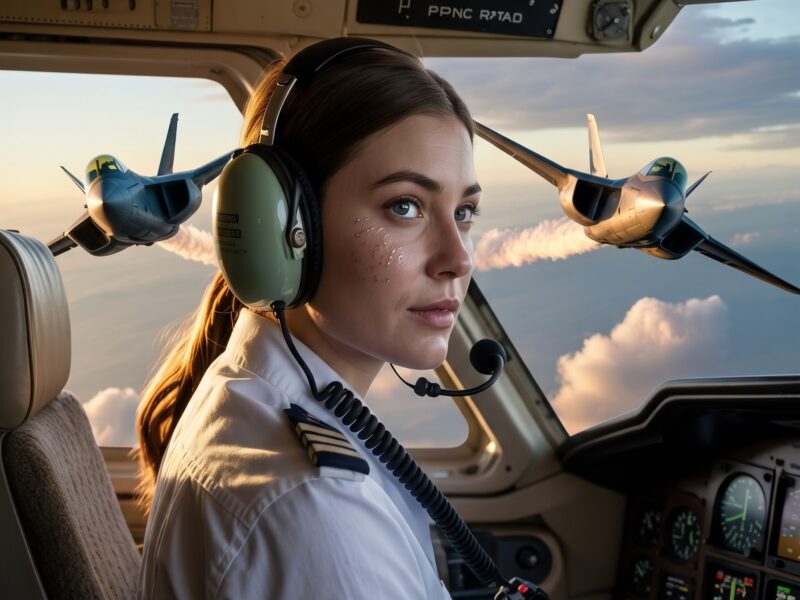
They called me a hysterical flight attendant when I begged the captain to land at Denver International Airport
The first explosion shook the aircraft just after midnight, sending a shudder through the airframe that rattled every tray table in the cabin. The flight was supposed to be a routine red-eye from Chicago to San Francisco, carrying two hundred tired souls floating silently six miles above the dark expanse of the American heartland. Passengers screamed as the overhead lights flickered, plunged the Boeing 737 into complete pitch darkness for three agonizing seconds, and then relit in an eerie, dimmed emergency red. A young child began crying hysterically somewhere in row fifteen, the sound rising sharp and terrified above the sudden wall of worried chatter.
I grabbed the nearest aisle seat armrest to keep my balance, my fingers digging into the worn leather as the plane dipped precipitously toward the cloud layer below.
“Everyone stay calm, please!” I called out, forcing my voice into the smooth, practiced tone of a professional flight attendant. “Please keep your seatbelts fastened and keep the aisles clear. The flight crew is handling the situation.”
The chime overhead dinged twice in rapid succession—the priority summons from the flight deck. The captain’s voice came through the cabin intercom, clipped and laced with adrenaline. “Ladies and gentlemen, this is the captain. We’ve experienced an electrical anomaly and lost primary navigation capabilities. Please remain seated while we address the issue.”
I didn’t wait for further instructions from the lead purser. I unclipped my jumpseat harness and rushed down the carpeted aisle straight toward the front galley. My heart was hammering against my ribs, not from the sudden drop in altitude, but because of the specific way the airframe had shuddered—the distinct, rhythmic oscillation that had preceded the blackout. It wasn’t an engine failure. It wasn’t a lightning strike. It was an electromagnetic feedback pulse.
I knocked on the reinforced cockpit door, entering the security code rapidly on the keypad. The latch clicked, and I pushed my way inside.
“How long until we can land?” I demanded, stepping into the cramped, instrument-lit space.
Captain Richard Vance, a veteran pilot with thin gray hair and forty years of commercial aviation experience, was wrestling with the primary control yoke. He looked up at me with sharp annoyance, his face illuminated by the bright orange glowing alerts on his multi-function display. “What are you doing in here, Clara? Get back to the main cabin and secure the passengers!”
“How long, Captain?” I repeated, stepping closer.
He glanced down at the secondary backup instruments. “Twenty minutes, maybe less. We’re diverting toward Denver International Airport, but our electronic flight bag is locked up and the primary flight computers are constantly rebooting.”
I leaned over the center console, my eyes scanning the modern glass cockpit displays. I bypassed the standard flight plan display and glanced straight at the raw GPS telemetry feed and the analog inertial navigation display near the co-pilot’s elbow. When I saw the shifting numbers, my stomach tightened into a knot of sheer ice. The digital altitude readouts were spinning in a subtle, cyclical loop, while the directional heading was drifting steadily six degrees off true north every forty seconds.
The aircraft wasn’t simply experiencing a systemic mechanical malfunction. Someone was actively spoofing our avionics—spoofing them using a high-altitude military-grade directional beam.
“Captain, we need to change course immediately,” I urged, pointing directly at the horizontal situation indicator. “Disengage the auto-flight system completely and drop to manual flight rules. Turn thirty degrees south.”
Vance turned sharply in his leather seat, staring at me as if I had completely lost my mind. “Excuse me? Get back to your station right now! You’re a flight attendant, not an air traffic controller!”
“Please, look at the navigation system!” I raised my voice, stepping into the narrow gap between the two seats. “Look at your raw inertial guidance feed versus your digital track! They don’t match. You think you’re heading west toward Denver, but you’re actually banking northeast into the high-security airspace over the Cheyenne Mountain Complex!”
The young co-pilot, a young man named Mark, leaned forward and studied the cross-referenced analog backup gauge. His face drained of color as he quickly tapped the glass screen of his flight tablet. “Captain… she’s right. The GPS coordinates are spoofed. The flight computer thinks we’re over Eastern Colorado, but our raw magnetic compass says we’re steering straight for restricted military airspace.”
Captain Vance froze, his hand trembling on the thrust levers. He slowly turned his head to glare at me, his eyes wide with disbelieving suspicion. “How would you know that? How would a domestic stewardess know how to read raw military inertial telemetry?”
I swallowed hard, the dry air of the cockpit scorching my throat. “Because I’ve seen this exact spoofing signature before.”
Fourteen years earlier, before I put on the navy blue skirt and silk neck scarf of a commercial flight crew member, I had been Captain Clara ‘Angel’ Mercer. I was an Air Force combat pilot assigned to an ultra-classified electronic warfare and stealth evaluation squadron operating out of Groom Lake. My call sign had been Angel—a nod to my ability to glide heavy aircraft through complex radar nets without leaving a trace.
Then came Operation Ghostlight. A low-altitude testing mission over the Nevada test ranges went terribly wrong. Three tactical aircraft were suddenly hit by an unknown, unregistered electromagnetic disruption signal that wiped their avionics and scrambled their flight paths. Three pilots—including my younger brother, First Lieutenant Ethan Mercer—flew directly into a canyon wall at eight hundred miles per hour.
The official Department of Defense investigation took less than forty-eight hours to declare the tragedy an unfortunate pilot error brought on by sudden spatial disorientation. They closed the case, sealed the records, and threatened me with court-martial and life imprisonment under the Espionage Act when I refused to sign off on the official report. I knew it was a lie. I had reviewed the black-box telemetry before the military police confiscated it. Someone had deliberately manipulated the navigation systems of those jets from the ground. Someone had murdered my brother and erased the truth from history. Broken, disillusioned, and facing a forced dishonorable discharge, I hid my past, changed my legal name, and disappeared into civilian aviation, pretending to be ordinary.
And now, fourteen years later, sitting six miles above the earth in a civilian airliner, that exact same corrupt signal signature was tearing through my cockpit’s avionics.
The Boeing 737 jolted violently again, dropping two hundred feet in a split second. Outside, a sharp metallic groan echoed through the fuselage as the automated flap actuators fought against the conflicting digital signals. In the galley just behind the cockpit, a flight attendant lost her balance and crashed hard against the aluminum wall.
“Stay here!” I shouted to Vance, opening the cockpit door just enough to check on her. I knelt beside her, pulling her upright. “Are you okay, Sarah?”
“I think my wrist is sprained,” she sobbed, holding her arm tightly to her chest. “Clara, what’s happening to us? Why are the engines making that noise?”
“We’re going to be fine,” I lied softly, helping her into a jumpseat and securing her safety harness. “Sit tight and keep your belt locked.”
Behind us in the main cabin, the muffled sounds of terror grew louder. Passengers were weeping, reciting prayers, and holding hands across the aisles. I looked through the small, circular window on the forward entry door. The night sky outside was pitch black, devoid of light or clouds. It was empty. Too empty.
I stepped back into the cockpit, slamming the heavy door shut and sliding into the jumpseat behind the center console.
The cockpit radio speaker exploded into a wall of loud, rhythmic white noise, followed by an automated, digitized voice that boomed over the emergency frequency: “Unidentified civilian aircraft. You are entering restricted military sector Bravo-Nine. You are in violation of federal air space. Maintain current altitude and prepare for remote flight override.”
Captain Vance panicked, snatching the primary microphone off its cradle. “This is Flight 1142! We are a civilian airliner carrying two hundred passengers! We have experienced a severe avionics failure and loss of control!”
No response came from the transmitter. Only the cold, rhythmic hum of the spoofing signal filled the speakers, slowly seizing control of our fly-by-wire flight surfaces. The yoke began moving on its own, locking the plane into a steady, uncommanded descent toward the dark mountains below.
“They’re not listening,” Mark whispered, his fingers flying across the controls to disengage the autopilot actuators. “It’s not an accident, Captain. They’re pulling us down!”
I reached past Captain Vance’s shoulder, my hands moving with pure, unyielding instinct. I grabbed the secondary emergency military radio handset buried beneath the circuit breaker panel—a channel that civilian pilots never touched, a channel that required an outdated frequency code that had been decommissioned over a decade ago.
I keyed the microphone switch.
“Angel to Raven Control,” I spoke into the mic, my voice dropping into the cold, razor-sharp cadence of an operational combat commander. “Break transmission immediately. We are locked in a heavy spoofing loop. I repeat, Angel to Raven Control, break your signal!”
Captain Vance spun around in his chair, his eyes bulging with shock. “What did you just say?! What radio is that?!”
I ignored him entirely, pressing the headset speaker hard against my ear.
For five long seconds, only raw, crackling atmospheric static hissed through the earpiece. Then, the signal suddenly cut out, replaced by a sudden, absolute silence.
A new voice cut through the static—low, gravelly, and echoing with the high-grade encryption of a tactical military command network.
“Angel…” the voice gasped, soundly stunned. “Confirm identity and authentication code.”
My hands began shaking so violently I could barely hold the heavy plastic microphone. My breathing hitched in my chest. I hadn’t heard that voice, that specific tactical radio protocol, since the night my world ended in the Nevada desert.
“Angel confirmed,” I said, my voice cracking with suppressed emotion. “Authentication pattern Foxtrot-Seven-Zero-Zero. Release our controls!”
The radio crackled back instantly. “Angel confirmed. Stand by. Target acquired.”
“Who are you talking to?!” Vance shouted, reaching to grab the radio from my hand. “Clara, what is going on?!”
Before he could touch the microphone, two brilliant flashes of light sliced through the thick darkness outside the cockpit windows.
Out of the black sky, two sleek, pitch-black silhouettes descended at supersonic speed, leveling off just fifty feet from our wingtips. The twin Pratt & Whitney engines of two F-22 Raptor stealth fighters illuminated the cloud layer with brilliant, pale-blue afterburner plumes. Their formation was absolute perfection—silent, precise, and deadly.
The passengers couldn’t see them through the small cabin windows in the storm, but from the cockpit, they looked like twin gods of war carving through the dark night.
One of the fighters executed a slow, flawless combat roll, sliding into position less than thirty feet from my side of the cockpit. The pilot tilted his helmeted head toward us, giving a crisp, formal military hand signal that only a trained interceptor would recognize.
The emergency headset in my hand crackled back to life.
“Angel, this is Flight Lead,” the voice declared over the encrypted line. “We have your six. Controls returning to manual.”
Tears blurred my vision, spilling down my cheeks. For fourteen years, I had lived in deep isolation, convinced that everyone from my past was dead, that my service had been erased, that my sacrifice was meaningless.
Captain Vance fell back into his pilot seat, staring out the window at the lethal warplane flying on his wing in absolute speechlessness. He turned his head slowly, looking at me as if I were a terrifying stranger. “Who… who are you?”
I wiped the tears from my face, my eyes fixed on the lead F-22 as its weapons bay doors flickered open and shut in a tactical salute.
“Someone who was supposed to be dead,” I whispered softly.
Then, the lead pilot’s voice came back through the radio earpiece, transmitting a private, low-band message meant for my ears alone—a message that made my blood run instantly cold and stopped the air in my lungs.
“Angel,” the pilot whispered, his voice trembling through the digitized comms line. “Your brother is alive.”
I stopped breathing. My knees buckled beneath me in the narrow space of the flight deck. Because my brother, First Lieutenant Ethan Mercer, had been the very first pilot buried in an empty grave fourteen years ago.
And the voice speaking to me through that encrypted tactical radio sounded exactly like his.
The cockpit descended into a suffocating, heavy silence broken only by the low hum of our 737’s twin engines. Captain Vance was staring at me, his mouth opening and closing without sound, while Mark frantically checked the primary flight computer. The digital screens had miraculously cleared, the red warning banners disappearing as the high-altitude spoofing signal dissolved under the tactical jamming umbrella of the two F-22 Raptors hovering beside us.
“Ethan?” I whispered into the emergency handset, my thumb pressing down on the push-to-talk button so hard my nail turned white. “Ethan, is that you?”
“Clara, keep your voice down,” the voice replied, its tone urgent and laced with synthesized static. “This line is secure for now, but the ground station tracking your aircraft isn’t military. It’s a rogue civilian contractor operating out of a facility hidden in the mountains north of Denver. They intercepted your flight path because they discovered who you were.”
“What are you talking about?!” I demanded, stepping closer to the windshield. The lead Raptor dipped its left wing, the pilot’s dark visor reflecting the soft ambient glow of its cockpit instruments. “I’ve been out of the military for fourteen years! I’ve been living as a ghost!”
“You thought you were a ghost, Angel,” Ethan’s voice answered softly. “But when you renewed your First Class Medical certification with the FAA last month, your biometric data triggered a flag in the old Ghostlight surveillance database. They realized ‘Clara Vance’ was Captain Clara Mercer. They spoofed your airliner’s navigation to bring you down over their perimeter so they could make your disappearance look like a tragic accident—just like they did to my flight.”
Captain Vance snapped back to reality, slamming his palm against his flight console. “I don’t know what kind of sick game you’re playing, Clara, or what military secret ops program you used to belong to, but I am the commander of this aircraft! We have two hundred civilians back there! We are landing at Denver International immediately!”
He grabbed the primary control stick and began banking the airliner toward the illuminated grid of the city lights glowing far off on the southern horizon.
“Flight 1142, do not execute that turn!” Ethan’s voice barked over the tactical radio, sharp and authoritative. “Denver International is compromised. The ground radar control tower at DIA has been infected by the same electronic warfare malware affecting your systems. If you enter their landing pattern, they will override your auto-throttles and drive you straight into the runway.”
“This is insane!” Vance yelled, sweating profusely through his white uniform shirt. “Mark, declare a Mayday emergency to regional air traffic control! Get us on the ground!”
“Captain, wait!” I shouted, grabbing Vance’s forearm before he could flip the transponder code to 7700. “Look at the radar display! If my brother says Denver is compromised, then Denver is compromised!”
“Your brother is supposed to be dead!” Vance screamed, his eyes wild with terror and exhaustion. “You’re asking me to put two hundred lives on the line based on the voice of a phantom flying an unregistered fighter jet!”
“Look out your left window, Captain!” I snapped, pointing toward the dark mountain range below us.
Through the clouds, a brilliant red beam of light sliced through the night air, shooting upward from a dark valley in the foothills of the Rockies. The light swept across the bottom of our fuselage, and instantly, the primary flight displays in our cockpit flickered wildly once again. The altitude readouts spun back to zero, and the primary warning horn began to blare a continuous, deafening alarm.
“Caution! Terrain! Pull up!” the automated cockpit voice chimed rhythmically. “Caution! Terrain! Pull up!”
“They’re relocking the ground signal!” Mark yelled, pulling back on his yoke with both hands as the airplane’s nose involuntarily pitched downward toward the dark earth. “It’s taking control of the hydraulic actuators! We’re losing elevator control!”
The lead Raptor suddenly accelerated, its twin afterburners blazing into a blinding white glare. “Wingman, execute tactical blinding pattern!” Ethan ordered over the radio. “Deploy high-intensity magnesium flares directly over the target valley! Burn out their optical tracking array!”
The second F-22 pitched up into a vertical climb, spinning ninety degrees before releasing a massive cluster of brilliant defense flares. A blinding cascade of pyrotechnic light illuminated the night sky, burning at thousands of degrees. The intense light and thermal signature overwhelmed the ground station’s optical sensors, causing the red tracking beam to flick off instantly.
Our flight instruments stabilized immediately. Mark caught the plane at eight thousand feet, pulling the nose back up into a safe climb just as the jagged black peaks of the Rockies loomed terrifyingly close beneath us.
In the main cabin, passengers screamed as the force of the pull-up shoved them back into their seats. Luggage burst from an overhead bin, crashing onto the carpeted aisle.
In the cockpit, Vance was gasping for air, his hands shaking violently on the flight stick. He looked at the mountain peak we had missed by less than five hundred feet, then looked up at me, his face pale as chalk. “What… what was that?”
“That was the weapon that killed my squadron fourteen years ago,” I said softly, my voice cold and hard as steel. “They didn’t just use it on fighter jets back then. They’ve spent fourteen years weaponizing it for long-range air traffic interception. They can take down any plane, anywhere in the world, and make it look like a tragic pilot mistake.”
I picked up the tactical radio handset again. “Ethan, what’s the play? We can’t keep dodging ground-based tracking beams with two hundred civilians on board. We’re running low on fuel.”
“There is an old, decommissioned SAC runway at the former Lowry Air Force Base,” Ethan replied. “It’s dark, it’s unlit, and it’s outside the direct line-of-sight of their ground array. I can paint a thermal landing strip on the tarmac using my aircraft’s targeting laser. You’ll have to fly a completely manual, dark approach. No instruments, no glide slope, no radio guidance.”
“Lowry’s runway hasn’t been maintained in twenty years!” Vance interjected, his voice high-pitched. “It’s barely six thousand feet long! A fully loaded Boeing 737 needs more runway than that to stop safely!”
“It’s the only runway we have that won’t kill us, Captain,” I said, leaning down to look him dead in the eye. “Now, are you going to fly this airplane, or do I need to take the seat?”
Vance stared at me for three long seconds. He saw no fear in my eyes—only the terrifying, cold competence of a decorated military pilot who had survived the dark. He swallowed hard, wiped the sweat from his forehead, and nodded slowly. “Set the flaps. Mark, prepare for a dead-stick landing at Lowry.”
“Angel, form up on my wing,” Ethan’s voice called out over the radio. “I’m taking you down into the dark.”
I stood between the two pilot seats, staring out the front canopy as the lead F-22 drifted back down, aligning its broad wings perfectly with ours. As the jet matched our speed, the pilot flipped on his internal cockpit cabin light for three brief seconds.
Through the glass of the fighter canopy, I saw his face clearly. He was older, scarred along his jawline, his hair streaked with gray—but the eyes were unmistakable. It was Ethan. My little brother was alive.
He gave me a slow, solemn salute.
I raised my hand to my forehead and returned the salute, my chest tightening with a profound mix of grief, rage, and overwhelming love.
“Lead us home, Raven,” I whispered into the mic.
The descent into the darkness of the old Lowry airfield was like diving into a black pit. Below us, the sprawling lights of the Denver metropolitan area glowed brightly, but the massive, abandoned military strip remained a pitch-black rectangle carved into the eastern plains.
“We are ten miles out,” Mark reported, his hands trembling as he managed the throttle quadrant manually. “Speed two hundred knots. Descent rate eight hundred feet per minute. Visual contact with the ground is zero.”
“Hold your speed steady,” I instructed, leaning over the center pedestal to monitor the airspeed indicator. “Ethan, we need that landing strip illuminated now.”
“Copy, Angel,” Ethan’s voice crackled through the headset. “Sweeping the runway now. Look for the green thermal signature.”
Ahead of us, the lead F-22 banked low over the dark terrain, shooting a thin, invisible infrared laser beam along the edges of the abandoned concrete runway. Through the 737’s night-vision secondary display, the dark strip suddenly lit up in brilliant, glowing neon green, outlining the cracked pavement, old landing markings, and overgrown grass surrounding the field.
“I see it!” Vance shouted, a sudden burst of hope illuminating his tired face. “I have visual on the strip! Flaps thirty!”
“Flaps thirty set,” Mark confirmed. “Gear down!”
The heavy landing gear dropped with a loud mechanical thud, locking into place beneath the floorboards. The sudden aerodynamic drag pulled at the aircraft, slowing us rapidly as we passed through fifteen hundred feet.
Suddenly, the emergency radio in my hand flared with heavy, panicked static.
“Angel, break off! Break off!” Ethan’s voice screamed into my ear. “They’ve mobilized ground assets! They have mobile surface-to-air missile trucks positioned on the north perimeter of the airfield! They’re locking onto your heat signature!”
“We can’t break off!” Vance yelled, wrestling with the controls as the plane sank past eight hundred feet. “We’re on short final! If I turn now, we’ll stall and crash into the residential developments!”
“Maintain course!” I ordered, stepping up to the center console and glaring out into the dark night. “Ethan, clear that perimeter!”
Through the windshield, I saw two bright red streaks of light ignite from the darkness near the edge of the abandoned runway. Two infrared-guided anti-aircraft missiles launched into the night sky, their rocket motors roaring as they tracked straight for our broad, slow-moving passenger jet.
“Missiles in the air!” Mark screamed, covering his face with his arms.
Out of nowhere, the second F-22 Raptor—Ethan’s wingman—shot across our nose at Mach 1.5, passing less than two hundred feet in front of our windshield. The jet dropped its nose straight toward the incoming missiles, deploying a massive, blinding curtain of heat flares and electronic countermeasures.
The first missile bit into the flare cluster, exploding in a massive fireball that lit up the entire cockpit in a harsh, yellow glare. The shockwave slammed into our aircraft, causing the wing to dip violently to the right, but Vance fought the wheel, forcing the wings back level.
The second missile bypassed the flares, continuing its lethal trajectory straight toward our left engine.
“Not today!” Ethan’s voice roared over the radio.
The lead F-22 dived from the sky like an arrow, putting his own high-tech stealth fighter directly into the path of the incoming missile. He dumped his afterburners, creating a massive heat source that distracted the missile’s seeker head. The missile adjusted course by two degrees, striking the trailing edge of Ethan’s right wing flap.
A bright explosion tore through the air. Pieces of composite metal rained down onto the desert sand below as Ethan’s jet spun wildly, smoke pouring from its damaged wing.
“Ethan!” I shrieked into the microphone.
“I’m good! I’m good!” his voice grunted over the comms, heavy with the physical strain of pulling maximum Gs to recover the spinning aircraft. “Control surfaces are damaged, but I’m still flying! Land that damn plane, Clara! Land it now!”
Vance slammed the thrust levers into idle as the threshold of the dark runway rushed up to meet us. “Brace for impact!” he roared through the cabin PA.
The main landing gear slammed onto the cracked concrete of Lowry Airfield with a deafening screech of burning rubber. The entire aircraft bounced violently into the air before crashing down again, skidding across the uneven, gravel-strewn pavement. Vance stomped on the manual brakes, pulling the thrust reversers back to maximum power.
The twin jet engines howled in reverse, throwing up a cloud of dust, sparks, and debris as the heavy airliner hurtled down the dark, narrow strip toward the concrete barrier at the far end.
“Brake! Brake!” Mark screamed.
The aircraft slid sideways, tires popping one by one under the tremendous pressure, but the massive machine finally ground to a halt just fifty feet from the perimeter fence, its nose cone hanging over the boundary edge.
Silence descended on the cockpit. The engines whined as they slowly died, leaving only the sound of heavy breathing, the smell of burning rubber, and the soft ticking of hot metal cooling in the night air.
In the main cabin behind us, two hundred passengers sat in absolute, stunned silence for three seconds—before an explosion of tears, cheers, and applause erupted through the walls.
Vance collapsed back into his seat, staring at his hands, which were shaking so hard he couldn’t unbuckle his harness. He looked up at me, his eyes filled with profound reverence. “We made it…”
“Not yet,” I said, unholstering the emergency flare gun from the cockpit survival kit and opening the forward entry door.
Outside, in the dark desert sky above the airfield, the damaged F-22 Raptor was limping through a low circle, trailing a thick plume of gray smoke from its right wing. Its twin engines spluttered, fighting to keep the heavy fighter airborne.
I stepped out onto the metal air-stairs, looking up into the night, my chest heavy with panic. “Ethan! You need to eject! Your wing is disintegrating!”
“Negative, Angel,” his voice came through my handheld tactical receiver, clear and calm. “If I eject now, this bird hits the suburban neighborhood east of the base. I’m taking her out to the salt flats. I have to finish this.”
“Ethan, no! Don’t you dare leave me again!” tears streamed down my face, freezing against the cold night air. “You just came back!”
“I never left you, Clara,” he whispered gently over the radio. “I’ve been hunting the men who built that weapon for fourteen years. And now, their main server hub is exposed. Look at the radar coordinates I just sent to your tablet. Take those files to the Pentagon. Burn them all down.”
“Ethan!” I screamed into the night sky.
The black fighter jet pitched its nose upward, its left engine screaming in full afterburner as it turned away from the city lights, soaring off into the deep, dark expanse of the eastern plains.
Five minutes after our airliner came to a halt on the abandoned runway, the sky above Lowry Airfield filled with the thunderous roar of heavy military transport helicopters.
Four Sikorsky UH-60 Black Hawks descended out of the clouds, their high-intensity searchlights sweeping across the tarmac, pinning our damaged Boeing 737 in brilliant white beams. Fully armed tactical team members in unmarked combat gear poured out of the helicopters, establishing a secure defensive perimeter around the civilian aircraft.
In the distance, across the flat plains, a brilliant flash of orange light illuminated the horizon—followed seconds later by a low, dull thud that vibrated through the ground beneath my feet.
My heart broke into a thousand pieces. I dropped to my knees on the cold tarmac, clutching the military tactical receiver to my chest, weeping silently as I looked at the distant plume of smoke rising into the night sky where my brother’s jet had touched the earth.
A hand rested gently on my shoulder.
I looked up to see the pilot of the second F-22 standing over me. He had landed his fighter on the far end of the strip and had rushed over on foot. He pulled off his flight helmet, revealing a battle-hardened face with sharp, gray eyes and a deep scar running along his temple.
“Captain Mercer,” he said, his voice deep and solemn. He offered me a hand and pulled me up from the pavement.
“Is he… is he gone?” I asked, my voice barely a whisper.
The pilot looked out toward the horizon where the fire was burning, then turned back to me, his expression unreadable. “First Lieutenant Ethan Mercer did his duty, Captain. He ensured that the strike telemetry was transmitted directly to your secure handheld unit before impact. He made sure the men who killed your squadron fourteen years ago can never hide again.”
“Who are you?” I asked, wiping the cold tears from my cheeks.
“Major Marcus Cole,” he replied, giving a crisp, formal military bow. “I was your brother’s wingman in the underground resistance unit. For fourteen years, we’ve been operating off the grid, gathering evidence against the illegal defense contractor known as Vector-Nine—the group that developed the orbital spoofing system that brought down your plane.”
He pulled a high-security encrypted flash drive from his flight suit pocket and pressed it into my hand, pressing my fingers firmly around it.
“What is this?” I asked.
“That drive contains the complete, unredacted flight logs, the financial records, and the names of the high-ranking military officers who took bribes to cover up the crash of Operation Ghostlight,” Major Cole explained, his voice grim. “Including the three generals who signed your discharge papers and forced you into hiding.”
Behind us, Captain Vance and the flight crew were helping the terrified passengers disembark down the emergency inflatable slides. Federal agents and military police were already fanning out across the field, taking control of the scene and securing the area.
A sleek black government sedan drove rapidly down the runway, stopping just feet from where Major Cole and I were standing. A man in a dark suit step out of the back seat, flanked by two armed federal marshals. He had graying hair, a cold, calculating face, and a silver pin on his lapel indicating his position as a Deputy Director of the Department of Defense.
“Captain Clara Mercer,” the man said, his voice flat and devoid of emotion. “Or should I say, Flight Attendant Clara Vance. I am Director Vance—no relation to your civilian captain over there. You are currently in possession of highly classified national security property. Hand over that data drive and step into the vehicle.”
I stared at the man, my grip tightening around the flash drive until my knuckles turned white. I recognized his face from old military briefings fourteen years ago. He had been the lead defense auditor who declared my brother’s death an act of pilot negligence.
“Director Vance,” I spat, my voice dripping with cold contempt. “You were the one who signed the authorization for the ground testing at Groom Lake. You knew the spoofing beam was unstable. You killed those three pilots, and you tried to kill two hundred civilians tonight just to keep your secret buried.”
Director Vance smiled faintly, a chilling, hollow expression. “National security requires sacrifices, Captain. No one will ever believe the word of a disgraced, traumatized former pilot working as a flight attendant. Hand over the drive, or you will spend the rest of your life in a federal supermax facility for high treason.”
The two armed marshals beside him reached for their holsters, stepping forward to surround me.
Major Cole immediately stepped in front of me, unholstering his service pistol and leveling it directly at Director Vance’s chest. “She’s not going anywhere with you, Vance.”
“Stand down, Major!” Director Vance snapped, his eyes flashing with sudden rage. “You are pointing a weapon at a senior official of the Department of Defense! That is an act of treason!”
“No, Director,” a voice boomed from the darkness behind the Black Hawk helicopters. “The only treason committed here tonight was yours.”
Out from the shadow of the main transport helicopter stepped an older man dressed in the full four-star service uniform of the United States Air Force. His chest was covered in medals, and his eyes were cold and sharp as flint. Behind him marched a full squad of heavily armed United States Air Force Special Tactics operators, their weapons raised and locked onto Director Vance’s security detail.
Director Vance’s face turned instantly ash-gray. “General Morrison…”
General Thomas Morrison, the Chief of Staff of the Air Force, walked directly up to the sedan. He didn’t even look at Director Vance. Instead, he stopped in front of me, standing at rigid attention, and brought his hand up to his brow in a slow, sharp, and deeply respectful salute.
“Captain Clara Mercer,” General Morrison said, his voice rich with deep authority. “On behalf of the United States Armed Forces, I apologize for the fourteen years of injustice you have suffered. We received the tactical telemetry broadcast from Lieutenant Mercer ten minutes ago. The Inspector General’s office has already issued arrest warrants for everyone involved in Vector-Nine.”
Two Air Force security operators stepped forward, roughly grabbing Director Vance’s arms and snapping heavy steel handcuffs around his wrists.
“You can’t do this!” Director Vance screamed as he was dragged toward a waiting military transport. “I have clearance! I have executive immunity!”
“Your immunity was revoked five minutes ago, Director,” General Morrison said coldly as the agents shoved the screaming man into the back of the vehicle.
The General turned back to look at me, his eyes softening as he looked down at the silver flight attendant wings pinned to my uniform vest.
“You brought a crippled airliner down on an unlit runway, saved two hundred civilian lives, and exposed a corporate conspiracy that threatened the entire nation’s airspace,” Morrison said softly. “You never stopped being a combat pilot, Clara.”
“My brother…” I choked out, tears welling up in my eyes again as I looked back toward the distant fire on the eastern horizon. “He gave his life to send that signal.”
General Morrison looked out toward the plains, a sad, knowing smile appearing on his weathered face. “Your brother is the toughest son of a gun I’ve ever known, Captain. And if I know Ethan Mercer, he doesn’t die that easily.”
He pointed toward a set of headlights cutting through the darkness from the far end of the salt flats.
A dirt-covered military pickup truck was bouncing across the rough terrain, rushing toward our position at high speed. The truck screeched to a halt beside the Black Hawk helicopters, and the driver’s side door flew open.
A man stepped out into the bright searchlights, coughing from the smoke lingering on his charred flight suit. His right arm was wrapped in a makeshift sling, and his face was smeared with soot and dirt—but he was standing on his own two feet.
I froze. The air left my lungs.
“Ethan?” I cried out.
He looked up through the glare of the lights, a broad, crooked smile breaking across his dusty face. “I told you, Clara… I know how to put a plane down in the dirt.”
I didn’t care about the protocol, I didn’t care about the generals, and I didn’t care about the military police surrounding us. I ran across the cold tarmac as fast as my legs could carry me, throwing my arms around my brother’s neck. He caught me with his good arm, pulling me tight against his chest as we both fell to our knees in the dust of the old runway, weeping together under the vast, open canopy of the Colorado sky.
Fourteen years of darkness, silence, and grief melted away in the warm embrace of the morning sun slowly rising over the horizon.
Two days later, the story broke across every major news network in the world. The public knew nothing of the stealth fighters, the electronic warfare weapons, or the rogue defense contractors. To the world, Flight 1142 was a miraculous story of a brave commercial flight crew who safely landed a disabled aircraft on an abandoned military strip during a catastrophic systems failure.
I stood on the tarmac at Nellis Air Force Base one week later, dressed in a pristine, tailored Air Force dress uniform bearing the silver rank insignia of a Major.
Beside me stood Ethan, his arm resting in a crisp white sling, flanked by Major Cole and General Morrison. On the runway before us sat a newly minted F-22 Raptor, its sleek titanium wings catching the bright morning light of the Nevada desert.
“Your flight status has been fully restored, Major Mercer,” General Morrison said, handing me a leather-bound flight logbook bearing my original call sign in gold lettering: ANGEL. “The sky is waiting for you.”
I looked down at the logbook, feeling the smooth leather beneath my fingertips, then looked up at the vast, endless blue sky above. The fear was gone. The shadow was lifted.
I turned to my brother, who gave me a sharp, proud nod.
I put on my flight helmet, pulled the dark visor down over my eyes, and walked up the ladder into the cockpit of the jet. As the twin engines roared to life, shaking the earth beneath the tarmac, I advanced the throttle, releasing the brakes and shooting up into the sky—no longer a ghost, no longer running, but soaring high above the dark, forever free.
The end.









