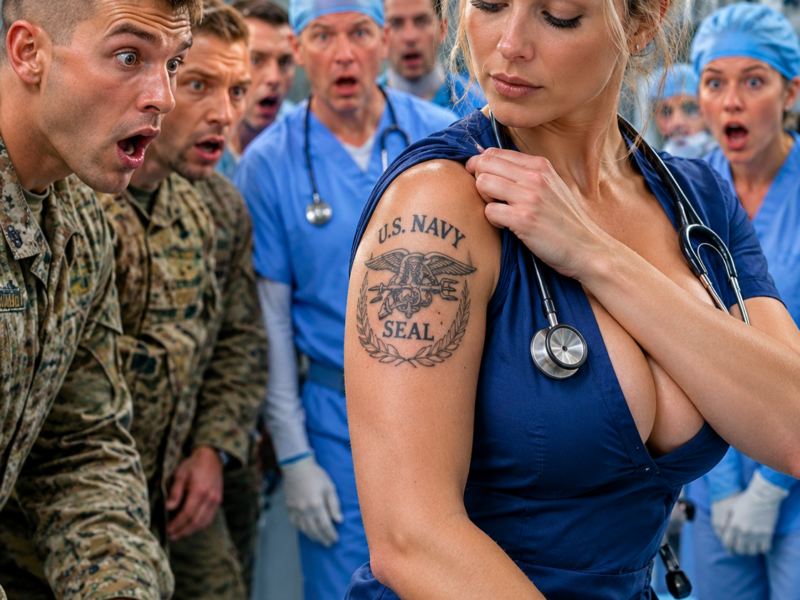
They called her the nurse who couldn’t stop shaking. They laughed at her oversized scrubs, her quiet voice, and the sleeves she never rolled up
“Pilot, listen carefully. Do not descend yet.”
Aaron Kessler’s voice cut through the radio static.
The hallway had gone silent. Nurses stood near the command post, watching her with expressions that ranged from confusion to disbelief. A few minutes earlier, she had been the quiet nurse everyone joked about. Now she was standing in the middle of the hospital, holding a radio like it was the most natural thing in the world.
The pilot answered.
“Copy, Kessler. We’re holding. Wind is pushing us east. We have limited visibility and an unstable device somewhere near the southern edge of the drop zone.”
Aaron studied the map.
“Ground team, confirm your position.”
A strained voice came through.
“Six personnel behind the eastern berm. We’re approximately 300 meters from the device. One soldier has a possible leg injury. We can’t see the aircraft through the dust.”
“That’s fine,” Aaron replied. “You don’t need to see the aircraft. You need to stay where you are and follow my instructions.”
She looked at the map again.
The range was familiar. She had studied similar terrain dozens of times during her military career. She remembered the tree line, the drainage ditch, the low ridge that curved around the western side of the training area.
But memory wasn’t enough.
She needed current information.
“Command, I need the latest coordinates for the device, the berm, and the ground team’s position. Confirm them independently before transmitting.”
The dispatcher repeated the request.
A few seconds later, the coordinates arrived.
Aaron checked them against the map.
Then she looked toward the radio.
“Pilot, approach from the northeast. Hold your current altitude until I confirm the wind correction. Keep clear of the southern perimeter.”
“Copy northeast approach.”
A gust rattled the windows.
For one terrible moment, Aaron was no longer standing in a hospital hallway.
She was back outside Kandahar.
The air was full of dust. The radio was full of voices. Somewhere beyond the ridge, a helicopter was coming in, and she was trying to convince herself that the coordinates were right.
Then came the explosion.
Ochoa’s voice disappeared.
Vance never answered again.
Aaron’s fingers tightened around the radio.
“Kessler?” Charlotte said softly.
Aaron blinked.
The hospital returned.
Six men were still waiting.
She couldn’t change what had happened two years ago. She couldn’t bring Ochoa and Vance back.
But she could make sure she didn’t abandon the people depending on her now.
“Pilot, report your position.”
“Approaching the northeast boundary. Visibility improving slightly.”
“Ground team, remain behind the berm. Confirm nobody has crossed the marked exclusion line.”
“Confirmed. All six accounted for.”
Aaron exhaled slowly.
“Good. Nobody moves until the aircraft is in the approved position. We are not rushing this.”
The pilot reported another shift in the wind.
Aaron listened, checked the updated figures, and relayed the correction to the ground command team. The approach was adjusted using the verified information coming from the range. She didn’t pretend to have eyes on a location she couldn’t see. She asked for confirmation, waited for the response, and checked every detail before allowing the operation to continue.
It was the discipline that had once kept her alive.
It was also the discipline she had spent two years trying to forget.
“Aircraft is holding,” the pilot reported.
Aaron looked toward the dispatcher.
“Confirm the device team has established the exclusion area.”
“Confirmed. EOD is monitoring the device. They are not declaring it safe yet.”
“Understood. We will not move anyone across that area until they authorize it.”
A minute passed.
Then another.
The radio crackled.
“Ground team reports one casualty is becoming unresponsive.”
Aaron’s stomach tightened.
“What’s his name?”
“Private First Class Miller.”
She closed her eyes briefly.
“Tell him help is coming. Keep him protected and have the medic assess him. Don’t let anyone take unnecessary risks trying to reach the aircraft.”
The pilot spoke again.
“Kessler, we’re running low on our safe operating window.”
Aaron looked at the map.
The ground team had been pinned for too long. The weather was shifting. The device was unstable. And the people waiting behind the berm were beginning to lose hope.
“Command, what’s the status of the alternate evacuation route?”
The dispatcher answered.
“Still blocked. EOD hasn’t cleared the southern approach.”
Aaron’s eyes moved to the western side of the map.
There was another possible corridor, but it required confirmation from the team on the ground.
“Ground team, can you identify the drainage channel west of your position?”
“Affirmative. We can see part of it through the dust.”
“Do not enter it. I need the ground commander to confirm whether it remains clear and whether the EOD team approves it as a safe route.”
There was a pause.
Then the ground commander responded.
“Checking now.”
Aaron waited.
The entire hallway seemed to be holding its breath.
Finally, the answer came.
“EOD confirms the western corridor is clear for movement. Ground team can use it once the aircraft is in position.”
Aaron nodded.
“Copy. Pilot, stand by for the ground commander’s final signal.”
The pilot acknowledged.
A few moments later, the ground commander gave the order.
“Team is moving. Six personnel accounted for. One litter casualty.”
Aaron kept her eyes on the map.
“Confirm when everyone is aboard.”
Thirty seconds passed.
Then the radio erupted.
“Six aboard! Six aboard! We are clear of the immediate hazard area.”
A nurse near the doorway covered her mouth.
Charlotte closed her eyes.
The dispatcher let out a breath that sounded almost like a sob.
Then the pilot spoke.
“Kessler, all personnel are accounted for. We’re heading to the designated medical landing zone.”
Aaron lowered the radio.
For a moment, she didn’t move.
She had done it.
Six people were alive.
Not because she had been lucky. Not because she had shouted louder than everyone else.
Because she had listened, checked, calculated, and refused to let panic replace judgment.
Charlotte approached her.
“Are you all right?”
Aaron tried to answer.
Nothing came out.
Her hands began shaking.
Not the small tremor people had mocked for eight months.
This was the kind of shaking that came after holding yourself together for too long.
Charlotte gently took the radio from her.
“You can sit down now.”
Aaron lowered herself into a chair near the wall.
Across the hallway, Prescott stood motionless.
He looked at the floor, then at the radio, then finally at Aaron.
For the first time since she had met him, he seemed to understand that the quiet woman he had been humiliating wasn’t someone who needed to prove herself.
She was someone who had already carried more than he could imagine.
Dr. Halverson found Aaron in the staff lounge twenty minutes later.
He brought her a bottle of water and placed it on the table.
“You saved Danny’s life,” he said. “You helped stabilize Simmons. And you just coordinated the evacuation of six people from an active hazard area.”
Aaron stared at the bottle.
“I did what I was trained to do.”
“That’s exactly what I’m talking about.”
She looked up.
Halverson pulled out a chair.
“I’ve worked in emergency medicine for fifteen years. I’ve seen people freeze, panic, and make terrible decisions when things get loud. I’ve also seen people who become calmer when everyone else loses control.”
He paused.
“You were one of those people today.”
Aaron gave a tired smile.
“Not all the time.”
“No. Nobody is.”
He glanced at her wrist.
“Can I ask you something?”
She nodded.
“Why did you never tell anyone?”
Aaron looked down at her tattoo.
The shield.
The lightning bolt.
The small letters beneath them.
“Because I didn’t want to be that person anymore.”
“What person?”
“The person everyone expected to be strong. The person who was supposed to know what to do every time someone screamed for help. The person who had to make decisions and live with them afterward.”
She swallowed.
“I lost two men. I spent two years replaying every second of that mission, wondering whether one different decision would have brought them home.”
Halverson leaned forward.
“Did you make the wrong call?”
Aaron didn’t answer.
“I’m not asking whether the mission went wrong,” he continued. “I’m asking whether you knowingly sent those men into danger.”
“No.”
“Did you have the information available to you at the time?”
“Yes.”
“Did you make the decision based on what you believed was accurate?”
Aaron nodded.
“Then you need to understand something. A tragic outcome doesn’t automatically mean the person who made the decision was guilty.”
Her eyes filled.
“Tell that to the families.”
“I would, if I could.”
He let the silence settle.
“Maybe you don’t need another person telling you to move on. Maybe you just need to stop punishing yourself for surviving.”
Aaron turned away.
For two years, she had been waiting for someone to say something that would make the guilt disappear.
But perhaps there were no words capable of doing that.
Perhaps healing began when she finally stopped demanding that it disappear.
The hospital administrator arrived shortly afterward.
Voss walked into the lounge carrying a tablet and wearing the same tight expression he had worn when he first questioned Aaron’s actions.
“I’ve reviewed the preliminary reports,” he said.
Aaron stood.
“Sir.”
“Please sit.”
He looked at Halverson.
“I understand that the emergency decompression was performed without prior physician authorization.”
Halverson crossed his arms.
“Yes. Because the patient was deteriorating rapidly and I was occupied with another critical case.”
“That’s still a credentialing issue.”
Aaron nodded.
“I understand.”
Voss turned toward her.
“I also understand that you have prior military qualifications that were not included in the information provided to the hospital.”
“I provided my nursing credentials and employment history.”
“You didn’t disclose your former role.”
“I wasn’t asked about it.”
Voss looked uncomfortable.
“That may be true.”
He glanced at the tablet.
“The hospital will need to review the circumstances surrounding the incident. We also need to determine whether your previous training can be recognized under our emergency response policies.”
Aaron’s expression remained neutral.
“I’m willing to cooperate.”
Voss hesitated.
Then he said something unexpected.
“I also want to acknowledge that your actions today helped save several lives.”
It wasn’t exactly an apology.
But it was the first time he had looked at her as more than a potential liability.
Before Aaron could respond, Charlotte entered.
“Colonel Marsh is here.”
Colonel David Marsh had been stationed at Fort Liberty for years. He was a senior officer who had worked with several Special Tactics units and knew the difference between a good report and a good operator.
He entered the lounge in uniform.
His eyes moved across the room before settling on Aaron.
“Staff Sergeant Kessler.”
Aaron stood automatically.
“Colonel.”
“At ease.”
He looked at her for a moment.
“I heard your voice on the command channel today. I wasn’t sure it was you until I received the full report.”
Aaron said nothing.
Marsh continued.
“Your separation file indicated you were leaving active duty for medical and personal reasons. I understood that you needed distance. I didn’t realize you had taken a nursing position this close to the training range.”
“I needed somewhere to start over, sir.”
He nodded.
“I understand.”
Then his expression hardened.
“I also want to discuss the clearance paperwork for this morning.”
Prescott had been standing outside the lounge.
At the mention of his name, he stepped inside.
Marsh turned toward him.
“Sergeant Prescott, I reviewed the range survey and your clearance signature. The records show that the inspection was not completed as required.”
Prescott swallowed.
“Sir, I relied on the previous survey.”
“You signed the current clearance.”
“Yes, sir.”
“Did you personally inspect the site?”
“No, sir.”
“Why?”
Prescott looked toward Aaron.
For a second, he seemed to search for an explanation that might make the situation smaller.
“I was supposed to conduct the inspection Tuesday morning. I overslept. I thought the previous survey would be sufficient, and I didn’t want to delay the exercise.”
Marsh stared at him.
“You didn’t want to delay the exercise?”
“Yes, sir.”
“Six soldiers were placed in danger because you signed a document without completing the required inspection.”
Prescott’s shoulders dropped.
“I understand, sir.”
“No. I don’t think you do.”
Marsh looked toward the hallway.
“Those six people were lucky. The hospital was lucky. And you were lucky that someone with the training to help happened to be standing nearby.”
Prescott lowered his eyes.
Aaron watched him without satisfaction.
She remembered the jokes.
The comments about her hands.
The way he had encouraged others to laugh.
But she also remembered the six men behind the berm.
She didn’t want revenge.
She wanted the next range inspection to be done properly.
“Colonel,” she said.
Marsh turned.
“Sergeant Prescott’s conduct needs to be addressed. But I want the focus to remain on fixing the training and safety procedures that allowed this to happen.”
Marsh studied her.
“That’s a reasonable request.”
He looked back at Prescott.
“You will report to your commanding officer for a formal review. Your duties are suspended pending that review.”
“Yes, sir.”
Prescott turned toward Aaron.
“I’m sorry.”
She held his gaze.
“Don’t apologize because you got caught.”
He looked down.
“Apologize because six people could have died.”
Prescott nodded slowly.
“I will.”
Then he left the room.
The following morning, Aaron returned to the emergency department.
She expected things to be awkward.
She expected whispers, questions, and perhaps a few people who suddenly wanted to become her closest friend.
Instead, Charlotte met her at the nurses’ station with two cups of coffee.
“Morning, Shepherd.”
Aaron stopped.
Charlotte smiled.
“Too much?”
Aaron shook her head.
“No. Just unexpected.”
“Good. You deserve a few unexpected things that aren’t terrible.”
Maria Delgado appeared from the supply room.
“I heard Simmons is asking for you.”
“How is he?”
“Stable. He’s been moved to the surgical floor. Danny’s doing better too.”
Aaron smiled.
“That’s good.”
Maria hesitated.
“Can I ask you something?”
“Sure.”
“Why did you let everyone think you were scared?”
Aaron considered the question.
“I wasn’t trying to convince anyone of anything. I just wanted to work without being recognized.”
“Did it help?”
“For a while.”
Maria nodded.
Then she looked at Aaron’s sleeves.
“You don’t have to hide anymore.”
Aaron glanced down.
Her sleeves were still pulled to her wrists.
She slowly rolled them back.
The tattoo caught the fluorescent light.
For the first time, she didn’t feel the need to cover it.
Three days later, Danny Ruiz was sitting upright in his hospital bed when Aaron came to check on him.
His chest dressing was clean, and his breathing was much better.
“Hey, Shepherd,” he said.
Aaron smiled.
“Don’t start.”
“Too late. Everybody knows now.”
“Everybody doesn’t need to know.”
Danny looked at her seriously.
“I was scared that day. I thought I was going to die.”
Aaron pulled up a chair.
“I know.”
“I couldn’t breathe. I couldn’t think. Then you came in and started giving orders like you’d done it a thousand times.”
“I had done it a thousand times.”
He laughed softly, then winced.
“Sorry.”
“Don’t make me come back in here and tell you to rest.”
Danny became quiet.
“Thank you.”
Aaron looked at him.
“You did the hard part. You stayed with us.”
“No, ma’am. You gave me the chance.”
She placed a hand briefly on his shoulder.
“I’m glad you’re still here.”
As she stood to leave, Danny spoke again.
“Can I ask you something?”
“Of course.”
“Are you going back?”
Aaron knew what he meant.
The military.
The field.
The old life.
She looked toward the window.
“No. I don’t think I can go back to that.”
Danny nodded.
“That’s okay.”
“But I might be able to help people prepare for what happens out there.”
His smile widened.
“Then I hope you do.”
A week later, Colonel Marsh called Aaron into his office at Fort Liberty.
A folder sat on his desk.
“We’ve been discussing what happened,” he said. “The hospital and the base both agree that our emergency response training needs improvement.”
Aaron opened the folder.
Inside were preliminary documents for a joint military-civilian trauma training program.
She looked up.
“You want me to help build this?”
“I want you to lead the training development. We need people who understand both sides of the problem.”
Aaron closed the folder.
“I appreciate the offer, sir. But I don’t want to return to operational duty.”
“I didn’t ask you to.”
He leaned back.
“You don’t have to wear a uniform to teach someone how to save a life.”
Aaron looked at the papers again.
For years, she had thought her only choices were to return to the field or disappear completely.
She had never considered that there might be something between those two things.
“I’d like the program to include civilian nurses, emergency physicians, paramedics, and military medics,” she said. “Not just the people already trained to respond under fire. Everyone needs to understand how to work together before the emergency happens.”
Marsh nodded.
“That’s exactly what I had in mind.”
“And I want the training to include the psychological side. The people who survive an incident don’t always leave it behind when the physical injuries heal.”
Marsh’s expression softened.
“That’s a good point.”
Aaron closed the folder.
“I’ll write the proposal.”
“By Friday?”
She gave him a small smile.
“By Friday.”
The program was approved six weeks later.
The hospital provided the training rooms. Fort Liberty provided instructors and equipment. The first group included nurses, emergency technicians, physicians, and military medics.
Aaron stood at the front of the room on the first morning.
Her sleeves were rolled to her elbows.
Her tattoo was visible.
On the table beside her sat a training radio, a map, and a stack of emergency scenario cards.
People who had once barely noticed her were now sitting in the front row, waiting for her to speak.
She looked around the room.
“Before we start, I want you to understand something. The goal isn’t to become fearless. Fear is normal. It tells you something matters.”
She paused.
“The goal is to learn how to think clearly when fear shows up.”
She began with casualty assessment, communication, and the importance of knowing when to act and when to wait for confirmation.
She didn’t tell stories to impress anyone.
She didn’t mention her old call sign unless it was relevant to the lesson.
She simply taught.
And the room listened.
At the end of the session, Charlotte approached her.
“You’re different up here.”
Aaron smiled.
“How?”
“You don’t look like you’re trying to disappear.”
Aaron glanced at the room.
“Maybe I’m not.”
Charlotte nodded.
“Good. We need you visible.”
Prescott’s investigation continued at Fort Liberty.
The review found that he had failed to complete the required site inspection and had signed the clearance paperwork without verifying the current conditions. His actions resulted in disciplinary consequences and the removal of his range-clearance responsibilities.
He also had to face the soldiers affected by the incident.
Aaron didn’t attend that meeting.
It wasn’t her responsibility to decide what forgiveness should look like.
One afternoon, however, Prescott came to the hospital.
He found her outside the training room after a session.
“Staff Sergeant Kessler.”
She turned.
“Sergeant.”
He stood awkwardly, no longer wearing the confident expression he once carried like armor.
“I wanted to apologize properly.”
Aaron waited.
“I was cruel to you. I made jokes about your hands. I encouraged the others to do the same. I thought you were weak because you didn’t defend yourself.”
He swallowed.
“And I signed a clearance I hadn’t earned the right to sign. I put people in danger because I didn’t want to admit I’d made a mistake.”
Aaron looked at him.
“Why are you telling me this?”
“Because I was wrong.”
He paused.
“And because I finally understand that being quiet doesn’t mean someone has nothing to say.”
Aaron nodded slowly.
“Thank you for acknowledging it.”
Prescott looked relieved, but she wasn’t finished.
“Don’t make this about earning my approval. Make sure you never do it again. And make sure you never put another soldier in danger just because you’re afraid of looking incompetent.”
“Yes, ma’am.”
He left.
Aaron watched him walk down the corridor.
She didn’t feel triumphant.
She felt tired.
But it was a different kind of tired now.
The kind that came after a difficult conversation instead of another night spent replaying the past.
That evening, Aaron returned to her apartment.
For two years, she had kept a small box at the back of her closet.
She hadn’t opened it since leaving the military.
Inside were her service medals, an old unit patch, a folded photograph, and two handwritten notes.
She sat on the floor and lifted the photograph.
Ochoa stood on the left, grinning at whoever had taken the picture.
Vance stood beside him, looking serious as always.
They were younger than she remembered.
Or perhaps she had simply grown older while carrying them.
Aaron traced the edge of the photograph.
“I wish you could have seen today,” she whispered.
She set it beside her.
“I taught a room full of nurses and medics. They listened. They asked questions. Nobody had to pretend they weren’t scared.”
Her voice broke.
“I still miss you.”
For a long time, she sat in silence.
Then she picked up the two notes.
One was a short message from Ochoa, written before their final deployment.
The other was a reminder from Vance about checking coordinates twice, no matter how confident she felt.
She read them both.
For years, she had treated those words like evidence of everything she had lost.
Tonight, they felt like something else.
A reminder that the men she loved had been more than the way they died.
They had been friends.
They had laughed.
They had complained about terrible coffee and long missions.
They had trusted her.
And she could honor that trust without spending the rest of her life punishing herself.
She carefully returned the notes to the box.
Then she placed the photograph on her bedside table instead of hiding it in the closet.
It was a small decision.
But it felt like the beginning of something.
Three months later, the joint trauma program held its first full training exercise.
The hospital’s emergency staff worked alongside military medics in a simulated mass-casualty scenario.
Danny Ruiz attended as a guest speaker, walking with only a slight limp.
Corporal Simmons had sent a handwritten letter from his rehabilitation facility.
The front read:
For Shepherd. Thank you for keeping your voice steady when the rest of us were afraid.
Aaron had placed it on the training room table.
After the exercise, the participants gathered around her.
A young nurse raised her hand.
“Can I ask something personal?”
Aaron nodded.
“Why did you leave the military?”
The room became quiet.
She could have given the short answer.
Personal reasons.
Medical separation.
A desire for a different career.
Instead, she decided to tell the truth.
“I lost two people I cared about during an operation. I spent a long time believing that if I had been better, faster, or smarter, they would have come home.”
She looked around the room.
“I thought leaving would make the memories stop. It didn’t.”
Nobody interrupted.
“I still hear helicopters sometimes and remember that night. I still have days when my hands shake. But I’ve learned that those things don’t mean I’m incapable of helping someone.”
She looked down at the letter.
“They mean I’m human.”
A young medic nodded.
Aaron continued.
“Some of you will make mistakes. Some of you will face situations where every available option carries risk. You will need training, good judgment, and people you can trust. And when something goes wrong, you will need the courage to examine what happened without turning every tragedy into a reason to hate yourself.”
She paused.
“Don’t confuse accountability with self-destruction. Learn. Improve. Remember the people you lost. But don’t stop living because they didn’t get the chance.”
The room remained silent for several seconds.
Then Danny began clapping.
Others joined him.
Aaron looked around, uncomfortable with the attention, but she didn’t step away.
She let them see her.
Later that afternoon, Maria found her in the hallway.
“You know something?” Maria said.
“What?”
“When you first started here, I thought you were just shy.”
Aaron smiled.
“I was trying very hard to be.”
“I also thought you were afraid of everyone.”
“I was.”
Maria leaned against the wall.
“Are you still?”
Aaron considered the question.
“Sometimes. But I’m not letting it make every decision for me anymore.”
Maria nodded.
“That’s a pretty good place to start.”
They stood together for a moment, watching the ordinary movement of the emergency department.
A patient arrived.
A phone rang.
Someone called for assistance.
The hospital continued doing what hospitals always do: carrying people through the worst moments of their lives.
Aaron turned toward the trauma bays.
Her hands were shaking slightly.
Maria noticed.
“Are you okay?”
Aaron looked down at them.
Then she smiled.
“I’m fine.”
And this time, it wasn’t a lie.
She knew the shaking might never disappear completely.
She knew some memories would always return when the helicopters passed overhead.
But she no longer believed she had to hide every scar to deserve a place in the world.
The people who had once laughed at her had mistaken quietness for weakness.
They had seen her sleeves and assumed there was nothing underneath.
They had seen her hands tremble and never wondered what those hands had carried.
They had mistaken the absence of explanation for the absence of strength.
Aaron Kessler had once guided aircraft through enemy territory, saved soldiers under fire, and carried the names of two fallen teammates through years of silence.
Now she was teaching a new generation how to respond when someone needed help.
She wasn’t returning to the person she had been before Kandahar.
She was becoming someone who could live with what happened there.
And perhaps that was a different kind of courage.
Not the courage to stand in front of danger without fear.
The courage to keep showing up after fear had taken something from you.
The courage to be gentle when life had given you every reason to become hard.
The courage to let people see you, even when being seen once cost you more than you knew how to bear.
Because the quiet ones are not always weak.
Sometimes they are simply carrying stories that would break the people laughing at them.
And sometimes, when the moment comes, they are the ones who step forward while everyone else is still waiting for someone to tell them what to do.
The End.









