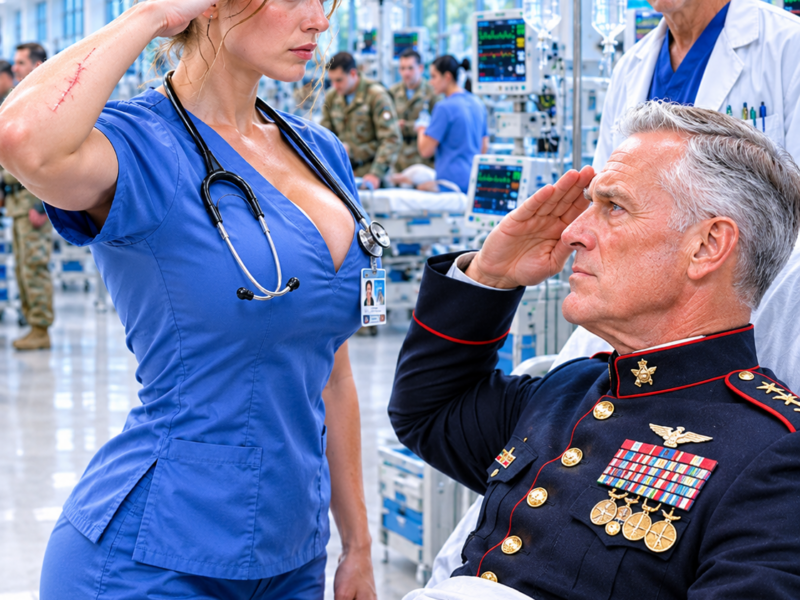
“They called her the mouse. They gave her the dirty jobs, laughed at her quiet voice, and treated her like she didn’t belong in their trauma center.
The first thing I heard was the monitor.
One long, continuous tone.
General William Garrison’s heart had stopped.
For half a second, the entire trauma bay seemed to disappear around me. The shouting, the alarms, the pounding rain against the windows—all of it faded beneath that single, terrible sound.
My hands were still inside his chest.
“Continue cardiac massage!” I ordered. “Dr. Paxton, keep the airway secured. Sergeant Miller, tell me how long he’s been down!”
“Almost two minutes!” Miller shouted.
“Then we’re not giving up.”
I had said those words before, in places where the nearest hospital was miles away and the ground shook with incoming fire. I had said them to young soldiers whose faces I could barely see through dust and blood.
And I said them now.
“Come on, General,” I whispered. “You didn’t survive that helicopter crash just to quit on me.”
I kept working.
The surgical team had not arrived yet. Dr. Keller was somewhere in the hospital, racing toward us. Until he got there, the responsibility belonged to me.
“Adrenaline is in,” Dr. Reed called.
“Good. Keep monitoring.”
I looked at the ultrasound screen. The fluid around the heart had been the problem. We had relieved the pressure, but the General had suffered a devastating injury. His heart needed time—and a reason—to start beating again.
“Clear!”
The team stepped back.
I watched the monitor.
Nothing.
“Again,” I said.
The defibrillator charged.
“Clear!”
Another shock.
For one awful moment, there was only silence.
Then the monitor flickered.
A weak rhythm appeared.
“Wait,” Dr. Reed said. “I’m seeing something.”
“Check for a pulse.”
Dr. Paxton pressed two fingers against the General’s neck.
His expression changed.
“I have one.”
“Strong?”
“Very weak. But it’s there.”
“Then we protect it. Keep the blood coming. Prepare him for the operating room.”
The room erupted into motion.
I finally stepped back, my arms trembling from exhaustion. My gloves were soaked, and my uniform was stained with blood. I looked down at the General, whose chest was now rising with the ventilator.
He was alive.
For the first time in several minutes, I allowed myself to breathe.
Sergeant Miller stood beside the operating table. His face was pale, and his eyes were fixed on me.
“Captain Mitchell,” he said quietly.
I looked up.
He hadn’t called me that by accident.
“Sergeant, we need to get the General upstairs.”
He nodded, but he didn’t move.
“Ma’am, I know who you are.”
I froze.
Across the room, Dr. Paxton looked between us.
“What is he talking about?” he demanded.
Miller swallowed.
“I served with men who heard stories about a medic in Kandahar. A woman who went into a minefield under enemy fire to bring six Marines out.”
I said nothing.
“They called her the Legend of Kandahar.”
The room became strangely quiet.
Miller took one step closer.
“Captain Abigail Mitchell. Army Nurse Corps. Attached to a special operations unit. Silver Star recipient.”
Dr. Paxton stared at me.
I removed my bloody gloves.
“Sergeant, this isn’t the time.”
“No, ma’am,” Miller replied. “It isn’t. But those men upstairs deserve to know who just saved their commander’s life.”
Before I could answer, a voice came from the doorway.
“She’s right. This isn’t the time.”
Dr. Harrison Keller had arrived.
He was still wearing his formal black suit from the hospital gala, but his tie was loose, his jacket was wet, and his expression was all business.
He surveyed the room in seconds.
“Status?”
“General Garrison has a pulse,” I answered. “He needs immediate surgical intervention. We relieved the tamponade, established an airway, and initiated massive transfusion. He’s unstable.”
Keller looked at the monitor, then at the open surgical field.
“Who performed the thoracotomy?”
“I did, Doctor.”
He studied me for a moment.
Then he nodded.
“Good work, Captain.”
I wasn’t sure whether he had heard Miller or simply understood what the situation demanded.
“Dr. Reed,” Keller continued, “prepare the operating room. Dr. Paxton, you’re coming with me. Sergeant, stay with your men.”
He turned back to me.
“Abigail, I want you in that operating room.”
Paxton’s head snapped toward him.
“Dr. Keller, she’s a nurse.”
Keller’s expression hardened.
“And she just kept a three-star general alive while you stood frozen.”
Paxton opened his mouth, then closed it.
I didn’t look at him.
There was no time for arguments. The General needed surgery, and the other crash victims still needed help.
For the next four hours, the hospital became a battlefield of its own.
The emergency department was filled with injured soldiers, frightened civilians, and exhausted staff. Some patients had broken bones. Others had severe burns, internal bleeding, or injuries from flying debris.
I moved from bed to bed, helping wherever I was needed.
I didn’t think about my reputation.
I didn’t think about the people who had mocked me.
I didn’t even think about the fact that my hands were shaking.
I thought about the next patient.
The next breath.
The next heartbeat.
By dawn, the storm had weakened. The rain was still falling, but the wind had finally stopped shaking the windows.
I was washing blood from my hands when Dr. Keller approached.
“Abigail.”
I turned off the faucet.
“Sir?”
“The General made it through surgery. He’s still critical, but he’s stable.”
My shoulders dropped.
“Thank God.”
Keller watched me for a moment.
“I’ve worked in this hospital for twenty-three years. I’ve seen talented doctors, brilliant surgeons, and people who can remain calm under extraordinary pressure.”
He paused.
“But what you did tonight was different.”
“I did what was necessary.”
“That’s exactly what I’m talking about.”
I dried my hands.
“Dr. Keller, I don’t want special treatment.”
“I’m not offering you special treatment. I’m offering you the respect you should have received from the beginning.”
I looked away.
For months, I had been treated as though I were invisible. I had been assigned the least desirable tasks, ignored during critical discussions, and ridiculed for speaking up.
Now, suddenly, people wanted to know my name.
It was an uncomfortable feeling.
“I just want to do my job,” I said.
Keller nodded.
“Then we’ll make sure you’re allowed to do it.”
He started to walk away, then stopped.
“One more thing. The hospital administration will want a full account of what happened tonight. I expect you to be there.”
I nodded.
“Of course.”
When I returned to the nurses’ station, I found Dr. Paxton standing beside the coffee machine.
He looked as though he hadn’t slept in days.
“Mitchell,” he said.
I stopped.
“Doctor?”
“I think we should talk.”
“About what?”
He glanced around to make sure nobody was listening.
“Tonight was complicated. We were understaffed, the situation was chaotic, and everyone was under pressure.”
I waited.
“I want you to understand that I was coordinating the department.”
I looked at him.
“Were you?”
His jaw tightened.
“I was managing several emergencies.”
“You were standing beside the trauma bed when the General lost his pulse.”
“I was assessing the situation.”
“And I was treating him.”
His face reddened.
“There’s no need to make this personal.”
“I didn’t.”
I walked past him.
For once, I didn’t feel the need to defend myself.
The truth was already in the room.
Later that morning, I was summoned to the hospital boardroom.
Dr. Keller was there, along with the hospital CEO, several senior administrators, and two military officers. General Garrison’s condition had improved enough for him to speak briefly, and he had requested that the hospital provide a formal account of his treatment.
Dr. Paxton was already seated when I entered.
He stood immediately.
“Abigail,” he said with a polite smile. “We’re glad you could join us.”
I took an empty seat.
The CEO began the meeting.
“Last night was one of the most challenging events this hospital has faced in years. We want to recognize the staff who responded.”
Dr. Paxton leaned forward.
“Absolutely. It was an extraordinary team effort. I was overseeing the emergency department when the military casualties arrived, and I made several critical decisions to stabilize the situation.”
I watched him speak.
He described the General’s arrival. He discussed the transfusion. He mentioned the emergency thoracotomy.
He even described the moment the General’s heart began beating again.
But he never mentioned who had performed the procedure.
The CEO nodded.
“Thank you, Doctor. And who was directly responsible for the emergency intervention?”
Paxton glanced at me.
“I coordinated the response, with assistance from the nursing staff.”
One of the military officers shifted in his chair.
“Which nurse?”
Before Paxton could answer, the boardroom door opened.
A hospital administrator stepped inside.
“Excuse me. General Garrison is on the phone. He insists on speaking to the people in this room.”
The CEO immediately stood.
“Of course. Put him through.”
A speakerphone was placed in the center of the table.
A few seconds passed.
Then a deep, tired voice filled the room.
“This is William Garrison.”
Everyone stood.
“General,” the CEO said, “we’re honored to hear from you. We’re glad to know you’re recovering.”
“I wouldn’t be recovering if it weren’t for one person in your emergency department.”
Paxton straightened.
“Thank you, General. I was happy to coordinate—”
“I’m not talking about you, Doctor.”
The room went still.
Garrison continued.
“I was unconscious for most of the treatment, but my men told me what happened. They told me a nurse took command when the department was overwhelmed. They told me she opened my chest, relieved the pressure around my heart, and kept working when everyone else thought I was gone.”
He paused.
“I want to know where Captain Abigail Mitchell is.”
Every face turned toward me.
I stood slowly.
“I’m here, General.”
There was a moment of silence.
Then his voice softened.
“Captain Mitchell. I owe you my life.”
“No, sir. You don’t owe me anything.”
“I disagree. And I intend to tell everyone in that room exactly what you did.”
Dr. Paxton lowered his eyes.
The General continued.
“I’ve been informed that you served in Afghanistan. That you were wounded during an operation near Camp Bastion in 2014. That you went back into an active minefield to recover six Marines.”
I closed my eyes briefly.
I hadn’t spoken about that night in years.
“General, that was a long time ago.”
“Not to the men who came home because of you.”
He took a breath.
“They remember.”
The military officer beside the CEO leaned forward.
“General, I can confirm her record. Captain Mitchell was awarded the Silver Star for extraordinary heroism under fire. Her actions during that operation were documented in the official after-action report.”
The CEO looked stunned.
“You received the Silver Star?”
I nodded.
“Yes, sir.”
“Why wasn’t this in your hospital personnel file?”
“Because I didn’t put it there.”
“Why not?”
I considered the question.
“Because I wasn’t hired here to be a soldier. I was hired to be a nurse.”
No one spoke.
I looked around the table.
“I don’t expect anyone to treat me differently because of what happened overseas. I don’t need a title or a medal to do my job. But I do expect my clinical judgment to be taken seriously. I expect the same respect as anyone else in this department.”
My voice remained steady.
“Last night, patients needed help. That was all that mattered.”
The CEO slowly nodded.
“That’s fair.”
Then he turned toward Dr. Paxton.
“Doctor, is there anything you’d like to add?”
Paxton looked at the table.
For the first time since I had met him, he seemed to have no prepared answer.
“I may have underestimated her experience,” he said.
“Her experience?” Keller asked. “You repeatedly dismissed her clinical concerns. She identified a life-threatening injury in a patient you refused to listen to. Then, last night, she took control when you couldn’t.”
Paxton’s face tightened.
Keller continued.
“This isn’t about one difficult night. It’s about a pattern.”
The CEO closed his folder.
“We will conduct a formal review of the emergency department’s leadership and patient-care procedures. Effective immediately, Dr. Paxton will be removed from his administrative duties pending that review.”
Paxton stared at him.
“You can’t be serious.”
“I am.”
The meeting ended shortly afterward.
I remained seated for a moment, looking at the empty chairs.
I had imagined many different versions of what it might feel like to finally be heard.
None of them involved a speakerphone, a hospital boardroom, and a general who had nearly died on my operating table.
Dr. Keller approached me.
“You all right?”
I nodded.
“I think so.”
“You know, Abigail, you could do more than work in the emergency department. We have a leadership position opening in trauma services.”
I shook my head.
“Not yet.”
“Not yet?”
“I need some time.”
He smiled.
“That’s fair.”
As I left the boardroom, I saw Sergeant Miller waiting in the hallway.
He stood at attention when he saw me.
“Captain.”
I stopped.
“Sergeant, we’re in a hospital.”
“Yes, ma’am. I know.”
He gave a small smile.
“My men asked me to tell you something.”
“What is it?”
“They want you to know that the General is going to be all right. And they want to thank you.”
I looked down the hallway toward the intensive care unit.
“Tell them they’re welcome.”
Miller hesitated.
“There’s something else. The General asked whether you’d visit him when you’re free.”
“I will.”
He nodded.
Then he looked at me with an expression I recognized from another lifetime.
“It’s good to see you again, Captain.”
I felt the old memories rise—the desert heat, the sound of distant gunfire, the weight of a wounded Marine against my shoulder.
For a second, I was back there.
Then I heard a monitor beeping somewhere behind me.
I was back in Boston.
“It’s good to see you too, Sergeant.”
Two days later, I visited General Garrison in the intensive care unit.
He was pale and exhausted, with tubes and monitors surrounding his bed. But he was awake.
When I entered, he turned his head.
“Captain Mitchell.”
“Good morning, General.”
He tried to sit up.
“Don’t,” I said. “You’re not cleared for that.”
He gave a weak laugh.
“Still giving orders.”
“Only when necessary.”
He studied me for a moment.
“You know, I asked Sergeant Miller about you.”
I pulled a chair beside his bed.
“I hope he didn’t exaggerate.”
“He didn’t. If anything, he left out a few things.”
I smiled faintly.
The General looked toward the window.
“I’ve commanded thousands of soldiers. I’ve received medals. I’ve been thanked by people whose lives I’ve helped change. But I don’t think I’ve ever properly thanked the people who carried me when I couldn’t carry myself.”
He turned back to me.
“That’s what you did in Kandahar. And that’s what you did here.”
I didn’t answer immediately.
“General, I was doing my job.”
“So was I,” he said. “And I know the difference between someone doing a job and someone refusing to let another person die.”
His words settled between us.
Then he extended his hand.
I took it carefully.
“Thank you, Captain.”
I held his hand for a moment.
“You’re welcome, sir.”
When I returned to the emergency department that afternoon, something had changed.
Not the building.
Not the fluorescent lights or the endless ringing phones.
The patients were still coming. The beds were still full. The work was still difficult.
But people looked at me differently.
Some were curious. Some were embarrassed. A few offered quiet apologies.
Brenda Carmichael approached me near the medication room.
“Abigail?”
I turned.
She looked uncomfortable.
“I wanted to apologize for how I’ve treated you.”
I waited.
“I thought you were inexperienced. I shouldn’t have made assumptions.”
“No,” I said gently. “You shouldn’t have.”
She nodded.
“I’ll do better.”
“I hope you do.”
I didn’t offer her a dramatic speech. I didn’t demand that she feel ashamed. I simply returned to my work.
Because I had learned something a long time ago.
Respect wasn’t something I needed to beg for.
And I didn’t need to prove my worth by telling people where I had been or what I had survived.
I only needed to keep showing up for the people who needed me.
That evening, I walked into Trauma Bay Three.
A young nurse was struggling to organize supplies while a frightened patient clutched his mother’s hand.
I stepped beside her.
“Take a breath,” I said. “We’ll handle this one step at a time.”
She looked at me.
“I’m sorry. It’s my first week, and everything feels overwhelming.”
I recognized that fear.
I had seen it in new nurses, young soldiers, and people who had suddenly found themselves in situations they never expected to face.
“You don’t have to know everything today,” I told her. “You just have to pay attention, ask questions, and never stop caring.”
She nodded.
Then the ambulance radio crackled.
Another patient was coming in.
I pulled on a fresh pair of gloves.
“Let’s get ready.”
The doors opened.
The next emergency began.
And I was exactly where I was supposed to be.
Not because I was a decorated soldier.
Not because a general had thanked me.
Not because the hospital finally knew my name.
I was there because, before anything else, I was a nurse.
And sometimes the bravest thing a person can do is simply refuse to walk away when someone needs help.
The End.









