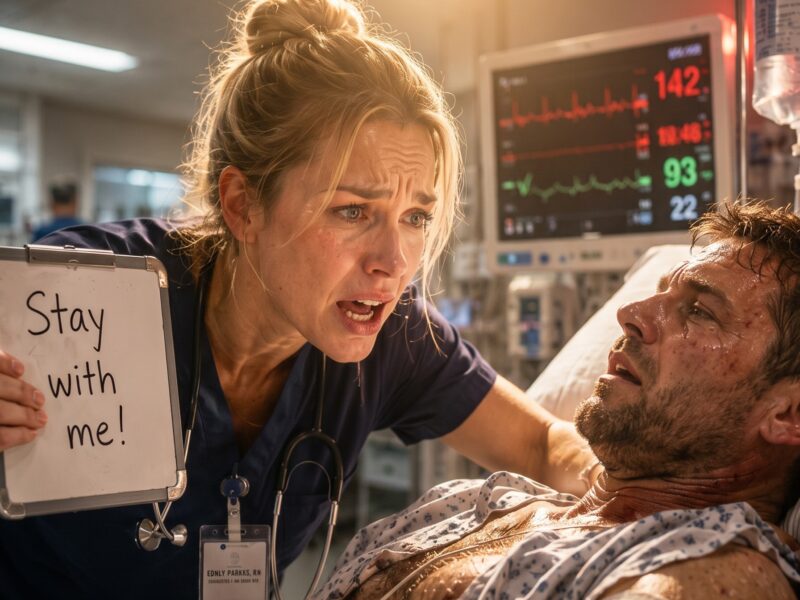
They assigned me the deaf Navy SEAL everyone considered impossible to handle, expecting the rookie nurse to fail in front of the entire hospital
The first thing Captain James Walker did when I entered his room was throw the metal clipboard against the cinderblock wall. It struck the floor with a sharp crack, scattering forty pages of clinical charts across the linoleum.
Behind me, two senior nurses exchanged amused, knowing glances. “Good luck, rookie,” one of them whispered loudly enough to echo down the corridor. “Try not to let him break your nose. The last girl lasted four minutes.”
They pulled the door shut, leaving me alone in the oppressive, sterile box of Room 314.
James sat rigidly on the narrow hospital bed, his muscular frame taut under a faded olive-drab t-shirt. His arms were a tapestry of faded tactical tattoos—a trident, a compass rose, coordinates faded into gray—and fresh, purple-yellow contusions. On the bedside table sat a velvet-lined case holding a Navy Cross, its blue ribbon stark against the medical plastic.
He didn’t look at me. Instead, he pressed the heels of his palms tightly against his ears, staring up at the water-stained ceiling tiles as if trying to physically crush a sound only he could hear.
His medical file was a nightmare of red flags: Severe acoustic trauma. Uncooperative. Hostile. Combat-induced psychosis. High risk for violence.
I had spent my first three weeks at Saint Jude’s Military Medical Center being treated like an incompetent burden by the senior staff. They assigned me the patient nobody else wanted, expecting the rookie nurse to crumble in front of the entire floor, giving them a tidy reason to transfer me out of the trauma unit.
Dr. Reynolds, the attending neuro-specialist, leaned casually against the observation window in the door, crossing his arms with a smug grin. “Let’s see how long you last, Rookie,” he mouthed through the glass.
I swallowed the humiliation burning in my throat and dropped to my knees to gather the scattered pages of James’s chart. As I stacked the papers, my heart hammered against my ribs. I felt his gaze shift.
James was staring at my fingers.
As I worked, my left hand had been absentmindedly moving—a subconscious habit I’d carried since childhood. I was fingerspelling the words on the medical sheets: T-I-N-N-I-T-U-S. T-R-A-U-M-A. My younger brother, Leo, had been born profoundly deaf, and American Sign Language had been my first real language long before I learned nursing terminology.
James’s body went deathly still. The rigid tension in his shoulders didn’t soften, but his hands slowly dropped from his ears. For the first time, his pale blue eyes focused directly on mine. They were fierce, hyper-vigilant, and filled with a profound, terrifying isolation.
I set the clipboard on the foot of the bed. Slowly, so as not to startle him, I raised my hands into his field of vision.
Are you okay? I signed, making the smooth, downward sweep from my chin to my chest.
His jaw flexed. His breathing hitched, a sharp inhale through his nose. He didn’t answer immediately. He stared at my hands as if convinced he was hallucinated the movement. Then, his large, scarred fingers flicked up, moving with the razor-sharp precision of military tactical signals merged with fluid ASL.
Finally, he signed back.
My throat tightened. Eleven years of clinical notes had categorized this man as a feral, non-verbal casualty of war who refused to communicate with doctors, therapists, or military liaisons. Nobody had thought to check if he was fluent in ASL. Nobody had bothered to ask.
I pulled a heavy plastic chair right up to the side of his bed, sitting within arm’s reach.
My name is Clara, I signed. Do you want me to stay?
He gave a single, firm nod, his gaze locking onto mine like a tractor beam.
Outside the observation window, Dr. Reynolds frowned, tapping his watch and gesturing for me to wrap it up. Nurse Jenkins chuckled, turning away from the window. “Look at her,” her voice filtered faintly through the door jamb. “She thinks she’s special.”
I ignored them, turning my back to the glass to block their view of our hands.
Over the next five days, Room 314 became an island in the chaotic sea of the surgical floor. James refused every other medical professional who stepped across his threshold. When Dr. Reynolds attempted to perform a routine cranial nerve exam, James nearly broke the physician’s wrist, shoving him into the hall. He rejected the heavy sedation protocols, swept the meal trays onto the floor if I wasn’t the one delivering them, and refused physical therapy entirely.
He wouldn’t let a single soul touch the deep, jagged scar that ran from behind his left ear down into his hairline—a wound the surgical notes casually chalked up to “shrapnel from an improvised explosive device.”
But he let me change his sterile dressings. He let me check his vitals, holding his arm perfectly still while the blood pressure cuff inflated. When the pain spiked at night—sweat soaking his sheets as his body fought the nerve trauma—he would reach out, touching two fingers to his chest, asking me to sit beside him in the dark until the tremors passed.
And as I cared for him, the official narrative surrounding Captain James Walker began to fall apart.
As a surgical nurse, I knew how to read operative reports. I knew what blast trauma did to soft tissue and bone. On my night shifts, I pulled James’s archivist records from the hospital’s central server.
His earliest military physicals were immaculate—top two percentile in auditory acuity for Special Warfare operators. The supposed “IED blast” had occurred four weeks prior during an unlisted, classified operation in the Baltic region. But when I examined the high-resolution CT scans of his temporal bone, something didn’t add up.
An explosive blast wave creates diffuse, bilateral pressure damage—shattering both eardrums equally and fracturing the delicate ossicles inside the middle ear. But James’s right ear was entirely undamaged. His left ear had suffered deliberate, localized surgical destruction. The auditory nerve hadn’t been severed by shrapnel; it had been excised with microscopic precision.
Every time I tried to ask him about the operation using sign language, James’s eyes would dart nervously toward the door or the ceiling vents. His fingers would spell out the same sharp, final phrase: Not safe. Walls have eyes.
The dam finally broke on a heavy, rain-slicked Thursday afternoon.
The sky outside was the color of wet slate, rain drumming relentlessly against the reinforced glass of Room 314. I was sitting beside James, teaching him a few updated colloquial signs while he tracked my movements with intense focus.
The heavy oak door swung open without a knock.
A tall man in a tailored dark blue naval dress uniform stepped into the room. He wore the insignia of a Commander in the Judge Advocate General Corps, his chest adorned with rows of service ribbons. Two muscular men in plain dark suits stood behind him in the corridor.
James took one look at the Commander’s gold shoulder boards and went rigid. His heart monitor, which usually hovered at a calm 60 beats per minute, spiked instantly to 130. His fists clenched so tightly his knuckles turned paper-white.
“Nurse Evans,” the Commander said, his tone crisp, smooth, and entirely devoid of warmth. “I am Commander Vance, Naval Special Warfare Legal Oversight. You need to vacate the room. We have official classified business with Captain Walker.”
He pulled a thick, string-tied manila envelope from under his arm.
Before I could stand up, James’s hand shot out. His fingers wrapped around my wrist with a iron, crushing grip. He didn’t hurt me, but the sheer urgency of his hold locked me in place. Sweat broke out across his forehead, his breath coming in shallow, ragged hitches. His eyes were wide, filled with an absolute, primal panic.
I looked down at his grip, then up at Commander Vance. “Captain Walker is my patient,” I said, my voice surprisingly firm. “He is currently undergoing intensive neurological recovery. His medical plan requires an advocate present during high-stress interactions.”
Vance’s expression hardened. “This is a matter of national security, Nurse Evans. Not nursing care. You do not have the security clearance to be in this room.”
He stepped closer to the bed, tearing open the red wax seal on the envelope. James shook his head violently, pulling my hand toward his chest as if trying to hide behind me.
Vance pulled out a single 8×10 glossy photograph and tossed it onto the tray table in front of James.
It was a military transport vehicle—an armored SUV—engulfed in a towering column of black smoke and white-hot thermite flames on a desolate, snow-covered road. Beneath the photo was a sheet of heavy paper with a single typed sentence: THE EXPLOSION WAS NOT AN ACCIDENT.
My hands trembled as I stared at the burning vehicle. James reached across the table, grabbed a black dry-erase marker I used for his whiteboard, and flipped the photograph over.
His hand shook so badly the ink sputtered, but he aggressively scribbled four capital words across the back of the photo:
THEY KNOW YOU’RE HERE.
I stared at the black letters, the breath catching in my throat. I looked up at James, my heart hammering against my ribs.
Who? I signed, my fingers trembling so violently the gesture was barely legible. Who knows I’m here?
James didn’t look at Commander Vance. He didn’t look at the armed guards in the hall. He slowly tilted his chin toward the black dome of the security camera mounted in the corner of the room above the door.
Then, he raised his hand and executed three precise, distinct signs that hit me like a physical blow to the chest.
Your. Brother. Alive.
The room seemed to lose all air. My vision narrowed to a pinprick.
“What did he just sign to you?” Commander Vance demanded sharply, stepping around the bed to grab the photograph. “Nurse Evans! What did he say?”
My deaf younger brother, Leo, had died eight years ago in a sudden, catastrophic car crash in upstate New York. I had attended his funeral. I had stood beside his closed casket. I had grieved him every single day of my life.
And James was staring at me with terrifying, absolute certainty—like he had been waiting in this silent hell all this time just to deliver that message.
“Nurse Evans!” Commander Vance’s voice barked like a whip, snapping the suffocating silence in the room. He snatched the photograph off the tray table, jamming it back into his leather folder. “Answer me. What did Captain Walker communicate to you?”
My mind was a chaotic blur of static and fire. Leo. Alive. It was impossible. It was a sick, twisted psychological tactic. It had to be. But as I looked at James, I saw no malice in his pale blue eyes—only a desperate, protective urgency.
I forced my facial muscles into a mask of professional composure, the years of nursing training kicking in to shield my inner panic.
“He… he signed that he wants you to leave,” I lied, my voice steady despite the roar of blood in my ears. “He’s overwhelmed by your presence, Commander. As his primary nurse, I am ordering you out of this room before his blood pressure induces a secondary stroke.”
Vance stepped so close I could smell the sharp, chemical scent of his expensive aftershave. “Listen to me very carefully, Clara. You are a civilian contractor in a federal facility. If you choose to meddle in classified warfare operations, you won’t just lose your nursing license—you will disappear into a brig in Leavenworth. Do you understand me?”
He didn’t wait for a response. He signaled his guards, turned on his heel, and marched out, slamming the heavy door behind him.
The moment the lock clicked, I spun around to face James. My hands were shaking so hard I could barely form the shapes.
What are you talking about? I signed, my gestures sharp, furious, and terrified. My brother Leo died eight years ago! It was a car accident! I buried him!
James reached out, taking both of my trembling hands in his broad, calloused palms. He held them still, grounding me, forcing me to breathe. Slowly, he released my wrists and began to sign, his movements deliberate and methodical.
Not a car crash, he signed. A cover story. Leo was not killed. He was taken.
I stepped back, bumping into the stainless steel counter. “No,” I whispered out loud, forgetting for a moment that he couldn’t hear me. “No, that’s impossible. Why would anyone take a seventeen-year-old deaf boy?”
James pointed to his own temple, then to his throat, then made the sign for Code. Language.
Leo was a genius, James signed. A prodigy in acoustic mathematics and non-verbal pattern recognition. He created a fluid, unhackable optical cipher based on advanced sign language and high-frequency light pulses. A military communications system that bypasses all digital interception.
My breath caught in my chest. Memory flashed back to our childhood home: Leo sitting at his desk until 3:00 a.m., filling dozens of black leather notebooks with complex geometric shapes, binary strings, and custom hand-sign diagrams. He called it his “silent song.” I had thought it was just the lonely pastime of an isolated, brilliant deaf kid.
A black-budget military intelligence contractor called Project Aegis found out about his work, James continued, his hands moving rapidly now, sweat dripping down his temple. They faked his death. They bought his legal identity, staged the accident, and moved him to a dark site in Northern Europe. He has been building their un-traceable satellite communications network for eight years.
Teardrops blurred my vision, hot and stinging. “Eight years…” I choked out, signing simultaneously. “He’s been trapped for eight years?”
He was forced to work, James signed. Until three months ago. When he realized Aegis was using his cipher to coordinate illegal off-the-books assassinations, he locked the master encryption key inside his head. He refused to give them the final sequence.
James pointed to the deep, jagged scar behind his left ear.
I was the team leader sent to secure him, James signed, his eyes darkening with a profound, bitter sorrow. My SEAL team was told we were rescuing a high-value hostage from a terrorist cell. When we breached the compound, I found Leo. He signed the truth to me. He told me Aegis was the enemy. He told me about you, Clara. He gave me your name. Your hospital.
What happened to your ear? I asked, my fingers numb.
James’s jaw flexed. Aegis betrayed us. They detonated a thermite charge on our extraction vehicle—the photo Vance showed me. My entire team died in the flames. I survived, but Aegis captured me. They didn’t want me dead yet; they needed to know if Leo had given me the master key. They took me to a medical facility in Munich and used a laser ablation scalpel to destroy my left acoustic nerve.
I gasped, covering my mouth.
They wanted to make sure I could never hear the cipher, James signed, a dark, cynical smile breaking across his face. They thought if they deafened me, they could break my spirit, label me insane, and isolate me in a military ward until I gave up Leo’s key. They didn’t know I already knew how to sign. They didn’t know Leo taught me his personal cipher in that compound.
The full, monstrous scope of the conspiracy hit me like a tidal wave. The hospital wasn’t a place of healing; it was a containment facility. Dr. Reynolds, Commander Vance, the security cameras—they were all part of the observation envelope designed to monitor James until he cracked.
And now, I was inside the wire with him.
Where is Leo now? I signed desperately. Is he alive?
Before James could answer, the red emergency light above the door began to flash silently. A sharp, mechanical click echoed through the frame as the electronic door lock engaged from the outside.
The overhead fluorescent lights died, plunging Room 314 into a murky, shadow-filled darkness lit only by the rain-streaked streetlamps outside the window.
James reacted instantly. He didn’t hesitate, didn’t flinch. In a single fluid, explosive movement, he rolled off the hospital bed, swept me by the waist, and dragged me down into the narrow gap between the bed frame and the solid brick wall just as the reinforced glass of the observation window shattered inward.
A high-powered, suppressed rifle shot—a soft thwip-thwip—punched two perfectly clean holes through the vinyl mattress right where my chest had been a fraction of a second earlier.
The strike team was moving in. The cover-up had just entered its final phase.
Glass rained down onto the linoleum floor like heavy hail. The room was filled with the bitter smell of ozone and shattered quartz.
James held me pinned beneath his heavy frame, his arm acting as a shield over my head. Despite his deafened state, his tactical instincts as a Tier-One operator were fully intact. He didn’t need to hear the suppressed gunshots; he read the physical air pressure changes, the shadows shifting across the ceiling, and the subtle vibration of boots on the floorboards.
He tapped my shoulder twice—a military signal for ready.
He reached up, grabbed the heavy chrome leg of the overturned bedside table, and ripped it free from its frame with a sickening crunch of tearing rivets.
A dark figure stepped through the shattered observation window, a suppressed carbine raised, a night-vision monocular glowing green over his left eye.
James didn’t stand up. He swept his leg out in a low, devastating leg-check, catching the operative behind the knee. The assassin went down hard, his rifle discharging harmlessly into the ceiling plaster. Before the man could recover, James drove the chrome table leg directly into the operative’s sternum with the force of a battering ram, knocking the air from his lungs in a wet gasp.
James grabbed the man’s tactical vest, slammed his helmeted head against the concrete floor twice until he went limp, and stripped the carbine and a sidearm from his harness in less than four seconds.
He shoved the suppressed pistol into my hands.
I stared at the heavy, matte-black weapon, my heart pounding so fast I thought my ribs would snap. “I… I’m a nurse,” I choked out, my voice lost in the darkness. “I don’t know how to use this!”
James grabbed my chin, forcing me to look into his icy blue eyes. He made two quick signs with his free hand: Safety off. Pull trigger.
He racked the slide of his captured carbine, signaling me to stay low and follow his shoulder.
We crept toward the shattered door frame. The hallway outside was bathed in the eerie, pulsating red glow of the facility’s emergency lockdown lighting. The primary alarms were flashing, but because this was a specialized neurological ward, the audible sirens had been muted to prevent patient disorientation. The silence made the blood-red corridor feel like a descent into hell.
At the far end of the hall, two more operatives in unmarked tactical gear were advancing, using sweeping weapon techniques to clear the rooms.
Dr. Reynolds was standing near the nurses’ station, holding a digital tablet, frantically typing commands. When he saw James and me step out of Room 314, his eyes went wide with terror.
“They’re loose!” Reynolds screamed, his voice muffled by the thick air as he backed away toward the executive elevators. “Execution Team, eliminate both of them! Do not let the nurse leave the floor!”
James didn’t hesitate. He raised the carbine, fired a three-round burst that shattered the digital control panel above the executive elevator, cutting the power grid to the shaft and trapping Reynolds on the floor.
The two operatives opened fire. Supersonic rounds chewed through the drywall, throwing dust and insulation into the air.
James pulled me into the alcove of the linen supply closet. He pushed me behind a stack of industrial laundry carts, his body completely shielding mine. He leaned out, fired two precisely aimed shots that dropped the first operative in the corridor, then ducked back as return fire tore through the wooden door frame above our heads.
We have to reach the basement, I signed frantically, pointing down toward the floor. The old morgue chute. It leads to the subterranean maintenance tunnels under the street!
James shook his head. No. Main exits are sealed. Vance controls the perimeter. We need Reynolds’s master security keycard.
He looked out the splintered door of the closet. Reynolds was crawling frantically across the blood-stained tile of the nurses’ station, trying to reach a manual override box mounted on the far pillar.
James checked the magazine of his rifle. Two rounds left, he signed. Cover me.
“What?!” I mouthed, my hands trembling violently around the grip of the pistol.
He didn’t wait. James stepped out of the closet into the open corridor, deliberately exposing himself to draw the remaining operative’s fire.
The operative swung his rifle toward James. I leaned out from behind the door frame, raised the heavy pistol with both hands, aimed blindly at the red fire extinguisher mounted on the wall directly above the operative, and pulled the trigger.
BANG!
The heavy recoil slammed through my wrists. The bullet struck the pressurized chemical cylinder. The extinguisher exploded in a massive, blinding cloud of white retardant foam, instantly blinding the operative and filling the narrow hallway with dense fog.
James moved through the white mist like a phantom. I heard two heavy, dull impacts, followed by the metallic thud of a rifle hitting the floor.
When the dust began to settle, the second operative was unconscious. James was standing over Dr. Reynolds, his tactical boot pressed heavily onto the doctor’s throat, pinning him to the floorboards.
Dr. Reynolds was sobbing, his hands clawing at James’s boot. “Please… please don’t kill me! I was just following orders! Aegis paid us millions to hold him here!”
James didn’t listen to his words—he couldn’t hear them anyway. He cold-bloodedly leaned down, snatched the silver master keycard hanging from Reynolds’s neck lanyard, and brought the butt of his rifle down against the physician’s jaw, knocking him cold.
James turned to me, wiping a smear of blood from his cheek. He swiped the silver keycard through the heavy steel double doors marked STAIRWELL 4 – AUTHORIZED PERSONNEL ONLY.
The heavy magnetic lock released with a reassuring green click.
We ducked into the stairwell, plunging down the concrete steps toward the subterranean levels of the medical center.
As we descended into the cold, damp air of the sub-basement, James stopped on the landing of Floor B2. He pulled a crumpled, blood-stained piece of paper from his pocket—a document he had hidden inside his pillowcase before the attack.
He smoothed it out against the cold concrete wall and pointed to a set of handwritten geographic coordinates written in a strange, non-standard cipher.
This is where they are holding Leo, James signed, his eyes burning with an intense, unyielding fire. A decommissioned naval radar station off the coast of Maine. Aegis is preparing to execute him as soon as they realize I’m out.
I looked at the coordinates, then at James. My entire life—my safe, predictable career as a nurse, my quiet apartment, my routine—was gone forever. I was a fugitive wanted by black-budget military operators.
I reached out and took the gun from my hip, checking the sight just like James had shown me.
Then let’s go get my brother, I signed.
The relentless rain had turned into a thick, bone-chilling coastal fog by the time we reached the jagged granite cliffs of Blackwood Point, Maine.
The decommissioned naval radar station sat like an ancient, concrete leviathan on the edge of the roaring Atlantic Ocean. A massive, rusted parabolic dish loomed over a cluster of windowless, heavily reinforced bunkers, surrounded by a double perimeter of chain-link fence topped with razor wire.
We had spent the last thirty-six hours traveling in a stolen, unregistered farm truck, bypassing the interstate highway system by navigating back roads. James had used his tactical training to hotwire the vehicle, swap the license plates, and secure two sets of dark, weather-resistant tactical gear from a hidden military supply cache he maintained in rural Massachusetts.
As we lay prone in the damp pine needles on the ridge overlooking the facility, James handed me a pair of high-powered tactical binoculars.
“Two guards on the eastern catwalk,” I signed to him, adjusting the focus on the green-tinted night-vision lenses. “Thermal security cameras every fifty yards. A heavy transport helicopter sitting on the pad with its rotors idling.”
James nodded, his face carved from cold stone. They are preparing to evacuate, he signed. Commander Vance knows we escaped the medical center. He’s closing the site and liquidating the assets.
“Liquidating the assets” meant killing Leo.
James pulled a laminated blueprint from his tactical vest—an architectural layout of the Cold War bunker he had acquired prior to his disastrous Baltic mission. He pointed to a deep subterranean vault three levels beneath the main antenna dish.
The signal isolation room, he signed. It’s concrete and lead-lined. It’s the only place they could keep Leo without his optical cipher leaking an external frequency. That’s where he is.
How do we breach the perimeter without triggering the main alarm? I asked, my heart hammering against my ribs.
James pulled a small, silver cylinder from his pack—a military-grade fiber-optic diagnostic splice tool—and a pair of heavy-duty wire cutters.
We don’t cut the power, James signed, a cold, feral smile touching his lips. We cut their optical relay. Leo’s cipher runs on light. If I sever their primary fiber line, the facility will automatically lock down its external comms, blinding Vance’s tactical team from receiving offshore support.
He grabbed his suppressed carbine and signaled me to follow his path down the muddy ravine.
We moved through the dark, fog-choked woods like shadows. James moved with an impossible, eerie grace—every footfall calculated, every shadow utilized. Even without his hearing, his spatial awareness was supernatural; he picked up the subtle vibrations of guard patrols through the wet earth, pulling me behind boulder outcrops seconds before flashlights swept the tree line.
We reached the utility junction box at the base of the perimeter fence. James popped the rusted panel with his combat knife, exposing a thick bundle of glowing fiber-optic cables.
He pulled out the diagnostic tool, spliced into the primary core line, and typed a quick, eight-digit sequence into the digital keypad.
It was Leo’s master override code—the cipher sequence James had memorized in the Baltic compound.
Instantly, the massive floodlights along the perimeter fence flickered and died. The perimeter security cameras dropped their lenses into an automated diagnostic loop, swinging helplessly toward the sky.
“Security grid is dark,” I signed, watching the guards on the catwalk wave their flashlights frantically, completely blind in the thick fog.
We have four minutes before they manually reset the emergency generator, James signed. Move.
He cut a clean, rectangular hatch through the razor fence with his heavy shears. We slipped through the gap, sprinting low across the wet asphalt of the staging yard toward the heavy steel blast doors of the main bunker.
James swiped Dr. Reynolds’s master security keycard through the door scanner. With a heavy, pneumatic hiss of pressurized air, the three-ton steel door unlocked and swung inward, revealing a dimly lit concrete stairwell descending into the earth.
We stepped inside, the door closing behind us with an ominous, metallic thud.
The interior of the bunker was freezing, smelling of ozone, diesel fuel, and damp salt air. We descended the concrete stairs to Level B3, passing abandoned control offices and empty server racks. Aegis had already begun burning documents; the air was thick with the acrid scent of charred paper and melting plastic.
At the end of a long, narrow hallway lined with reinforced concrete pillars, two armed guards stood outside a heavy glass-windowed door marked ENVIRONMENTAL TEST CELL 1.
Inside the room, lit by the harsh white light of a single desk lamp, sat a young man.
He was thin, pale, wearing a oversized gray sweatshirt, his dark hair messy and unkempt. He was sitting at a metal desk covered in black leather notebooks, his long fingers rapidly moving over a illuminated glass tablet, drawing intricate, fluid geometric light patterns.
My breath caught in my throat. Tears rushed to my eyes, burning hot against my cold cheeks.
It was Leo.
He was thinner, older, his face marked by years of isolation and exhaustion, but it was my brother. He was alive.
“Leo…” I choked out, a sob breaking from my chest.
Before I could move, a door at the side of the hallway opened, and Commander Vance stepped out, flanked by three heavily armed contractors.
Vance held a sleek, chrome-plated revolver in his gloved hand.
“I must admit, Captain Walker,” Vance said, his voice echoing loudly in the narrow corridor as he raised his gun, “your persistence is truly remarkable. To track us across four states without hearing a single sound… a testament to Navy SEAL training.”
James didn’t stop. He didn’t slow down.
He saw Vance raise the weapon. James threw his shoulder into me, shoving me violently behind a reinforced concrete pillar just as Vance pulled the trigger.
BANG!
The heavy bullet ricocheted off the concrete, throwing sharp chips of stone into the air.
James drew his captured pistol, dropped into a low shooting stance, and fired three rapid shots down the hall. Two of the contractors fell instantly, their weapons clattering against the floorboards.
The third contractor opened fire with an automatic submachine gun, chewing through the concrete pillar, pinning us in place.
Inside the glass cell, Leo heard the heavy vibrations of the gunfire. He stood up from his desk, looking around in terror.
His eyes locked onto the concrete pillar where I was crouching.
Through the bullet-resistant glass, our eyes met.
Leo froze. His mouth opened in a silent, disbelieving gasp. He pressed his trembling hands against the thick glass, tears instantly spilling down his pale cheeks.
Clara? he signed through the window, his fingers moving in the familiar, frantic rhythm of our childhood. Clara, is that you?
I’m here, Leo! I signed back from behind the pillar, tears streaming down my face as bullets chipped the concrete above my head. I came for you!
Vance stepped up to the reinforced glass of Leo’s cell, pressing the barrel of his chrome revolver against the pane, aimed directly at Leo’s head.
“Drop your weapons, Captain Walker!” Vance screamed toward our pillar, his face twisted in desperate rage. “Drop them now, or I put a bullet through the prodigy’s skull! The cipher dies with him, but so do you!”
The standoff in the subterranean corridor was absolute. The air was thick with the scent of cordite, gunpowder, and the heavy, metallic stench of fresh blood.
From behind the concrete pillar, I could see Vance’s finger tightening on the trigger of his revolver. He was cornered, desperate, and completely out of options. The emergency generators were starting to rumble in the sub-basement, red warning lights beginning to flash along the ceiling as the system tried to reset its communications relay.
James was pressed against the pillar beside me, his breathing slow and measured. He couldn’t hear Vance’s shouting, but he could read the situation through the glass reflection on the far wall. He saw Vance’s hand on the gun. He saw Leo trapped inside the cell.
James looked at me, raising his hand.
I need three seconds, James signed, his eyes dead serious. When the light changes, run to Leo.
What light? I signed frantically.
Inside the glass cell, Leo was staring at James. Despite the gun pointed at his head, Leo’s eyes were sharp, bright, and filled with a sudden, brilliant understanding.
Leo raised his hands behind Vance’s back, visible only to James and me through the window. He began to move his fingers in a rapid, dazzling sequence of light-speed signs—the final, master override string of his silent cipher.
He was sending an optical pulse instruction directly to the illuminated glass tablet on his desk.
3… 2… 1… Leo signed.
Leo slammed his palm onto the tablet surface.
Every single high-intensity strobe light mounted inside the environmental test cell—installed to simulate sunlight for isolated captives—instantly overloaded, detonating in a blinding, million-lumen flash of pure white light.
The glass cell transformed into a miniature sun.
Vance screamed, dropping his revolver, clutching his face as the overwhelming glare burned through his retinas. The remaining contractor staggered backward, completely blinded, firing his weapon aimlessly into the ceiling plaster.
James didn’t flinch. His eyes had already been tracking the countdown.
He exploded from behind the pillar like a mountain lion. In a single, continuous motion, he closed the distance, grabbed the blinded contractor’s submachine gun, twisted it from his grip, and drove a brutal knee strike into the man’s ribs, dropping him instantly to the floor.
Vance was on his knees, crying out in pain, blindly waving his revolver through the air. “I can’t see! I can’t see!”
James stepped up behind Vance, caught his gun hand by the wrist, twisted it back until the bone snapped with a sharp CRACK, and kicked the weapon down the hallway. He then delivered a short, devastating palm-strike to Vance’s temple, knocking the Commander into total darkness.
The threat was eliminated.
James grabbed the emergency manual release lever beside the cell frame and pulled it down with all his strength.
The three-ton glass door hissed open.
Leo stumbled out of the cell, blinded and shaking, his arms reaching out into the empty air.
I ran down the corridor, throwing my arms around his neck, pulling his thin frame tightly against my chest. “Leo! Oh God, Leo!” I cried, burying my face in his shoulder, sobbing so hard my entire body shook.
Leo held me, his face pressed into my neck, his fingers gripping my tactical vest as if terrified I would vanish if he let go. He made soft, high-pitched sounds of joy in the back of his throat—the familiar, beautiful sounds of my little brother.
He pulled back, his hands rapidly framing my face, wiping away my tears with his thumbs.
You’re real, he signed, his hands shaking wildly. You’re real. They told me you were dead. They told me everyone was gone.
I’m here, I signed back, kissing his forehead. I never stopped loving you. I’m never leaving you again.
Leo turned toward James. The young prodigy stepped up to the broad Navy SEAL, raising his hands, and performed a slow, deeply respectful sign of military gratitude—a gesture reserved for heroes.
Thank you, Captain, Leo signed.
James gave a single, respectful nod, his face softening into a genuine, warm smile—the first real smile I had ever seen on his face.
We need to move, James signed, pointing toward the emergency stairwell. The automated distress signal was sent when the fiber was cut. Federal Marshals and State Police are five minutes away.
We helped Leo through the dark corridors, ascending the concrete stairs out of the subterranean hell and stepping back out into the cool, fresh air of the Maine coast.
The fog was beginning to lift. The first golden rays of dawn were breaking over the stormy horizon of the Atlantic Ocean, cutting through the dark pine trees and illuminating the rusted radar dish above us.
In the distance, the wail of approaching sirens echoed through the valley—not Vance’s black-budget operatives, but legitimate state police cruisers and federal oversight teams responding to the automated breach signal Leo had broadcast to the Justice Department server.
We sat together on the hood of the farm truck at the edge of the ridge, watching the sun rise over the water.
Leo sat between us, wrapped in a warm wool blanket, his head resting against my shoulder, finally at peace after eight long years in the dark.
James sat on my other side, holding a clean notepad and a pen. He wrote a line on the paper and passed it to me.
What happens now, Nurse Evans?
I took the pen, looked at my brother, then at the brave, silent man who had risked everything to tear down a monstrous conspiracy and give me my family back.
I wrote four words beneath his question and handed the pad back to him:
Now we start living.
James read the words, looked up at me, and raised his hand to his chest, making the sign for Together.
I took his hand in mine, holding it tight, as the silent world around us opened up into the bright, endless light of a new day.
The end.









