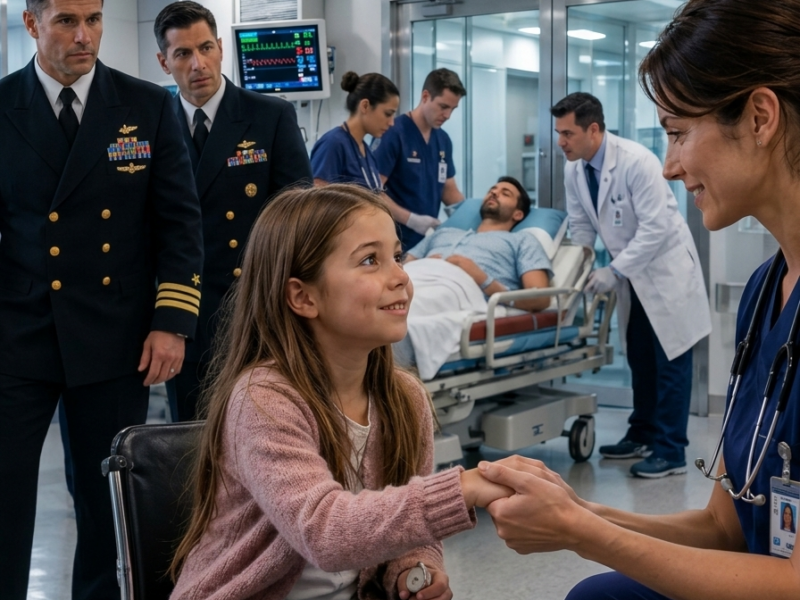
The wounded Navy SEAL’s little daughter suddenly pointed at me from her hospital bed and whispered, “I know you,” while her father angrily ordered me away
The intensive care wing of Naval Medical Center Portsmouth carried a specific kind of quiet at four in the morning. It was not peace; it was an exhausted truce between monitors, pressurized oxygen lines, and the nurses who walked the polished linoleum in soft-soled clogs. I had worked the night rotation in pediatric trauma for six years, long enough to know the weight of different silences. There was the heavy stillness of a post-operative recovery, the tense hush of an unstable intracranial bleed, and the jagged, defensive silence of military families who treated the hospital room like an forward operating base under siege.
Room 414 belonged to the third category.
The patient was five years old. Her intake chart identified her as Maya Miller, admitted thirty-six hours earlier with blunt abdominal trauma, hairline rib fractures, and dehydration following an automobile accident on Route 17. The vehicle had rolled twice into a ditch; her father, Chief Petty Officer Nathan Miller of Naval Special Warfare Group Two, had walked away from the wreckage with cracked clavicles, third-degree friction burns along his forearms, and a concussion he refused to let the staff treat with anything stronger than over-the-counter ibuprofen.
He had not slept since they brought her in. He sat in the vinyl recliner wedged between the bed and the window, his broad frame curled forward, elbows planted on his knees. His uniform blouse hung over the back of the chair, leaving him in a faded brown undershirt that exposed the dense crosshatch of surgical scars across his shoulders and upper back. His jaw was dark with four days of stubble, his knuckles bruised, his eyes bloodshot and tracking every movement I made as I stepped across the threshold with the night-shift medication tray.
“Morning vitals, Chief,” I said, keeping my tone deliberately low, level, and unremarkable. In pediatric wards, nurses learn to become background furniture to keep anxious parents from startling. “Just checking her line and her temperature.”
He did not answer. He merely watched me through half-lidded eyes, the muscles along his jaw flexing once, twice, like a dog deciding whether a visitor warranted a bite.
I moved to the side of the bed. Maya was small for five, her dark brown hair tangled against the pillow, skin pale against the starched white linens. A bruise the color of an overripe plum blossomed across her left cheekbone, fading into a scrape near her hairline. The pulse oximeter on her index finger blinked a steady 98 percent; the saline drip was running without resistance.
I reached out to adjust the roller clamp on the intravenous tubing where it entered the catheter taped to the back of her left hand.
Her fingers snapped shut around my wrist.
Her grip was shockingly tight for a child who had spent the last two days drifting in and out of narcotic slumber. Her palm was damp, hot with low-grade fever. Her eyelids fluttered, then opened wide, dark irises ringed with raw pink veins from crying.
“Maya,” I whispered, resting my free hand gently over hers. “It’s alright, sweetheart. It’s just Nurse Emily. I’m just checking your water tube.”
She did not let go. She stared straight into my eyes, her gaze unnervingly steady, devoid of the hazy disorientation typical of post-trauma pediatrics.
“You’re the lady from my dreams,” she said.
The words were soft, barely carrying over the rhythm of the heart monitor, but they had the strange, crystalline clarity of an absolute fact.
I smiled gently, the rehearsed, comforting smile every nurse uses to soothe delirium. “You’ve never seen me before, sweetheart. You’ve had a lot of medicine to help your tummy heal. Sometimes medicine makes us see funny things when we sleep.”
From the corner of the room, the vinyl chair groaned as Nathan Miller surged to his feet.
“Leave her alone,” he commanded.
His voice was not loud, but it had the concussive, grating rasp of someone used to shouting over rotor wash and artillery. The room suddenly felt three sizes smaller. He closed the distance between the recliner and the bed in two silent strides, his scarred hand coming down on the metal rail with enough force to make the IV bag sway.
I stepped back immediately, raising both hands to chest height in the universal gesture of non-threat. “I was only checking her site, Chief. Her infusion rate is stable.”
The SEAL looked at me with an icy, visceral revulsion that made the hair on my arms stand up. It was not the ordinary frustration of a stressed parent; it was personal, poisoned, and ancient. His gaze raked across my face, down my scrubs, and back to my eyes, his mouth twisted in a sneer that looked half like disgust and half like terror.
“My daughter has been through enough without you hovering over her,” he said through clenched teeth. “Check what you need to check and get out.”
“Understood,” I replied quietly. Professional dignity is the only armor a nurse has when a family member decides you are the enemy. I picked up my clipboard from the foot of the bed, marked her vitals in the flow sheet, and turned toward the heavy corridor door. “Dr. Bradley will do morning rounds at six. Ring the call button if she complains of nausea.”
I had my hand on the metal handle when Maya’s voice cut through the quiet again.
“Wait.”
I paused, glancing back over my shoulder.
The little girl had dragged herself upward against the pillows, wincing as her injured ribs protested the movement. Nathan reached out instinctively to support her shoulders, murmuring, “Easy, bird, stay down, you’re hurting yourself,” but Maya ignored him. Her small right hand reached beneath the hospital pillow, fumbling beneath the foam core until her fingers emerged clutching something small, crimson, and frayed.
She held it out toward me.
“Can you give this to my daddy?” she asked.
Nathan turned to see what was in her fist.
The change in him was instantaneous and terrifying. Every drop of color drained from his face, leaving his tanned, weathered skin the shade of wet cement. His hands, which had been steady enough to hold his daughter upright, began to shake—not a tremor, but a violent, uncontrollable spasm. His breath caught in his throat with a dry, clicking gasp, like a man who had taken a high-caliber round between his ribs.
“Where did you get that?” he choked out. The authority in his voice was gone, replaced by a raw, bleeding horror.
Maya looked up at him, her dark eyes entirely free of guile. “She gave it to me.”
“Who?” Nathan demanded, his knuckles turning dead white where he gripped the mattress. “Maya. Who gave that to you?”
The little girl pointed her small, bruised finger directly at me.
I froze against the doorframe. The cold stainless steel of the latch dug into my palm. “Maya, no,” I said, my chest tightening. “I didn’t give you anything. I’ve only been your nurse since midnight.”
She shook her head, slow and deliberate. “Not today.”
The room became painfully, suffocatingly quiet. The only sound was the mechanical wheeze of the oxygen flowmeter on the wall and the frantic, spiking beep-beep-beep of Maya’s cardiac lead as her father’s agitation transferred into her small body.
Nathan slowly stood up to his full height. He looked like a ghost standing in a hospital room, towering over his daughter, his eyes fixed on the scrap of fabric in her palm.
“Who gave you the ribbon, Maya?” he asked again, his voice dropping to a fragile whisper that seemed on the verge of splintering. “Tell Daddy the truth.”
She whispered, “Mommy.”
Nathan shut his eyes, his head dropping back, and two thick tears tracked down through the grit and dried sweat on his cheeks. A shudder ran through his broad shoulders, deep and convulsive.
Her mother was dead. I knew that from the social history in the electronic chart: Biological mother deceased four years prior, civilian fatality, non-service connected. There was no next-of-kin listed on the emergency contacts other than Nathan and a maternal aunt in Idaho who hadn’t answered her phone when the highway patrol called.
“Maya,” Nathan rasped, kneeling beside the bed until his face was level with hers. “You know Mommy is in heaven. You know she went away when you were just a baby. You don’t have Mommy’s things. We lost the house in Coronado. We lost everything in the fire.”
“She gave it to me before the car went upside down,” the little girl said simply. She reached out and dropped the ribbon onto the blue blanket. “She said Daddy would need it because he was going to be sad.”
I stepped away from the door, drawn by an impossible, dizzying gravity. “Chief Miller… may I?”
He didn’t move. He didn’t tell me to leave. He looked paralyzed, trapped in a nightmare from which he could not wake.
I approached the bed and picked up the ribbon with two fingers. It was satin, narrow, about eight inches long, faded from bright scarlet to the dusty pink of an old brick. The edges were singed, sealed with a lighter flame to keep them from unraveling—a trick people who work with nylon and cordage use. At the center of the band was a tiny embroidered forget-me-not, stitched in blue silk thread with an amateur, uneven hand.
Something cold, metallic, and sharp twisted in the center of my skull.
A migraine? No. It was not pain; it was the sudden, sickening sensation of falling through ice into dark water. My fingers knew the texture of the satin before my eyes confirmed it. The weave was rough on the underside, smooth on top. My thumb automatically moved to the corner, where the edge had been folded over double.
There was a name stitched into the hem in microscopic, crooked blue letters.
Emily.
My breath stopped entirely. My name. Not a common spelling, not a printed label. Stitched by hand, with the distinctive open loop on the letter E that I had drawn on my notebook covers since I was a teenager.
Nathan saw my face change. He lunged forward, snatching the ribbon out of my fingers so fast the satin burned across my skin. He brought it up to his eyes, searching the hem.
When he saw the stitching, he stumbled backward two steps until his back hit the glass partition separating Room 414 from the nurse’s station. He looked at me as though the floor had disappeared beneath him, as though gravity had reversed and the ceiling was about to swallow us both.
“Where did you get that ribbon?” he whispered. The rage was dead. In its place was a bottomless, terrified confusion.
“I honestly don’t know,” I whispered back, my voice trembling so hard the words barely took shape. “I have never seen that child before yesterday. I swear to you on my license, on my life, I don’t know where she got that.”
Nathan reached into his back pocket with hands that were visibly shaking. He pulled out a battered tactical smartphone, the screen spiderwebbed with cracks from the car crash. His thumb scrambled across the glass, swiping past tactical maps, encrypted messaging apps, down into an archived folder buried deep within the phone’s memory.
He turned the screen toward me.
“Look at it,” he ordered, his breath coming in short, jagged gasps. “Look at her.”
I looked.
The photograph had been taken in what looked like an open-air café near a harbor. Sunlight bounced off the water in the background. In the foreground sat a young woman in a denim jacket, laughing as she held a six-month-old infant in her lap. The baby was Maya—the same wide, curious dark eyes, the same cowlick in her hair.
Tied around the woman’s left wrist was the red satin ribbon, the embroidered blue flower clearly visible against her sun-browned skin.
The woman was me.
It was not a likeness. It was not a woman who looked like my sister or shared my cheekbones. It was my nose, my slightly crooked left canine, the tiny brown mole three millimeters below my right collarbone. But the hair was longer, sun-bleached at the tips, and her eyes had a light in them that I had never seen in any mirror I had looked into for the last six years.
“That’s… that’s a composite,” I stammered, backing toward the medicine counter. “Someone altered a digital file. That isn’t possible. I’ve lived in Norfolk my whole life. I went to Old Dominion. I worked at Bon Secours before I came here. I don’t know you.”
Nathan didn’t blink. He lowered the phone two inches, his finger pointing at the woman’s left hand where it rested against the baby’s ribs.
“Under her thumb,” he whispered. “Look.”
In the photograph, beneath the base of the woman’s left thumb, was a crescent-shaped white scar about an inch long, slightly puckered where the tissue had healed without stitches.
My hands felt numb. Slowly, without my brain giving the command, I turned my left palm upward under the fluorescent light of the trauma room.
There it was.
The identical crescent-shaped white scar, puckered and pale against my vein. I had carried that mark as long as I could remember. My mother had told me I got it when I was seven, falling off an old wooden dock into an oyster bed.
“No,” I said, shaking my head violently. “No. That’s a coincidence. Scars happen. Everyone has scars.”
Nathan whispered, “That’s impossible. I buried you. I identified the dental records from the wreckage in Kyrenia. The agency gave me your rings. They gave me your flag.”
Maya suddenly pushed her blankets aside, her small body trembling with effort as she reached her arms toward me across the metal rail.
“Mommy,” she whined, the sound small, frightened, and heart-wrenching. “Please stay. My tummy hurts. Please don’t go back into the water.”
My legs gave out. I didn’t fall; I sank into the visitor’s chair beside the bed, my knees folding under me as if the bones had turned to chalk. Without thinking, my hand reached out and took hers. Her small fingers curled around mine with the absolute, unquestioning trust of an infant finding its nest in the dark.
She leaned close to my ear, her breath smelling of grape-flavored electrolyte solution and iron.
“Mommy said you would come back when Daddy was hurt,” she whispered. “She said you were sleeping, but the red ribbon would wake you up.”
A bolt of pure white lightning cracked across the base of my skull.
For a microsecond, the hospital room vanished. I wasn’t smelling antiseptic; I was smelling salt spray, burning diesel fuel, and Mediterranean pine. I heard the high-pitched whine of an approaching outboard motor, the hollow thump of a hull against concrete, and a man’s voice shouting in Greek over the shriek of a coastal squall.
Then the vision collapsed, leaving me gasping for air, clutching the side of the bed while the monitor beside Maya wailed in panic.
The ceiling lights overhead flickered once. Twice. A high-voltage buzz hummed through the walls as the fixtures dimmed to a dull, jaundiced yellow before snapping back to full brightness.
Nathan’s phone vibrated violently against his thigh.
He didn’t take his eyes off me as he brought the device to his ear, his thumb swiping green on an incoming call displaying no caller ID, only a string of twelve hexadecimal characters.
“Miller,” he barked, his voice reverting by sheer reflex to operational discipline.
He listened. The silence on his end stretched for three seconds, five seconds, seven seconds.
His gaze never left mine, but every line of tension in his body turned from grief into the coiled, lethal readiness of a man standing on an active drop zone.
The speaker volume was turned high enough that in the quiet of the trauma room, the voice on the other end leaked through the receiver—flat, metallic, processed through a tactical scrambler, but undeniably urgent.
“Sir, we have a breach on the transit manifest,” the voice said. “The biometric trigger you flagged in the regional medical database just pinged the field office. The asset from Operation Deep Shore… the woman from the old photograph.”
Nathan’s jaw locked. “Where?”
“Portsmouth Naval, fourth floor,” the voice replied, cold and unhurried. “Move your daughter out now, Chief. A retrieval team is four minutes out.”
The voice paused, then added the sentence that stopped the blood in my veins:
“She was supposed to be dead four years ago.”
The phone in Nathan’s hand went dead with a dry, synthetic click. The screen did not sleep; it cycled through three lines of corrupted code before the display turned an oily violet and died completely, the battery cell killed remotely from the other end of the line.
Nathan did not drop the device. He crushed it against the metal bedrail with a single, downward snap of his palm, the glass splintering into gray dust, before letting the carcass fall into the biohazard bin at his feet.
“Get your bag,” he said.
The tone was no longer that of an exhausted widower. The slouch was gone; his center of gravity had dropped four inches, his weight balanced on the balls of his feet. His eyes swept the trauma room—not looking at me as a person, but calculating vectors: window to the parking annex, thirty-foot drop; corridor to the service elevators, eighty yards; fire stairwell, forty yards to the east.
“Nathan, talk to me,” I stammered, still sitting in the chair, my fingers still trapped in Maya’s grip. “What retrieval team? Who was on that phone?”
“You don’t know,” he said. It wasn’t a question. He was reading my pupil dilation, the carotid artery hammering against the skin of my neck, the cold sweat shining on my forehead. “You genuinely don’t have a clue what you are.”
“I am an emergency room nurse!” I yelled, the volume of my voice startling Maya, who whimpered and curled her knees toward her bruised chest. “I’ve worked this floor for six years! My name is Emily Vance! I have a mortgage, I have a tax return, I have—”
“You have a cover package that cost the Special Operations Command four million dollars and three dead officers to build,” Nathan cut in, his voice drops of acid on metal. He leaned over the bed, his thumbs pressing into the quick-release clips of Maya’s abdominal binder. “Your name isn’t Emily Vance. Your name is Emily Miller. You were a Lieutenant Commander assigned to the Naval Special Warfare Development Group’s technical reconnaissance element. You spoke four dialects of Arabic and conversational Greek, and you spent eighteen months undercover in the Turkish Republic of Northern Cyprus tracking the logistics line for black-market biological centrifuges.”
He reached behind the headwall, his fingers finding the main oxygen valve and yanking the green hose free with a loud, violent hiss.
“And four years ago, on an unpaved road outside Bogazi, your convoy took two RPG-7s through the engine block. The vehicle burned until the aluminum melted into the asphalt. They pulled three bodies out of the slag. The forensic pathologist from Dover signed off on your jaw fragment. I stood on the tarmac at Dover Air Force Base while six sailors in dress blues carried an empty lead-lined casket past me.”
He scooped Maya off the mattress in one fluid, terrifyingly gentle motion, cradling her against his uninjured shoulder while his left hand gathered her blanket to cover her hospital gown. Maya didn’t cry; she hooked her small chin over his collarbone, her eyes wide, staring at me with the ancient, unblinking patience of a child who had already lived through the end of the world once.
“If I died,” I whispered, the words tasting like copper in my mouth, “then who am I?”
“You’re the liability,” Nathan said. “And the people who burned your car four years ago just realized you didn’t burn with it.”
The lights in Room 414 flickered again. This time, they didn’t recover.
The main bank of fluorescent tubes died with a dull, concussive pop, leaving only the amber glow of the emergency exit signs and the red digital display of the cardiac monitor running on its internal battery. Down the hall, beyond the heavy acoustic doors of the pediatric ICU, the chime of an elevator arriving at the fourth floor sounded—three sharp, musical tones that felt completely wrong in the middle of a power failure.
Hospitals don’t lose main power without the emergency generators kicking in within seven seconds.
Nine seconds passed. Ten. The hallway remained in the red, murky gloom of battery backups.
“They cut the transfer switch in the basement,” Nathan murmured. He stepped to the door, pressing his back against the drywall, peeking through the narrow wire-reinforced glass panel into the central corridor. “No local security. They’re running a clean sweep. Four-man element, tactical gear under civilian jackets. They aren’t Shore Patrol.”
He turned his head to look at me. “Do you have your hospital badge?”
“Yes,” I breathed, my hand flying to the plastic card clipped to my scrub pocket.
“The drug dispensary behind the nurse’s station,” he said. “Does it have a manual key override or is it all RFID?”
“Both. The shift supervisor has the physical brass key in the lockbox under the desk.”
“Good,” Nathan said. “Get it. We need two auto-injectors of atropine, fifty milligrams of diphenhydramine, and all the sterile saline flushes you can shove in your pockets. If they use aerosol dispersal in the stairwell, Maya won’t last forty seconds.”
“Aerosol?” My mind was rebelling, screaming at me to hit the staff-assist button on the wall, to call for security, to wake the charge nurse. But through the small glass window of the door, I saw something that silenced the impulse forever.
Down the long, linoleum hallway, past the reception desk where the night clerk usually sat doing crossword puzzles, two men were walking.
They did not look like doctors. They wore gray windbreakers, dark tactical trousers, and low-profile earpieces with translucent acoustic tubes running behind their ears. One of them carried an oversized nylon duffel bag with a rigid bottom—the exact dimensions of a broken-down submachine gun case.
The night clerk, Mrs. Gable—a sixty-two-year-old grandmother who had brought lemon bars to the breakroom four hours ago—stood up from behind her computer monitor, her hands raised in confusion.
The first man didn’t slow down. He didn’t speak. He reached across the marble counter with a gloved left hand, caught her by the front of her cardigan, and drove the heel of his right hand upward into the base of her nose with a sickening, muffled crunch.
Mrs. Gable collapsed behind the desk like an empty coat.
The man didn’t look down at her. He didn’t check for a pulse. He kept walking, his gloved hand reaching beneath his jacket to draw a suppressed pistol with an extended magazine.
The horror that slammed into me was not the panic of a civilian.
It was worse. It was recognition.
Target confirmation, four-meter lead, silent breach. The phrase surfaced in my mind before I could stop it, cold and clinical, spoken in an internal voice that was not the voice of the nurse who spent forty minutes comforting a toddler with a sprained wrist. My breathing shifted—deep, rhythmic, four seconds in, four seconds out, oxygenating the blood without expanding the ribcage.
“Nathan,” I whispered, my voice dropping an octave, flat and dry. “The fire stairwell on the east wing is alarmed. If they trip it, the magnetic locks on the maternity ward drop. It’ll trap them in the corridor.”
Nathan stopped. He looked at me, his slate-gray eyes wide in the dark.
“You remember the layout,” he said.
“I don’t remember,” I replied, my hands moving to my hair, pulling the plastic pins out and letting it fall around my neck so it wouldn’t offer an easy grab-point from behind. “I know it. There’s a difference.”
“Move,” he muttered.
We slipped out of Room 414 into the darkened hallway. The air was already changing, growing cool as the HVAC units wound down. Nathan kept Maya tucked against his left flank, his right hand holding a heavy stainless-steel oxygen wrench he had pulled from the wall bracket behind the bed—eighteen inches of hardened steel, six pounds of blunt-force leverage.
We moved low, using the shadow of the linen carts along the north wall. Fifty feet ahead, the two men in windbreakers were methodically checking room numbers, moving from 402 toward our position.
“Room 408 is empty,” I whispered against Nathan’s shoulder. “Patient was discharged to step-down at midnight. The adjoining bathroom has a laundry chute that drops to the basement linen collection room. It’s a twenty-four-inch galvanized steel tube.”
“Maya can’t take that drop with broken ribs,” Nathan hissed.
“She doesn’t take it,” I said, my fingers closing around the brass key I had snatched from the broken lockbox behind the nurses’ station as we passed. “We drop the linen hamper down first. Two mattresses from the cribs, taped together with surgical adhesive. It creates a six-foot deceleration pocket at the bottom.”
Nathan stared at me in the dim orange emergency light. For a fraction of a second, the suspicion, the grief, the four years of agonizing loneliness vanished from his eyes, replaced by an expression that hit me like a physical blow: absolute, unreserved professional trust.
“You always were better at improvised extraction than I was,” he murmured.
“Don’t flatter me,” I said, my pulse finally surging, hot and wild. “I still don’t remember your face.”
“You will,” he said. “When we hit the water, you will.”
We breached Room 408. Nathan pulled the two foam mattresses off the pediatric examination tables while I ripped four rolls of three-inch silk medical tape from the supply cabinet, binding the pads into a dense, cylindrical wedge. He shoved the bundle into the square mouth of the laundry chute and let it drop. Three seconds later, a dull, muffled thump echoed up the galvanized pipe from forty feet below.
“Hold her,” Nathan said, transferring Maya into my arms.
The little girl didn’t resist. She buried her face against the collar of my scrubs, her small hands clutching the fabric so tightly the cotton strained. “Mommy,” she whispered into my skin. “Your hair smells like the lemon tree.”
A shutter opened inside my skull.
A whitewashed terrace. Blue shutters hanging loose in the wind. A terracotta pot with a dwarf lemon tree, its leaves speckled with white sea salt. Nathan standing by an outdoor grill with an apron over his combat pants, laughing while grease popped against his bare skin.
My knees buckled. A sob caught in my throat—not of grief, but of the terrifying, violent return of a life I had never been permitted to mourn.
“Emily!” Nathan’s hand caught my elbow, his grip like iron. “Stay in the room! Eyes on me!”
I blinked. The terrace vanished. I was in a darkened hospital room with a dying phone and an assassin twenty yards down the hall.
“I’m here,” I rasped. “I’m here.”
“I go down first,” Nathan said, swinging his legs into the narrow chute. “Count three seconds, then lower Maya by her wrists. I’ll catch her at the collar. Then you drop.”
“Nathan—”
“Three seconds, Emily. Move.”
He slipped into the darkness of the pipe, his boots scraping against the metal for half a second before gravity took him.
One.
From the corridor outside, the heavy wooden door of Room 408 was kicked open with enough hydraulic force to splinter the latch completely out of the frame.
A man in a gray windbreaker stepped into the room, the cylindrical silhouette of a sound suppressor leveled straight at my forehead.
The man did not hesitate. In high-threat interdiction, there is no monologue, no demand for surrender, no dramatic pause. His finger was already curling around the trigger of the Glock 19 before his rear foot had settled on the threshold.
My body moved before my conscious mind registered the threat.
It was not courage; it was the cold, muscle-memory geometry of an operator whose neural pathways had been etched by thousands of hours of close-quarters combat drills. I didn’t drop Maya. I dropped my center of mass, driving my left heel backward into the steel leg of the mobile vitals cart behind me.
The cart shot forward across the slick linoleum like an unguided missile.
The suppressed round left the barrel with a flat, pneumatic phut. The bullet punched through the plastic monitor casing on top of the cart, spraying shards of LCD glass and sparks into the shooter’s face. The steel frame slammed into his shins, knocking his base of support out from under him.
He stumbled, his second shot tearing a furrow through the acoustic ceiling tile above my head.
I didn’t try to engage him. I pivoted on my right foot, thrust Maya into the open mouth of the laundry chute, and let go of her wrists.
“Catch!” I screamed down the pipe.
A split second later, a deep, grunt of impact echoed from the basement forty feet below: Nathan’s voice, rough and breathless, shouting: “Got her! Drop, Em! Drop!”
The shooter was already recovering. He shoved the cart aside with a curse, his weapon coming back on line, the laser sight painting a trembling red dot across my sternum.
I didn’t jump feet-first. I threw myself horizontally into the chute, head-down, arms tucked against my ears like a diver entering a narrow trench.
The steel walls of the pipe were freezing, slick with lint and decades of grease. The sound was deafening—a terrifying, metallic roar as my scrub top caught the rivets, tearing the fabric from my ribs. For two seconds, there was only the sensation of weightless vertigo, the smell of burnt zinc, and the deafening shriek of friction.
Then I hit the decelerator.
The twin foam mattresses absorbed the primary force, but the deceleration slammed the wind from my lungs with the force of a baseball bat to the solar plexus. I bounced off the compressed foam, my hips twisting, and crashed into a mountain of soiled surgical towels and hospital sheets that filled the industrial collection bin.
Hands—huge, calloused, and trembling with adrenaline—grabbed the collar of my torn scrub top and hauled me upright before my head could clear.
“On your feet,” Nathan barked in my ear. “We have twenty seconds before they drop a fragmentation grenade down that shaft.”
I gasped, my lungs burning, dragging air through teeth coated in dust.
Maya was sitting on top of a folded laundry hamper, clutching the red satin ribbon in both fists, her dark eyes wide but completely silent. She was not crying. Children raised in the shadow of the teams learned early that noise brought the dark.
“Where are we?” I choked out, stumbling out of the bin onto the cracked concrete floor of the hospital’s sub-basement.
“Boiler annex, sub-level two,” Nathan said. He had found a discarded pipe wrench from a maintenance bench, tucking it through the belt of his jeans alongside the steel oxygen tool. “Old civil defense tunnels run under the road toward the Elizabeth River fuel docks. They were decommissioned in ninety-four, but the blast seals are still pneumatic.”
A sharp, metallic clink-clink-clink bounced down the metal chute above us.
“Down!” Nathan roared, throwing his body across Maya and me, slamming us both into the concrete gap between two massive cast-iron steam boilers.
The concussion was terrifying.
The grenade detonated inside the confined steel tube of the chute, channeling ninety percent of the overpressure straight down like the barrel of a cannon. A tongue of orange fire and black soot vomited from the lower mouth of the pipe, followed by a shower of shredded galvanized metal that peppered the boiler casing above our heads like shrapnel. The floor bucked; the iron pipes groaned, spewing jets of scalding white steam into the corridor as the overhead fixtures shattered.
In the ringing, dust-choked darkness that followed, my mind finally fractured open.
The dam did not break slowly. It blew out from the foundations.
The scent of burning diesel.
The road outside Bogazi.
I wasn’t in the back of the lead vehicle. I was driving.
The orange flash of the first rocket hitting the radiator. The steering wheel snapping in my hands, breaking both my wrists. The rollover. The taste of my own blood pooling beneath my tongue.
And then the men who pulled me out through the shattered windshield.
They hadn’t been enemies. They wore the uniforms of the United States Naval Security Group Activity.
A sterile white room in a medical facility with no windows. A man with silver hair and gold cufflinks sitting across from me, holding a syringe with a clear, viscous amber liquid.
“You found the manifest, Commander,” the man said, his voice cultured, polite, devoid of malice. “You should have left the logistics accounts alone. Nathan and the child will be taken care of. A very generous pension. But you… you are too good at pattern recognition to be allowed to speak to the oversight committee.”
“Kill me,” I spat at him, my mouth full of broken teeth.
“No,” the silver-haired man replied, smiling gently as the needle entered the carotid artery on the left side of my neck. “Death creates martyrs. Amnesia creates citizens. You’re going to be a nurse, Emily. You’ve always had such gentle hands.”
“Emily!”
Nathan was shaking my shoulders, his face inches from mine in the steam-filled dark. “Emily, snap out of it! The secondary line is breached! We have to move!”
I looked at him through the settling soot.
I didn’t see a stranger anymore. I didn’t see Chief Petty Officer Miller, the angry parent from Room 414.
I saw the boy from Coronado who had proposed to me on the jetty with a ring made from fifty-pound monofilament fishing line. I saw the man who had stayed up with me for seventy-two hours straight when Maya had respiratory syncytial virus in that miserable, drafty rental house outside San Diego. I saw my husband.
“Nathan,” I whispered.
He stopped. His fingers tightened on my arms, his jaw working as if he were trying to find words in a language he hadn’t spoken in half a decade. “Em?”
“You left your dress uniform shoes in the trunk of the rental car in Nicosia,” I said, the words spilling out through dry, cracked lips. “You had to stand inspection before the defense attaché in polished combat boots, and you blamed the Cypriot valet for stealing them.”
Nathan let out a sound that was half-laugh, half-sob, pulling me against his chest with enough force to crack my ribs. For three seconds, in the boiling, sulfurous dark of a ruined basement, we were whole.
“I thought you were in the ash, Em,” he choked into my hair. “God forgive me, I looked at those dental records and I believed them.”
“They used an amnestic protocol,” I said, pulling back, my eyes locking onto his with absolute, lethal clarity. “Targeted scopolamine and neural inhibitors. They didn’t want to kill me because my father was on the Senate Armed Services Committee. If I turned up dead under suspicious circumstances, he’d have authorized an independent autopsy. If I disappeared into a regional hospital with a fabricated background and twenty years of synthetic medical credentials, I was invisible.”
“Who authorized the burn?” Nathan asked, his voice deadly quiet.
“Admiral Vance,” I replied. “Director of the Defense Intelligence Agency’s Special Projects Division.”
Nathan went completely still. “Vance? He was the one who delivered your casualty notification to my quarters. He gave me your combat cross.”
“He was the one selling the centrifuges to the private consortium in Dubai,” I said. “And the only reason they’re trying to kill us tonight isn’t because I woke up. It’s because Vance just got nominated for the Joint Chiefs. His confirmation hearings start on Tuesday. If a single audit ties him to the Cyprus logistics accounts, he goes to Leavenworth for treason.”
From the end of the maintenance corridor, the heavy steel fire door groaned under the impact of a hydraulic breaching ram.
THUD.
THUD.
The concrete dust drifted down from the ceiling like gray snow.
“How many on their team?” I asked, reaching down to take the steel pipe wrench from his belt.
“Six total,” Nathan said, lifting Maya onto his hip, his free hand gripping the oxygen tool. “Two at the service exit on the west side, four coming down the main stairwell. They’re using subsonics and thermal optics.”
I looked at the massive high-pressure steam manifold running along the wall beside us. The main pressure valve was secured with a red cast-iron wheel, chained to an anchor bolt to prevent accidental release.
“They have thermal,” I said, a cold, vicious smile touching the corners of my mouth. “Let’s give them some heat.”
The breaching ram struck the fire door a third time, and the heavy steel frame buckled inward with a concussive shriek of torn bolts. Through the four-inch gap, a flash-bang canister arced into the steam-filled room, bouncing twice across the wet concrete.
“Cover your ears!” I hissed to Maya, dragging her behind the massive curved belly of Boiler Number Two.
The detonation was an ear-splitting, concussive hammer that blew the remaining light bulbs into powder. But in the subterranean corridor, surrounded by forty tons of solid cast iron and water, the pressure wave had nowhere to go. It rebounded off the concrete bulkheads, washing back toward the doorway just as the first two operators breached the opening in a low, disciplined stack.
They were equipped with helmet-mounted quad-tube night vision systems—an expensive, high-definition setup that amplified thermal radiation in high-contrast green.
I didn’t give their pupils time to adjust.
Using the long handle of the pipe wrench as a breaker bar, I drove the hardened steel jaw into the brass stem of the boiler’s manual pressure release valve and threw my entire body weight downward.
The fifty-year-old brass pin sheared with a high-pitched ping.
Two hundred and fifty pounds per square inch of superheated, pressurized steam erupted from the safety manifold in a blinding, roaring wall of white-hot fog.
The effect on their optics was catastrophic.
Thermal imaging systems rely on temperature differentials to create a picture. When ten thousand cubic feet of two-hundred-degree vapor instantaneously fills a confined room, the sensors white out into blinding, featureless static. The two operators staggered backward, tearing at their helmets as the extreme heat overwhelmed the optics and scorched the exposed skin around their eye sockets.
“Go!” I shouted.
Nathan moved with the terrifying, explosive speed that had made him a legend in the teams. He closed the ten-yard gap through the blinding steam like an artillery shell, his six-foot frame emerging from the white mist before the lead operator could even lower his carbine.
The heavy steel oxygen wrench struck the first man’s collarbone with a sickening, hollow crack. The operator dropped to his knees, his weapon clattering across the wet floor, but Nathan didn’t wait for him to hit the ground. He caught the falling man’s tactical vest, pivoted his hips, and hurled the two-hundred-pound operative directly into the path of the second shooter.
Both men went down in a tangled heap of nylon, Kevlar, and shattered carbon fiber.
I moved right behind him, carrying Maya against my hip, my right hand holding the heavy pipe wrench like a club. As the second operator rolled onto his back, his sidearm clearing his holster, I drove the flat end of the tool downward into his wrist. The bone snapped with a crisp, dry pop. The pistol skittered across the wet concrete into the drainage trench.
“Stairwell clear!” Nathan roared, grabbing the lead operator’s dropped MPX submachine gun from the floor, stripping the magazine to check the load, and slapping it back into the well with the palm of his hand. “Move, Emily! The tunnel is forty yards north!”
We broke into a sprint through the blinding steam.
The access tunnel was an unpainted, rectangular concrete artery built during the height of the Cold War to link the naval hospital to the deep-water fuel piers on the Southern Branch of the Elizabeth River. It was cold, smelling of creosote, motor oil, and the rank, sulfurous muck of the tidal marshes. Water dripped from the ceiling in rhythmic, hollow taps, pooling in the expansion joints along the floor.
Nathan ran with a steady, loping stride, the submachine gun tucked under his right arm, Maya’s head pressed firmly against his neck. The little girl had not made a sound since the boiler room. Her fingers were still clenched around the red satin ribbon, the frayed end trailing over her father’s shoulder like a miniature guidon.
“How far to the river?” I asked, my lungs burning, the salt from my own sweat stinging the raw scrape across my cheek.
“Half a mile,” Nathan answered, not breaking his cadence. “The pier has a floating maintenance dock for the harbor patrol. If the reserve boat is tied up, we have twenty-eight feet of fiberglass and twin Yamahas.”
“And if it isn’t?”
“Then we swim.”
Behind us, from the mouth of the tunnel half a mile back, the distinct, rhythmic chatter of automatic weapons fire echoed through the concrete tube.
Not single shots. Controlled, three-round bursts.
“They aren’t shooting at us,” I said, my tactical mind processing the sound before my feet slowed. “The cadence is wrong. That’s suppression fire.”
Nathan skidded to a halt on the wet concrete, dropping to one knee, bringing the MPX up to his cheek. “They’re engaging someone else.”
Down the long, dark tunnel, the muzzle flashes lit the gray walls in sharp, strobing pulses. Then came the sound of a voice—booming, distorted through a tactical megaphone, bouncing off the damp concrete with the force of a train engine:
“Command element, this is Master Chief Miller! Stand down your weapons! The perimeter is secured by United States Coast Guard Tactical Law Enforcement Team Three! Drop your arms and lay face down on the deck!”
Nathan froze. The stock of the submachine gun hovered against his shoulder.
“That’s… that’s not the Coast Guard,” he whispered. “That’s Miller.”
“Who?”
“My brother,” Nathan said, his voice cracking with pure disbelief. “Marcus.”
Out of the darkness of the tunnel, illuminated by the high-intensity LED searchlights of two tactical utility carts, six men in maritime law enforcement coveralls advanced. They didn’t have their weapons raised; their carbines were slung across their chests, barrels pointed at the deck.
Leading them was a man who looked like an older, broader version of Nathan, his face scarred with the same weather-beaten grit, his tactical vest bearing the gold anchors of a Command Master Chief.
Marcus Miller stopped ten yards from where Nathan knelt.
He didn’t look at the gun pointed at his chest. He looked at Maya, then at Nathan, and finally, his gaze shifted to me.
His mouth opened, but no sound came out. The massive, combat-hardened sailor took off his tactical helmet, his hands visibly shaking, and let it fall onto the wet concrete with a hollow, echoing clatter.
“Emily?” Marcus breathed, his voice breaking into a thousand jagged pieces. “My God… Emily?”
“Marcus,” Nathan rasped, lowering his weapon. “How did you find this tunnel?”
“The phone ping,” Marcus said, stepping forward, his eyes never leaving my face. “Nathan, when that encrypted line hit the Portsmouth switchboard, it tripped a red-line alert at the Naval Criminal Investigative Service cold-case desk in Quantico. We’ve been running a parallel investigation on Vance for six months. We knew he was moving money through Cyprus. We knew the crash outside Bogazi was dirty.”
He reached out, his massive, calloused hand hovering in the air before resting gently on Maya’s head. The little girl looked up at him, her small bruised face breaking into the first real smile I had seen in thirty-six hours.
“Uncle Marcus,” she said softly. “Mommy woke up.”
Marcus wiped his nose with the back of his forearm, his eyes bloodshot and swimming with tears. “Yeah, bird. I see that. I see she did.”
He looked at Nathan, the professional steel snapping back into his voice. “Vance’s security team has been neutralized at the main entrance. Federal marshals are executing a search warrant on his quarters at the Washington Navy Yard right now. He’s done, Nate. The whole rotten house is coming down.”
The submachine gun slipped from Nathan’s fingers, clattering against the concrete.
He didn’t look at his brother. He didn’t look at the tactical team securing the corridor. He turned slowly, his boots dragging on the wet floor, and reached for me.
I met him in the middle.
We came together with the violent, desperate impact of two ships colliding in a gale. His arms wrapped around my waist, lifting me completely off the concrete, his face buried in the hollow of my neck where the skin was still hot from the steam. I held the back of his head, my fingers tangling in his short, sweat-soaked hair, our breath mingling in the cold, salt-tinged air of the tunnel.
Between us, Maya pressed her cheek against our joined shoulders, her small hand reaching up to tuck the frayed red ribbon into the pocket of my scrub top.
“I told you,” she whispered against my collarbone. “Mommy always comes back.”
Six months later, the morning tide along the coast of North Carolina carried the smell of pine needles, wet sand, and clean, cold salt.
The cottage sat on a narrow bluff overlooking the Currituck Sound, surrounded by live oaks draped in Spanish moss and a weathered wooden dock that jutted eighty feet into the shallow, brackish water. It was an old house, built in the fifties, with cedar shingles that had silvered in the sea wind and a wide screened-in porch where the ceiling fans turned with a slow, rhythmic tick.
I sat on the top step of the porch, holding a white ceramic mug of black coffee between both hands, feeling the steam rise against my face.
My left hand was still scarred. The white crescent beneath my thumb would never fade; the jagged line across my left collarbone from the crash outside Bogazi had healed into a thin, pale ridge that pulled slightly when I stretched. But the tremors were gone. The nightmares—those formless, terrifying voids of cold water and white rooms—had stopped three months ago, replaced by memories that were sharp, warm, and real.
Down on the dock, Nathan was kneeling beside a sixteen-foot wooden skiff, replacing the spark plugs on an old two-stroke outboard motor.
He wore a faded pair of board shorts and an oil-stained gray t-shirt, his bare shoulders brown from weeks in the sun. The tension that had lived behind his eyes for four years—that feral, wolf-like vigilance that made him track every shadow in a room—had softened into a quiet, unhurried strength. Every few minutes, he would pause, wipe his greasy hands on a rag, and look up toward the porch.
Whenever his eyes met mine, his mouth would tilt into that slow, crooked grin that had belonged to him since he was twenty years old.
“Daddy, look!”
Maya’s voice came from the marsh grass near the foot of the dock.
She was running along the packed mud of the low-tide line, wearing yellow rubber boots that came up to her knees and a blue sun hat that was three sizes too large. In her hands, she held an old plastic bucket filled with hermit crabs and salt marsh snails, her face streaked with dry gray mud.
She was healthy. The bruised ribs had knitted clean; her weight had come back, her cheeks round and pink with the sun.
“Bring ’em up here, bird!” Nathan called back, his voice easy, carrying across the flat water. “Let your mother see what you stole from the fish!”
Maya scrambled up the wooden steps of the bluff, her boots clumping loudly against the cedar planks, until she dropped onto the porch floor beside my knees with a dramatic, breathless groan.
“They’re very fast today,” she announced, peering into the bucket with serious, scientific intensity. “The one with the green shell tried to pinch my thumb.”
“Did he?” I laughed, setting my mug down and reaching out to adjust her hat. “Maybe he thinks your thumb looks like a shrimp.”
“He doesn’t know anything,” she decided, leaning her head against my knee with the effortless, total certainty that only six-year-olds possess. “Mommy, can we take the boat to the sandbar this afternoon?”
“If your father gets that motor running before noon,” I said. “Otherwise, you’re rowing.”
“Daddy can row,” she said instantly. “His arms are like trees.”
Nathan walked up the path from the dock, carrying his metal toolbox in one hand and a cold bottle of soda in the other. He kicked off his deck shoes at the bottom of the steps and sat down beside me, his shoulder pressing against mine, the warmth of his skin radiating through my linen shirt.
“Plugs are clean,” he said, taking a sip from the bottle. “She’ll fire on the first pull.”
“You said that last week,” I remarked, leaning my head against his shoulder. “And we spent two hours drifting toward Kitty Hawk while you cursed at the carburetor.”
“That was a mechanical anomaly,” he replied without missing a beat. “Unforeseen fuel-air mixture failure. Not my fault.”
“Uh-huh.”
He set the bottle down, reached into his back pocket, and pulled out an envelope bearing the official embossed seal of the United States District Court for the Eastern District of Virginia.
The paper was heavy, legal-grade bond.
“NCIS courier dropped it off at the marina post office this morning,” Nathan said, his voice dropping into that quiet, steady register he used when the old world brushed against the new.
I opened the flap.
The document was short. A final, non-appealable sentencing order from a federal judge in Alexandria. Former Admiral Arthur Vance had entered a guilty plea to two counts of espionage, four counts of procurement fraud, and one count of conspiracy to commit extrajudicial rendition. The sentence was life imprisonment at the United States Penitentiary, Administrative Maximum Facility in Florence, Colorado. No parole. No contact with outside media. No military honors upon death.
Attached to the legal order was a separate, single-page memorandum signed by the Secretary of the Navy.
To: Commander Emily Miller, USN (Ret.)
Subject: Restoration of Service Record and Honorable Retirement.
All records pertaining to the incident of October 14, 2019, have been corrected. The entry of ‘Killed in Action’ has been expunged and replaced with ‘Distinguished Service under Hostile Fire.’ Full back-pay, medical disability benefits, and the Navy Cross have been deposited and credited to your primary account.
The Navy expresses its profound regret for the administrative and personal injury suffered by you and your family.
I stared at the black ink of the signature for a long time.
Four years of an erased life. Four years of living in a small apartment in Norfolk, believing I was an orphan who had never known love, changing bandages in an emergency room while my husband sat three miles away in an empty house, staring at an empty grave.
A single tear tracked down my cheek, hot and clean, landing on the crisp white paper of the memorandum.
Nathan’s hand reached out, his thumb gently catching the drop before it could soak into the ink.
“Do you want to keep it?” he asked softly.
I looked at the document. Then I looked down at Maya, who had tipped her bucket over on the lower step and was currently watching three hermit crabs slowly crawl across the rough cedar planks toward the garden bed.
Beside the porch railing, in a large terracotta pot we had bought at the garden center in Manteo two months ago, sat a dwarf lemon tree. Its dark green leaves were glossy in the morning light, speckled with tiny, white blossoms that smelled like honey and citrus.
Tied around the main trunk of the young tree was a faded, frayed red satin ribbon, its embroidered blue flower facing out toward the sea.
I folded the legal memorandum in half.
Then I folded it again, and again, until it was a small, tight square no larger than a matchbox.
“No,” I said, leaning over the rail and dropping the paper into the metal trash can beside the steps. “I already know who I am.”
Nathan smiled. It was the same smile from the photograph in Cyprus—the one taken by the harbor when the world was young and full of sunlight. He wrapped his arm around my shoulders, pulling me into his side, while Maya let out a triumphant cheer as her favorite hermit crab successfully reached the soft dirt beneath the lemon tree.
The sea wind blew through the porch, warm, sweet, and smelling of home. The monitors were gone. The guns were gone. The silence that filled the morning was not a truce.
It was peace.
The end









