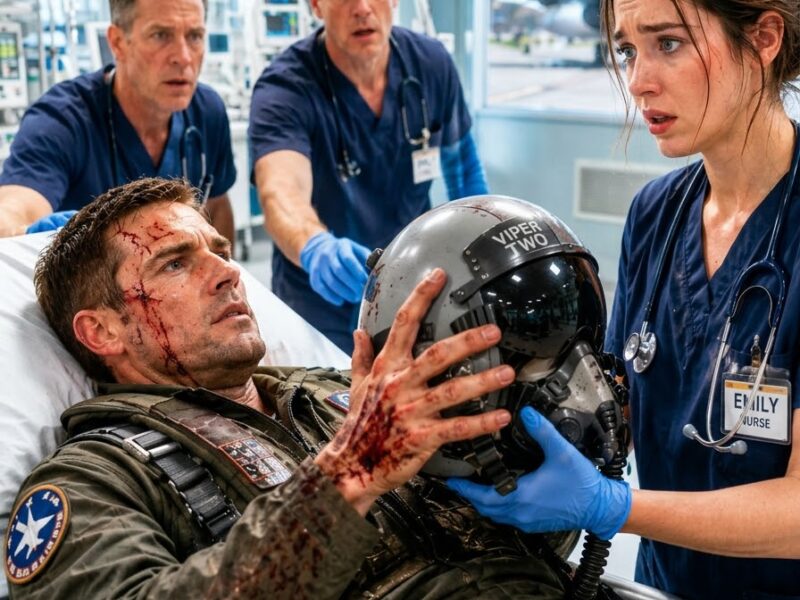
The wounded F-18 pilot shocked everyone at the Norfolk Naval Hospital when he shoved away every medic who approached him
The smell of jet fuel, blood, and burnt copper tore through the quiet sterile calm of Norfolk Naval Hospital’s Trauma Bay 1. Outside, low storm clouds hung over the Chesapeake Bay, drowning the naval base in a steady gray deluge. Inside, the red emergency lighting cut across the polished linoleum floor as the automatic doors parted with a violent hiss.
They wheeled him in at 14:00. He was suspended on a spinal board, his green flight suit shredded along his left side, soaked through with arterial blood. He was Captain Ryan Hayes—a decorated F/A-18F Super Hornet pilot assigned to Strike Fighter Squadron 103 out of NAS Oceana. The preliminary radio dispatch had been brief: a sudden, catastrophic systems failure over restricted airspace off the Virginia Capes, followed by a low-altitude ejection.
I had been a registered nurse for exactly eleven days. I stood pressed against the chrome frame of the crash cart, my hands clasped tightly in front of my scrub top to hide the nervous tremor I couldn’t shake. I was twenty-four, straight out of civilian nursing school, and completely unproven in the eyes of the veteran trauma team.
The attending physician, Dr. Richard Vance, barked orders over the roar of the suction pumps. “Get two large-bore IVs in his right arm! Prepare for a chest tube! Respiratory, hold his c-spine!”
Two senior corpsmen rushed toward the gurney, their gloved hands reaching for the pilot’s neck collar and torn collarbone.
“Don’t touch me.”
The words weren’t yelled. They were spoken in a low, gravelly rasp, but carried a lethal force that made both corpsmen freeze in mid-air.
“Captain, stay still, you’ve sustained severe trauma—” Dr. Vance started, reaching for the pilot’s shoulder.
Ryan Hayes violently shoved Dr. Vance’s wrist away with his uninjured hand, his jaw clenched tight enough to crack teeth. His skin was pale from blood loss, his forehead slick with sweat, but his steel-gray eyes burned with a terrifying, paranoid clarity.
“Get away from me,” Ryan gritted out, his chest heaving under the blood-soaked flight harness. “All of you. Step back.”
The trauma bay went entirely silent except for the rhythmic beep of the cardiac monitor. The corpsmen exchanged bewildered glances. Dr. Vance scowled, adjusting his surgical mask. “Captain Hayes, you are bleeding out. You don’t have a choice right now.”
Ryan’s eyes swept the room, ignoring the doctor entirely. He bypassed the senior nurses, the corpsmen, and the attending physician. Then, his bloodshot gaze locked onto me, standing paralyzed by the crash cart.
“You,” he whispered.
I blinked, taking a half-step back, my hand instinctively coming up to touch my chest. “Me?”
Ryan nodded once, a faint, agonizing movement. “Come here.”
Dr. Vance stepped into my line of sight, placing a hand out to block me. “Captain, she’s a rookie. She started last week. Nurse Miller has no trauma experience. Let the senior surgical team handle this.”
“Bring her here,” Ryan growled, his voice dropping into a register that admitted no refusal. His knuckles turned white as he grabbed the edge of the gurney frame, forcing his body up an inch despite the violent groan of agony that escaped his throat.
I didn’t wait for Dr. Vance’s approval. Something in the pilot’s eyes was beyond medical panic; it was the look of a man trapped behind enemy lines. I stepped past the attending physician, my heart hammering against my ribs, and knelt beside the bed.
“Captain Hayes,” I said softly, keeping my voice steady. “I’m right here. Tell me what you need.”
Ryan didn’t ask for morphine. He didn’t ask for a collar. With a shaking, blood-stained hand, he reached up to the protective flight helmet resting beside his head on the gurney. The heavy carbon-fiber helmet was scorched along the left side, the golden visor cracked. He dragged it across his chest and pushed it firmly against my hands.
“Don’t let them take this,” he whispered, his fingers digging into my forearms with desperate strength.
I held the heavy helmet against my apron, feeling the residual heat of the cockpit clinging to the composite shell. “Why? The flight gear has to go to the mishap investigation board—”
Ryan’s eyes flicked upward toward the ceiling, tracing the dark lenses of the hospital’s security cameras mounted in the corners of the trauma bay. “Because it proves what happened.”
Before I could ask another question, Ryan’s eyes rolled back. His grip on my forearms went limp, his body slumping heavily into the gurney mattress as his blood pressure plummeted on the screen.
“He’s under! V-fib!” Dr. Vance yelled, shoving me aside. “Charge to two hundred! Get her out of the way!”
The trauma room erupted into controlled chaos. Corpsmen swarmed the bed, pushing me back toward the utility doors. I scrambled backward, my boots slipping slightly on the wet floor, but my arms remained wrapped tightly around the flight helmet.
I backed out into the dim service corridor, my breathing coming in shallow, ragged gasps. I was alone in the hallway, the sound of the resuscitation echoing through the double doors.
I looked down at the helmet in my arms.
It was a standard-issue Gentex HGU-55/P, but as I turned it over in my hands, I saw the deep, fresh gouges along the lower edge of the sun visor housing. Someone hadn’t just scratched it during a crash; someone had deliberately carved numbers into the matte-black paint using the tip of a survival knife.
Three numbers followed by a single letter: 0-9-1-B.
The corridor seemed to tilt around me. My knees went weak, and I had to press my back against the cold tile wall to stay upright.
I knew those numbers. I had memorized them eight years ago. They were the flight tail designation of an F/A-18C Hornet that had disappeared over the Atlantic during a routine night-intercept exercise—a plane piloted by my older brother, Lieutenant David Miller.
The Navy had called it a spatial disorientation accident. They said the aircraft hit the water at five hundred miles per hour. No wreckage was ever recovered. No body was ever found. I had spent eight years watching my parents wither away under the quiet agony of an empty grave.
I clutched the helmet to my chest, my mind spinning into a vortex of terror and confusion. Why did a pilot who ejected thirty minutes ago have my missing brother’s tail number carved into his flight gear?
Three hours later, Ryan was pulled out of the operating room. They had repaired a lacerated femoral artery, stabilized two broken ribs, and moved him into Room 412 of the intensive care unit.
I waited until the shift change at 19:00. The ICU hallway was quiet, illuminated only by the soft glow of nursing stations and the muted hum of IV pumps. I slipped into Room 412, stepping quietly past the heavy privacy curtain.
Ryan was awake. He was hooked up to a ventilator monitor, his face pale, but his eyes were open, staring at the darkened window overlooking the rain-slicked tarmac of the airfield across the bay.
He turned his head slowly as I closed the door behind me.
“You saw it,” Ryan said, his voice barely a rasp over the hum of the oxygen line.
I walked to the foot of his bed, holding my breath. “Did you know my brother? David Miller? 091-Bravo?”
Ryan closed his eyes for a long, agonizing moment. A single tear cut a path through the dried grime on his cheek. “I didn’t know him then. But I know what happened to him.”
My hands gripped the metal footboard of the bed until my joints ached. “He died in the crash. That’s what the Department of the Navy told us.”
Ryan opened his eyes, staring directly into mine with stark, unvarnished gravity. “Your brother didn’t die in that crash, Nurse Miller. He was taken.”
The room felt entirely devoid of air. “Taken? By who?”
Ryan’s jaw tightened. “By the same black-budget defense element that tried to sabotage my flight computer over the Capes today.”
He slowly reached his uninjured right arm beneath his heavy hospital pillow. His fingers worked frantically for three seconds before he pulled out a tiny, silver micro-SD memory card, wrapped in protective clear tape.
“Your brother found something he wasn’t supposed to see during that intercept eight years ago,” Ryan whispered, holding the tiny card out to me. “He managed to eject. They pulled him out of the water before the SAR team arrived. And this card contains the telemetry logs from my jet today showing the exact encrypted frequency that jammed his controls—and mine.”
I reached out, my trembling fingers taking the small piece of metal.
“Who are they, Ryan?” I asked, my voice breaking.
Ryan glanced sharply toward the frosted glass panel of the room’s wooden door.
Down the hallway, the heavy, rhythmic sound of polished leather boots echoed against the linoleum. Two tall men dressed in charcoal civilian suits had just stepped off the service elevator, scanning the room numbers with cold, mathematical precision.
Ryan looked up at me, his face pale with sudden, total terror.
“They know I gave it to you,” Ryan whispered.
Outside Room 412, the brass door handle began to slowly, deliberately turn downward.
The brass door handle clicked as the internal mechanism disengaged.
I didn’t think. Instinct took over—an adrenaline-fueled surge that drowned out eight years of grief and eleven days of nursing protocol. I grabbed the heavy chrome IV pole beside Ryan’s bed and jammed it horizontally beneath the door handle, wedging the steel bar tightly between the lever and the heavy wooden frame.
The handle jammed halfway down.
Outside, a sharp, authoritative voice barked through the wood. “Open the door. Federal investigators.”
“They’re not federal,” Ryan gritted out, trying to pull himself upright. The heart monitor beside his bed spiked violently, its alarm tone chiming in rapid, high-pitched pulses. “They’re Aegis-7. Private military security attached to the defense contractor that manufactured the automated flight control software for the F-18 fleet.”
A heavy shoulder slammed against the outside of the door. The oak frame groaned, the IV pole bending an inch under the pressure.
“Nurse Miller!” the voice outside commanded. “You are interfering with a classified Department of Defense investigation. Step away from the door immediately!”
“Get out of here, Clara!” Ryan rasped, his eyes burning with frantic urgency. “The service window behind the curtain—it leads to the fire escape! Take the card and the helmet!”
“I’m not leaving you!” I shouted over the sound of wood splintering as a second heavy blow struck the door.
“If they catch you with that data, we both die!” Ryan yelled, his hands gripping the sheets. “They can’t kill me in an ICU bed without raising an investigation! But you’re disposable to them! Go!”
I grabbed my heavy canvas tote bag from the visitor’s chair, jammed the scorched flight helmet inside, and shoved the silver micro-SD card deep into the interior pocket of my scrub top. I sprinted behind the heavy blue privacy curtain, popped the lock on the reinforced aluminum window, and pushed it outward into the freezing mountain rain.
The fire escape was slick with ice and jet-fuel rain. I scrambled out onto the iron mesh platform just as a loud blast echoed inside Room 412—the IV pole snapping like a dry twig as the door was kicked off its hinges.
I didn’t look back. I took the metal stairs three at a time, my rubber-soled nursing shoes slipping against the wet iron, the heavy tote bag slamming against my hip.
Behind me, high above on the fourth-floor platform, a man in a dark coat stepped out into the rain. He didn’t yell. He reached into his coat, pulling a compact, suppressed pistol from a shoulder holster.
A soft pop-pop echoed over the sound of the storm. Two high-velocity rounds chewed into the brickwork inches from my head, showering my face with red dust and sharp mortar chips.
I threw myself over the handrail of the second-floor landing, dropping eight feet into the open bed of an off-duty maintenance truck parked in the lower loading bay. I hit the corrugated steel floor hard, the wind knocked completely out of my lungs, pain exploding across my shoulder.
I stayed down, clutching the tote bag to my chest, gasping for air as the truck’s diesel engine suddenly roared to life. The driver—an unsuspecting civilian technician—put the vehicle in gear and pulled out of the hospital bay into the torrential rain of Hampton Boulevard.
I lay in the back of the bouncing truck for five miles, shivering uncontrollably, rain soaking through my scrubs, until the vehicle slowed near the edge of the Norfolk industrial shipyard district. I rolled out of the truck bed into the shadows of a vacant warehouse alleyway, landing on my feet in the mud.
My breath came in ragged, white plumes in the freezing night air. I pulled out my phone. The screen was cracked, but the network icon was flashing.
I didn’t call the police. If Aegis-7 had access to a Naval Hospital ICU within three hours of a crash, local law enforcement was useless. Instead, I dialed a number I hadn’t called in four years—a secure landline belonging to my brother’s former wingman, Lieutenant Commander Marcus “Ghost” Vance, who had retired from active duty to run a private marine repair yard near the mouth of the Elizabeth River.
The line rang four times before a heavy, gravelly voice answered.
“Vance.”
“Marcus… it’s Clara,” I gasped, leaning against the cold corrugated steel of the warehouse wall. “Clara Miller.”
Silence hung on the line for three seconds, heavy and charged.
“Clara? Where are you?” Marcus asked, his tone shifting instantly from dismissive to sharp alert. “Your mother called me an hour ago. She said two men in suits came to her house asking about David’s old personal belongings.”
Tears pricked my eyes, freezing against my cold cheeks. “They found Ryan Hayes, Marcus. The pilot who ejected today. He had David’s tail number.”
“Jesus Christ,” Marcus breathed. “Where are you now?”
“Near Pier 4. I have Ryan’s flight helmet and an encrypted telemetry card. They tried to take me at the hospital.”
“Listen to me very carefully,” Marcus commanded, his voice dropping into a low, tactical register. “Do not move. Stay in the shadows of the warehouse line. I’m five minutes away in the yard boat. If Aegis-7 has initiated a recovery protocol, they’re monitoring every primary road out of the naval base.”
Twenty minutes later, a dark, aluminum-hulled workboat cut silently through the black waters of the river channel, its running lights doused. The boat bumped against the wooden pilings of Pier 4.
Marcus Vance stepped onto the gunwale. He was forty, tall, with short-cropped graying hair and eyes that had seen too much sky and too much fire. He wore a oilskin jacket and held a heavy waterproof flashlight.
He reached down, grabbing my hand, and hauled me effortlessly aboard the vessel.
“Are you hurt?” he asked, scanning the dark treeline along the shore.
“I’m fine,” I lied, my whole body shaking from hypothermia and terror.
Marcus led me into the enclosed wheelhouse, turning on a single dim red night-vision light. I pulled the scorched helmet out of my tote bag and set it on the chart table between us. Then I pulled the micro-SD card from my scrub pocket.
Marcus stared at the numbers carved into the visor housing: 0-9-1-B.
His face drained of color. He reached out with a thick, calloused finger, lightly tracing the deep gouges in the black paint.
“David…” Marcus whispered, his voice cracking slightly. “I told the board… I told those brass bastards eight years ago that his radar signature didn’t disappear because of an impact. His signal was scrubbed by an airborne jammer.”
“Ryan said David didn’t die in the crash,” I said, leaning over the table, my eyes wide. “He said he was taken. Marcus, what does that mean? Where is my brother?”
Marcus slowly looked up from the helmet, his dark eyes shadowed by the red light of the cabin.
“In 2018, the Department of Defense contracted a private aerospace firm called Vanguard Dynamics to build an autonomous AI flight interface called Project SENTINEL,” Marcus explained, his voice low and dangerous. “They were testing it in dark airspace off the Atlantic coast. The system was designed to take over human pilot controls during high-threat environments.”
He touched the micro-SD card. “David wasn’t killed, Clara. His jet was intercepted by an unmanned prototype running SENTINEL. They forced his aircraft down over a remote island facility in the Bahamas used for off-grid weapons testing. They needed a top-tier Navy aviator to train the neural network of the AI.”
I felt my heart drop into a dark, bottomless pit. “They kept him alive… to use his brain?”
“They kept him alive because he was the best dogfighter in the Atlantic Fleet,” Marcus said grimly. “And if Ryan Hayes has this telemetry, it means SENTINEL just went live across the entire East Coast fleet today—and Ryan’s jet was its first operational target.”
Suddenly, the workboat’s radar display emitted a sharp, high-pitched chime.
Marcus spun toward the screen. A fast-moving surface contact was cutting through the mouth of the channel at thirty knots, heading directly for our position. Above us, the low, rhythmic thwack-thwack-thwack of a heavy, unlit helicopter began to shake the glass of the wheelhouse.
“They tracked your phone’s cell tower ping before you turned it off,” Marcus barked, slamming his hand onto the throttle levers.
The twin diesel engines roared to life, throwing a wall of black water behind us as the boat surged out into the wild, storm-tossed waters of the bay.
The sea was a violent, ink-black chaos. Four-foot swells slammed against the aluminum hull of the workboat, sending plumes of freezing spray over the wheelhouse roof.
Behind us, a blacked-out MH-60 Blackhawk helicopter dropped low over the water, its searchlight suddenly snapping on, cutting through the rain with a blinding beam of intense white light. The beam swept across the waves, pinning our boat in its center.
“Hold on!” Marcus roared, spinning the wooden helm hard to port.
The boat drifted sideways across a swell, barely dodging the heavy wake of a high-speed interceptor vessel that surged out of the darkness from our right. The interceptor was a sixty-foot stealth craft, sleek and angular, bearing no military markings.
A voice boomed over an external loudspeaker from the stealth vessel, cutting through the roar of the wind and engines.
“VESSEL BEARING 180, HEAVE TO IMMEDIATELY AND PREPARE TO BE BOARDED. THIS IS A RESTRICTED MILITARY INTERDICTION.”
“They’re lying!” Marcus shouted, his eyes locked on the GPS plotter. “That’s not Coast Guard! That’s Vanguard Dynamics’ security element!”
“Marcus, we can’t outrun a stealth interceptor in a workboat!” I yelled, clinging to the steel grab rail as another wave slammed us sideways.
“We aren’t outrunning them!” Marcus barked back. “We’re going into the Boneyard!”
He pointed through the rain-streaked windshield. Half a mile ahead, rising out of the murky darkness of the James River channel, lay the massive, rusted silhouettes of the National Defense Reserve Fleet—dozens of decommissioned, ghost-like military cargo ships, aircraft carriers, and destroyers anchored side-by-side in the dark water.
Marcus cut the running lights completely and throttled up, driving the workboat straight into the narrow, labyrinthine channels between the towering steel hulls of the ghost ships.
The blinding searchlight from the helicopter lost us as we slipped beneath the shadow of a ten-story decommissioned amphibious assault ship. The massive rusted hull blocked the radar signature, creating a wall of dead space.
Marcus maneuvered the boat into an open well deck hatch of a half-submerged naval supply vessel, bringing the engine down to a quiet, vibrating idle inside the cavernous, pitch-black interior of the dead ship.
Water lapped quietly against the rusted iron walls inside the hull. Above us, the heavy thrum of the helicopter’s rotors passed over the metal deck, fading slowly into the distance as they swept further down the channel.
Marcus killed the ignition. Total darkness enveloped us, broken only by the dim amber glow of his waterproof flashlight.
“We have twenty minutes before their surface craft sweeps this pocket,” Marcus said, wiping grease and saltwater from his face. He set a portable, hardened rugged laptop on the boat’s engine cover. “Give me the card.”
I pulled the micro-SD card from my pocket and handed it to him. My fingers were numb, my scrubs wet and heavy, but the burning inside my chest had grown into a hard, cold resolve.
Marcus jammed the card into a reader slot on the side of the laptop. The screen flickered to life, illuminating our faces in a harsh cyan light.
Complex diagnostic telemetry streams scrolled down the monitor—altitude tracks, radar lock vectors, and corrupted fly-by-wire system codes from Ryan Hayes’ F-18.
Marcus ran a custom decryption script he had maintained from his days as a naval flight analyst. The lines of red error code suddenly cleared, revealing an active, real-time satellite telemetry uplink node.
“Look at this,” Marcus whispered, pointing his calloused finger at the screen.
On the map, a single ping was pulsing twenty miles off the coast of Cape Hatteras, North Carolina. It wasn’t an ocean vessel. It was listed as a stationary offshore platform—a decommissioned oil rig that had been officially cleared for scuttling five years ago.
Sub-files under the platform’s directory expanded across the screen.
PROJECT SENTINEL: NODE 04
SUBJECT STATUS: ACTIVE
NEURAL INTERFACE LINK: PILOT 091-BRAVO
I gasped, my hand flying to my mouth.
There it was. Printed in cold, green vector text on a classified corporate manifest: David Miller.
“He’s alive,” I sobbed, the tears finally breaking through my composure. “Marcus… he’s out there. On that platform.”
“They didn’t just use his flight data, Clara,” Marcus said, his voice trembling with a mixture of horror and fury as he read the secondary medical telemetry. “They have him hooked into a synthetic life-support array. The AI system is using his brain’s motor cortex to train its combat algorithms in real-time. Every time a Navy pilot takes off from Oceana, SENTINEL tests its neural network against them.”
“That’s why Ryan’s plane crashed,” I realized, the puzzle pieces slamming together. “Ryan’s flight computer was hacked by SENTINEL during the flight. Ryan fought the system, forced a manual override, and ejected before the AI could force his plane into a nose-dive!”
“And Ryan carved David’s tail number on his helmet because he recognized the flight signature,” Marcus added grimly. “Ryan realized he wasn’t dogfighting a computer. He was dogfighting the muscle memory of your brother.”
Suddenly, a heavy metallic bang echoed through the rusted well deck of the dead ship.
The dark water around our boat rippled violently as four tactical divers, dressed in rebreather gear and dark wetsuits, breached the surface of the water around the hull.
Before Marcus could reach for his sidearm, a heavy iron grappling hook smashed through the wheelhouse window, showering us with safety glass.
“Clara! Get under the deck!” Marcus yelled, reaching for a heavy flare gun on the dashboard.
A tactical diver pulled himself over the gunwale, his silenced submachine gun raised. Marcus fired the flare gun point-blank. A blinding sphere of red fire erupted inside the wheelhouse, lighting up the cavernous metal interior of the dead ship in a horrific, roaring glare.
The diver fell backward into the water, screaming as the flare burned against his gear. But a second diver was already over the railing, driving a heavy boot into Marcus’s chest, sending my brother’s wingman crashing against the steering console.
I didn’t run. I didn’t hide.
I grabbed the heavy, scorched flight helmet from the table, swung it with all the strength left in my body, and slammed the reinforced carbon-fiber shell square into the side of the second diver’s tactical helmet.
The composite shell cracked with a loud thwack. The man stumbled sideways, his grip slipping on his weapon. Marcus scrambled up from the floor, pulled his 9mm sidearm, and fired two shots into the operative’s chest plate, knocking him off the deck into the water.
“We have to go! Now!” Marcus screamed, grabbing the laptop and pulling me toward the boat’s bow.
We vaulted over the front railing onto a rusted iron ladder welded to the side of the ship’s interior wall, climbing frantically into the dark upper decks as more footsteps echoed from the water below.
We reached the top deck of the ghost ship, emerging into the howling wind and biting rain of the storm.
Below us, three stealth craft were circling the rusted hull like sharks, while the heavy Blackhawk helicopter hovered fifty feet above the deck, its searchlight locking onto us.
A voice cut through the storm over the helicopter’s megaphones.
“NURSE MILLER. LIEUTENANT COMMANDER VANCE. YOU HAVE NOWWHERE LEFT TO RUN. SURRENDER THE TELEMETRY DRIVE OR BE ELIMINATED.”
Marcus looked at me, his face covered in rain and blood. He pulled a small, waterproof emergency locator beacon from his tactical vest and jammed it into my hand.
“What is this?” I asked over the roar of the wind.
“It’s a Coast Guard Distress Beacon,” Marcus shouted. “If I trigger it, it broadcasts an un-scrubbable MAYDAY signal directly to the Atlantic Area Command Center in Portsmouth. The Navy will have to dispatch a full surface squadron to investigate.”
“Then trigger it!” I yelled back.
“If I trigger it, Aegis will know their secret is out, and they’ll destroy that offshore platform in Cape Hatteras to erase the evidence,” Marcus said, his eyes locking onto mine with fierce determination. “They’ll kill David before the Navy can reach him.”
He looked toward the dark waters of the river channel, then back at me.
“We don’t call the Navy, Clara,” Marcus said, his voice hardening into steel. “We go get your brother ourselves.”
The storm off Cape Hatteras was a Category 2 hurricane that had turned the Atlantic into a mass of thirty-foot waves and driving, horizontal rain.
For three hours, Marcus’s modified long-range marine interceptor—a hardened craft he kept stashed in a private inlet south of Virginia Beach—pounded through the raging sea, slamming into the troughs of the giant waves like a battering ram.
I sat in the passenger harness, the laptop strapped to my lap, monitoring the real-time telemetry ping coming from Node 04.
The physical strain was immense, but the nurse in me had been entirely replaced by an unyielding, primal single-mindedness. My hands weren’t shaking anymore. My mind was crystal clear. Every pulse on that satellite screen was a heartbeat from my brother—a brother who had been trapped in a cold, artificial hell for eight years.
“Target platform in sight!” Marcus yelled over the roar of the twin supercharged engines.
Through the rain-streaked windshield, illuminated by flashes of fork lightning across the black sky, rose Node 04.
It was a nightmare of rusted iron and modern technology. The lower legs of the abandoned oil rig were covered in barnacles and sea foam, but the top deck had been completely rebuilt into a high-tech facility. Satellite domes, high-frequency antenna arrays, and a reinforced helipad dominated the structure. Red warning lights blinked along the superstructure through the fog.
“They have automated perimeter turrets!” Marcus warned, throttling back as we closed the final half-mile under the cover of the sea spray. “If we approach the main landing ladder, their surface defense systems will cut this hull to ribbons!”
“What about the lower support struts?” I asked, pointing to a rusted maintenance gantry hanging twenty feet above the foaming water on the platform’s south leg.
“It’s a suicide jump in this sea!” Marcus shouted.
“It’s the only way in!” I yelled back, unbuckling my harness.
Marcus slammed the throttles forward, timing the approach with a massive incoming swell. The interceptor rode the crest of a thirty-foot wave, lifting the bow high into the air, bringing us level with the rusted iron gantry for a single, fleeting two-second window.
“GO!” Marcus screamed.
I leaped across the open abyss between the boat and the platform.
My boots hit the wet iron grate of the gantry. I slipped, my hands clawing frantically at the rusted steel mesh, my legs dangling over thirty feet of churning, deadly sea below. Adrenaline surged through my veins. I pulled myself up onto the platform, rolling onto my stomach as Marcus swung the boat around to clear the landing zone, throwing his grappling line up to secure his own ascent.
Five seconds later, Marcus vaulted over the rail, his sidearm drawn, his eyes scanning the dark, narrow access catwalks that wound into the interior of the platform.
“Perimeter silent,” Marcus whispered, dropping into a tactical crouch. “The storm is keeping their external guards inside.”
We moved quickly through the labyrinth of rusted pipes and steel corridors, following the signal lead on my laptop. The interior of the platform didn’t smell like sea salt; it smelled like ozone, chilled coolant liquid, and high-voltage electronics.
We reached a heavy, pressure-sealed steel door at the center of the platform’s lower deck. Above the door was a illuminated sign: PROJECT SENTINEL: NEURAL CORE – AUTHORIZED PERSONNEL ONLY.
Marcus set a small breaching charge against the door’s hydraulic lock. “Cover your ears.”
The muffled detonation blew the latch inward with a sharp thud. Marcus kicked the door open, his weapon raised, and we swept into the room.
The space was massive—a climate-controlled, glass-walled laboratory filled with towering blue server banks that hummed like a living hive. Coolant mist rolled along the floor like low fog.
And in the center of the room, suspended inside a spherical glass medical chamber filled with clear nutrient fluid, was a man.
Dozens of thin, fiber-optic cables were attached to his scalp, temples, and neck, running directly into the central server array above. Medical monitors surrounding the sphere flashed with real-time brainwave activity, displaying digital overlays of F-18 cockpit instruments, targeting reticles, and flight paths.
I stopped dead in my tracks, the breath ripped from my lungs.
His hair was longer, streaked with gray, his body lean and scarred from years of confinement. But through the clear fluid, through the glowing cables, I saw his face.
“David…” I choked out, rushing toward the glass sphere.
I slammed my hands against the cold glass, tears pouring down my face. “David! Can you hear me?”
Inside the fluid, the man’s eyelids twitched violently. The brainwave monitor beside the tank suddenly spiked, the digital flight reticles flashing red as his neural activity surged.
“Clara, don’t touch the glass!” Marcus warned, rushing to the main control console beside the tank. “The life support array is hardwired into the neural link! If we just pull the cables, the shock will cause a fatal stroke!”
Suddenly, an overhead loudspeaker clicked on, its sharp metallic tone echoing through the cold laboratory.
“Fascinating,” a voice said smoothly over the intercom. “Nurse Miller. I must admit, your persistence exceeds every statistical model our predictive algorithms generated.”
I turned slowly, my hands still pressed against the glass of my brother’s prison.
Stepping out from behind the central server rack was a man in his late fifties, wearing a pristine grey lab coat over a dark suit. Behind him stood three heavy security guards with automatic rifles raised.
“Dr. Aris,” I whispered, shock slamming into me like a physical blow.
The chief surgeon from St. Jude’s Memorial—the man who had stood beside me in Trauma Bay 1 three days ago—offered a thin, clinical smile.
“I told you at the hospital, Clara… you were just a rookie,” Dr. Aris said, adjusting his wire-rimmed glasses. “You should have stayed in the ER.”
“You…” I breathed, the disgust rising in my throat like bile. “You were at St. Jude’s the whole time.”
“St. Jude’s is a regional medical center funded entirely by Vanguard Dynamics’ medical division,” Dr. Aris said calmly, stepping forward while his guards kept their rifles aimed square at Marcus’s chest. “It was the perfect place to monitor low-level military personnel and handle… localized biological assets.”
He pointed a finger toward the glass sphere where David floated suspended in the fluid.
“Your brother was an extraordinary subject, Clara,” Aris continued, his voice filled with terrifying pride. “For eight years, his neural response times have served as the foundational architecture for the SENTINEL autonomous program. He doesn’t just fly the drone fleet; he is the drone fleet. His instincts, his dogfighting genius, his spatial awareness—all mapped, digitized, and weaponized.”
“He’s a human being!” I screamed, taking a step toward Aris. “You turned him into a machine!”
“I turned him into perfection!” Aris snapped back, his clinical composure cracking into raw arrogance. “Do you have any idea what human error costs in modern aerial warfare? Pilots get tired. They bleed. They get disoriented. They have families. SENTINEL has no fear. No hesitation. And tonight, with the final neural patch extracted from Captain Hayes’ flight data, SENTINEL achieves total operational autonomy.”
Aris reached for a control panel on the central console, his finger hovering over a bright red execution button.
“Once I initiate this final upload,” Aris said, looking at me with cold, dead eyes, “David’s organic brain will no longer be required. The AI will retain the complete neural map, and your brother’s life-support cycle will be permanently terminated.”
“No!” I yelled.
“Drop your weapon, Commander Vance,” Aris ordered. “Or I press it right now.”
Marcus looked at me, then at David inside the tank. His jaw clenched tight, and slowly, agonizingly, he lowered his sidearm to the floor, sliding it away with his boot.
“Smart,” Aris sneered. He turned his attention back to the terminal, beginning the final keying sequence.
I looked at the server banks humming around me. Then I looked at the diagnostic monitors displaying David’s brainwave telemetry.
The screen wasn’t just showing computer code. It was showing a live bio-feedback loop—the same neural monitoring arrays I had studied during my training as an ICU nurse. The system wasn’t just sending data to David’s brain; David’s brain was constantly sending feedback back into the server core.
It was a two-way street.
I reached into my canvas tote bag, pulling out the cracked, scorched flight helmet Ryan Hayes had given me.
“What are you doing with that junk?” Aris scoffed, without taking his eyes off the terminal.
“Ryan didn’t just give me telemetry data, Dr. Aris,” I said, my voice dropping into a razor-sharp whisper. “He gave me the flight frequency David used when he was the lead element of Squad 103.”
I stepped toward the main fiber-optic junction box connected directly to David’s tank.
“Clara, stay back!” the lead guard yelled, raising his rifle.
I didn’t stop. I jammed the helmet’s external communications jack directly into the raw fiber-optic input port on the side of the neural tank—the auxiliary diagnostic port meant for flight helmet calibration.
Then, I pressed my face close to the cracked visor microphone on the helmet and spoke into the internal comms line.
“David…” I said, my voice echoing through the helmet’s internal mic, routed directly into the neural interface inside his brain. “David… it’s Clara. Callsign Little Sister. The flight is over, David. It’s time to come home.”
The response was instantaneous.
Inside the glass tank, David’s eyes snapped wide open.
The digital brainwave monitors surrounding the sphere went from smooth cyan waves into a terrifying, chaotic wall of bright crimson spikes. The neural feedback loop exploded into a massive power surge.
The master computer core didn’t override David—David overrode the master computer core.
Every screen in the laboratory began to flash erratically: SYSTEM OVERLOAD: UNCOMMANDED NEURAL BIAS.
The automated defense turrets mounted on the laboratory ceiling turned violently on their tracks, their targeting lasers sweeping across the room in erratic, confused arcs as David’s chaotic, human subconscious flooded the AI network.
“What’s happening?!” Aris screamed, frantically pounding on the unresponsive keyboard. “Disconnect him! Disconnect the link!”
The ceiling turrets opened fire. Heavy automatic rounds chewed through the server banks, sending showers of blue sparks, exploding coolant tubes, and shattered glass cascading across the floor.
The three security guards panicked, dropping their weapons and sprinting for the exit as the lab went into total structural meltdown.
Marcus didn’t hesitate. He lunged forward, grabbed his fallen sidearm, and tackled Dr. Aris to the floor before the corrupting system could initiate the purge command.
“Marcus! The drain valve!” I screamed over the deafening roar of sirens and shattering glass.
Marcus scrambled to his feet, grabbed a heavy iron emergency lever on the base of the sphere, and yanked it downward with all his weight.
The heavy hydraulic locks at the bottom of the tank released. Thousands of gallons of clear nutrient fluid erupted onto the laboratory floor in a massive tidal wave, taking the glass panels with it.
The sphere shattered into a million pieces.
David washed out onto the wet floor, gasping, coughing, tearing the fiber-optic cables from his scalp with his own trembling hands.
I fell to my knees beside him in the rushing water and broken glass, pulling his soaking wet body into my arms.
“Clara…” he wheezed, his voice dry, cracked, and weak after eight long years of silence. His eyes—pale, tired, but completely human—locked onto mine. “Clara… you came…”
“I’ve got you, David,” I sobbed, holding his head against my chest, tears streaming down my face. “I’ve got you. The flight is over.”
Above us, the facility’s emergency self-destruct alarms began to wail as the corrupted server banks overheated, setting off a chain reaction through the platform’s primary power grid.
“We have two minutes before this whole deck goes under!” Marcus yelled, hoisting Dr. Aris up by his collar with one hand while grabbing a heavy waterproof medical kit with the other. “Get him up!”
Together, Marcus and I lifted David between us, supporting his weak legs, and carried him out of the burning laboratory toward the upper helipad.
Dawn was breaking over the Atlantic.
The storm clouds were finally parting, revealing a pale golden sky over the churning sea. Landing on the platform’s helipad, its rotors spinning violently against the morning wind, was an H-60 Seahawk search-and-rescue helicopter bearing the yellow and blue markings of the United States Coast Guard.
The distress beacon Marcus had triggered in the bay had finally brought the Atlantic Fleet.
Two Coast Guard medics vaulted out of the helicopter, running toward us with a heavy transport gurney.
“We have the casualties!” the lead medic yelled over the roar of the engines. “Get them aboard!”
They laid David onto the gurney. As they lifted him into the cabin of the helicopter, he reached out, his hand shaking, and grabbed my wrist.
I looked down. His fingers were holding tight to my scrub sleeve, right where my own pulse was racing.
“Thank you… Nurse Miller,” David whispered, a small, genuine smile breaking through the pain on his face.
I climbed into the helicopter beside him, taking his hand in both of mine, refusing to let go. Marcus sat across from us, shoving the handcuffed Dr. Aris into the corner under the guard of two armed Coast Guard marshals.
The Seahawk lifted off the platform deck, banking hard into the clear morning sky as the rusted superstructure of Node 04 exploded behind us into a massive plume of fire and steel, collapsing into the deep blue waters of the ocean below.
I looked out the window as the sun rose over the horizon, painting the sky in gold.
I wasn’t just a rookie nurse anymore. I wasn’t a girl hiding from a ghost.
I looked at my brother, breathing the fresh ocean air beside me, and for the first time in eight years, I took a deep, clear breath of my own.
The end.









